❌

Vue normale

Russia is building its own Starlink to guide drones like Shaheds. Ukraine answers with new Space Forces meant to knock those satellites out
9 novembre 2026 à 10:08

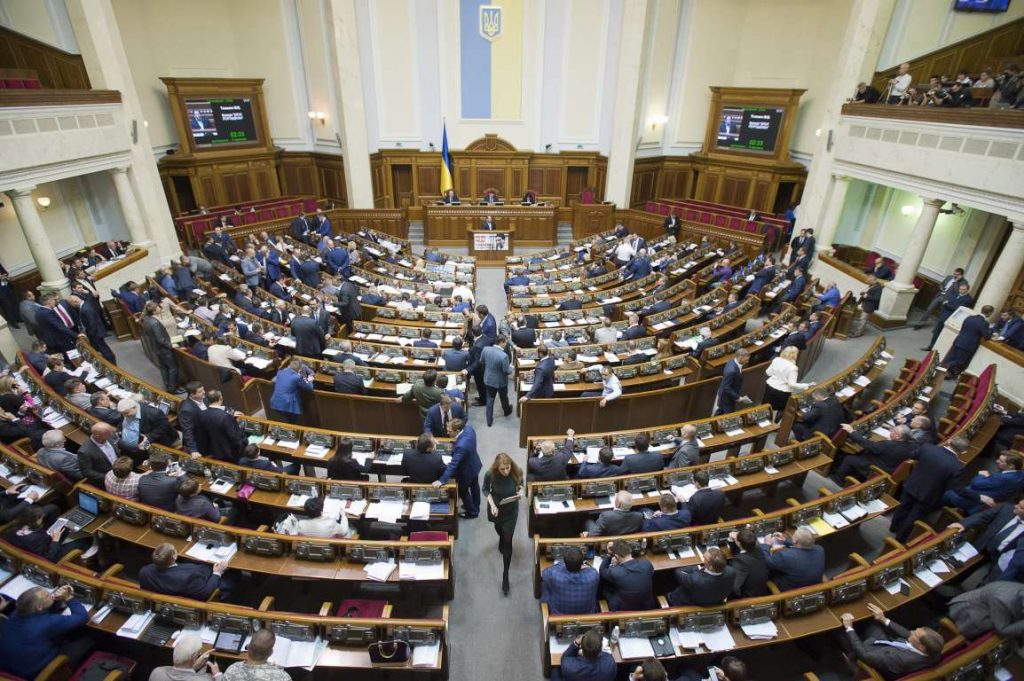
Ukraine is standing up a Space Forces branch of its military to fight Russia in orbit. On 9 November, the Ukrainian Parliament passed a law creating the Space Forces within the Armed Forces, a branch whose core missions will be to destroy Russian satellites and strike Moscow’s new military satellite network, Taras Berezovets of the Territorial Defense Forces Command said on 24 Channel.

The force was created against the backdrop of a slowdown in the speed of Ukraine’s military Starlink terminals after the diesel deal between US President Donald Trump and Russian President Vladimir Putin. It was also created amid Russia’s development of its “Rassvet” system, which will coordinate its forces.

What the new branch is for

Berezovets laid out three aims for the branch:

  • destroying Russian satellites and striking the “Rassvet” network
  • managing Ukraine’s own satellites
  • folding space reconnaissance into combat as leading armies do.

Because Ukraine cannot launch spacecraft from its own territory during the war, the satellites would be put into orbit by partners and then pass under the direct command of the Space Forces.

“There are enough ranges in the world: France, the UK, which can provide us with the appropriate capabilities,” he said.

Why a space branch now

Berezovets recalled that Ukraine became the first country in the world to create Unmanned Systems Forces in February 2024, and called a separate space branch the logical next step against Russia, whose own military-space forces have long been in action.

“The decision to create a separate branch, space forces within the Armed Forces of Ukraine, is correct, if only because within the enemy’s forces they have long operated, the VKS, Russia’s military-space forces. Let’s not forget that the war is waged, among other things, at the level of satellites that carry out reconnaissance missions,” he stressed.

The threat from Rassvet

Berezovets described “Rassvet” as a Starlink analog that Russia is building for combat, capable of feeding operators data from reconnaissance drones and redirecting strike drones like Shaheds mid-flight.

He said Russia has put 32 craft into orbit this year to pass data and correct drone routes in real time, letting its drones rely less on preset paths and slip past Ukrainian air defense and electronic warfare.

The system is still in testing and glitching. Russia lost contact with three craft in the past month, he said, but warned against underestimating a project Moscow feeds with foreign components bought around sanctions.

Another Russian “state-of-the-art” Su-57 fighter burned at Akhtubinsk, apparently without anyone shooting at it

30 octobre 2026 à 09:40

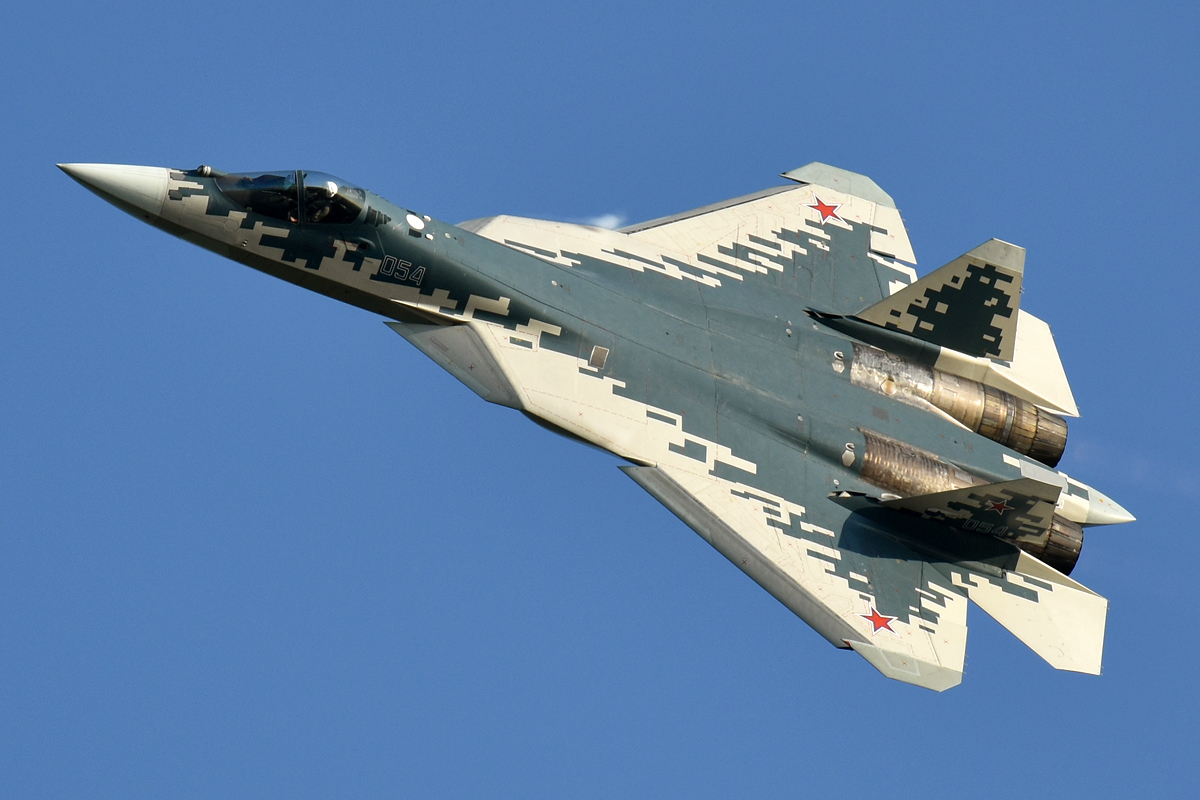
ukraine reports first ever damage russia's newest stealth fighter su-57 felon sukhoi jet illustrative sukhoi_design_bureau_054_sukhoi_su-57_(49581303977)

Another of Russia's Su-57 stealth fighters has burned out on the ground, Ukrainian military news outlet Militarnyi reported. A Ukrainian Telegram channel blamed an engine start gone wrong and published satellite images of the scorched airfield.

Russia's war against Ukraine leans on warplanes that strike from standoff range, and Ukraine has spent this year hunting them on their airfields. Its newest fighter is a rare sight in that fleet: Ukrainian intelligence estimated Russia had about 20 Su-57s, against 135–140 Su-35S and 140–145 Su-30 jets, and could not tell how fast more are built.

Satellite images show where the jet burned

The fire broke out at the Akhtubinsk airfield in Russia's Astrakhan Oblast on 29 October. The Ukrainian Telegram channel Absolutely Reliable Source said the multirole fighter caught fire during a malfunction at engine start. It said the jet burned out completely. Militarnyi called the cause preliminary.

Satellite image of the Akhtubinsk airfield in Russia's Astrakhan Oblast after the Su-57 fire, with the burned site marked, 29 October 2026
Satellite image of the Akhtubinsk airfield in Russia's Astrakhan Oblast after the Su-57 fire, with the burned site marked, 29 October 2026. Satellite image: Telegram channel Absolutely Reliable Source

The channel's satellite images show a dark scorch mark and debris on open ground between the airfield's taxiways.

Scorch mark left by the Su-57 fire at the Akhtubinsk airfield in Russia's Astrakhan Oblast, 29 October 2026
Scorch mark left by the Su-57 fire at the Akhtubinsk airfield in Russia's Astrakhan Oblast, 29 October 2026. Satellite image: Telegram channel Absolutely Reliable Source

Akhtubinsk has seen Su-57s hit before. Ukrainian drones first damaged Su-57s there in June 2024, and Ukrainian intelligence said two were likely hit.

The fourth Su-57 hit or lost this year

Militarnyi counted the fire as the fourth time a Su-57 was hit or lost in 2026. Ukraine's General Staff said drones hit several Su-57s and a Su-34 at the Shagol airfield in Chelyabinsk Oblast on 25 April. Ukrainian intelligence later said the state of those jets was unknown.

On 23 July, a Su-57 crashed in Moscow Oblast. A Russian Telegram channel said Russia's own air defenders shot it down.

ukraine reports first ever damage russia's newest stealth fighter su-57 felon sukhoi jet illustrative sukhoi_design_bureau_054_sukhoi_su-57_(49581303977)
Explore further

“Quiet as mice”: Ukrainian pilots neutralized Russia’s Su-57 marketing campaign over their skies

Russia's air force received two new Su-57s in September, its second batch this year, Militarnyi reported.

Ukraine keeps hitting Russian warplanes on the ground. On 29 October, Ukraine's Navy said its Neptune missiles destroyed two Su-34s at the Marinovka airfield in Volgograd Oblast. Two weeks earlier, it reported hitting six Su-34s at Borisoglebsk in Voronezh Oblast. Russia uses those bombers to drop glide bombs on Ukrainian towns.

Ukraine’s Navy says it hit six Su-34 bombers at a Russian airbase with Neptune missiles—the jets that drop glide bombs on Ukrainian towns (updated)

15 octobre 2026 à 04:54

borisoglebsk

Ukraine’s Navy hit six Su-34M bombers at Russia’s Borisoglebsk military airfield in Voronezh Oblast with Neptune missiles overnight into 15 October, the Navy said. Residents filmed a large fire at the base after a missile alert, and the Navy’s count has not been independently confirmed. The facility is about 400 km from the frontline.

Glide bombs are now central to how Russia’s army fights, used to pin down Ukrainian defenders, including drone teams, before small infantry groups move in. They also hit frontline cities and the civilians who live in them.

Six bombers and flight equipment hit, the Navy says

The Neptune coastal missile system also hit technical equipment that supports flights, the Navy said. It recorded secondary detonations and a fire on the airfield and said details were still being clarified.

The Su-34M can carry several guided and high-explosive aerial bombs at once, along with missiles, the Navy noted. It called the jet one of Russia’s key tools for glide-bomb strikes on Ukrainian positions and frontline towns. In September, a Ukrainian Neptune missile reached a Russian warship at its own pier.

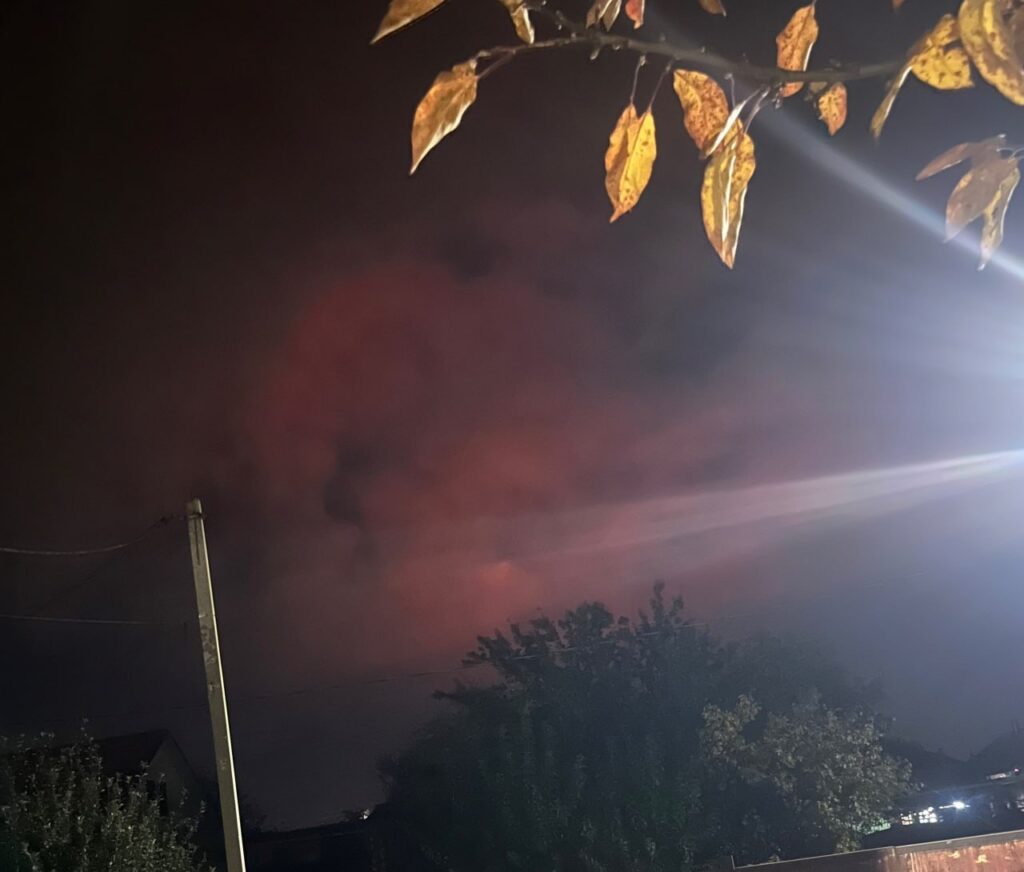
Smoke over Borisoglebsk during the fire at the military airfield, 14 October 2026.
Smoke over Borisoglebsk in Voronezh Oblast, Russia, during the fire at the town’s military airfield, 14 October 2026. Photo: Supernova+/Telegram

Fire over the airfield late on 14 October

Voronezh Oblast Governor Aleksandr Gusev declared a missile alert across the region shortly before 22:00 local time on 14 October. Within an hour, Ukrainian monitoring channel Exilenova+ reported explosions and a fire, preliminarily at the Borisoglebsk airfield. It later wrote that the airfield had come under missile attack and a fire was burning there. Ukrainian monitoring channel Supernova+ posted footage from the town showing the blaze.

A large fire is raging at the site of the missile strike. https://t.co/l4aqVvNJIg pic.twitter.com/JYjhM57GYh

— Exilenova+ (@Exilenova_plus) October 14, 2026

On the morning of 15 October, Gusev claimed that 33 drones and several jet-powered aerial targets had been downed over the oblast overnight. He did not mention the airfield.

A base Ukraine has hit before

The airfield hosts the 783rd training aviation center and units of the 105th composite aviation division of Russia’s Aerospace Forces, which flies Su-34, Su-35S, and Su-30SM jets, Ukrainian defense outlet Militarnyi reported. In summer 2026, it had no permanently based combat jets, and Russia used it mainly as a stopover to refuel and rearm aircraft striking Ukraine, the outlet said, citing satellite observation.

Ukrainian drones hit the airfield overnight on 8 July, starting a fire, and satellite images later showed its fuel and lubricants depot destroyed. Drones also attacked the base’s pilot training center in July 2025.

The same night, Ryazan Oblast Governor Pavel Malkov reported a fire at an oil refinery in Ryazan. It came as Ukrainian President Volodymyr Zelenskyy said Ukraine was resuming strikes on Russian refineries.

Update: Satellite imagery confirms the strike

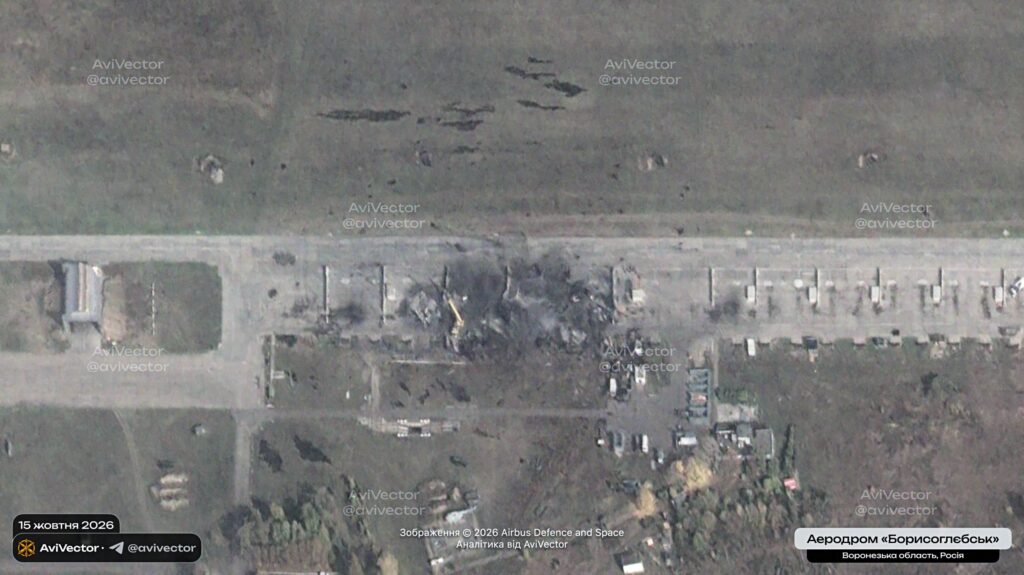
New satellite images show damage at Borisoglebsk airbase and six Su-34 bombers positioned in the affected area two days earlier, although the extent of the aircraft losses remains unconfirmed.

Satellite image shows the aftermath of Ukraine's strike on Borisoglebsk airbase in Russia's Voronezh Oblast on 15 October 2026. Image: Airbus Defence and Space / AviVector.
Satellite image from 13 October shows six Russian Su-34 fighter-bombers parked in the area later struck at Borisoglebsk airbase. Image: Exilenova+.

The monitoring channel Exilenova+ reports that 4 airframes were completely destroyed, while 2 others sustained significant damage.

❌