❌

Vue lecture

Tech sell-off drives US markets down by nearly $1tn after subpar earnings reports

Big tech stocks falter as investors question whether billions being poured into AI can generate returns quickly enough

A sell-off of tech stocks that began earlier this month and gained steam with disappointing earnings from leading tech companies drove US markets down by hundreds of billions of dollars on Friday. In total, the decline has knocked nearly $1tn in value off the tech-heavy Nasdaq exchange in one week and erased about $2tn in a month.

The S&P 500, the index of the 500 most valuable companies in the US, fell by more than 1% Friday, losing hundreds of billions of dollars in market value. It was on track to erase its gain for October, even though it set its all-time high during the same month. The weakness for technology stocks dragged the Nasdaq composite down even further, more than 3%, also erasing hundreds of billions in value. The Dow Jones Industrial Average fell less.

Continue reading...

© Photograph: Brendan McDermid/Reuters

© Photograph: Brendan McDermid/Reuters

© Photograph: Brendan McDermid/Reuters

  •  

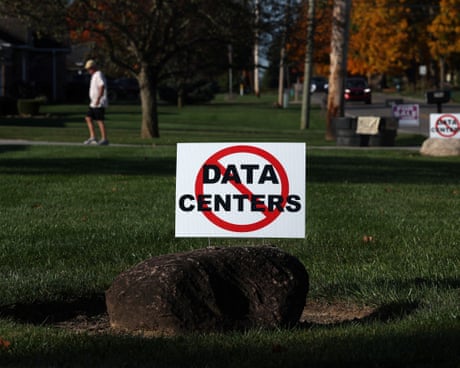
Datacentres are deeply unpopular – so the geniuses at OpenAI are rebranding them | Arwa Mahdawi

These resource-guzzling centres drive up utility bills and are hated across the political spectrum. Cue a clunky, but potentially influential, new name for them

Jesus may have turned water into wine, but Donald Trump has done one better: he turned Lake Ontario into Lake America and the Gulf of Mexico into the Gulf of America. And then, for his next trick, he insisted we all stop talking about artificial intelligence (AI) and call it superintelligence (SI) instead.

Those, of course, are only a few of the name changes the president has ushered in. When he’s not golfing or commenting on senators’ buttocks, president Trump loves a rebranding project. Which makes sense: coming up with a new name is far easier than making meaningful improvements to people’s lives.

Continue reading...

© Photograph: Shannon Stapleton/Reuters

© Photograph: Shannon Stapleton/Reuters

© Photograph: Shannon Stapleton/Reuters

  •  

Citizen-led ballot initiatives seek to limit electricity firms’ political donations in Michigan

One motion considers reining in political spending while another proposes to municipalize the grid in sign of anger with datacenters and high bills

Two citizen-led ballot initiatives seek to rein in Michigan’s powerful electric utilities as residents say politicians have failed to address pressing issues around controversial datacenters, high energy rates and poor electric reliability.

On Tuesday, voters statewide will consider a nation-leading ban on political donations by the state’s deeply unpopular regulated utilities. At the same time, organizers in Ann Arbor, one the state’s largest cities, are proposing to banish utility giant DTE Energy by municipalizing the grid. It would establish a public power company to deliver energy.

Continue reading...

© Photograph: Jim West/Universal Images Group/Getty Images

© Photograph: Jim West/Universal Images Group/Getty Images

© Photograph: Jim West/Universal Images Group/Getty Images

  •  

Kremlin sees “no similar plans” after Oleshky—Kyiv plans to set up a center to return civilians Russia holds

Ukraine’s Human Rights Commissioner Dmytro Lubinets. Photo: Dmytro Lubinets

Ukraine will create a Center for the Return of Civilians to bring home Ukrainian civilians held by Russia or living under occupation, Human Rights Commissioner Dmytro Lubinets said on 2 November. On the same day, the Kremlin said it had no plans, for now, for another humanitarian operation like the one in occupied Oleshky.

The Oleshky truce, the longest since 2022, got civilians out because Moscow agreed to it. Within a week, the Kremlin went from calling such a truce a possible precedent to saying it has nothing similar planned, for now. For Ukrainians still in Russian prisons or under occupation, the next negotiated exit has no date.

Oleshky exposed the gaps

In Lubinets’s view, the Oleshky mission showed that Ukraine’s efforts to return civilian hostages from Russian prisons and civilians from occupied territory are not coordinated enough. His office will run the center, modeled on the Child Rights Protection Center, which he called a similar pilot.

Families of people held by Russia or living under occupation will be able to apply to the center, and it will draw attention to Russia’s violations of civilians’ rights. Lubinets said his office is building it on its own, with partners willing to help, and not together with Russia. Still, he said he had agreed with Russia’s Human Rights Commissioner Yana Lantratova to make aid deliveries to Oleshky regular, and the two sides are now discussing how to send them at least once a month.

Kremlin: no similar plans for now

On 26 October, Kremlin spokesman Dmitry Peskov said the Oleshky truce could become a precedent for humanitarian pauses elsewhere. On 2 November, he told a briefing Moscow had no similar plans or initiatives for now, saying each case is unique.

Lantratova claimed Russia had expected more people to leave, but many did not want to leave their homes and relatives. She cited individual cases, including a woman who would not leave her mother after a stroke.

How the mission unfolded

Oleshky lies on the Dnipro’s left bank, across from Ukrainian-held Kherson. In July, international monitors confirmed Russia’s blockade of the town. In September, an Odesa volunteer said residents were foraging for roadside grass. Russian troops also seized food Ukraine dropped by drone, the town’s Ukrainian administration head said.

On 23 October, the White House announced a local ceasefire brokered by US First Lady Melania Trump. It ran from 27 October to 1 November, and its zone expanded beyond the town. Both sides kept their commitments, Lubinets said on 1 November.

Ukrainian troops used the pause to evacuate 167 civilians from Ukrainian-held riverside villages, Ukraine’s General Staff reported. On 31 October, the two ombudsmen agreed to keep working toward regular humanitarian missions.

  •  

Crise de l'aide alimentaire aux États-Unis : un enjeu de campagne dans l’Arizona

À l'approche des élections de mi-mandat aux États-Unis, l'Arizona, État clé du scrutin, est en première ligne d'une réforme majeure de l'aide sociale. Depuis l'adoption de la loi budgétaire de Donald Trump en 2025, près de la moitié des bénéficiaires de l'aide alimentaire y ont perdu leurs allocations. Une chute sans équivalent dans le pays. Les autorités reconnaissent aujourd'hui que certains devraient pourtant y avoir toujours droit. Un sujet devenu brûlant dans la campagne électorale.

  •  
❌