❌

Vue lecture

Germany accuses Russia of a drone bomb attempt at Leipzig. Now its eight biggest airports get drone detection

The likely process of monitoring the airspace over airports connected to Germany’s new drone detection system. Photo: Deutsche Flugsicherung / Holger Matthies

Germany is expanding drone detection at its airports with a new system operated by German air traffic control provider Deutsche Flugsicherung (DFS), the German Federal Ministry for Transport (BMV) announced on 5 October.

Germany has accused Russia of attempting a hybrid attack at Germany’s Leipzig/Halle Airport near a Ukrainian An-124 aircraft using a drone carrying explosives. Earlier, Finnish President Alexander Stubb said Europe must be prepared for “continued hybrid and sabotage attacks” by Russia, adding that Russia seeks to sow panic through such actions.

On Monday, two more sites were added—Stuttgart and Hamburg. As of Monday, seven of Germany’s eight largest airports were equipped with the new drone detection system in their approach and departure areas.

Germany seeks responses to new hybrid threats

The Federal Ministry cited the reason for the new measure: drones near airports can affect air traffic very quickly.

Federal Transport Minister Steffen Bilger and Baden-Württemberg Transport Minister Nicole Razavi were briefed on the new system at Stuttgart Airport, where it is being put into operation, the ministry said. The system creates “an important technical basis for detecting potential threats at an early stage and quickly informing the competent authorities,” Bilger said.

“With today’s commissioning of the drone detection system at Stuttgart Airport, the federal government is fulfilling a key promise: it is not only talking about the dangers posed by unmanned aircraft, but is also following through with very concrete action. Protecting critical infrastructure and ensuring the safety of passengers at Stuttgart Airport require continuous adaptation to a changing security situation,” Razavi said, according to the ministry.

The new DFS system allows drones near airports to be detected at an early stage and information about possible threats to air traffic to be passed more quickly to the relevant authorities. This helps them assess risks and respond to them more quickly, the statement said.

DFS is responsible for detecting drones in approach and departure areas, while the Federal Police and other security services are responsible for preventing threats and defending against drones. The BMV, Federal Ministry of the Interior, DFS, Federal Police and airports coordinate their work to exchange information quickly and maintain a shared picture of the situation.

No further details about how the system operates have been disclosed.

The first stage of the expansion at Germany’s eight major commercial airports will be fully implemented this week, with the systems in Stuttgart and Hamburg being put into operation, the statement said.
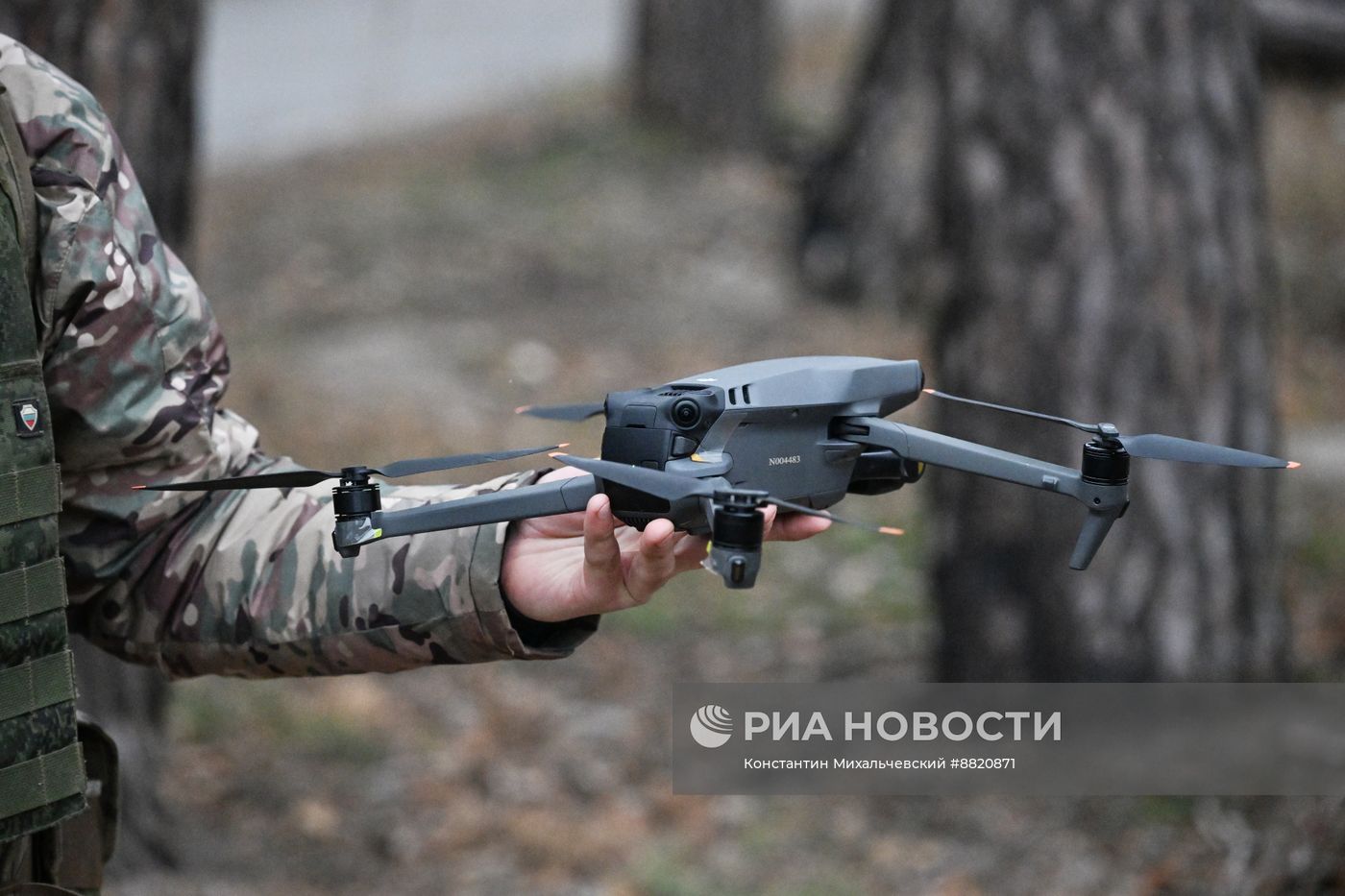
Illustrative image of a Russian drone. Photo: RIA Novosti/Konstantin Mikhalchevsky
Explore further

A drone came down beside a Bundeswehr air base, weeks after Berlin blamed Moscow for the Leipzig airport attack

The system will also be installed at the airport where a bomb-laden drone was found

The system will also be put into operation at Leipzig/Halle Airport this week, meaning that the first stage will be fully implemented at all eight of Germany’s largest commercial airports, according to the press release.

A quadcopter drone carrying a Semtex explosive flew directly toward a parked Ukrainian An-124 Ruslan cargo aircraft and struck its wing at Leipzig/Halle Airport in Germany on the evening of 4 August, Die Zeit reported on 10 August. The drone hit the aircraft at around 19:30 local time, bounced off the wing, and fell to the ground without detonating, according to the media outlet.

Ukrainian An-124 at Leipzig/Halle Airport in Germany, 5 August 2026. Photo: screenshot from Bild video

Germany has accused Russia of attempting the drone attack and announced further sanctions against Russian citizens and institutions, Tagesschau reported on 1 September.

At the crime scene, investigators found the drone configuration, explosives and detonation technology that had already appeared in other Russian hybrid operations and in Russia’s war against Ukraine, Federal Interior Minister Alexander Dobrindt said during a joint press conference with Federal Foreign Minister Johann Wadephul, the media outlet reported.

The German government assumes that Germany has been and will be a target of further such Russian attacks. Germany is not at war with Russia but is a “target of war,” Foreign Minister Wadephul said, according to the outlet.

  •  

At ruined Donetsk’s airport, three Russians snap selfies and ready jet-powered Geran-4. Ukrainian drone slips in unseen and rams their launcher

russia steers its long-range drones ground towers—kyiv says hit one occupied crimea · post russia’s new “geran-4 seeker” shahed variant uses machine-vision ai targeting geran 4 ukraine news ukrainian reports

Russian troops were taking selfies beside a jet-powered Shahed launcher when a Ukrainian drone hit them. A Ukrainian drone attacked a pickup truck converted to launch Russian Shahed drones in the Donetsk airport area while its crew prepared to fire a jet-powered Geran-4, according to video from the Cursed Empire drone unit of the 100th Separate Mechanized Brigade that volunteer Serhii Sternenko published on 6 October.

Three Russian soldiers struck a pose by their drone launcher near Donetsk airport

It was their last selfie. Ukrainian drones hit the crew moments later as they prepared to fire a jet-powered Geran-4
🎥 Serhii Sternenko pic.twitter.com/ri9bNztW5y

— Euromaidan Press (@EuromaidanPress) October 6, 2026

Russia launches Shahed drones, including jet-powered ones, from pickup trucks and fixed launchers, and the ruined Donetsk airport, about 50 kilometers from the front line, is one of its drone bases. In September, Oboronka outlet counted that in general, Russia has at least 63 launchers at its drone bases, which are built to survive strikes.

The video shows three carefree Russian soldiers next to a pickup fitted with a launch frame.

"That was their last photo shoot," Sternenko noted, commenting on the hit on the soldiers.

The primary target

Earlier, an officer of the 1st Separate Center of the Unmanned Systems Forces, call sign “Falco,” explained that the primary goal of strikes on drone bases is to disrupt Russia's ability to launch drones.

This is done by destroying launchers and storage facilities, as well as creating an aerial threat over the drone base. Such attacks can delay drone launches indefinitely, while the destruction of infrastructure can reduce the overall number of drones launched.

But the "jewel" of anti-drone port operations is the military staff

Although these facilities are important targets, the Unmanned Systems Forces have another priority: drone operators.

“The most difficult and, at the same time, the most valuable target is the operator. They don’t stay near the launchers for long,” Falco said.

By taking out drone operators, Ukraine inflicts losses on a scarce resource. There are already relatively few of them, and Russia will have to spend additional money and time training new crews.

  •  

The tanks that fuel Moscow’s airliners are reported burning after Ukraine’s latest drone raid on the capital region

tanks fuel moscow's airliners burning after ukraine's latest drone raid capital region · post fire volodarskaya pipeline station moscow oblast attack 6 2026 video exilenova+ militarnyi пожежа на лпдс володарская

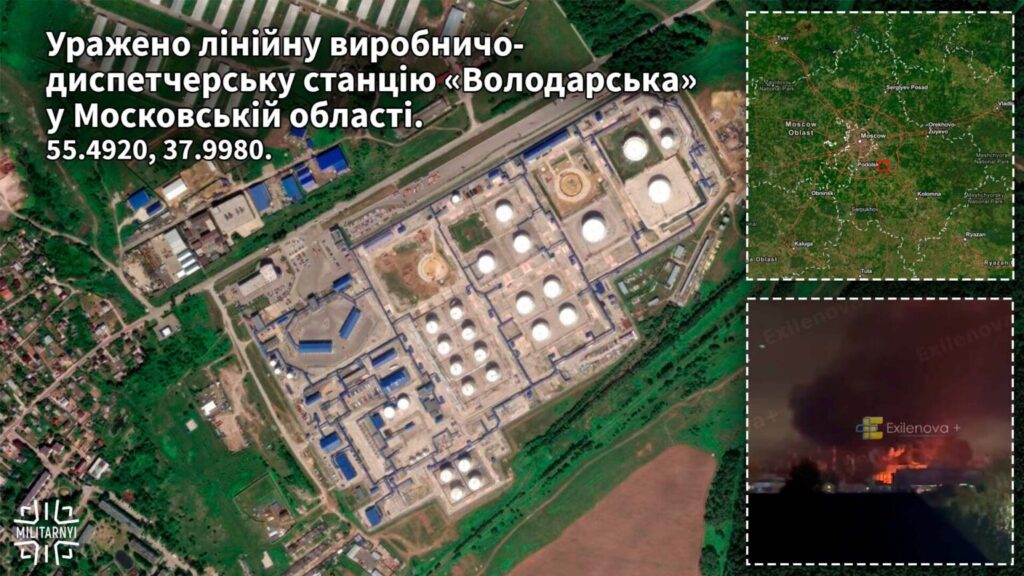
Drones attacked Moscow and Moscow Oblast overnight on 6 October, and a fire broke out at the Volodarskaya pipeline station, the region's largest oil depot, monitoring Telegram channels reported. The station supplies jet fuel to Moscow's main airports. Local authorities did not mention the fire, while claiming to have downed hundreds of drones.

Ukraine's long-range drones have spent years working through Russia's oil industry, and Kyiv says its strikes have now disabled more than half of Russia's refining capacity. The storage and pipeline hubs that move the remaining fuel are what keep the army, the capital, and the export flows supplied.

Fire at the Moscow region's largest fuel depot

Ukrainian monitoring channel Exilenova+ wrote that the Volodarskaya station was burning after the attack, and Ukrainian monitoring channel Supernova+ reported the strike on the depot. Exilenova+ then posted the site's coordinates near the village of Konstantinovo. Supernova+ said a storage tank was on fire, and Exilenova+, citing locals, later wrote that two tanks were burning.

Russian news Telegram channel Astra geolocated a Supernova+ video to Konstantinovo in Ramensky district. The station had not been reported attacked before, Astra said.

tanks fuel moscow's airliners burning after ukraine's latest drone raid capital region · post volodarskaya pipeline station moscow oblast attacked drones 6 2026 its location marked лпдс володарская аналіз мілітарного
The Volodarskaya pipeline station in Moscow Oblast, attacked by drones on 6 October 2026, with its location marked on a map. Graphic: Militarnyi, ESRI map, photo: Exilenova+

The station lies 40 km from central Moscow, Militarnyi reported. Drone alerts in the area began at 23:43 on 5 October. From 03:24, reports came in of Ukrainian Peklo drones flying through Oryol Oblast toward Moscow Oblast, the outlet said. Ukraine's military has not commented on the strike.

Konstantinovo: the Volodarskaya oil products pumping and dispatch station continues to burn. According to local residents, two storage tanks are on fire.

The station, a branch of Transneft–Upper Volga, is directly linked to the Moscow aviation hub’s largest airports. pic.twitter.com/KooKJnV1X6

— Exilenova+ (@Exilenova_plus) October 6, 2026

Early in the night, Exilenova+ claimed a strike on the Moscow refinery in Kapotnya. It later said the footage circulating from there was most likely archival.

Jet fuel for Vnukovo, Domodedovo, and Sheremetyevo

The station has 27 tanks with a combined capacity of about 250,000 m³, according to Militarnyi. It connects to the ring pipeline for petroleum products around Moscow, which carries aviation fuel to Vnukovo, Domodedovo, and Sheremetyevo airports. Russia's state pipeline operator Transneft has said the station can move up to 3 million tonnes of jet fuel, 2.8 million tonnes of diesel, and 1.6 million tonnes of gasoline a year.

Astra gave a lower figure: about 3 million tonnes of petroleum products a year in total, arriving from the Moscow and Ryazan refineries. Supernova+ described Volodarskaya as a branch of Transneft–Upper Volga, as did Militarnyi, while Astra named Transnefteprodukt.

Vladimir Putin voted in the presidential election in Russia
Explore further

Russia has warned its cities about every strike for years. During the heaviest raid yet, on election day, it left the sirens silent

Russia claims hundreds of drones downed

Moscow Mayor Sergei Sobyanin claimed that 650 drones flew toward the Moscow region from the evening of 5 October to the morning of 6 October. Most were downed far from the city, and 105 near Moscow, he claimed, without mentioning any damage. Adding up his later posts, Astra counted at least 718 drones aimed at Moscow. Moscow Oblast Governor Andrei Vorobyov claimed that 185 drones were downed over 16 municipalities. He later called it one of the largest drone attacks and put the toll at two killed and nine injured, with 47 detached houses damaged in seven municipalities.

lukoil’s norsi refinery in kstovo, nizhny novgorod oblast
Explore further

Fifth drone-related NORSI shutdown in under five months leaves all major Lukoil refineries offline

Not the first Transneft site or Moscow fuel target

Ukraine has targeted Russia's pipeline network before. On 2 October, drones set Transneft's Samara station on fire. During Russia's Duma elections on 20 September, a strike reached Moscow's fuel supply. The Moscow refinery fully stopped processing oil after that attack. Days later, Kyiv offered to halt refinery strikes if Russia stopped hitting Ukraine's power grid. Russia has not taken the deal.

  •  
❌