❌

Vue lecture

Russia’s Starlink rival lost a second satellite after it apparently sat idle for 103 days
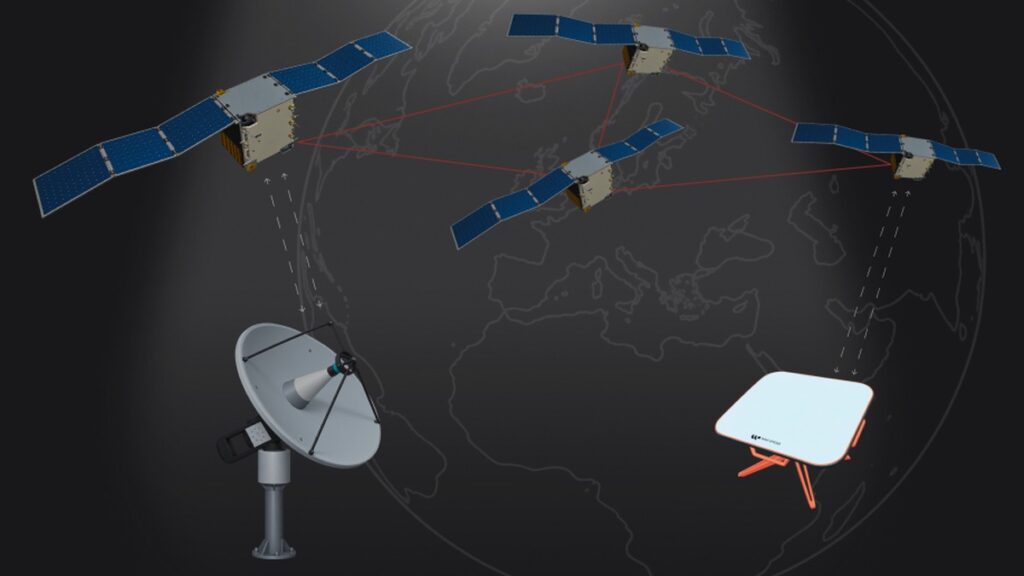
Illustration of the Russian Rassvet satellites by Bureau 1440

A satellite built for Rassvet, Russia’s answer to Starlink, burned up on 30 October, Ukrainian defense outlet Defense Express reported. It is the network’s second loss since launches began in March. A third stricken satellite may have been saved, though sources disagree.

On 5 February, Ukraine and SpaceX blocked the Starlink terminals Russian troops had used without permission. Officially, Rassvet is a commercial internet service. If it works, though, Russian forces could get satellite links that Kyiv has no US company to ask to switch off. The EU’s 21st sanctions package targeted Rassvet in July but left its operator, Bureau 1440, off the list.

A satellite that apparently never maneuvered

Satellite No. 17 went up on 19 July aboard a Soyuz-2.1b rocket with 15 others. It apparently never fired its engine, Defense Express wrote. After 103 days, residual air drag pulled it low enough to burn.

No. 23 was sinking too. On 20 October, at 220 km, Bureau 1440 managed to start lifting it, and it keeps climbing, Defense Express said. Space analyst Anatoly Zak’s launch page still lists it among satellites expected to fall, citing the Aerospace Corporation. Public tracking data from 1 November put it at about 316 km, marked active.

Slow, but working

Of the 30 satellites in orbit, 26 have reached about 500 km, Defense Express said. The outlet described that as a staging altitude before a joint climb to the planned 800 km. Russian telecom outlet ComNews offered another reading in July: Bureau 1440 had likely lowered the working orbit to 514 km. The company’s press office did not answer ComNews.

rassvet_featured_dark
Explore further

Russia is building Starlink no foreign company can switch off. Ukraine names 49 firms behind it, and 23 face no sanctions from Kyiv’s allies at all

The first loss followed the same pattern. Satellite No. 4, from the March batch, fell in early June without ever raising its orbit.

The serial satellites are already in test use. At a Moscow tech forum on 7 October, Bureau 1440 showed a video call over Rassvet to Adygea, a Russian republic, according to ComNews. Its first such demo, in 2023, ran on test satellites.

Flat objects on Russian Molniya-2 drones were reported as Rassvet terminals. Serhii “Flash” Beskrestnov, an adviser to Ukraine’s president, rejected that, and Defense Express concluded they are probably not.

  •  

Russia is building Starlink no foreign company can switch off. Ukraine names 49 firms behind it, and 23 face no sanctions from Kyiv’s allies at all

rassvet_featured_dark

Ukraine’s Military Intelligence (HUR) has published the names of 49 Russian and Belarusian companies and institutions building Rassvet, Russia’s low-orbit satellite internet system, on its War&Sanctions portal, the agency said on 28 October. It needs it for its military purposes.

Russian troops ran front-line communications and long-range strike drones on smuggled Starlink terminals until SpaceX blocked them on 1 February 2026. Ukraine still flies on Musk’s network, and on 24 October it got back to full speed after a ten-day cap imposed abroad. Rassvet is meant to give Russia’s army satellite links under its own control.

HUR has said Moscow may struggle to obtain components for more satellites, and its list names the suppliers that sanctions would need to target while the network is still being built.

Terminals for Iskander-M command vehicles

Rassvet is first of all a military communications system. Russia plans to use it for command and control, strike platforms, and drones, and to install terminals in the command-and-staff vehicles of Iskander-M missile systems, HUR says.

The Central Research Institute of Automation and Hydraulics is involved in integrating Rassvet into army communications, including fitting command vehicles, Iskander ones among them, with terminals once 292 satellites are in orbit, according to the portal. The same institute produces guidance components for the Iskander-M and Kinzhal missiles.

Planned coverage takes in Ukraine and the EU first, and once it is wide enough, Russia could use the system in hybrid attacks on other countries. That is why partners should block Rassvet’s access to components, equipment, and software now, the agency said.

Roscosmos launches it, a Belarusian missile maker signs on

The lead company is Bureau 1440, part of the IKS Holding tech group. According to the portal, it is linking its flight control center to systems of the Russian Defense Ministry. Roscosmos launches the satellites into orbit, and its head, Dmitry Bakanov, personally oversees Rassvet.

Meanwhile, Belintersat, Belarus’s national satellite operator, signed a partnership with Bureau 1440 in May 2026 to bring Rassvet into Belarus’s telecom network. It is a branch of the Plant of Precision Electromechanics, Belarus’s lead missile developer and maker of the Polonez rocket launcher.

Another Belarusian firm, Aerospace Instruments, prototypes components for the system.

23 of 49 not sanctioned by Kyiv’s allies

Of the 49, 23, Roscosmos among them, are not under sanctions by any country in the sanctions coalition. The companies involved “must be included in all blacklists” of countries, banks, and businesses, the agency wrote.

32 satellites launched, seven launches to go

Russia launched its first 16 Rassvet satellites earlier this year. Stable communications would need 200–250 in orbit, Serhii “Flash” Beskrestnov, then adviser to Ukraine’s defense minister, said in May.

By August, Russia had launched 32 Rassvet satellites and planned seven more launches by the end of 2026, a HUR official told Janes. Only 12 of them, all from the first batch, had reached a sustainable altitude by the end of August, ISW reported.

  •  
❌