Post came in response to rumor of ‘huge migrant caravan’
Brian Dawkins says he did not give permission for footage
The NFL has asked the US Department of Homeland Security to take down a video likening former Eagles star Brian Dawkins’s most violent hits to a clampdown on immigrants.
The video posted to social media on Sunday shows Dawkins’ pregame walkout as he chants “The time has come,” followed by a series of violent hits from his playing career. The DHS post includes the caption “Our time has come” in response to a social media account claiming a “huge migrant caravan” is approaching the United States’ southern border.
Sending migrants to countries they do not come from can have deadly consequences and must be halted, says report
The deportation of thousands of migrants from the US to third countries has set off a “cascade of human rights violations” that could have “deadly” consequences, two dozen UN human rights experts have warned.
Since Donald Trump returned to power in 2025, the US government has been offering millions of dollars to foreign governments to take in migrants, including refugees and asylum seekers, with no ties to their countries. Deals have been struck with 35 nations, nearly a third of them in Africa.
The president amplified negative social media comments about Representative María Elvira Salazar of Florida, a move that drew a rebuke from at least one Republican.
Wilber Rafael Garcés Pérez has bullet lodged in back as accounts differ over events leading to traffic-stop shooting
The Venezuelan man shot by federal immigration officers after a traffic stop in Texas needs surgery to avoid losing feeling on the left side of his body, according to his supporters.
Wilber Rafael Garcés Pérez, 28, has spent the past five days in detention with a bullet lodged in his back, after Immigration and Customs Enforcement (ICE) rapidly removed him from a hospital in Austin where he had been taken on Sunday after the shooting.
Bobby Pulido, a Tejano musician running as a Democrat for the House, has left his Republican opponent struggling to match his star power in a district that President Trump won easily in 2024.
Bobby Pulido is running for a House seat anchored in the Rio Grande Valley of Texas. President Trump won the district by 18 percentage points in 2024, but it is now seen as competitive.
Federal law requires a 90-day “quiet period” before elections, likely restricting the immediate scope of a decision that allows the use of a citizenship database to examine voter rolls.
“I think this is going to have very little impact on the midterms,” Derek T. Muller, a law professor and election law expert at the University of Notre Dame, said of the ruling.
Cattle industry groups in Texas, Oklahoma and Kansas and two Republican senators said the Trump administration’s immigration enforcement actions were hurting operations.
Exclusive: Democrats Dick Durbin of Illinois and Alex Padilla of California seek to prevent unlawful arrests
US senators have introduced legislation aimed at cutting down warrantless or specious ICE arrests, and curbing the agency’s ability to indefinitely detain immigrants who do not pose any danger to their communities.
The new legislation, shared exclusively with the Guardian, would require immigration officers to obtain an administrative warrant from a supervisor outlining a probable cause for detaining someone. Such a warrant must also be presented to each person who is detained, the bill says, alongside notice of when the detainee must appear in immigration court.
The Supreme Court allowed the Trump administration to deploy a system that merges personal data from across the government. Questions remain about its reliability.
In advance of the upcoming midterm elections, the Trump administration has embarked on an intensive campaign to prove that noncitizens are voting illegally, despite evidence that it is very rare.
Every night, for months, as they settled into bed at their home in Watts, California, seven-year-old José, named after his father, would look over to his mother, Alma Ramirez, and ask her one question:
State election officials said they reviewed 185 records homeland security sent them and confirmed they were US citizens
The Department of Homeland Security (DHS) wrongly identified 185 people on Nevada’s voter rolls as non-citizens, state officials said this week, escalating concerns over the shoddy methodology the government is using to raise fear about non-citizen voting ahead of the midterm elections.
In July, Donald Trump gave a speech saying DHS had found a combined 278,000 non-citizens on the rolls in Nevada, California, Pennsylvania and New Jersey. Follow-up letters to each of those states weakened the claim, saying there only could be as many as 278,000 non-citizens on the rolls, including up to 15,903 in Nevada.
GAO documents array of costly problems as ICE pursues controversial plans to rapidly increase detention capacity
US Immigration and Customs Enforcement (ICE) and other federal agencies have wasted tens of millions of dollars pursuing controversial plans to rapidly increase detention capacity – and the total will likely rise due to continuing mismanagement, congressional investigators warned on Thursday.
The US government accountability office (GAO) documented costly problems in several initiatives ICE has pursued since Donald Trump returned to office in January 2025 and ordered the mass arrest and deportation of people his administration has deemed should be forced out of the country.
Man left bloodied and hurt after immigration enforcement agents tried to arrest him in Evanston, a Chicago suburb
An eyewitness has described how two federal immigration agents allegedly beat and badly injured a US citizen in a botched arrest attempt in Illinois, and left the man dazed and bleeding on the ground as they walked away after realizing their apparent mistake.
Bystander Ryan Garton told the Associated Press that he saw the agents pinning down the man, who is Black, on the side of the road as he was driving home on Sunday in Evanston, a suburb of Chicago. He said he pulled over to record what was happening on video.
A Guatemalan immigrant who died after fleeing an attempted arrest was driving a car registered to the suspect who was sought by agents, officials said.
Karla Barberi, left, and Gema Lowe, of the immigrant advocacy group Movimiento Cosecha GR, call for justice on Thursday for a man who died in a car crash while fleeing ICE officers in Grand Rapids, Mich.
The decision adds a new burden for the government as it attempts to rapidly remove migrants from the United States without interference from their lawyers.
Several individuals who were in the first group sent from the United States to Liberia under a new third-country deportation arrangement walking to a beach in Marshall, Liberia, last month.
It was the Trump administration’s latest stumble in its effort to find proof of widespread noncitizen voting, despite decades of evidence that it is extremely rare.
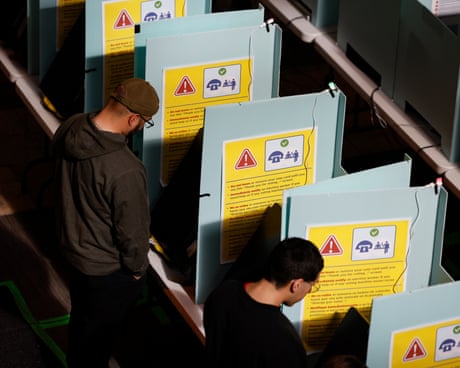
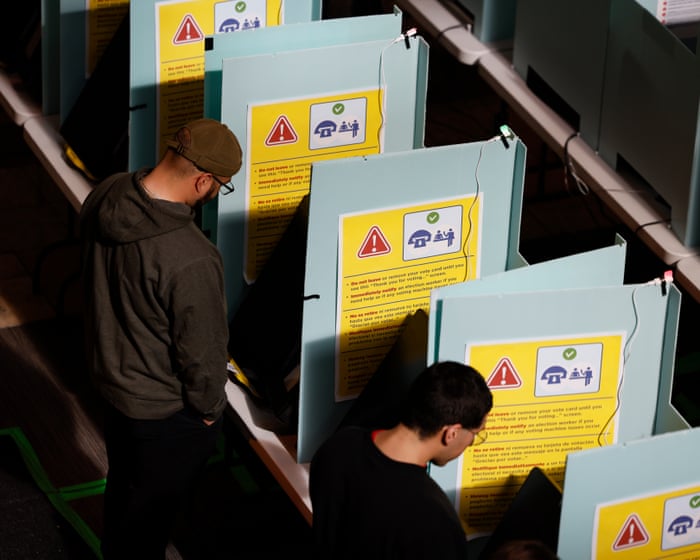
Despite its claims, the Trump administration has not yet offered evidence of a single instance of a noncitizen on Nevada’s voter rolls. Above, people cast their votes in Las Vegas in 2024.
Attorney general Todd Blanche requests that justices overturn lower court ruling that halted such removals
The Trump administration has asked the US supreme court to allow it to deport immigrants to countries other than their own, the latest effort to seek approval for a controversial policy that fulfils Donald Trump’s mass deportation agenda.
Todd Blanche, the US attorney general, said on Thursday morning that the Department of Justice would ask the conservative-majority supreme court for help, nearly a week after a lower court judge rejected the policy.
The activist, Daniel Thomas on Thursday denied causing criminal damage when he filmed himself slashing an inflatable dinghy in the English Channel that had an emergency responder on board.
Mario David Coronado Juarez was killed when his car struck a tree and burst into flames as he attempted to avoid ICE
Leading Democrats and immigration advocates in Michigan are demanding transparency from federal authorities after a man died in a fiery car crash as he attempted to avoid agents from Immigration and Customs Enforcement (ICE).
Mario David Coronado Juarez, a Guatemalan national, was killed on Sunday in Grand Rapids when his vehicle struck a tree at high speed and burst into flames shortly after the ICE officers tried to conduct a traffic stop.
Social media posts, including from the Department of Homeland Security and a Texas Republican candidate, have helped stir fear among people of South Asian heritage.
The immigrant remains in federal custody after a second hospital visit, with a bullet still lodged near his neck, his lawyer said. Immigration officials contested his assertion that he has been denied medical care.
A video analysis finds that a federal immigration officer was standing to the side of Wilber Rafael Garces Perez’s car when the officer apparently fired through the rear passenger window. But the events surrounding the shooting remain murky.
Since May, the Coast Guard has deployed six surveillance drones across the Great Lakes to stop the flow of drugs and illegal border crossings from Canada. But there is little illegal activity on the northern border, and the sailing drones are raising privacy concerns.
A Venezuelan immigrant, Wilber Rafael Garces Perez, was shot in Austin, Texas, on Sunday after a traffic stop. The shooting prompted calls from local officials for a transparent investigation.
Police tape surrounds the location where local authorities say a U.S. Immigration and Customs Enforcement officer shot and wounded a man in Austin, Texas, on Sunday.
Texas state troopers at the scene where one person is believed to have been shot during a confrontation with Immigration and Customs Enforcement agents.
The department has pulled hundreds of agents from their regular duties to find noncitizens on the voter rolls, despite decades of evidence that widespread voter fraud is exceptionally rare in the United States.
Representative María Elvira Salazar, a three-term representative from Miami, won re-election by 20 percentage points in 2024. Her ad suggests worry among some Republicans about their standing with Hispanic voters.
An escalating confrontation on Native land southwest of Tucson threatens to upend decades of uneasy cooperation between the Tohono O’odham Nation and the United States.
“It’s like me bulldozing right through the Arlington Cemetery,” said Verlon Jose, the chairman of the Tohono O’odham Nation.
Alternative for Germany, an anti-immigrant party widely known as the AfD, could take power in the state of Saxony-Anhalt, which has spurred panic among its immigrant population.
Québec solidaire a annoncé hier qu’un gouvernement solidaire accueillerait 70 000 immigrants permanents par an.
Le Parti libéral souhaitait, jusqu’en 2024, en accueillir 70 000, mais son nouveau chef, Charles Milliard, ne s’est pas encore prononcé sur un nombre précis.
La Caq maintiendrait le plan adopté en novembre dernier qui prévoit l’accueil de 45 000 résidents permanents par an.
Le Parti québécois limiterait leur nombre à 35 000 par an.
Le Parti conservateur n’a pas indiqué combien il souhaiterait en accueillir.
En quelques jours, plus de 1 500 personnes – dont plusieurs centaines hier – sont arrivées par la mer en provenance du Maroc dans l’enclave espagnole de Ceuta.
Les corps de neuf personnes qui avaient tenté de rejoindre la rive à la nage ont été repêchés.
Le gouvernement espagnol a déployé des militaires.
Il a indiqué que les personnes entrées illégalement seront rapatriées vers le Maroc.
Ceuta, située à la pointe nord du Maroc, est l’une des deux enclaves espagnoles en Afrique du Nord.
C’est une frontière terrestre de l’Union européenne sur le continent africain.
Il paraît que l’Allemagne et le Danemark devraient servir d’exemple au Québec en matière de politique migratoire. C’est ce que laisse entendre le député Alex Boissonneault dans une vidéo voulant défaire le « mythe » que « plus d’immigration veut dire moins de pénurie de main d’œuvre ». Selon lui, les gouvernements allemand et danois ont changé leur politique d’immigration après avoir réalisé que l’immigration ne règle pas la pénurie de main-d’œuvre. M. Boissonneault connaît-il réellement la politique migratoire de ces deux pays et leurs fondements?
À gauche: Alex Boissonneault, député d’Arthabaska-l’Érable depuis 2025 À droite: Mette Frederiksen, première ministre du Danemark depuis 2019
« Il y a plusieurs exemples de pays qui ont changé de politique en matière d’immigration parce qu’ils ont constaté cette situation. C’est le cas de l’Allemagne. L’Allemagne qui comptait beaucoup sur l’immigration pour combler ses postes vacants mais qui a constaté en 2023 que l’augmentation de l’immigration avait créé une pénurie de main d’œuvre dans les secteurs névralgiques. Donc il y a eu changement de politique. »
C’est complètement faux. La modification de la politique migratoire allemande en 2023 n’a rien à voir avec des considérations économiques ou sociales. Au même moment où le gouvernement d’Olaf Scholz renforçait le contrôle des frontières, l’Allemagne cherchait à attirer des travailleurs étrangers, en particulier les travailleurs qualifiés, notamment en réduisant les barrières administratives. Voici ce qu’affirmait Scholz en novembre 2024: « Aucun pays du monde ne peut connaître de croissance économique avec une main-d’oeuvre qui diminue. C’est la vérité à laquelle nous sommes confrontés. » Dans le même discours, le chancelier allemand défend le droit de l’Allemagne de choisir qui est admis en son sein, donc de repousser les réfugiés. Le problème de l’Allemagne n’est pas que l’immigration ne suffit pas à combler la pénurie de main-d’oeuvre, mais qu’elle ne parvient pas à attirer une main d’oeuvre de souche européenne en assez grande quantité.
« Même chose pour le Danemark avec un gouvernement social-démocrate, normalement considéré de gauche. Le gouvernement danois a constaté que l’augmentation de l’immigration a eu des conséquences négatives sur les services à la population. Il y a donc eu un changement de politique. »
Encore une fois, ce « changement de politique » du gouvernement danois n’a rien à voir avec l’économie ou avec les services à la population. C’est une question purement idéologique et, ce gouvernement ne s’en cache pas, raciste.
Commençons par dire que le racisme n’est pas une question de droite ou de gauche. On peut très bien être à gauche économiquement et à droite sur le plan de l’identité nationale. C’est le cas de la première ministre danoise, Mette Frederiksen, très attachée à l’État-providence danois, mais ouvertement raciste. En 2018, elle proposait de renvoyer les migrants « non occidentaux », non seulement du Danemark, mais de l’Europe, et de les placer dans des camps de concentration en Afrique sous supervision des Nations unies. À son arrivée au pouvoir en 2019, Frederiksen a promis de faire du Danemark un pays « sans demandeur d’asile ». En 2021, le gouvernement danois a voté une loi pour expulser les demandeurs d’asile hors d’Europe en attendant le traitement de leur demande, en contradiction totale avec les traités internationaux et les directives européennes. En 2022, une entente est signée avec le Rwanda. En gros, le Danemark paie le Rwanda pour détenir les demandeurs d’asile. Un bien triste revirement pour le premier pays à avoir signé la Convention de 1951 sur les réfugiés. Ce n’est pas sans raison que ce gouvernement « social-démocrate » est appuyé par l’extrême droite danoise.
En soi, la politique de Frederiksen et des sociaux-démocrates ne jure pas avec celle des administrations précédentes. Depuis le début des années 2000, le gouvernement danois est hostile à l’immigration. Le délai nécessaire pour obtenir la résidence permanente est passé de trois à huit ans. La « loi sur les étrangers » est modifiée régulièrement pour devenir toujours plus restrictive et viser des groupes en particulier. Elle a été modifiée 42 fois entre 2017 et 2019. Et la loi danoise est ouvertement raciste en ciblant des groupes spécifiques. En 2016, les Syriens ont été directement ciblés par une loi restreignant l’accés au regroupement familial pour les réfugiés et confisquant leurs objets de valeur pour financer leur séjour. En 2018, des mesures sont prises pour que des peines plus sévères soient infligées aux « résidents non occidentaux ». Des amendes importantes sont infligées aux personnes venant en aide aux « immigrants irréguliers ». Et pour bien montrer que la politique danoise est motivée par le racisme et non pas par des préoccupations économiques ou sociales, le Danemark a ouvert grand ses portes aux réfugiés ukrainiens fuyant l’invasion russe.
Ironiquement, ces dernières années, c’est la droite (modérée) qui a commencé à demander un assouplissement des politiques migratoires au Danemark. Pas pour des raisons humanitaire, mais pour des raisons économiques. Il y a une pénurie de main-d’œuvre, voyez-vous. Et les employeurs aimeraient bien qu’on leur permette de recruter à l’étranger les travailleurs qu’ils ne trouvent pas localement.
Christèle Meilland, chercheuse à l’Institut de recherches économiques et sociales (IRES), explique que la politique migratoire danoise s’appuie sur un discours « assimilant les étrangers, et particulièrement les réfugiés, à un fardeau pour l’État-providence ». Ça vous rappelle quelque chose?
Il paraît que l’Allemagne et le Danemark devraient servir d’exemple au Québec en matière de politique migratoire. C’est ce que laisse entendre le député Alex Boissonneault dans une vidéo voulant défaire le « mythe » que « plus d’immigration veut dire moins de pénurie de main d’œuvre ». Selon lui, les gouvernements allemand et danois ont changé leur politique d’immigration après avoir réalisé que l’immigration ne règle pas la pénurie de main-d’œuvre. M. Boissonneault connaît-il réellement la politique migratoire de ces deux pays et leurs fondements?
À gauche: Alex Boissonneault, député d’Arthabaska-l’Érable depuis 2025 À droite: Mette Frederiksen, première ministre du Danemark depuis 2019
« Il y a plusieurs exemples de pays qui ont changé de politique en matière d’immigration parce qu’ils ont constaté cette situation. C’est le cas de l’Allemagne. L’Allemagne qui comptait beaucoup sur l’immigration pour combler ses postes vacants mais qui a constaté en 2023 que l’augmentation de l’immigration avait créé une pénurie de main d’œuvre dans les secteurs névralgiques. Donc il y a eu changement de politique. »
C’est complètement faux. La modification de la politique migratoire allemande en 2023 n’a rien à voir avec des considérations économiques ou sociales. Au même moment où le gouvernement d’Olaf Scholz renforçait le contrôle des frontières, l’Allemagne cherchait à attirer des travailleurs étrangers, en particulier les travailleurs qualifiés, notamment en réduisant les barrières administratives. Voici ce qu’affirmait Scholz en novembre 2024: « Aucun pays du monde ne peut connaître de croissance économique avec une main-d’oeuvre qui diminue. C’est la vérité à laquelle nous sommes confrontés. » Dans le même discours, le chancelier allemand défend le droit de l’Allemagne de choisir qui est admis en son sein, donc de repousser les réfugiés. Le problème de l’Allemagne n’est pas que l’immigration ne suffit pas à combler la pénurie de main-d’oeuvre, mais qu’elle ne parvient pas à attirer une main d’oeuvre de souche européenne en assez grande quantité.
« Même chose pour le Danemark avec un gouvernement social-démocrate, normalement considéré de gauche. Le gouvernement danois a constaté que l’augmentation de l’immigration a eu des conséquences négatives sur les services à la population. Il y a donc eu un changement de politique. »
Encore une fois, ce « changement de politique » du gouvernement danois n’a rien à voir avec l’économie ou avec les services à la population. C’est une question purement idéologique et, ce gouvernement ne s’en cache pas, raciste.
Commençons par dire que le racisme n’est pas une question de droite ou de gauche. On peut très bien être à gauche économiquement et à droite sur le plan de l’identité nationale. C’est le cas de la première ministre danoise, Mette Frederiksen, très attachée à l’État-providence danois, mais ouvertement raciste. En 2018, elle proposait de renvoyer les migrants « non occidentaux », non seulement du Danemark, mais de l’Europe, et de les placer dans des camps de concentration en Afrique sous supervision des Nations unies. À son arrivée au pouvoir en 2019, Frederiksen a promis de faire du Danemark un pays « sans demandeur d’asile ». En 2021, le gouvernement danois a voté une loi pour expulser les demandeurs d’asile hors d’Europe en attendant le traitement de leur demande, en contradiction totale avec les traités internationaux et les directives européennes. En 2022, une entente est signée avec le Rwanda. En gros, le Danemark paie le Rwanda pour détenir les demandeurs d’asile. Un bien triste revirement pour le premier pays à avoir signé la Convention de 1951 sur les réfugiés. Ce n’est pas sans raison que ce gouvernement « social-démocrate » est appuyé par l’extrême droite danoise.
En soi, la politique de Frederiksen et des sociaux-démocrates ne jure pas avec celle des administrations précédentes. Depuis le début des années 2000, le gouvernement danois est hostile à l’immigration. Le délai nécessaire pour obtenir la résidence permanente est passé de trois à huit ans. La « loi sur les étrangers » est modifiée régulièrement pour devenir toujours plus restrictive et viser des groupes en particulier. Elle a été modifiée 42 fois entre 2017 et 2019. Et la loi danoise est ouvertement raciste en ciblant des groupes spécifiques. En 2016, les Syriens ont été directement ciblés par une loi restreignant l’accés au regroupement familial pour les réfugiés et confisquant leurs objets de valeur pour financer leur séjour. En 2018, des mesures sont prises pour que des peines plus sévères soient infligées aux « résidents non occidentaux ». Des amendes importantes sont infligées aux personnes venant en aide aux « immigrants irréguliers ». Et pour bien montrer que la politique danoise est motivée par le racisme et non pas par des préoccupations économiques ou sociales, le Danemark a ouvert grand ses portes aux réfugiés ukrainiens fuyant l’invasion russe.
Ironiquement, ces dernières années, c’est la droite (modérée) qui a commencé à demander un assouplissement des politiques migratoires au Danemark. Pas pour des raisons humanitaire, mais pour des raisons économiques. Il y a une pénurie de main-d’œuvre, voyez-vous. Et les employeurs aimeraient bien qu’on leur permette de recruter à l’étranger les travailleurs qu’ils ne trouvent pas localement.
Christèle Meilland, chercheuse à l’Institut de recherches économiques et sociales (IRES), explique que la politique migratoire danoise s’appuie sur un discours « assimilant les étrangers, et particulièrement les réfugiés, à un fardeau pour l’État-providence ». Ça vous rappelle quelque chose?

 Connexion