Vue lecture

Russia grinds up the eastern approach to Sloviansk after its northeastern push stalled

The aftermath of the destruction following one of the strikes in Sloviansk

Russian forces have gained ground on the eastern approaches to Sloviansk and continue to prioritize an eastern route toward the city, according to the Institute for the Study of War (ISW). Their earlier push from the northeast had bogged down, and Russia now aims to set up a future assault on one of the last major cities Ukraine still holds in Donetsk Oblast. A quick move on the city itself remains extremely unlikely, ISW said.

Russia's 2026 summer campaign in the east has advanced through field edges and small villages rather than the breakthroughs the Kremlin keeps promising, the grinding pattern that has defined the fighting across Donetsk Oblast for years.
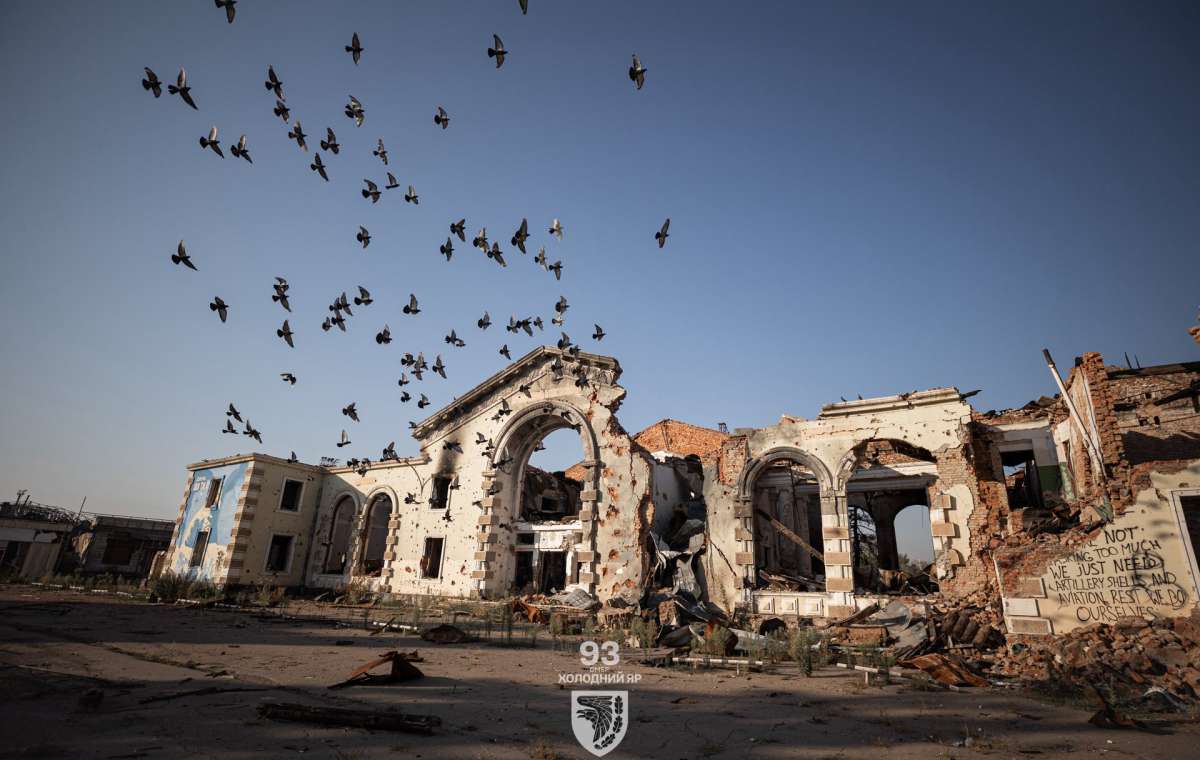
Destroyed Kostiantynivka
Explore further

Kostiantynivka: Why one city in Donbas matters so much that Putin lies about having captured it

The eastern approach

Ukrainian military observer Kostiantyn Mashovets reported that Russian forward units are advancing across several tactical areas at once in the Sloviansk direction. He said the command of Russia's 3rd Combined Arms Army rushes assault infantry forward right after each successful infiltration. Russian troops reached the southeastern edge of Pyskunivka, east of Sloviansk, from the east and northeast, moving off positions they had seized on the southern bank of the Siverskyi Donets, Mashovets said. Zakitne lies northeast of Pyskunivka and Kryva Luka southeast of it, and ISW read the advance as evidence Russia has consolidated positions in both.

They also infiltrated the southern and southeastern outskirts of Mykolaivka from western Rai-Oleksandrivka. ISW assessed that Russia is running a dual effort to connect its units near Kryva Luka with those at Rai-Oleksandrivka, so it can assault Mykolaivka from dominant terrain to the east and south at once. Mashovets added that other Russian groups slipped through three settlements along the E-40 Bakhmut-Sloviansk highway, trying to hold the western bank of the Siverskyi Donets-Donbas Canal and reach the river just east of the city.

ISW observed reports on 23 August that Ukrainian forces repelled a Russian infiltration attempt in Mykolaivka.
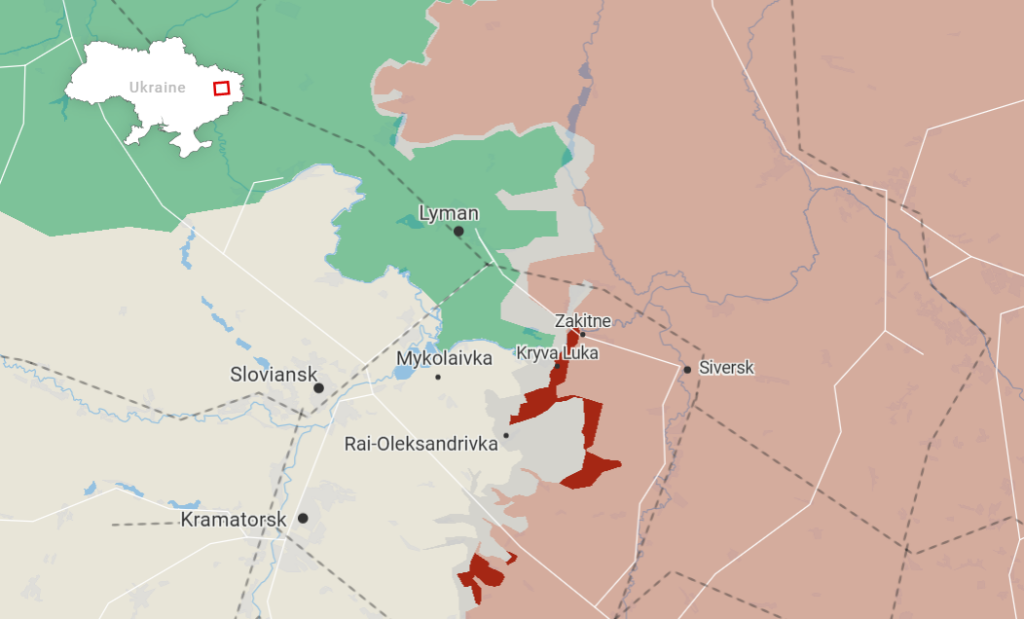
Oleksandr Borodin, spokesperson for Ukraine's 3rd Army Corps, said the Lyman direction falls in his corps' zone and that Russia's goal there is to half-encircle the Sloviansk-Kramatorsk agglomeration from the flank—first securing bridgeheads across the rivers, then cutting logistics. He called those plans unrealistic:

"We have quite serious defensive positions there and have been preparing for a long time. The capabilities they currently have to try to accomplish this task are insufficient even to come close to achieving such a goal."

Why Moscow switched directions

Russia prioritized attacking Sloviansk from the northeast through Lyman when it opened its spring-summer 2026 offensive, but that effort has largely stalled. The Siverskyi Donets River, which loops north and northeast of the city, together with a web of canals, handed Ukrainian defenders a natural moat. So Russian commanders now treat Mykolaivka as a key prize. Taking it would let them strike west toward Sloviansk from the east, skirting the water obstacles that blocked the northeastern route.
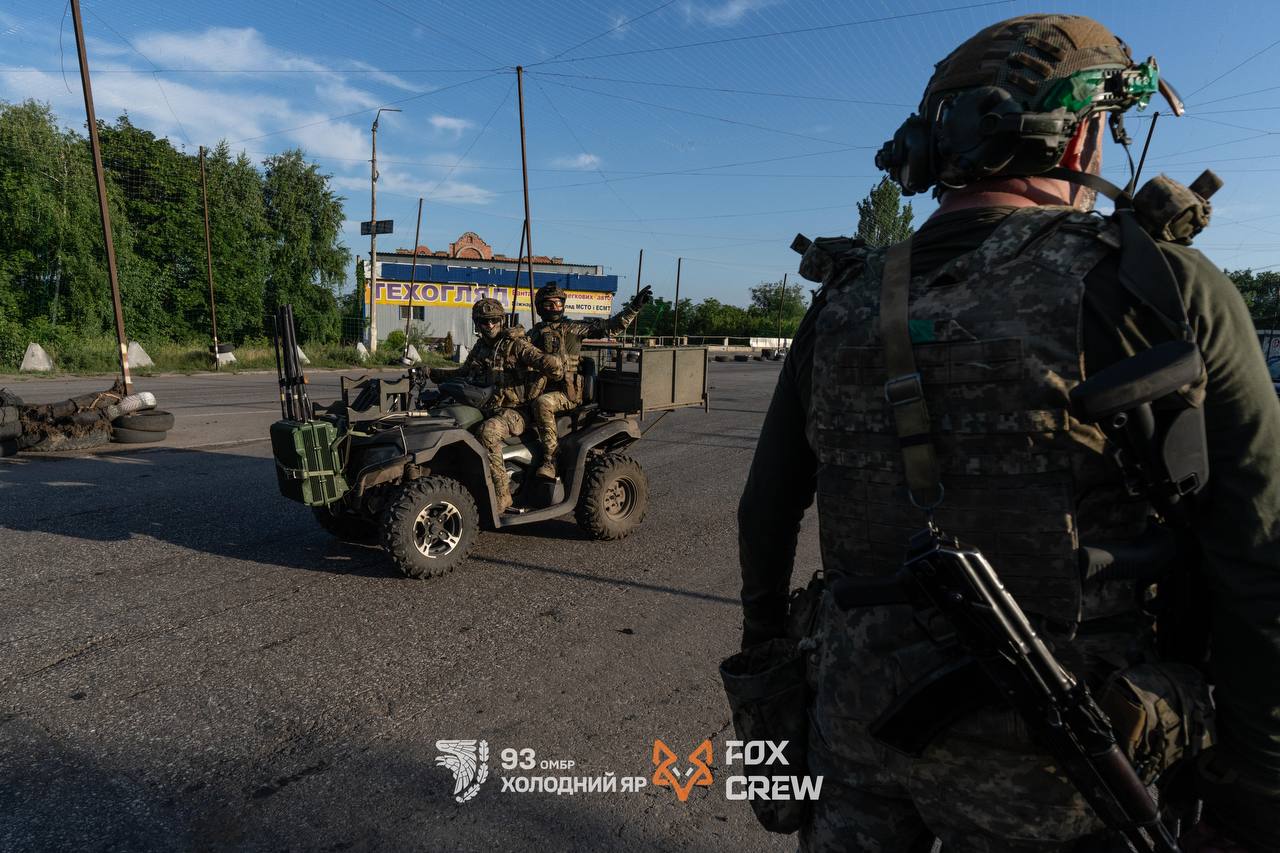
Soldiers of the 93rd Separate Mechanized Brigade’s Fox Crew prepare for a logistics run near the Kramatorsk–Kostiantynivka road in Donetsk Oblast. The unit, once focused on anti-tank warfare, now uses strike drones to disrupt Russian supply lines. Credit: 93rd Separate Mechanized Brigade / Fox Crew.
Explore further

Ukrainian intelligence units will not help: Analyst warns that once Russia breaks into Sloviansk and Kramatorsk, reinforcing them only delays inevitable

A slow road into the Fortress Belt

Sloviansk anchors the northern end of Ukraine's Fortress Belt, a chain of fortified cities that has blunted Russian advances in Donetsk Oblast since 2014. ISW cautioned that Russian forces are extremely unlikely to make fast gains west of Mykolaivka, since they still need to seize several more settlements first.

Ukraine's President Volodymyr Zelenskyy said on 23 August that Putin has ordered his army to seize all of Donetsk Oblast by 31 December. By ISW's count, it is the 15th such deadline since 2022, and Russia has missed every one that has come due.

Zelenskyy put Russia's frontline casualties this year at around 267,000, including about 155,000 killed, and said 70% to 80% of them fall in the Kostiantynivka direction. Russia holds about 79.89% of Donetsk Oblast, by ISW's count, and Zelenskyy said the Kremlin is preparing to mobilize around 300,000 men after the 18–20 September State Duma elections, partly to reinforce Donetsk and Luhansk oblasts.
  •  

Ukrainian intelligence units will not help: Analyst warns that once Russia breaks into Sloviansk and Kramatorsk, reinforcing them only delays inevitable

Soldiers of the 93rd Separate Mechanized Brigade’s Fox Crew prepare for a logistics run near the Kramatorsk–Kostiantynivka road in Donetsk Oblast. The unit, once focused on anti-tank warfare, now uses strike drones to disrupt Russian supply lines. Credit: 93rd Separate Mechanized Brigade / Fox Crew.

Ukrainian analysts warn that the situation on a key stretch of the Donetsk front is becoming increasingly dangerous for two cities central to Ukraine's defense. The eastern flank of the Sloviansk-Kramatorsk agglomeration is taking on an increasingly threatening character, and earlier stabilization measures are clearly not working, military analyst Oleksandr Kovalenko said.

The two cities anchor the line that has held Russia back for over a decade. Sloviansk and Kramatorsk form part of the so-called fortress belt, the line of Ukrainian fortifications that has restrained the Russian advance since 2014. The agglomeration serves as the most important bastion and logistics hub for Ukrainian forces in the east. A threat to it is a threat to the backbone of Ukraine's defense in Donbas.

Russia is 12 to 13 km away

Kovalenko laid out how close Russian forces have come. Their forward positions are 12-13 kilometers from Sloviansk and Kramatorsk. He warned that if Russia's pace does not slow, the first infiltrations into both cities could come by December 2026.

The advance is measured in ground lost. The problem on the eastern flank runs about 30 kilometers, where Russia's 3rd Combined Arms Army operates.

"Only in the third week of August, Russian forces captured 21 square kilometers of Ukrainian territory in this section of the frontline," the expert said.

Russia uses the terrain of the "Cretaceous Flora" reserve, its hilly micro-relief rather than open steppe, to advance, absorbing not just square kilometers into pockets but villages and settlements.

The flank threatens neighboring sectors

The deterioration is spreading pressure sideways. The advance creates pressure from the southern bank of the Siverskyi Donets on the zone of the 3rd Army Corps, which had stabilized the Lyman direction and pinned Russian forces near Yampil, Kovalenko believes. The former Siverskyi direction saw the fastest rate of territorial loss of any sector in 2025, slowed in April and May 2026, but the 3rd Combined Arms Army's advance has not yet been stopped.

The cumulative loss is large. After losing more than 500 square kilometers over a year, the unstable flank, sagging since June 2025, is becoming a problem for other directions, looming over or pressuring them.

Kovalenko argued the sector has gone months without attention while threatening both the main agglomeration and the successfully held directions around it.

Analysts urge reinforcement before it is too late

Kovalenko proposed a specific fix. The sector must be reinforced as soon as possible, he said, suggesting that the nearest resource, Andrii Biletsky's 3rd Army Corps, often described as one of the most capable formations in Ukraine's forces, be used at least to relieve both banks of the Siverskyi Donets.

"Once infiltrations into Sloviansk and Kramatorsk begin, reinforcing garrisons and landing intelligence-directorate troops will not solve the problem but only delay the inevitable," he warned.

A second analyst gave a similar warning. Yurii Butusov, a drone company commander in the National Guard's "Khartia" corps, said that if Ukraine's forces retreat from there, Russia gains tactical advantages and Sloviansk-Kramatorsk is gradually lost, ultimately leading to the loss of the Donbas.

He also said that only Biletskyi can take responsibility for this battle.

"Only orderly command and organization at the front now will allow us to turn the course of a battle that is so far not going in our favor," Butusov said.

  •  

Russia squeezes the flanks, then infiltrates the middle. Around Kramatorsk, it can’t do both

Par : David Axe

Soldiers of the 93rd Separate Mechanized Brigade’s Fox Crew prepare for a logistics run near the Kramatorsk–Kostiantynivka road in Donetsk Oblast. The unit, once focused on anti-tank warfare, now uses strike drones to disrupt Russian supply lines. Credit: 93rd Separate Mechanized Brigade / Fox Crew.

  • Russian forces use the same strategy over and over to capture Ukrainian cities
  • Surround on the flanks, infiltrate in the middle
  • But that strategy requires doing both at once, and Russia lacks the infantry
  • Around Kramatorsk, every Ukrainian unit that holds forces a shuffle that stalls something else

Russian troops are slowly marching toward and around Kramatorsk and Sloviansk, the last two big free cities in eastern Ukraine's Donetsk Oblast.

The Russians have a standard playbook for taking a Ukrainian city, and running it means doing two things at the same time. Along the nearly 100-km Kramatorsk front, they don't have the infantry to do both at once. Every time a Ukrainian brigade holds somewhere, the Russians have to move men to cover it—and something stalls somewhere else.

That strategy is simple in concept but difficult in practice. The idea is for Russian forces to advance along a city's under-protected flanks in order to put pressure on the main supply lines of the city's garrison. As the flank attacks squeeze the garrison's logistics, Russian infiltrators slip into the city, hoping to create a lodgement for follow-on forces.

The final assault through that lodgement comes late in the campaign, after the Ukrainians are already weakened by a lack of supplies.

Structural Deterrence

Russian offensive planning at the operational level remains disciplined on paper: groupings are sequenced, axes are assigned, objectives are staggered. What the discipline is not is well-manned. I read the shift to two- and three-man infiltration teams on… https://t.co/Py1GbXM9aR

— Vitaly (@M0nstas) July 24, 2026

The strategy only works when the troops on the flanks and those in the middle work together. The former squeezes. The latter infiltrates. The problem for the Russian Center Group of Forces on the Kramatorsk front is that it's not squeezing and infiltrating at the same time. That delays the overall Russian advance and buys time for Ukrainian forces to dig in, reinforce, and hope for a miracle.

"Russian offensive planning at the operational level remains disciplined," mapper and analyst Vitaly explained. But only "on paper," Vitaly added. "Groupings are sequenced, axes are assigned, objectives are staggered."

"What the discipline is not is well-manned," the mapper wrote.

Vitaly reads one recent Russian adaptation as evidence of the shortfall rather than of cleverness. "I read the shift to two- and three-man infiltration teams on motorcycles and ATVs as less a sign of tactical innovation than of a manpower deficit that organization is straining to hide," he wrote.

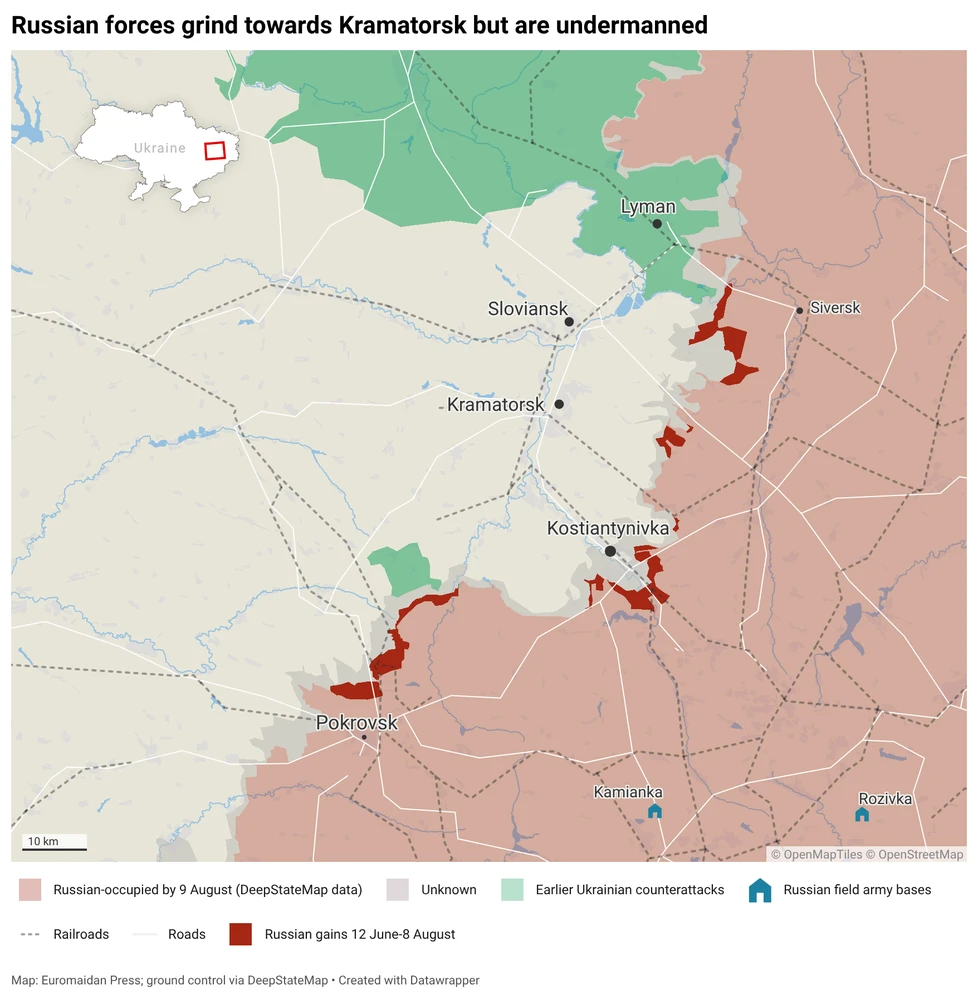
Russian forces advance towards Kramatorsk and Sloviansk, making inroads in the last 2 months
Map: Euromaidan Press

Manpower shortages

Ukraine's manpower problems are well-known. Fewer observers appreciate that Russia struggles, too. Yes, the Russians still recruit around 30,000 fresh troops every month. In theory, that's enough new manpower to replace monthly losses.

But replacing casualties is not the same as resourcing a strategy. Ukraine's commander-in-chief Oleksandr Syrskyi put the Russian force in Ukraine at 721,300 at the end of June—a gain of only around 11,000 since late 2025, against Russian losses he estimated at 30,000 to 35,000 a month. Contract recruitment collapsed in the spring, falling by a third year on year, and Ukraine's foreign intelligence service counted 195,000 contract recruits by early July against an annual target of 409,000.

A Russian general, speaking anonymously to the investigative outlet IStories, put the requirement more starkly. To capture the rest of the Ukrainian-held Donbas, he said Russia would need to replace at least 55,000 to 60,000 casualties every month—roughly double what it recruits. That figure rests on a single unnamed source and should be weighed accordingly. But it describes the same gap Vitaly sees on the map.

When a Ukrainian brigade defeats one attack anywhere along the Kramatorsk front, it may compel Russian regiments to shuffle troops between units in order to quickly replace the losses. The shuffle may sap the combat power of a flanking or infiltration unit working along some other section of the front.

A weak flanking unit may not be able to keep up the pressure on enemy supply lines, perhaps imperiling the adjacent infiltration unit as it probes for the gaps in Ukrainian defenses that the flankers were supposed to help create. By the same token, weak infiltrators may find gaps in Ukrainian defenses, but fail to secure a lodgement—effectively wasting the efforts of the adjacent flankers.

A drone operator from the 81st Air Mobile Brigade.
Explore further

Russia is assaulting the gateway to Sloviansk. Ukraine’s 81st Brigade is holding it nearly alone

"That gap keeps producing the same effect," Vitaly explained. The Ukrainian armed forces' "ability to hold separate sections of the front independently forces Russian formations to compensate for each other's failures, and that compensation creates new stalls."

Vitaly gave a name to the effect, and was careful about what he was not claiming. "I call it structural deterrence—not deterrence in the conventional sense, and not a doctrine, but the byproduct of asking an undermanned army to keep a sequenced plan on schedule."

A byproduct is not a defense, and it holds only as long as the Ukrainians can keep producing it. That requires synchronization of their own. Supplies and reinforcements must arrive when and where they're most badly needed. Air and artillery support should shift from sector to sector depending on the urgency of the local garrisons' needs.

All that is to say, the lack of synchronization that has slowed the Russians' march on Kramatorsk could eventually speed up the Russians' march—if and when the Ukrainians are the ones struggling to synchronize.

It's worth noting that the Russians aren't advancing fast toward Kramatorsk and Sloviansk, but they are advancing—especially from the northeast.

The Russians may not be perfectly synchronized. But they're clearly synchronized enough to grind toward the last free cities in Donetsk. Just very, very slowly.

A 53rd Mechanized Brigade trooper.
Explore further

Can Ukrainian forces save Sloviansk and Kramatorsk?

  •  
❌