❌

Vue lecture

Russian missiles that fell in Poland were only weeks old, prosecutors’ preliminary dating shows

Russian Kh-101 cruise missile moments before striking Okhmatdyt Children's Hospital in Kyiv, as identified by Ukraine's Security Service. 8 July 2024. Screenshot from a video on the KyivToday Telegram channel.

All three objects that fell in eastern Poland on 20 November were Russian Kh-101 cruise missiles, Polish prosecutors said on 22 November. Preliminary findings indicate they were produced in the fourth quarter of 2026 at plants in Dubna, Moscow Oblast.

The finding comes as NATO's North Atlantic Council meets in Brussels on 23 November to discuss the airspace violation. In July, a single Kh-101 fell in Lublin province, and prosecutors dated it to the second quarter of 2026. This time, at least three entered Polish airspace in one night. If the dating holds, both the July missile and these three were made this year.

What investigators found

Investigators found the remains at Nowy Lipowiec in Lublin province, and at Rudnik nad Sanem and Mołodycz in Podkarpackie province, the Lublin Regional Prosecutor's Office said. With the fourth quarter starting on 1 October and the missiles falling on the night of 19–20 November, none was more than 50 days old, going by the preliminary dating.

Smoke in the sky over houses in Chmielek, Biłgoraj County, Poland, 20 November 2026
Explore further

A farm camera caught a flash: Russia’s missile barrage on Ukraine may have reached Poland

Two missiles and most likely a jet-powered drone had fallen in Poland, Defense Minister Władysław Kosiniak-Kamysz told a press conference on 20 November. At the same briefing, Poland's Operational Commander Gen. Ireneusz Nowak estimated that Russia had fired 72 Kh-101s at Ukraine overnight. He said 11 objects came right up to Poland's borders, and three had violated its airspace as of the briefing. Kosiniak-Kamysz placed the probable drone at Mołodycz, RMF24 reported, and prosecutors now say the object was a Kh-101 like the other two.

The Nowa Dęba question

Kosiniak-Kamysz called the violation another Russian provocation and said that, in his view, the timing was not accidental. He tied it to a coalition-of-the-willing exercise taking place that day at Nowa Dęba in Podkarpackie province.
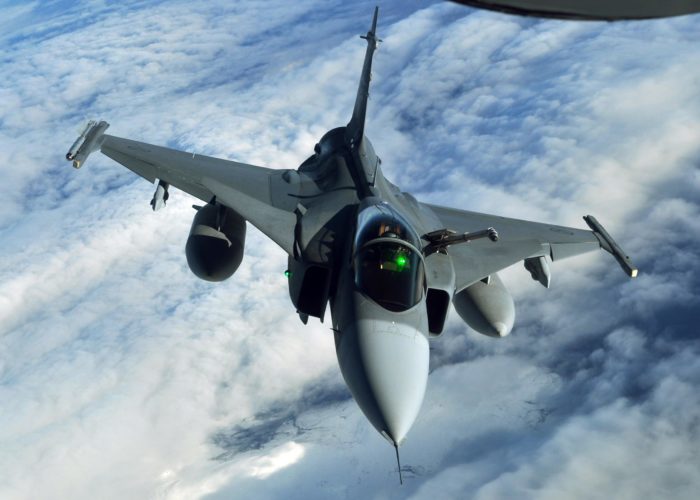
A Swedish JAS-39 Gripen fighter jets to Ukraine
Explore further

Poland discloses why it didn’t shoot down Russian cruise missile, even though Swedish pilot had NATO’s green light

More than three Russian objects may have entered Poland, and the military was considering the possibility that at least two were heading toward Nowa Dęba, Radio ZET reported, citing unnamed sources. Prime Minister Donald Tusk also pointed to a possible deliberate Russian provocation and cautioned that the link to the exercise remains a hypothesis, Defence24 reported.

On 21 November, NATO Secretary General Mark Rutte visited Warsaw, where he spoke of a dangerous incident. Meanwhile, the press service of Poland's Permanent Representation to NATO announced that day that the North Atlantic Council would meet, with Deputy Defense Minister Paweł Zalewski representing Poland. On 23 November, the Lublin Regional Prosecutor's Office said it would try to establish whether the missiles had been directed at Poland deliberately.

  •  

Poland discloses why it didn’t shoot down Russian cruise missile, even though Swedish pilot had NATO’s green light

A Swedish JAS-39 Gripen fighter jets to Ukraine

A Swedish fighter pilot had NATO’s permission to shoot a Russian cruise missile out of Poland’s sky. He never pulled the trigger. Weather too thick to identify the Kh-101 stopped the Gripen pilot during Russia’s 20 November barrage, Lieutenant General Ireneusz Nowak, commander of Poland’s Operational Command, told Rzeczpospolita.

On 1 October, Poland introduced procedures that allowed it to shoot down Russian targets without waiting for visual confirmation. However, the country has likely now returned to peacetime protocols, said military expert Serhii Zhurets. He added that the situation has become a serious challenge to Poland's security and demonstrated the need to maintain a high level of air defense effectiveness, Espreso reports.


The incident occurred during the Coalition of the Willing drills on Polish territory, which includes countries united to coordinate security guarantees, military and financial aid, and post-war stabilization plans for Ukraine, under the leadership of the UK and France.

The green light that went unused

The Swedish Gripen pair flew under NATO’s Combined Air Operations Center in Uedem, Germany, which issued a condition-based order, an authorization letting the pilots decide for themselves to fire once set conditions were met.

One pilot moved on an object his systems flagged as a probable Kh-101 but could not confirm it, by eye or through the jet’s optoelectronic sensors. The obstacle was “extremely difficult weather conditions” in the interception area, Nowak explained, and the pilot held fire despite the NATO clearance.

Eleven objects, three across the border

Poland tracked 11 objects that could threaten its airspace simultaneously. Three crossed the border, and none caused deaths or injuries, Nowak said.

To guard the sky, Poland put up two F-16s from Łask and the two Swedish Gripens, backed by a Saab 340 early-warning plane, a Dutch MRTT tanker, and ground-based air defenses.

A “yellow” alert declared at 1:40 a.m. gave way to the top “red” level at 5:49 a.m. and held until noon. After 7 a.m., as Russian bombers loosed fresh cruise missiles on their way home, more F-16s went up from Krzesiny, and territorial-defense teams fanned out to find where the objects fell.

Drones first, then the missiles

The attack unfolded in two phases: Russian forces sent drones, including fast jet-powered ones, then followed with Kalibr and Kh-101 cruise missiles. Poland knew the launch sites, the numbers, and the flight paths, helped by data Ukraine passed through its Wiraż air-situation system.

  •  

A farm camera caught a flash: Russia’s missile barrage on Ukraine may have reached Poland

Smoke in the sky over houses in Chmielek, Biłgoraj County, Poland, 20 November 2026

An object possibly from Russia's mass missile and drone attack on Ukraine fell and burned in a field in southeastern Poland on the morning of 20 November, Polish officials said. Ukrainian airspace monitors had tracked a Kh-101 cruise missile heading for Poland minutes before the Polish government warned residents of parts of two border voivodeships of an air threat. A regional crisis official said it was not yet clear whether the object was a missile or a drone.

Russia's air war on Ukraine keeps spilling over NATO's eastern edge. If confirmed, it would be at least the second time this year that a Russian cruise missile has come down in Poland, after months of Russian drones crossing into Romania and Moldova, a pattern that analysts at the Institute for the Study of War read as a likely effort to make such violations routine.

Ukrainian monitors report a missile in Poland

At 06:28 Polish time (07:28 in Kyiv), the Ukrainian airspace monitoring channel mon1tor_ua warned Poland that a Kh-101 was flying toward it from Lviv Oblast. At 06:32, the monitoring channel eRadar posted "Missile in Poland," then wrote that it had been tracked near the town of Cieszanów in Poland's Podkarpackie voivodeship and was no longer flying.

Southeastern Poland, 20 November 2026: where an object fell near Lipowiec and Chmielek in Biłgoraj County, Lublin Voivodeship, the farm in Kopki whose camera filmed the flash, and where Ukrainian monitors said a Kh-101 they tracked from Lviv Oblast vanished from radar near Cieszanów
Southeastern Poland, 20 November 2026: where an object fell near Lipowiec and Chmielek in Biłgoraj County, Lublin Voivodeship, the farm in Kopki whose camera filmed the flash, and where Ukrainian monitors said a Kh-101 they tracked from Lviv Oblast vanished from radar near Cieszanów. Map: Euromaidan Press

Poland's Government Security Center warned parts of Lublin and Podkarpackie voivodeships of an air threat at 06:33 Polish time, and sirens sounded in Lublin at 06:35, Ukrainian defense outlet Militarnyi reported. A security camera filmed a flash on the horizon. The footage came from a farm in Kopki, in Podkarpackie, and probably showed a blast between the villages of Chmielek and Nowy Lipowiec, the local weekly Kronika Tygodnia said.

At 07:07 Polish time, Poland's Operational Command said it had passed an air-threat warning to the Government Security Center over a suspected violation of Polish airspace by unidentified aerial objects, and was checking its radar records. Its spokesman, Lt Col Jacek Goryszewski, told TVN24 the military was checking two possible violations, one near Chmielek.

Dariusz Działo of the Lublin voivodeship crisis management center told TVN24 a flying object was found in the village of Lipowiec in Biłgoraj County. "The object fell on fields near a forest and started burning," he said, adding that it posed no threat to residents or the forest.

routes of russian missiles and drones in Ukraine
Routes of Russian missiles and drones during the 20 November attack. Map: PPO Radar

Warsaw says the threat has passed

Prime Minister Donald Tusk wrote that his defense and interior ministers had briefed him on Biłgoraj County "in connection with the violation of Polish airspace," that there was no longer an air threat, and that services were on site. Deputy Foreign Minister Marcin Bosacki told TVN24 that one of the Russian objects from "today's very, very serious attack on Ukraine" may have fallen in the county, citing information from the military. Ukraine also told Warsaw that something may have fallen near the Polish-Ukrainian border crossing at Hrebenne, probably on the Ukrainian side, he said. Prosecutors in Lublin, investigating with the military police and military counterintelligence, said they were still establishing the number and nature of the objects, TVN24 reported.

Russian missiles and drones have crossed Ukraine's western borders before

On 30 July, a Russian Kh-101 flew about 95 km into Poland and crashed in a field in Lublin Voivodeship during another mass strike on Ukraine. Russian drones have repeatedly crossed into Romania and Moldova this year. On 24 September, drones entered Moldova and Romania while Poland scrambled jets twice. On 17 October, Romanian F-16s downed two Russian jet drones over Romania's territorial waters near Sulina. Moldova recorded 39 Russian drone incursions in the first eight months of 2026, against 17 in all of 2025, President Maia Sandu said.

two children pulled rubble alive three did survive—one village near kryvyi rih after russian missile attack · post site where cruise came down lublin voivodeship poland 30 2026 місце падіння
Explore further

The Russian missile that hit Poland was made only months earlier, prosecutors found

The Institute for the Study of War assessed in September that the incursions are "likely part of the Kremlin's efforts to normalize airspace violations by intensifying their frequency." Ukraine's Foreign Intelligence Service warned the same month that Russia was stockpiling missiles for autumn and winter strikes on Ukraine's critical infrastructure and for possible provocations against European NATO members.

  •  
❌