❌

Vue lecture

Drones hit Ust-Luga port near NATO’s border, starting a fire and injuring three workers

Aftermath of the attack on the port of Ust-Luga

Drones hit the port zone of Ust-Luga overnight on 11 November, starting a fire and injuring three workers, Leningrad Oblast Governor Aleksandr Drozdenko wrote.

Ust-Luga is Russia’s largest Baltic port, and its oil terminals ship crude and refined products. Two days earlier, drones set fire to the Kirishi refinery, which fuels St. Petersburg. Every strike on Ust-Luga also reaches NATO’s doorstep: the port lies only about 30 km from the Estonian border.

Fire seen from Estonia

Drozdenko first wrote at 05:02 Kyiv time (the same in Finland and the Baltics) that, according to preliminary information, there had been a hit in the port zone. He added that a transformer substation had shut down. At 06:23, he wrote that the workers’ lives were not in danger. One was hospitalized with a shrapnel wound to the leg, regional official Nikita Dontsov told TASS, Lenta.ru reported.

NASA FIRMS data show two clusters of new heat detections on 11 November: a main one in the port and a smaller one about 8 km to the west-southwest. The area showed none in the previous month.

NASA FIRMS heat detections at the port of Ust-Luga and about 8 km to the west-southwest, 11 November 2026
NASA FIRMS heat detections at the port of Ust-Luga and about 8 km to the west-southwest, 11 November 2026. Screenshot: NASA FIRMS

Estonian broadcaster ERR published images it says show the attack seen from Ida-Viru County.

The fire at the port of Ust-Luga is visible from Estonia. pic.twitter.com/5ev0HpgMiZ

— Exilenova+ (@Exilenova_plus) November 11, 2026

As of 14:00, Ukraine’s General Staff had not commented. It confirmed the 1 September strike on the port’s Novatek complex the following day.

A record night for Leningrad Oblast

By Drozdenko’s claimed tally of 150 drones downed, it was the region’s largest attack, topping 145 on 18 October, Russian outlet Agentstvo Novosti noted. Restrictions at St. Petersburg’s Pulkovo airport from 23:47 to 06:29 delayed more than 30 departures and about 20 arrivals, and two planes bound for the city landed in Helsinki, it added.

Map of the drone strike on the port of Ust-Luga in Leningrad Oblast, about 860 km from the Ukrainian border
Map: Euromaidan Press/Datawrapper

At 23:27 on 10 November, within a minute of Drozdenko’s drone-danger notice, Latvia’s National Armed Forces issued an orange alert for Ludza. It later raised orange alerts in Krāslava, Balvi, Aizkraukle, Madona, Cēsis, Smiltene and Gulbene.

In Lithuania, NATO fighters twice tried and failed to destroy a drone that had entered from Belarus, and one missile that missed was later found in the Biržai district, Defense Staff chief Giedrius Premeneckas told reporters, LRT reported. He said the drone then crossed Latvia and Estonia into Russia and could have been disrupted during Ukraine’s attack, though this was unconfirmed. Crisis center head Vilmantas Vitkauskas called Russian claims that Lithuania opens its airspace to Ukrainian drones a lie.
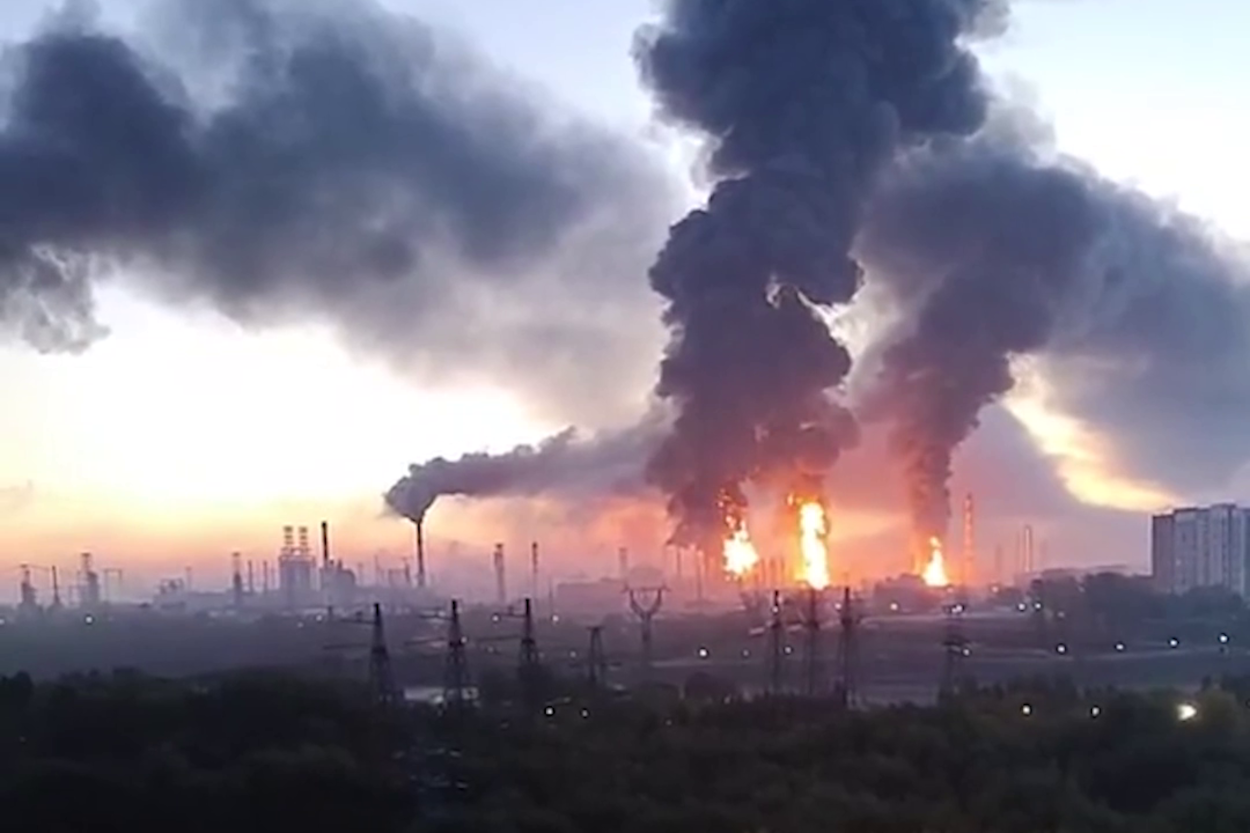
Smoke over Moscow after a mass Ukrainian drone attack on an oil refinery and logistics facility, 20 September 2026. Screenshot from video: Zelenskyy
Explore further

Reuters: Ukrainian drone strikes disrupt 30% of Russia’s oil refining capacity, deepening fuel crisis as Moscow keeps exporting diesel

At 02:09 and 02:15, Finland’s Defense Forces set temporary airspace and maritime restriction zones in the eastern Gulf of Finland, calling them a precaution to protect bystanders and counter potential drones. At 03:12, the Estonian Defense Forces warned of a possible air threat in six southern counties, and two northeastern ones at 03:45, ERR reported.

  •  

Drones hit three of the four refineries feeding Moscow last week. Overnight, they set fire to the one fueling St. Petersburg

Fire at the Kinef oil refinery seen from Kirishi, Leningrad Oblast, Russia, after a Ukrainian drone attack, 9 November 2026

Ukrainian drones hit the Kinef oil refinery in Kirishi, one of Russia’s largest, overnight on 9 November and started a fire, Leningrad Oblast Governor Alexander Drozdenko said. Monitoring channels also reported explosions at a Russian air base in occupied Crimea and burning wind turbines in occupied Luhansk Oblast. A day after drones closed a bridge on Russia’s road to Crimea, satellite imagery shows the damage.

Ukraine has spent months hitting the refineries that turn Russian crude into fuel for the army and money for the war budget. Kyiv says the campaign has knocked out more than half of Russia’s refining capacity. The pressure now reaches gas stations across the country. Rosneft, Russia’s largest oil company, has limited fuel sales in all regions, Russian Telegram channel Agentstvo Novosti reported, after drones hit three of the four refineries that supply Moscow within a week. With this strike, the campaign turned north to the main fuel source of Russia’s second-largest city.

Fires at the refinery that supplies St. Petersburg

Drozdenko first acknowledged drone hits in the industrial zone of Kirishi, a town about 800 km from the Ukrainian border. Debris also hit an apartment, and a family was evacuated, he said. By morning, he said a drone had hit the refinery grounds and the fire was contained. The attack also damaged Kirishi’s heating equipment, and heat and power generation have since been restored. Drozdenko claimed air defenses downed 113 drones over the region overnight.

Ukrainian Telegram channel Exilenova+ posted the first reports of the attack shortly after 3 a.m. Kyiv time. It later shared footage of several fires burning at the plant and called it the first attack on the refinery since August.

More from Kirishi, moment of the attack

— Exilenova+ (@Exilenova_plus) November 9, 2026

Drones last hit Kinef in late August, when Ukraine’s General Staff put its capacity at about 20 million tons of crude a year. Ukraine also confirmed damage to the plant in March. Another Ukrainian monitoring channel, Supernova+, listed three crude-processing units as possible points of impact, citing local footage. Ukraine’s General Staff has not yet commented on the strike.

kirishi

Russian Telegram channel Astra described the refinery as the key fuel supplier for St. Petersburg and the source of jet fuel for its Pulkovo airport. Russia’s aviation agency imposed temporary flight restrictions at Pulkovo during the attack.

Kirishi, panoramic view of oil refinery

— Exilenova+ (@Exilenova_plus) November 9, 2026

Drozdenko also claimed that drone “debris” hit the roof of an apartment block in Vsevolozhsk, outside St. Petersburg, and later said a woman on the top floor died.

Explosions in occupied Crimea and Luhansk Oblast

In occupied Luhansk Oblast, a drone hit a wind turbine, Exilenova+ said. The channel later shared video of wind turbines burning in Alchevsk, which it said Ukraine built in 2013 before Russia seized them.

Wind turbines are burning after an attack in Alchevsk, in the occupied part of Luhansk Oblast.

— Exilenova+ (@Exilenova_plus) November 9, 2026

In occupied Crimea, residents told Ukrainian monitoring channel Krymsky Veter of explosions at the Hvardiiske air base from 00:44 local time. Subscribers reported another blast at 01:26, then dense Russian air defense fire and one more explosion at 02:23, the channel added. Russia has launched drones at Ukraine from Hvardiiske. Officials on either side have not commented.

Residents also heard explosions near Zuia and in the Krasnoperekopsk district. The channel’s monitoring group spotted a fire at a Russian border post near Sterehushche, citing satellite heat signatures. Russia’s Defense Ministry claimed it downed 430 drones overnight over 13 oblasts, the Moscow region, and Crimea.

Satellite images show the damaged Mius bridge

Satellite images confirm damage to the bridge over the Mius River on the R-280, Russia’s highway from Rostov to occupied Mariupol and Crimea, Krymsky Veter’s monitoring group said.

Satellite image of the bridge over the Mius River on the A-280 highway from Rostov-on-Don to occupied Mariupol, Rostov Oblast, Russia, marked with damage to the road surface and a secondary burn area, 8 November 2026. Image: Krymsky Veter, translated by Euromaidan Press
Satellite image of the bridge over the Mius River on the A-280 highway from Rostov-on-Don to occupied Mariupol, Rostov Oblast, Russia, marked with damage to the road surface and a secondary burn area, 8 November 2026. Image: Krymsky Veter

The imagery shows a damaged road surface, and the fire was still burning at midday on 8 November, the group added. Drones damaged the bridge that morning, and traffic on the highway was stopped.

A map of the Mius River bridge at km 97 of the R-280 highway in Rostov Oblast, Russia, a street-level view of the bridge, and Rostov Oblast Governor Yuri Slyusar's posts on the drone attack of 8 November 2026, with the posts machine-translated
Explore further

Russia was widening this bridge to four lanes for its Crimea road. Drones have now closed it

The bridge is badly damaged and repairs will take a long time, Ukrainian Telegram channel DroneBomber wrote. Until then, traffic faces a 30 km detour, it said.

More from Kirishi, moment of the attack

— Exilenova+ (@Exilenova_plus) November 9, 2026

Kirishi, panoramic view of oil refinery

— Exilenova+ (@Exilenova_plus) November 9, 2026

Wind turbines are burning after an attack in Alchevsk, in the occupied part of Luhansk Oblast.

— Exilenova+ (@Exilenova_plus) November 9, 2026
  •  
❌