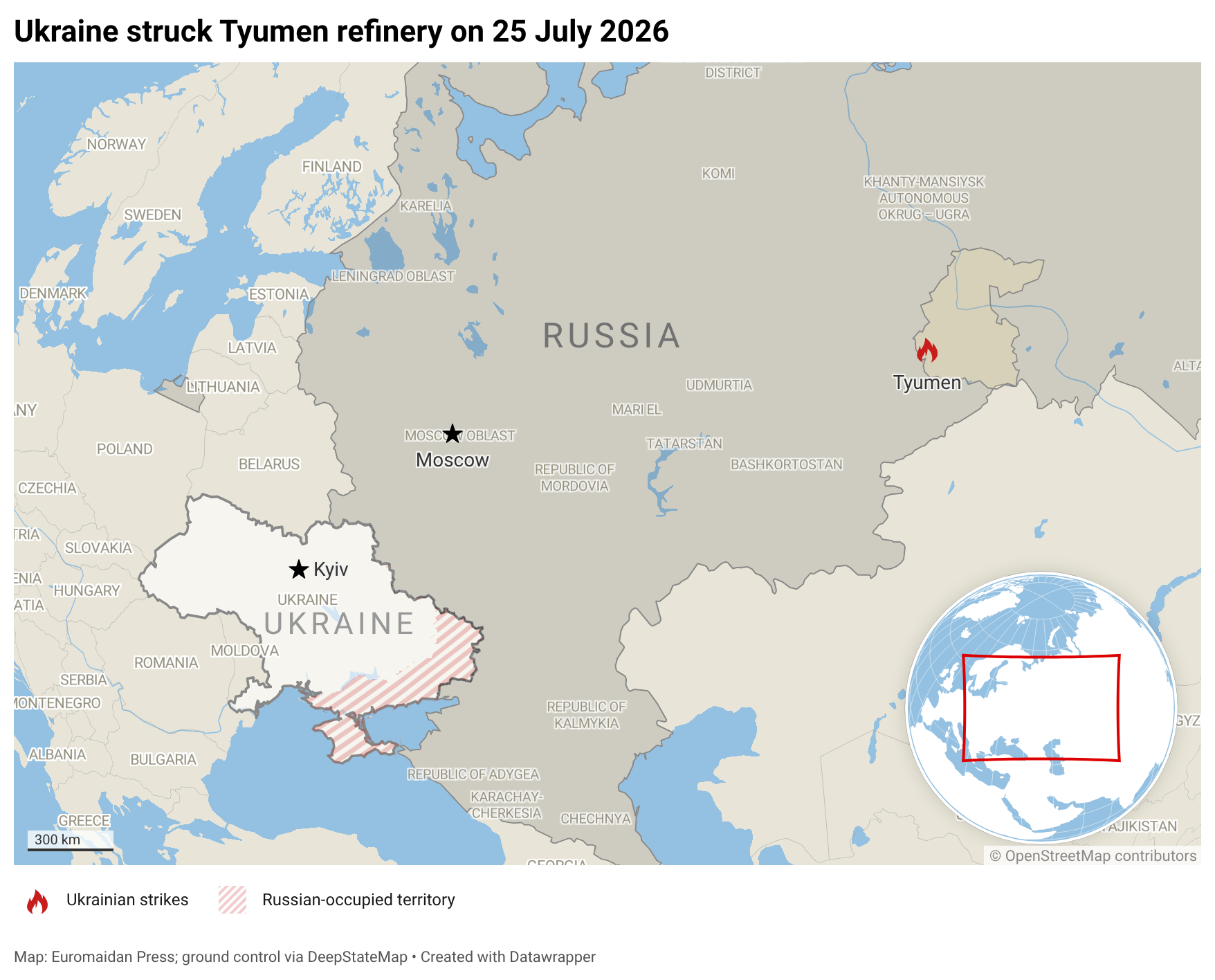
Russia's Tyumen oil refinery has fully halted crude processing and fuel output since a late-July Ukrainian drone strike, two industry sources told Reuters on 28 July. The plant sits more than 2,000 kilometers from Ukraine, deep in western Siberia. How long the damaged gasoline production will take to repair remains unclear.
Ukraine's drone campaign against Russian fuel plants and depots has pushed rationing from Russian border regions all the way into Siberia, turning gasoline supply and oil revenue into pressure points on Moscow's war economy. Every refinery knocked offline trims the fuel and cash that sustain Russia's invasion, and Kyiv often keeps returning to the same targets faster than Moscow can rebuild them.
The plant stopped making fuel
RI-Invest, which owns the Tyumen refinery, shut down crude processing and all product output on 25 July, when the Ukrainian drones hit the facility, according to the two sources in a Reuters report carried by The Moscow Times. The drone strike that day damaged the plant's secondary units and set them on fire.
The blaze hit a diesel hydrotreating unit rated at 2.6 million tons a year. It also struck the combined high-octane gasoline complex, which pairs a catalytic reformer with an isomerization unit. Neither source could estimate how long the gasoline repairs would run, according to Reuters.
Explore further
Oil sites 1,300 km east, a port terminal near the front—Russia’s deep rear had one loud night
A plant already patching an older fire
The same diesel hydrotreating unit spent last month under repair after a 6 June fire from internal causes. The gasoline complex was built under a license from the US firm UOP and started operating in 2018. The refinery's full capacity reaches 9 million tons a year, the sources said. In 2024 it processed 5.7 million tons of crude, turning out 0.5 million tons of gasoline and 2.8 million tons of diesel.
Drones over Siberia, far from any front
On 25 July, Tyumen Oblast Governor Alexander Moor confirmed the drone attack on the region and reported no casualties.
Ukrainian drones had already reached the same plant on 20 June. The lost output tightens a home fuel market that has run short since spring, as Kyiv escalated its campaign against oil-processing plants.
Tyumen Oblast is currently also bracing for major flooding as the Tura River rises.
Russian strikes on Black Sea shipping have brought Ukraine’s grain corridor to its first full stop since it opened in August 2023, Ag Bull Trading reported. The freeze is splitting the price of wheat in two, pushing it down on Ukrainian farms even as it climbs abroad, Latifundist’s analysis found.
Rapeseed now sells for about $70 a ton less than it did a week earlier, and wheat at the farm is fetching roughly a fifth less than last autumn. Some buyers are cutting their offers overnight, market participants reported.
With ships no longer calling, traders have stopped buying, and grain that would have sailed has nowhere to go; the near-total halt of seaport trade has pushed prices down at the ports. More than 90% of Ukraine’s farm exports move through three deepwater Odesa ports.
Explore further
Russia’s port strikes leave Ukraine’s grain with almost nowhere else to go
Carriers pull out as world prices climb
Maersk suspended service at a terminal in Chornomorsk’s fishing port and rerouted cargo to Romania’s Constanta, while the main ports and the corridor itself stayed open, as ThePublic reported; Hapag-Lloyd also paused its Chornomorsk calls.
On world exchanges, the same grain is moving the other way: Chicago wheat has jumped about 16% in July as attacks on Black Sea shipping stoke supply fears. Egypt, Algeria, and Indonesia together buy about 60% of Ukraine’s wheat, USDA figures show.
The freeze is splitting the price of wheat in two, pushing it down on Ukrainian farms even as it climbs abroad.
Grain piles up with nowhere to go
Seaborne farm exports have all but stopped, and with about 10 million metric tons of grain unsold from last season already competing for storage with the new crop, prices for growers keep sliding. The strain on the farm sector could turn critical within two to three months, the All-Ukrainian Agrarian Council’s deputy head Denys Marchuk warned.
The state has imposed no restrictions—shipowners paused their own calls after a run of Russian strikes on civilian cargo ships, Agriculture Minister Taras Vysotskyi told Latifundist.
He urged growers who can afford it to hold off selling, and said Ukraine may need to store an extra 10 to 12 million metric tons of grain it cannot ship, appealing to international partners for temporary storage capacity. The strikes went to the UN Security Council on 27 July, a session convened at Kyiv’s request.
Explore further
Russia’s ship strikes stall Ukraine’s grain corridor. The damage is moving inland
Growers face rising costs of their own—fuel, fertilizer, and equipment—and some are buying diesel on credit at about 87 hryvnias ($1.93) a liter, leaving little room to hold grain off a falling market.
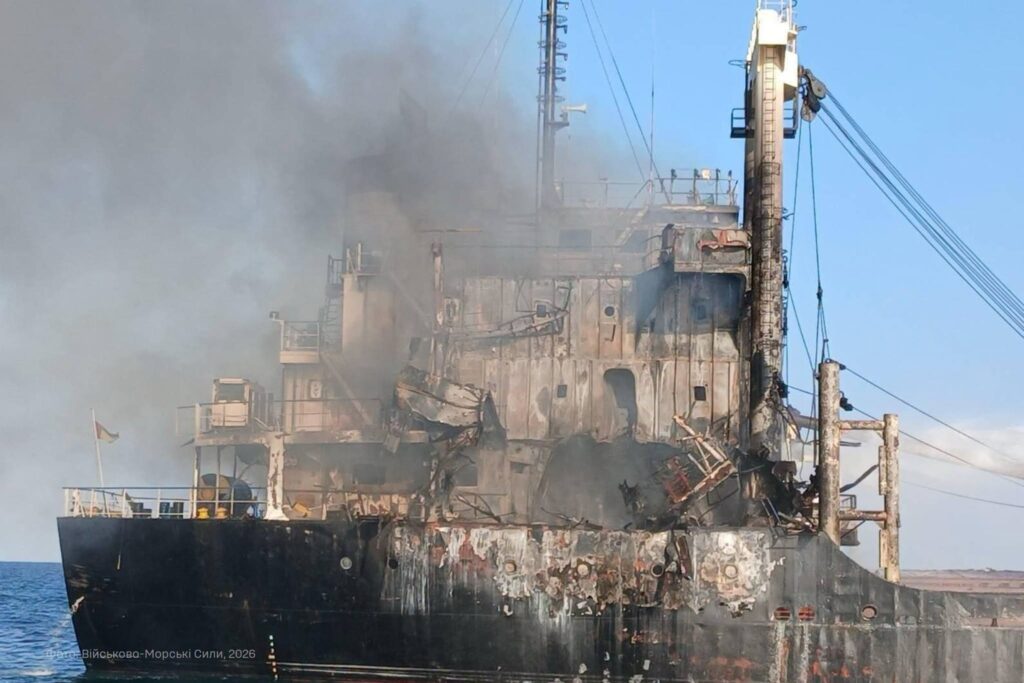
Yet nothing has been formally closed. The deadliest strike came on 19 July, when Russian missiles hit the Golden Leo, a Turkish-owned bulk carrier, as it left Odesa loaded with grain, a strike killing 10. The corridor remains officially open. The harvest has fewer ways out.
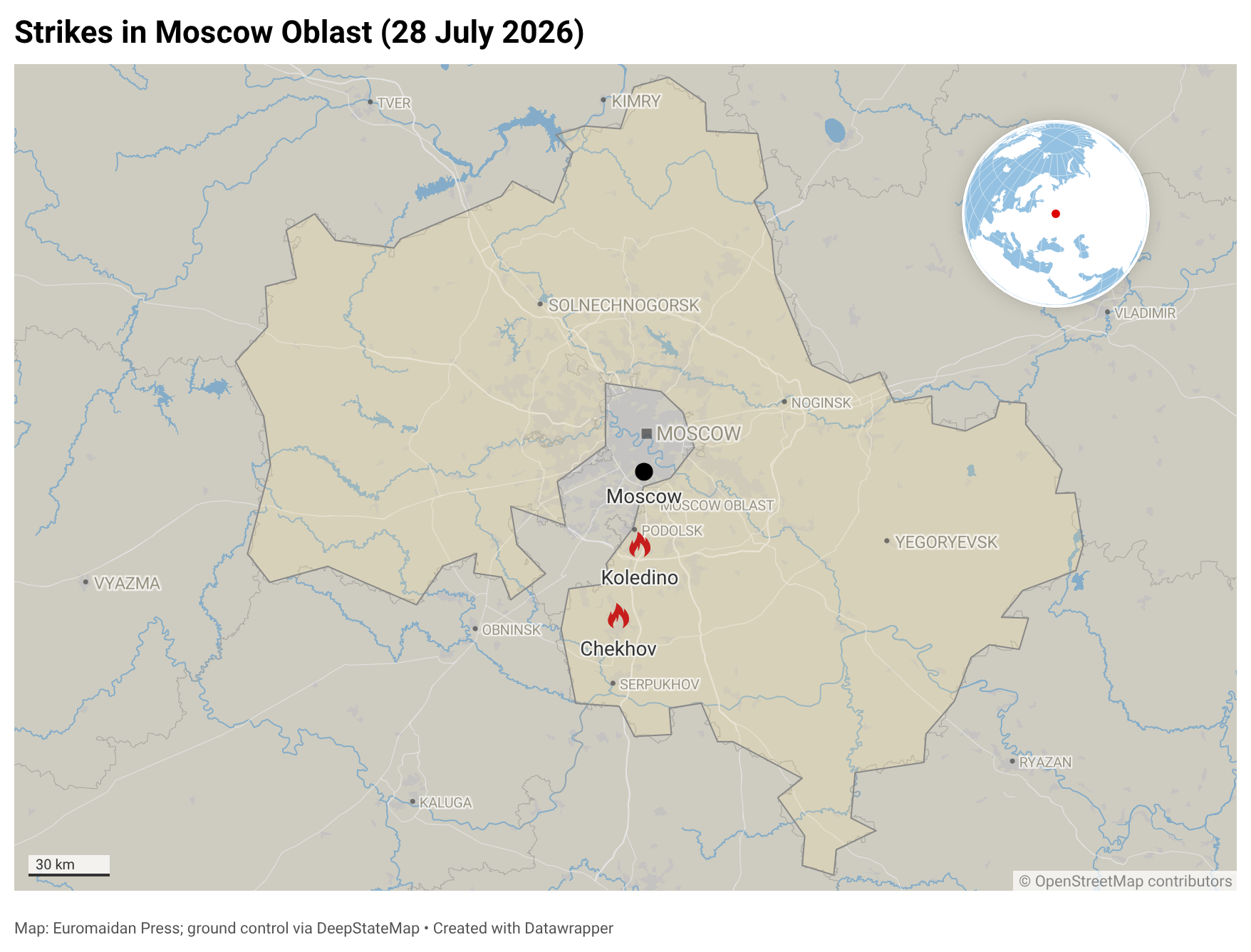
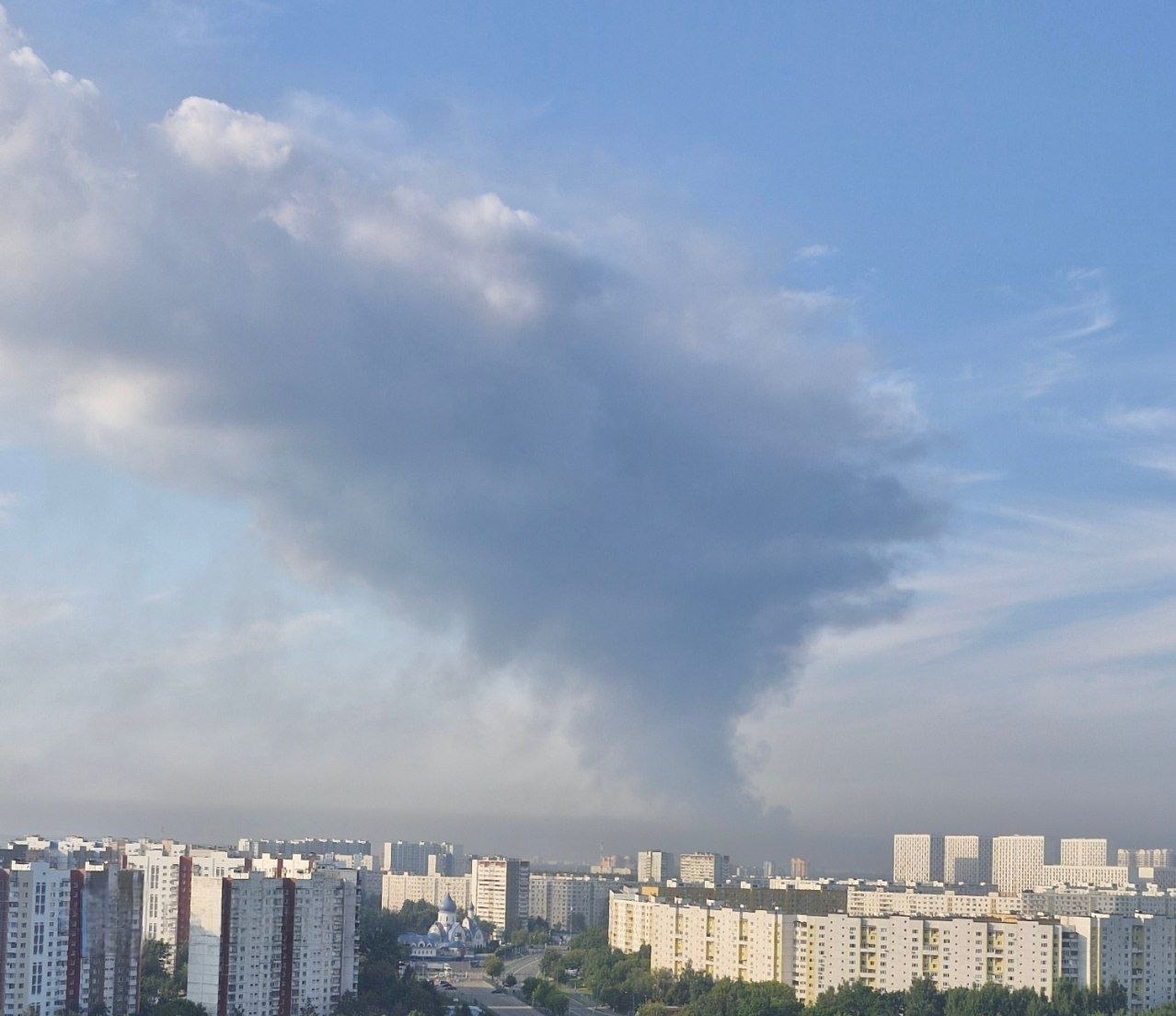
Ukrainian drones struck logistics and industrial sites across Russia's Moscow Oblast on the morning of 28 July, according to monitoring channels and local authorities. Fires broke out near Podolsk and in Chekhov, while Russia's biggest online marketplace said its own warehouse kept running. Russian officials claimed air defenses downed hundreds of drones.
Earlier this month, Ukraine expanded its deep-strike campaign from primarily oil refineries and fuel depots in Russia to the warehouses of Wildberries, Russia's largest e-marketplace. The campaign aims at undermining Russia's wartime economy that sustains the ongoing invasion of Ukraine.
Aimed at Russia's Amazon, the hit landed next door
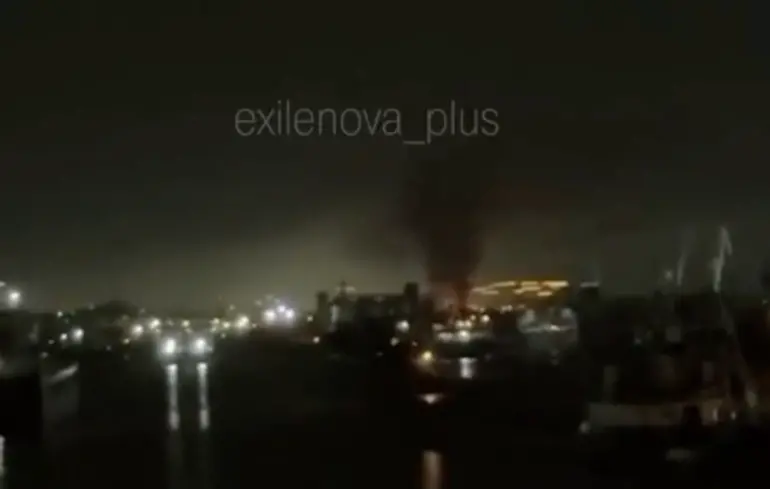
Early on 28 July, Ukrainian monitoring channel Exilenova+ started reporting drone activity over Moscow Oblast. Over the next hours it posted photos, video, and its own read of the target. The channel judged the strike as a likely attempt on the large Wildberries logistics center in Koledino, south of Podolsk. Air-defense fire, it said, probably pushed the hit onto the third-party warehouse right beside it.
Wildberries is Russia's biggest online retailer, its answer to America's Amazon or China's AliExpress. The neighboring depot belongs to Koledino 3PL, an independent logistics and fulfillment operator.
Russian news Telegram channel Astra identified the burning building as that 3PL site. Residents of nearby Podolsk reported explosions and a fire that same morning. Supernova+ backed the account of a hit on the 3PL warehouse.
The operator's own site lists the warehouse at about 10,000 m². It stores goods, packs orders, labels and ships for clients that include Auchan, Magnit, Lenta, Pyaterochka, Fix Price and Detsky Mir. Next to it sits what one industry listing calls the marketplace's largest distribution center, over 200,000 m². Wildberries' press service said the complex was working normally. Monitoring channels still believe the intended target was the Wildberries hub.
Warehouse of the 3PL logistics operator is burning near Moscow
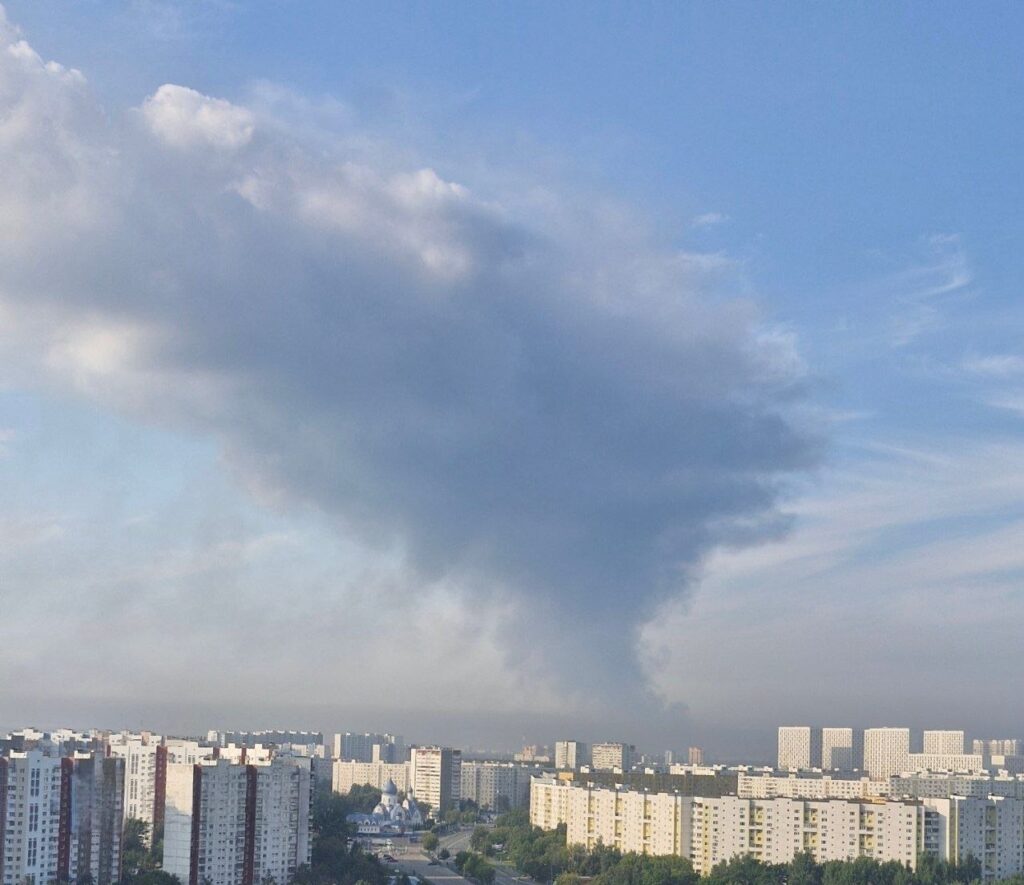
In Koledino, Ukrainian drones struck the facility sitting next to a large Wildberries warehouse, which remains unharmed.
Podolsk district head Grigory Artamonov played it down, reporting only a damaged fence at a private house and a fire in a wooded area.
A rubber plant on fire in Chekhov
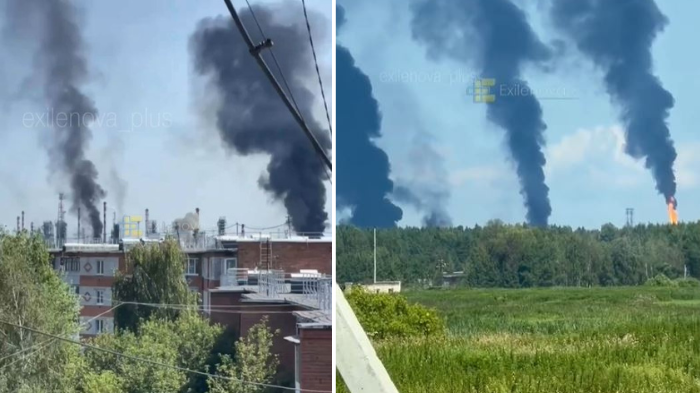
Video published by Exilenova+ also showed drones hitting an enterprise in Chekhov. More footage captured a fire after a drone reportedly struck a smokestack on a plant's grounds. Astra's analysis placed the blaze at the Chekhov Regeneration Plant. Residents had reported explosions overnight.
The plant recycles worn car tires into regenerate, rubber crumb and powder, and makes more than 600 rubber goods. By its own account, it is one of Russia's biggest producers in the field. Chekhov municipal head Mikhail Sobakin confirmed the attack, saying rubber had caught fire at the plant and crews were putting it out, with several buildings in the city damaged.
Moscow mayor Sergei Sobyanin first claimed 12 drones downed near the capital around 5 a.m. He later put more than 390 aircraft over the region between 20:30 and 6:30, saying air defenses hit most "on distant approaches" and 81 near Moscow. Russia's Defense Ministry claimed its air defenses downed 356 Ukrainian drones overnight, across a dozen regions plus the Moscow area, occupied Crimea and the Azov Sea. None of the figures could be independently checked.
Explore further
Ukraine went for Russia’s “AliExpress” again—its next-door warehouse was ablaze
Deep-strike campaign continues
Since 18 July, Ukrainian drones have hit at least ten of the marketplace's centers, in Elektrostal, Kotovsk, Krasnodar, Nevinnomyssk, Voronezh and Yekaterinburg. The previous successful strike came on 24 July, at complexes near St. Petersburg, in Leningrad Oblast and in occupied Simferopol. On 20 July, drones struck the Wildberries center in Podolsk and an oil depot in nearby Lvovsky, both catching fire, as the effort widened from oil refineries to retail and industry.
Ukrainian President Volodymyr Zelenskyy has earlier explained the strikes on the "Russian AliExpress" by saying Moscow uses the platform to bring in sanctioned drone and navigation parts.

 Connexion


 Exilenova+