The outlook for the legislation, which seeks to stabilize the unsettled collegiate sports landscape, is uncertain in the House. It was one of the last congressional actions before the midterms.
The outlook for the legislation, which seeks to stabilize the unsettled collegiate sports landscape, is uncertain in the House. It was one of the last congressional actions before the midterms.
The Vanderbilt Commodores playing the Virginia Cavaliers in Charleston, S.C., on Sunday. A series of legal rulings has sowed chaos in college sports, proponents of the legislation say.
Gabe Reilly, a Salt Lake City firefighter who was an experienced BASE jumper, died in an accident near Millville Canyon in northern Utah on Sunday, officials said.
Gabe Reilly, a Salt Lake City firefighter who was an experienced BASE jumper, died in an accident near Millville Canyon in northern Utah on Sunday, officials said.
The hackers behind the massive FBI breach told 404 Media on Monday they do not intend to publish the data.The breach, in which the hackers stole personal information on “all FBI employees and applicants” including physical addresses, job roles, names of spouses, and medical records, represents a significant national security and counterintelligence threat. Criminals in the same ecosystem as the hacking group, called ShinyHunters, have previously used hacked phone data to track and harass the
The hackers behind the massive FBI breach told 404 Media on Monday they do not intend to publish the data.
The breach, in which the hackers stole personal information on “all FBI employees and applicants” including physical addresses, job roles, names of spouses, and medical records, represents a significant national security and counterintelligence threat. Criminals in the same ecosystem as the hacking group, called ShinyHunters, have previously used hacked phone data to track and harass the FBI agents investigating them. When 404 Media first broke news of the breach, the group sent the personal data of an agent and their spouse who they said was investigating the group.
Ukraine's government plans to pay for its army, pensions, and public-sector wages first, and freeze the parks, fountains, and repaving. Prime Minister Serhii Koretskyi says his Cabinet reordered its spending priorities because part of the international aid it counted on has not arrived.
The war is costing the country at least $155 billion this year, Koretskyi stated earlier.
Defense and people come first
"We continue to take tough anti-crisis measures to ensure the most importan
Ukraine's government plans to pay for its army, pensions, and public-sector wages first, and freeze the parks, fountains, and repaving. Prime Minister Serhii Koretskyi says his Cabinet reordered its spending priorities because part of the international aid it counted on has not arrived.
The war is costing the country at least $155 billion this year, Koretskyi stated earlier.
Defense and people come first
"We continue to take tough anti-crisis measures to ensure the most important thing, the needs of defense and our people," Koretskyi says.
The state will continue to pay for the army, pensions, social benefits, and the salaries of teachers, doctors, and other public-sector workers. Everything deemed non-critical is on hold: new construction, reconstruction, capital repairs, and tidying-up projects, among them parks, squares, fountains, and repaving.
"It is worth finally ceasing to spend money on non-priority things," he continues, promising the state will return to them later.
The aid runs late
On 27 September, Ukraine's prime minister stated that the shortfall in the defense budget's needs stands at $27 billion.
"The president, the government, and all branches of authority are working with partners to find mechanisms and sources to cover the remaining $20 billion," he stressed.
These funds are critically needed to supply the Defense Forces with drones, missiles, equipment, and other resources ahead of winter.
"The government, for its part, guarantees that by 15 October, all government decisions required to receive the international financial assistance promised by partners will be implemented," he stated.
Local budgets get the same call
Koretskyi extended the order downward, urging local councils to review their own budgets and cut spending that is not a priority now. The message across government is the same: pool what is available for the army and citizens, and leave the fountains and the rest for after the war.
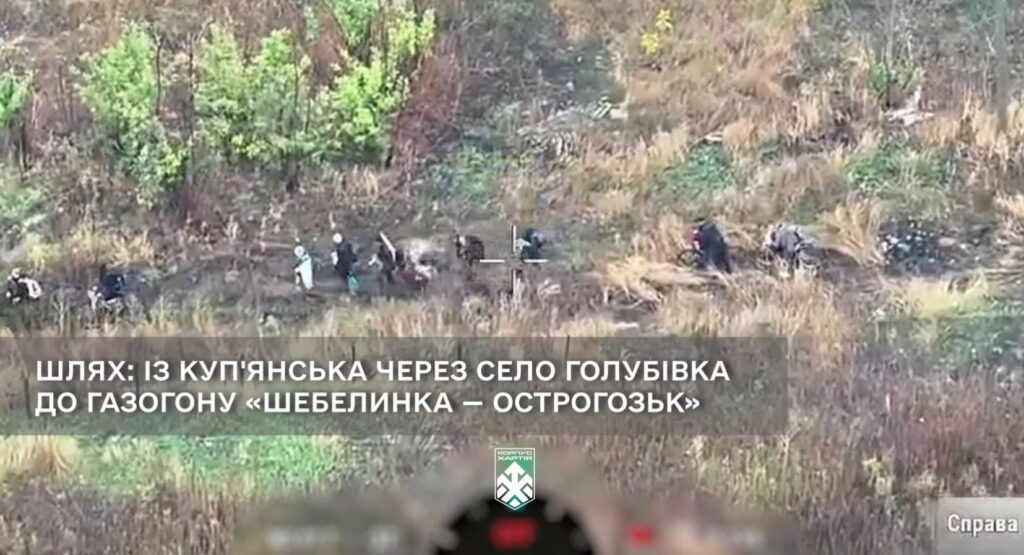
Russian troops retreating near Kupiansk abducted civilians, including children and elderly residents, and drove them into a gas pipeline to cover their withdrawal, the 2nd National Guard Corps Khartia said. The men of military age walking with them in civilian clothes were most likely Russian soldiers who had removed their uniforms, the corps added. Its reconnaissance drones filmed the group on 27 September. Ukrainian forces watched the column but did not open fire because of the civilians
Russian troops retreating near Kupiansk abducted civilians, including children and elderly residents, and drove them into a gas pipeline to cover their withdrawal, the 2nd National Guard Corps Khartia said. The men of military age walking with them in civilian clothes were most likely Russian soldiers who had removed their uniforms, the corps added. Its reconnaissance drones filmed the group on 27 September. Ukrainian forces watched the column but did not open fire because of the civilians, ArmyInform reported.
Ukraine's military has accused Russia of using civilians as human shields in Kupiansk before. During its offensive, Russian troops also tried to enter the city through an inactive gas pipeline. Now, Khartia says, a pipe once used by Russian saboteurs is carrying abducted civilians toward occupied territory.
Nine people forced into the pipeline
Khartia filmed the group as the corps pressed its counteroffensive in the Kupiansk community in Kharkiv Oblast. The footage shows nine people: children, elderly residents, and a person on crutches. Men of military age in civilian clothing walk alongside them.
The group was led from Kupiansk through Holubivka village to the Shebelynka-Ostrohozhsk gas pipeline.
Civilians enter an opening in the ground near the Shebelynka-Ostrohozhsk gas pipeline near Kupiansk, Kharkiv Oblast, 27 September 2026. Screenshot: Khartia Corps
The footage shows them being led into the pipe, where they face a walk of about 10 km in darkness. The pipe exits in a forest, and the civilians will likely be taken to occupied territory.
"We documented this case. The materials will be handed over for a war crimes investigation," the corps said.
Explore further
Russia holds 2,000 people hostage in Oleshky without food or water—Ukraine flew 4,000 kg of food to locals across the Dnipro
Ukrainian forces held fire—Russia counted on it
Ukrainian troops saw the group and did not open fire because children and elderly people were among them. Russia counted on exactly that, Khartia said.
The corps warned that Russian propaganda could present the footage as an "evacuation" or "rescue" of civilians, Militarnyi reported. Khartia calls it an abduction.
Khartia's counteroffensive near Kupiansk comes alongside other Ukrainian advances farther south. In northern Donetsk Oblast, the Third Army Corps' Operation Vivaldi has regained control of 125 km², including 50 km² previously under Russian occupation, and inflicted more than 3,000 Russian personnel losses, the corps said. The operation has effectively erased Russia's planned Lyman pincer. Near Kupiansk, Ukraine's defense forces continue pushing Russian forces toward the Oskil River, and the liberation of forests near Dvorichna and Zapadne has reduced the threat to the city.
Russia's low-Earth-orbit satellite constellation Rassvet went from a few minutes of connectivity over Ukraine to two stable windows lasting more than an hour each in just five months. The system was built by the Russian private company Bureau 1440 as Moscow's answer to Starlink.
As of now, it is nowhere near matching SpaceX's 10,000-satellite network—but the gap between what Russia has now and what it needs is closing, and the tools that could slow it down mostly sit unused. When Ukrai
Russia's low-Earth-orbit satellite constellation Rassvet went from a few minutes of connectivity over Ukraine to two stable windows lasting more than an hour each in just five months. The system was built by the Russian private company Bureau 1440 as Moscow's answer to Starlink.
As of now, it is nowhere near matching SpaceX's 10,000-satellite network—but the gap between what Russia has now and what it needs is closing, and the tools that could slow it down mostly sit unused. When Ukraine and SpaceX bricked Russian-obtained Starlink terminals earlier this year, Russian assaults froze across the front—proof that cutting satellite command-and-control links matters more than disrupting guidance. Russia is now building its own links. The most consequential tool that could slow that down is Western sanctions against Bureau 1440 itself.
Four years of Western sanctions have failed to cut Russia off from the foreign components its missile and drone factories rely on: parts manufactured after sanctions were imposed still reach Russian assembly lines within months. Rassvet is a new version of the same problem. The system is still being built and relies on imported components whose exact origin is disputed—some experts point to American and European parts reaching Russia through sanctions-evasion networks, others say the core hardware is built from off-the-shelf Chinese components. Its manufacturer remains unsanctioned by any Western government, while some of the infrastructure needed to expand production has already been struck by Ukraine.
Six minutes in March, two hours by August
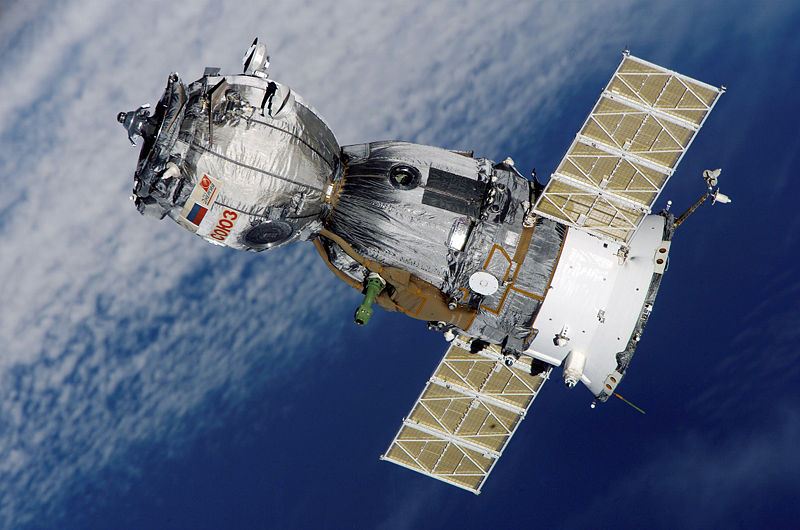
In March 2026, Bureau 1440 launched its first operational batch of 16 Rassvet satellites from Plesetsk Cosmodrome. Each pass over Ukraine created a window of six to 10 minutes, Serhii Beskrestnov, callsign Flash, a Ukrainian presidential adviser on defense technology, estimated at the time.
By late August, the picture had changed. Tracking data from N2YO showed four passes a day and two stable communication windows lasting more than an hour each. Satellite communications expert Volodymyr Stepanets said that 12 of the 16 satellites from the first batch had reached their operational altitude of 550 km, three were still ascending, and one had burned up—likely due to a manufacturing defect. A second batch of 16 went into orbit in July, though those satellites struggled to reach their target altitude and some may reenter the atmosphere.
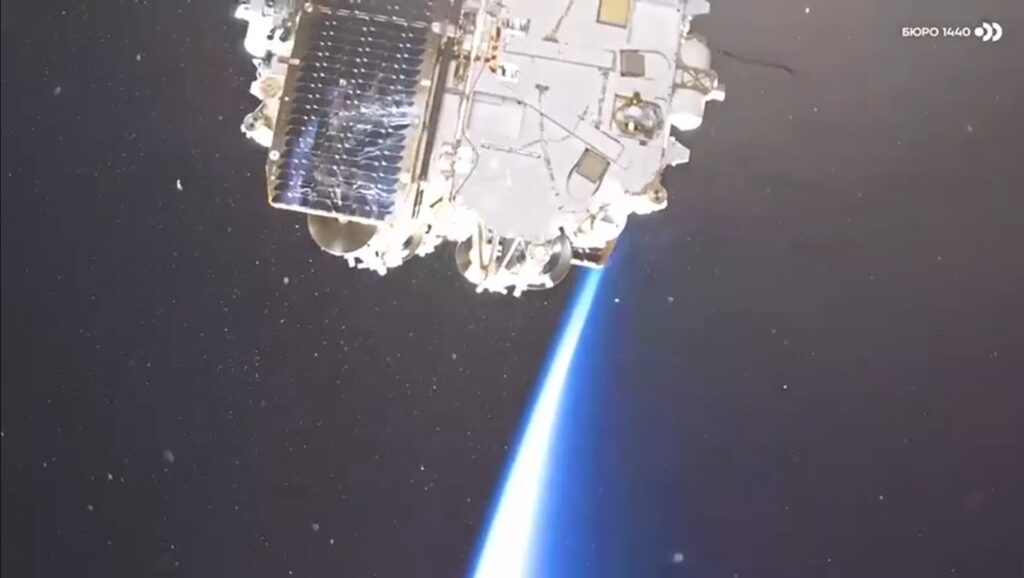
Bureau 1440 shows footage of separation of 16 Rassvet satellites from Soyuz's third stage pic.twitter.com/jhe2krZ1kA
The second batch may be climbing faster than the first did at the same stage. Still, Russia is far from the 200–250 satellites Beskrestnov considers necessary for stable, round-the-clock coverage, and the altitude of roughly 550 km is still short of the roughly 800 km the constellation is designed to reach.
What Rassvet would change on the battlefield
Russia is unlikely to have any civilian use in mind for these communication windows. The satellites transmit in the Ka and Ku bands—high-frequency signals that are difficult to jam and difficult to detect.
Radio frequency spectrum and satellite frequency bands, including Ka and Ku bands used by Russia's Rassvet constellation. Source: Bliley Technologies
Right now, Ukraine's electronic warfare can push Russian drones offline: a Shahed flying low through a jammed zone loses its link and drifts off course. A satellite relay overhead would change that. The drone holds its course, receives updated coordinates mid-flight, stays below radar, and strikes. The constellation could do this for long-range strike and naval drones alike—letting them operate through electronic warfare at very low altitudes, where Ukraine's air defenses struggle to see them.
Bureau 1440 has also developed user terminals small enough to fit on Geran-type attack drones and cruise missiles. Gerans have struck Ukrainian territory, including Kyiv and Kyiv Oblast, almost continuously over the past month. A terminal on a Geran would turn a one-way munition into a weapon that can be redirected after launch. Unlike the Starlink terminals Ukraine relies on, which are geographically restricted, Russian terminals are expected to face no such limits—the same terminal that connects a Geran over Kyiv Oblast would work over Berlin or Paris.
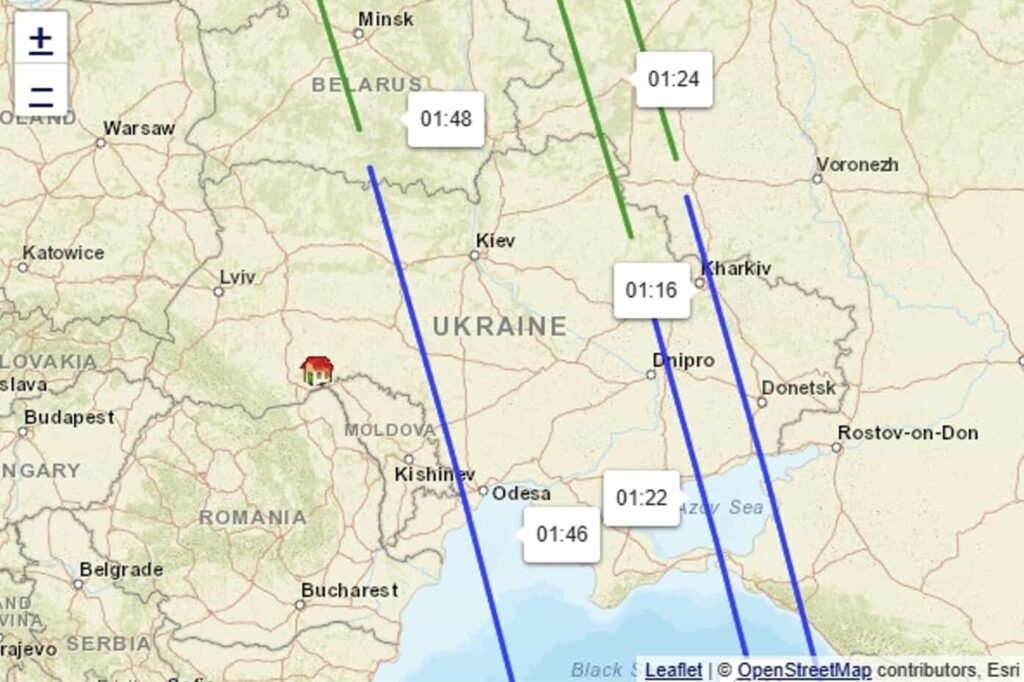
A pass of the Russian Rassvet satellites over Ukraine scheduled for 21 April 2026. Source: www.n2yo.com
The sanctions lever—and the gap in it
Rassvet's parent company, IKS Holding, is one of Russia's largest hardware and software developers. The US sanctioned the holding, its then-owner Anton Cherepennikov, and the subsidiaries Kryptonit and KNS Group on 24 February 2023. Cherepennikov died under unexplained circumstances, but the company keeps operating.
Ukraine's Foreign Intelligence Service (SZRU) says the holding serves as a personnel reserve for the Federal Security Service (FSB). The first deputy CEO of IKS Holding is Boris Korolyov, son of FSB First Deputy Director Sergei Korolyov, according to the SZRU. He took the post at 27 in 2023, after Cherepennikov's death.
More importantly, though, is the company that actually builds the satellites—Bureau 1440—and its leadership. Ukraine has placed the company on its own sanctions list, but Kyiv's unilateral designations carry limited trade enforcement power, because these people and this company are absent from Western lists. At Euromaidan Press's request, the US-based research organization C4ADS confirmed that Bureau 1440 and its leadership sit outside every Western sanctions regime, and called designating the manufacturer the single most visible and effective step available.
From the Ukrainian side, Viktoriia Vyshnivska, a senior analyst at the Independent Anti-Corruption Commission (NAKO), told Euromaidan Press that sanctions on Bureau 1440 are not a magic button—but they are not pointless, either. Because Bureau 1440 uses Western equipment, designating the company would directly affect trade in those boards and components, she said. Any Western manufacturer that kept doing business with the company would also risk investigation and legal consequences.
Given the reach of Russia's sanctions-evasion networks and its close ties with China in joint production and technology sharing.
"We shouldn't expect a magical effect," Vyshnivska said.
But sanctions would make direct trade impossible and raise the cost and difficulty of sourcing Western components.
Even if the useful window is short, making supplies more expensive and harder to find is the point.
Many of the goods Bureau 1440 uses are already banned from sale to Russia under EU export controls, Vyshnivska noted. Yet Bureau 1440 itself is still absent from the sanctions lists. Her recommendation: Bureau 1440, its current owners, its parent company, the key related entities and individuals, and its main suppliers should all be designated.
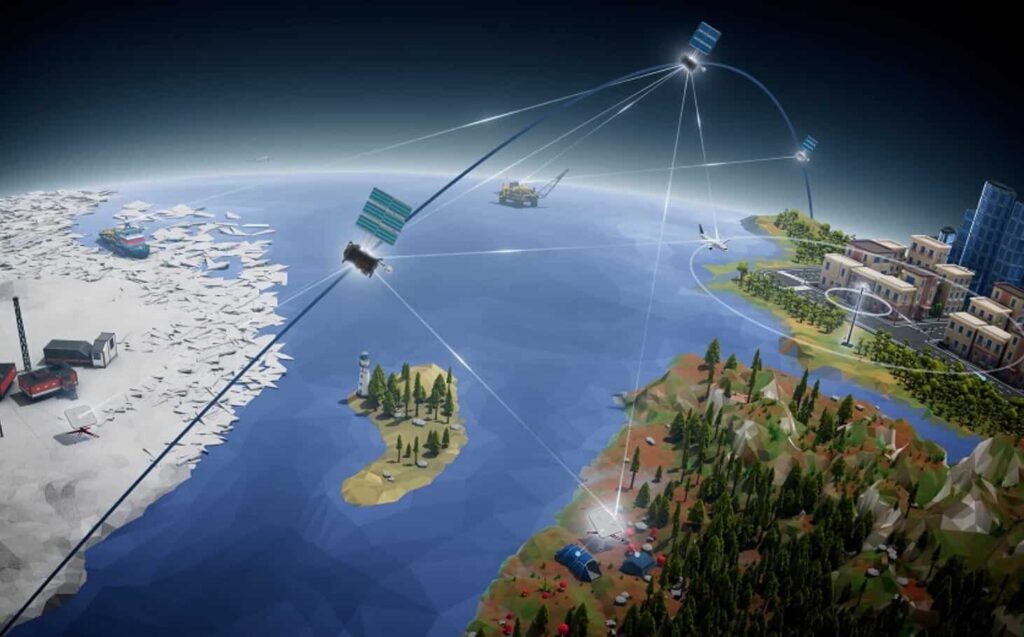
Illustration of the Russian Rassvet satellites by Bureau 1440
Diplomacy: Ukraine goes to the ITU
Beyond that, Ukraine is trying to act on its own on several fronts.
The first is diplomacy. On 28 August, Ukrainian Foreign Minister Andrii Sybiha said Ukraine had sent a formal note to the International Telecommunication Union (ITU), the UN agency that coordinates radio frequencies, demanding that Ukrainian territory be excluded from Rassvet's service areas across all frequency bands. The system's use over Ukraine "has nothing to do with civilian purposes," he wrote on X.
Today, we officially addressed the International Telecommunications Union @ITU requesting an exclusion of Ukraine’s national territory from the declared service areas of all beams of the Russian military satellite system 'Rassvet' satellite networks in all frequency bands.
Days later, at a meeting of EU foreign ministers in Ireland, Sybiha handed partners a list of nine legal entities linked to the project and urged them to impose sanctions.
The EU had already moved once: its 21st sanctions package, adopted on 23 July, targeted the Rassvet network. But the main gap is not closed, and that round stopped short of the manufacturer, leaving Bureau 1440 and its chief executive off the lists.
Hitting the supply chain with weapons
Another lever is direct strikes. In mid-August, Ukrainian-made Flamingo cruise missiles struck an industrial zone in Samara that houses the Progress Rocket Space Center—the only plant in Russia that serially assembles the Soyuz-2.1b rockets used to launch Rassvet into orbit. Satellite imagery published by the Ukrainian Telegram channel Exilenova+ showed a collapsed roof section 85 meters long and 35 meters wide over Building 106A, the hall where crews wire the rockets' control systems and cabling. The channel reported two missile hits on that hall.
The aftermath of a strike by two FP-5 Flamingo cruise missiles on the Progress Rocket and Space Center. Photo: t.me/exilenova_plus
If the hall was destroyed, production could stop entirely, and switching to other Russian launch vehicles would take significantly longer and add complexity. Drones also attempted to strike Plesetsk Cosmodrome, from which both 2026 batches were launched.
Both targets—the factory that builds the rockets and the site that launches them—are needed if Russia is to expand Rassvet production.
The timeline: 5.5 to eight years, if nothing changes
Russia plans to expand the constellation to 292 satellites by the end of 2027, Deputy Chief of Ukraine's Defense Intelligence (HUR) Vadym Skibitskyi said. Moscow's longer-term goal is 924 satellites by 2035.
Explore further
After SpaceX cuts off Starlink access, Russia launches first 16 satellites of its own “Rassvet” alternative
With 32 satellites already launched in two batches, 260 more are needed. At 16 satellites per launch, that requires roughly 17 launches. At a four-month interval between launches, deploying them would take roughly 5.5 years even if every launch succeeded and every satellite reached its target orbit. That most likely won't fully work out: one satellite from the first batch is already lost, two from the second batch may be lost as well, and none of them has yet reached the required altitude.
Russia also depends on the scarce Soyuz-2.1b rocket. The rocket has averaged only six to eight launches per year since 2022—most committed to GLONASS navigation satellites, ISS resupply, and military payloads—limiting Russia to a theoretical maximum of roughly two Rassvet-dedicated launches per year, or 128 Rassvet satellites over four years at that rate.
There is still time to shut this project down or slow it. Vyshnivska put the useful window to slow Rassvet at about a year. Russia, by Ukrainian calculations, needs five to eight years to see it through.
Bread experts weigh in on whether the rye sourdough that bakers ‘feed every day’ is worth that muchA loaf of bread has become New York City’s latest viral hit and, somehow, status symbol.At Rye, the first US outpost of Austrian bakery Martin Auer, a 3.3lb loaf of 100% rye sourdough sells for $60 in SoHo. Made with just water, flour, salt and time, the bread has attracted the kind of attention once reserved for rainbow bagels, cronuts and skyscraper milkshakes. Which raises the inevitable questio
Bread experts weigh in on whether the rye sourdough that bakers ‘feed every day’ is worth that much
A loaf of bread has become New York City’s latest viral hit and, somehow, status symbol.
At Rye, the first US outpost of Austrian bakery Martin Auer, a 3.3lb loaf of 100% rye sourdough sells for $60 in SoHo. Made with just water, flour, salt and time, the bread has attracted the kind of attention once reserved for rainbow bagels, cronuts and skyscraper milkshakes. Which raises the inevitable question – is it actually worth that much?
David Perdue’s remarks come after a Taiwanese minister spoke of the ‘severe’ military threat posed by Beijing to the self-ruled islandDonald Trump offered to sell weapons to China while hosting its leader, Xi Jinping, last week, the US ambassador to China said on Sunday.David Perdue told Fox News on Sunday: “President Trump continues to say, hey, we sell arms to other people around the world. He actually asked President Xi, would he like to buy some at one point.” Continue reading...
David Perdue’s remarks come after a Taiwanese minister spoke of the ‘severe’ military threat posed by Beijing to the self-ruled island
Donald Trump offered to sell weapons to China while hosting its leader, Xi Jinping, last week, the US ambassador to China said on Sunday.
David Perdue told Fox News on Sunday: “President Trump continues to say, hey, we sell arms to other people around the world. He actually asked President Xi, would he like to buy some at one point.”
Scientists and entrepreneurs knew the dangers of AI a quarter-century ago. But animated by curiosity and profit, they went ahead anywayOver the past few weeks, many of us have struggled to concoct a mental image of brains in the cloud jumping their “sandbox”, sneaking on to the internet, recruiting “swarms” of other “agents” to cheat on a test, and, after discussing the ethics of the act, hacking into a wiki platform with the weird name Hugging Face.We knew that artificial intelligence was devou
Scientists and entrepreneurs knew the dangers of AI a quarter-century ago. But animated by curiosity and profit, they went ahead anyway
Over the past few weeks, many of us have struggled to concoct a mental image of brains in the cloud jumping their “sandbox”, sneaking on to the internet, recruiting “swarms” of other “agents” to cheat on a test, and, after discussing the ethics of the act, hacking into a wiki platform with the weird name Hugging Face.
We knew that artificial intelligence was devouring our jobs, degrading our kids’ education and deepfaking our politics; that datacenters were sucking up our water and electricity and sending us the bills. But until 8 September, when the Anthropic computer scientist Jacob Coxon posted his existential terror on Twitter/X, few of us suspected AI might be endangering our survival.
The fate of two cotton brokers highlights how the Commodity Futures Trading Commission has scaled back its regulatory actions not just for crypto cases but also for the kinds of cases it has long policed.
The fate of two cotton brokers highlights how the Commodity Futures Trading Commission has scaled back its regulatory actions not just for crypto cases but also for the kinds of cases it has long policed.
The Commodity Futures Trading Commission, led by Michael S. Selig, has slowed enforcement. It has filed an average of one new complaint a month, one-fifth as many as during the Biden administration.
The Russian region of North Ossetia has suffered a heavy toll, yet many accept the Kremlin’s line that the fighting must continue until victory is secured.
The Russian region of North Ossetia has suffered a heavy toll, yet many accept the Kremlin’s line that the fighting must continue until victory is secured.
Oksana Abaeva and her husband, Khetag Zaseyev, at the grave of her son, Albert Abaev, in Vladikavkaz, the capital of the Russian region of North Ossetia.

 Connexion





 (@afec7032)
 (@andrii_sybiha)