❌

Vue normale

Year ago, only 12 Ukrainian brigades could order weapons online. Now, 500 units participate in revolutionary program that has delivered 1.3 million drones to front
23 septembre 2026 à 14:11

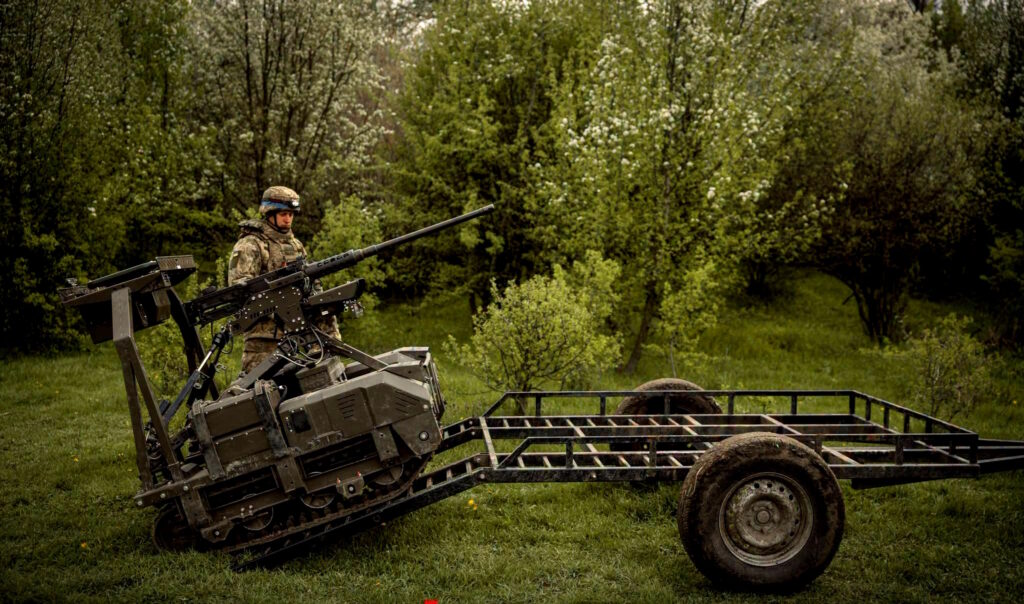
The image shows a Ukrainian soldier standing next to an unmanned ground robotic vehicle. Source: The General Staff

A year ago, 12 Ukrainian brigades could order their own weapons off a state marketplace. Now, more than 500 units can. DOT-Chain Defense, which lets frontline units order necessary supplies using state funds or bonuses with just a few clicks, has scaled across most of Ukraine's Defense Forces, the Defense Ministry said.

The platform is the delivery backbone of Ukraine's soldier-led procurement revolution. It lies in a shift in the philosophy of defense procurement. Ukraine is abandoning the Soviet principle of "fight with whatever is handed down from above" and transitioning to a market-based model that centers on the choice of the individual soldier.

Over its first year, it has put more than 1.3 million drones and other systems into units' hands, worth about $1.9 billion, and the orders show what this war runs on: 84 percent are drones, with electronic-warfare gear and ground robots making up most of the rest. It is also the engine behind the points-for-kills system that lets units bank credit for battlefield results and spend it on their own equipment.

Access jumps from 12 to 500 units

The growth has been steep. DOT-Chain Defense is now used by combat units across the armed forces, the National Guard, the border and special transport services, the police, the Security Service, and Defense Intelligence, says Deputy Defense Minister Mstyslav Banik.

Assault regiments and the "Drone Line" project have joined, ordering unmanned systems to their own specifications.

Drones dominate the orders

By the ministry's count, electronic-warfare systems make up 8.6 percent of everything ordered, ground robotic complexes 7.2 percent, and ammunition a sliver at 0.2 percent.

The gear, worth about $1.9 billion, came both through direct marketplace purchases and through the "Army of Drones. Bonus" program, the points system tied to the same platform.

The US copies the model

The approach has drawn imitators. The US has launched its own Amazon-style marketplace for military drones, explicitly modeled on Ukraine's Brave1 Market and DOT-Chain Defense. For Ukraine, the payoff is data: a running record of which weapons work on which part of the front, which the state uses to scale up what performs.

Russia is mapping everyday targets across Kyiv, from trolleybus depots to Zhuliany airport, top monitoring channel says, ahead of next ballistic strike

23 septembre 2026 à 13:21

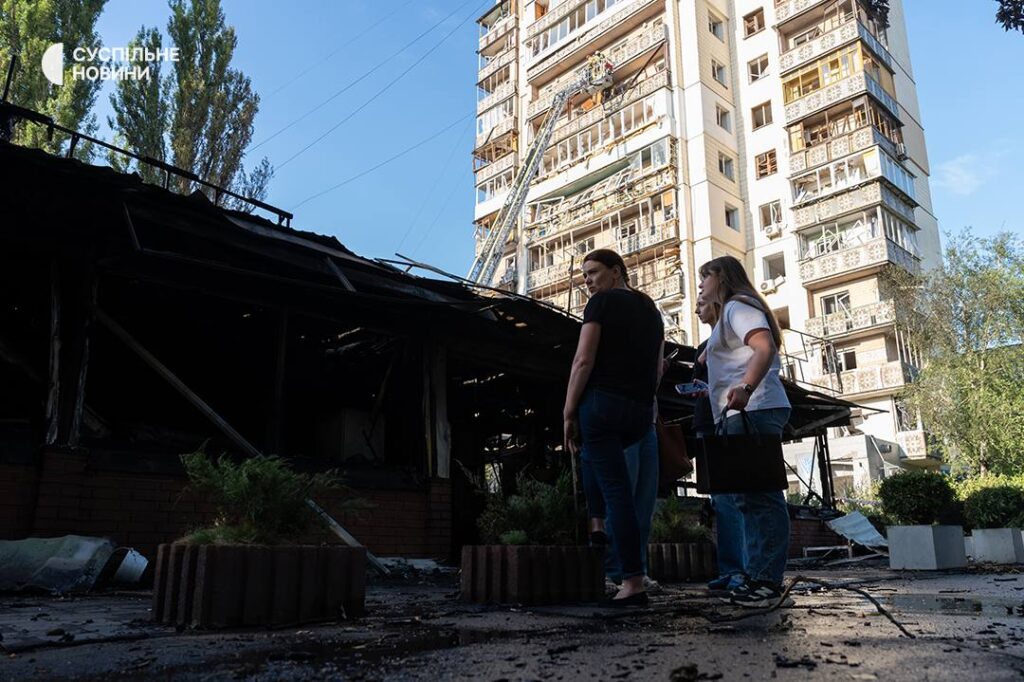
Aftermath of a massive Russian ballistic missile attack in Kyiv's Lukianivka district, 19 July 2026. Photo: Suspilne

Russia is scouting Kyiv and the surrounding region for its next targets, from power substations and railways to hypermarkets and airports. Nikolaievsky Vaniok, a major Ukrainian monitoring channel, says Russian aerial reconnaissance has been mapping specific sites across the capital and Kyiv Oblast, and a national-security official warns that a ballistic strike is being prepared.

The reported scouting fits Russia's pattern of taking apart Ukraine's power and civilian infrastructure as winter nears, with Moscow switching to terror or rear as its tactics of the war.

Signs of preparation are present

Andrii Kovalenko, who heads the National Security Council's Center for Countering Disinformation, has also confirmed Russia is preparing a ballistic strike, with signs of the preparation visible, while its diplomats stall on any real step toward a ceasefire.

Ballistics are the threat Ukraine's air defenses struggle most to stop: in a recent attack on Kyiv's water system, not one of Russia's ballistic missiles was intercepted.

"The enemy is preparing a ballistic strike. Signs of preparation are present," he wrote, adding the warning to "be attentive in the coming days."

The scouting maps the everyday

Nikolaievsky Vaniok, which tracks Russian air activity, says the reconnaissance had lingered over the capital's ordinary machinery.

In Kyiv, it listed traction substations and other rail infrastructure, an Auchan hypermarket and similar stores in the Obolon district, power substations across several districts, a trolleybus depot, and Zhuliany airport.

In Kyiv Oblast, there are substations near Bucha and Irpin, many more that feed the railways, possible fuel depots near Borodianka and in the Bila Tserkva district, and the airfield at Vasylkiv. The account could not be independently verified.

Jet-drone defenses run late

Ukraine is racing to build a large-scale defense against jet-powered drones, the fast Gerans that have strained Kyiv's air cover, but the channel's administrator said the work was moving at "its own pace".

"If we manage a proper counter before winter, that will be very lucky," he added.

He swore to defend Ukraine, then switched to Russia when it seized Crimea. Twelve years later, Ukrainian FPV drone found him commanding Russian regiment

23 septembre 2026 à 13:06

Colonel Oleksandr Isaiev. Source: the Book of Executioners, a Ukrainian government project documenting Russian war crimes

Ukraine has taken out a Russian artillery regiment commander in Kherson who was once a Ukrainian naval officer and who betrayed his country in 2014. Colonel Oleksandr Isaiev, a Mykolaiv native who defected to Russia during the seizure of Crimea and rose to command Russia's 8th Artillery Regiment, was killed by a Ukrainian FPV drone on 19 September, the Book of Executioners, a Ukrainian government project documenting Russian war crimes, said.

Isaiev's death, if confirmed, closes a decade-long arc of betrayal. The Ukrainian citizen, who served in Ukraine's military from 1992, defected while serving as a senior officer in Ukraine's coastal artillery, joined Russia's Black Sea Fleet, and by 2024 was commanding a Russian regiment that shelled the country he had sworn to defend.

A drone finds the commander

The regiment Isaiev led, military unit 87714, operated on the coastal tactical axis in southern Ukraine as part of Russia's "Dnepr" grouping, the project said. An FPV drone, the small first-person-view aircraft that now dominates the front, struck him in Kherson Oblast on 19 September. The project provided no further details on the location, time, or circumstances of the strike.

The betrayal dates to Crimea

Isaiev was by 2014 chief of staff and first deputy commander of the 406th Separate Coastal Artillery Brigade in Ukraine's navy.

When Russia seized Crimea that year, he switched sides, in what Ukraine calls high treason, and took a post as chief of staff and deputy commander of the same 8th Artillery Regiment on the Russian side.

Discharged to the reserve in 2015, he returned to Russian service in October 2022 to join the war against Ukraine, and in September 2024 was made the regiment's commander and promoted to colonel.

A database keeps the list

The Book of Executioners is Ukraine's public register of those it accuses of crimes against the country, and it closed its report on Isaiev with a standing vow: every war crime will be investigated, every war criminal identified, found, and, in time, punished.

Ukraine’s Vivaldi counteroffensive near Lyman just got help from behind Russian lines: partisans say they cut rail supply to three Russian regiments, no explosion needed

23 septembre 2026 à 10:54

ATESH partisan Footage of a fire on a relay cabinet at the Bataysk railway junction, near Rostov-On-Don, Russia, 21 December 2025. Screenshot from video: ATESH

Ukrainian partisans say they have sabotaged the railway signaling that keeps Russian troops supplied on the Lyman front. The ATESH movement reports that its agents disabled four relay cabinets on a line through Voronezh Oblast that carries military cargo to Russian forces there, delaying ammunition to three regiments.

The strike was timed to help Ukraine's Operation Vivaldi, the counteroffensive the Third Army Corps is running near Lyman in northern Donetsk. In its first phase, the operation cleared 75 square kilometers of Russian infiltrators and de-occupied another 10.

Cutting the rail line that feeds the Russian units facing that offensive is, by ATESH's account, part of the same fight, targeting the supply line rather than the front.

Four cabinets go dark

The sabotage hit a rail corridor running through the Voronezh, Novovoronezh, Liski, and Ostrogozhsk areas of Voronezh Oblast, a route ATESH says Russia uses to move military cargo toward the Lyman axis.

Relay cabinets house the switching gear that runs a line's automatic signals. Knocking them out can freeze traffic on a stretch of track without a single explosion, and ATESH says its agents disabled four of them. As with the movement's other claims, the account could not be independently verified.

Ammunition backs up

By ATESH's telling, the signaling failure delayed shipments of ammunition and engineering materiel to the 1st and 15th Guards regiments and the 254th Motor Rifle Regiment. Russian commanders, it said, had to rush in repair crews and divert resources to guard the infrastructure. A delayed shipment, far behind the front, can be felt at it, where an assaulted position waits for the ammunition that does not arrive.

ATESH hunts the supply lines

ATESH is a network of pro-Ukrainian agents operating inside Russia and Russian-occupied territory, and it has increasingly gone after the rail and power infrastructure that sustains Moscow's war. This month, the group also said it knocked out the power supply of a plant in Voronezh that makes components for Russian missiles.

Ukraine’s new drone ferries FPV drones deep behind Russian lines and releases them there. It costs about $9,900 and does three other jobs too

23 septembre 2026 à 10:38

Kara, Ukraine's new drone ferries FPV drones deep behind Russian lines. Source: Defender Media

A Ukrainian company has disclosed a small aircraft that can bomb a target, relay radio signals, carry FPV drones behind enemy lines, or strike on its own. The KARA, a fixed-wing drone made by Ukrskytechnology, is listed on Ukraine's state Brave1 Market in three tiers, from a bare airframe to a ready-to-fly aircraft, Defender Media reported.

One airframe does the work of several, and it goes for some $9,900. The marketplace it sits on, Brave1 Market, has processed more than $235 million in orders, lists over a thousand products, and lets frontline units buy gear even before a weapon clears formal codification.

One airframe does four jobs

What the KARA does depends on how it is kitted out. Fitted one way, it drops cargo; another, it works as a signal repeater to extend a unit's radio reach; another, it ferries FPV drones deep into the enemy rear to be released; and another, it carries out strikes itself. Buyers choose among an empty glider they equip themselves, a Plug-N-Play version with basic electronics installed, and a Ready-To-Fly model.

The drone flies light and far

The specifications are modest but flexible, according to Ukrskytechnology. The KARA has a tactical radius of 70 kilometers, and a stated endurance of 2.5 hours, cruises at 90 kilometers per hour and tops out at 120, and works at 200 meters but can climb to 3,000.

It runs on either an electric motor or a combustion engine, and carries two payload blocks of up to three kilograms each under the wing. Launched by catapult and landing like a plane, it takes 10 minutes to set up.

The marketplace lists it now

The KARA is being prepared for codification, the formal approval that clears a weapon for standard state procurement, but it does not have to wait for that to reach the front. Brave1 Market was built precisely so that units can buy proven kit fast, without waiting on the slow pipelines of the past, and the KARA is already there for the price of a used car.

❌