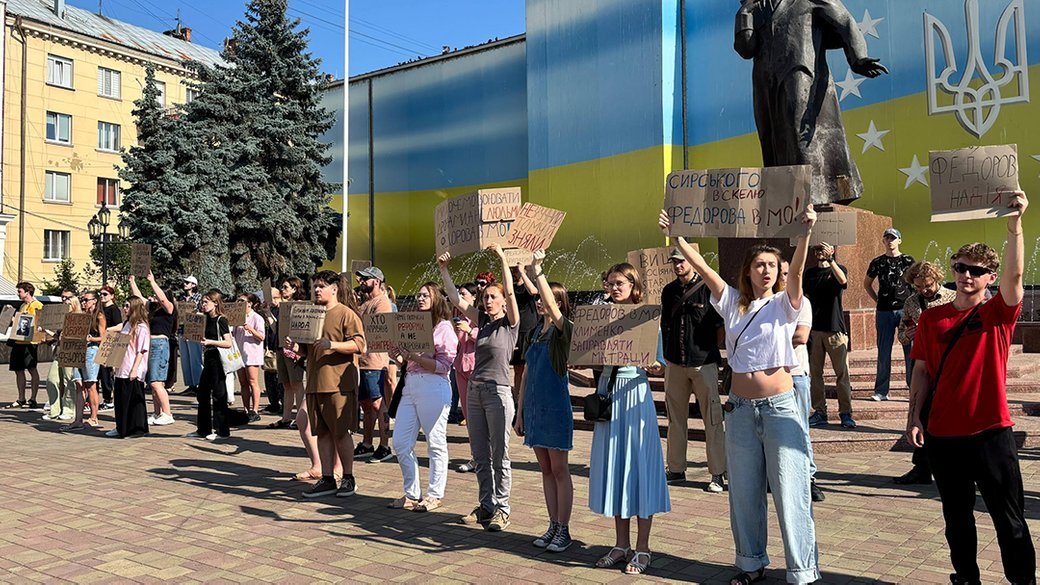
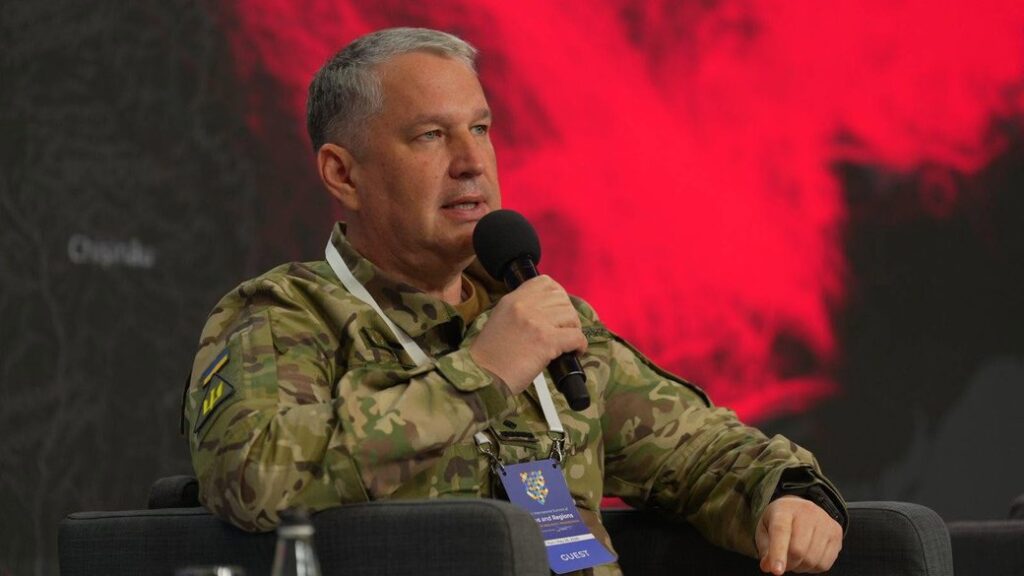
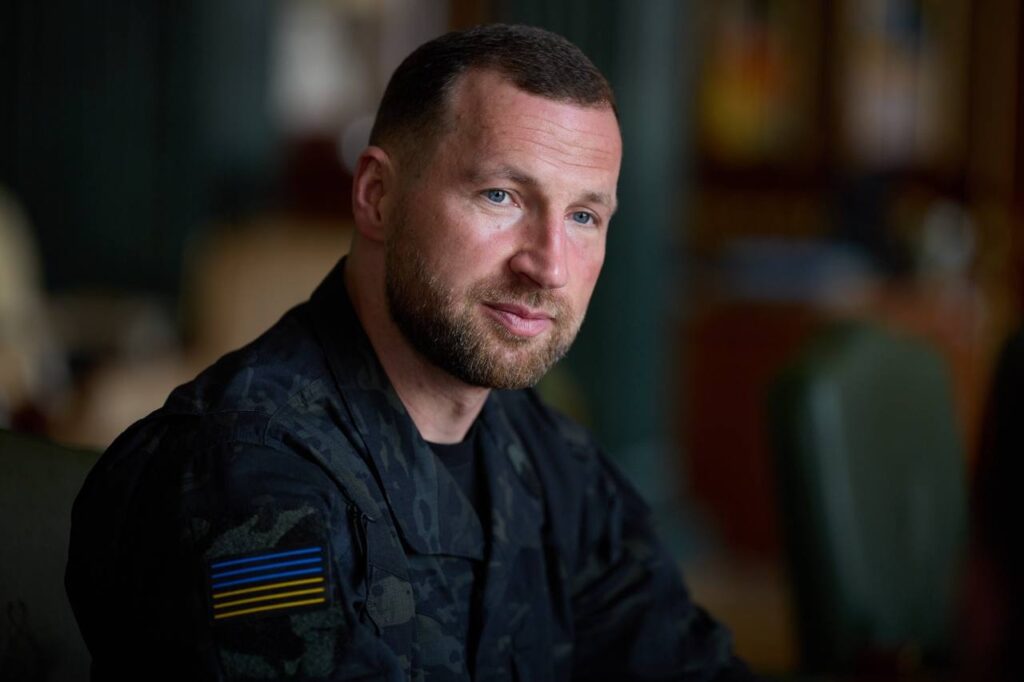
Ukraine’s President Volodymyr Zelenskyy told the crowds demanding the return of dismissed Defense Minister Mykhailo Fedorov that they were right to protest even during the war—then pressed ahead anyway, naming his special operations chief Yevhenii Khmara acting defense minister and passing over both Fedorov and Interior Minister Ihor Klymenko, the reported frontrunner.
Explore further
Ukraine’s President Volodymyr Zelenskyy told the crowds demanding the return of dismissed Defense Minister Mykhailo Fedorov that they were right to protest even during the war—then pressed ahead anyway, naming his special operations chief Yevhenii Khmara acting defense minister and passing over both Fedorov and Interior Minister Ihor Klymenko, the reported frontrunner.
Explore further
“Cardboard” protests against Zelenskyy’s firing of Fedorov erupt across Ukraine
It was the second time in a year that street protests have thrown one of Zelenskyy’s decisions into doubt. Last July, a week of rallies forced him to reverse a law stripping Ukraine’s anti-corruption agencies of their independence. He called his own answer an ellipsis rather than a full stop and said Fedorov would remain on his team in a role to be named later, he told a briefing reported by Ukrainska Pravda.
At the briefing, Zelenskyy floated Interior Minister Ihor Klymenko as the man who could stop it.
The president tied the incoming minister’s first task to ending “busification”—recruitment officers seizing men in public and bundling them into minibuses bound for enlistment offices. At the briefing, he floated Interior Minister Ihor Klymenko as the man who could stop it. By evening, he had chosen Khmara instead.
The rallies he answered had filled nearly 20 cities that morning, most of the crowds young, and they stayed peaceful.
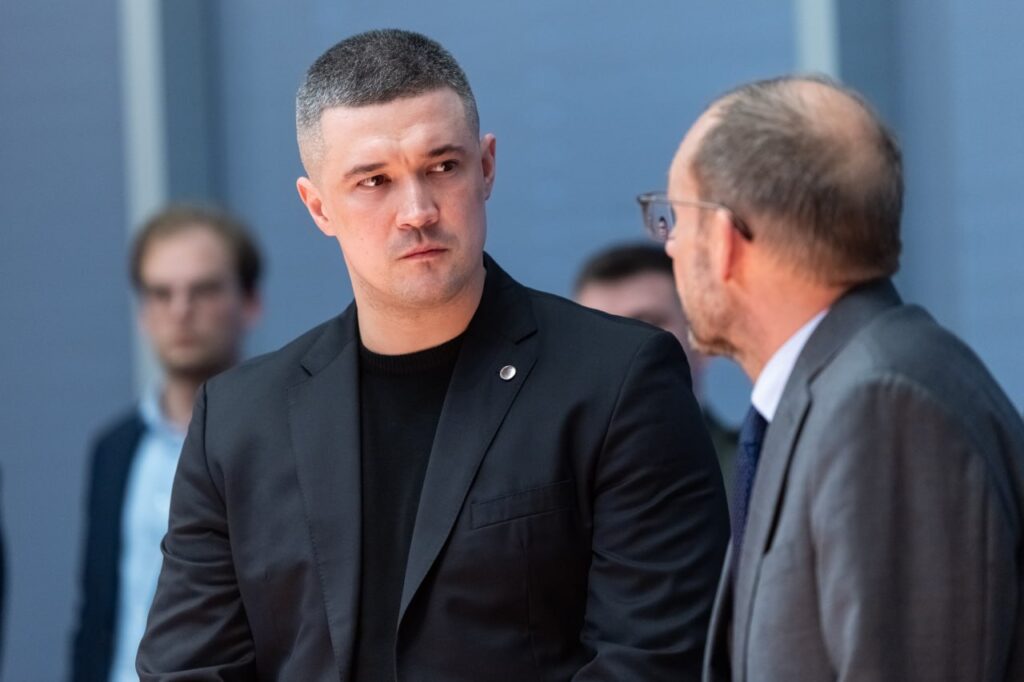
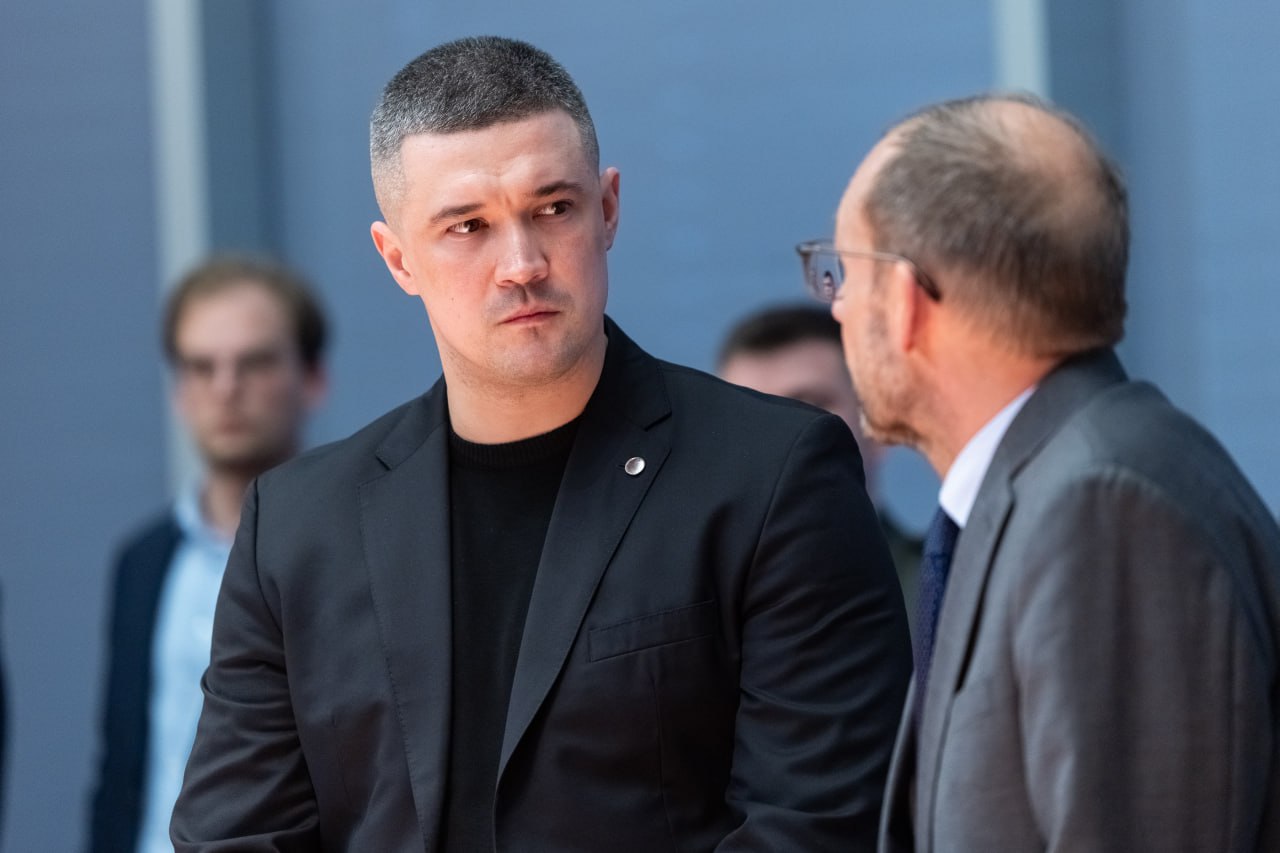
Ukrainian Defense Minister Mykhailo Fedorov in Germany, on 15 April 2026. Source: Fedorov
The man he fired blames the army
Fedorov, in his own farewell briefing hours earlier, argued that no minister can fix mobilization without deeper change within the army, since Ukraine’s recruitment centers answer to the military command rather than the Defense Ministry, as reported by LIGA.net.
Zelenskyy told his party’s faction that Fedorov had botched the recruitment-center reform.
Where leadership and supply already work, he said, the problem disappears—pointing to the National Guard’s 13th “Khartia” brigade, which he said has a waiting list of at least 2,000 foreign volunteers. The state, he added, is selling its recruits lies and chaos.
Explore further
Fedorov breaks his silence: Ukraine’s army chief Syrskyi gave him an ultimatum—then blocked his reforms
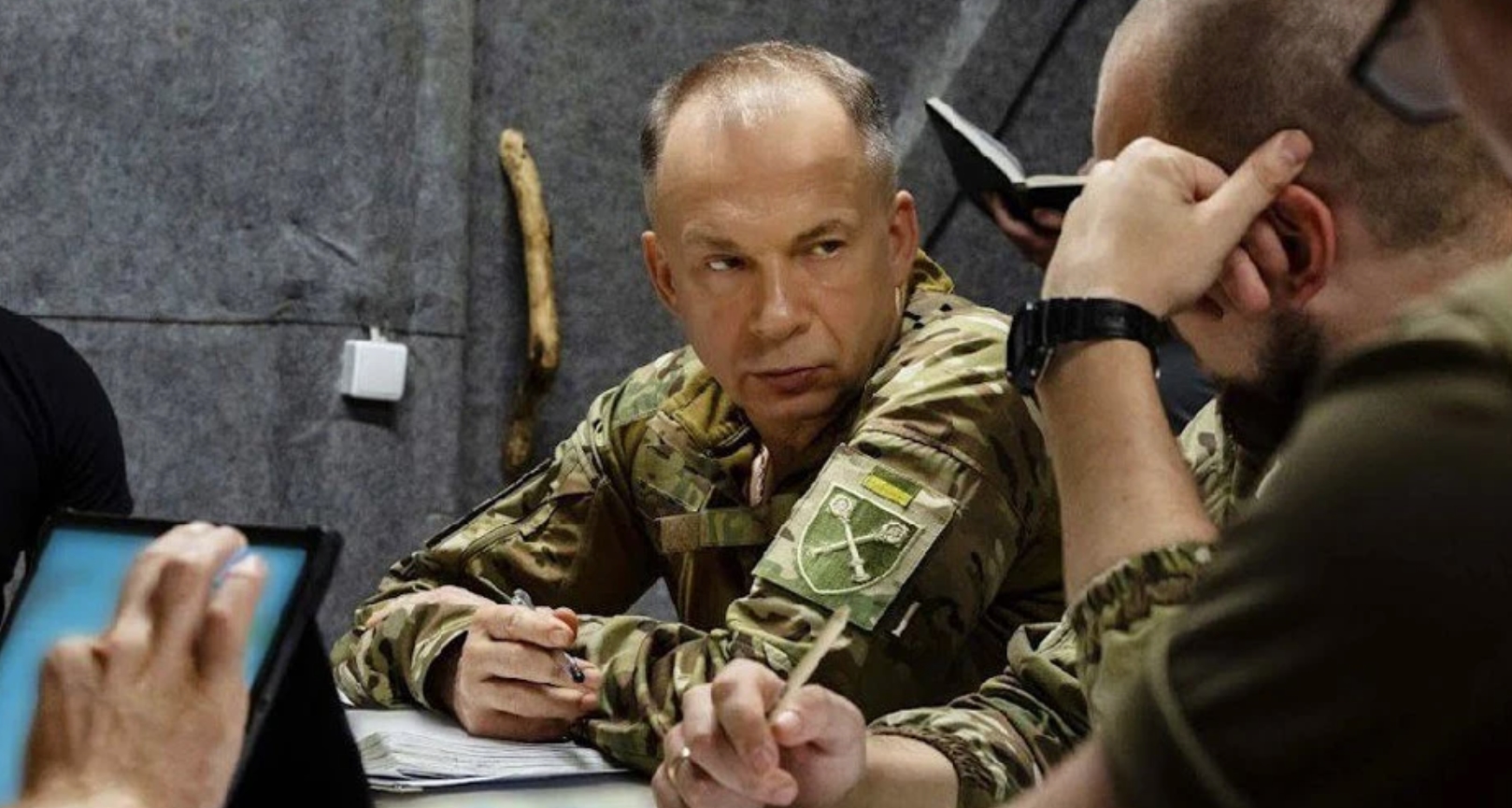
That runs counter to the reason given for his removal. Zelenskyy told his party’s faction that Fedorov had botched the recruitment-center reform and that he could not choose between the minister and Commander-in-Chief Oleksandr Syrskyi, lawmakers said afterward, as Censor.net reported.
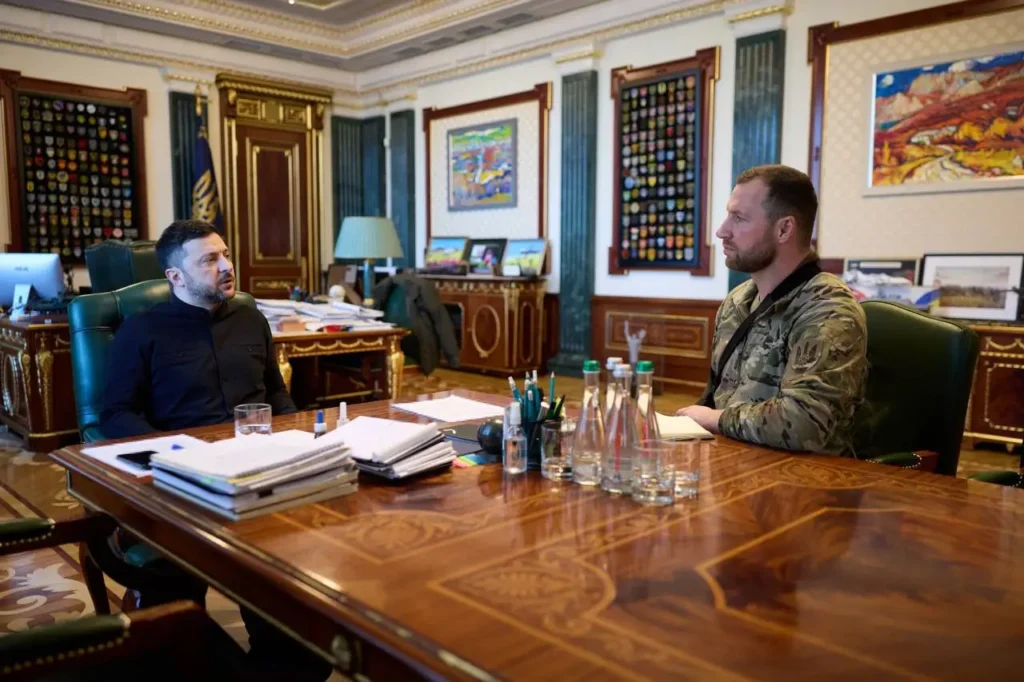
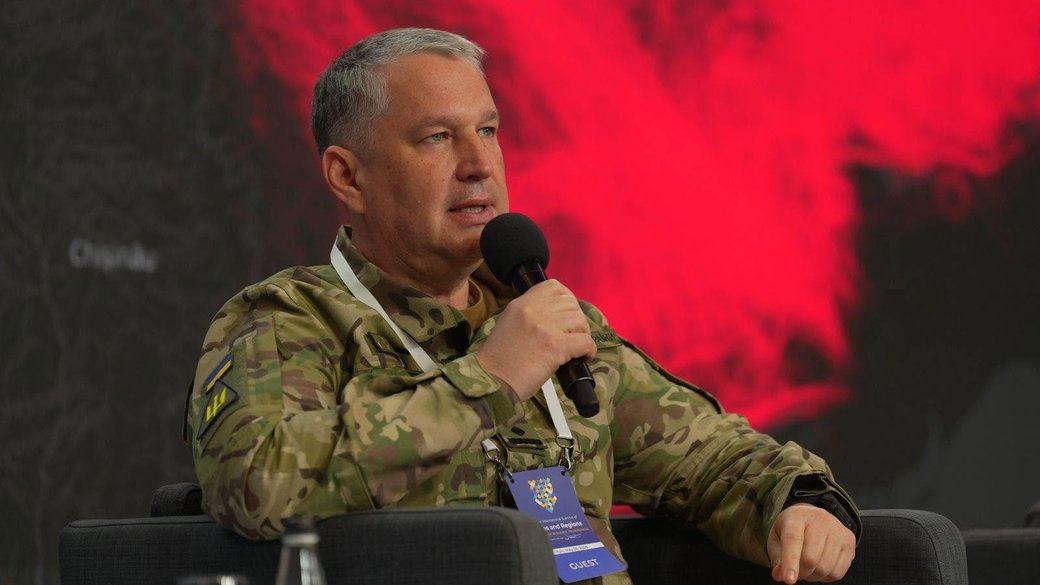
Ukrainian President Zelenskyy (left) meets with Yevhen Khmara after his appointment to lead the SBU during Ukraine's largest wartime reshuffle. 5 January 2025. Photo: Zelenskyy/TB
Zelenskyy turns to his special operations chief
Khmara, whom Zelenskyy had made acting head of the Security Service in January, was told to run the ministry. The president praised his experience directing Ukraine’s long-range strike operations against Russia and said he would ask parliament to confirm him once the legal formalities were done, the president wrote on his official channel.
Parliament has already confirmed a new prime minister, Naftogaz chief Serhii Koretskyi. Khmara’s confirmation is the vote still to come.
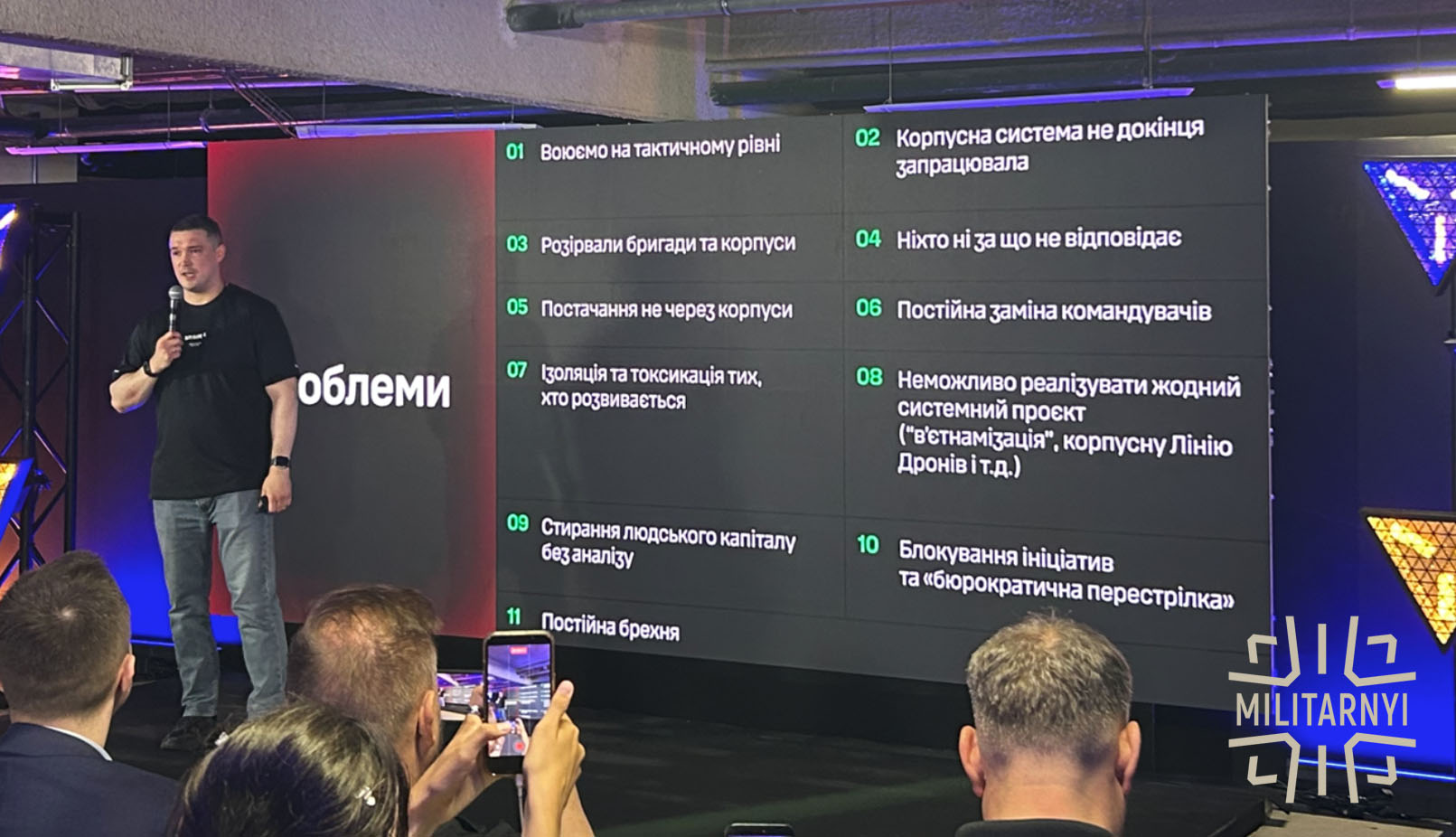
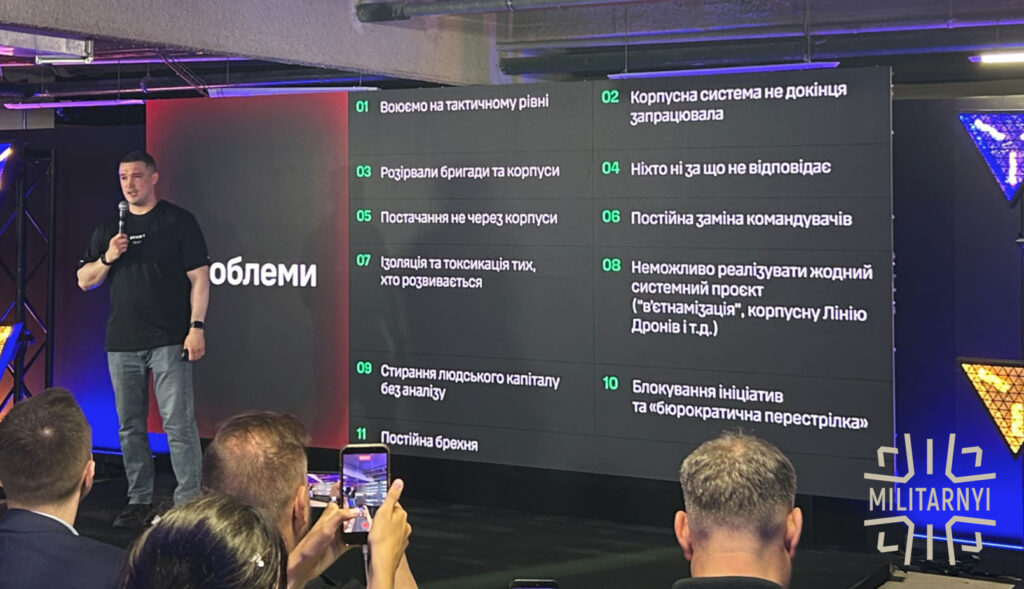
Outgoing Defense Minister Mykhailo Fedorov used a briefing on 16 July to say Ukraine's top military command blocked his reforms and that Commander-in-Chief Oleksandr Syrskyi handed him an ultimatum, Militarnyi reported. He said he had pushed to replace both Syrskyi and General Staff chief Andrii Hnatov, and that the General Staff spent months refusing to sign off on his changes. He spoke a day after confirming he was leaving the post.
Ukraine has spent the war rebuilding it
Outgoing Defense Minister Mykhailo Fedorov used a briefing on 16 July to sayUkraine's top military command blocked his reforms and that Commander-in-Chief Oleksandr Syrskyi handed him an ultimatum, Militarnyi reported. He said he had pushed to replace both Syrskyi and General Staff chief Andrii Hnatov, and that the General Staff spent months refusing to sign off on his changes. He spoke a day after confirming he was leaving the post.
Ukraine has spent the war rebuilding its army around open tenders and a homegrown drone industry, a shift that pits startup-style managers against a traditional command structure over who controls the tools the front now runs on. Fedorov's account lands in the middle of a government shakeup. President Volodymyr Zelenskyy moved this week not to renominate him, with Interior Minister Ihor Klymenko set to take the defense post and Naftogaz chief Serhii Koretskyi approved as prime minister.
Zelenskyy's decision drew a rare wartime backlash: protests broke out in Kyiv and more than a dozen cities, and deputy Air Force commander Pavlo Yelizarov resigned the same day, warning that the firing and the blocking of Fedorov's reforms would "cause numerous casualties and destruction of Ukraine."
Fedorov, credited with building the drone force that reshaped the war, is being replaced mid-reform.
Fedorov said that once Zelenskyy told him he did not plan to dismiss Syrskyi, he accepted it and agreed to work with the general, "because our client is the Ukrainian people." But his ministry's initiatives began to be blocked, he said, and Syrskyi was "not ready to talk about problems personally, to his face."
Explore further
“Cardboard” protests against Zelenskyy’s firing of Fedorov erupt across Ukraine
Instead, the commander preferred to "weave intrigues" and assume someone had ordered a media campaign against him. That is what led Syrskyi to effectively deliver an ultimatum, Fedorov said.
"Instead of figuring out how to defeat Russia asymmetrically, which is the commander-in-chief's task, he figured out how to split the country," he said.
Fedorov stressed he had not set an "either me or Syrskyi" condition and was ready to keep working, and credited Syrskyi with saving the country in 2022. But the war had fully changed since, he argued:
"The drone changes the architecture. The management system has changed, we must change."
Explore further
The Syrskyi feud was not it: why Ukraine really dropped its drone-war minister
Why he wanted the command replaced
Fedorov said he had proposed "radical personnel decisions" — removing both Syrskyi and Hnatov — to fix systemic problems in the army, Liga reported. Ukraine has no other option, he argued, if it wants to beat the enemy asymmetrically and with minimal losses, "where strong leader-commanders will develop, will not be suppressed and written off." He tied the demand to ending abuses in the army, including in the Skelia assault regiment, hit weeks earlier by reports of non-combat deaths in its training centers.
The blocking
The obstruction was concrete, Fedorov said. For six months the General Staff refused to sign the documents needed to change the ministry's structure and create a competence center, citing formal objections and a reluctance to bring in new people.
Explore further
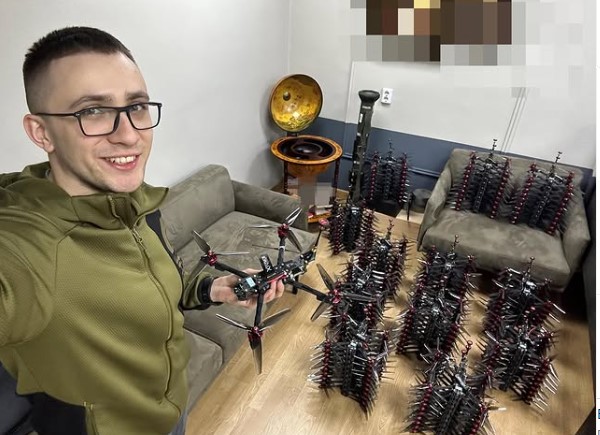
“Our state became further from victory”: Ukraine’s top volunteer, whose fund bought 286,000 FPV Drones, just lost his defense post
The ministry kept improvising around the blocks:
"We always hacked this with some non-standard solutions and continue to do it, but overall it doesn't work if we're talking about a serious system."
Even routine reforms stalled — approving a basic plan to supply brigades with drones took four months, and distribution still ran on loyalty rather than need, he said at the same briefing.
Fedorov also rejected the blame directed at his ministry over mobilization, noting the recruitment centers answer to the commander-in-chief and the General Staff, not to him, Liga reported. There is no fixing mobilization "without a new social contract and without real changes in the army," he said.
President Volodymyr Zelenskyy has removed the defense minister who built Ukraine’s drone war and pushed Elon Musk to cut Russia off from Starlink—Mykhailo Fedorov, a minister whom Ukrainians, in the last national poll, trust more than the president himself. Analysts and anti-corruption campaigners say the entire government was dissolved to make his removal possible without a scandalous vote.
President Volodymyr Zelenskyy has removed the defense minister who built Ukraine’s drone war and pushed Elon Musk to cut Russia off from Starlink—Mykhailo Fedorov, a minister whom Ukrainians, in the last national poll, trust more than the president himself. Analysts and anti-corruption campaigners say the entire government was dissolved to make his removal possible without a scandalous vote.
Explore further
Ukraine’s reformist defense Minister is out after six months. Earlier, his audit exposed $7.2 billion in defense overspending
The move has set off a sharp public backlash, which commentators are comparing to last summer’s anti-corruption protests. A senior air force commander resigned, and cardboard-sign crowds returned to the streets of Kyiv, Lviv, Odesa, and other cities on the morning of 16 July, hours after Russian ballistic missiles killed two people in Kyiv overnight. Parliament is expected to vote on Zelenskyy’s nominee, Interior Minister Ihor Klymenko, later in the day.
By mid-morning, the protests had spread to Ivano-Frankivsk, Kremenchuk, Poltava, Mykolaiv, with crowds in Kyiv chanting “Shame.”
The crowds gathered at the same Kyiv square, beside the Ivan Franko Theatre and in sight of the Office of the President, where they massed a year ago to defend the country’s anti-corruption agencies. This standoff forced Zelenskyy to reverse course within nine days. By mid-morning, the protests had spread to more cities—Ivano-Frankivsk, Kremenchuk, Poltava, Mykolaiv—with crowds in Kyiv chanting “Shame.”
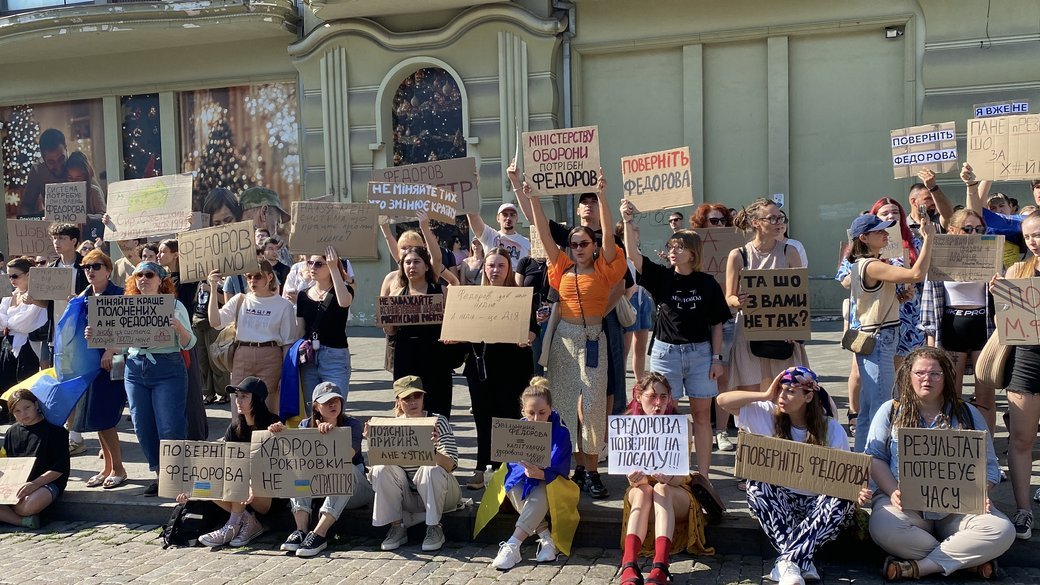
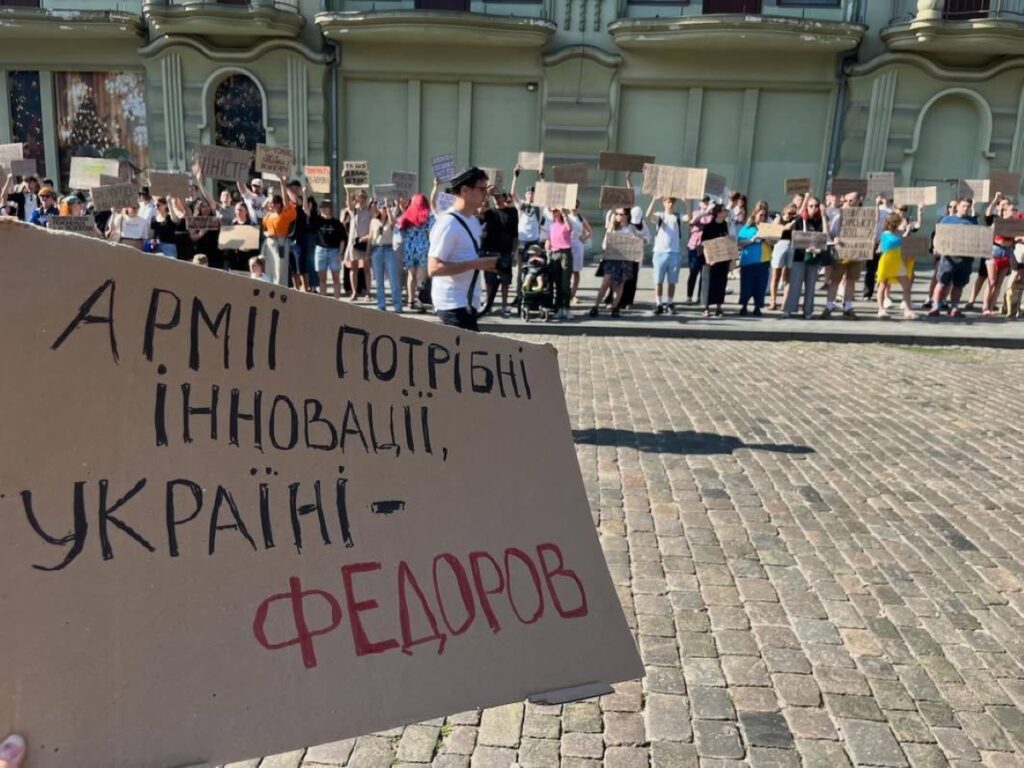
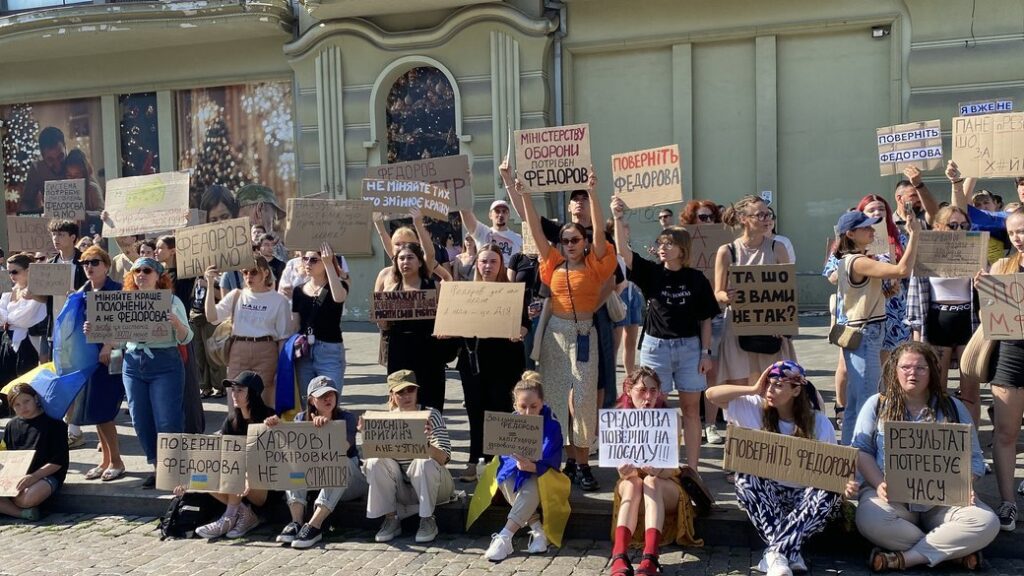
Protesters on Rishelievska Street in Odesa on the morning of 16 July rally against the dismissal of Defense Minister Mykhailo Fedorov, one holding a sign reading “The army needs innovation, Ukraine needs Fedorov.” Photo: Телебачення Торонто / @torontotv
A resignation from inside the air force
Pavlo Yelizarov, a deputy commander of the air force, announced his resignation in protest, saying he had joined the armed forces in 2022 to win the war, not to imitate activity, and warning that stalling Fedorov’s air-defense reforms would let more Russian missiles and drones through. He called the dismissal grave harm to the country’s defense but said he would stay in uniform.
Explore further
Ukraine’s deputy Air Force commander resigns the moment Fedorov loses the ministry
Serhii Sternenko, who advised the ministry on drones, also stepped down.
By the figures Fedorov published in his farewell message, the air force’s interception rate for attack drones rose from 83% to 91% during his six months, and for cruise missiles from 47% to 87%—gains he tied to after-action reviews of each mass Russian strike. His team also ran the Logistics Lockdown program, which is choking Russian resupply to occupied Crimea.
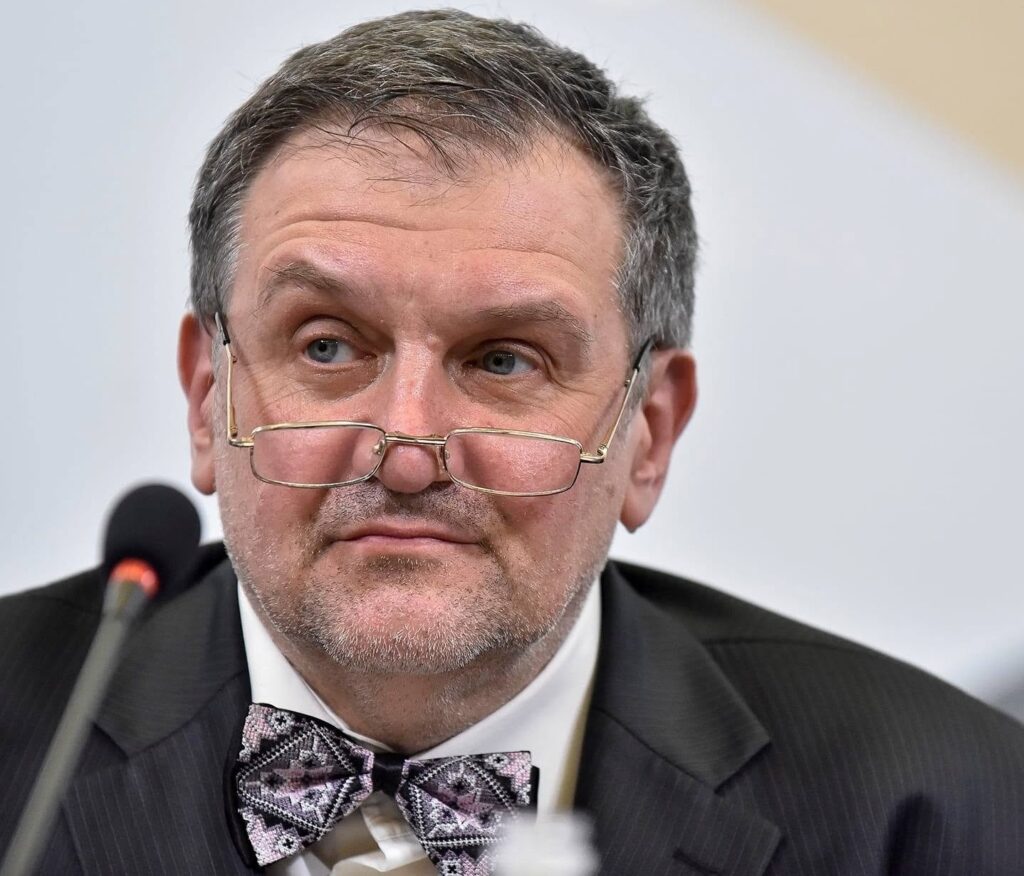
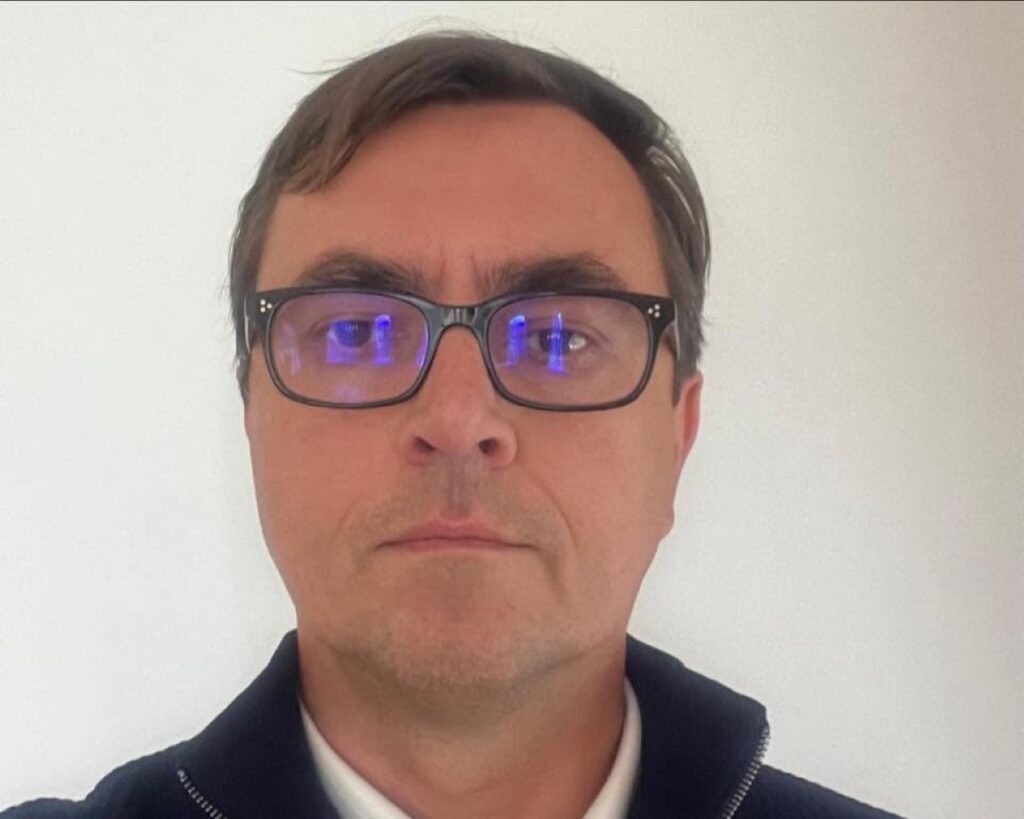
Olexiy Haran, professor of comparative politics at Kyiv-Mohyla Academy and research director at the Ilko Kucheriv Democratic Initiatives Foundation. Photo: Olexiy Haran / Facebook
The minister who outpolled the president
Zelenskyy has cast the decision as a management problem. At a Servant of the People faction meeting on 15 July, he pointed to a running conflict between Fedorov and Commander-in-Chief Oleksandr Syrskyi. He said Fedorov had failed to deliver mobilization reform, according to lawmakers who were there.
The stated reason for dismissing Prime Minister Yulia Svyrydenko—the need for an energy specialist before winter—was unpersuasive.
Olexiy Haran, professor of comparative politics at the National University of Kyiv-Mohyla Academy and research director at the Ilko Kucheriv Democratic Initiatives Foundation, offered Euromaidan Press a different read.
The stated reason for dismissing Prime Minister Yulia Svyrydenko—the need for an energy specialist before winter—was unpersuasive, he said, since outgoing first deputy prime minister and energy minister Denys Shmyhal was already a high-level specialist in the field.
The more convincing explanation lay in Fedorov: dissolving the whole cabinet let Zelenskyy drop him without a targeted dismissal vote that would have drawn a scandal. Anti-corruption campaigner Daria Kaleniuk reached the same conclusion, telling the Kyiv Independent the entire government resignation was conceived to remove Fedorov.
In a recent poll, more Ukrainians trusted Fedorov than distrusted him by a margin of 29 points—wider than Zelenskyy’s 27.
The trigger, Haran said, may be Fedorov’s popularity. In a recent KIIS poll from May and early June, more Ukrainians trusted Fedorov than distrusted him by a margin of 29 points—wider than Zelenskyy’s 27, and beaten only by the Kharkiv mayor and the war’s most-trusted commanders, among them former army chief Valerii Zaluzhnyi.
Zelenskyy, Haran said, may have come to see his defense minister as a rival, and he predicted the removal would only lift Fedorov’s standing.
Volodymyr Omelyan, former minister of infrastructure of Ukraine. Photo: Volodymyr Omelyan / Facebook
A former minister’s harsher read
Former infrastructure minister Volodymyr Omelyan told Euromaidan Press that the reshuffle could be an attempt to strengthen the government before a hard winter—but only if real professionals are appointed and left to work free of the Office of the President, which he doubted would happen.
He dismissed a theory foreign analysts had raised with Euromaidan Press—that the change is meant to reset relations with Poland—as nonsense.
Zelenskyy’s overriding aim, Omelyan argued, is to consolidate the security services and sideline the opposition to hold power indefinitely, with the war effort, arming the military, and EU integration all ranked behind the private interests of a few people around him.
He dismissed a theory foreign analysts had raised with Euromaidan Press—that the change is meant to reset relations with Poland—as nonsense, saying it would take new presidents in both countries.
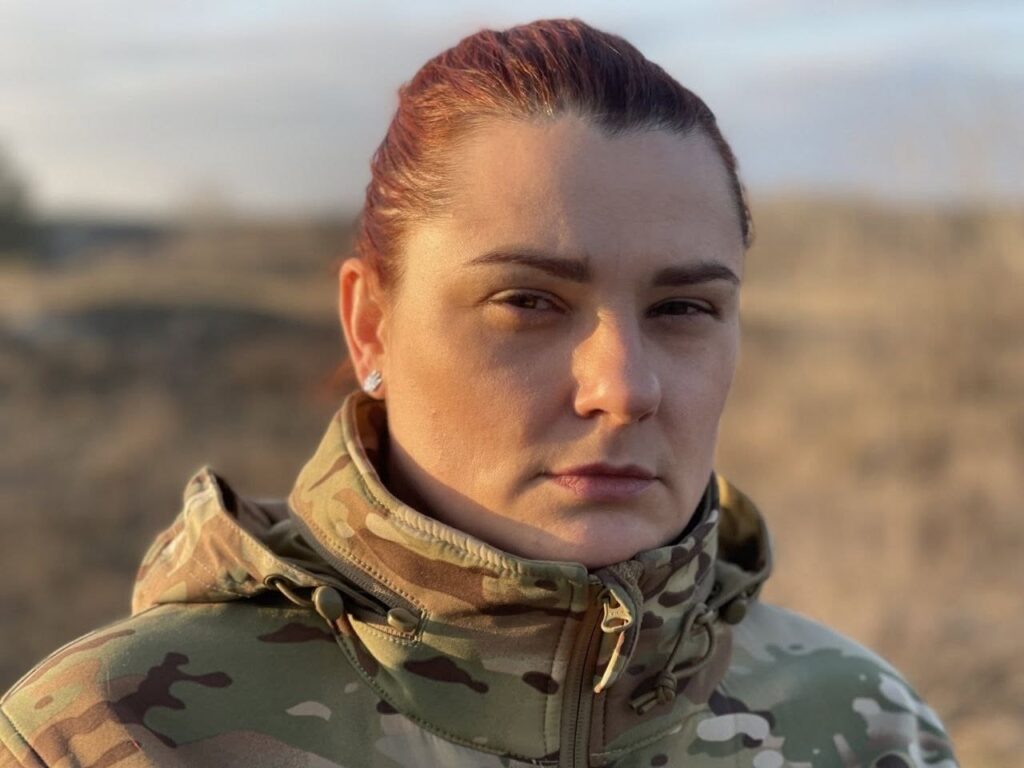
Liudmyla Buimister, non-affiliated member of Ukraine's parliament. Photo: Liudmyla Buimister / Facebook
Doubts about the successor
Klymenko, tapped to replace him, brings his own controversy. Non-affiliated MP Liudmyla Buimister warned that handing him defense would endanger a key wartime ministry, saying he had failed outright as interior minister.
She blamed him for the chaotic “busification” mobilization drives—in which men are seized off the street into vans—that police, she said, first stood back from and then made worse, in remarks on Telegram.
A reversal would mean Zelenskyy openly readmitting Fedorov, and the president, he said, is stubborn.
Incoming prime minister Serhii Koretskyi defended the nominee, calling him a results-driven minister. The objection lands on the exact ground Zelenskyy used to justify the swap: he faulted Fedorov for failing on mobilization, and mobilization is the brief on which Buimister says Klymenko has already failed.
Whether the protests move Zelenskyy is the open question. Last summer, mass protests and a freeze on EU aid reversed a similar move in nine days. Haran expects it to be harder this time: a reversal would mean Zelenskyy openly readmitting Fedorov, and the president, he said, is stubborn in such moments.
Peaceful "cardboard protests" against the dismissal of Defense Minister Mykhailo Fedorov broke out in Kyiv and at least 16 other Ukrainian cities on the morning of 16 July. The "cardboard" refers to handmade signs the protesters hold. The rallies were timed to the parliament session set to weigh a wider government reshuffle, and echoed last year's protests over Ukraine's anti-corruption bodies. Their message was to keep Fedorov in the job.
Ukraine has spent the war rebuildi
Peaceful "cardboard protests" against the dismissal of Defense Minister Mykhailo Fedorov broke out in Kyiv and at least 16 other Ukrainian cities on the morning of 16 July. The "cardboard" refers to handmade signs the protesters hold. The rallies were timed to the parliament session set to weigh a wider government reshuffle, and echoed last year's protests over Ukraine's anti-corruption bodies. Their message was to keep Fedorov in the job.
Ukraine has spent the war rebuilding its defense procurement around open tenders and a homegrown drone industry, changes that turned on the small circle of officials now being reshuffled mid-war. Losing that circle in the space of a few days—an arms-industry chief and a key minister—hands the next team a running reform to carry without its architects, at a moment when the front depends on the machine they built.
Kyiv fills the square that hosted last year's protests
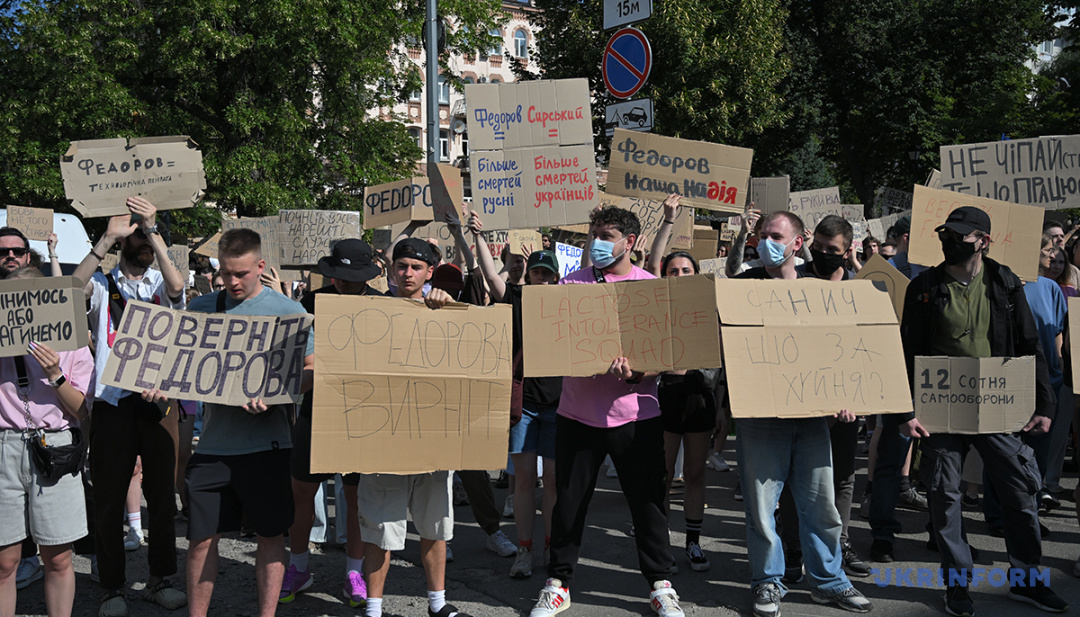
In Kyiv, participants gathered from early morning in the square beside the Ivan Franko National Academic Drama Theater.
Protesters hold cardboard signs at a rally against Defense Minister Mykhailo Fedorov's dismissal in Kyiv, 16 July 2026. Signs read "Bring back Fedorov," "Fedorov = technological genius," "Fedorov = more dead Russians. Syrskyi = more dead Ukrainians," "Don't touch it, it works," "Sanych (a colloquial way to address Zelenskyy, — Ed.), what the hell?" Photo: Ukrinform
Suspilne says the action was called by veteran and former combat medic Dmytro Koziatynskyi, one of the organizers of the 2025 protests defending the independence of Ukraine's anti-corruption agencies, the National Anti-Corruption Bureau (NABU) and the Specialized Anti-Corruption Prosecutor's Office (SAP). He asked people to bring cardboard placards and stressed that the action must stay peaceful.
Rally in Kyiv against the dismissal of Defense Minister Fedorov
Hundreds filled a Kyiv square by the President's Office with cardboard signs, chanting "Fedorov is the defense minister!"
Protesters oppose the constant reshuffling of officials and the removal of people whose work they consider effective, Koziatynskyi said. Hundreds gathered on the square, most of them young people and students, chanting "Fedorov is defense minister!"
A rally in support of Ukraine's Defense Minister Mykhailo Fedorov in Ivano-Frankivsk, 16 July 2026. Signs read "Decisions should strengthen defense" and "Katsaps (Russians, - Ed.) support Fedorov's resignation." Photo: Suspilne Ivano-Frankivsk / Inna Sendetska-Moniuk
From Lviv to Odesa, the same message
Similar rallies ran the same morning in Ivano-Frankivsk, Vinnytsia, Lutsk, Khmelnytskyi, Lviv, Uzhhorod, Dnipro, Ternopil, Odesa, Mykolaiv, Cherkasy, Rivne, Zaporizhzhia, Zhytomyr, Chernivtsi, and Poltava.
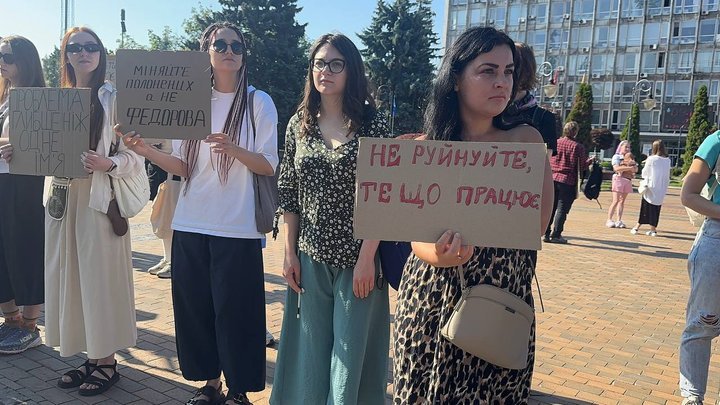
A rally in support of dismissed Defense Minister Mykhailo Fedorov in Vinnytsia, 16 July 2026. Signs read "Don't destroy what works" and "Swap prisoners, not Fedorov." Photo: Suspilne Vinnytsia
Crowd sizes ranged from a few dozen to around a hundred per city. Several began with a minute of silence for those killed in the Russo-Ukrainian war.
Ivano-Frankivsk rallies against Zelenskyy's firing of Fedorov. Similar rallies ran in Kyiv, Kharkiv, Lviv, Uzhhorod, Ternopil, Lutsk, and Zaporizhzhia.
About 100 people gathered outside the administrative building on Hrushevskoho Street in western Ukraine's Ivano-Frankivsk on… pic.twitter.com/SjdbzhbMy5
The signs spelled out the anger. In Vinnytsia, people held signs reading "Don't destroy what works," "Bring back Fedorov," and "Don't take away hope." In Lutsk, slogans included "Ukraine needs results, not personnel games." In Lviv, protesters on Svobody Avenue by the Taras Shevchenko monument carried placards asking why one man's ego mattered more than the state's defense, and one that read "The audit showed 300 billion in theft. They removed the auditor, not the thieves."
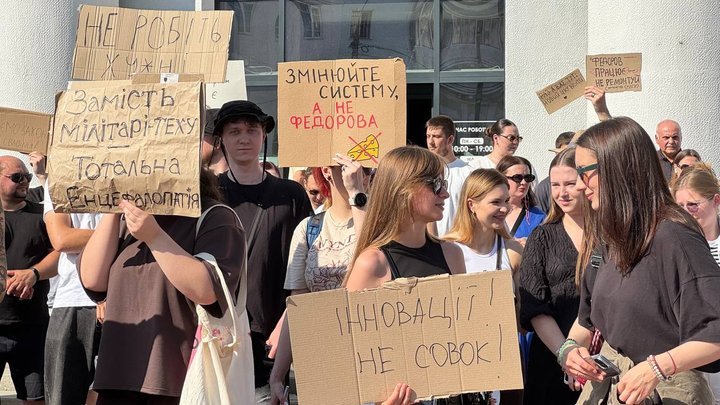
Protesters voice their stance on the government reshuffle at a rally in Khmelnytskyi, 16 July 2026. Signs read "Don't do dumb things," "Instead of military tech — total encephalopathy," "Change the system, not Fedorov," and "Innovation, not Soviet ways." Photo: Suspilne Khmelnytskyi
In Mykolaiv, 26 people gathered by the city council with signs reading "Moscow is glad about your decision" and "Swap prisoners, not Fedorov."
Explore further
Ukraine’s deputy Air Force commander resigns the moment Fedorov loses the ministry
Cherkasy protesters chanted "Klymenko — no" and "Give back prisoners, not Fedorov." Lviv participant Sofia Boiko said she came out for democracy and a free country, calling it wrong to remove someone who had finally started making decisions that worked, and describing Fedorov as the most effective defense minister of the full-scale invasion.
Residents rally against the dismissal of Defense Minister Mykhailo Fedorov in Dnipro, 16 July 2026. Signs read "Bring [him] back, you animals!", "Why do I need a system that works against me," "Removing Fedorov = helping the Russians," and "Drone lovers for Fedorov." Photo: Suspilne Dnipro
The Ukrainian government–run United24 media platform joined today's protests:
"Today, the UNITED24 Media is pausing all publications to join protests over the dismissal of Defense Minister Mykhailo Fedorov. See you there," the project's X wrote.
What led to the protests
The rallies followed President Volodymyr Zelenskyy's decision not to renominate Fedorov as defense minister. Deputies from the Servant of the People party told Suspilne, after a faction meeting with the President, that he would instead put forward Interior Minister Ihor Klymenko for the post — a figure associated in public perception with a Soviet-style mindset.
Commanders of two National Guard corps, however, supported the nomination of Klymenko. Notably, the National Guard is subordinate to the Interior Ministry, not the Armed Forces.
Explore further
Ukraine’s reformist defense Minister is out after six months. Earlier, his audit exposed $7.2 billion in defense overspending
On 15 July, Fedorov confirmed he was leaving and summed up his tenure, listing among his results cutting Russian forces off from Starlink, expanding drone-procurement programs, a procurement reform, weapons contracts, and the testing of Ukrainian ballistic missiles.
A rally in support of Defense Minister Mykhailo Fedorov in Chernivtsi, 16 July 2026. Signs read "Fedorov to the Defense Ministry," "Fedorov is our hope," "Syrskyi to Skelia, Fedorov to MoN." Photo: Suspilne Chernivtsi
Mykhailo Fedorov summarized his tenure as Defense Minister, citing the cutoff of Russian forces from Starlink, the launch of the Logistics Lockdown campaign to isolate occupied Crimea, increased funding for the Drone Line, and larger drone purchases than last year.
Parliament is due on 16 July to consider the personnel changes, with Fedorov's replacement part of a broader reshuffle.
Fedorov led the Defense Ministry from January 2026, having replaced Denys Shmyhal. Klymenko took over the Interior Ministry in February 2023 after Denys Monastyrskyi died in a helicopter crash in Brovary. The defense minister is appointed by parliament on the President's nomination, as the post falls under the presidential quota.
A senior Ukrainian Air Force commander has quit over Defense Minister Mykhailo Fedorov's removal, public broadcaster Suspilne reported. Pavlo Yelizarov tied his resignation to the reshuffle, and warned about the reforms it leaves hanging.
Ukraine is deep into its fifth year of full-scale war and reshuffling its government mid-fight, with the president dropping a popular reformer reportedly to smooth over a feud with the military's highly unpopular top commander.
A resignat
A senior Ukrainian Air Force commander has quit over Defense Minister Mykhailo Fedorov's removal, public broadcaster Suspilne reported. Pavlo Yelizarov tied his resignation to the reshuffle, and warned about the reforms it leaves hanging.
Ukraine is deep into its fifth year of full-scale war and reshuffling its government mid-fight, with the president dropping a popular reformer reportedly to smooth over a feud with the military's highly unpopular top commander.
A resignation report tied to one firing
Yelizarov posted his resignation report in the stories on his Facebook page. He gave a single reason: Fedorov's dismissal.
He called Fedorov the initiator of "strategic reforms in the field of air defense." Yelizarov said that firing and the alleged blocking of those reforms "will cause numerous casualties and destruction of Ukraine."
Explore further
Ukraine’s reformist defense Minister is out after six months. Earlier, his audit exposed $7.2 billion in defense overspending
Yelizarov joined Ukraine's Armed Forces on 24 February 2022, the first day of Russia's full-scale invasion. He took the deputy Air Force command on 19 January 2026.
The reshuffle behind the exit
His departure comes during a wider Cabinet shake-up. Ukraine's parliament confirmed Fedorov as defense minister on 14 January, replacing Denys Shmyhal, in Yulia Svyrydenko's government.
Explore further
“Our state became further from victory”: Ukraine’s top volunteer, whose fund bought 286,000 FPV Drones, just lost his defense post
On 15 July, President Volodymyr Zelenskyy signaled he would propose Interior Minister Ihor Klymenko for the post in the new Cabinet — a criticized pick.
Fedorov's exit closed a six-month tenure that opened with an audit uncovering billions in defense overspending. His removal also pushed out the ministry's top drone-fund adviser.

 Connexion
 Hromadske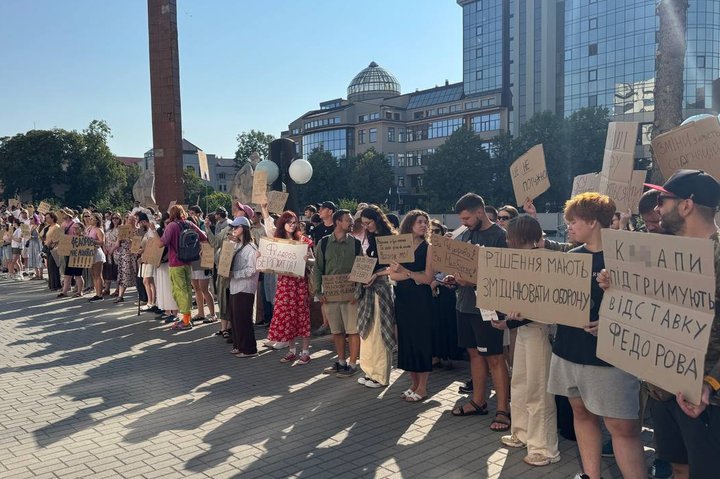
![cardboard protests against zelenskyy's firing fedorov erupt across ukraine · post residents rally dismissal defense minister mykhailo dnipro 16 2026 signs read bring [him] back animals why do need system](https://euromaidanpress.com/wp-content/uploads/2026/07/%D0%A3-%D0%94%D0%BD%D1%96%D0%BF%D1%80%D1%96-%D0%BC%D1%96%D1%81%D1%82%D1%8F%D0%BD%D0%B8-%D0%B2%D0%B8%D0%B9%D1%88%D0%BB%D0%B8-%D0%BD%D0%B0-%D0%BC%D1%96%D1%82%D0%B8%D0%BD%D0%B3-%D0%BF%D1%80%D0%BE%D1%82%D0%B8-%D0%B2%D1%96%D0%B4%D1%81%D1%82%D0%B0%D0%B2%D0%BA%D0%B8-%D0%BC%D1%96%D0%BD%D1%96%D1%81%D1%82%D1%80%D0%B0-%D0%BE%D0%B1%D0%BE%D1%80%D0%BE%D0%BD%D0%B8-%D0%A4%D0%B5%D0%B4%D0%BE%D1%80%D0%BE%D0%B2%D0%B0.-%D0%A1%D1%83%D1%81%D0%BF%D1%96%D0%BB%D1%8C%D0%BD%D0%B5-%D0%94%D0%BD%D1%96%D0%BF%D1%80%D0%BE.jpg)