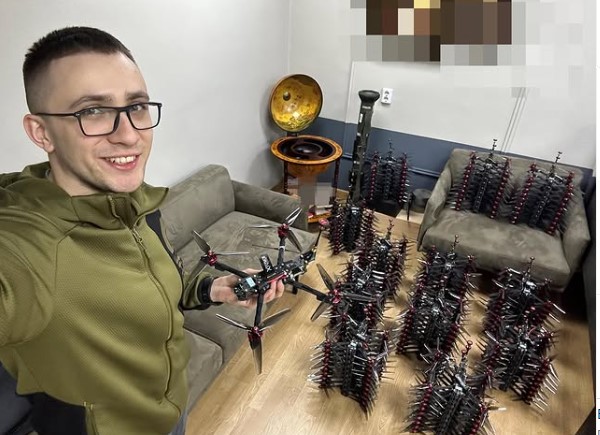
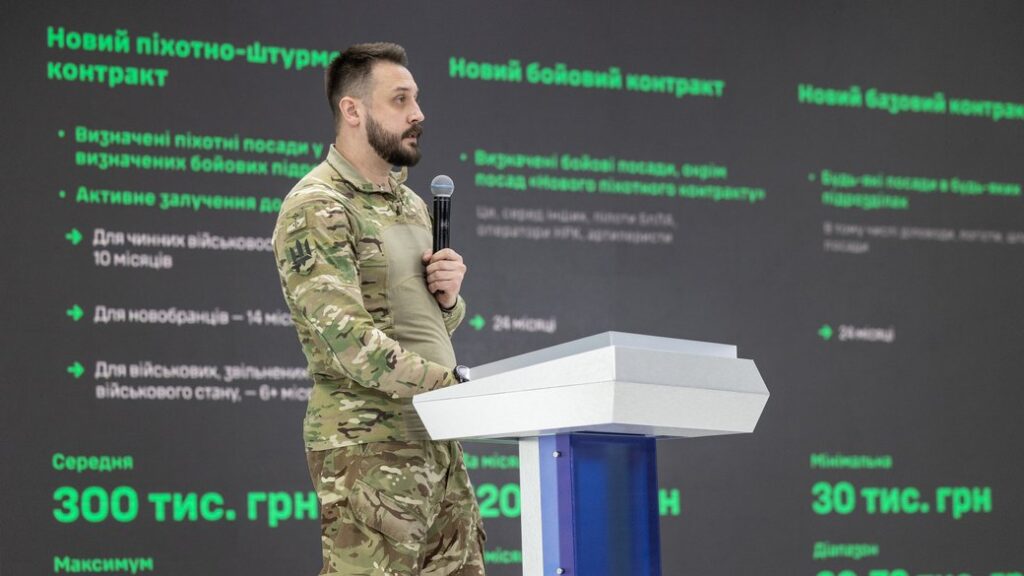
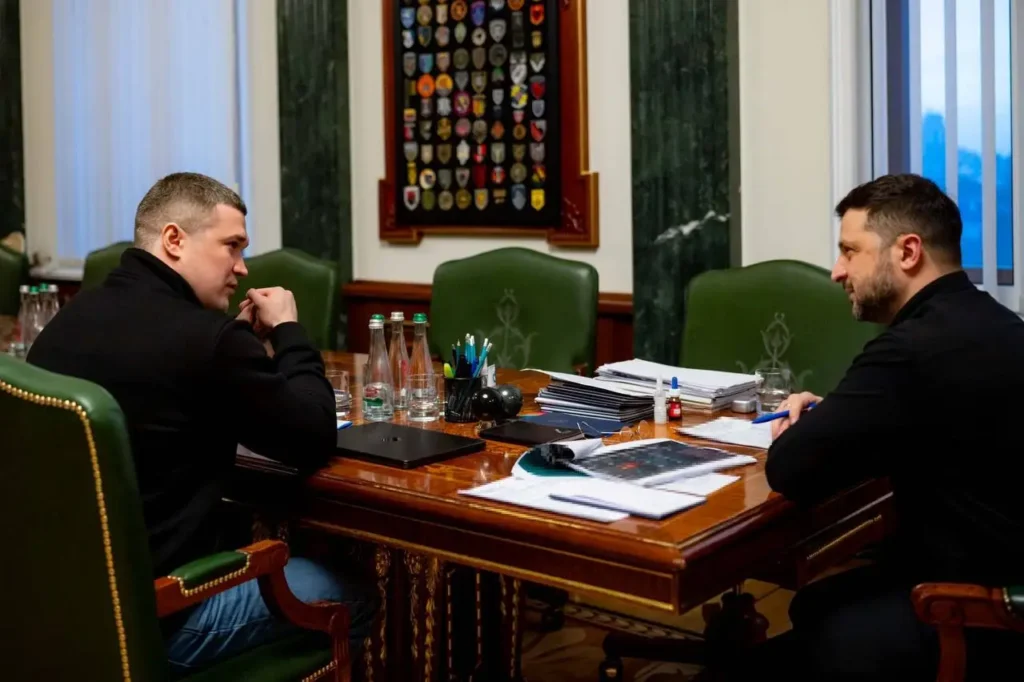
One of Ukraine's most prominent drone volunteers has given his comments on the new defense minister. Serhii Sternenko, a civic activist and former adviser to ousted Defense Minister Mykhailo Fedorov, has congratulated Yevhenii Khmara on his appointment to lead the Defense Ministry, Sternenko wrote on his Telegram channel.
Ukraine's parliament confirmed Khmara as defense minister after removing Fedorov, and figures from his circle, rather than boycotting his replacement,
One of Ukraine's most prominent drone volunteers has given his comments on the new defense minister. Serhii Sternenko, a civic activist and former adviser to ousted Defense Minister Mykhailo Fedorov, has congratulated Yevhenii Khmara on his appointment to lead the Defense Ministry, Sternenko wrote on his Telegram channel.
Ukraine's parliament confirmed Khmara as defense minister after removing Fedorov, and figures from his circle, rather than boycotting his replacement, are lining up to work with the new minister for Ukraine's sake.
Sternenko owns a charity foundation that has purchased 291,502 FPV drones, which have helped the Ukrainian military shoot down 12,954+ aerial targets.
Sternenko offered help and wished the minister endurance
Sternenko has framed his congratulations in terms of Ukraine's benefit.
"I wish Defense Minister Khmara success and resilience. He will need them. This is in Ukraine's interest," he wrote.
He offered his fund's expertise. Together with his team, he is ready to help the new minister with matters concerning FPV drones, because that, too, is in Ukraine's interest, Sternenko said, extending the cooperation of one of the country's largest drone-supply operations to the incoming minister.
He paired the welcome with a warning about dialogue
Sternenko's support came with a pointed caveat. He said the country "finally has a defense minister," but that many unresolved issues remain regarding "government-society" interaction.
Solving them requires engagement from the top, he argued. Their resolution requires the active involvement of the president and the emergence of agency in parliament, Sternenko said, expressing hope that, under extremely difficult conditions for Ukraine, "there will still be room for reasonable dialogue and cooperation for the sake of victory."
Earlier, Mstyslav Banik, who served as a deputy to Fedorov, said he would stay on under the newly appointed Defense Minister. He is responsible for carrying out the defense-procurement reform and became a deputy defense minister under Fedorov on 25 March 2026, having previously led the ministry's digital products. Batnik led the development of "Army+" and "Reserve+", the apps that digitized military service and mobilization.
A member of former Defense Minister Mykhailo Fedorov's team is moving over to the new minister. Mstyslav Banik, who served as a deputy to Fedorov, says he is staying on under the newly appointed Defense Minister, Yevhenii Khmara, Suspilne reports.
Khmara will propose that the core of the current Defense Ministry team stay in their positions. In particular, this concerns specialists responsible for procurement reform, according to sources from the ruling Servant of the
A member of former Defense Minister Mykhailo Fedorov's team is moving over to the new minister. Mstyslav Banik, who served as a deputy to Fedorov, says he is staying on under the newly appointed Defense Minister, Yevhenii Khmara, Suspilne reports.
Khmara will propose that the core of the current Defense Ministry team stay in their positions. In particular, this concerns specialists responsible for procurement reform, according to sources from the ruling Servant of the People, per RBC-Ukraine.
Banik stays to continue the reform
Banik has run a central piece of the ministry's modernization. He is responsible for carrying out the defense-procurement reform and became a deputy defense minister under Fedorov on 25 March 2026, having previously led the ministry's digital products.
In 2025, he moved to the role of head of digital products at the Defense Ministry, where he led the development of "Army+" and "Reserve+", the apps that digitized military service and mobilization, before taking on procurement reform.
Khmara wants to keep the team
Banik is not the only figure Khmara wants to retain. According to reports, Khmara wants First Deputy Defense Minister Oleksii Vyskub to stay in his post as well, MPs said.
The priority behind the retentions is the reform's momentum. Khmara considers it important to continue the procurement reform, particularly the part connected to international support for Ukraine, MPs said, so keeping the specialists who built it preserves the expertise and the relationships with partners that the overhaul depends on.
Continuity amid a contested change
The retentions may temper a leadership change that drew protests. Khmara's appointment followed the removal of Fedorov, which prompted a month of rallies demanding Fedorov's return.
That the reformers are staying suggests that the change of minister need not mean a change in how Ukraine equips its forces.
Earlier, Fedorov addressed Ukrainians, saying the country cannot remain without a fully appointed defense minister, but at the same time called for mechanisms that would allow elections during the war.
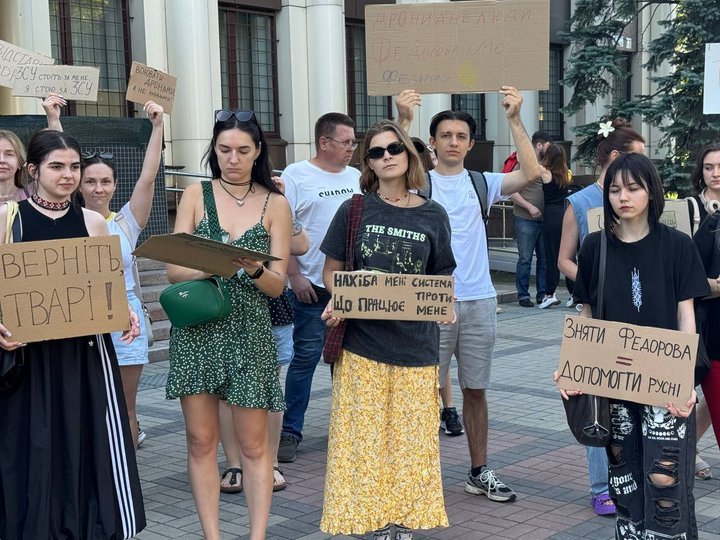
Ukrainian activists who spent a month calling for the former defense minister’s return have criticized the appointment of his successor. People rallying in Kyiv's Mariinskyi Park for the reinstatement of Mykhailo Fedorov as defense minister greeted the news of Yevhenii Khmara's appointment to the post with disappointment, Ukrinform reports.
The rally caps a month of protests over Fedorov's dismissal. People have gathered on Ukraine's streets since President Volodymyr Ze
Ukrainian activists who spent a month calling for the former defense minister’s return have criticized the appointment of his successor. People rallying in Kyiv's Mariinskyi Park for the reinstatement of Mykhailo Fedorov as defense minister greeted the news of Yevhenii Khmara's appointment to the post with disappointment, Ukrinform reports.
The rally caps a month of protests over Fedorov's dismissal. People have gathered on Ukraine's streets since President Volodymyr Zelenskyy removed Fedorov amid a logistics-lockdown operation against Russia and successful strikes deep into its territory. Parliament approved Khmara despite the protests.
"Shame!" protesters reacted to the appointment
The crowd met the appointment with anger. They began chanting "Shame!" and beating drums as the news of Khmara's confirmation broke.
They said that the post "should belong to another person" and appealed to the Ukrainian government: "We greatly respect Khmara, but please, do not hide behind Khmara," the activists said.
"We demand dialogue"
The protesters framed their grievance as a lack of dialogue with the president. They chanted slogans including "We demand dialogue," "Do not destroy our future," "Dialogue, not ignoring," "Fedorov instead of Khmara," "Power is the people," and "Power is responsibility," and said there was no dialogue with Zelenskyy on the matter.
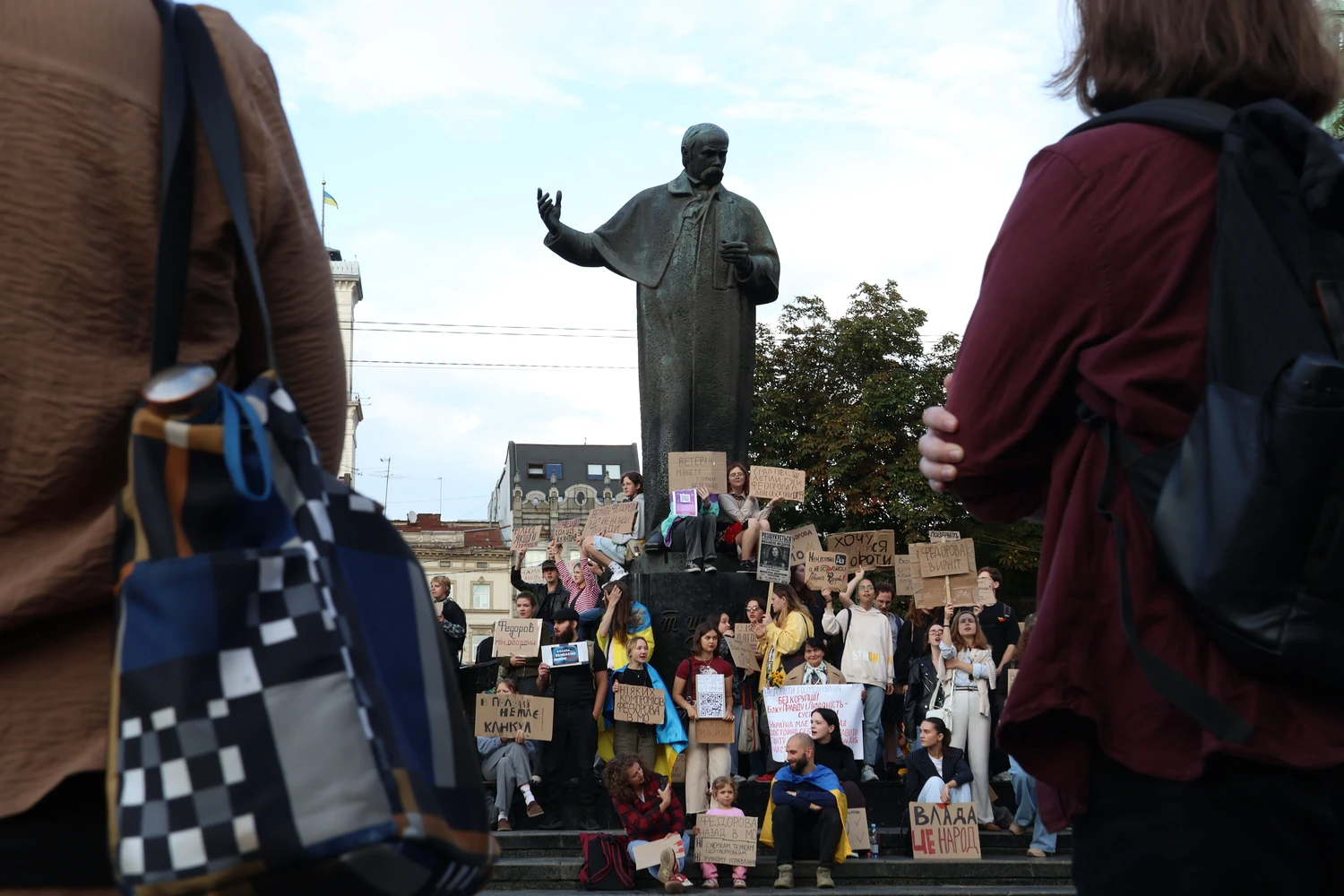
Some held placards reading "Return Fedorov," "Against Khmara," "Thank you for Drapatyi, return Fedorov," and others praising Fedorov's record on strikes against Russia.
The protest continues
The activists announced a pause and the next step. After the news of Khmara's appointment, they said they were ending this particular protest and called on people to come to Ivan Franko Square at 7 p.m., saying they plan to hold such actions there daily.
The day before the vote, Fedorov addressed Ukrainians, saying the country cannot remain without a fully appointed defense minister, but at the same time called for mechanisms that would allow elections to be held in full during martial law.
He did not name a specific proposal or answer the question of who exactly should launch this mechanism, adding only that "democracy cannot be a hostage to Russia."
He also stated that Fedorov declared a "systemic crisis of governance" in Ukraine and criticized the influence of private interests on the parliament's work, effectively hinting that the current leaders are ineffective.
Mykhailo Fedorov, a popular young leader who was fired last month, said Russia should not be allowed to dictate when Ukrainians can choose their next government.
Mykhailo Fedorov, a popular young leader who was fired last month, said Russia should not be allowed to dictate when Ukrainians can choose their next government.
Mykhailo Fedorov in Kyiv, the Ukrainian capital, last month. He did not immediately put himself forward as a candidate to succeed President Volodymyr Zelensky.
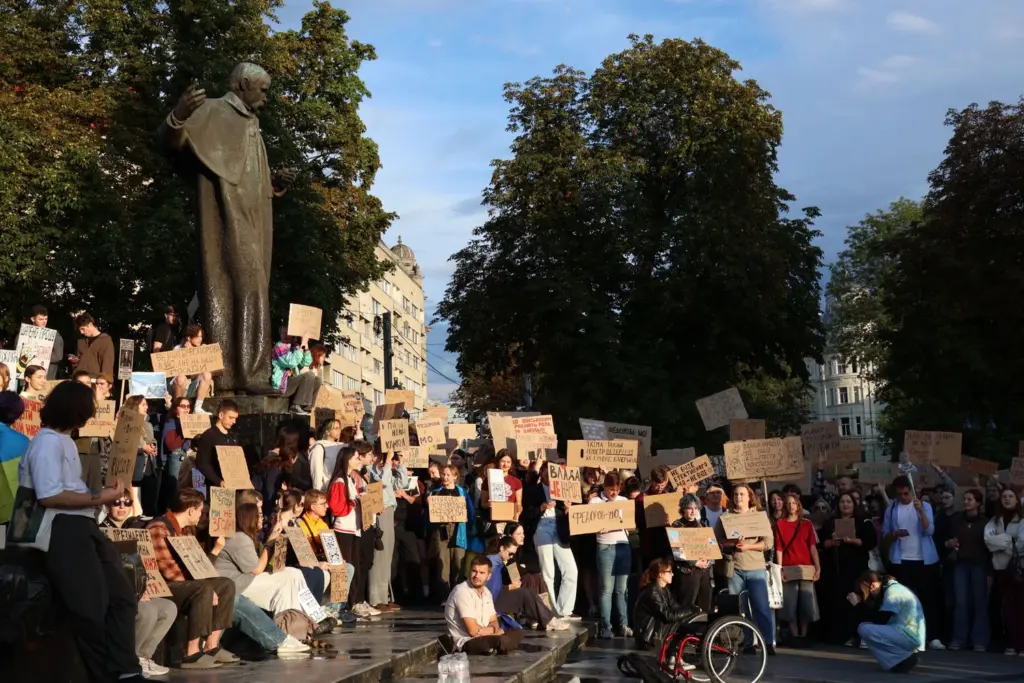
On 16 July 2026, protesters took to the squares in Ukrainian cities with cardboard signs bearing the same demand in various forms: to reinstate Ukraine’s Defense Minister Mykhailo Fedorov. The following day, protesters added a new demand: to dismiss Commander-in-Chief of the Armed Forces of Ukraine Oleksandr Syrskyi. A few days later, Zelenskyy met the second demand—but not the first, which the protesters are still waiting on.
Since the beginning of the full-scale i
On 16 July 2026, protesters took to the squares in Ukrainian cities with cardboard signs bearing the same demand in various forms: to reinstate Ukraine’s Defense Minister Mykhailo Fedorov. The following day, protesters added a new demand: to dismiss Commander-in-Chief of the Armed Forces of Ukraine Oleksandr Syrskyi. A few days later, Zelenskyy met the second demand—but not the first, which the protesters are still waiting on.
Since the beginning of the full-scale invasion, Ukraine has been under martial law, which necessarily restricts democracy in order to centralize governance. The country is not holding elections, citizens’ rights are restricted, and the military has become one of the country’s key institutions. Under these circumstances, the President dismissed one of the most important figures in the military at the demand of street protesters.
These centralizing tendencies of wartime rule could lead either to “strengthening democracy” or to “strengthening authoritarianism,” political science professor Anatolii Romaniuk told Euromaidan Press—and this year's protests, he argues, show that society is reaching for more democracy. Ukrainians recognize the cardboard-sign protests as an expression of democracy while also worrying about what such developments mean for a country at war.
What the protests for Fedorov achieved
On 14 July, the Verkhovna Rada of Ukraine backed the resignation of Prime Minister Yuliia Svyrydenko and the Cabinet of Ministers;
On 15 July, Fedorov confirmed that he was leaving the position of Defense Minister;
On 16 July, the first demonstrators gathered on Ivan Franko Square in Kyiv holding handwritten cardboard signs calling for Fedorov’s return. Similar protests soon spread to other Ukrainian cities;
On 20 July, Major General Yevhenii Khmara, acting head of the SBU, became acting defense minister—the post the protesters want returned to Fedorov.
On 21 July, President Zelenskyy announced that the commander-in-chief would be replaced. The following day, Syrskyi was officially dismissed, with Maj. Gen. Mykhailo Drapatyi appointed as his successor;
On 24 July, protestersdeclaredthe rallies open-ended until Zelenskyy reinstates Fedorov as Defense Minister.
“The fact that the authorities took the protesters’ demand into account is good,” Romaniuk says. He considers this an important element of political culture.
More than three weeks on, the protests continue—smaller than at their July peak but daily, from Lviv to frontline Dnipro, now under a broader call for "dialogue and reforms" in the defense sector. Fedorov himself has declined to lead them: he told the New York Times he will not go into opposition during the war or be "artificially dragged" into politics, and has turned down every post the president has offered except the one he lost.
We stood, we stand, and we will stand
Not every protester can fully explain every aspect of the issue, but they all recognize a sense of injustice and feel compelled to speak out against it, Ukrainian photojournalist Stas Kozliuk says.
Romaniuk sees these handwritten, highly individual signs as evidence of personal agency.
“This is a form of self-expression—of a person's identity, views, and position. To me, the cardboard sign itself is a powerful marker. Not a professionally printed slogan, because once perfectly designed placards start appearing at protests, it usually means someone has commissioned them,” Romaniuk says.
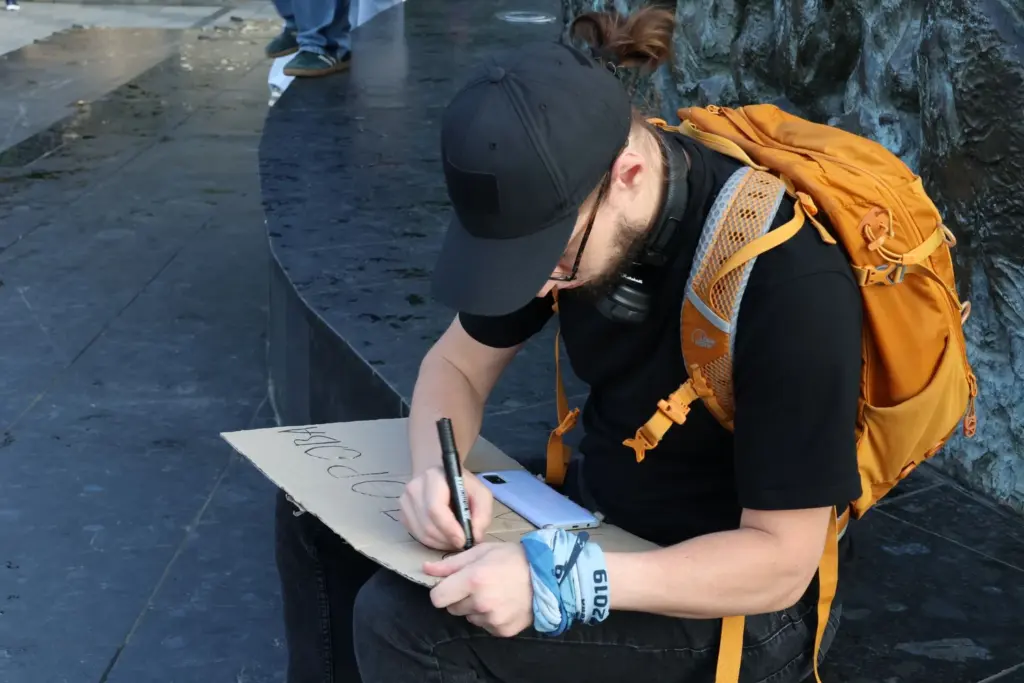
A protester prepares a handwritten cardboard sign before joining the demonstration calling for Mykhailo Fedorov's reinstatement as Minister of Defense. Photo: Euromaidan Press.
Do we know who the people holding cardboard signs at the protests are? Probably not. According to Ukrainian analyst Vadym Denysenko, no one really knows who these protesters are. He argues that no comprehensive sociological research has been done on either last year's protests or the current wave.
“Who are these people? Do they have a political program? What is their vision of the future? Ultimately, do they see themselves entering politics? These are basic questions. The answers would cost a few tens of thousands of dollars, yet no political force has been willing to spend that money,” Denysenko wrote on Facebook.
Twenty-two-year-old Dariia, who came to the rally in Lviv on 24 July, believes that the protests will not simply disappear.
“I think people will stay for as long as it takes, until Fedorov is restored to a position where he can genuinely influence the current situation,” she says.
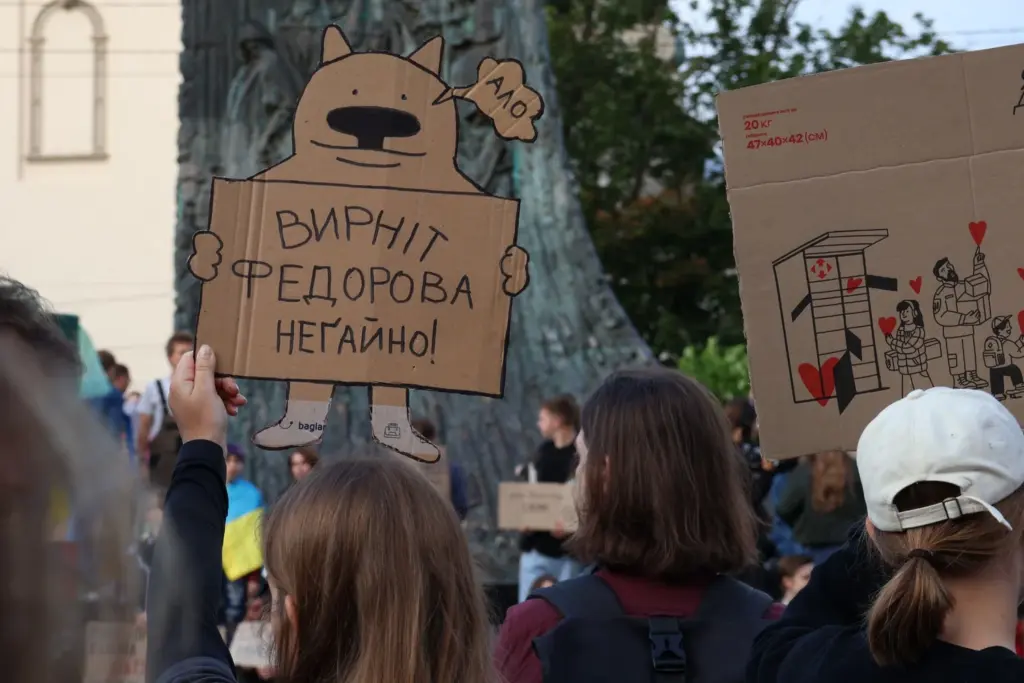
A protester holds a hand-drawn cardboard sign reading “Bring Fedorov back immediately!” during a demonstration in Lviv. Photo: Euromaidan Press.
Among the protesters at the 24 July rally in Lviv was also a woman holding a cardboard sign that read: “Swap the POWs, not Fedorov.” She came there with her husband and child.
“I am originally from Kharkiv. My father is missing, so first of all I was against Syrskyi. Now I am already satisfied. But now we need Fedorov, because he is ‘technology, not people,’” the woman said.
Explore further
Ukraine’s Gen Z protested for their anti-corruption agencies last year. Now they’re protesting for one man
Strength and risk at the same time
Russia has sought to exploit the protests for its own purposes. It seizes on the fact that Ukrainians hold different views on the protests, amplifies divisions in public opinion, and presents them as evidence that the country is becoming ungovernable.
Writing for Ukrainska Pravda, media expert Oksana Moroz argues that the Kremlin has attempted to weaponize public discontent through coordinated information campaigns.
According to Moroz, Russia relied not only on artificially generated TikTok videos spreading narratives harmful to Ukrainian society but also on Telegram. There, she says, “a classic network of Russian or pro-Russian bloggers” circulated posts aimed, among other things, at discrediting the demonstrations. These bloggers promoted claims that the protests were orchestrated and that participants were being paid to attend.
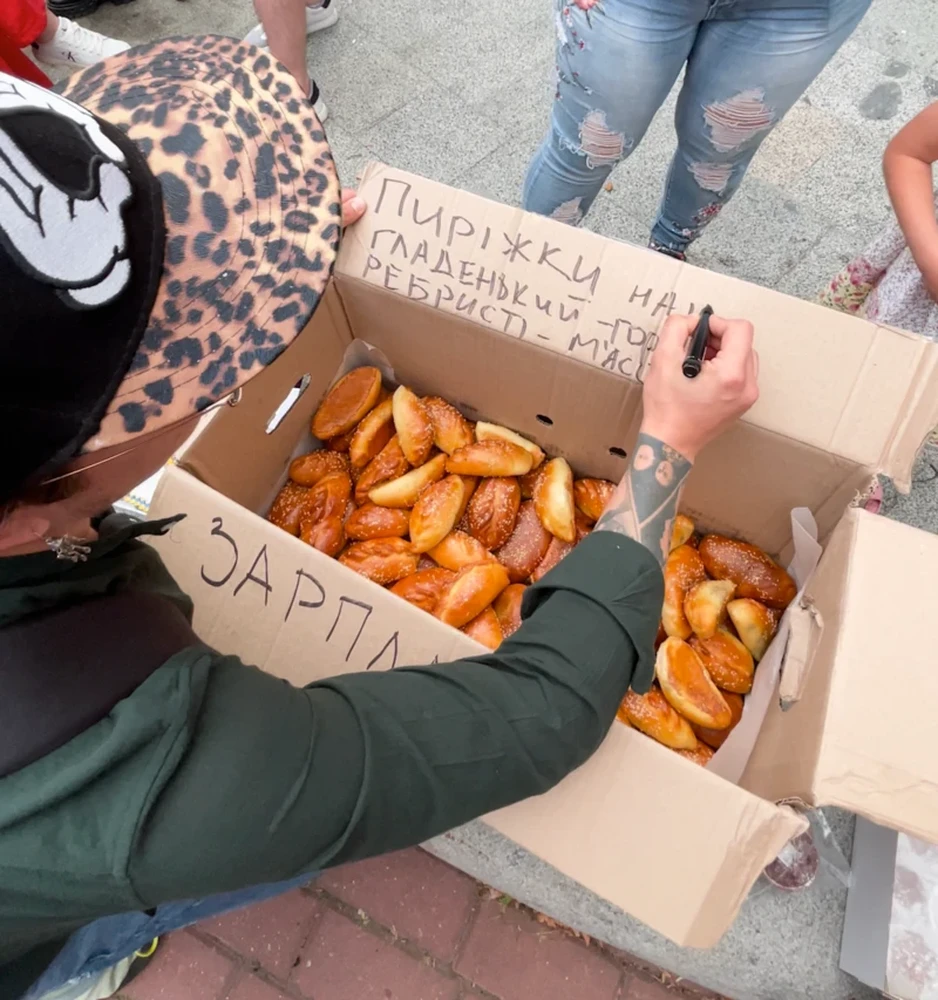
Some demonstrators have responded to those accusations with humor. Protesters voluntarily bring candy, cookies, pastries, and other snacks to share with anyone attending, joking that this is the “salary” they supposedly receive for protesting.
Caption: A box of pastries brought to the protest by participants so anyone could grab a symbolic snack. The word “Salary” is apparently written on the side of the box. Photo: Sofiia Sereda / BBC.
Military Ombudsperson Olha Reshetylova argues that “a sense of injustice in society cannot be bought, fabricated, or created overnight through a social media post. It is the result of accumulated and unresolved problems.”
Where the line has to be drawn
Opinions within the military are divided. Some servicemembers have openly supported the protests despite pressure from their commanders. Others believe demonstrations of this kind are inappropriate and harmful under wartime conditions, says Reshetylova.
“Many people around me today — including combat officers — see the cardboard-sign protests as infantile, detached from reality, and unacceptable while the country is fighting a war. Although I disagree with some of the protesters' demands, I do not share that view,” she says.
Personnel changes in the military should be made in consultation with the officers responsible for the country’s defense, says MP and member of the Verkhovna Rada Committee on National Security, Defense, and Intelligence Oleksandr Fedienko. He emphasizes that this reduces the risk of weakening the country’s defense capabilities due to inappropriate personnel changes.
Despite his positive view of the protests, Romaniuk warns that such pressure is dangerous in a country at war.
“During wartime, changing the military because of protests rather than professional assessments carries obvious risks. In this case, things ended well. But as a mechanism, it is dangerous. Someone could organize demonstrations demanding the dismissal of any official. That is where the line has to be drawn.”
Dariia, back at the Lviv rally, voiced her own doubt about whether President Zelenskyy would meet the demand:
“The pessimistic question arises: are they feeding us these little crumbs so that we calm down and forget about it? Many older people, for example, my parents, think that they will feed us a crumb of honey now, and then start stealing the budget again.”
Ukrainians place the most trust in Valerii Zaluzhnyi, Ukraine's ambassador to the United Kingdom and former commander-in-chief of the Armed Forces, according to a nationwide survey the Kyiv International Institute of Sociology (KIIS) conducted between 16 and 31 July. Some 66% of respondents said they trust him, against 24% who do not—a net balance of +42%.
Close behind sits Mykhailo Fedorov, the former defense minister who previously led the Ministry of Digital Transfor
Ukrainians place the most trust in Valerii Zaluzhnyi, Ukraine's ambassador to the United Kingdom and former commander-in-chief of the Armed Forces, according to a nationwide survey the Kyiv International Institute of Sociology (KIIS) conducted between 16 and 31 July. Some 66% of respondents said they trust him, against 24% who do not—a net balance of +42%.
Close behind sits Mykhailo Fedorov, the former defense minister who previously led the Ministry of Digital Transformation and launched the Diia app. Pollsters recorded 63% trust and 16% distrust for him, producing the strongest net balance in the survey at +46%.
Kyrylo Budanov, head of the President's Office and former chief of Ukraine's Defence Intelligence, rounded out the top three. He drew 61% trust and 22% distrust, for a balance of +39%.
Zelenskyy ranks fourth
President Volodymyr Zelenskyy followed the three military and government figures, trusted by 56% of respondents and distrusted by 38%, for a net balance of +18%. At the opposite end of the ten-name list, former president Petro Poroshenko drew the weakest result—20% trust against 76% distrust, a balance of −56%.
The institute also flagged a rise in confidence in Fedorov as the standout shift since its May 2026 telephone survey, the only change it called significant.
Firm trust versus tentative trust
Sociologists further split the responses into "completely" and "rather" trust. Across the leading figures, roughly half—or fewer—of those expressing trust chose the softer "rather" option rather than "completely," the institute noted, a distinction it argued carries political weight.
Those who "completely" trust Zelenskyy mostly want to see him as president after the war—while those who "rather" trust him mostly want someone else. — Kyiv International Institute of Sociology
KIIS interviewed 1,808 respondents using a mixed-mode design, splitting the sample evenly between computer-assisted telephone interviews and face-to-face tablet interviews on territory controlled by Ukraine.

 Connexion