Vue normale

  • ✇Euromaidan Press
  • Why can’t Ukraine just blow up Russian launchers firing ballistic missiles at its cities?
    There is a reason Ukraine cannot simply blow up the launchers firing ballistic missiles at its cities. Russia's Iskander launchers are extremely hard to catch, and interfering with the missiles' production is nearly as difficult, presidential adviser Serhii "Flash" Beskrestnov said on the national telethon, according to UNIAN. The launchers survive by never staying still or coming within reach. Iskander launchers head to their firing positions only when a combat task is
     

Why can’t Ukraine just blow up Russian launchers firing ballistic missiles at its cities?

5 août 2026 à 15:54

ukrainian intelligence russia’s advanced missile arsenal shrinks nearly 50% since russia's iskander-m its mobile launcher iskander domestic pyongyang-supplied kn-23 ballistic stockpile has dropped 580 300 told liga report does mention

There is a reason Ukraine cannot simply blow up the launchers firing ballistic missiles at its cities. Russia's Iskander launchers are extremely hard to catch, and interfering with the missiles' production is nearly as difficult, presidential adviser Serhii "Flash" Beskrestnov said on the national telethon, according to UNIAN.

The launchers survive by never staying still or coming within reach. Iskander launchers head to their firing positions only when a combat task is set, sometimes moving along forest roads for five hours to avoid detection by satellites, then deploying fast, firing, and fleeing.

They launch from 140 to 150 kilometers behind the front line, which is why catching one on the march or at its firing position is so hard.

The launcher is a fleeting target

Beskrestnov described a weapon designed to be gone before it can be hit.

"The deployment of the Iskander happens very quickly. Then the launch. The Iskander fires and then flees the position," he said.

The forest-road approach and the 140- to 150-kilometer standoff are deliberate. By staying beyond HIMARS' range and moving under tree cover to evade satellites, the launcher gives Ukraine almost no window to detect, target, and strike it before it fires and moves on.

Attacking the factories is hard too

Ukraine's other option, hitting production, faces its own obstacles. The missiles are made deep underground, where they are not easy to attack, Beskrestnov said.

He also claimed sanctions do not work well against the Iskander because it is "probably the only product made 100% from Russian resources and Russian electronics." That claim sits awkwardly against Ukraine's own documented findings.

Ukraine's sanctions commissioner, Vladyslav Vlasiuk, reported that an Iskander fired at Kyiv Oblast on 10 July held more than 140 foreign components, 62 of them American. Meanwhile, Ukraine's Defense Intelligence has said that without foreign parts, Russia cannot build the missile at all. Ukraine has repeatedly struck the plants making Iskander components, precisely because those production nodes are vulnerable.

The interception gap makes it worse

The launcher problem compounds the shortage of defenses against the missiles themselves. With Ukraine short of the Patriot interceptors that are the only reliable defense against Iskander ballistic missiles, and the launchers nearly impossible to catch, Russia can keep firing them at a pace Ukraine cannot fully answer, striking cities from safe forest positions deep behind the front.
  • ✇The Kyiv Independent
  • Ukraine hits Russian electronic warfare facility making Shahed, Iskander components, General Staff says
    Ukraine struck a critical Russian military-industrial site overnight on July 5 that produces components for high-precision weapons used by Moscow to attack Ukraine, the General Staff of Ukraine's Armed Forces reported. The site in question is JSC VNIIR-Progress, a Russian state institute that specializes in developing electronic warfare (EW) systems, including the Kometa antenna arrays, used to jam satellite, radio, and radar signals.The institute is located in Cheboksary, Chuvash Republic, abou
     

Ukraine hits Russian electronic warfare facility making Shahed, Iskander components, General Staff says

5 juillet 2025 à 11:05
Ukraine hits Russian electronic warfare facility making Shahed, Iskander components, General Staff says

Ukraine struck a critical Russian military-industrial site overnight on July 5 that produces components for high-precision weapons used by Moscow to attack Ukraine, the General Staff of Ukraine's Armed Forces reported.

The site in question is JSC VNIIR-Progress, a Russian state institute that specializes in developing electronic warfare (EW) systems, including the Kometa antenna arrays, used to jam satellite, radio, and radar signals.

The institute is located in Cheboksary, Chuvash Republic, about 1,200 kilometers (745 miles) away from the Ukrainian border.

The Kometa antenna is used in Shahed-type drones, Iskander-K cruise missiles, and guided aerial bomb modules — all high-precision weapons used by Russia to strike civilian and military targets across Ukraine.

The General Staff confirmed that Ukrainian weapons reached the target area but said final damage assessments were still underway.

The VNIIR-Progress institute has been sanctioned by both the United States and the European Union for its role in supporting Russia's war effort.

The Iskander-K is a precision-guided cruise missile with a range of up to 500 kilometers (311 miles), frequently used by Russia to target civilian areas. Shahed drones have become a central part of Moscow's airstrike tactics since late 2022 due to their low cost and high payload.

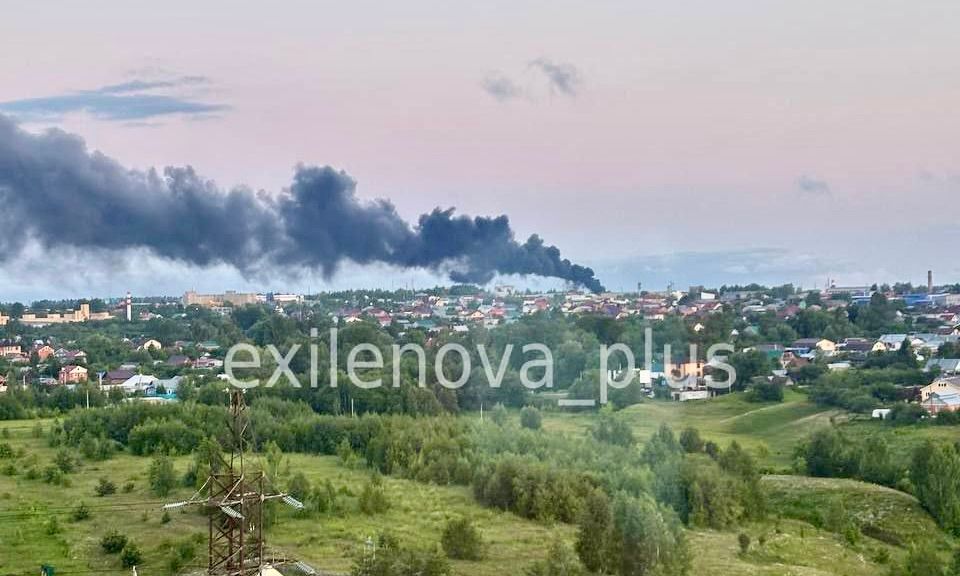
Located on the Volga River, Cheboksary is the capital of the Chuvash Republic and lies deep inside Russian territory. Russian independent media outlet Astra and local Telegram channels earlier reported explosions in the city overnight.

Russia's Defense Ministry claimed to have shot down two drones over the region.

This marks the second known Ukrainian drone strike on VNIIR-Progress. On June 9, explosions and fires were also reported at the facility following another drone attack.

❌