Vue normale

  • ✇Euromaidan Press
  • Putin says Russia is 12 km from Sumy—1.5 km farther than in June
    On 1 September, Russian President Vladimir Putin said during a conversation with journalists that Russian troops had 12 km left to reach Sumy. Censor.NET estimated from DeepState’s map that Russian forces were approximately 17 km from Sumy’s administrative boundary. Russian military commanders have systematically exaggerated their gains on the battlefield. The Institute for the Study of War (ISW) describes such claims as part of a Kremlin information campaign aimed at c
     

Putin says Russia is 12 km from Sumy—1.5 km farther than in June

2 septembre 2026 à 10:19

Russian President Vladimir Putin in the Russian army command center, 26 October, 2025. Screenshot from video.

On 1 September, Russian President Vladimir Putin said during a conversation with journalists that Russian troops had 12 km left to reach Sumy. Censor.NET estimated from DeepState’s map that Russian forces were approximately 17 km from Sumy’s administrative boundary.

Russian military commanders have systematically exaggerated their gains on the battlefield. The Institute for the Study of War (ISW) describes such claims as part of a Kremlin information campaign aimed at creating the impression of major Russian gains. In this case, the Russian president cited exaggerated gains that, compared with his previous claims, appear to be a setback.

What Putin said

“The ‘North’ group of forces continues to create a security belt along the Russian-Ukrainian border in the border areas of the Sumy region... There are 12 km left to Sumy, to the Sumy ring road,” Putin said during the press conference.

Censor.NET reported that Russian forces were about 17 km from Sumy without specifying the reference point, while Putin did not say which section of the city’s ring road his 12 km figure referred to.
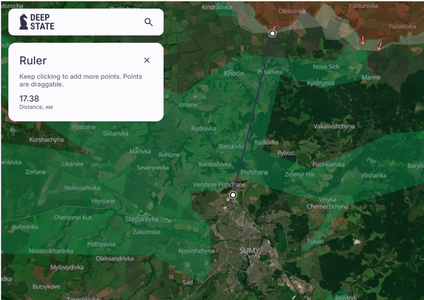
Approximate visualization of Censor.NET’s reported 17 km distance from the DeepState frontline toward Sumy. Map: DeepState / Chart: Euromaidan Press

Putin previously gave a different distance

On 28 June, during an interview with Russian propagandist Pavel Zarubin, Putin said that Russian troops had “about 10.5 km” left to reach Sumy. At the time, he also explained the offensive as the creation of a “security zone” along Russia’s border.

Putin’s claimed distance to Sumy therefore increased by approximately 1.5 km in just over two months, contradicting the Kremlin’s portrayal of a continuing advance.

Other exaggerations

In July 2026, Putin claimed that Russian forces had “completely captured” Kostiantynivka. Ukraine’s General Staff rejected the claim, saying Ukrainian forces continued defensive operations in the city. ISW also said some videos of Russian flags being raised in Kostiantynivka were likely AI-altered.

On 2 December 2025, Putin claimed that Russian forces had captured Pokrovsk in Donetsk Oblast. ISW found no evidence confirming the city’s complete capture and assessed that its fall would not enable Moscow to achieve a significant breakthrough.

  • ✇Euromaidan Press
  • Russia’s Starlink rival falters as latest satellite batch stalls in low orbit, ISW says
    The Rassvet communications satellites Moscow launched in July are likely to have shorter operational lifespans than planned because atmospheric drag increases at their current altitudes, the Institute for the Study of War (ISW) reported. Moscow accelerated Rassvet’s deployment after its forces lost unauthorized Starlink access in February. A complete network could support battlefield communications and remotely controlled strikes against Ukraine, but existing satellites
     

Russia’s Starlink rival falters as latest satellite batch stalls in low orbit, ISW says

1 septembre 2026 à 15:57

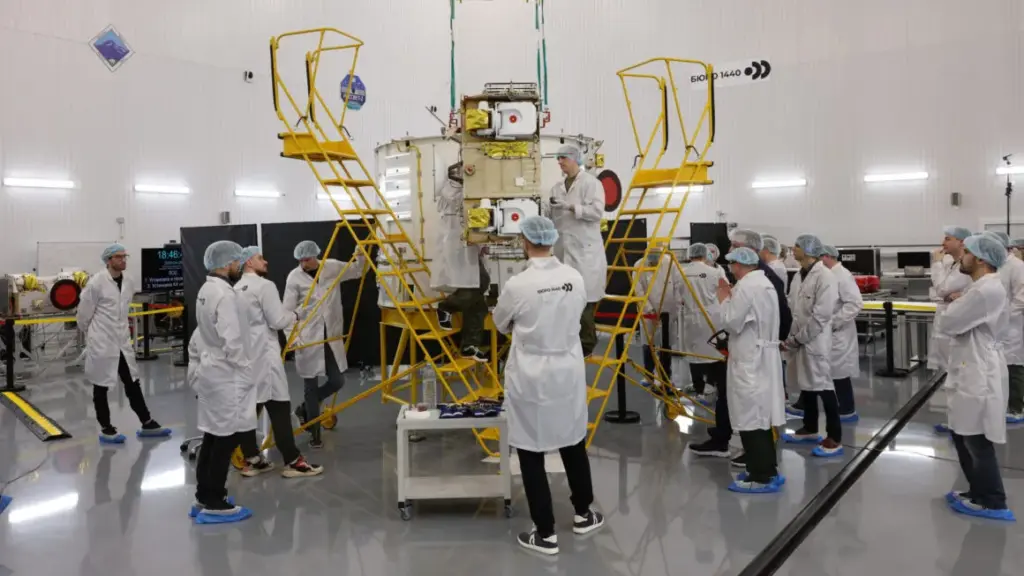
Employees of Russian company Bureau 1440 work on a Rassvet communications satellite.

The Rassvet communications satellites Moscow launched in July are likely to have shorter operational lifespans than planned because atmospheric drag increases at their current altitudes, the Institute for the Study of War (ISW) reported.

Moscow accelerated Rassvet’s deployment after its forces lost unauthorized Starlink access in February. A complete network could support battlefield communications and remotely controlled strikes against Ukraine, but existing satellites provide only brief connectivity windows. The latest setback will likely delay continuous coverage, ISW assessed.

Russian forces had relied heavily on unauthorized Starlink terminals for frontline communications, drone operations, and command-and-control. Ukraine and SpaceX blocked them on 5 February, disrupting Russian communications and assaults across several sectors. A Russian-controlled network could reduce Moscow’s dependence on SpaceX and illicit supply chains for terminals.

None of the 16 satellites launched on 19 July had reached 550 kilometers as of 31 August, according to N2YO tracking data cited by ISW. Many remained between 300 and 400 kilometers, some were gradually losing altitude, and at least two were reportedly heading toward atmospheric reentry.

ISW identified 550 kilometers as the altitude reached by the successful first-batch satellites, while reporting 870 kilometers as Rassvet’s intended operational altitude. At lower altitudes, satellites must use more fuel to counter greater atmospheric drag, shortening their operating lives.

Of the 32 Rassvet satellites launched in 2026, only 12—all from the first batch launched on 24 March—reached sustainable altitudes. They remained at roughly 550 kilometers and provided two daily connectivity windows over Ukraine totaling up to 90 minutes, ISW reported.

Russia needs at least 200–300 working satellites for stable, round-the-clock coverage, presidential defense-technology adviser Serhii “Flash” Beskrestnov assessed. Bureau 1440 plans “dozens” more launches and “hundreds” more satellites, but Russia depends on the scarce, costly Soyuz-2.1b rocket.

Only six to eight Soyuz-2.1b launches of all types have occurred since 2022, limiting Russia to a maximum of 128 Rassvet satellites over four years at that rate, ISW assessed.

Ukraine struck the Progress Space Rocket Center, which builds Soyuz-type vehicles, on 14–15 August and attempted to strike Plesetsk Cosmodrome on 23 August, ISW noted. Both Rassvet batches launched from Plesetsk, showing Ukraine can threaten the rockets and launch infrastructure required to expand the constellation, the institute assessed.

What is Rassvet?

Rassvet, meaning “Dawn,” is a low-Earth-orbit broadband constellation developed by Bureau 1440 as Russia’s domestic alternative to Starlink. Its 5G-based satellites are intended to provide high-speed, low-latency internet independently of SpaceX.

Although initially designed for civilian communications, a mature network could provide Russian forces with battlefield connectivity, command-and-control links, and connections to long-range drones. Moscow aims to place 292 satellites in orbit by the end of 2027 and 924 by 2035.

  • ✇Euromaidan Press
  • Russia’s North Korean missiles could threaten Kyiv and six other regions, ISW says
    Russia is deploying six launchers for North Korean ballistic missiles in Voronezh Oblast, the Institute for the Study of War (ISW) reported on 20 August. The assessment cited Ukraine’s military intelligence agency (HUR). Russia has already used North Korean missiles in deadly strikes across Ukraine, and Pyongyang is supplying more of them. From Voronezh Oblast, the weapons could threaten Kyiv and six other regions, adding to the ballistic arsenal Moscow can use in mass
     

Russia’s North Korean missiles could threaten Kyiv and six other regions, ISW says

21 août 2026 à 17:13

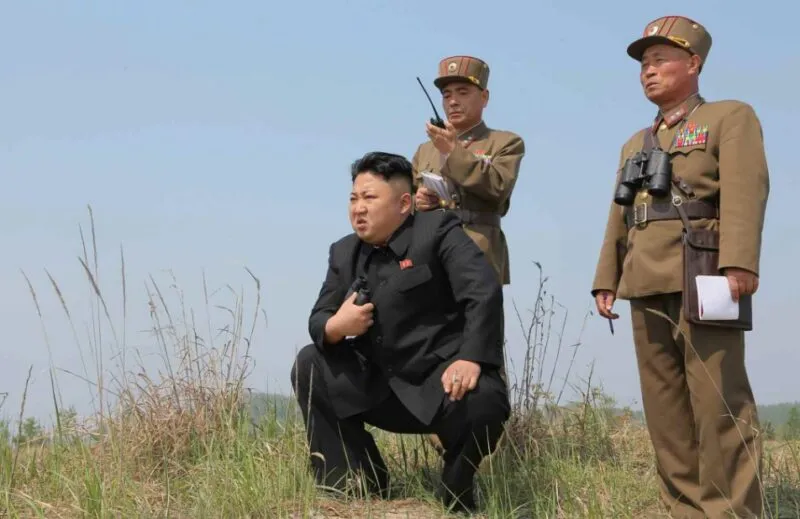
North Korean leader Kim Jong-un crouches in a grassy field while two uniformed military officers stand behind him.

Russia is deploying six launchers for North Korean ballistic missiles in Voronezh Oblast, the Institute for the Study of War (ISW) reported on 20 August. The assessment cited Ukraine’s military intelligence agency (HUR).

Russia has already used North Korean missiles in deadly strikes across Ukraine, and Pyongyang is supplying more of them. From Voronezh Oblast, the weapons could threaten Kyiv and six other regions, adding to the ballistic arsenal Moscow can use in mass attacks intended to overwhelm Ukrainian air defenses.

Six launchers expand Russia’s missile threat

The North Korean missiles could reach Kyiv, Sumy, Kharkiv, Chernihiv, Poltava, Dnipropetrovsk, and Zaporizhzhia oblasts, ISW said.

The unit may eventually field 120 missiles. HUR said North Korea had transferred around 50 KN-23, KN-24, and upgraded KN-30 ballistic missiles to Russia by July.

The KN-30 can carry a 2,500-kilogram warhead, though ISW has seen no evidence of Russia using it against Ukraine. Other North Korean missiles have larger warheads than Russia’s Iskander-M but are less accurate, Ukrainian military expert Anatolii Khrapchynskyi said.

Those missiles could join Russia’s combined attacks. ISW expects Moscow to stockpile ballistic and cruise missiles for several days before launching large barrages intended to overwhelm Ukraine’s air defenses.

ISW pointed to the 19–20 August attack as the latest example of that pattern. The barrage lasted nearly nine hours and killed at least 15 people in Kyiv. Ukraine’s Air Force said it intercepted most drones and cruise missiles, but no longer routinely reports how many ballistic missiles Russia launches or Ukraine intercepts.

North Korean missiles have already killed civilians

Preliminary evidence indicated that Russia used a North Korean ballistic missile in a 30 July strike on Radushne, Dnipropetrovsk Oblast, that killed five members of one family.

On 10 August, a North Korean missile killed seven Zaporizhstal steelworkers and injured 21 others in Zaporizhzhia, Ukrainian officials said. The workers were heading to a shelter when the missile struck.

Ballistic missiles travel at high speed and leave civilians little time to seek cover. They are also harder to intercept than drones or cruise missiles, while Ukraine has limited supplies of the Patriot interceptors used against them.

  • ✇Euromaidan Press
  • Russia calls them “volunteers.” They’re Ukrainian prisoners of war forced into a new combat brigade
    Russia consolidated several units composed of Ukrainian prisoners of war and alleged defectors into a single brigade and labeled it "volunteer," the Institute for the Study of War (ISW) reported. The move scales up a practice ISW has tracked since 2022, when Moscow first began pressing captured Ukrainian soldiers into combat formations. ISW assessed the practice as a likely violation of the Geneva Convention, which bars using prisoners of war in military operations.
     

Russia calls them “volunteers.” They’re Ukrainian prisoners of war forced into a new combat brigade

7 août 2026 à 08:27

Russia consolidated several units composed of Ukrainian prisoners of war and alleged defectors into a single brigade and labeled it "volunteer," the Institute for the Study of War (ISW) reported. The move scales up a practice ISW has tracked since 2022, when Moscow first began pressing captured Ukrainian soldiers into combat formations. ISW assessed the practice as a likely violation of the Geneva Convention, which bars using prisoners of war in military operations.

Russia's treatment of Ukrainian prisoners extends far beyond forced recruitment into combat units. Russian forces executed at least 337 confirmed Ukrainian prisoners of war by the end of 2025, and leaked chats from a Russian general showed that brutality toward captives runs through the chain of command.

Moscow merges five POW units into one brigade

Russia's Defense Ministry Volunteer Corps announced on 6 August that it had formed the "first Ukrainian Volunteer Spetsnaz Brigade." The formation absorbed at least five existing units: the "Maksim Krivonos" and "Aleksei Berest" battalions, and the "Aleksandr Matrosov," "Martyn Pushkar," and "Slobodskoy" detachments. Each of these units reportedly drew members from captured Ukrainian soldiers or Ukrainians who allegedly defected to Russia.

The Volunteer Corps framed the new brigade as a formation of willing participants. At least one Russian military blogger, however, openly stated the brigade is composed of Ukrainian prisoners of war. ISW noted the admission as significant.

2023

ISW: Russia officially deploys Ukrainian POWs to front lines

One of the merged units, the Krivonos battalion, previously figured in a Russian propaganda operation. Moscow presented a Polish citizen as a defector to that battalion in 2025. Months later, a court in occupied Luhansk Oblast sentenced the same man to 13 years as a mercenary.

A practice ISW has tracked since 2022

ISW first documented Russia forming combat units from Ukrainian prisoners in November 2022. The most recent confirmed case before this brigade was the Bogdan Khmelnitsky battalion, which operated as part of the DNR interior ministry's Kaskad unit in western Donetsk Oblast starting in December 2023.

The Geneva Convention on prisoners of war prohibits using captured soldiers in military activities on behalf of the detaining power. It also states that no prisoner "may at any time be sent to or detained in areas where he may be exposed to the fire of the combat zone" and that prisoners shall not "be employed on labor which is of an unhealthy or dangerous nature."
❌