Vue normale

Reçu — 15 juillet 2026 Euromaidan Press
  • ✇Euromaidan Press
  • A month’s worth of Russia’s oil exports is stuck at sea—135 million barrels loaded but not delivered
    Ukraine's strikes on Russian refineries are pushing Moscow to export crude it can no longer process at home, Bloomberg reported. Buyers are not taking it fast enough, so Russian oil is piling up on tankers at sea. The value of those exports keeps sliding, and tanker loadings dipped in the week to 12 July. Sanctions were supposed to choke the money, yet Russia keeps its crude moving on a sprawling fleet of tankers bound for Asia — the very chain Kyiv now works to break. The
     

A month’s worth of Russia’s oil exports is stuck at sea—135 million barrels loaded but not delivered

15 juillet 2026 à 09:10

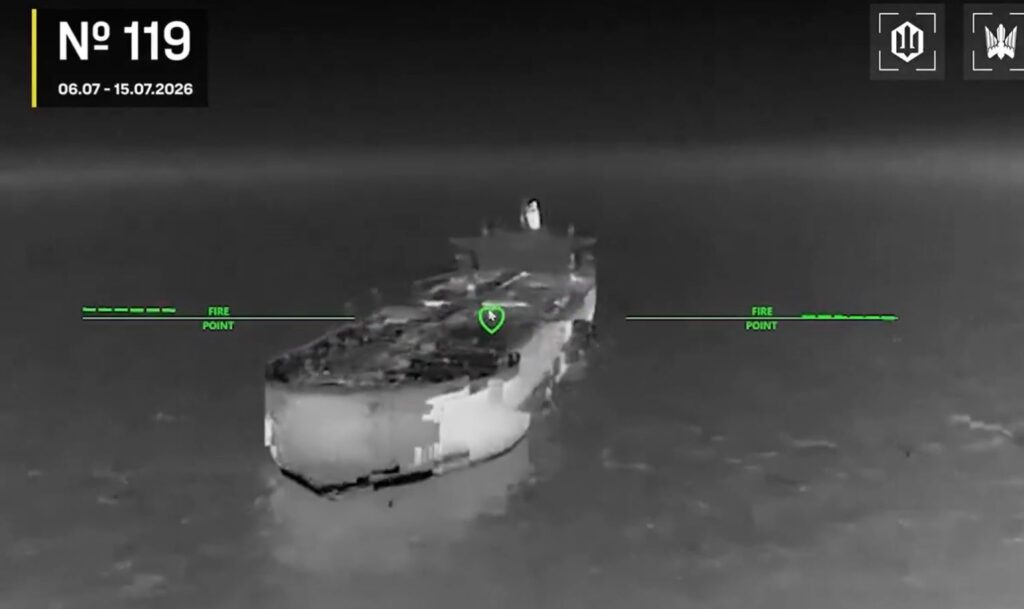
azov sea wasn't enough—ukraine's drones followed russia's oil fleet black · post russian tanker thermal sight ukrainian naval drone during strikes marked 119th vessel hit 6–15 2026 operation sbs video

Ukraine's strikes on Russian refineries are pushing Moscow to export crude it can no longer process at home, Bloomberg reported. Buyers are not taking it fast enough, so Russian oil is piling up on tankers at sea. The value of those exports keeps sliding, and tanker loadings dipped in the week to 12 July.

Sanctions were supposed to choke the money, yet Russia keeps its crude moving on a sprawling fleet of tankers bound for Asia — the very chain Kyiv now works to break. The near-term damage is to price, not volume, but cheaper barrels, slower sales, and a fresh US sanctions push could deepen the squeeze on the revenue that pays for the war.

Ukraine's refinery strikes are forcing crude onto the water

Ukraine has stepped up its strikes on Russia's refineries. Yesterday, it hit the Gazprom Neftekhim Salavat plant far inside Russia, and the Afipsky facility near the Black Sea. The wave of attacks has driven Russian refining runs to their lowest in more than 21 years this month. That deepens a domestic fuel crunch and squeezes the global market. With less crude to process at home, Moscow is likely diverting more into exports as its own production falls. Russia pumped 8.93 million barrels a day in June — about 830,000 below the level it promised the OPEC+ producer group.

The Azov Sea wasn’t enough—Ukraine’s drones followed Russia’s oil fleet into the Black Sea

The oil is piling up faster than buyers take it

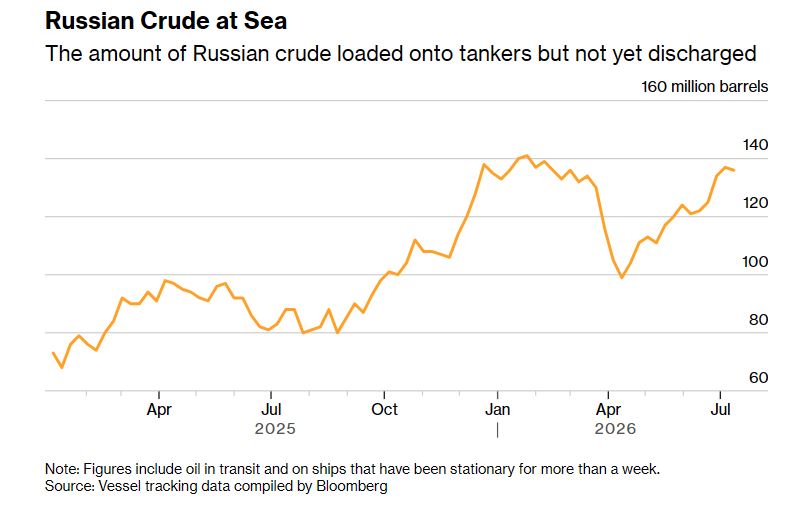
Soaring exports are not being matched by deliveries. So Russian crude is stacking up on tankers, loaded but not yet discharged, Bloomberg wrote. The total has climbed back near its start-of-2026 highs — about 135 million barrels by Sunday.
month's worth russia's oil exports stuck sea—135 million barrels loaded delivered · post russian crude onto tankers yet discharged 2025–2026 sea ukraine news ukrainian reports
Russian crude loaded onto tankers but not yet discharged, 2025–2026. Chart: Bloomberg vessel-tracking data

Cargoes are building up near Egypt in the Mediterranean and east of Singapore. Five Urals tankers are anchored off Egypt, and another five have halted near Singapore, a gathering point for shadow-fleet ships hauling sanctioned oil. A growing share of the oil at sea is on vessels that seem to be sitting idle rather than sailing.
month's worth russia's oil exports stuck sea—135 million barrels loaded delivered · post tankers loading crude russian terminals port weeks ending 12 5 28 2026 ukraine news ukrainian reports
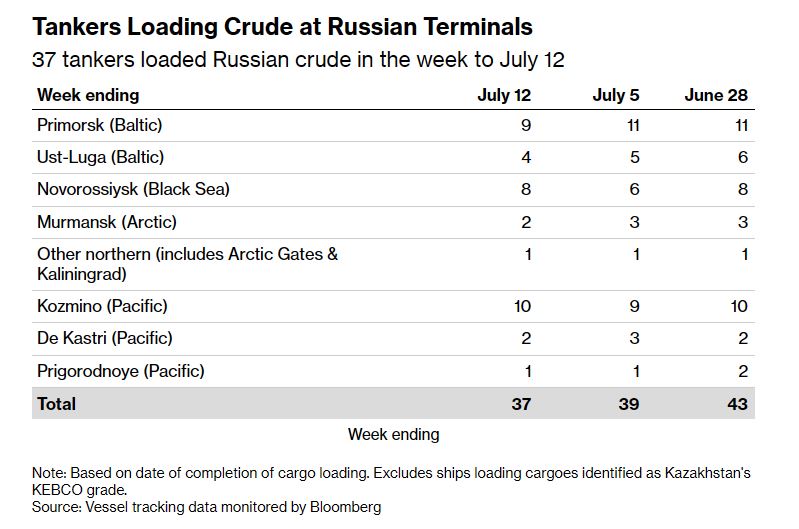
Tankers loading crude at Russian terminals by port, for the weeks ending 12 July, 5 July, and 28 June 2026. Chart: Bloomberg vessel-tracking data

Fewer tankers, and less money for the same oil

Russia shipped 3.98 million barrels of crude a day in the week to 12 July, down from 4.08 million. Year-to-date volumes remain above every annual average since 2022, yet the four-week export value fell $200 million to $1.68 billion a week. Urals prices have nearly halved since mid-April.
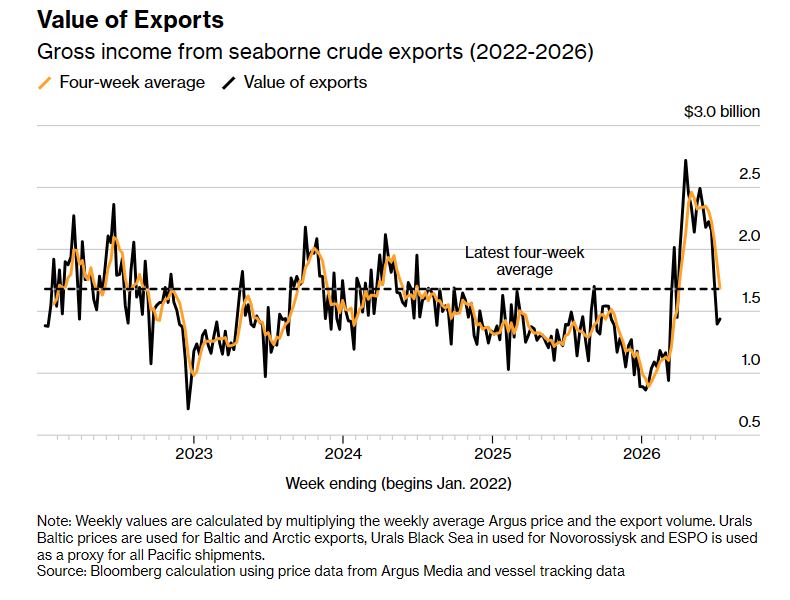
month's worth russia's oil exports stuck sea—135 million barrels loaded delivered · post gross weekly income seaborne crude 2022–2026 latest four-week average value ukraine news ukrainian reports
Gross weekly income from Russia's seaborne crude exports, 2022–2026, with the latest four-week average. Chart: Bloomberg calculation using Argus Media price data and vessel-tracking data

Russia sent 4 million barrels of oil a day toward Asia. Only about half was openly bound for India and China, while 1.9 million barrels a day remained undeclared, likely until tankers crossed the Arabian Sea. Türkiye took 160,000 barrels a day, and Syria 40,000.

Reçu — 13 juillet 2026 Euromaidan Press

Ukraine says Russia’s Alabuga workers, including minors, are now inside Zaporizhzhia’s reactor complex, turned into military base

13 juillet 2026 à 15:34

add new post russian troops ukraine's zaporizhzhia nuclear power plant illustrative image/ telegram channel tsaplienko occupiers prepping hold hostage znpp's personnel

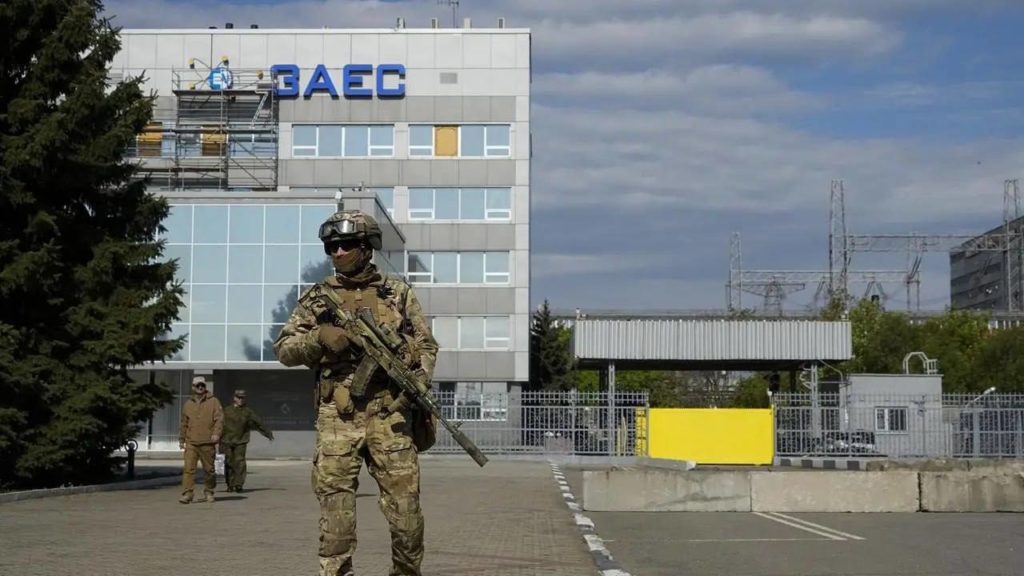
Russia is operating Shahed drone control points inside Europe's largest nuclear plant. Ukraine's Defense Intelligence says Russian forces have deployed control points for Gerbera-Seeker and Geran-Seeker kamikaze drones at the occupied Zaporizhzhia Nuclear Power Plant (ZNPP), staffed with workers brought in from the Alabuga special economic zone, including underage students. 

Alabuga is Russia's main Shahed factory in Tatarstan, and it has a documented record of recruiting minors and foreign women onto its production lines. Ukrainian intelligence now reports that Alabuga personnel are inside the reactor complex of a six-reactor nuclear station.

All six ZNPP reactors are in cold shutdown. Russian occupying forces have parked military equipment directly in the turbine halls of reactor units 1, 2, 5, and 6, turned basements and bomb shelters into weapons depots, and installed machine-gun nests and missile systems on the roofs of the reactor buildings, per Ukrainian intelligence.

IAEA experts denied access to reactor halls

Ammunition and equipment are stored beneath the technical passages and overpasses that connect the reactor units to other buildings.

Some technical facilities near the shoreline of the former Kakhovka reservoir have been mined. A Rosgvardia contingent of 1,500 troops guards the plant.

IAEA experts do not have full access to the reactor units or the special technical facilities. Inspections are conducted along pre-agreed plans and routes, which Ukrainian intelligence says makes an objective assessment of the situation difficult or impossible. Russia has restricted IAEA access to reactor halls since at least 2024.

Plant has one power line left and 21 blackouts behind it

ZNPP had 10 external power lines before the occupation. One works now. The plant suffered another blackout on 3 July 2026 — the 21st since the full-scale war, per Ukrainian intelligence.

A nuclear plant in cold shutdown still needs electricity. Cooling systems for the reactors and the spent fuel storage run on it, and when off-site power fails, the plant falls back on diesel generators trucked in through a war zone. Europe's largest nuclear facility has been living on that margin since 2022.

The 17th blackout came in June 2026, the fifth of that year alone, and more than 500 missiles and drones were recorded inside the 30-km surveillance zones of Ukrainian nuclear plants during 2025

Cooling pond is two meters below its minimum

Russian occupiers are not maintaining the required water level in the cooling pond. As of July 2026, it stands at 12.86 meters, compared with a minimum of 15 meters.

Russia destroyed the Kakhovka Dam on 6 June 2023, which severed the plant's original water supply.

Rosatom is forcing staff onto its contracts

ZNPP employed roughly 11,000 people before the full-scale war. About 7,500 remain, including 500 workers from an outsourcing company that holds no license to work at the station.

All staff are being forced to sign contracts with Rosatom under threat of dismissal, according to the Ukrainian intelligence. Personnel brought in from Russia lack the qualifications to service the plant, because ZNPP differs substantially from Russian nuclear facilities.

Ukraine has proposed amending the IAEA statute to disqualify states that deliberately undermine nuclear safety from the agency's governing bodies. Russia sits on the IAEA Board of Governors.

❌