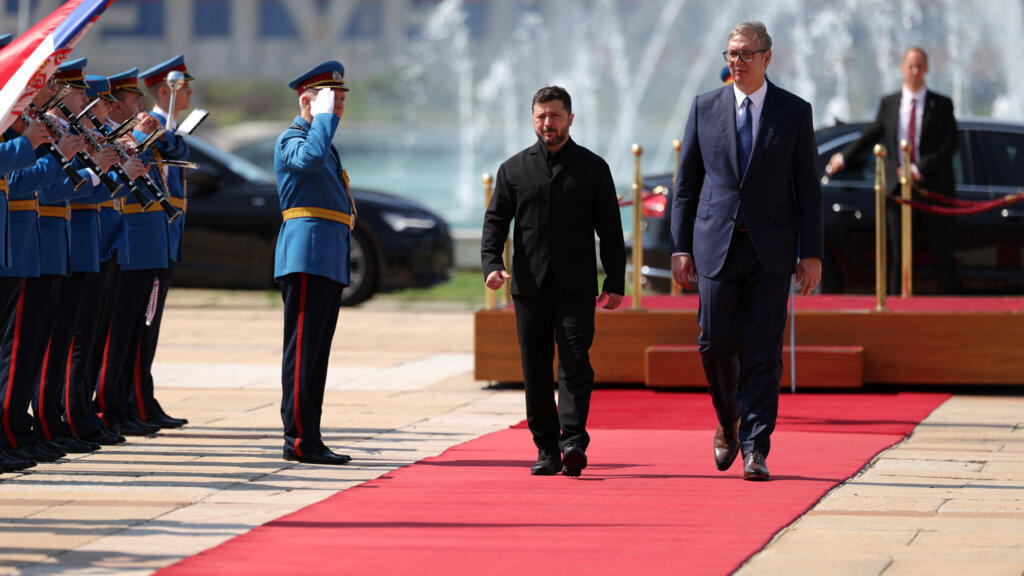
Ukraine has reached concrete agreements with the United States for monthly deliveries of interceptor missiles for its Patriot air defense systems, President Volodymyr Zelenskyy said at a joint press conference with Serbian President Aleksandar Vučić in Belgrade on 8 August.
The commitment does not close Ukraine's gap. Zelenskyy said the monthly volume remains insufficient and laid out a parallel effort to secure interceptors from Europe, the Middle East and further afield, as US shipments have thinned this year.
The US as the primary supplier
Repelling ballistic missiles has been a problem since the start of the full-scale war, and the search for a solution begins with the country that builds the systems, Zelenskyy said.
"From the first days of the war in Ukraine there was nothing to repel ballistic missiles. This is very difficult work. In which directions can this problem be solved? Well, first of all, who has anti-ballistic missiles and systems? The manufacturer. That is the United States of America, first of all. Can they help? We are working. Will they allocate us missiles every month? Yes. We have agreements," he said.
Asked whether that supply met Ukraine's needs, he answered: "Are these missiles enough? No." He added that the monthly volumes of American missiles had decreased this year compared with 2025.
Where else Kyiv is looking
Patriot missiles are also held by European countries, Zelenskyy said, naming Germany and Poland as able to substantially strengthen Ukraine's air defense. Kyiv is also in talks with Norway, the Netherlands and Middle Eastern states.
South Korea and Japan could potentially help but do not currently hand over such systems, which Zelenskyy attributed to restrictions in their domestic legislation and constitutions. Ukraine is separately discussing air defense with Israel; the president said Ukraine is ready to buy but that no such option exists at present.
"Every day I speak with one European state or another and with Middle Eastern states so that Ukraine receives additional missiles outside the American package. We are simply at the level where all our institutions must work on this, not only the president. Everyone must work, otherwise there will not be enough missiles," he said.
The Belgrade remarks came a day after Zelenskyy arrived on his first official visit to Serbia.
Zelenskyy had bilateral meeting with Serbian President Aleksandar Vučić. Vucic voiced support for Ukraine's territorial integrity and its path to the European Union.
What esle Zelenskyy and Vučić discussed
The two presidents held talks that ran across the countries' European integration, trade and energy cooperation, a prospective free-trade zone, and diplomatic paths to ending Russia's war on Ukraine. Vučić had said ahead of the meeting that he would discuss both countries' route to EU membership, along with economic and energy cooperation and other opportunities
On the economy, Vučić said the sides had reviewed infrastructure projects and the involvement of Ukrainian companies in Serbia. On peace efforts, Zelenskyy said the leaders had discussed diplomatic instruments capable of bringing the war closer to an end.
Before the press conference, the sides held a ceremony to sign a memorandum on cooperation in animal health and food safety. The document was signed by Serbia's Minister of Agriculture, Forestry and Water Management Dragan Glamočić and Ukraine's ambassador to Serbia Oleksandr Lytvynenko.
Territorial integrity
Vučić framed Serbia's position as a matter of UN principle and tied it to Ukraine's reciprocal stance on Serbia.
"We support the UN Charter, UN resolutions, and this means the territorial integrity of all UN members, which means the territorial integrity of Ukraine as well. Likewise we are very grateful to Ukraine for supporting the territorial integrity of the Republic of Serbia. And as far as we are concerned, we will continue this principled policy. There are no 'buts' on this question. This is being said very clearly and resolutely now," Vučić said.
Support on the road to the EU
Vučić said Ukraine could always count on Belgrade's support in EU accession, and the two discussed both countries' European path during the meeting.
"We wish for Ukraine to open all negotiating clusters as quickly as possible, to close them as quickly as possible, because this is the wish of the Ukrainian people, of the Ukrainian leadership. And speaking of ourselves, we have not had and will not have any problems regarding this in the future. On the contrary, everything we can do to help Ukraine on its European path, we will do," Vučić said.
Trade at $321 million in six months
Vučić said trade between the two countries is growing rapidly: while it stood at $450 million for all of last year, it had already reached $321 million in the first six months of this year.
"The most important import item is iron ore from Ukraine. And I believe that cooperation in the sphere of agriculture, but also in other spheres of energy, everywhere trade turnover can be greater. We discussed projects in the sphere of infrastructure, involving Ukrainian companies on the territory of Serbia. I believe we can have serious and good results in the future," the Serbian president said.
Vučić said he hoped cooperation between the countries would become "significantly stronger and larger-scale" after the war ends. In future, he said, Serbia and Ukraine could jointly export certain goods and enter third-country markets, in particular in Africa and Asia.
"I think we will yet see agreements on such cooperation. Yesterday we had long discussions, today the discussions were really good. I am grateful to President Zelenskyy for the visit to Serbia. I hope we received you properly. And I want to believe that our meetings in the future will be incomparably more frequent than they were before," Vučić added.
A free-trade zone by the end of 2026
Zelenskyy said negotiations on creating a free-trade zone between Ukraine and Serbia are under way, and expressed hope the agreement could be concluded by the end of 2026.
"Our teams must work well to speed up the agreement on a free trade zone between Ukraine and Serbia. These negotiations are progressing, this is positive. And it would be good to prepare everything by the end of this year for concluding the agreement on free trade between Ukraine and Serbia," the Ukrainian president said.
Damaged energy grid and a Serbian humanitarian package
Zelenskyy described the state of Ukraine's infrastructure under Russian strikes.
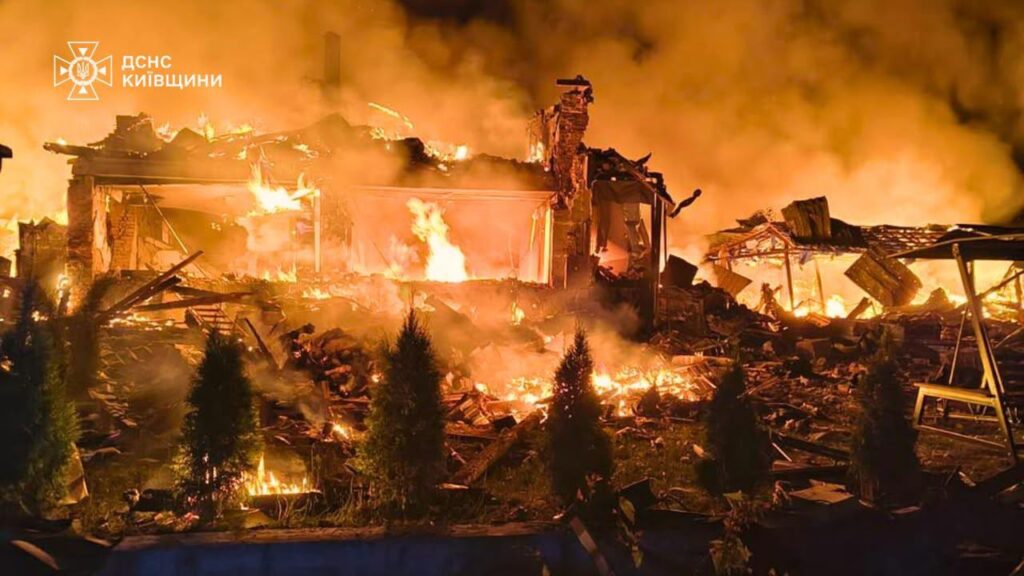
"For the fifth year now we in Ukraine are forced to go through all these strikes. Russian strikes are aimed mostly at facilities that work precisely for the life of the people. We have virtually no undamaged power plants left. Many railway stations are destroyed, hospitals, universities, ordinary civilian enterprises. In a time of such a war we appreciate and are very grateful for all the support that Ukraine receives from other countries, from other peoples," Zelenskyy said.
He said Ukraine continues to expand all formats of cooperation with partners to give communities and people "more resilience, more capacity to hold out despite all the challenges of the war."
Zelenskyy said Serbia would provide Ukraine with a humanitarian aid package. "We are grateful that there will be a new package of humanitarian support from Serbia for Ukraine, in particular in the sphere of medicine, in the sphere of energy. This is very important for us," he said.
Diplomacy to end the war
Zelenskyy said the leaders had discussed diplomatic instruments that could bring the war closer to an end, and pointed to capitals with influence over the process.
"It is important that everywhere in the world they know what we want, and this is true, and this is a fact, we want a dignified peace, that every opportunity be used for the sake of peace, for the sake of guaranteed security. All available opportunities that exist in Washington, and in Beijing, in the capitals of Europe, our partners in the Middle East, in the Gulf, in all the capitals of the world that have influence over the relevant processes," Zelenskyy said.

 Connexion