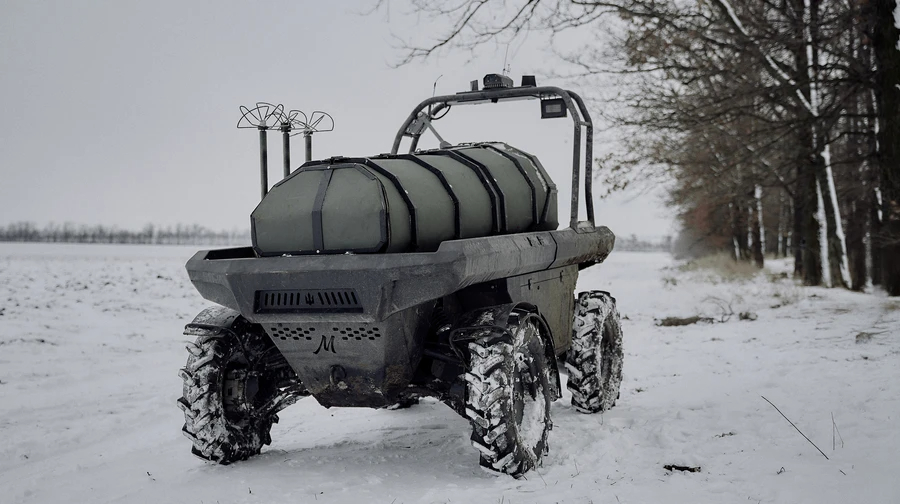
Ukraine's ground robots ran more than 100,000 missions in the first eight months of 2026. The Defense Procurement Agency will now buy logistics and strike ground robotic complexes according to specifications set by the Defense Ministry, rather than approving models one at a time, the ministry announced.
The mechanism is three days old. The agency applied the same structure to fiber-optic FPV drones on 22 August—classes, multiple lots each, no supplier above half a class. Ukraine is standardizing how it buys entire weapons categories, one category at a time.
The rules sort makers by class
Complexes will be divided into classes by operating range and payload, with four to five lots per class. No single manufacturer may take more than half the order within one class.
Suppliers must meet the technical specifications and hold at least one codified ground robotic complex. The procurement runs in a closed environment under defense security requirements.
"A tender is one of the best instruments for this, because we can buy more equipment for the same money and minimize the risk of supply disruptions by splitting the order among different manufacturers," Deputy Defense Minister Mstyslav Banik said.
Mission volume keeps climbing
Monthly figures of ground robot missions logged in the DELTA combat system rose almost without interruption: 7,511 in January, 11,028 in April, 19,969 in July. Units recorded another 15,729 between 1 and 20 August, about 790 a day compared with roughly 640 a day in July, The Defense Post reported.
Ukraine has contracted more than 22,000 ground robots since January, nearly double the total for all of 2025. The number of units operating them grew from 117 at the end of 2025 to 230 by mid-2026.
A commander disputes the evacuation case
The ministry lists casualty evacuation as one of the tender's purposes. A frontline officer challenged that three days ago.
Tetiana Chornovol, who commands an anti-tank guided missile platoon, said ground robots are too slow for evacuation and often easy targets for Russian drones, arguing brigades need staffed evacuation teams and small light-armored vehicles instead.
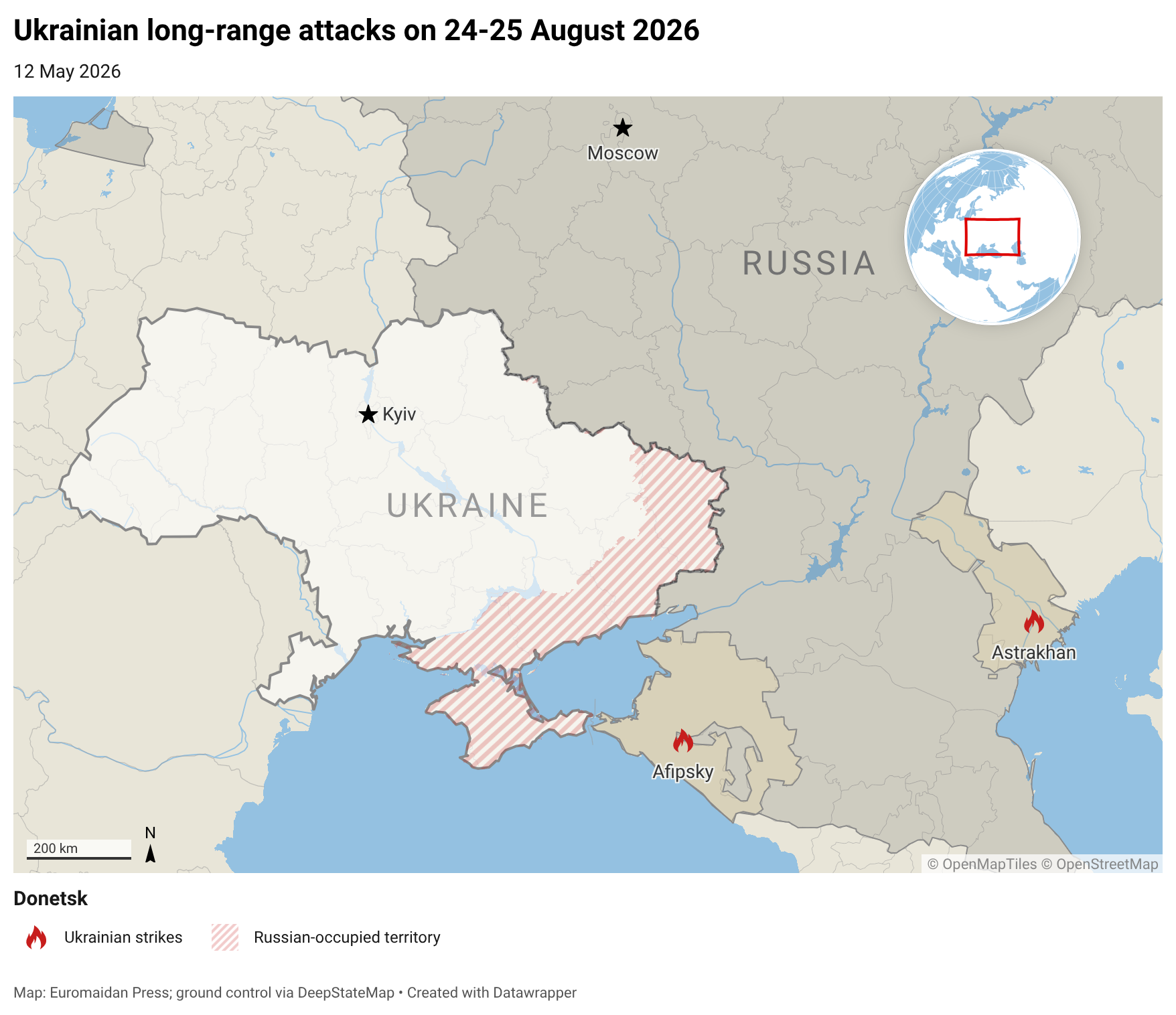
Ukrainian drones struck the Afipsky oil refinery in southern Russia overnight on 25 August, monitoring Telegram channels reported. Regional authorities claimed falling drone debris caused fires. Ukraine's General Staff later confirmed the strike, and, in the same post, a hit on a gas processing plant in Astrakhan Oblast the night before.
Ukraine's long-range drones reach deep into Russia against refineries and fuel depots, but also arms plants, military bases, rail nodes, and the warehouses of Russia's biggest online retailers — straining the economy and cutting the oil revenues that feed the war machine.
Fire at the plant, and Russia's debris account
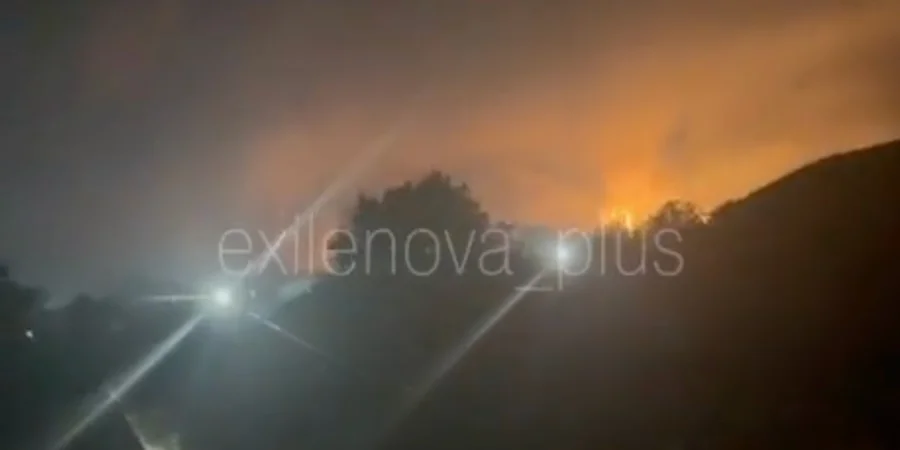
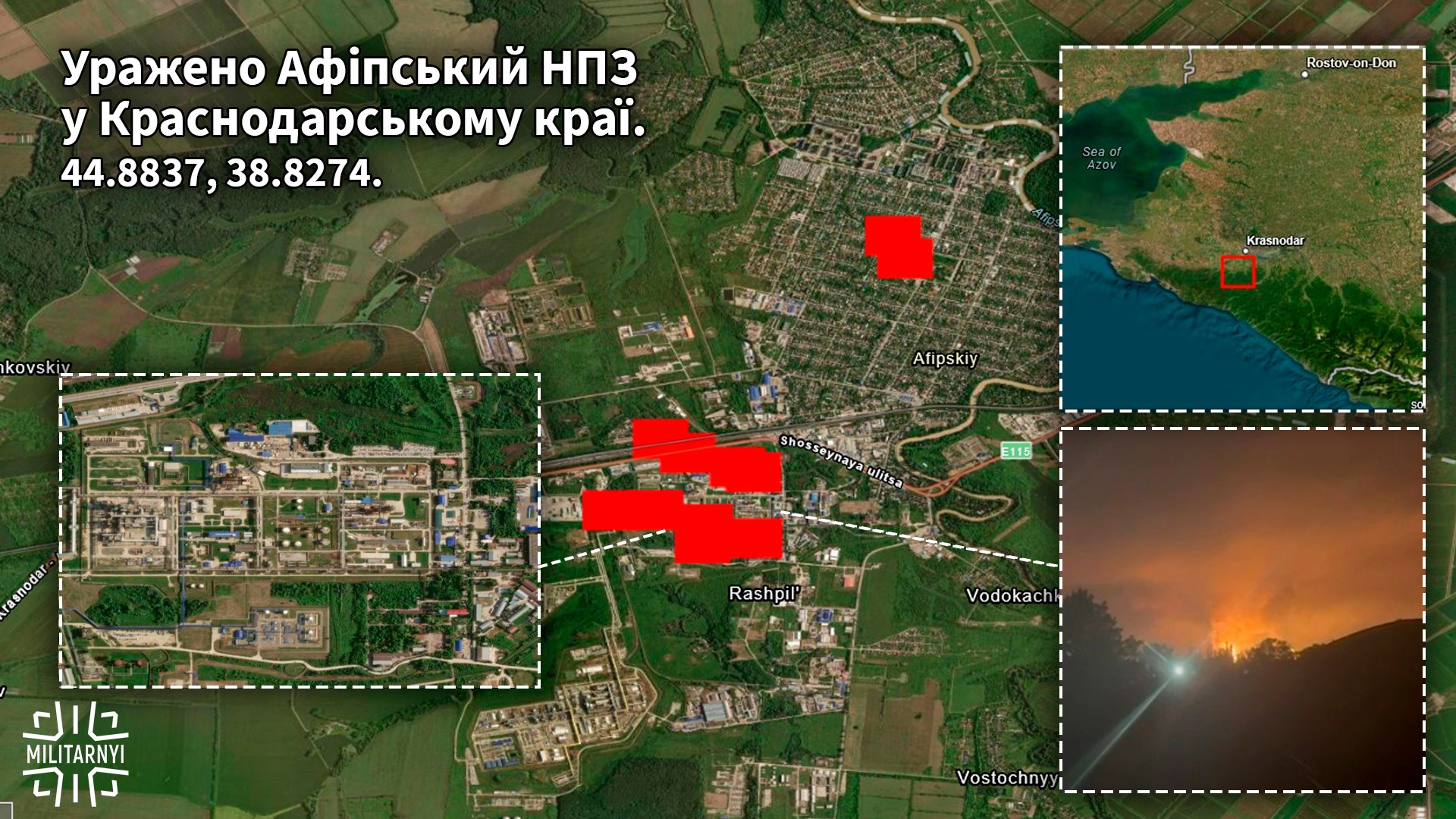
Initially, the Ukrainian monitoring Telegram channels Exilenova+ and Supernova+ reported the strike, publishing footage of the fire and placing one burning storage tank on the plant's grounds. NASA's FIRMS satellite fire data confirmed the burning site, Militarnyi reported.
Fire-detection points at the Afipsky oil refinery and in Afipsky settlement, Krasnodar Krai, Russia, 25 August 2026, with insets showing the plant, its location southwest of Krasnodar, and the fire at night. Map: Militarnyi analysis using ESRI mapping and NASA FIRMS data
The Krasnodar Krai operational headquarters stated that falling drone parts started the fire. Governor Veniamin Kondratyev claimed that debris fell on the grounds of the Afipskaya railway station, killing two people and injuring two more, and stated that fires broke out in the nearby settlement and at the refinery itself.
Ukrainian forces struck two U-272 gas separation units at the Astrakhan gas processing plant the night before, the General Staff wrote in the same post. That plant makes technical sulfur, which goes into explosives.
Drones also attacked Rostov Oblast overnight, with the Novoshakhtinsk refinery as the target, according to Supernova+.
Afipsky ranks among the largest refineries in southern Russia and handles more than 2% of the country's refining, Ukrainian sources said. Reuters, citing industry sources, put 2024 throughput at the plant together with the linked Krasnodar refinery at 7.2 million tons. Reuters also described it as export-oriented and not currently making commercial gasoline or diesel for the domestic market, a narrower picture than the product list Ukrainian sources give. Ukraine's military has previously described Afipsky as a producer of motor fuels for Russia, involved in supplying the Russian army.
The refinery Ukraine keeps targeting
Drones have reached the plant repeatedly this year, in January, March, June, and July, making the latest hit the fifth since the start of the year, The Moscow Times counted. In the July case, the Russian news Telegram channel Astra said the fire started near the tank farm.
Ukrainian drones have attacked Russian refineries more than 70 times since the start of 2026 and knocked several dozen plants out of service, The Moscow Times said, while Ukraine's General Staff counted 194 strikes on refineries in the first half of the year alone. Five stopped processing entirely after strikes since 1 August: Permnefteorgsintez, Orsknefteorgsintez, Zapsibneftekhim, and the Saratov and Volgograd refineries, the outlet said.
Ukrainian investigators recovered an unencrypted American AI module from a Russian Molniya drone that killed three civilians near a Zaporizhzhia gas station on 6 July, and read the code that guided its targeting, the New York Times reported. No human operator made the final call.
Commercially sold AI boards have been turning up inside Russian strike weapons for more than a year, and autonomy is the direction both armies are moving in. What changed is the evidence rather than the technology. Until now, autonomy had to be inferred from what a wreck lacked—an antenna, a radio trace.
Tetiana Bubynets, a 19-year-old accounting student at Zaporizhzhia National University, was declared dead at a hospital, one of her professors said. Oleksii Svirin, 41, and Roman Karpii, 48, later died of their injuries. The drone had attempted to navigate around an apartment building toward the gas station's propane tanks but struck a wall and detonated near people sheltering there.
What investigators found in the wreckage
The wreckage contained an Nvidia Jetson Orin minicomputer, an off-the-shelf AI module that costs a few hundred dollars. The chip was not encrypted. Ukrainian officials said they could read the terrain imagery loaded for visual navigation and the object-detection code that defined what the drone was trained to target, NYT reported. The drone carried no radio antennas and was flying in a wave of approximately six, none of them transmitting. A missing antenna alone would not prove self-targeting—a drone flying a preprogrammed route needs no antenna either, but it would have no use for an Nvidia chip.
Human operators had programmed the drone to fly toward the gas station and set the general target area before launch. Once near the site, the onboard system identified and selected the specific object—most likely propane tanks it had been trained to recognize—on its own, drone experts and military officials said. Vadym Kushnikov, a drone expert at the Kharkiv Aviation Institute, described the drone as "a preprogrammed tool trained in virtual reality to track specific objects," NYT reported.
Russian Molniya kamikaze drones. Photos from Russian sources via Militarnyi
Where else the Nvidia module has turned up
Kateryna Bondar, a senior fellow at the Wadhwani AI Center at the Center for Strategic and International Studies in Washington, told NYT that no earlier Russian strike by a self-targeting drone has been documented killing civilians, which would make 6 July the first such case on record. She called the Nvidia module "the best proof" that Russia was experimenting with autonomous AI.
The Jetson Orin is not new to the battlefield. The module is made by the American chipmaker Nvidia. Ukraine's sanctions on Russia's AI drone supply networks, imposed in August 2025, hit Russian, Chinese, and Belarusian drone developers and component suppliers—not Nvidia.
Ukrainian intelligence first identified the module in the V2U autonomous strike drone in June 2025, mounted in a Chinese Leetop A203 minicomputer. It has since reported Jetson-based AI modules in Russia's Lancet and Klin drones—the Klin an older Jetson TX2—and, most recently, in the S-71 Monokhrom cruise missile.
In those cases, the finding was the hardware, and what Ukrainian intelligence inferred from it. This time, the code itself was legible.
Nvidia confirmed to NYT that the photographed board was a Jetson Orin. The company said the minicomputer is a consumer-grade product "sold to students, developers and start-ups for a wide range of beneficial applications," that it does not sell the computer in Russia, and that it is widely available through resellers.
Zaporizhzhia as testing ground
Russia began test flights of AI-guided Molniya drones in May, and had begun testing self-targeting systems in the V2U several months earlier, some of those for last-mile guidance only, Ukrainian air defense experts told NYT. Local air defense officials said Russia has been aiming at civilian objects—pumps and propane tanks at gas stations—along with military recruitment centers while trying out autonomous drones in Zaporizhzhia. Why those targets were chosen for the tests is not clear.
Gas stations have been under sustained attack independently of the AI trials. Russia has destroyed approximately 200 across Ukraine since spring, around 50 in June alone, by UNITED24 Media's count.
In Zaporizhzhia, gas stations now prop plastic sheeting at odd angles around propane tanks to confuse the drones' image recognition, and Ukraine has turned to shooting down drones that electronic warfare cannot jam.
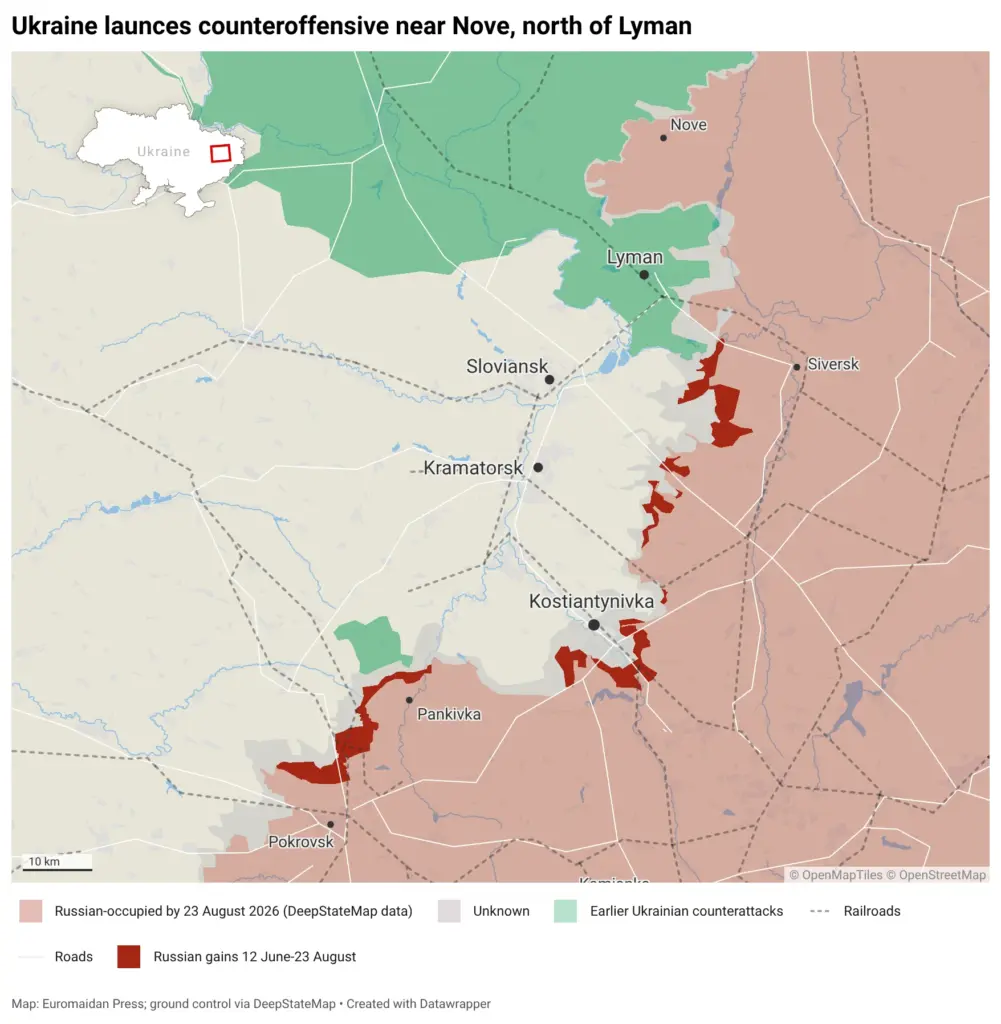
Without much fanfare, Ukrainian forces have been counterattacking north of Lyman in eastern Ukraine's Donetsk Oblast
The Ukrainian advance takes some pressure off the free city of Sloviansk, just 20 km to the southwest
The problem is: the Russians are advancing toward Sloviansk and Kramatorsk from several other directions
Russian forces are fighting against time to close a pincer around the last free cities in eastern Ukraine. The deadline: the coming winter, which will strip the leaves from the trees and leave any attacking force exposed to overhead surveillance and attack.
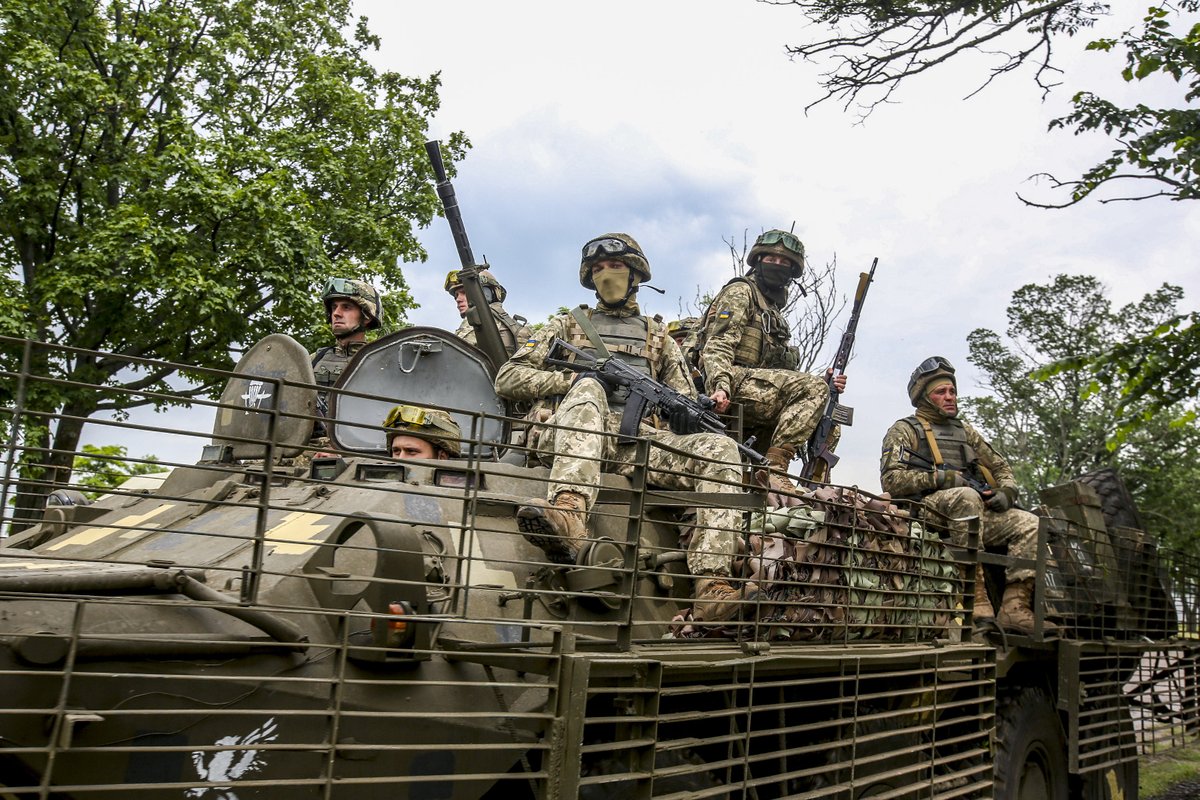
But in one key sector, Ukrainian forces are spoiling the coordinated Russian operation to partially surround Sloviansk and neighboring Kramatorsk. With admirable operational security, or OPSEC, a clutch of Ukrainian brigades under the 3rd Army Corps hasn't just blunted the advance of the Russian Center Group of Forces—it has pushed the Russians back.
This Ukrainian counterattack along the axis through the town of Lyman, ongoing since May, has largely escaped widespread notice. Yes, there is some scant video evidence of Ukrainian attacks. And yes, a few analysts have adjusted their maps to account for apparent Ukrainian advances, especially in the direction of Nove, a Russian-occupied village 15 km north of Lyman, which itself lies 15 km north of Sloviansk.
Ukrainian forces have been conducting for weeks two unnoticed counter-attacks in two directions of the frontline.
With barely any geolocation, the Ukrainians kept a good level of OPSEC and the russians have been reluctant to publish videos from these areas.
But for the most part, Ukrainian and Russian sources have avoided talking about Lyman. "The Ukrainians kept a good level of OPSEC and the Russians have been reluctant to publish videos from these areas" depicting their retreats, analyst and mapper Clément Molinnoted in June, just a few weeks after the Ukrainians attacked toward Nove.
Molin, for one, expects the OPSEC to lift in the coming days. "By the end of the month, we should have an official update on the good results of a Ukrainian offensive that has largely remained secret," he wrote on Monday.
Situation near Nove as of 23 August. Map: Euromaidan Press
April offensive
The Ukrainians' limited counteroffensive around Lyman apparently kicked off on in mid-April. One of the first attacks that left any real evidence occurred on 22 May, when a small Ukrainian mechanized force—perhaps from the 60th or 66th Mechanized Brigade, the 77th Air Assault Brigade, or the Presidential Brigade—attacked in armored trucks and M-113, Stryker, and BTR-4 armored personnel carriers. Heavy bomber drones flew top cover.
The Russian 144th Motor Rifle Division fought back with its own drones. Interceptor drones took aim at the bombers. First-person-view and heavy bomber drones blasted at least one BTR-4, hitting it before and after it dropped off its infantry passengers. Drones struck some of the disembarked Ukrainian infantry.
How many Ukrainian troops survived and entrenched in new positions on 22 May is unclear. Regardless, the Ukrainian 3rd Army Corps wasn't done with Nove. Attacks continued. And sometime after the 22 May assault on Nove, "the Ukrainians managed to consolidate their gains," Molin concluded after scrutinizing a few videos and some satellite imagery.
By early July, Ukrainian forces had succeeded in "operationally encircl[ing] the Russian forces defending the village of Nove," according to analyst and mapper Thorkill. "Fierce fighting is currently underway to expel the Russians from that locality," Thorkill reported at the time.
Sytuacja w rejonie Nowego (Łyman).
Jednym z odcinków frontu w Donbasie, na którym wojska ukraińskie prowadzą obecnie działania zaczepne, jest rejon wsi: Nowe – Zełena Dolyna, na północ od Łymanu. Od połowy maja 2026 r. pozycje rosyjskiej 144 Dywizji Strzelców Zmotoryzowanych… pic.twitter.com/2EJQgz4eps
The aim of the Ukrainian counterattacks is obvious. The 3rd Army Corps intends to put pressure on the northern right flank of 10 km-by-10-km salient jutting into the battleground north of Lyman. The Russian 144th Motor Rifle Division has been pouring troops into the salient, clearly intending to surround and isolate Lyman instead of directly assaulting it—all in order to clear a path toward Sloviansk.
Salients are risky for both sides, however. The farther the Russians extend their Lyman salient, the more exposed they are on their flanks. The Ukrainians know this. And even if the 3rd Army Corps can't fully cut across the salient in order to surround the Russians inside of it, the corps can at least take advantage of the salient's exposed flanks.
Capturing Nove, on the very northern edge of the salient, could allow the Ukrainians to bring to bear more artillery and drones on the Russians south of Nove. The 3rd Army Corps doesn't have to fully encircle the Russian troops closest to Lyman in order to hammer them with withering firepower.
Explore further
Ukraine’s quiet counteroffensive took 745 square km. Russia’s dead Starlink is how
Just how successful the 3rd Army Corps has been in its local counteroffensive could become clearer very soon. That won't spell lasting relief for Sloviansk and Kramatorsk, however. Fighting against the clock as summer begins turning into fall and then winter, the Russians are slowly advancing toward the twin cities from several directions.
The siege of Kramatorsk and Sloviansk is coming. Perhaps not this year, but surely by 2027. To fully safeguard the twin cities, the Ukrainians would need to duplicate their success north of Lyman along several other directions.
That's a big ask of a Ukrainian force that's overall still outnumbered and outgunned.
Russian President Vladimir Putin has made inadequate drone defenses and slow repairs grounds for putting private assets under state management. His 24 August security decree opens a new way to government control over Russia’s economy.
It expands a mechanism Russia has used against foreign-owned businesses since 2023, according to research by Nektorov, Saveliev and Partners (NSP), a Russian law firm that tracks state takeovers.
The text does not specify what counts as “ineffective” drone protection or how quickly a facility must be restored.
A business need not lose a facility before the measure can apply. Decree No. 604 allows action over late security measures, safety violations, conduct that endangers normal operations, ineffective counter-drone steps, or delayed restoration.
The text does not specify what counts as “ineffective” drone protection or how quickly a facility must be restored. Covered sectors include energy, industry, communications, utilities, transport, logistics, and life-support infrastructure, plus any sites deemed important to Russia’s security or economic stability.
Foreign controllers are also covered, including foreign organizations and citizens controlling Russian companies. Temporary management can reach all or part of an entity’s Russian property, securities, stakes in Russian companies, and other property rights—the rule is not limited to the damaged or vulnerable facility alone.
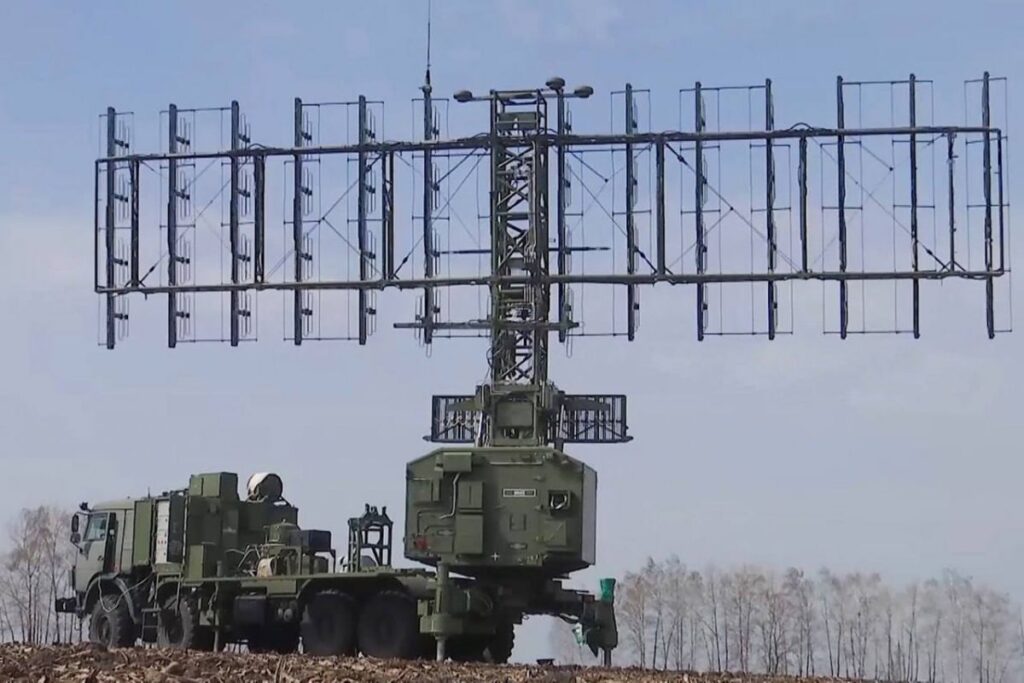
A mobile Russian air-defense radar pictured in April 2024. Russia’s new decree lets the state take control of wider company assets when drone defenses are deemed inadequate. Photo: United Russia.
“Temporary” control has no deadline
At the same time, the text mentions no automatic return deadline. Putin must instruct the government to begin temporary management and then end it. By default, the Federal Property Management Agency assumes the owner’s powers, except for the right to dispose of the assets. The assets’ costs will be covered from its income.
Interfax published Denis Manturov’s remarks. The first deputy prime minister said the measure would be used selectively for specific security tasks and would leave formal ownership unchanged.
Komsomolskaya Pravda’s Alexander Kots raised a practical problem: Russian law, he wrote, gives businesses no instructions for defending sites against drones or cruise missiles, while barriers require extensive approvals, and private guards cannot easily be given weapons more powerful than shotguns.
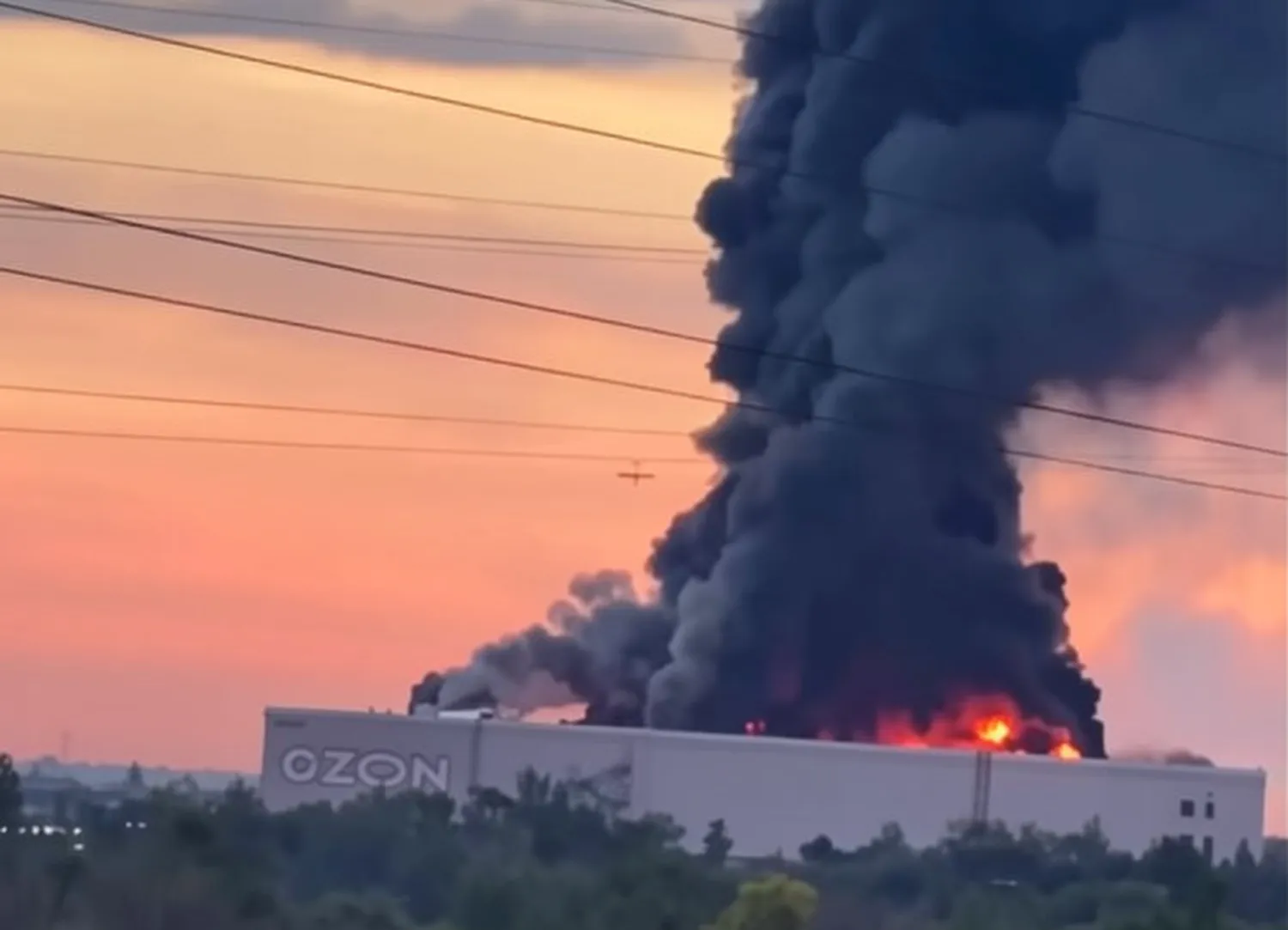
The decree followed weeks of Ukrainian attacks on Russian refineries, ports, and warehouses. Ozon reported six disruptions at its facilities after 22 August. The listed retailer’s shares fell as much as 29.09% from Friday’s close on Monday, after five weeks of strikes on privately held Wildberries.
Explore further
Why did Ozon fall as much as 29% while Russia’s market lost 2.9%?
NSP’s nationalization study records more than 100 cases since 2022 and about 6.5 trillion rubles (about $78 billion) in seized assets. It says cases averaged one court hearing and roughly two months.
The NSP temporary-management table lists several foreign-owned businesses placed under “temporary” management from 2023 whose owners still lack access because the arrangements remain indefinite.

 Connexion
 forces have been conducting for weeks two unnoticed counter-attacks in two directions of the frontline.