Baltimore project to be partly funded by US government but owned by defense firm Anduril, founded by Palmer Luckey
Donald Trump on Tuesday announced the opening of a new $6.6bn shipbuilding factory in Baltimore, partly funded by the US government but owned by Anduril Industries, a politically connected defense company.
Trump’s appearance at a currently unused shipyard in Sparrows Pointis a boost to Anduril, whose founder, Palmer Luckey, is a major GOP campaign fundraiser. Luckey has hosted campaign fundraisers for at least 20 Republican politicians, including Trump, the Guardian reported in August. He has given $5.9m to Republican causes since 2017.
Russian missiles and drones destroyed 13 million Ukrainian books this summer, The Guardian reported. That is about a third of all books printed in Ukraine this year, the government estimates.
Russia is striking civilian warehouses, including those where publishers store their books. The uncertainty is pushing publishers toward safe international bestsellers, Publishers Weekly reported. "We'll all end up fed up with safe, non-risky books—if there are still publishers around to publish them," said Iryna Baturevych, co-founder of the publishing news outlet Chytomo.
Millions of Ukrainian books on fire
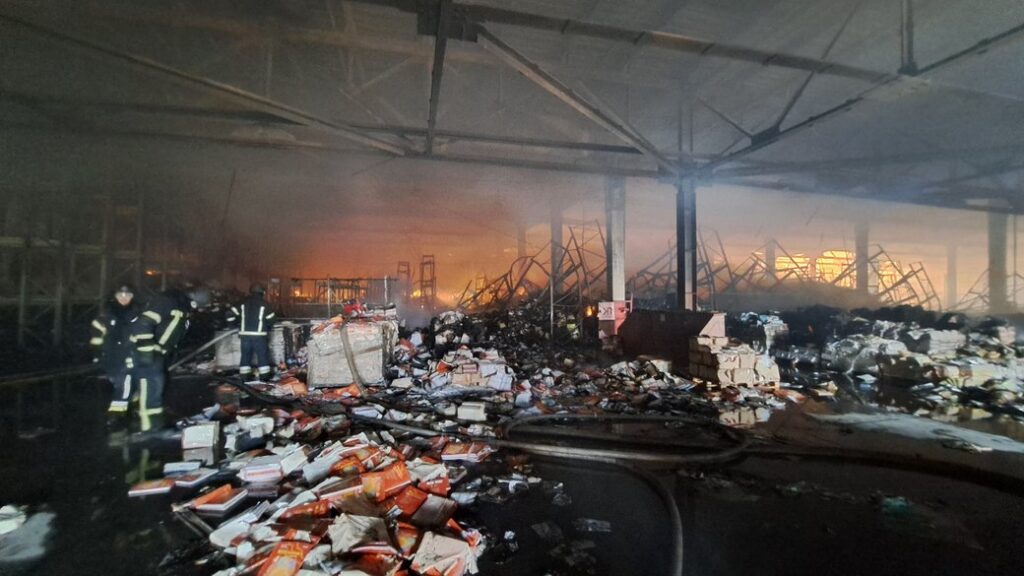
Ranok is one of Ukraine's largest publishing houses and a leader in children's literature and school textbooks. On one day in August, Russia destroyed more than 85% of its stock, The Guardian reported.
Viktor Kruhlov, the publisher's co-founder and chief executive, was on the warehouse floor at its headquarters in Kharkiv. The facility, built on the site of a former bread factory, covered about 10,000 m².
Together with five senior colleagues, he was discussing plans for the upcoming school year, the peak of the distribution season. Moments after the meeting began, a strike hit about 30 meters from where the staff had gathered. Kruhlov heard an explosion and almost at once saw a huge fire. As colleagues tried to put out the flames, a second strike came, and he realized there could be a third and a fourth, so the staff evacuated. Fifty people were on shift that day, and no one was injured, Kruhlov told The Guardian.
Eight million books, including 628,000 new school textbooks, were in the warehouse at the time. None could be saved. Firefighters battled the blaze for a week.
Several editorial staff members who saw the remains of the warehouse for the first time looked shaken as they recognized fragments of books they had helped create.
"When you see what was produced with your brain, with your hands, with your imagination, spoiled by Russia, it's an awful feeling," Kruhlov said.
He predicted shortages at Ranok's stores this fall, when the books in stock run out and there is nothing to replace them.
Literature is part of Ukrainian identity
Kruhlov is convinced that Russia deliberately targeted the book warehouse, but Bohdana Laiuk, Ukraine's deputy culture minister, sees the strikes as part of Russia's broader campaign against warehouses, The Guardian wrote.
"They cannot occupy Kyiv. So they target warehouses around Kyiv to take the possibility of everyday life from us—and books are part of everyday life," she said.
Books also matter to Russia's occupiers, Laiuk said.
"When the Russians occupy, the first thing they do—and we know this from the areas that were occupied and then liberated in 2022 in the Kherson and Kharkiv regions—is to go to the libraries, take the Ukrainian language books out, and destroy them," Laiuk said.
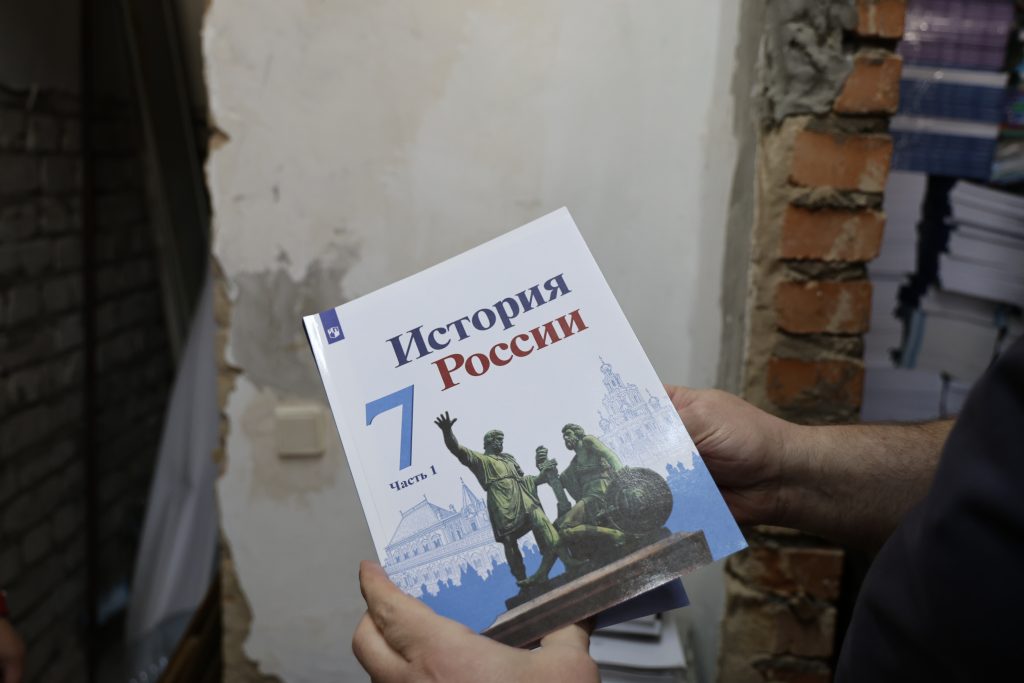
One of the Russian history textbooks that Russian troops brought to a school in Kherson Oblast, summer 2024. Photo: Ivan Antypenko
Before 2022, about 70% of the Ukrainian book market consisted of Russian-language titles, most of them imported from Russia.
Russian dominance in Ukrainian publishing developed over centuries, from tsarist bans on publishing in Ukrainian in the 19th century to Soviet Russification. Ukrainian writers were purged, and Ukrainian literature stayed in the shadow of Russian literature, the article notes.
Laiuk calls the dominance of Russian books a form of colonialism. Russia deliberately built its own information space in Ukraine through books, media, and television, she argues, so that everything would be ready for it once its tanks arrived.
Even after independence, a commercially successful Ukrainian-language novel was long seen as unlikely. But at the start of the full-scale invasion in 2022, Ukrainian bookstores stopped selling Russian imports, and interest in Ukrainian literature grew, from 1920s classics and poetry to contemporary authors and translations.
"So people are asking: what does it actually mean to be Ukrainian? Literary culture gives us the place to understand who we are," Laiuk told The Guardian in 2023.
The future of Ukrainian literature is uncertain
Ranok is now rushing to reprint textbooks and bestsellers: schools need the former, while sales of popular titles will help the publisher make up for lost revenue.
Shelves at the renovated Ranok bookstore during its opening in Rivne, June 2022. Photo: Rivne City Council
For debut authors and writers of less commercial or experimental books, the situation is particularly difficult. Even before the strike on Ranok's warehouse, some publications had been delayed by attacks on printing infrastructure.
Ksenia Shpak's debut novel, an urban fantasy about a girl displaced from eastern Ukraine to the Carpathians, was due out in February 2025 but was published only that November, the article says. Half of the print run was in Ranok's Kharkiv warehouse when it was attacked.
It was her first published book, and Shpak fears the publisher will now focus on bestsellers and reprint her novel only if money allows. The Ukrainian book market is also feeling demand level off and the cost of living rise, she said.
Despite the loss of 8 million books, Kruhlov remained optimistic. Looking over the ruined warehouse in Kharkiv, he said he planned to rebuild everything—and to do it better.
At least 25 injured at block party shooting in Georgia and three wounded in Baltimore park shooting, officials say
Two people were killed and at least 25 others injured when a shooting erupted at a homecoming block party in Vienna, Georgia, early on Sunday, according to authorities.
In another high-profile mass shooting in the US over the weekend, a 12-year-old girl was shot and killed and three other people were wounded after gunfire evidently broke out over a parking spot in a Baltimore park on Saturday, officials said.
You can still buy a Singapore Sling in the colonial-era hotel where it’s said to have been invented more than a century ago. Custom versions have arisen nearby.
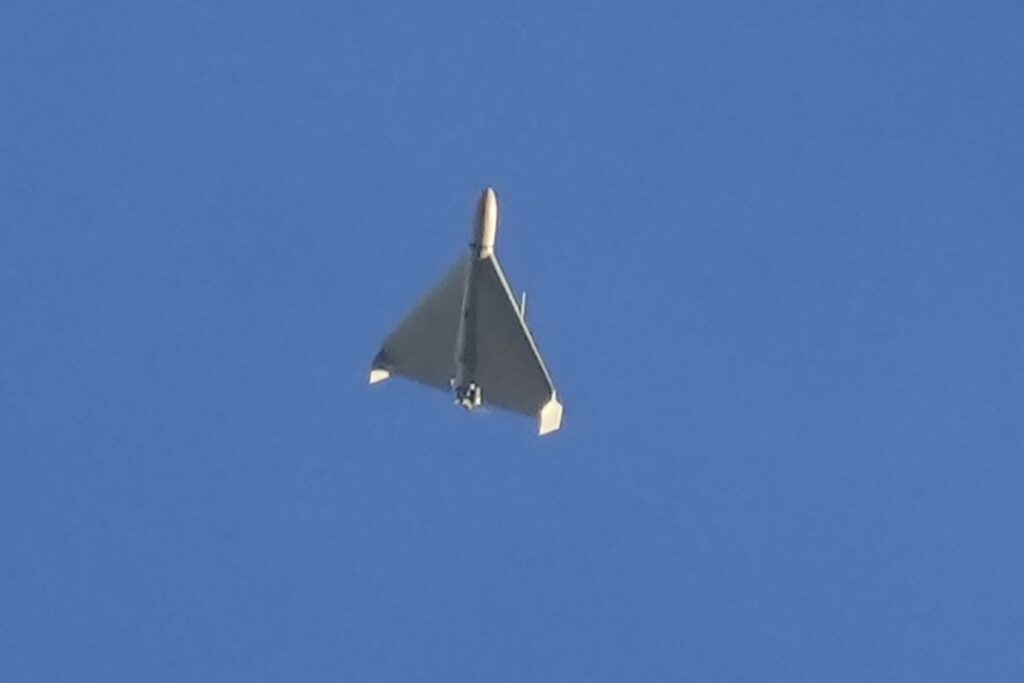
An unknown drone has flown right up to the US missile-defense base in northern Poland, and how the military responded has raised questions about how well the site is protected from the air. Rather than shoot the drone down near Redzikowo, a cornerstone of NATO's missile shield, the unit followed a set of procedures that included a call to 112, Poland's civilian emergency line, Onet reported.
Meanwhile, European intelligence officials are considering the possibility that Russia could test NATO’s resolve in the near future. According to one official, a potential attack could occur “within months, not years," The Guardian reports.
Surveillance systems detected the drone about half a kilometer from the base on 15 September, where it operated for roughly five minutes.
This incident is linked to a similar one in 2025. Almost a year ago, also in September, around 19 Russian drones crossed into Polish airspace. Poland shot down only four Russian drones with modern Polish F-16s and Dutch F-35s. Meanwhile, Ukraine downs 87.4% of Russian long-range drones. Poland only shot down 17-21% of the drones that entered its airspace.
The base sits at the heart of NATO's shield
Redzikowo hosts the US Navy's Aegis Ashore installation, an American component of NATO's missile-defense system and one of the most sensitive military sites in Poland. It matters strategically to Poland, NATO, and the US. While American personnel guard it, Poland has taken primary responsibility for its security and assigned a dedicated unit.
Even before the base opened, there were efforts to secure anti-drone systems for it, on the logic that a site best protected from the ground can stay exposed from the air.
The ministry keeps its methods quiet
The Polish Defense Ministry says it established where the operator was flying from, notified the relevant services, including the police, and treats every case of unauthorized drone activity near a guarded site seriously. What it will not say is whether it tried to neutralize the drone, or whether the anti-drone and electronic-warfare systems at Redzikowo were used at all, citing security.
Warnings pile up across the flank
The stakes are rising along NATO's eastern edge. Prime Minister Donald Tusk told parliament on 17 September that, by the assessment of NATO, Ukrainian, and US intelligence, Russia's plans include drone and missile strikes on countries backing Ukraine, Poland among them, possibly staged to look "accidental" and test whether Article 5 means anything. Warsaw insists it is ready and will hit back at any attack. The Redzikowo drone, and the four-of-nineteen record behind it, are why that confidence keeps drawing questions.

 Connexion