The US president’s need to assert dominance is igniting patriotism abroad and a backlash at home
What do bullies do when someone stands up to their bullying and punches them in the face? They look for someone weaker to bully who won’t punch back.
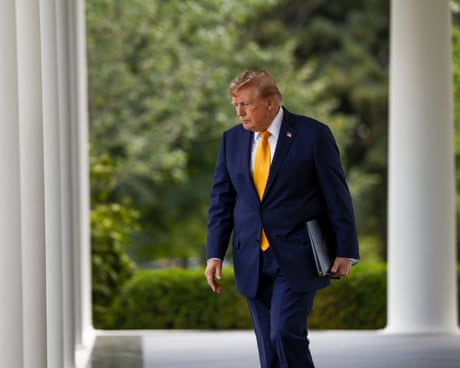
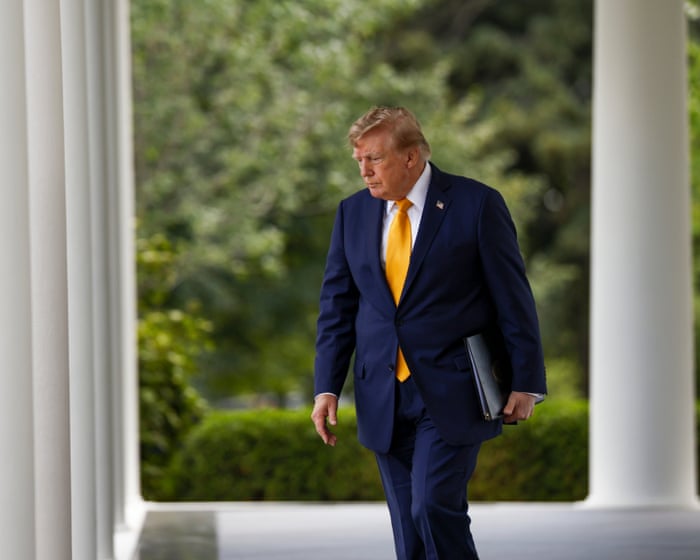
Presumably that’s why Donald Trump has now taken on Canada, after Iran punched back so hard in the cage match the US president began more than six months ago as to leave him humiliated and baffled.
Mark Carney has rebuked Donald Trump’s administration and urged officials in Washington to “start being serious” amid escalating trade tensions between the US and Canada.
Days before Canada is due to retaliate against Trump’s sweeping tariffs with its own duties on US goods, the Canadian prime minister criticized US officials for insulting his country. “It is beneath their office,” he said.
Democratic senator Chuck Schumer is introducing a bill that would reverse Donald Trump’s most recent tariffs, among them the new 50% duty on Canadian goods, MS Now reported.
While the Senate minority leader’s proposed legislation has virtually no chance of becoming law, Schumer hopes that his proposal shows that Democrats are actively fighting the affordability crisis. Schumer first shared his proposed legislation with MS Now.
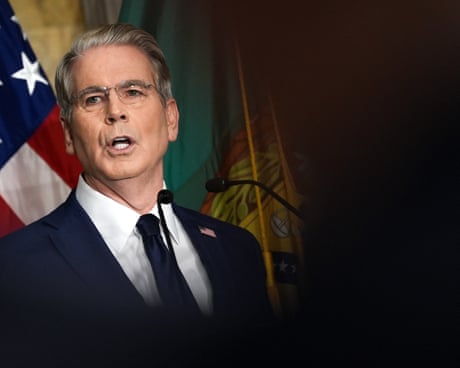
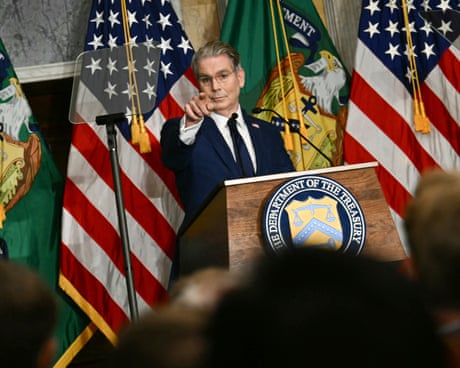
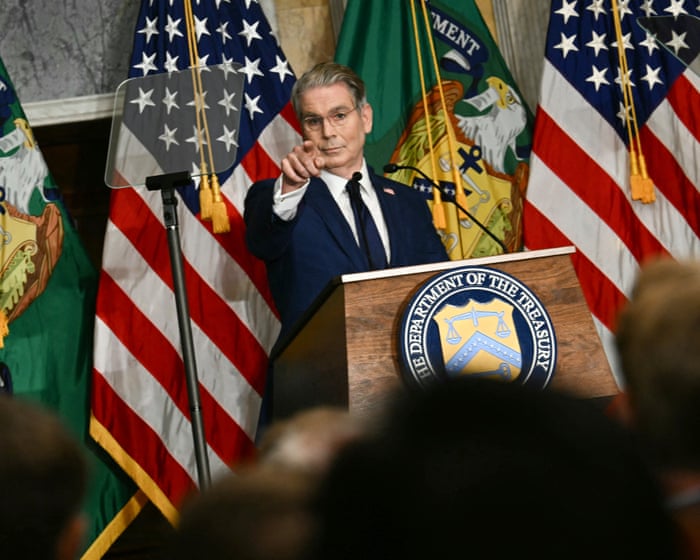
We’re watching today as Scott Bessent, the US treasury secretary, and Kevin Warsh, the chair of the Federal Reserve, deliver their opening remarks at the G20 meetings in Asheville, North Carolina.
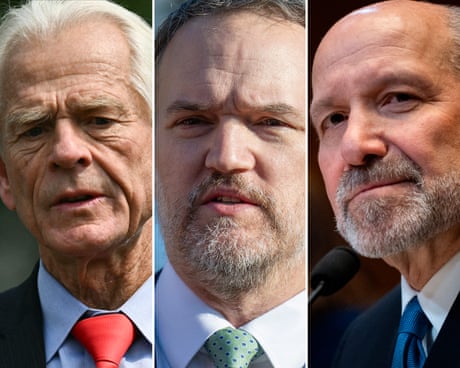
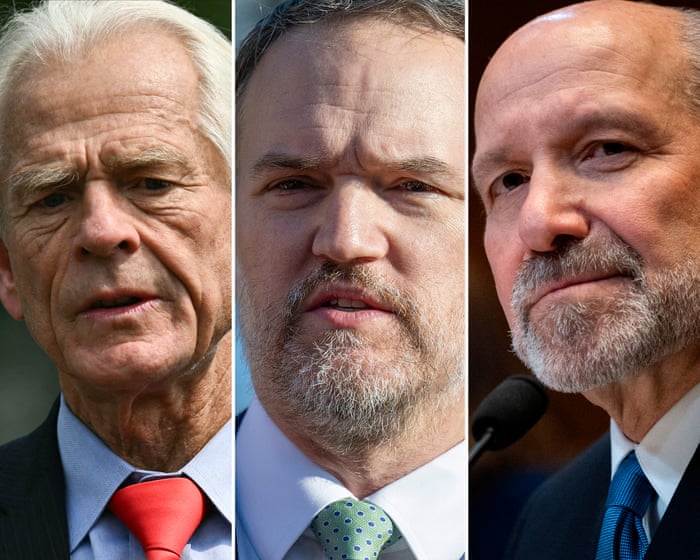
US trade representative Jamieson Greer has a level-headed reputation but commerce secretary Howard Lutnick and White House adviser Peter Navarro also have key roles
Having reportedly read Victor Hugo’s Les Misérables, in French, during a military tour of duty in Iraq, Jamieson Greer considered himself an unlikely target for accusations of francophobia.
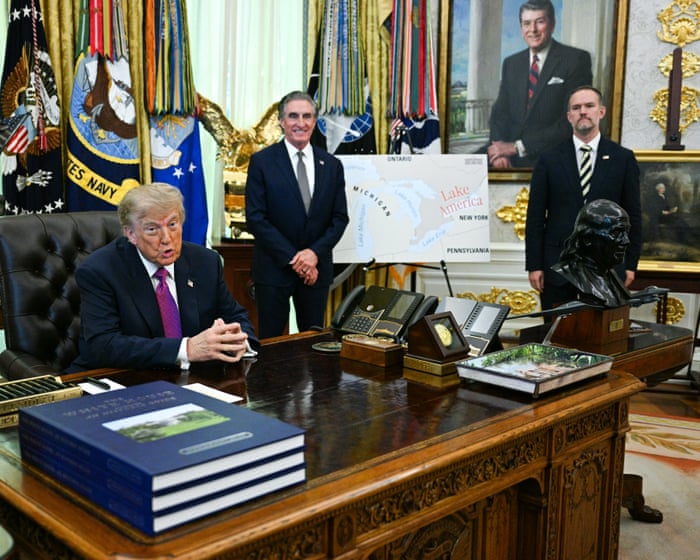
But Donald Trump’s US trade representative, hitherto one of the president’s less high-profile cabinet members, found himself in that uncomfortable position amid the acrimonious collapse of bilateral trade talks with Canada that now threatens to degenerate into an all-out trade war between the two close trading partners whose economies are tightly intertwined.
There’s little optimism about treasury secretary’s ability to handle Trump’s tariffs, Iran sanctions and colossal US debt
History remembers Gen Dwight Eisenhower, the supreme commander of the allied forces in Europe during the second world war, for his role in the D-day invasion of Normandy. Whether Scott Bessent will achieve similar posterity as the face of the “economic D-day” in Iran remains to be seen.
The US treasury secretary, already trying to manage a $40tn national debt pile, this week took charge of Donald Trump’s effort to reverse-engineer his war of choice. Whereas the US would typically take on an adversary with diplomacy, sanctions and military force, in that order, the US president started with a six-month bombing campaign and now hopes that economic isolation can finish the job.
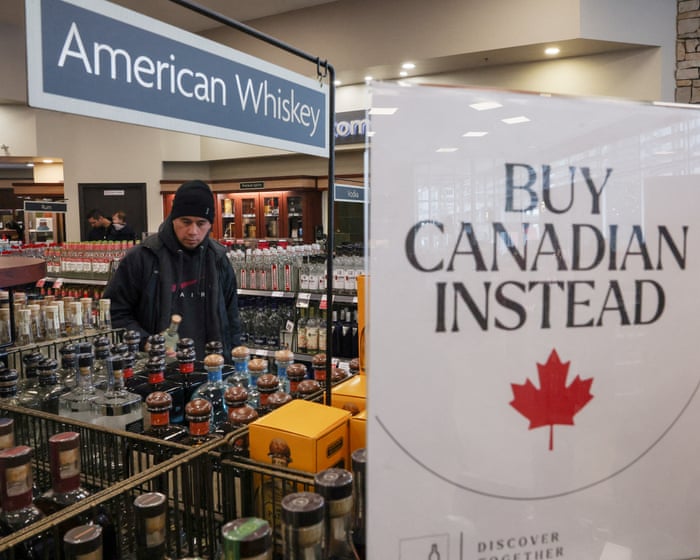
Avoiding US goods and services – from tech to whisky to air travel – has forced many to find a new way of living
For William McDonald, 38, a diesel mechanic from Thunder Bay, Ontario, “Canadian is always the first choice,” even if it means his weekly bills are higher.
“As soon as Trump started putting those tariffs on in February [last year], I started boycotting US goods,” he said. “Avoiding American products has driven my costs up, and I’m still happy to do it.
Unpopular new policy comes as midterms loom and control of Congress could be decided by several Michigan races
Every day $1bn worth of goods crosses the river dividing Detroit, Michigan, and Windsor, Ontario, two largely blue-collar US and Canadian cities that have come to act as one in the creation of North America’s auto industry.
News this week of Donald Trump’s escalating trade spat with Canada has everyone worried. Political and economic leaders and observers labeled the move an act of “hubris” , blamed Trump’s “ego”, and called the escalation “insanity”.
A reminder that we are covering the latest out of Jackson Hole, Wyoming, where Kevin Warsh – the new chair of the Federal Reserve – will deliver his first speech as the head of the US central bank at the annual economic policy symposium.
As my colleagues note, Warsh is under pressure to provide clarity on how the FederalReserve should handle with inflation if price pressures don’t abate.
They should ask the question Reagan asked at the end of his debate against Jimmy Carter: ‘Are you better off now than you were before this presidency?’
The midterm elections are already upon us, and every Democrat and independent running against a Republican should ask voters the question Ronald Reagan asked on 28 October 1980, at the end of his televised debate against Jimmy Carter: “Are you better off now than you were before this presidency?”
Unless you’re very, very rich, the answer is obviously: “No, I’m worse off.”
Energy bills have increased three times faster than the rate of inflation while Trump has been president. The national average monthly utility bill reached $280 in early 2026, a 12% increase since the end of 2024, just before the second Trump administration took office.
Are we seeing the first signs of panic in Donald Trump’s Treasury? The US is by far the world’s biggest debtor, and the steady rise in global long-term interest rates – which I have long argued was inevitable – is starting to cause real pain.
Until now, the Treasury secretary, Scott Bessent, has dismissed concerns about US debt, which recently surpassed $40tn, as a big nothingburger. Growth, in his telling, will be so spectacular the US will easily be able to meet its interest obligations without any significant tax rises or spending cuts, while the rest of the world will happily keep feeding it money. But if Bessent really believes that, why is he trying to strong-arm the bond market by fiddling with the maturity structure of government debt?
Tariffs on Canada, threats against Iran’s partners and bond market intervention show a president weaponising US power while making Americans poorer at home
Three moves in the last week have exposed the limits of Donald Trump’s economic bullying. The US slapped 50% tariffs on another $20bn of Canadian goods – then threatened the same rate on the cars, trucks, parts and steel that America Inc depends on. On Monday, the Treasury secretary, Scott Bessent, menaced Iran’s trading partners with exclusion from the US financial network, hoping that coercion can deliver what months of war have not. And as the costs of war, tariffs and pro-billionaire tax cuts helped send US bond yields higher, the Treasury stepped in to tame long-term rates. These are not contradictory policies but a gamble: that US economic power can be repeatedly weaponised without reducing others’ willingness to depend on it.
The Trump administration’s “D-day” sanctions are potentially the most consequential because they expose the scaffolding of American financial power. While markets shrugged off the immediate threat, that calculation might change were the US to target a major Chinese refinery or bank. Such an escalation could spark a trade war with Beijing. The US has leverage. But China has pressure points – especially farmers in Republican states – that make using it costly. In the long run, there is a price to pay. Nations hold one another’s currencies partly because they trust the political relationship. Mr Trump is testing what happens when they don’t.
The Council of the EU on June 12 approved fresh tariffs on fertilizers and remaining agricultural goods from Russia and Belarus, aiming to reduce Russian export revenues.
The measures target those goods that have not yet been subject to additional customs duties and will enter into force on July 1. The tariffs on fertilizers will increase gradually over the next three years.
"Polish Presidency motto is 'Security, Europe!' and these measures increase our economic security by reducing dependencies from Russia," said Michal Baranowski, the trade undersecretary at the Polish Economy Ministry.
"We are further reducing Russia’s export revenues and therefore its ability to finance its brutal war. This is united Europe at its best," he said in a statement.
The new tariffs will apply to goods that made up around 15% of all agricultural imports from Russia in 2023. Fertilizer tariffs will focus on certain nitrogen-based products, the Council said in a statement.
Russian fertilizers accounted for more than a quarter of all of the EU's imports in this sector in 2023, worth almost $1.5 billion.
Apart from stifling Russia's trade revenue, the step also aims to reduce the EU's dependence on Russian and Belarusian goods, protect European farmers, and diversify the supply.
The EU adopted higher tariffs on cereals, oilseeds, and some other products from Russia and Belarus in May 2024. Earlier this year, the European Commission proposed imposing similar measures on all remaining agricultural products from the two countries.

 Connexion