
 Connexion

Moldova plugs into Romania and buys zero Russian gas as its president warns Russia will try harder to shake the country

Moldova has switched on a power line that links it directly to the Romanian market and the European grid, the Moldovan presidency said. The route avoids Transnistria, its Russian-backed breakaway region. The country, which is not in the EU, already buys no Russian gas and plans two more lines to Romania. Its president expects Russia to keep trying to destabilize it.
Russia has spent years turning energy into a weapon against its neighbors, and its war has made Ukraine's power grid a constant target. A strike on Ukrainian substations can ripple across the border to countries wired into the same system. Russian gas has not stopped flowing into Europe either. The EU imported a record volume of Russian Arctic liquefied natural gas (LNG) in the first nine months of 2026. A country that breaks both kinds of dependence takes a lever out of Moscow's hands.
Moldova's first new power line since independence
The 400-kilovolt line runs 158 km, the presidency said, from Vulcănești in the south to the capital, Chișinău, with two modernized substations. It went live on 8 November in the presence of EU Enlargement Commissioner Marta Kos. That gives the country “an additional route for transporting electricity and a lower risk of disconnection,” the presidency said.

It is the first power line Moldova has built since independence, Radio France Internationale (RFI) reported. Moldova can now import electricity straight from Romania, avoiding Transnistria. Romanian broadcaster Digi24 said the line cuts reliance on the Cuciurgan power hub in the breakaway region.
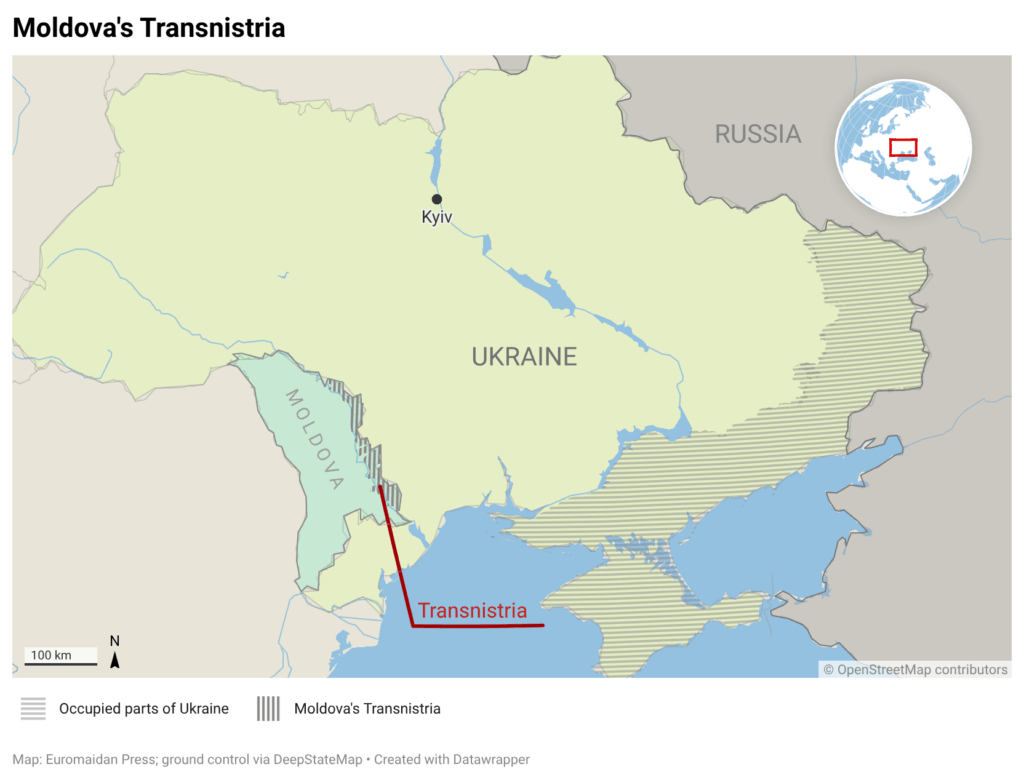
The World Bank lent €61 million for the project. The loan was approved in September 2019, when Sandu headed the government. Construction ended in November 2025, and testing followed. Moldovan Energy Minister Dorin Junghietu said the war next door complicated deliveries, logistics, and the works.
Sandu says Moscow can no longer use energy to blackmail Moldova
Moldovan President Maia Sandu marked the launch with a post on X. She said Moldova buys zero Russian gas and two more lines to Romania are on the way.
“For decades, Moscow used energy to blackmail us. No more,” Sandu wrote.
At the ceremony, she said energy independence lets Moldova choose where it buys energy “without being vulnerable to pressure and blackmail.” She recalled that the country was threatened with losing light and heat whenever it chose differently from Moscow. The last such disconnection came in autumn 2021, she said. She also said wars have pushed up prices on foreign markets and the government will again look for ways to ease bills for vulnerable families this winter.
Russian strikes on Ukraine have already cut Moldova's key link to Europe
Moldova's grid is tied to Ukraine's, which Russia attacks almost daily. On 23 March, Russian strikes on Ukraine knocked out the Isaccea–Vulcănești line, Moldova's key connection to Romania. Sandu said Russia bore sole responsibility. Earlier this year, a fault in Ukraine's grid left parts of Moldova without power. The attacks go on. On 8 November, Russian strikes cut power to more than 600,000 customers in Dnipropetrovsk Oblast.
Moldova is also building links with Ukraine and investing in renewables, the presidency said. The Bălți–Suceava line to Romania, worth about €77 million, has money from the European Bank for Reconstruction and Development, the European Investment Bank, and a €15 million EU grant. US grants will pay for the Strășeni–Gutinaș line. Moldova is also negotiating to buy up to 50 million m³ of gas from Ukraine, according to RFI.
Sandu expects more Russian attempts to destabilize Moldova
Two days before the launch, Moldova's National Security Council approved cybersecurity measures after an October cyberattack. After the meeting, Sandu said that “Russia does not want Moldova to advance.” She said some Moldovan politicians align with Russia's efforts and expected more attempts to destabilize the country in the coming months.
The pressure has come on several fronts this autumn. In October, Moldova expelled a Russian diplomat after a Russian Geran drone crashed on its territory. Moldova and Ukraine are also both waiting to open their next blocks of EU accession talks.
Read also
-
Russian drone explodes in Moldova, day after its opposition moves to suspend its pro-EU president. Analyst says that’s no coincidence
-
80% of Moldovans say country is unprepared for attack as Russian drones flow into its airspace, but few back NATO membership
-
One Russian drone held up seven flights in Moldova, Zelenskyy’s trip to Norway for King Harald V’s funeral among them

