Ukraine's new defense minister wears his war on his wrist. Yevhenii Khmara's bracelet carries, on each of its chains, the engraved name of a comrade who did not come back from the war, The National Interest reported.
Khmara took over the Defense Ministry on 19 August, replacing Mykhailo Fedorov, whose July dismissal set off nationwide protests. He came to the job from the SBU, Ukraine's Security Service, which he had led for seven months when Ukraine's campaign against Russian oil refining reached its widest scale.
He did not volunteer the story
Khmara did not explain the bracelet until a reporter asked him about it over dinner in Kyiv this month. The names now travel with him into the meetings where decisions about Ukraine's defense are made.
He ran the SBU during the oil campaign
Alpha, the SBU's special operations unit, is a tiny share of Ukraine's armed forces, yet the service's own accounting credits it with an outsized share of the damage inflicted on Russia, up to 20 percent of all enemy infantry losses.
More telling is what happened to Russian oil during his seven months in charge of the service. Ukraine's General Staff now estimates that nearly 43 percent of Russia's refining capacity has been knocked out. To a large extent, this is the result of the campaign Khmara helped oversee.
Khmara also developed a doctrine of ruthless cost asymmetry: strike operations designed to cost roughly 2 percent of the economic damage they inflict, targeting not individual facilities but critical nodes within the system.
Khmara insisted that part of the staff of the previous minister stayed
Earlier, Khmara has proposed that the core of the former Defense Ministry team remain in their positions. In particular, this concerns specialists responsible for procurement reform.
Mstyslav Banik, who served as a deputy to Fedorov, confirmed that he was staying on under the newly appointed defense minister. He led a central part of the ministry's modernization and is responsible for implementing the defense procurement reform.
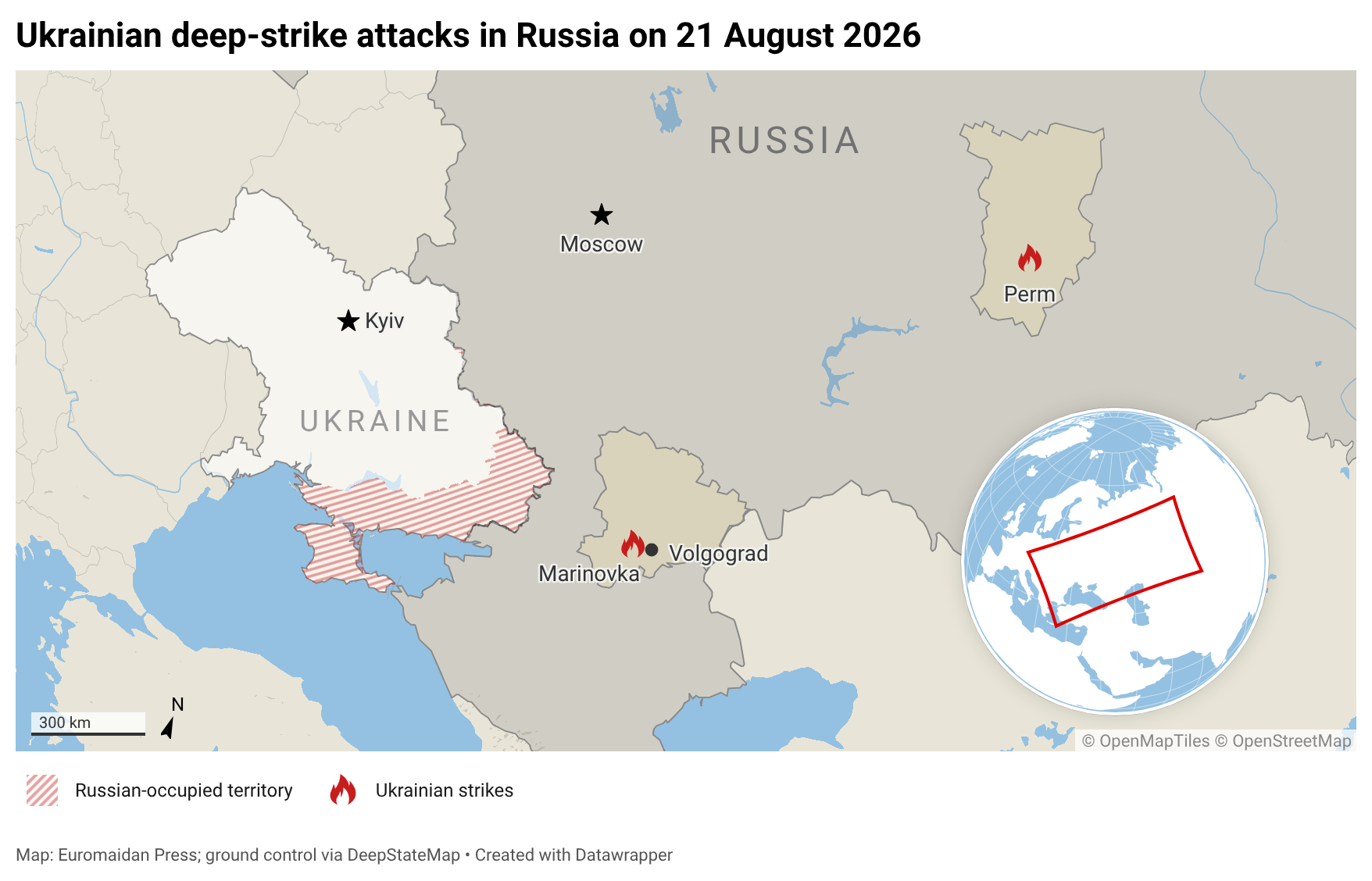
Ukraine struck one of Russia's largest oil refineries deep in the Urals and a military airfield overnight in a long-range attack, Ukrainian President Volodymyr Zelenskyy announced on 21 August. The Ukrainian Army's General Staff confirmed the refinery and airfield hits, while Zelenskyy said the same night also reached the Black Sea and brought fresh damage from earlier strikes on a Russian warplane and a drone-launch site.
Ukraine's long-range drone campaign has spent the year reaching ever deeper into Russian territory, forcing Moscow to spread its air defenses across thousands of kilometers and driving fuel shortages that now reach beyond its borders. Each strike on Russia's oil backbone compounds the strain on its refining and export earnings, even as the Kremlin diverts chemicals meant for weapons into keeping filling stations supplied.
Fire at a major Lukoil refinery in Perm
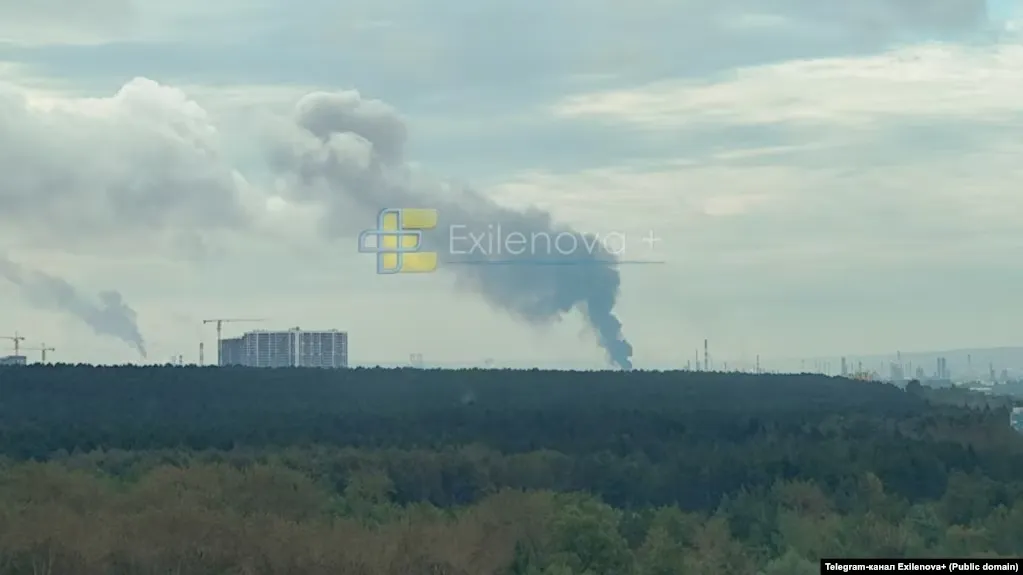
Zelenskyy said the overnight drones hit the Lukoil-Permnefteorgsintez refinery — known as PNOS — in Perm, where the General Staff recorded a fire on the plant's grounds. The target sits more than 1,500 km from Ukraine's northern border, in a region near the Ural Mountains.
The refinery is one of Russia's largest, able to process more than 13 million tons of crude a year, with more than half its output sold abroad until recently. It supplies fuel to both Russia's economy and its army.
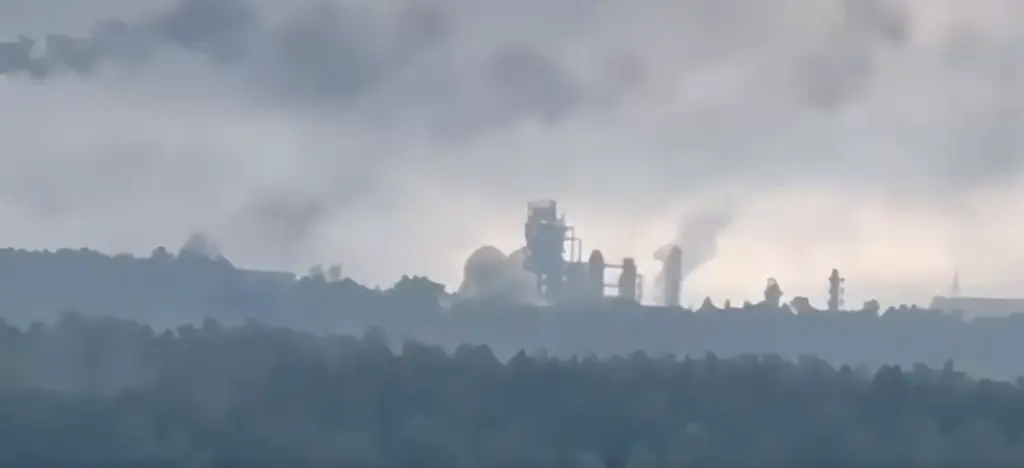
Ukrainian Telegram channels Supernova+ and Exilenova+ shared footage of explosions and a rising plume, with locals reporting a series of blasts at the site. Russia's Perm Krai authorities claimed they repelled the attack and downed 16 drones.
Kyiv has repeatedlyhit the plant through the year. After a strike at the end of July, it had been running well below capacity.
Airfield, Black Sea, and other targets the same night
The General Staff said the same night's drones also struck the Marinovka military airfield in Volgograd Oblast, located in Russia's Volga region, with the damage still being assessed, while Zelenskyy added that Ukraine achieved unspecified results in the Black Sea. The military also reported hitting a drone storage and launch site near Donetsk, a materiel warehouse in occupied Crimea, two command posts in Donetsk and Zaporizhzhia oblasts, and six relay stations in Crimea used to steer Russia's Geran and Gerbera attack drones.
Zelenskyy also confirmed damage from earlier strikes: a Russian Su-34 fighter-bomber hit at the Akhtubinsk airfield, about 600 km from the front line, and a drone store and launch site struck at Primorsko-Akhtarsk, roughly 180 km away. The strike extends a run of deep hits this month, from the TANECO refinery in Tatarstan and a Black Sea oil terminal to three refineries hit in one night and an Omsk refinery struck 2,500 km away in Siberia.
Ukraine’s Defense Forces struck a major oil refinery and a Black Sea oil terminal on 19 August and overnight into 20 August, Ukraine’s General Staff reported. Drones also hit a key mainland electricity hub supplying occupied Crimea, Militarnyi reported after analyzing NASA satellite data.
Together, the reported strikes put three parts of Russia’s war machine under attack within hours: fuel production, Black Sea oil exports, and the mainland electricity bridge to occupied Crimea. They continue a deep-strike campaign intended to disrupt fuel supplies and logistics supporting Russia's invasion
A major refinery deep inside Russia
Ukraine struck the TANECO refinery in Nizhnekamsk, in the Russian republic of Tatarstan, where the General Staff reported a fire at the production site. Militarnyi had earlier identified the same facility from eyewitness footage showing a drone reaching the city’s industrial zone despite Russian air-defense fire.
Ukrainian attack drones swarmed Russia’s Nizhnekamsk Oil Refinery this morning, scoring multiple hits and setting the plant on fire.
Seen here, a Ukrainian Fire Point FP-1 maneuvers and then dives into one of the already-burning Russian refinery’s process units. pic.twitter.com/3v9AjEZFs5
Owned by Tatneft, TANECO is one of Russia’s newest, largest, and most technologically advanced refineries. It can process more than 16 million tons of crude annually and produces gasoline, diesel, aviation fuel, marine fuel, and other petroleum products.
Neither the General Staff nor the available imagery established whether processing equipment was damaged or production stopped.
A Black Sea terminal moving about 20 million tons a year
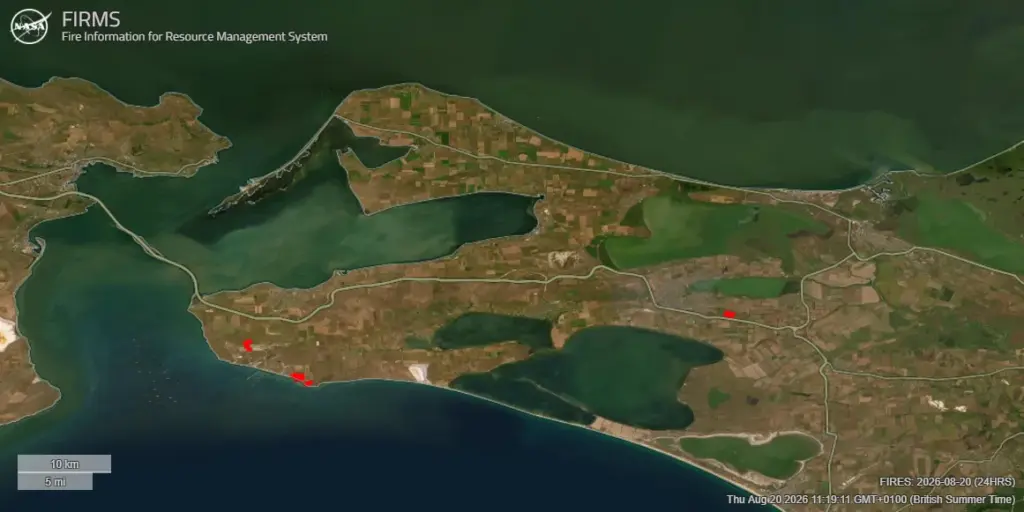
Ukraine also hit the Tamanneftegaz oil and gas terminal in the village of Volna, Krasnodar Krai, where the General Staff reported another fire. Militarnyi found a corresponding fire in NASA Fire Information for Resource Management System (FIRMS) data and assessed that storage tanks were likely burning.
Thermal anomalies on NASA FIRMS from left to right: Tamanneftegaz terminal and Taman 500-kilovolt substation. Source: NASA FIRMS
Militarnyi described Tamanneftegaz as southern Russia’s largest private oil terminal. The complex can handle about 19.9 million tons annually, while its tank farm held more than 1 million cubic meters before Ukrainian attacks began.
The Tamanneftegaz terminal receives, stores, and loads petroleum products onto tankers, making it an important link in Russia’s Black Sea exports. Drones previously hit three tanks and pipelines there on 30 July.
The mainland electricity gateway to occupied Crimea
Drones hit the Taman 500-kilovolt substation in Krasnodar Krai, where NASA satellite data recorded a fire, Militarnyi reported. All four lines of Russia’s power bridge across the Kerch Strait pass through this high-voltage hub, making it the principal mainland gateway for electricity sent to occupied Crimea, Militarnyi reported.
Confirmed: Metrics show a sudden decline in internet connectivity across Russian-controlled Crimea with high impact to Sevastopol and Simferopol corresponding to a power blackout after overnight Ukrainian drone attacks targeting energy infrastructure pic.twitter.com/dqCXzTDcWO
Power failed in Simferopol, Sevastopol, Kerch, Feodosia, and Yalta around 1:45 a.m., according to Suspilne Crimea. Electric transport stopped in several cities. Sevastopol’s occupation chief said restrictions were lifted after about 90 minutes, although the grid remained unstable and some nearby settlements still lacked electricity. Social facilities in Sevastopol switched to backup power.
Crimean Wind also reported explosions near the Kafa and Malorechenske substations inside Crimea, Suspilne Crimea reported. The available evidence therefore does not establish that the Taman strike alone caused the outages.
Ukraine’s sustained long-range strike campaign
Ukraine's long-range strikes on Russian targets have ramped up in recent months. One day earlier, drones hit a key crude-processing unit at the Bashneft-UNPZ refinery in Ufa, Militarnyi reported. Ukraine had also struck TANECO on 10 August and both Nizhnekamsk refineries on 12 June, Suspilne reported.
Euromaidan Press reported that Ukrainian deep strikes hit 18 Russian oil and gas facilities in May, making it the heaviest month of 2026 at that point. On 6 August, drones attacked a top-five refinery in Yaroslavl for the seventh time this year. Five days later, they reached Orsk, about 1,500 kilometers from Ukraine.
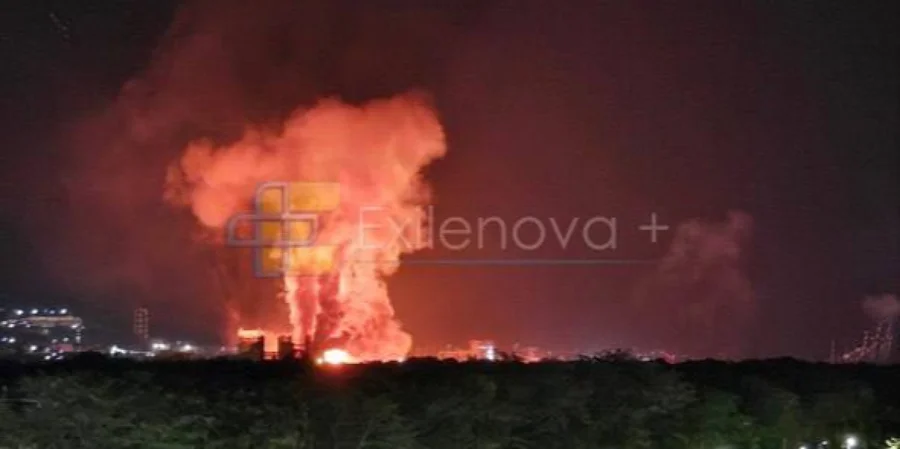
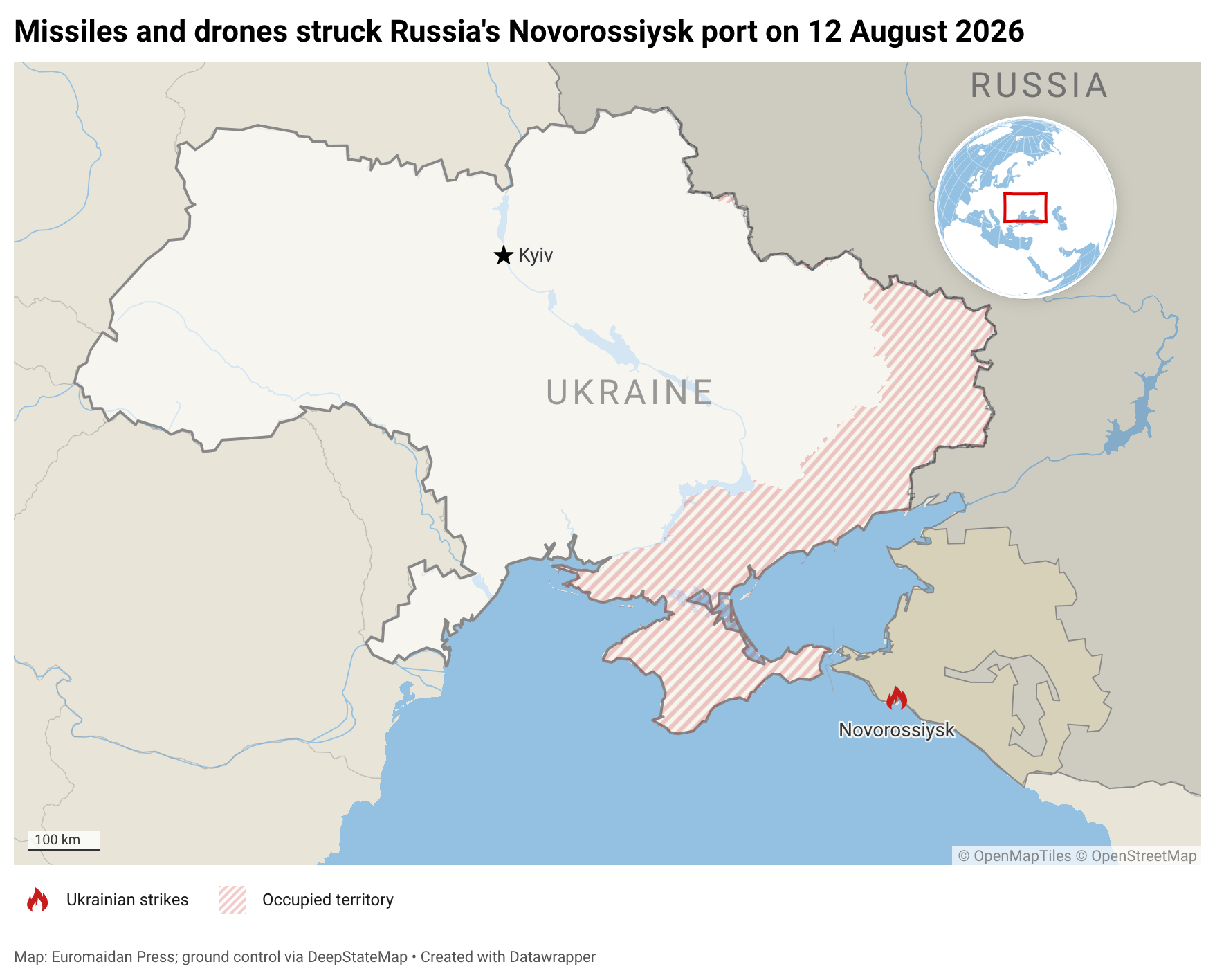
On 12 August 2026, Ukraine targeted Russia's main Black Sea naval base and oil terminal at Novorossiysk overnight. Fires broke out at the port's oil and fleet facilities, two of Russia's largest grain terminals stopped work, and debris damaged homes across the city, according to Ukrainian monitoring channels and local Russian authorities. Ukrainian President Volodymyr Zelenskyy confirmed the operation hours later.
Russia's southern coast is where much of the war is paid for, the loading point for the oil revenue and grain exports that keep the invasion running, and it now sits within reach of Kyiv's long-range weapons.
Kyiv calls it a "unique operation" on the fleet's last big base
Zelenskyy said Ukraine's Defense Forces hit the Novorossiysk naval base overnight on 12 August. The port city is situated more than 350 kilometers from the front line on Russia's eastern Black Sea coast. The Ukrainian president described the assault as a unique operation against the last main outpost of Russia's Black Sea Fleet.
"Our Palianytsia jet drones, Neptune missiles, and naval uncrewed systems precisely struck the designated targets," he said, adding that hits were confirmed on air-defense positions, piers, and seaport infrastructure.
Fires at the Sheskharis oil terminal and the naval harbor
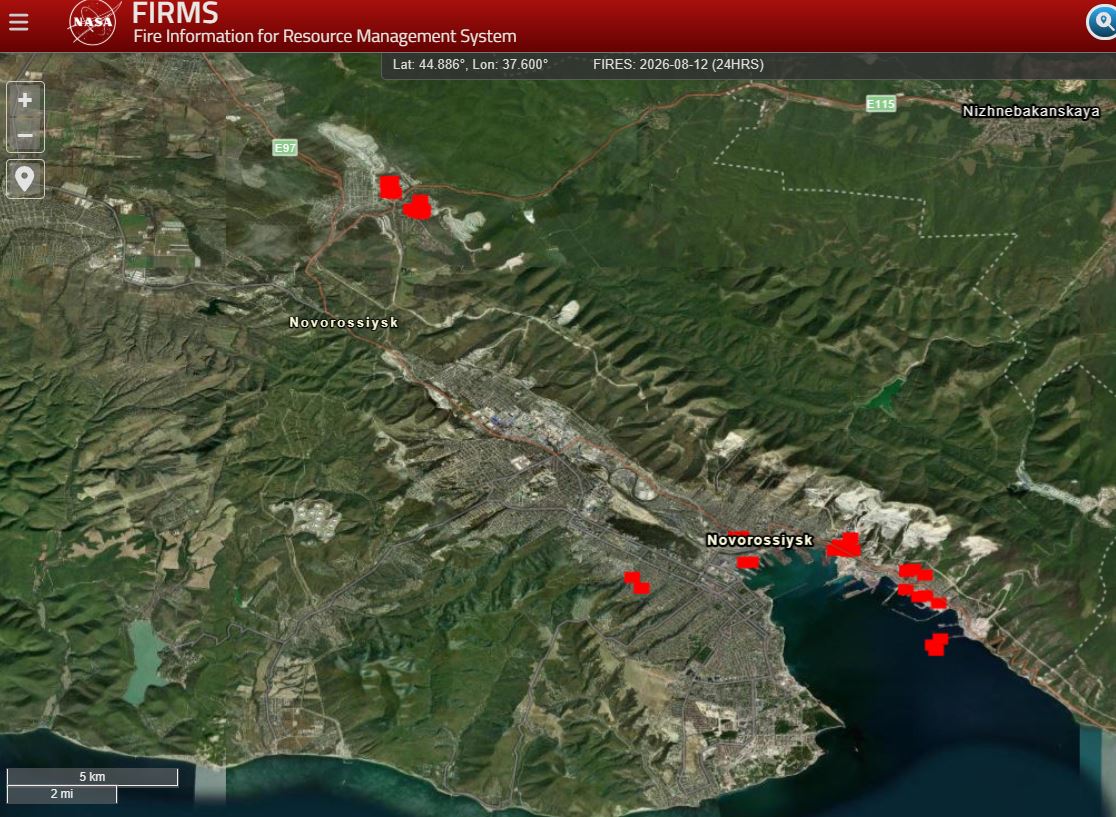
Ukrainian drones hit the oil terminal and the naval base, the Ukrainian defense outlet Militarnyi reported. Its analysis of NASA satellite fire data placed blazes at the Sheskharis complex, where crude loads onto tankers, and near the naval base and fuel-storage tanks.
A NASA FIRMS map shows fires detected in and around Novorossiysk on 12 August 2026. Map: NASA FIRMS
Sheskharis is the endpoint of Transneft's main pipelines and a key export point for Russian crude on the Black Sea. Novorossiysk ships 600,000 to 700,000 barrels of oil a day.
The Ukrainian monitoring channel Krymsky Veter said fires broke out near the Sheskharis pier and the military harbor where Black Sea Fleet ships and submarines dock. Russia moved vessels to Novorossiysk after Ukrainian strikes pushed the fleet out of occupied Crimea.
Two grain terminals stop at the world's top wheat exporter
Novorossiysk's two largest grain-handling terminals halted work after the strikes, Reuters reported, citing four industry sources. The world's top wheat seller, Russia sends most of its exports out through Black Sea ports.
The Novorossiysk grain terminal, which can move 8.5 million tons a year, halted work as owner Demetra Holding assessed the damage. NKHP, a terminal handling 7.1 million tons a year, also stopped, its main owner OZK said, adding that no one was hurt. The Ukrainian monitoring Telegram channel Exilenova+ described NKHP, Russia's largest deepwater grain terminal, as one of the sites hit.
The strikes extend Ukraine's effort to deny Russia the grain and oil revenue that funds the war, a mirror of Russia's own summer campaign against Ukraine's ports: as Moscow strikes Odesa's terminals to choke Ukrainian exports, Kyiv works to shut Russia's own.
Russia says its own drone debris damaged homes and killed two
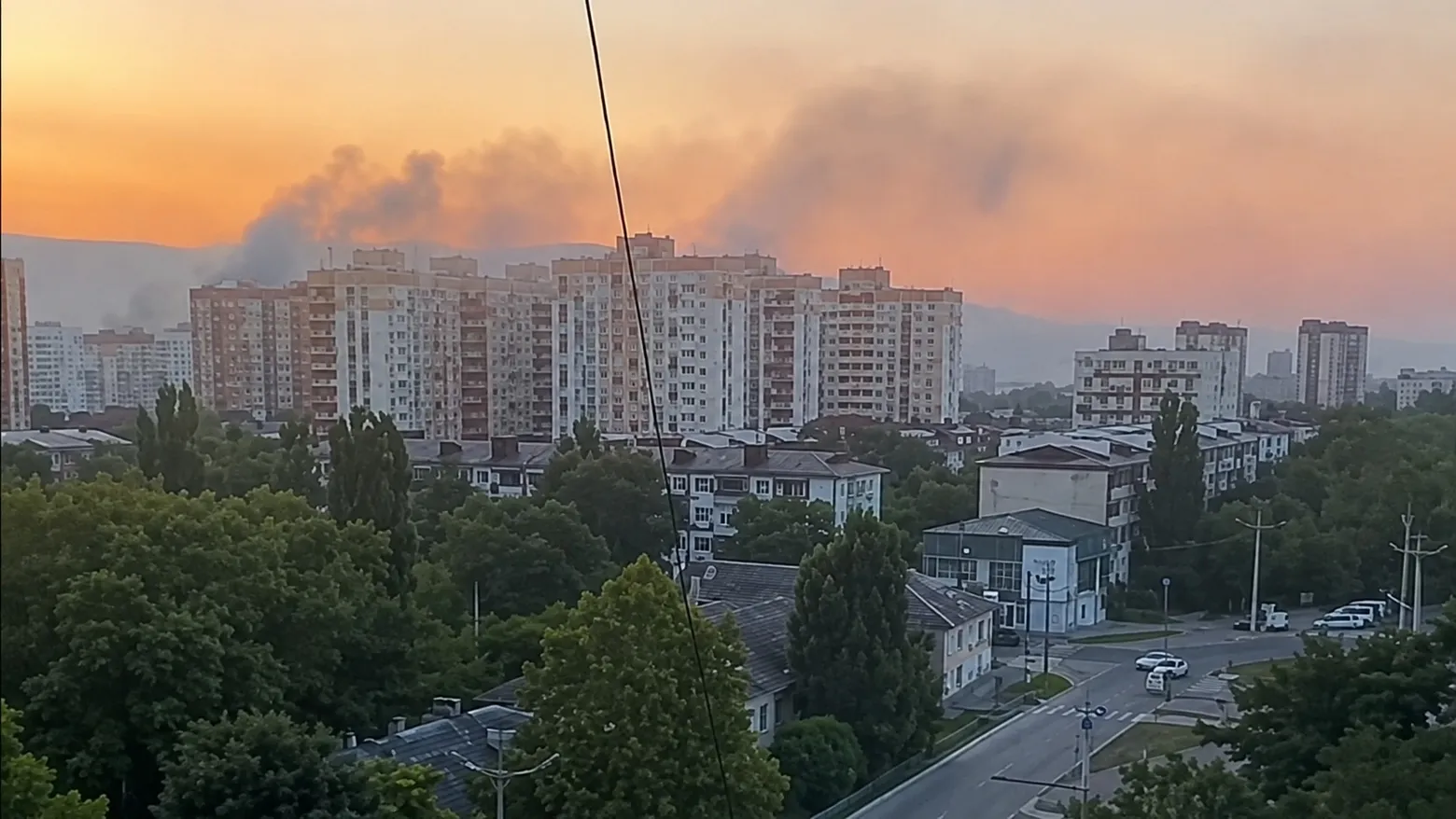
Krasnodar Krai Governor Veniamin Kondratyev claimed several hundred drones attacked the region overnight and that falling debris struck 21 residential buildings and four enterprises in Novorossiysk. He claimed two people were killed, including an eight-year-old child, and 13 wounded across the krai, with about 90 residents moved to temporary shelters.
Smoke rises over Novorossiysk after a Ukrainian strike on the Russian Black Sea port, 12 August 2026. Screenshot from a video: Exilenova+
Novorossiysk Mayor Andrei Kravchenko claimed debris hit six residential buildings, a commercial building, and a construction site, and that there were casualties.
The Russian news Telegram channel Astra reported that a café burned on Sukhumskoye Shosse, across the road from the entrance to the Novorossiysk naval base. Astra also found that a strike damaged School No. 15 near the fleet's ship berths.
Part of a widening summer campaign
The strike fits a broader Ukrainian effort this summer to carry the war onto Russian soil and drain the Kremlin's ability to fight. A day earlier, Ukrainian drones set a Wildberries logistics complex ablaze near Voronezh and hit an oil refinery in Orsk. Overnight on 10 August, drones struck a petrochemical plant in Tobolsk and a refinery in Tatarstan.

 Connexion

 Confirmed: Metrics show a sudden decline in internet connectivity across Russian-controlled Crimea with high impact to Sevastopol and Simferopol corresponding to a power blackout after overnight Ukrainian drone attacks targeting energy infrastructure