Vue lecture

Ukraine is running short of its best missiles for hunting Russia’s jet drones. Now MiG-29s are firing 1970s weapons
Par : David Axe

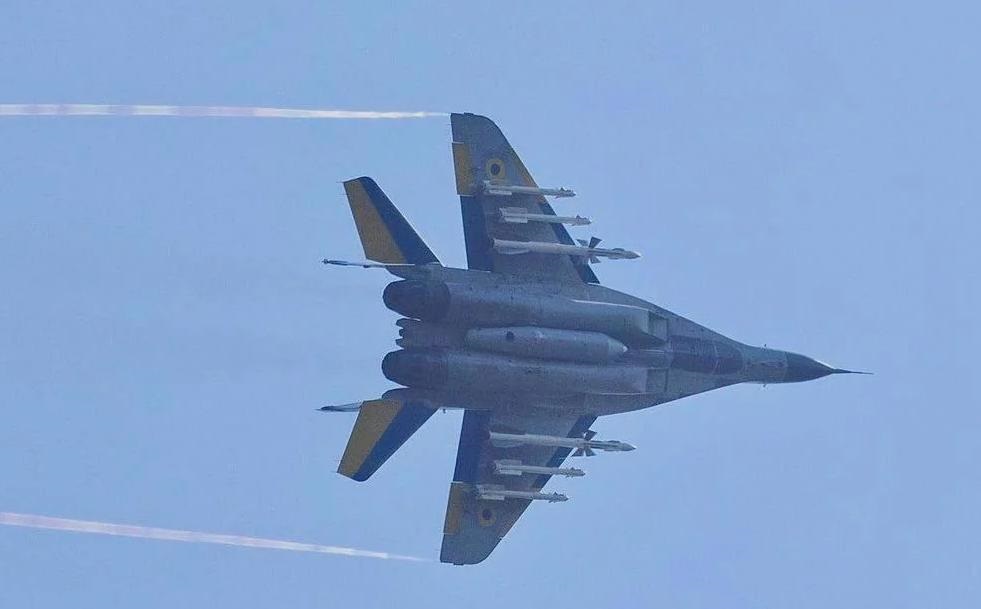
MiG-29 with R-27s and R-73s.

  • Russia is launching more jet-propelled Geran drones and Banderol missiles
  • Speeding along as fast as 700 km/hr, these munitions are hard to intercept
  • Ukraine's fighters are up to the task—but they are reaching for missiles designed in the 1970s

Russia is launching more of its best jet-propelled attack drones and miniature cruise missiles at Ukrainian ports, cities, warehouses, and power plants. The speedy Geran-3, Geran-4, and Geran-5 drones and Banderol missiles can zoom right past Ukraine's ground-based guns and slower interceptor drones, so the Ukrainian air force is deploying more supersonic fighters to chase down the Russian munitions.

But there's a problem. The Ukrainian jets are running short of the missiles that work best against them.

A deepening shortage of infrared-guided AIM-9 missiles and radar-guided AIM-120 missiles for the Ukrainian air force's ex-European Lockheed Martin F-16 fighters has been reported elsewhere. Less well known is what has been happening to the Soviet-era missiles carried by Ukraine's older Mikoyan MiG-29 fighters.

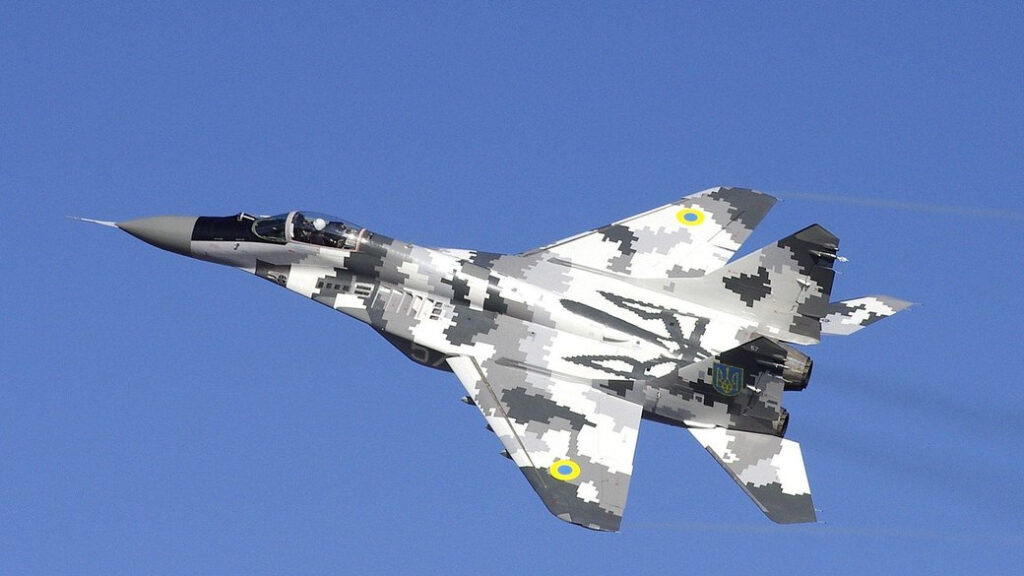
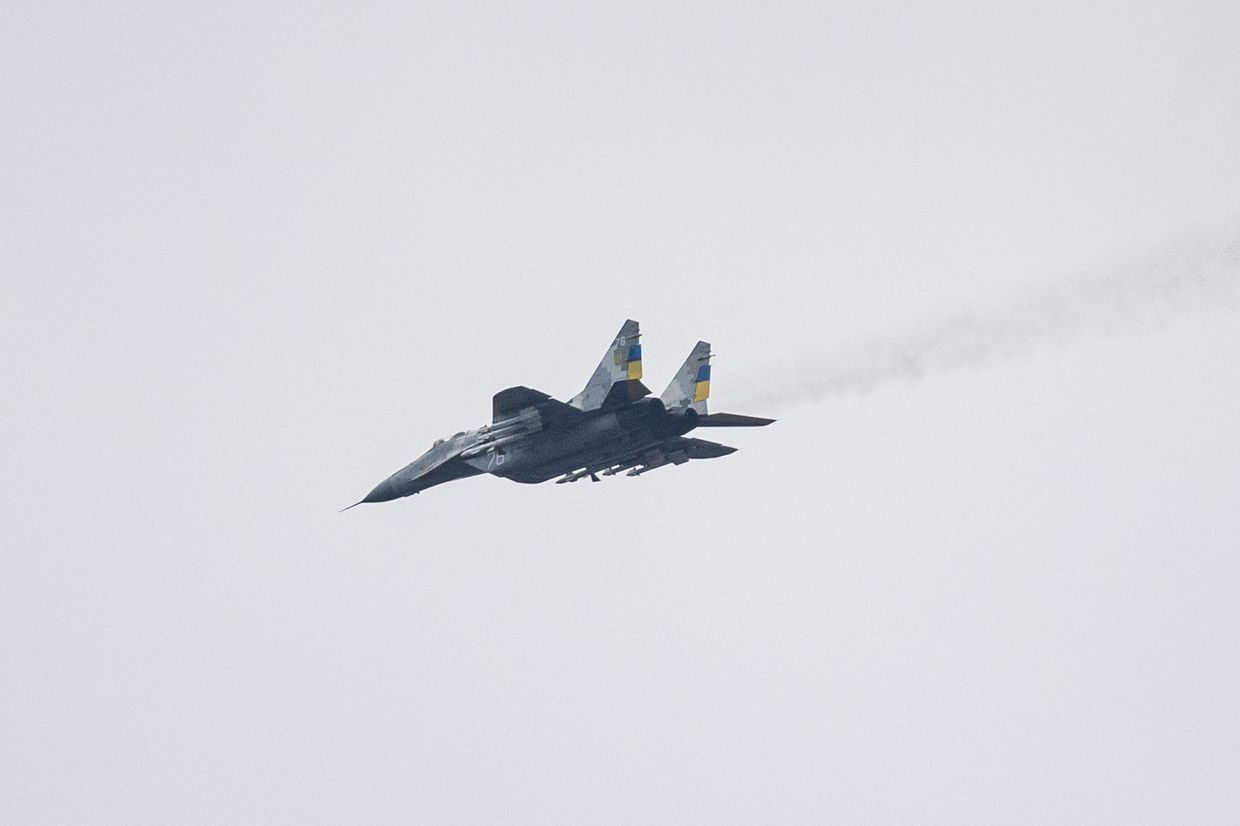
The F-16 is probably the most numerous Ukrainian fighter type, with around 50 in service. But the MiG-29 is a close second. Despite steep losses of MiG-29s in the 55 months since Russia widened its war on Ukraine, Ukrainian aviation brigades may still fly dozens of the classic Soviet-made fighters. MiG-29s are daily sights in the sky over the port of Odesa in southern Ukraine as the twin-engine fighters chase down Russian missiles and drones.

The missile shortage spreading to F-16s really concerns me.
Because at the same time out of nowhere we are seeing Ukrainian MiGs flying combat sorties with older R-60 missiles and not R-73s.

Here’s a recent video of an R-60 being used against a banderol cruise missile : pic.twitter.com/UMhtXW2o2p

— capt. Wild Bill Kelso (@_wild_billkelso) September 4, 2026

The MiG-29 can carry the full array of Soviet-style air-to-air missiles in the Ukrainian inventory including the infrared-guided R-60 and R-73 and the radar-guided R-27. But the missile of choice for intercepting the 500 km/hr Gerans and 700 km/hr Banderols is the more modern R-73. The $300,000 heat-seeking missile is maneuverable and accurate at the close ranges that are typical of fighter-on-drone engagements. Its one known weakness is cloud: a Ukrainian pilot said in 2022 that the R-73 tracks poorly through it, which is part of why pilots sometimes fall back on the cannon.

Ukraine went to war in 2022 with substantial stocks of R-73s and surely received additional copies from allies. While Ukrainian industry built some components for the 1980s-vintage missiles, they were and still are assembled in Russia—so the supply is finite. And the rate of expenditure rose sharply as Ukraine pushed the R-73 into roles it was never built for: onto ground-based launchers, after the 9M33 missiles for its Soviet Osa air defense systems ran short, and even onto some of its robotic boats.
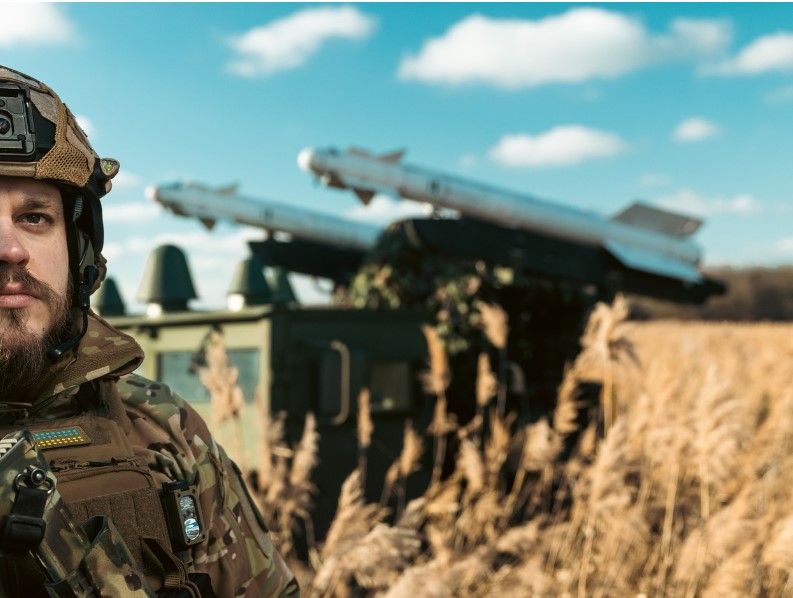
Ukrainian mobile air defense system firing Soviet R-73 air-to-air missiles
Mobile air defense system with R-73 missiles from the 3rd Separate Assault Brigade, March 2025. Photo: Maksym Zaichenko

Down to the 1970s stock

The sign of that pressure is the return of the R-60—a missile designed in the 1970s and considered obsolete when Russia widened the war. Last month an R-60 was visible in the wreckage following the crash of a Ukrainian MiG-29. And this week, video circulated of a MiG-29 downing a Banderol with one at extremely low altitude.

Ukraine's air force had enough R-73s in 2022 that nobody expected to see R-60s again. Continuous interception of Russian cruise missiles and Shahed-type drones changed that, Militarnyi reported. Nor is this improvisation: since November 2025 Ukraine has been running a program to modernize the R-60, replacing analog seeker components with digital ones to sharpen its infrared sensitivity, and adapting it for ground launch. Ihor Fedirko of the Ukrainian Council of Defense Industry called it a temporary way to put otherwise unusable missiles to work.

It's not that the R-60 isn't suitable for downing a Geran or Banderol. It's that it's less suitable than an R-73. "I don't think Ukraine would be using R-60 missiles unless it had nothing else left," one close observer of the Ukrainian air force noted.
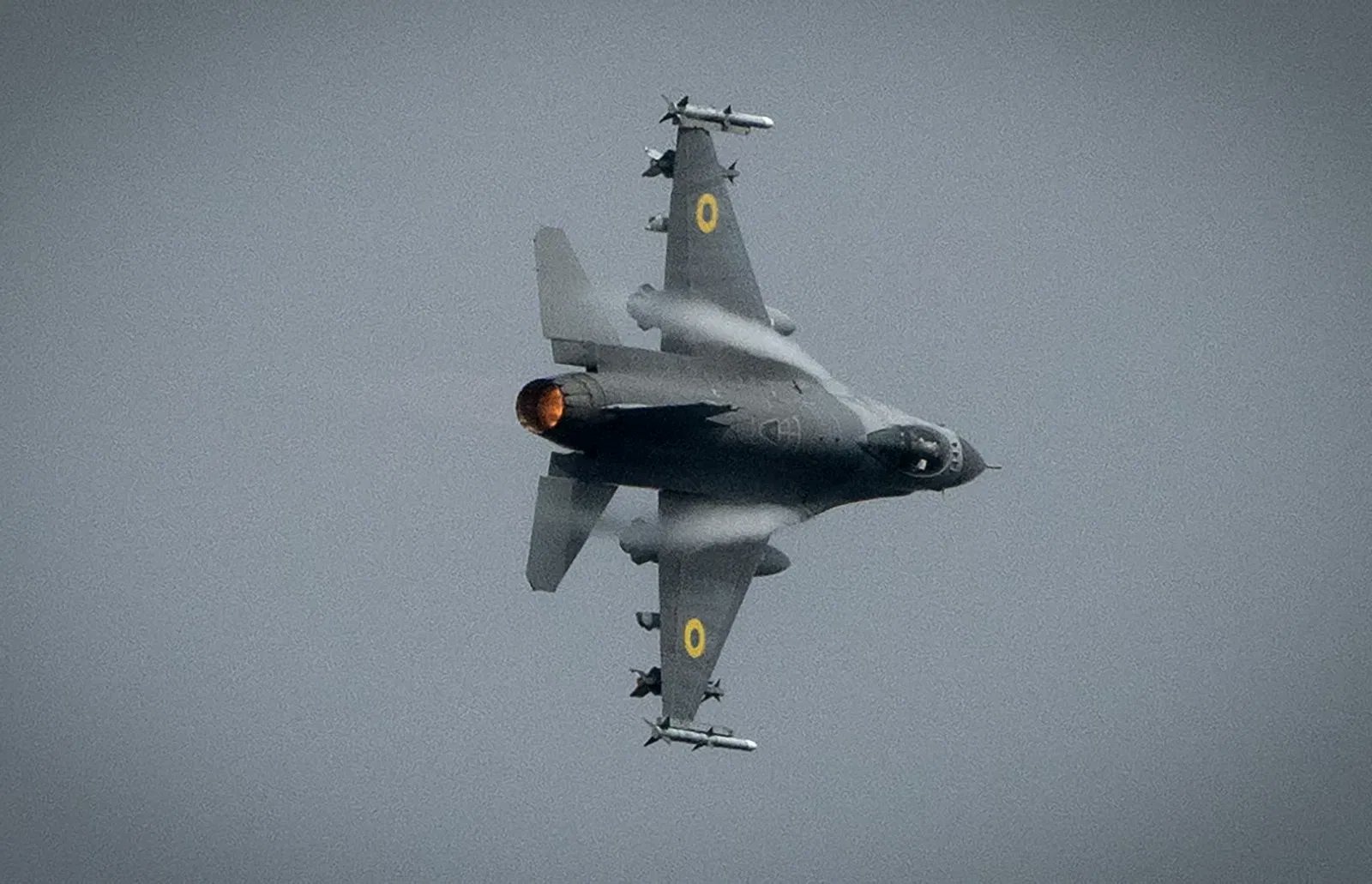
A Ukrainian air force F-16.
Explore further

Ukraine’s F-16s are so short of Western missiles that pilots fall back on jet’s built-in M61A1 Vulcan cannon, which risks killing civilians below

The only other alternative is for a fighter to use its gun. But that's risky, as the pilot must fly dangerously close to a drone or missile before opening fire; the resulting explosion could take out both the interceptee and the interceptor.

In the same way Russia is exhausting Ukraine's long-range surface-to-air missile batteries by firing more ballistic missiles than Ukrainian forces can intercept with their dwindling supply of Patriot missiles, Russia may also be exhausting Ukraine's fighters and their limited stocks of short-range air-to-air missiles.

As the Ukrainian missiles run out, more of the Russian missiles and drones get through—and strike their targets.

I’m not a missile expert but the missile on the left looks like an R-60. Perhaps Ukraine was trying to burn through some old R-60s it had and one malfunctioned.
It could also just be An R-27 but I don’t know.
The missile on the right looks to be an R-73 pic.twitter.com/yyZ0tSmaf4

— capt. Wild Bill Kelso (@_wild_billkelso) August 11, 2026

The problem is going to get worse before it gets better. Russian industry is ramping up production of both the jet-propelled Geran models and the Banderol, and jet output overtook piston output in August. The Russians launched a reported 1,500 jet Gerans in July and 2,500 in August. Interception rates for the fast drones specifically ran as low as 50% in July, though they may have ticked up to 60% or even 70%.

But that's still too low considering that Ukrainian air defenders usually shoot down 90% of slower propeller-driven Geran-1s and Geran-2s. "Nobody wants interception rates in the 60s/70s," explained Michael Bohnert, an analyst for the RAND think tank in California.

New models of faster interceptor drones, which several Ukrainian manufacturers are scrambling to deliver to front-line forces, may help restore the 90% kill rate for even the fastest Gerans. But "jet-interceptor output has been behind jet-drone output," Bohnert noted. So it's likely that, for a few months at least, the Russians will have the numerical edge, and the Ukrainians will have no choice but to continue sortieing F-16s and MiG-29s to reinforce ground-launched air defenses.

But what happens when the fighters run out of even their oldest missiles?
  •  

Second Russian MiG-29 in two days: Ukraine’s drones worked over Millerovo airbase

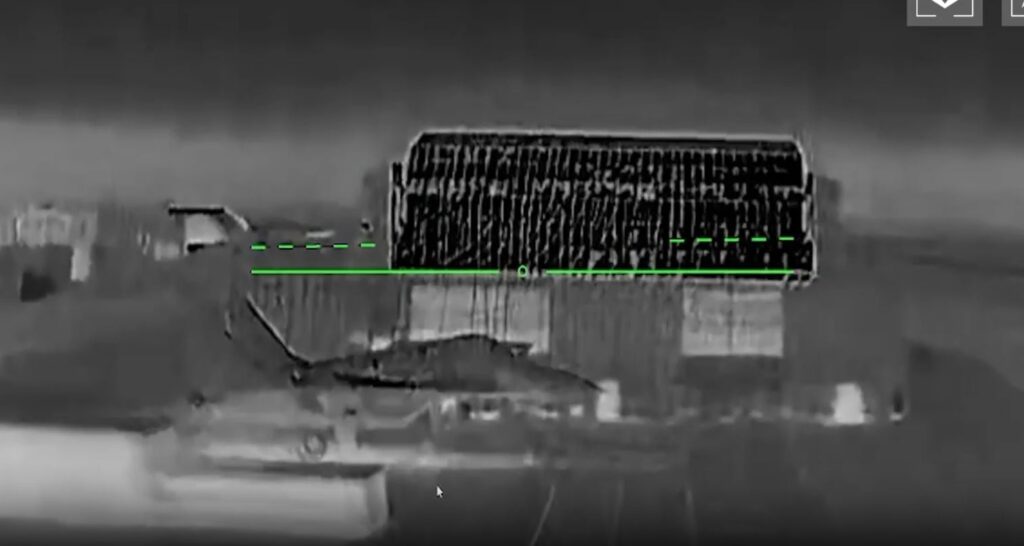
second russian mig-29 two days ukraine's drones worked over millerovo airbase · post fighter jet beside shelter rostov oblast russia ukrainian drone's sights 24 2026 telegram madyar ukraine news reports

Ukrainian drones worked over dozens of Russian military and industrial sites overnight on 24 August, reaching from occupied Ukraine and the Black Sea to southern Russia, the commander of Ukraine's Unmanned Systems Forces (SBS) reportedThe night's targets included a fighter jet at a Russian airbase, air-defense radars, fuel and propellant facilities, and vessels of Russia's sanctions-evading shadow fleet. A fuller breakdown released later in the day named the site of each strike and the unit that carried it out. Footage released with the breakdown shows the strikes.

Ukraine has been running mid-range strikes across the belt from occupied Crimea to Rostov Oblast for months, taking out the radars, missile batteries, and the aircraft that fly air-defense patrols over it — a rolling effort to thin the cover that meets every deeper Ukrainian strike.

A fighter jet and a decoy at the same airbase

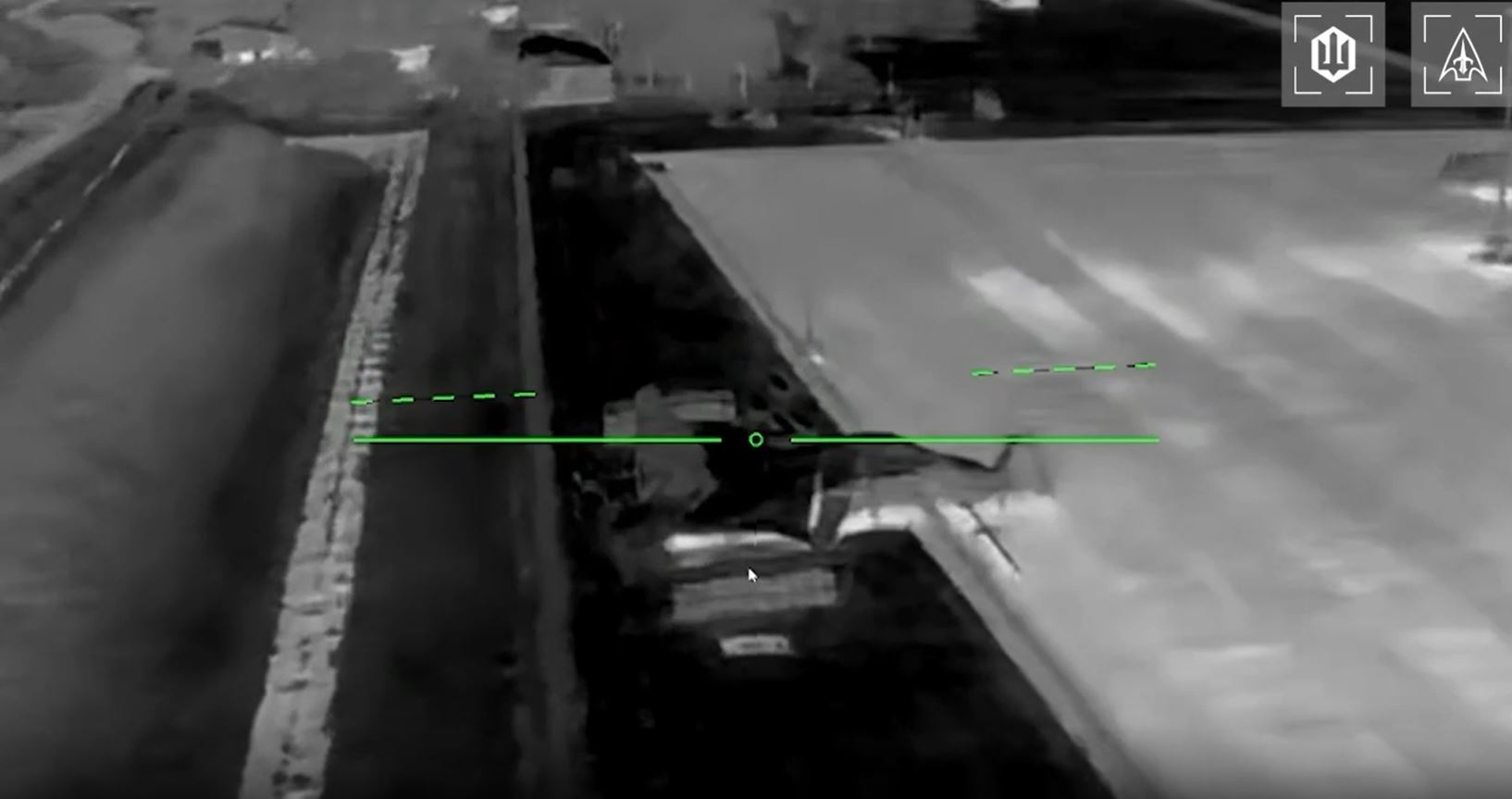
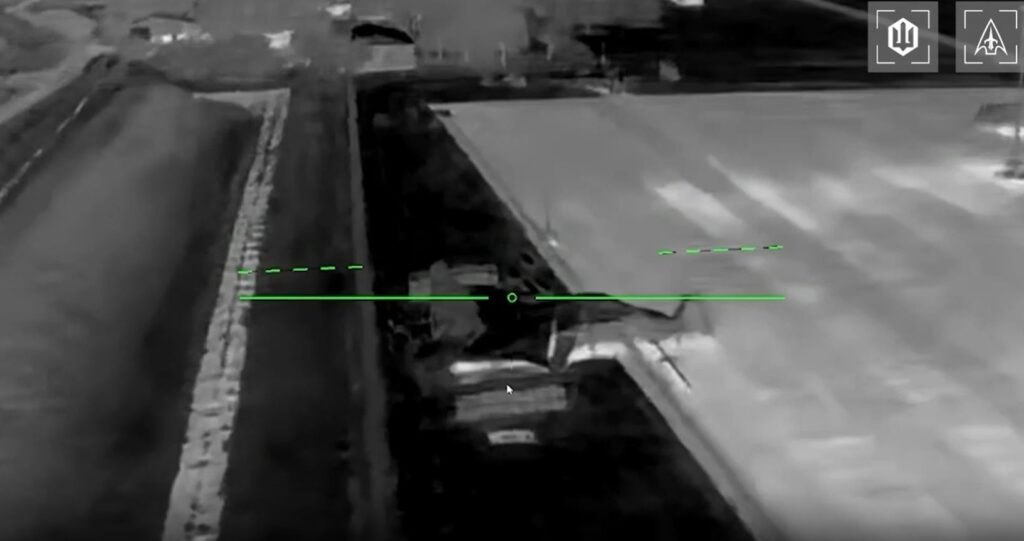
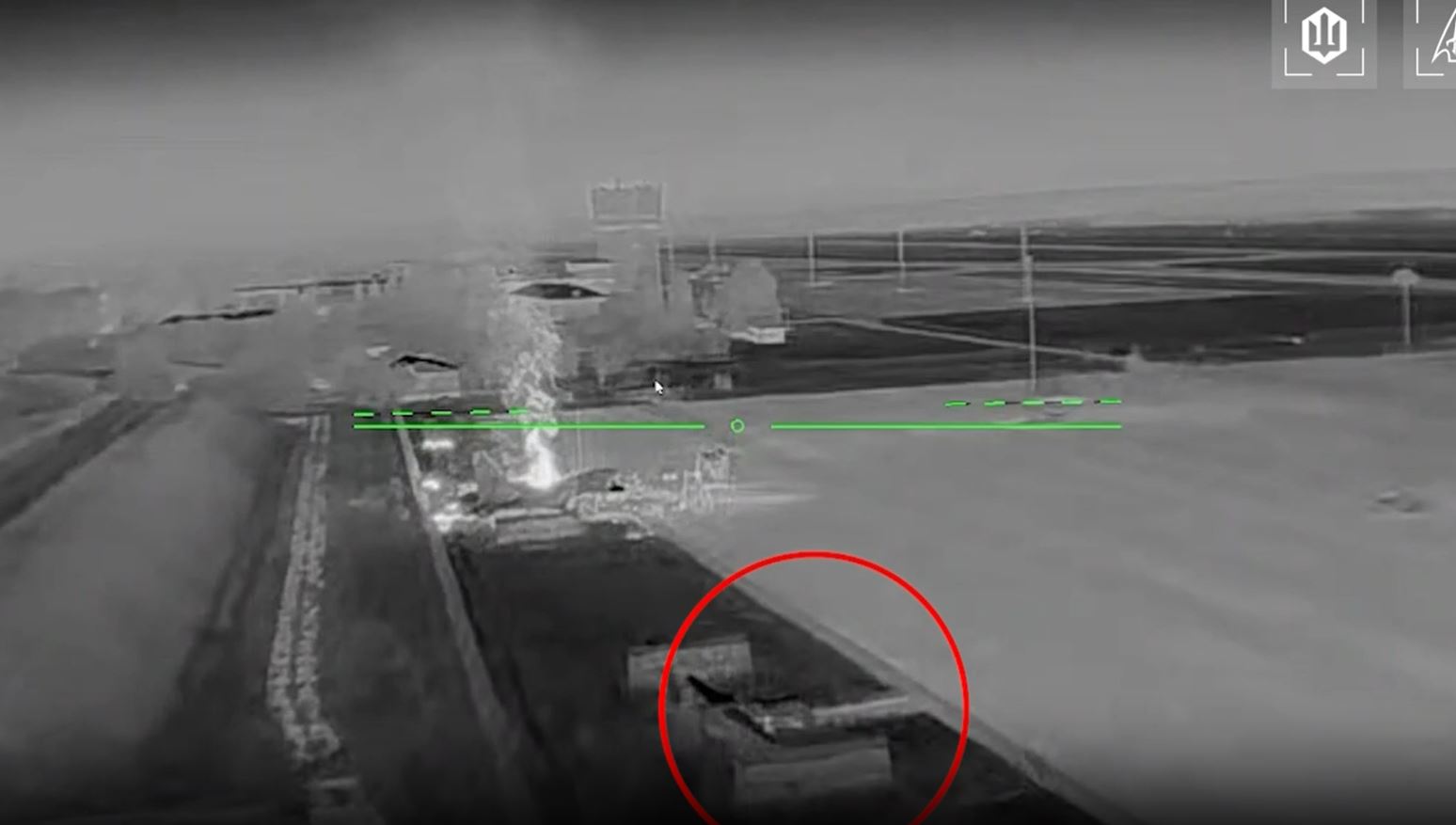
Robert Brovdi, callsign Madyar, said his crews hit 66 targets in the operational depth of the Russian rear. Among them was a MiG-29 at Dolotinka, on the grounds of the Millerovo airbase in Rostov Oblast. The 1st Separate Center of the SBS carried out that strike.

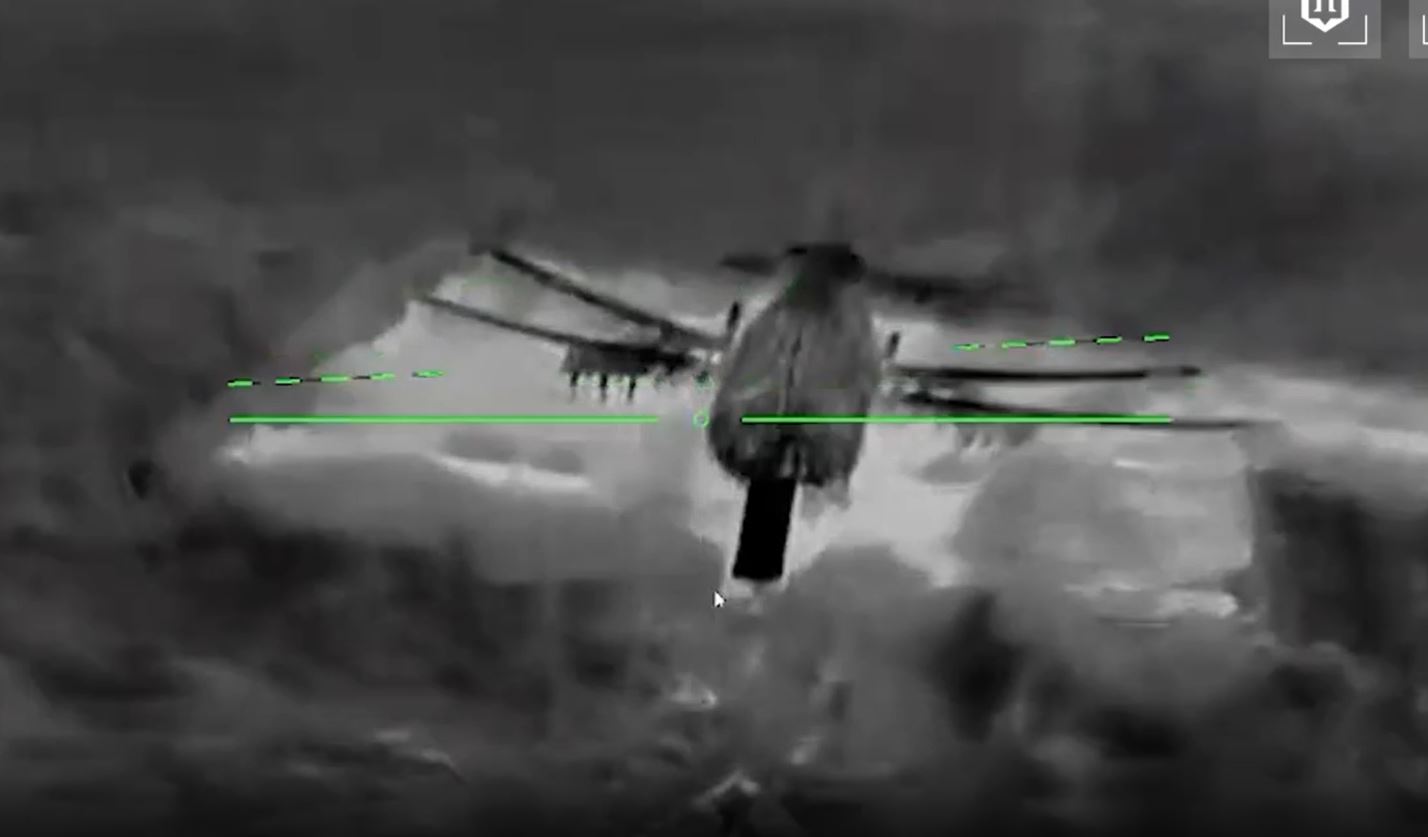
second russian mig-29 two days ukraine's drones worked over millerovo airbase · post ka-52 helicopter mockup rostov oblast russia ukrainian drone's sights 24 2026 heli ukraine news reports
A Ka-52 helicopter mockup at Millerovo airbase in Rostov Oblast, Russia, in a Ukrainian drone's sights, 24 August 2026. Photo: Telegram/Robert Brovdi

The same unit hit a mockup of a Ka-52 Alligator attack helicopter at the same location. Russia uses such decoys to draw drones away from real aircraft.

two russian fighters one spy drone hit kranodar radars anti-air systems elsewhere—ukraine forces · post combat aircraft ukrainian drone's sights vityazevo airfield krasnodar krai russia 23 2026 su-33 video sbs
Explore further

Ukraine’s drones hit two Russian fighters and a spy drone—and blinded radars from occupied Crimea to Rostov

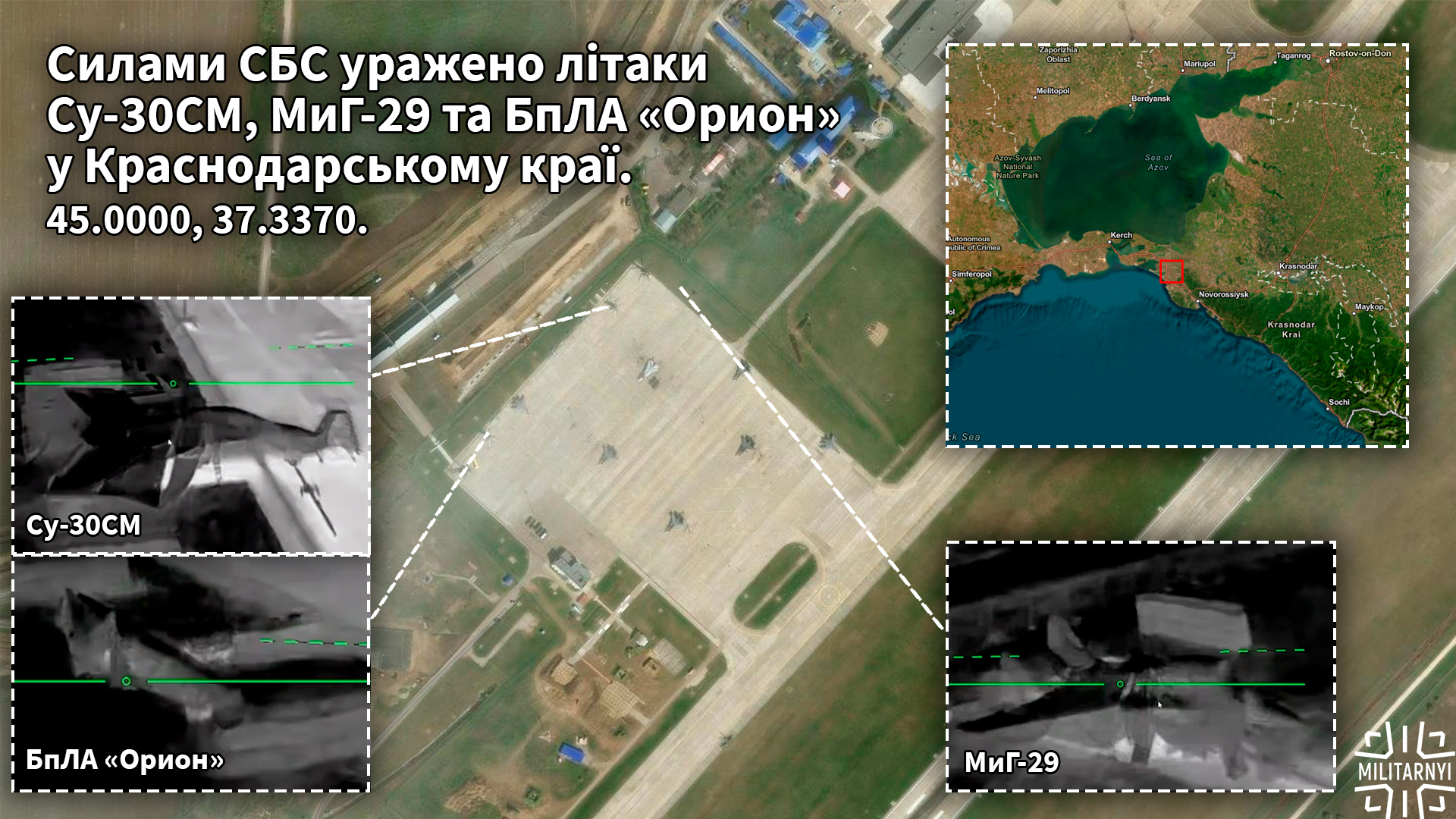
It was the third Russian fighter jet Ukrainian drones reached in two days. Crews struck another MiG-29, a jet SBS identified as a Su-33 and Militarnyi assessed as a Su-30SM, and an Orion strike-reconnaissance drone at Vityazevo in Krasnodar Krai on 23 August. Ukrainian drones have caught a MiG-29 on a Russian airfield before, at Kursk in July.

Four radars, from Rostov Oblast to occupied Crimea

Crews hit four radar systems overnight. Two Kasta-2E2 sets went down at Geraskin and Karaichev in Rostov Oblast, and a Nebo-SV at Gukovo in the same oblast. All three fell to the 1st Separate Center.

The fourth, an ST-68, stood at Rozdolne in occupied Crimea. The 9th Kairos battalion of the 414th Madyar's Birds brigade struck it.

The radar work is part of a campaign against Russian sensors and launchers that has run for months without a pause.

Rocket propellant, fuel, and two ships

The 1st Separate Center struck the Kamensky Combine at Kamensk-Shakhtinsky in Rostov Oblast, a plant producing solid rocket fuel, according to SBS. The 9th Kairos battalion hit a fuel tank at Yeysk in Krasnodar Krai. In occupied Luhansk Oblast, the 20th K-2 brigade struck a fuel depot belonging to the 106th material support brigade of Russia's 41st Army at Dovzhansk. 

Brovdi also said his crews hit and destroyed two shadow-fleet vessels, a tanker and a bulk carrier, in the Black Sea. No independent account of either loss has appeared.

A drone school, relays, and a base in occupied Kherson Oblast

In occupied Kherson Oblast, Ukrainian crews destroyed the quarters of a Russian National Guard rapid-response unit and hit two relay stations for Geran attack drones, according to the SBS breakdown.

second russian mig-29 two days ukraine's drones worked over millerovo airbase · post explosions base national guard rapid-response unit strilkove occupied kherson oblast 24 2026 - seen ukraine news ukrainian
Explosions at the base of a Russian National Guard rapid-response unit in Strilkove, occupied Kherson Oblast, 24 August 2026. Photo: Telegram/Robert Brovdi

They also struck a shelter for a Zala reconnaissance drone crew in occupied Crimea, a drone school in occupied Zaporizhzhia Oblast, and a drone laboratory in occupied Donetsk Oblast.

Brovdi also reported 11 Russian rear deployment points burning across occupied Zaporizhzhia, Donetsk, and Luhansk oblasts, along with strikes on energy nodes in occupied territory.

  •  

Ukraine’s drones hit two Russian fighters and a spy drone—and blinded radars from occupied Crimea to Rostov

two russian fighters one spy drone hit kranodar radars anti-air systems elsewhere—ukraine forces · post combat aircraft ukrainian drone's sights vityazevo airfield krasnodar krai russia 23 2026 su-33 video sbs

Ukraine's drones hit three Russian aircraft and eleven air-defense targets in one day, its Unmanned Systems Forces reported on 23 August. The strikes reached from occupied Crimea to airbases hundreds of kilometers inside Russia. They pushed the force's August count of struck Russian air-defense assets to 20, the latest run in a Ukrainian campaign against Russia's radars and launchers that has not paused for months.

Russia leans on a layered net of radars and mobile launchers to keep Ukrainian drones and missiles away from its airfields, fuel plants, and occupied land, so every set burned off that net widens the corridors its long-range weapons fly through. With its S-400 battery caught in the open again and jets chased off Crimea still within reach, Russia has shrinking safe ground for the aircraft and air defenses covering its south — a squeeze already visible when Ukraine caught a fighter and its protecting launcher on the same airfield weeks earlier.

A one-day sweep of 14 targets

The Unmanned Systems Forces (SBS) commander, Robert Brovdi, callsign Madyar, put the 23 August haul at 14 targets. They included two fighter jets, a strike-reconnaissance drone, eight radar systems, a Tor and a Pantsir short-range launcher, and a position of an S-400 — a Russian long-range air-defense system.

Eleven of the 14 fell in Rostov Oblast and Krasnodar Krai in southern Russia. The other three were in occupied Crimea. 

two russian fighters one spy drone hit kranodar radars anti-air systems elsewhere—ukraine forces · post aftermath strike combat aircraft seen another ukrainian vityazevo airfield krasnodar krai russia 23 2026 дорозвідка
Aftermath of the strike on a Russian combat aircraft as seen from another Ukrainian drone at Vityazevo airfield in Krasnodar Krai, Russia, 23 August 2026. Screenshot: SBS

Jets that fled Crimea, caught on the mainland

The three aircraft were struck at Vityazevo, a Krasnodar Krai airfield about 300 km from the front line, the 1st Separate Center of the Unmanned Systems Forces said. Militarnyi assessed that the jet SBS called a Su-33 was likely a two-seat Su-30SM, judging by its cockpit hump.

two russian fighters one spy drone hit kranodar radars anti-air systems elsewhere—ukraine forces · post ukrainian strikes su-30sm fighter mig-29 orion strike-reconnaissance vityazevo airfield krasnodar krai russia 23 2026 airfield's
Ukrainian drone strikes on a Su-30SM fighter, a MiG-29 fighter, and an Orion strike-reconnaissance drone at the Vityazevo airfield in Krasnodar Krai, Russia, 23 August 2026, with the airfield's location marked on the map. Collage: Militarnyi

Russia flies the Su-30 from its southern bases to attack Odesa and Mykolaiv oblasts, to hunt Ukrainian sea drones, and to patrol occupied territory. The struck jet likely belonged to a naval aviation regiment pushed off Crimea by repeated Ukrainian strikes on the peninsula.

two russian fighters one spy drone hit kranodar radars anti-air systems elsewhere—ukraine forces · post strike podlyot radar holovativka rostov oblast russia 23 2026 sbs ukraine news ukrainian reports
A strike on a Russian Podlyot radar at Holovativka in Rostov Oblast, Russia, 23 August 2026. Screenshot: SBS

Based on the SBS footage, Militarnyi says one drone could not hit the fighter cleanly. It exploded beside the aircraft and set off a fire that Russian crews tried to put out — a near miss, but enough to sideline the jet for a long stretch. A second drone then found the MiG-29 fighter jet and scored a direct hit, starting a large fire. A third caught the Orion, a strike-reconnaissance drone Russia uses to launch small cruise missiles and to track Ukrainian naval drones in the Black Sea.

Radars, launchers, and an S-400 on the coast

The air-defense targets ran across three regions. In occupied Crimea, crews hit a Nebo-U long-range radar at Sevastopol, the ST-68 at Yevpatoria some 30 km from the front, and a 36D6M at Uiutne. In Rostov Oblast and Krasnodar Krai they knocked out more radars, including two Kasta-2E2 sets and two Podlyot radars, plus the Tor at Pudovy and the Pantsir at Yeysk.

The 413th Reid regiment of the SBS reported hitting the S-400 position near Gelendzhik on the Krasnodar coast — the same stretch where drone crews have caught the system out in the open before.

two russian fighters one spy drone hit kranodar radars anti-air systems elsewhere—ukraine forces · post enhanced colorized frame thermal footage view ukrainian closing st-68 radar moments before impact yevpatoria occupied
Enhanced and colorized frame from the drone thermal footage showing the view from a Ukrainian drone closing on a Russian ST-68 radar moments before impact at Yevpatoria in occupied Crimea, 23 August 2026. Screenshot: Ukraine's Unmanned Systems Forces (SBS)

An August of hunting Russia's air shield

A battlefield video counter run by the force reached 20 Russian air-defense assets struck through August. The month's work extended a campaign that has steadily burned through the sensors and launchers guarding Russian airfields and occupied territory. 

  •  

Poland was ready to scrap these MiG-29s. Bulgaria’s interest just revived the Ukraine deal.

ukrainian mig-29mu1 levels key russian-used bridge near pokrovsk pinpoint strike (video) · post mig-29 tail number 57 “white” 114th tactical aviation brigade flight 2014 military pages militarnyi arhfine-foto-myg-29-bortovyj-nomer-57-bilyj-114-brygada-taktychnoyi-aviatsiyi-2014-rik-foto-ukrainian-military-pages ukraine news

Bulgaria's interest in buying Poland's retiring MiG-29s has pushed Warsaw and Kyiv closer to finalizing their long-stalled swap, Polish officials say.

Poland and Ukraine are in the final stage of negotiating a deal to transfer Poland's aging MiG-29 fighter jets to Ukraine in exchange for drones and Ukrainian drone-warfare know-how, with the jets potentially shipping within weeks, Polish outlet Wirtualna Polska reported, citing sources in the Polish Armed Forces and Defense Ministry. The report follows months of on-and-off talks that Poland's own officials have repeatedly declared both close to done and dead.

Polish Deputy Defense Minister Cezary Tomczyk said on Polsat News that Bulgaria's competing interest in the jets has "livened up" Warsaw's discussions with Kyiv. Bulgaria has told Poland that if Ukraine will not commit, Sofia would buy the jets itself, Tomczyk said.

"I hope it will be soon," Tomczyk said when asked when Poland intends to sign the agreement with Ukraine. He said Poland has laid out the technologies and know-how it wants from Ukraine in return, calling the exchange in both countries' interest. "Today I cannot say with 100% certainty that this matter will be finalized, but we hope so."

According to Wirtualna Polska, the deal covers Soviet-era jets Poland's air force is retiring as it phases in Western aircraft, in exchange for a large batch of Ukrainian drones of various types and the transfer of Ukrainian combat know-how. The outlet reports Poland wants data on strike-drone communications links, control principles, footage of strikes on targets, and physical samples of the hardware itself.

Poland's Defense Ministry has said the process picked up pace after Rustem Umerov took over as head of Ukraine's Foreign Intelligence Service, with President Volodymyr Zelenskyy tasking him with negotiating drone agreements. A source involved in the talks told Wirtualna Polska that Ukrainian drone maker Fire Point has offered to supply Poland with 1,500 long-range drones, plus a matching batch if war breaks out — an offer the source said Poland regards cautiously, since a company citing force majeure in wartime could leave Warsaw without the hardware it was promised.

A deal that has collapsed and revived for a year

Poland and Ukraine signed a bilateral security agreement in July 2024 that raised the prospect of transferring a squadron of at least 14 Polish MiG-29s. By early 2026, Warsaw had narrowed the offer to six to eight jets. In June, Poland froze the transfer, with Deputy Defense Minister Tomczyk citing Ukraine's refusal to share its drone and counter-drone technology. Talks restarted in July after Kyiv sent Warsaw a letter with concrete proposals, and by 31 July, Poland said Ukraine had returned with a specific list of drones it would hand over — a proposal Poland's ministry was still reviewing.

Poland's ambassador to Ukraine, Vasyl Bodnar, told Ukrainska Pravda's Yevropeiska Pravda that dialogue continues but that several obstacles still stand in the way of the transfer.

Why this matters

The MiG-29 remains a core part of Ukraine's air force even as it shifts to F-16s, Mirages, and incoming Gripens — Ukrainian pilots already fly the Soviet-era jets and have adapted them to carry Western precision weapons, so a new batch could enter service without the delays a Western aircraft transition requires. Poland's own hesitation reflects the same trade-off every one of its allies faces: what it gives up in hardware, it wants back in the operational knowledge Ukraine has built fighting Russia's drone war for four years — knowledge with no equivalent on any NATO training ground.

  •  

Ukrainian MiG-29 strikes Russian drone hub, ammo depot in Zaporizhzhia direction, releases video

Ukrainian MiG-29 strikes Russian drone hub, ammo depot in Zaporizhzhia direction, releases video

A Ukrainian MiG-29 fighter jet carried out a precision strike on Russian positions in the Zaporizhzhia direction, targeting a command post for drone operators and a combined ammunition and fuel depot, Ukraine's Air Force reported on June 13.

The Air Force did not disclose the exact location of the strike but thanked international partners for providing the guided munitions used in the attack.

"We thank our partners for their highly accurate and effective 'arguments'," the service wrote.

0:00
/
A Ukrainian MiG-29 fighter jet carried out a precision strike on Russian positions in the Zaporizhzhia area of southern Ukraine on June 13, 2025. (Ukraine's Air Force / Telegram)

The MiG-29, a Soviet-designed multirole fighter jet, remains a front-line platform in Ukraine's air force and has been adapted to carry Western-supplied precision-guided weapons.

Zaporizhzhia Oblast, located in southeastern Ukraine, remains one of the war's most contested areas. While the city of Zaporizhzhia is under Ukrainian control, southern parts of the region remain occupied by Russian forces.

Commander-in-Chief Oleksandr Syrskyi said on May 31 that Russia has intensified offensive operations across several key areas, including Zaporizhzhia, as part of a broader summer push.

Ukrainian forces have continued to conduct airstrikes and sabotage missions to degrade Russian supply lines and disrupt offensive preparations.

Russia preparing strategic reserves for conflicts beyond Ukraine, Ukraine warns
“According to our intelligence, Russia has started to prepare strategic reserves, which indicates plans for combat operations not only in Ukraine,” Ukraine’s Foreign Minister Andrii Sybiha said
Ukrainian MiG-29 strikes Russian drone hub, ammo depot in Zaporizhzhia direction, releases videoThe Kyiv IndependentAnna Fratsyvir
Ukrainian MiG-29 strikes Russian drone hub, ammo depot in Zaporizhzhia direction, releases video
  •  
❌