Vue normale

Russia pulled its fleet back to Novorossiysk to keep it safe. Ukraine hit it there with 15 kinds of weapons at once
13 août 2026 à 06:06

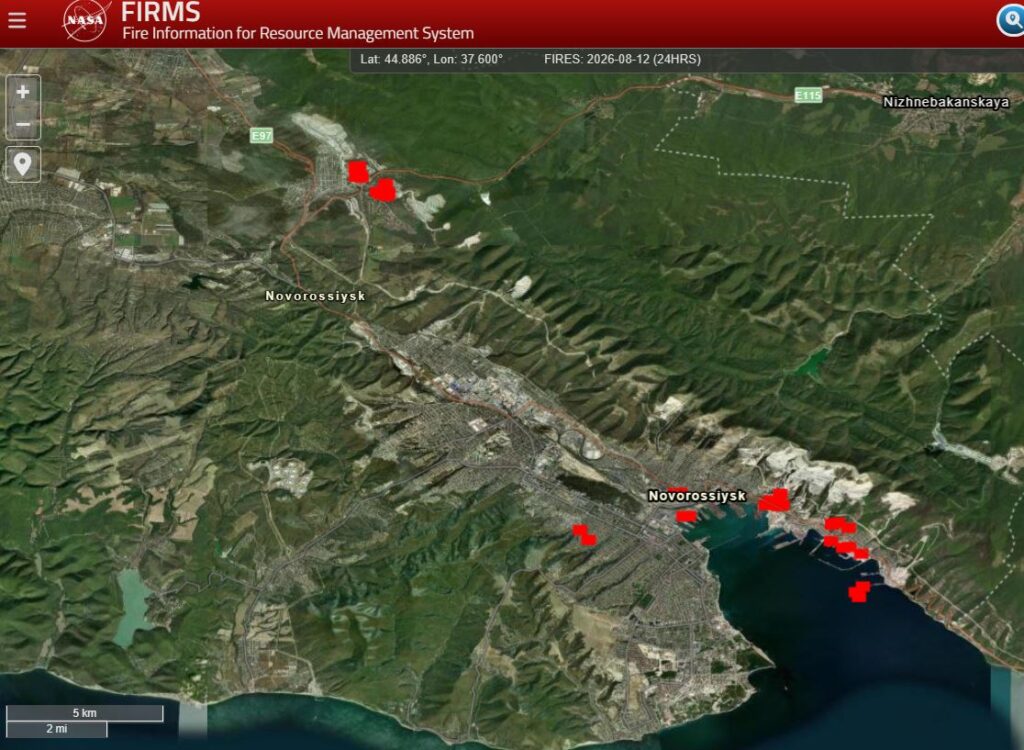
sea drones jet neptune missiles hit one russian port single night · post nasa firms shows fires detected around novorossiysk 12 2026 ukraine news ukrainian reports

Ukraine struck the Novorossiysk naval base in Russia's Krasnodar Krai overnight on 12 August, and for the first time coordinated more than 15 different strike systems in a single operation, President Volodymyr Zelenskyy said. The package combined Palianytsia jet drones, Neptune anti-ship missiles and naval drones, hitting warships, air defenses and oil infrastructure at the Black Sea Fleet's main base.

Novorossiysk is the refuge Russia's fleet fled to after Ukrainian drones and missiles pushed it out of occupied Crimea. Reaching its warships there with a mixed salvo — and getting through air defenses that bystander footage showed firing heavily — is the operational read the strike carries, more than any single ship damaged.

The systems and the targets

Zelenskyy named more than a dozen systems that worked together for the first time, from the Palianytsia and Peklo drones to the long-range Neptune and a set of naval drones. He thanked weapons developers for the added reach, framing the coordination itself as the milestone rather than the results.

The Security Service of Ukraine (SBU) confirmed hits on two Kalibr-carrying frigates, the Admiral Essen and Admiral Makarov, and the patrol ship Vasily Bykov. The same strike hit an S-300 radar, a firing position on one of the port's piers, the Sheskharis oil terminal and three of the harbor's berths — a target list wider than the ships alone.

How many ships

The three Ukrainian accounts agree on the two frigates but not on the full tally. The General Staff counted four warships, adding a Buyan-M missile ship to the SBU's three. Zelenskyy separately cited a large landing ship and a corvette among the vessels hit.

Independent analysts who reviewed satellite imagery told The Maritime Executive the damage did not appear catastrophic, with no ships visibly burning or sinking. Ukraine's General Staff said the assessment is still under way.

The fleet's shrinking refuge

The strike extends a campaign that has driven Russia's fleet eastward without Ukraine fielding a navy of its own. Having lost safe basing in Sevastopol, Russia moved its ships more than 300 kilometers from the front — far from Ukraine, but no longer out of reach.

The operation's footprint reached past the base. Russian authorities in Novorossiysk declared a state of emergency and cut water to the port city, and the strike on the Sheskharis oil terminal hit infrastructure that helps fund the war. Zelenskyy said Ukraine would keep striking such targets, and that Russia alone can end the war it started.
  • ✇Euromaidan Press
  • Ukrainian drones black out occupied Sevastopol and hit the Balaklava power plant
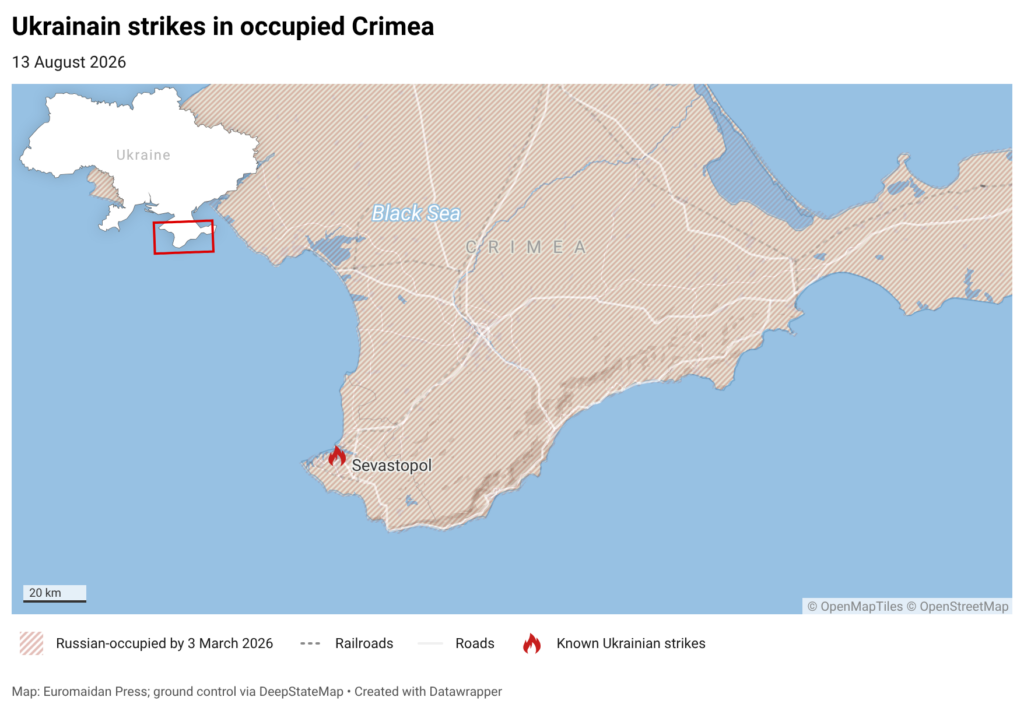
    A large-scale Ukrainian drone attack cut electricity across occupied Sevastopol overnight on 13 August, with power later restored on a temporary scheme after strikes damaged the city's energy infrastructure, the Russian-installed head of the city wrote on his Telegram channel. The blackout is the latest blow in Ukraine's months-long campaign to isolate occupied Crimea by degrading the fuel, power, and transport networks Russia relies on to hold the peninsula. Sevastopol
     

Ukrainian drones black out occupied Sevastopol and hit the Balaklava power plant

13 août 2026 à 05:20

A large-scale Ukrainian drone attack cut electricity across occupied Sevastopol overnight on 13 August, with power later restored on a temporary scheme after strikes damaged the city's energy infrastructure, the Russian-installed head of the city wrote on his Telegram channel.

The blackout is the latest blow in Ukraine's months-long campaign to isolate occupied Crimea by degrading the fuel, power, and transport networks Russia relies on to hold the peninsula. Sevastopol — the former main base of Russia's Black Sea Fleet — has lost power repeatedly since early June, when Ukraine sharply escalated strikes on Crimean energy sites.

What was hit

Drones headed toward the Balaklava thermal power plant, one of the peninsula's two main power stations, while mobile fire groups worked over Sevastopol, the monitoring channel Crimean Wind reported. Witnesses described an explosion and the loss of electricity across the city.

A fire also broke out at a large water-supply facility near the village of Shturmove, south of Sevastopol, around the time of the strike on Balaklava, the same channel said. The cause has not been established. The site houses the city's No. 3 hydro unit, which supplies Sevastopol's water.

Elsewhere on the peninsula, gunfire was reported near the Tavriiska thermal power plant, and Russian air defense operated near the Gvardiiske airfield.

A grid already rationing power

Russia closed the Crimean Bridge to road traffic during the attack, the crossing's occupation-run information channel reported.

The outage lands on a grid already under strain. Sevastopol last went fully dark on 27 July, and in July the occupation authorities imposed a rolling blackout schedule that left residents with about six hours of electricity a day. Since early June, Ukrainian strikes have repeatedly cut power across Crimea, with some districts dark for a week or more, alongside disruptions to water and mobile coverage.

The isolation campaign

Ukrainian officials have described the strikes as stages of a plan to cut occupied Crimea off from mainland Russia. Beyond power plants, Ukraine has hit the fuel tankers supplying the peninsula, the bridges and rail links feeding it, and Russian vessels — leaving Crimea rationing petrol and, at times, short of food.

Ukraine's military had not publicly claimed the 13 August strike as of publication.

  • ✇Euromaidan Press
  • Ukraine strikes Gazprom’s Salavat refinery again as Russia’s fuel shortages return in 16 regions
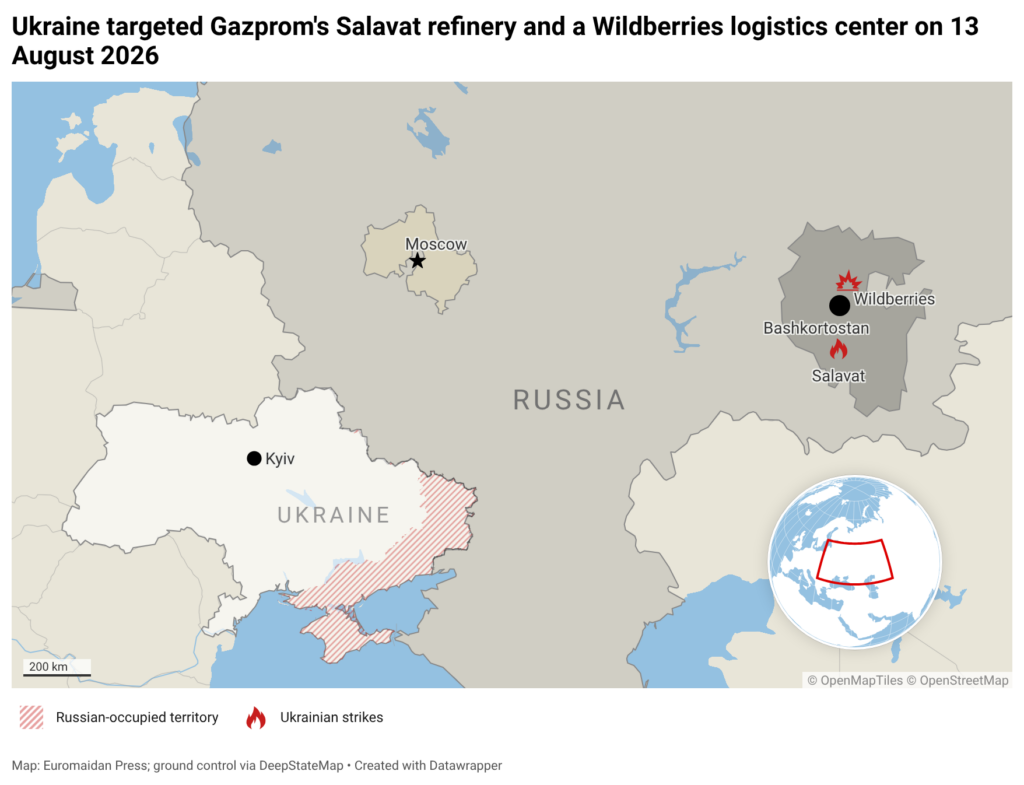
    Ukrainian drones struck the Gazprom Neftekhim Salavat oil-refining and petrochemical complex in Russia's Bashkortostan on the morning of 13 August, setting off a fire — the second strike on one of Russia's largest refineries in a month. The repeat hit lands as Ukraine's deep-strike campaign forces Russian refining to its lowest level since 2002 and pushes fuel shortages back into at least 16 regions, where drivers again face queues and sales limits at filling stations.
     

Ukraine strikes Gazprom’s Salavat refinery again as Russia’s fuel shortages return in 16 regions

13 août 2026 à 04:15

Gazprom Neftekhim Salavat

Ukrainian drones struck the Gazprom Neftekhim Salavat oil-refining and petrochemical complex in Russia's Bashkortostan on the morning of 13 August, setting off a fire — the second strike on one of Russia's largest refineries in a month.

The repeat hit lands as Ukraine's deep-strike campaign forces Russian refining to its lowest level since 2002 and pushes fuel shortages back into at least 16 regions, where drivers again face queues and sales limits at filling stations. Striking the same plants faster than Moscow can repair them is the point — each return resets the clock on units that take weeks or months to rebuild.

What happened

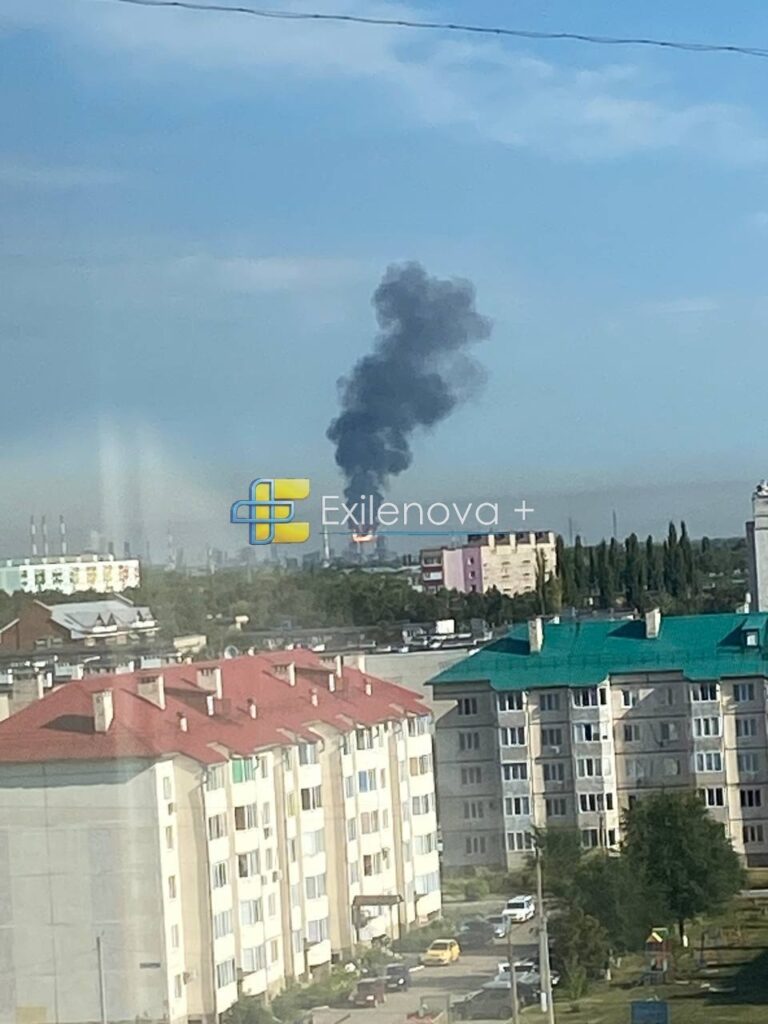
Bashkortostan's head, Radiy Khabirov, confirmed that debris from a downed drone fell in Salavat's industrial zone and sparked a blaze, which he called a "terrorist attack." Ukrainian monitoring channels Exilenova+ and Supernova identified the target as the Gazprom Neftekhim Salavat plant, and residents reported a column of black smoke over the site. Ukraine's military had not commented on the strike.

The complex is one of Russia's largest refining and petrochemical sites. It processed about 7.2 million tons of crude in 2024 — roughly 2.7% of Russia's total refining — and turns out gasoline, diesel, jet fuel, ammonia, and more, according to Reuters, citing industry sources.

Ukrainian drones struck the same plant on 14 July, damaging two primary distillation units and halting operations; industry sources told Reuters the repairs could take weeks to months. Open-source data cited by Radio Svoboda places Russia's only heptyl rocket-fuel producer, the Salavat Chemical Plant, inside the same industrial perimeter, though there is no confirmation it was hit.

A campaign that keeps resetting repairs

Since early August, at least four refineries have stopped processing after Ukrainian strikes, including plants in Orenburg, Tyumen, Saratov, and Volgograd oblasts. Across 2026, attacks have interrupted work at no fewer than 26 refineries, seven of them still offline at the end of July, according to S&P Global.

Russian refining has fallen to about 3.6 million barrels a day, the lowest since 2002, per EA Analytics — the trigger for the fuel crisis now resurfacing. Shortages had eased by late July, but by mid-August residents of at least 16 regions were again reporting queues and sales restrictions, with Ai-92 and Ai-95 grades pulled from some Gazprom and Lukoil stations.

Attack on warehouse Wildberries

Drones also struck a Wildberries logistics center under construction in Bashkortostan's Chishminsky district, according to the monitoring channel Astra.

Wildberries is Russia's largest online retailer. The hub—about 187,000 square meters—has been under construction since 2024 on the grounds of the "Center of Agrotechnologies" agropark.

  • ✇Euromaidan Press
  • 115 days in a forest Russia has tried to seize since 2022—one border guard’s stand
    By the State Border Guard Service of Ukraine's account, Mykhailo, one of its soldiers, deployed to the forest in October 2024 with the rapid-response border commandant unit Shkval and held off Russian assaults while fortifying the ground under constant drone attack. Holding a position like that on a static, drone-saturated front takes endurance as much as firepower. A unit has to supply itself, down to digging its own water under fire. The Serebryanskyi forest, on the b
     

115 days in a forest Russia has tried to seize since 2022—one border guard’s stand

13 août 2026 à 03:37

ukrainian-soldier-well

By the State Border Guard Service of Ukraine's account, Mykhailo, one of its soldiers, deployed to the forest in October 2024 with the rapid-response border commandant unit Shkval and held off Russian assaults while fortifying the ground under constant drone attack.

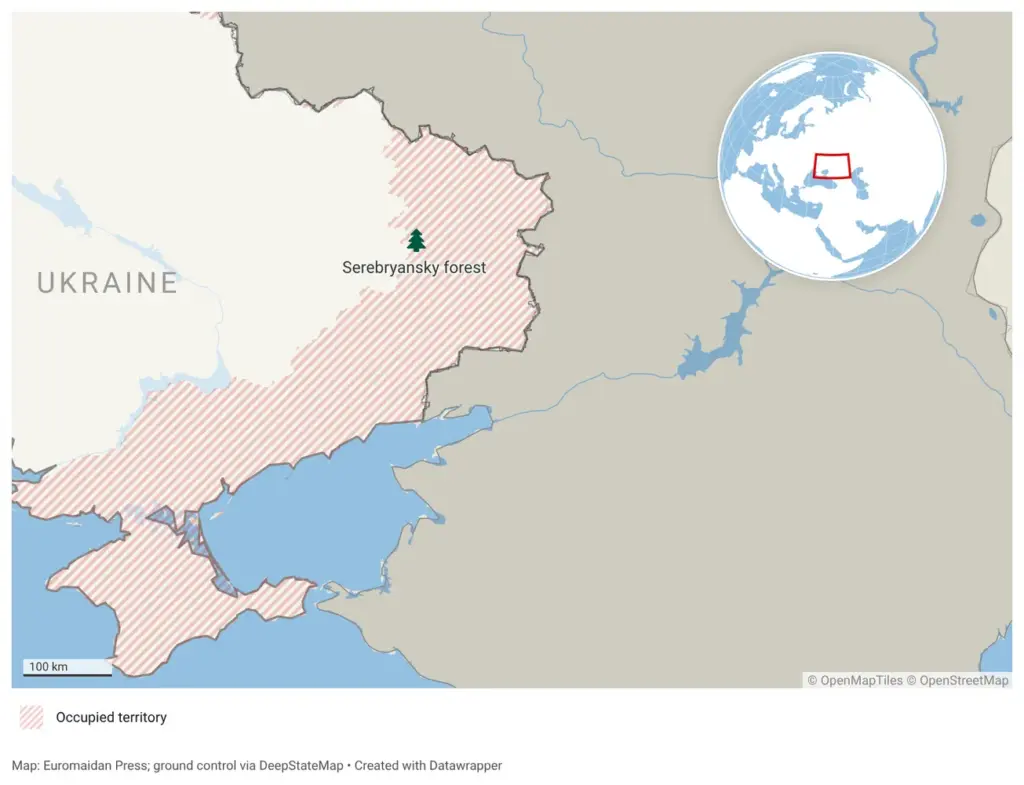
Holding a position like that on a static, drone-saturated front takes endurance as much as firepower. A unit has to supply itself, down to digging its own water under fire. The Serebryanskyi forest, on the border of Luhansk and Donetsk oblasts, has been contested since 2022. Euromaidan Press has previously reported on Ukrainian storming operations in the forest and on Azov's account of driving Russian forces from some positions there in 2024.

Serebryansky-forest
Map: Euromaidan Press; ground control via DeepStateMap • Created with Datawrapper

Mykhailo worked abroad in construction after his studies, then signed a contract with the State Border Guard Service in 2020. He served first at the Nismychi unit, then at Belz, where he worked as a district inspector, before the October 2024 rotation with Shkval put him on the positions for 115 days.

"Logistics were not easy. Drones delivered the food, and we also had to supply the positions with water. So we even dug our own well, to have our own water and to be able to bring in more food," Mykhailo recalled.

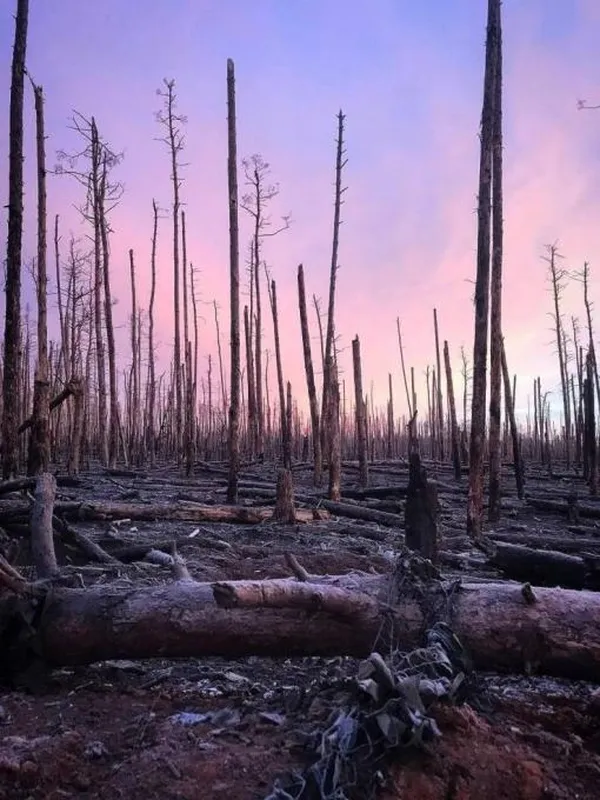
Serebrianskyi forest, Luhansk region, Ukraine
Serebrianskyi forest, Luhansk region, Ukraine. Photo: State Environmental Inspectorate in Luhansk region

He returns repeatedly to the men around him. When his own endurance ran out, he said, it was his brothers-in-arms who kept him in place.

"Your brothers-in-arms motivate you. When I said I couldn't take it anymore, they said: 'Sit tight. Together to the end.' And so we all sat there together to the end," he said.

Mykhailo is motivated by his family, which he considers his greatest incentive to defend Ukraine.

❌