Vue normale

  • ✇US news | The Guardian
  • R Kelly formally appeals to Donald Trump to commute his 31-year prison sentence
    The R&B singer was found guilty of racketeering, sex trafficking and producing child abuse images, with his lawyer lobbying the US president for more than a yearR Kelly has formally appealed to the US president, Donald Trump, for a reduction of his 31-year prison sentence for racketeering, sex trafficking and child abuse images, in a filing to the Department of Justice.The 59-year-old R&B singer, whose full name is Robert Sylvester Kelly, was found guilty in 2021 of leading a criminal en
     

R Kelly formally appeals to Donald Trump to commute his 31-year prison sentence

15 juillet 2026 à 22:20

The R&B singer was found guilty of racketeering, sex trafficking and producing child abuse images, with his lawyer lobbying the US president for more than a year

R Kelly has formally appealed to the US president, Donald Trump, for a reduction of his 31-year prison sentence for racketeering, sex trafficking and child abuse images, in a filing to the Department of Justice.

The 59-year-old R&B singer, whose full name is Robert Sylvester Kelly, was found guilty in 2021 of leading a criminal enterprise that recruited women and underage girls for illegal sexual activity and pornography, for which he was sentenced to 30 years in prison. In 2022 he was found guilty on three counts of child abuse images and three counts of child enticement and sentenced to 20 years in prison, which he is serving nearly entirely concurrently but for one additional year.

Information and support for anyone affected by rape or sexual abuse issues is available from the following organizations. In the US, Rainn offers support on 800-656-4673. In the UK, Rape Crisis offers support on 0808 802 9999. In Australia, support is available at 1800Respect (1800 737 732). Other international helplines can be found at ibiblio.org/rcip/internl.html

Continue reading...

© Photograph: Antonio Perez/AFP/Getty Images

© Photograph: Antonio Perez/AFP/Getty Images

© Photograph: Antonio Perez/AFP/Getty Images

Iranian American Woman Held in Iran on Spying Charges Is Released

15 juillet 2026 à 23:21
The dual Iranian-U.S. citizen, Dena Karari, had her passport seized in December 2024 and had not been able to leave Iran as she faced espionage charges.

Trump Says He’ll Seek to Replace Immigrant Truck Drivers With Veterans

15 juillet 2026 à 21:14
The president has pushed to curtail the commercial licenses of immigrants, including legal residents, whom he has blamed for crashes.

© Doug Mills/The New York Times

President Trump mentioned a plan to crack down on truck drivers in the United States without legal status and to replace them with veterans during a panel at a military investment summit in Carlisle, Pa., on Wednesday.
  • ✇US news | The Guardian
  • Trump says Iran has released US citizen detained since 2024
    Dena Karari, dual US-Iranian citizen, ‘now safely outside of Iran, and in good condition’, president posts on Truth SocialDonald Trump said Wednesday Iran had agreed to release an American citizen who was “wrongfully detained” since December 2024.“She is now safely outside of Iran, and in good condition,” Trump wrote on social media, without naming the woman. “The United States of America appreciates this gesture of Goodwill by Iran!” Continue reading...
     

Trump says Iran has released US citizen detained since 2024

15 juillet 2026 à 20:20

Dena Karari, dual US-Iranian citizen, ‘now safely outside of Iran, and in good condition’, president posts on Truth Social

Donald Trump said Wednesday Iran had agreed to release an American citizen who was “wrongfully detained” since December 2024.

“She is now safely outside of Iran, and in good condition,” Trump wrote on social media, without naming the woman. “The United States of America appreciates this gesture of Goodwill by Iran!”

Continue reading...

© Photograph: Julia Demaree Nikhinson/AP

© Photograph: Julia Demaree Nikhinson/AP

© Photograph: Julia Demaree Nikhinson/AP

Investigators Seek Information From Government Officials as Part of Air Force One Leak Investigation

15 juillet 2026 à 20:36
After The New York Times reported on security concerns related to the Qatari-donated jet, the F.B.I. sought to speak with several people who flew aboard the plane with President Trump last week and asked for their phones.

© Doug Mills/The New York Times

President Trump on July 1 at Joint Base Andrews next to the jet donated by Qatar, before its first flight as Air Force One.
  • ✇US news | The Guardian
  • China and Xi Jinping seen more favourably than the US and Trump in poll of major countries
    Global views appear to have flipped in Beijing’s favour, driven in part by tensions between the Trump administration and US allies, a new Pew survey showsThe world has largely viewed the US more favourably than China for years, but those opinions have flipped in Beijing’s favour this year, according to a new poll from the Pew Research Center, a remarkable shift driven in part by tensions between the Trump administration and US allies.More people have favourable views of China than the US in 25 o
     

China and Xi Jinping seen more favourably than the US and Trump in poll of major countries

15 juillet 2026 à 19:46

Global views appear to have flipped in Beijing’s favour, driven in part by tensions between the Trump administration and US allies, a new Pew survey shows

The world has largely viewed the US more favourably than China for years, but those opinions have flipped in Beijing’s favour this year, according to a new poll from the Pew Research Center, a remarkable shift driven in part by tensions between the Trump administration and US allies.

More people have favourable views of China than the US in 25 out of the 36 countries and territories that were surveyed, including Canada and Mexico. The poll was conducted from February to May, a period when the United States and Israel were engaged in a war against Iran.

Continue reading...

© Photograph: Evan Vucci/Reuters

© Photograph: Evan Vucci/Reuters

© Photograph: Evan Vucci/Reuters

  • ✇US news | The Guardian
  • Drained reflecting pool reveals Trump’s ‘American flag blue’ liner is now closer to gray
    Trump’s effort to revamp the landmark stretched well past the goal of having it ready by the Fourth of JulyThe newly drained Lincoln Memorial reflecting pool’s bottom surface has noticeably faded since it was lined with a protective coating in a color Donald Trump called “American flag blue” this spring.An Associated Press reporter and photographer viewed the fenced-off reflecting pool on Wednesday from the top of the Washington Monument. The new liner appears grayer than when the pool was repai
     

Drained reflecting pool reveals Trump’s ‘American flag blue’ liner is now closer to gray

15 juillet 2026 à 19:28

Trump’s effort to revamp the landmark stretched well past the goal of having it ready by the Fourth of July

The newly drained Lincoln Memorial reflecting pool’s bottom surface has noticeably faded since it was lined with a protective coating in a color Donald Trump called “American flag blue” this spring.

An Associated Press reporter and photographer viewed the fenced-off reflecting pool on Wednesday from the top of the Washington Monument. The new liner appears grayer than when the pool was repainted and refilled with water in early June. Debris that had been visible earlier this week after the pool was drained is now largely gone, after work crews removed it.

Continue reading...

© Photograph: Rahmat Gul/AP

© Photograph: Rahmat Gul/AP

© Photograph: Rahmat Gul/AP

FBI Evidence Team Visits Lincoln Memorial Reflecting Pool

15 juillet 2026 à 19:51
Officials surveyed the newly drained pool, where the floor began peeling soon after a $16 million repair job. President Trump has blamed vandals.

© Demetrius Freeman for The New York Times

Investigators examining the drained Lincoln Memorial Reflecting Pool in Washington on Wednesday.
  • ✇US news | The Guardian
  • ‘We screwed up the comms’: JD Vance admits errors over Epstein files release
    Vice-president tells Joe Rogan administration botched handling and should have released all documents from startJD Vance agreed with criticism that the Trump administration botched the handling of the release of the Jeffrey Epstein files, telling podcast host Joe Rogan that “we absolutely screwed up the comms”.The Department of Justice’s repeated moves to delay the release of documents related to the convicted sex offender drew bipartisan disapproval last year. The files have been one of the mos
     

‘We screwed up the comms’: JD Vance admits errors over Epstein files release

15 juillet 2026 à 19:06

Vice-president tells Joe Rogan administration botched handling and should have released all documents from start

JD Vance agreed with criticism that the Trump administration botched the handling of the release of the Jeffrey Epstein files, telling podcast host Joe Rogan that “we absolutely screwed up the comms”.

The Department of Justice’s repeated moves to delay the release of documents related to the convicted sex offender drew bipartisan disapproval last year. The files have been one of the most significant political liabilities to Donald Trump since his second term began.

Continue reading...

© Photograph: Bloomberg/Getty Images

© Photograph: Bloomberg/Getty Images

© Photograph: Bloomberg/Getty Images

Trump Administration Fires Roger Rogoff, U.S. Attorney, Minutes After His Appointment

15 juillet 2026 à 22:15
Federal judges had chosen the veteran Seattle prosecutor to fill the vacant seat. Now, a potential legal battle looms.

© Ted S. Warren/Associated Press

Roger Rogoff, a former federal prosecutor and state judge, in court in Seattle in 2016.

Hegseth Plans to Screen All Troops, Including Women, for Low Testosterone

16 juillet 2026 à 05:30
Pete Hegseth, as defense secretary, has sought to cultivate an image as a manosphere-friendly leader.

© Kenny Holston/The New York Times

The goal, Defense Secretary Pete Hegseth said in a social media message, was a “High-T Department of War.”

U.S. Military Again Blockades Iranian Ports After Collapse of Cease-Fire

15 juillet 2026 à 19:02
President Trump ordered U.S. warships and aircraft to stop vessels going to and from Iran. Enforcing a blockade takes a huge commitment of warships and aircraft.

© Mike Blake/Reuters

The U.S.S. Abraham Lincoln in San Diego in 2022. According to the U.S. Naval Institute, as of Monday it is anchoring one of two aircraft carrier strike groups deployed in the Northern Arabian Sea.

Todd Blanche, Trump’s Attorney General Pick, Faces Crucial Hurdle After Rocky Hearing

15 juillet 2026 à 20:49
Even a single Republican “no” vote would block Mr. Blanche’s nomination from consideration by the full Senate, which could sink his confirmation.

© Kenny Holston/The New York Times

Todd Blanche on Wednesday at his confirmation hearing to be attorney general. It is not clear when the Senate Judiciary Committee will schedule a vote.

Billboard in Iran’s Capital Depicts Trump in a Coffin

15 juillet 2026 à 14:41
Threatening imagery in Enghelab Square is nothing new, but has rarely taken such lurid form.

© Vahid Salemi/Associated Press

A billboard in Enghelab Square in central Tehran on Wednesday, with graffiti saying “We Will Kill Trump.”
  • ✇US news | The Guardian
  • New $1 coin featuring Trump in production at US Mint, treasury says
    Coin commemorating 250th anniversary will be released this fall and marks first time a living president appears on currencyThe treasury department announced on Wednesday that the US Mint has started producing a new commemorative $1 coin featuring Donald Trump as part of the nation’s 250th anniversary celebration.The coin is scheduled for release this fall. Treasury officials said its final design was approved earlier this year by the US Commission of Fine Arts, whose members were appointed by Tr
     

New $1 coin featuring Trump in production at US Mint, treasury says

15 juillet 2026 à 19:59

Coin commemorating 250th anniversary will be released this fall and marks first time a living president appears on currency

The treasury department announced on Wednesday that the US Mint has started producing a new commemorative $1 coin featuring Donald Trump as part of the nation’s 250th anniversary celebration.

The coin is scheduled for release this fall. Treasury officials said its final design was approved earlier this year by the US Commission of Fine Arts, whose members were appointed by Trump.

Continue reading...

© Photograph: Treasury Secretary Scott Bessent via X

© Photograph: Treasury Secretary Scott Bessent via X

© Photograph: Treasury Secretary Scott Bessent via X

Senators Press for Scrutiny of Blanche’s Role in Spiking Clemency Inquiry

15 juillet 2026 à 18:35
During his confirmation hearing, the acting attorney general refused to discuss the termination of an investigation into a commutation issued by President Trump.

© Kenny Holston/The New York Times

Todd Blanche, the acting attorney general, during a Senate confirmation hearing on Wednesday.
  • ✇US news | The Guardian
  • Trump rails against New York’s statewide datacenter moratorium
    AI-friendly president shared a post saying governor Kathy Hochul should scrap the one-year policy ‘IMMEDIATELY’Donald Trump railed against the New York governor, Kathy Hochul, for pausing the construction of large new datacenters, the resource-intensive facilities that power artificial intelligence.New York became the first US state to enact a moratorium on new datacenters on Tuesday, when Hochul signed an executive order mandating a one-year statewide pause on so-called “hyperscale” datacenters
     

Trump rails against New York’s statewide datacenter moratorium

15 juillet 2026 à 14:05

AI-friendly president shared a post saying governor Kathy Hochul should scrap the one-year policy ‘IMMEDIATELY’

Donald Trump railed against the New York governor, Kathy Hochul, for pausing the construction of large new datacenters, the resource-intensive facilities that power artificial intelligence.

New York became the first US state to enact a moratorium on new datacenters on Tuesday, when Hochul signed an executive order mandating a one-year statewide pause on so-called “hyperscale” datacenters.

Continue reading...

© Photograph: Matt Roberts/Shutterstock

© Photograph: Matt Roberts/Shutterstock

© Photograph: Matt Roberts/Shutterstock

  • ✇US news | The Guardian
  • Trump’s barbed eulogy for Lindsey Graham reveals how fragile his ego is
    In interviews and social posts, the loyalty-obsessed president couldn’t help but weave criticism into his praiseThis was originally published in This Week in Trumpland. Sign up to receive it in your inbox every WednesdayNormal procedure in the immediate aftermath of an unexpected death is to shower the deceased with praise, irrespective of whether it is deserved.Donald Trump, commemorating Lindsey Graham in recent days, has taken a different tack, sometimes extolling the South Carolina senator’s
     

Trump’s barbed eulogy for Lindsey Graham reveals how fragile his ego is

15 juillet 2026 à 12:54

In interviews and social posts, the loyalty-obsessed president couldn’t help but weave criticism into his praise

Normal procedure in the immediate aftermath of an unexpected death is to shower the deceased with praise, irrespective of whether it is deserved.

Donald Trump, commemorating Lindsey Graham in recent days, has taken a different tack, sometimes extolling the South Carolina senator’s virtues but at other times rather diminishing the newly deceased 71-year-old.

Continue reading...

© Photograph: Jacquelyn Martin/AP

© Photograph: Jacquelyn Martin/AP

© Photograph: Jacquelyn Martin/AP

Trump Endorses Mike Lindell, MyPillow Founder, for Minnesota Governor

15 juillet 2026 à 12:15
He is a close ally of President Trump and has been a leading proponent of the election denial movement, which falsely claims that voting machines are often rigged.

© Callaghan O'Hare/Reuters

Mike Lindell at the Conservative Political Action Conference in Grapevine, Texas, in March.
  • ✇US news | The Guardian
  • Wisconsin panel finds Elon Musk’s $1m state supreme court voter giveaway was likely illegal
    Musk distributed money to three people before the 2025 election, which he claimed was critical to Trump’s agendaBillionaire Elon Musk likely violated Wisconsin law when he gave out $1m checks to voters in the 2025 state supreme court election, a bipartisan elections panel has found.Musk distributed the money before the vote, which he claimed was critical to Donald Trump’s agenda and “the future of civilization”. Continue reading...
     

Wisconsin panel finds Elon Musk’s $1m state supreme court voter giveaway was likely illegal

15 juillet 2026 à 12:25

Musk distributed money to three people before the 2025 election, which he claimed was critical to Trump’s agenda

Billionaire Elon Musk likely violated Wisconsin law when he gave out $1m checks to voters in the 2025 state supreme court election, a bipartisan elections panel has found.

Musk distributed the money before the vote, which he claimed was critical to Donald Trump’s agenda and “the future of civilization”.

Continue reading...

© Photograph: Jeffrey Phelps/AP

© Photograph: Jeffrey Phelps/AP

© Photograph: Jeffrey Phelps/AP

  • ✇US news | The Guardian
  • Trump endorses MyPillow founder Mike Lindell in Minnesota governor’s race
    Republican Trump ally has spent years promoting discredited claims about 2020 electionDonald Trump has endorsed Mike Lindell’s bid for Minnesota governor, calling the MyPillow founder “one of America’s greatest and most hard working Patriots” in a Truth Social post on Wednesday.Trump described Lindell as someone who had “sacrificed” more than almost anyone else “in fighting for our country, especially when it comes to Election Integrity”, invoking Lindell’s years spent promoting discredited clai
     

Trump endorses MyPillow founder Mike Lindell in Minnesota governor’s race

15 juillet 2026 à 10:52

Republican Trump ally has spent years promoting discredited claims about 2020 election

Donald Trump has endorsed Mike Lindell’s bid for Minnesota governor, calling the MyPillow founder “one of America’s greatest and most hard working Patriots” in a Truth Social post on Wednesday.

Trump described Lindell as someone who had “sacrificed” more than almost anyone else “in fighting for our country, especially when it comes to Election Integrity”, invoking Lindell’s years spent promoting discredited claims about the 2020 election. Trump said Lindell “will MAKE MINNESOTA GREAT AGAIN” and gave him full-throated support ahead of the state’s 11 August Republican primary, where early voting is already under way.

Continue reading...

© Photograph: Mandel Ngan/AFP/Getty Images

© Photograph: Mandel Ngan/AFP/Getty Images

© Photograph: Mandel Ngan/AFP/Getty Images

  • ✇US news | The Guardian
  • White House overturns DHS halt to ICE traffic stops despite killings of two men
    Move comes after Trump rebuked his own homeland security department and insisted ICE maintain policyThe White House overturned a one-day old homeland security department (DHS) memo that said they would be halting traffic stops in the wake of recent stops that left two men killed in the space of a week on Wednesday morning, hours after Donald Trump insisted ICE keep making them.Federal officers across the US had been told to temporarily stop pulling drivers over on Tuesday. That directive came af
     

White House overturns DHS halt to ICE traffic stops despite killings of two men

15 juillet 2026 à 11:40

Move comes after Trump rebuked his own homeland security department and insisted ICE maintain policy

The White House overturned a one-day old homeland security department (DHS) memo that said they would be halting traffic stops in the wake of recent stops that left two men killed in the space of a week on Wednesday morning, hours after Donald Trump insisted ICE keep making them.

Federal officers across the US had been told to temporarily stop pulling drivers over on Tuesday. That directive came after ICE agents fatally shot Lorenzo Salgado Araujo in Houston on 7 July and Joan Sebastián Durán Guerrero in Maine on Monday. Both men were unarmed, neither was the intended target of the operation that killed him, and in both cases the agents involved wore no body camera to record what happened.

Continue reading...

© Photograph: Mark Felix/AFP/Getty Images

© Photograph: Mark Felix/AFP/Getty Images

© Photograph: Mark Felix/AFP/Getty Images

  • ✇Coda Story
  • FIFA’s games betray our trust
    A lot is written about corruption, but fundamentally it’s about trust and how healthy societies can’t exist without it; and the World Cup has shown what happens when trust breaks down. The decision to allow U.S. striker Folarin Balogun to play in the World Cup match against Belgium was, according to FIFA, made by the relevant disciplinary committee in a routine manner. However, following the similarly generous treatment accorded to Portuguese megastar Cristiano Ronaldo before the tournament bega
     

FIFA’s games betray our trust

15 juillet 2026 à 09:05

A lot is written about corruption, but fundamentally it’s about trust and how healthy societies can’t exist without it; and the World Cup has shown what happens when trust breaks down. The decision to allow U.S. striker Folarin Balogun to play in the World Cup match against Belgium was, according to FIFA, made by the relevant disciplinary committee in a routine manner. However, following the similarly generous treatment accorded to Portuguese megastar Cristiano Ronaldo before the tournament began, a lot of people not unreasonably questioned whether the rules were being set aside for commercial reasons.

It’s only football, so does this matter? In some ways, of course not. But I think the episode is instructive of how quickly trust can disappear. No one is under any illusions that FIFA is motivated purely by the desire to spread sweetness and light, thanks to corruption scandals, the grotesque “peace prize,” and all the other nonsense. But previously, what happened on the pitch was assumed to be sacrosanct, which is why these disciplinary decisions mattered more than it at first might appear.

Shortly after the U.S.-Belgium game, Argentina played Egypt, coming back from a two-goal deficit to achieve a remarkable 3-2 victory. I watched the game with my family, and it was notable how — instead of being amazed by Lionel Messi’s wizardry — all of us focussed instead on a refereeing discrepancy that led to a goal for Egypt being ruled out, and a seemingly identical one for Argentina being allowed. 

Previously we would have given the referee the benefit of the doubt: even if he’d made a mistake, we’d accept it was an honest one. But now we knew that the tournament had intervened to keep bankable stars playing for longer, in violation of its own precedents and regulations. Any decision that has that effect, as this one did, was immediately suspect. 

In the past, particularly when living in Russia, I used to hear a lot of Westerners being quite enthusiastic about corruption: it was nice they’d say, if they’d been stopped speeding, to be able to pay the police officer a bribe on the spot, and skip all the annoying paperwork. But that was a short-sighted way of looking at it: once a police officer, or anyone else in a position of power, gives anyone special treatment, then the trust that keeps all our interactions civilised, starts to break down. The more it is broken down, the harder it is to repair.

I am not particularly interested in football (Welsh rugby, on the other hand), which is a game I find both dull and mercenary. Besides, the Welsh team tends not to be very good. But I am interested in corruption, and I was surprised by how angry the Balogun affair made me. If you love a game, you need to hate its arbiters giving out special treatment, even if you are the beneficiary of it. That is a lesson quite a lot of politicians need to learn, both in the United States and elsewhere.

A report from the Anti-Corruption Data Collective makes particularly grim reading in this light. Lobbying by “high-risk foreign individuals” is higher under Donald Trump than it has previously been; the amounts being spent are often obscure; much of the lobbying is to overturn previous anti-corruption efforts; and, most worryingly, efforts are aimed not just at individual cases, but at the whole principle of fighting corruption.

“If these influence campaigns are successful, this sets a dangerous precedent where the standard for holding corruption accountable shifts according to whoever holds power in Washington. For those seeking to undo consequences of their corrupt acts, each time lobbying works, it confirms that there is a price at which these consequences can be undone,” the report notes. So just like football then.

Cometh the hour, cometh the bin

Sunlight, it is often said, is the best disinfectant. Though I don’t know if that’s literally true when it comes to bacteria, transparency is certainly a useful antidote to the kind of backroom deals that make corruption possible. Generally speaking, politicians honour this idea in principle, if not necessarily in practice, so it’s unusual for British far-right politician Nigel Farage to have launched an election campaign on the single issue that he personally should be allowed to keep his financial affairs secret.

All the other major parties have decided to sit this one out until the official inquiry into Farage’s finances is concluded, at which point there may well be another by-election anyway, leaving serial novelty candidate Count Binface to provide the main opposition. It’s odd to think that someone who obscures his face behind a giant rubbish bin and pretends to be a spacelord from the planet Sigma IX could be the voice of transparency, but it’s 2026, and that appears to be where we are. It would be genuinely hilarious if he won.

Of course, while we’re distracted by the attention-seeking behaviour of tiresome bores like Farage, actually important things are happening elsewhere. It’s definitely worth taking a look at this report into the Iranian drone industry, which illustrates how changes in the world economy have led to a weakening of American influence in particular, and Western influence in general.

This growth of a multi-node decentralised trade system is paralleled by the growth of the large and highly-efficient ‘Chinese Money Laundering Networks,’ which operate with the same scale and speed as any large financial institution, and now dominate illicit crypto activity. This is an interesting paper on how military strategists should think about money laundering, considering its significance in allowing adversaries to buy components for drones, and so on. 

We also need to remember, however, that by using money laundering legislation and sanctions profligately, we are lessening their effectiveness by teaching people how to evade them. Like antibiotics, we’ll miss them when they don’t work anymore.

A version of this story was published in this week’s Oligarchy newsletter. Sign up here.

The post FIFA’s games betray our trust appeared first on Coda Story.

  • ✇Coda Story
  • The Chilean curse is its abundance of riches
    After kilometers of flat, orange desert, the bus dives down through an increasingly lunar landscape as it reaches San Pedro de Atacama. Amidst the sea of red rocks, patchy vegetation and distant high plains known as altiplanos, a small sign appears on the side of the road. The entry marker has been tagged in graffiti. “Se vendió los salares.” “They sold the salt flats.”  The town of San Pedro, located in the north of Chile not far from the borders with Argentina and Bolivia, then appears like
     

The Chilean curse is its abundance of riches

15 juillet 2026 à 08:48

After kilometers of flat, orange desert, the bus dives down through an increasingly lunar landscape as it reaches San Pedro de Atacama. Amidst the sea of red rocks, patchy vegetation and distant high plains known as altiplanos, a small sign appears on the side of the road. The entry marker has been tagged in graffiti. “Se vendió los salares.” “They sold the salt flats.” 

The town of San Pedro, located in the north of Chile not far from the borders with Argentina and Bolivia, then appears like an oasis. In this hub for international tourism, small buses packed with visitors make trips from the dusty, bustling center to explore the region’s various geysers, sand dunes and volcanoes. Night sky tourism ventures offer a unique look at the southern stars. But it is the vast white salt flats, formed between 100 and 10 million years ago, that people come from around the world to see. 

As tectonic plates slowly shifted, water flowing from the Andes mountains lost access to the sea and settled into a natural drainage area known as an endorheic basin. Here, water evaporated quickly, leaving a white crust of salt on top and below, a rich mélange of minerals – lithium, potassium, magnesium, and boron — encased in brine. The Salar de Atacama is one of the biggest salt flats in the world — and one of the most important.

On March 11, Jose Antonio Kast, Chile’s new president took office. Kast, a conservative ostentatiously close to Donald Trump, has long been a critic of Chile’s national lithium strategy. One of his first actions as president was to sign an exploratory deal with the United States to extract rare earths and essential mirals. Chile, the world’s largest producer of copper and second largest of lithium, is central to the Trump administration’s plans to reduce its reliance on China as a source of the rare earths and metals that are fundamental to modern industry, from semiconductors to electric vehicles to batteries to defense technology.

Even before Kast took office, he attended Trump’s “Shield of the Americas” summit in Miami, an ostensibly security-related alliance that is also an attempt led by the U.S. to curb China’s growing influence in Latin America. Under the previous Chilean government, China had become a dominant player in the national lithium industry, as it had in Argentina. With Javier Milei, a Trump ally, in office in Buenos Aires, having another ally ensconced in Santiago has been a significant boost to U.S. plans to reclaim its role as the overwhelming regional hegemon. It was intervention from Washington, for instance, that led to Chile abandoning a $500 million Chinese telecom deal to link the two countries via undersea fiber optic cables.

Amidst the geopolitical wrangling, though, is the question of who benefits from Chile’s national resources and what impact the relentless drive to extract those resources has on the country and its people.

Sonia Ramos Chocobar sweeps kibble from the small kitchen table of her home on the outskirts of San Pedro and shoos her five dogs and three cats into the yard. Chocobar has just returned home after several days in neighboring Calama – where she was attending the first-ever Salt Flats Conference – and the house is a mess. The climate activist has made time between her afternoon grocery shopping and an evening community gathering to meet with me. 

Activist Sonia Ramos Chocobar. 

Chocobar, in her 70s, is a bit of a local legend. In 2009, she made national news when she and another environmental activist (Amelia Mamani, since deceased) silently walked from San Pedro to Santiago, a distance of 1,534 kilometers, to raise awareness about the environmental risks of geothermal exploration near a geyser known as El Tatio — sacred to the Lickanantay indigenous community she comes from. The “march of the grandmothers” was followed by other environmental actions. Most recently, Chocobar walked to Antofagasta, the gritty port town that exports much of the copper, lithium and other resources mined out of the vast expanses of land in what’s known as Chile’s Gran Norte (“Greater North”) region. 

This time her message was different: save the Atacama salt flats.

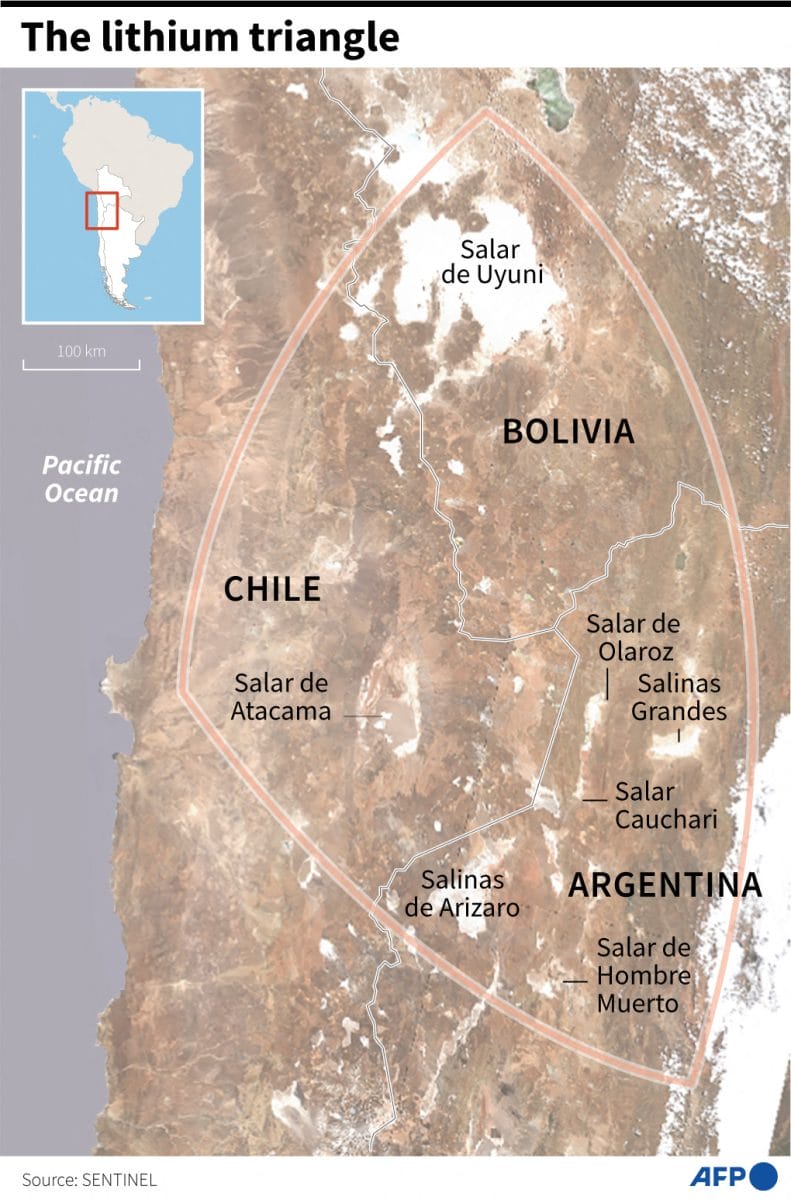
The broader area where the borders of Chile, Argentina and Bolivia converge is often referred to as the world’s “lithium triangle.” This lost corner of South America is believed to hold 68% of the world’s lithium reserves — a key element in the production of the lithium-ion batteries that fuel not only electric vehicles, but, increasingly, data centers and other large “green” infrastructure projects. San Pedro, roughly in the middle of the triangle, is sitting on a modern gold mine — and a faultline for the future of renewable energy.  

Map showing the "lithium triangle" comprising deposits of the key metal in Chile, Bolivia and Argentina. Graphic by AFP via Getty Images.

The town of 2,500 full-time residents has long been at the center of a tug-of-war between different actors, all of whom claim sovereignty – dominion – over the salt flats surrounding it: the indigenous communities who have called this environment home for centuries, the Chilean state and the international markets salivating over the “white gold” extracted from it. Over the years, and through much negotiation on local, national and international levels, a sort of entente had been reached: the state owns the resource, private companies exploit it and some of the profits kick back to local communities. Lithium was even granted a special status under a dictatorship-era decree: a “strategic” mineral, only to be mined with the express agreement of the State. The election of Kast has already disrupted this tenuous equilibrium. The Chilean president has removed environmental protections from roughly 40 different types of natural resources — reopening the tap that has long fueled extractivism and inequality in Chile after four years of left-wing, protectionist policies. 

With counter space cleared and the tape recorder set, Chocobar begins to speak, choosing her words carefully and pausing regularly for emphasis. She sounds tired, but steely. “We are always in a constant effort to protect our water, our land,” she tells me. “We have the misfortune of the Pacific. And we have the misfortune that the Salar de Atacama is one of the greatest lithium sources in the world.”

It wasn’t always this way — in fact, the “resource curse” is relatively new, she explains. For a long time, the Atacama desert was viewed by most Chileans as a no man’s land. Growing up as a member of the Lickanantay indigenous community — also known as the Atacameño people — Chocobar learned how to coexist with the harsh environment, rather than to dominate it. How to extract groundwater, which plants to grow, when and where to shuffle crops. “If we are millenary people, it is because we have found many ways to survive here,” she says. “People think the desert is lifeless, but it’s the exact opposite.” 

Over her many years, Chocobar has seen these techniques slowly disappear: dried-up streams, dying flora and fauna, water rerouted from communities to corporations. The natural richness of the desert lands she calls home has been converted into a monocrop for export. The culprit? The world’s increasingly rapacious appetite for rare earths and metals.

Flamingos drink from a pool on the salt flats of the lithium-rich Atacama desert. But numbers are falling, with studies linking it to mining activity in the area.

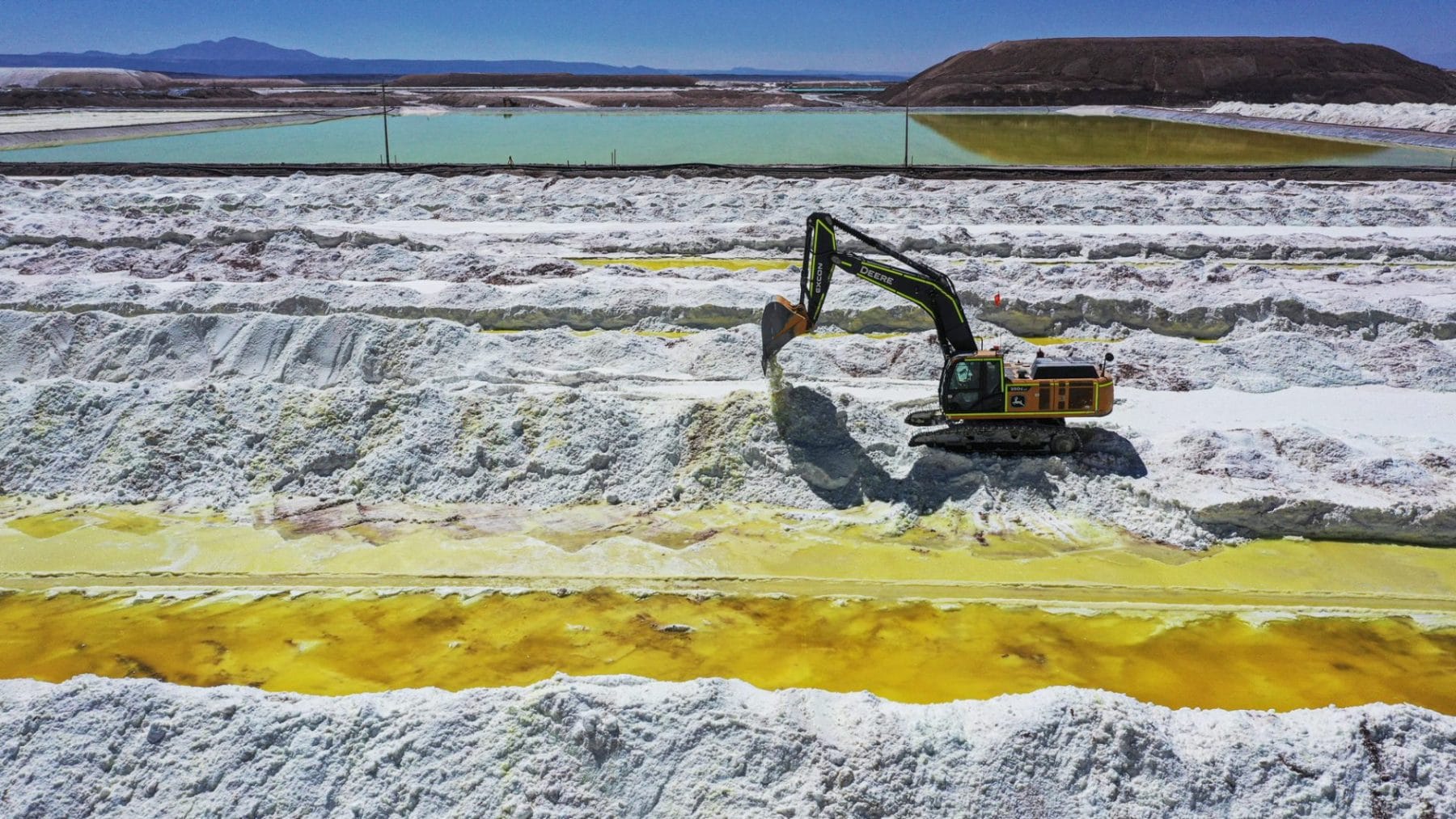
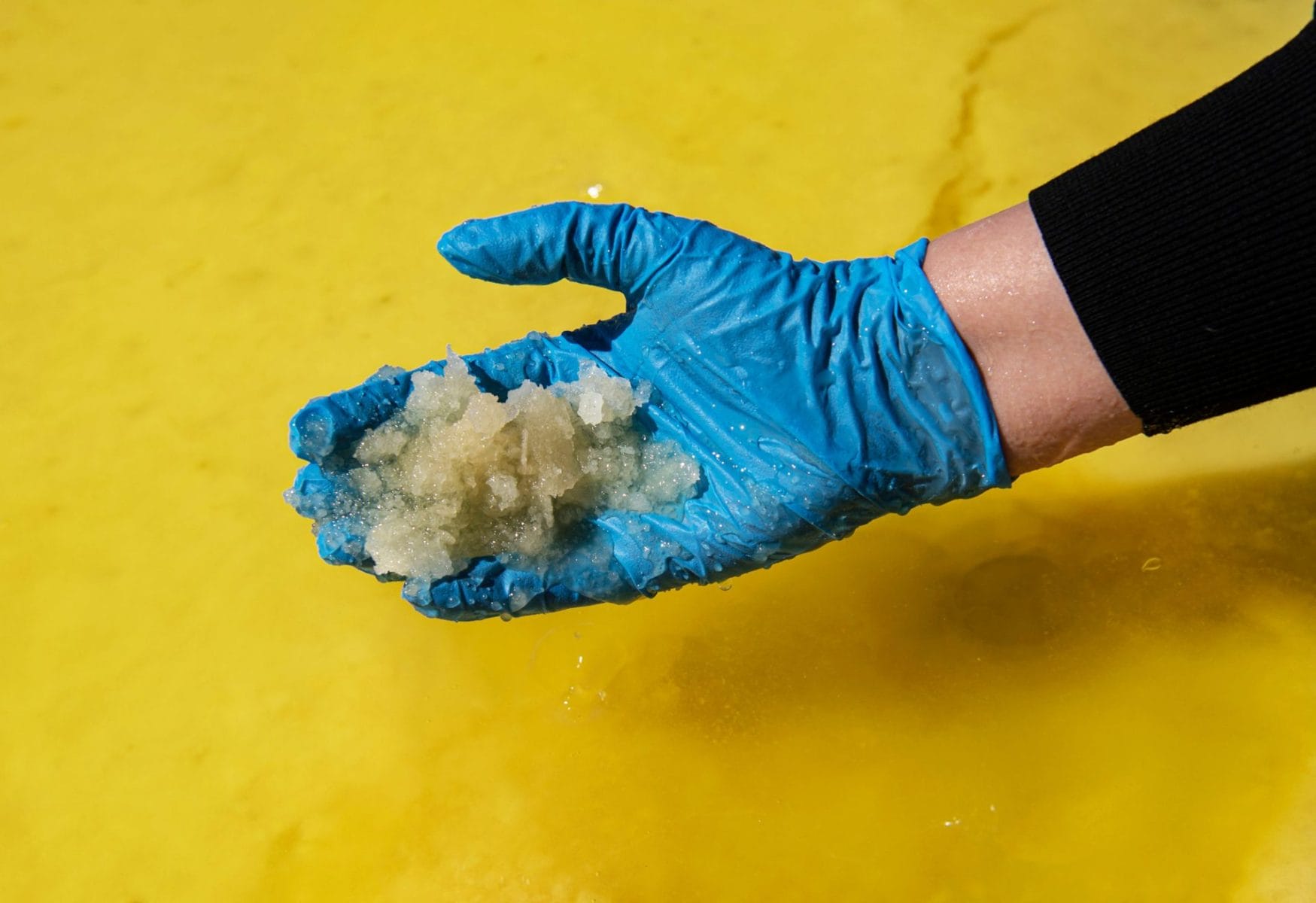
Lithium demands huge amounts of water. To extract the resource through a process called brine evaporation, mineral-rich groundwater is pumped from beneath the salt flats at a rate of thousands of liters per second into vast open-air ponds. Then, the water is evaporated to reveal the lithium. 95% of this groundwater — which once belonged to the smattering of 18 indigenous communities that inhabit the region — quite literally disappears into thin air. 

For local communities, the strain is already noticeable. In San Pedro, an estimated 49% of residents don’t have access to running water, says journalist Ernesto Picco. In one town — the ironically named Santiago del Rio Grande — Picco has reported, 100% of residents have no access to water. 

It's not only humans who are being affected. The water scarcity has modified the breeding and feeding habits of alpaca populations, a local llama herder in neighboring Toconao, Hugo Flores, told me. A river used to run through San Pedro. On one of my days in town, I climbed down a ladder and walked across the dried up stream to get a better view of the distant Licancabur Volcano. The caked ground chipped under my sandals.

“We’re sitting on a watershed, and yet there is water scarcity,” Chocobar explains. “We’re being conquered, in a sense — commercially, economically. It is a natural laboratory that is being destroyed.” 

Lithium hasn’t always been so coveted.

When it comes to minerals, in Chile, copper was for a long time — and still is, to a certain extent —king. Since its discovery in the 1880s, the South American country has been one of the world’s largest exporters of copper, which is drilled out of open pit mines in the Gran Norte region. From the window of a taxi in the port city of Antofagasta the day before, I had admired the massive telescopic loading chutes that transport the mineral directly into the hull of boats, releasing brown-gold particles into the air that settles on surfaces — park benches, balconies, cars — across the city.

It wasn't until the 1960s that the Chilean government began to recognize the benefits of lithium after accidentally discovering it buried in salt brine during an exploration aimed at identifying additional water sources for copper mining. The timing couldn’t have been better. “After World War II, there was a lot of speculative value in lithium as a nuclear material,” James J. A. Blair, a professor at Cal Poly Pomona who has published several papers on lithium mining in Chile, explained over a recent video call. 

In 1979, about six years into his 17-year iron reign and following the lead of the United States, which had done the same, Chilean dictator Augusto Pinochet declared lithium a “strategic resource” reserved exclusively for the state — not on account of its economic potential, which was at the time unknown, but as a national security stockpile. 

This seemingly small linguistic tweak has had long-lasting effects. 

After Pinochet’s decree, lithium extraction came under the auspices of Chile’s State Development Agency, CORFO, which started to ink contracts with private firms for further exploration. A year later, CORFO partnered with U.S.-based Foote Minerals to form the Chilean Lithium Company (SCL), in which the state held a 45% stake. 

What began as a Cold War precaution would quietly harden into one of the most unusual resource regimes in the world. By carving lithium out from the standard mining code, written in the 1930s, the Chilean state created a hybrid model. Lithium was not exactly nationalized, but neither was it fully privatized. “Lithium sits in a legal gray zone in Chile,” Blair told me. “It’s formally non-concessionable — meaning private actors can’t just stake a claim the way they would for copper — but in practice, the state has delegated extraction through long-term agreements that are incredibly favorable to a small number of firms.”

During the dictatorship’s wave of privatizations in the 1980s, control over key lithium assets was transferred to a small circle of politically connected actors. Among them: Julio Ponce Lerou, Pinochet’s son-in-law, who would go on to run SQM, now one of the world’s dominant lithium producers.

“Decisions were made in a highly centralized and opaque way,” researcher Gonzalo Gutiérrez told me over cafeteria food at the University of Chile, in Santiago. “By the time lithium became economically important, the institutional framework was already locked in.”

That framework has proven to be remarkably durable. Even as Chile transitioned back to democracy in the 1990s and expanded its role as a global mining powerhouse, lithium remained an exception — governed not through open concessions but through a handful of contracts administered by CORFO. 

In her 2025 book “Extraction,” researcher Thea Riofrancos notes that even today, two firms — SQM and Albemarle — effectively operate as a “a legally sanctioned private duopoly.” Control over lithium, she writes, is a tightrope between “the palpable potential of public control and the reality of corporate dominance.” 

For Ramón Balcázar, the founder of the San Pedro-based nonprofit, Fundacion Tantí, this legal exceptionalism has had profound consequences on the ground. “The state claims ownership, but the impacts are local,” he said. “Communities were never meaningfully included in the design of these contracts, yet they are the ones living with the depletion of water and the transformation of their ecosystems.”

Balcazar’s nonprofit sits on a side street in San Pedro, across from a trendy French bakery called La Franchuteria that sells iced lattes at European prices. 

Since its founding in 2016, Fundacion Tanti’s small team of researchers has studied the effects of lithium mining on indigenous communities in the Atacama desert. The period has coincided with nothing less than an explosion in the demand for Chilean lithium. 

The growth has mostly been tied to a dramatic rise in demand for electric vehicle batteries. Between 2015 and 2024, global lithium demand grew roughly sixfold, largely driven by EV batteries. The boom has fundamentally reshaped lithium markets: whereas EV batteries accounted for only about 15% of lithium demand in 2017, they made up roughly 85% by 2023. In Chile, arguably the world’s lithium breadbasket, raw materials are mined for export but rarely do its benefits trickle back down to communities.

Left: Brine ponds and processing areas of the lithium mine of the Chilean company SQM, in the Atacama Desert, Calama, Chile.
Right: A worker displays 9% lithium from a sample pool at Chilean company SQM's lithium mine in the Atacama Desert, Calama, Chile. Martin Bernetti/AFP via Getty Images.

“Where is the lithium going? To Elon Musk?” Daniela Rodriguez, a local journalist and activist I spoke with in San Pedro, asked. “To send rockets into space, to power electric cars that you never even see around here?” 

In 2021, Balcazar and fellow researchers came up with a neat term for this phenomenon: “green extractivism.” “What we are seeing is not an energy transition — it’s an expansion of the extractive frontier under a green label,” he told me. 

Faced with increasing demand for lithium to fuel the “green revolution,” the Chilean state has tried to thread the needle. In 2019, after a wave of mass protests against neoliberal inequality known as “el estallido social” (the social uprising), Chileans elected Gabriel Boric, a young, tattooed reformer who promised to, among other things, reassert state control over the lithium supply chain to redistribute its value. 

“Lithium is the mineral of the future,” Boric said on the campaign trail. “Chile can’t make the historic mistake of privatizing resources again.” His government promised a paradigm shift: more community involvement, more protection of wetlands, greener methods of extraction. Lithium, he seemed to say, would benefit Chileans across the whole supply chain and not just a select few at the top.

In April 2023, the government announced its National Lithium Strategy. The policy sought to expand production while increasing state control through public-private partnerships, renegotiate the contract with SQM (the same private company once headed by Pinochet’s son-in-law) and include community and indigenous participation in future lithium exploration decisions. 

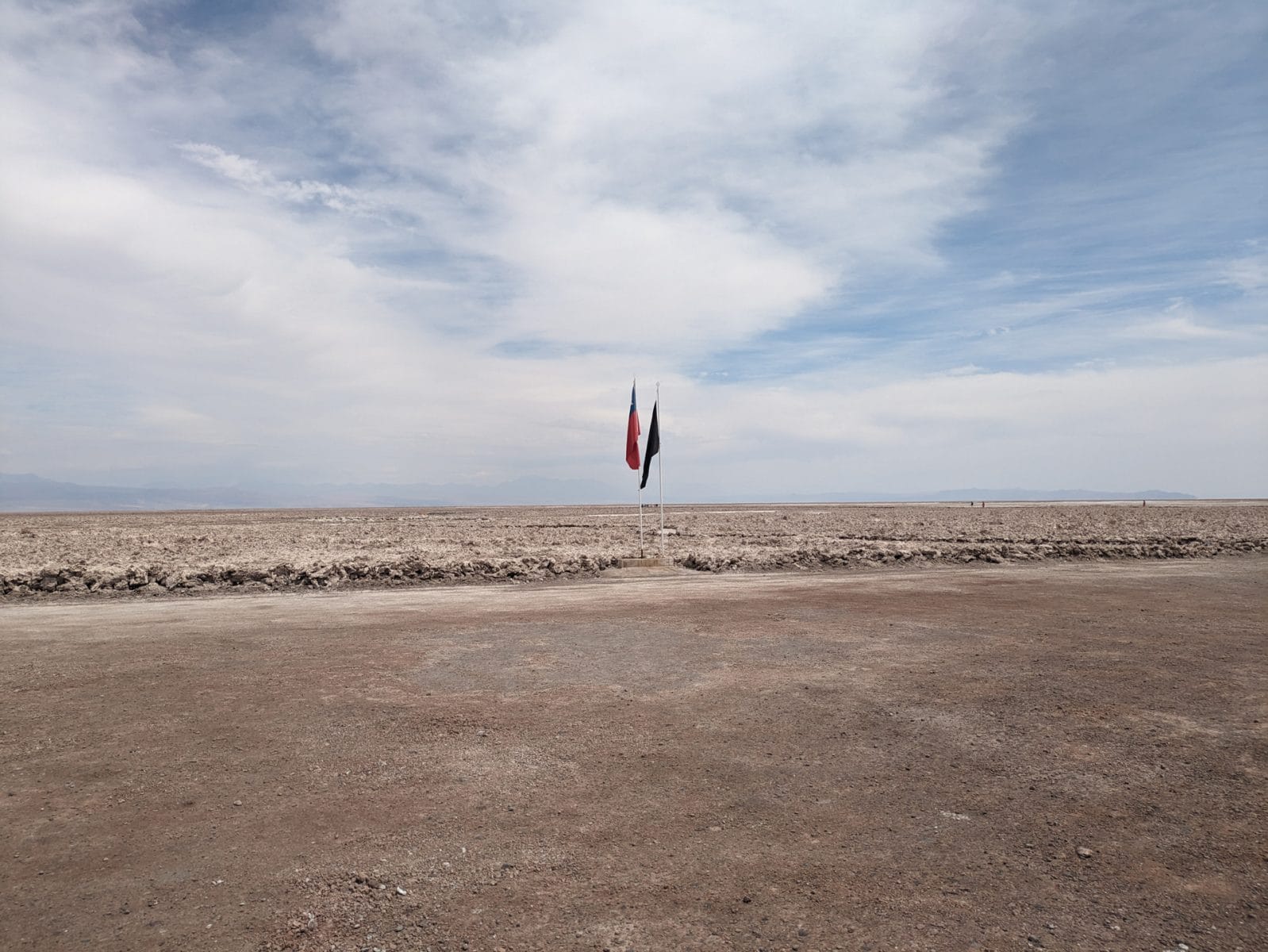
A Chilean flag next to a black flag symbolizing indigenous resistance. 

In all, Boric’s government identified 68 salt flats that could be opened to mining exploration, but also 27 wetlands to be protected, Riofrancos, the author of “Extraction,” notes in her book. 

“The national lithium strategy is Boric's most successful policy,” Nicolas Grau, Boric’s former finance minister, told me over the phone. “It will allow Chile to industrialize through lithium — growing the economy while also protecting the environment.” After years of passive control, the state would finally take a more “protagonistic role” in managing the resource, Grau said, without nationalizing it.

To Riofrancos, the juggling act under Boric was typical of what happens when a state tries to pry some space in a market where extractivism has long been left unchecked. “Boric’s blueprint cited Allende as an inspiration, but his approach was more conciliatory toward extractive capital than anything Allende had proposed,” she writes. 

Local communities in San Pedro felt similarly. “The only thing politicians care about is being in power,” Chocobar said in San Pedro. “For all intents and purposes, we might as well not exist.” 

Boric’s successor, Kast has quickly rolled back environmental protections, fulfilling his campaign promises of commercializing mining and partnering with the U.S. regardless of the environmental impacts on the salt flats. 

Jorge Heine, a former Chilean diplomat and expert on international relations, argues that Kast is more constrained than it might appear. “People tend to overestimate how much a single administration can reshape lithium policy,” Heine explained. “This is a sector governed by long-term contracts, by international commitments, and by a legal framework that has proven remarkably resilient. Kast can tweak, accelerate, or slow things down, but dismantling the model entirely would come at a significant political and economic cost.”

But huge costs are already being paid, costs that communities in San Pedro have been living with for decades. Could Kast’s attempts to liberalize lithium mining and potentially exacerbate inequalities and environmental damage galvanize resistance?

For now, the signs of that resistance are still weak: graffiti scrawled on the side of the road, a grandmother walking along a highway with a cardboard sign, four panels of wood hung in a town square. But like lithium itself, transformations tend to take place very slowly at first — millennia of build-up in the brine — until suddenly they happen very fast. From Santiago to Atacama, protesters have been taking to the streets. In June, broader protests against Kast’s dismantling of social programs and services turned violent. 

At some point, austerity for the people contrasted with largesse for mining companies, technology companies and acquisitive foreign powers becomes hard for even a government elected in a landslide to defend.

The post The Chilean curse is its abundance of riches appeared first on Coda Story.

Trump Pressures ICE to Resume Traffic Stops After They Were Halted Over Fatal Shootings

15 juillet 2026 à 20:22
Immigration and Customs Enforcement had ordered its officers to halt most vehicle stops across the country after they shot two people over the past week.

© Doug Mills/The New York Times

In a post on social media on Wednesday, President Trump defended the traffic stops and urged ICE to “go back and do your very important job.”

What to Know About Todd Blanche’s Order Granting Trump Immunity From I.R.S. Audits

15 juillet 2026 à 15:01
Acting attorney general Todd Blanche’s decision to grant President Trump protection from I.R.S. audits was a central issue in his confirmation hearing on Wednesday.

© Haiyun Jiang for The New York Times

President Trump’s extraordinary protection from the I.R.S. is expected to be a central issue in the confirmation hearing on Wednesday.

The Vague Clause That Helps Explain the U.S.-Iran Fight Over the Strait of Hormuz

15 juillet 2026 à 07:26
The memorandum of understanding between the United States and Iran has done little to calm tension, in part because they disagree on what it actually means.

© Reuters

A vessel at the Strait of Hormuz, as seen from Musandam, Oman, on Wednesday.

Clayton Dodges Question on 2020 Election, and Democrats Call Him on It

15 juillet 2026 à 17:50
Jay Clayton’s nomination to lead the U.S. intelligence community comes as the White House pushes to use declassified intelligence to show concerns about election security.

© Jeenah Moon/Reuters

The Senate Intelligence Committee is expected to vote on Jay Clayton’s nomination early next week.

For Israel, the U.S.-Iran Hostilities Have Created an Uneasy Limbo

15 juillet 2026 à 05:03
Officials see a return to full-blown war as preferable to an agreement that fails to curb the threats Iran poses to Israel. Meanwhile, they wait.

© Avishag Shaar-Yashuv for The New York Times

Israelis gathering near a public shelter in Tel Aviv after a warning of incoming missiles from Iran in March.

Over 100 House Democrats vote to end military aid to Israel in significant rebuke to US ally – as it happened

15 juillet 2026 à 21:54

This live blog is now closed.

In his opening statement before senators today, Todd Blanche, said that he is “pleased to testify again today to tell everybody here that we are doing just that-we are keeping America safe”.

The nominee for attorney general, who has been leading the justice department in an acting capacity since Pam Bondi was fired in April.

Continue reading...

© Photograph: Nathan Posner/Shutterstock

© Photograph: Nathan Posner/Shutterstock

© Photograph: Nathan Posner/Shutterstock

  • ✇US news | The Guardian
  • Todd Blanche downplays Trump alliance in confirmation hearing
    President’s pick for attorney general faces tough questions over purging of career prosecutors, January 6 and EpsteinTodd Blanche sought to downplay his close relationship with Donald Trump, tried to distance himself from decisions regarding January 6 rioters, and defended his handling of files regarding Jeffrey Epstein as well a settlement agreement that created a $1.8bn slush fund and giving the president and his family immunity from audits during his confirmation hearing to be the next attorn
     

Todd Blanche downplays Trump alliance in confirmation hearing

15 juillet 2026 à 13:19

President’s pick for attorney general faces tough questions over purging of career prosecutors, January 6 and Epstein

Todd Blanche sought to downplay his close relationship with Donald Trump, tried to distance himself from decisions regarding January 6 rioters, and defended his handling of files regarding Jeffrey Epstein as well a settlement agreement that created a $1.8bn slush fund and giving the president and his family immunity from audits during his confirmation hearing to be the next attorney general in front of the Senate judiciary committee on Wednesday.

Blanche served as Trump’s personal attorney before being tapped to be the deputy attorney general – the No 2 position at the justice department at the start of last year. He has been serving as the acting attorney general since April, when Trump fired Pam Bondi, and has amped up Trump’s retribution agenda.

Continue reading...

© Photograph: Nathan Posner/Shutterstock

© Photograph: Nathan Posner/Shutterstock

© Photograph: Nathan Posner/Shutterstock

Jay Clayton Expected to Face Tough Questions in Confirmation Hearing

15 juillet 2026 à 05:03
His nomination to lead the U.S. intelligence community comes as the White House pushes to use declassified intelligence to show concerns about election security.

© Jeenah Moon/Reuters

After nominating Jay Clayton, the U.S. attorney for the Southern District of New York, to be director of national intelligence, President Trump abruptly ordered a delay in his confirmation process.

For Israel, the U.S.-Iran Hostilities Have Created an Uneasy Limbo

15 juillet 2026 à 05:03
Officials see a return to full-blown war as preferable to an agreement that fails to curb the threats Iran poses to Israel. Meanwhile, they wait.

© Avishag Shaar-Yashuv for The New York Times

Israelis gathering near a public shelter in Tel Aviv after a warning of incoming missiles from Iran in March.
❌