❌

Vue normale

  • ✇Euromaidan Press
  • Ukraine has tested near-space kill systems at least three times. A lawmaker wants them in production

    Kyiv is turning to near space for answers to two problems, Russia’s Oreshnik missile and its reliance on Starlink, The Guardian reported. Alongside the interceptor tests, Ukraine has put a test satellite for its own network into orbit, and its military says it struck the factory that builds rockets for Russia’s Starlink replacement. Zelenskyy said in October that Ukraine had received only 24 Patriot interceptors from the US in 90 days. Patriot could in theory target the Oreshnik’s separ
     

Ukraine has tested near-space kill systems at least three times. A lawmaker wants them in production

9 novembre 2026 à 07:56

Satellites in orbit. Illustrative image: Depositphotos

Kyiv is turning to near space for answers to two problems, Russia’s Oreshnik missile and its reliance on Starlink, The Guardian reported. Alongside the interceptor tests, Ukraine has put a test satellite for its own network into orbit, and its military says it struck the factory that builds rockets for Russia’s Starlink replacement.

Zelenskyy said in October that Ukraine had received only 24 Patriot interceptors from the US in 90 days. Patriot could in theory target the Oreshnik’s separated warheads, but in practice that is unlikely because the system can track and engage only a limited number of targets at once, Oleg Katkov, editor-in-chief of Defense Express, said.

“It is a priority”

“It is a priority,” said Fedir Venislavskyi, who heads the state security subcommittee of parliament’s defense committee.

“We’ve already demonstrated launches of exo-atmospheric systems and we are working to see if we can get that in production,” he said.

The Guardian did not say when the tests took place.

“The enemy is already threatening Ukrainian territory from international space via Oreshnik missiles,” Venislavskyi said. The missile climbs into near space, then releases several independently targetable warheads, and Moscow has used it at least three times, The Guardian noted. Ukraine’s Foreign Intelligence Service said in January that Russia planned serial production of the Oreshnik in 2026, at five or more a year.

On Starlink, Venislavskyi said Ukraine “saw communications drop and jeopardise our military’s command-and-control systems.” From 14 October, Starlink and its military version, Starshield, cut out on Ukrainian platforms moving faster than about 161 km/h, until Zelenskyy said speeds were restored on 24 October. Earlier that month, Ukraine’s Himera and Denmark’s GomSpace launched Obria Nano, a test satellite for a planned sovereign network of reportedly about 245 satellites, The Guardian wrote.

Hitting Russia’s space industry

On 15 August, Ukraine’s General Staff said its forces struck Samara’s Progress Rocket and Space Center, maker of the Soyuz-2 rockets that carry Russia’s Rassvet satellites. Samara Oblast Governor Vyacheslav Fedorishchev claimed a missile hit an unnamed industrial enterprise. Separately, Fire Point co-founder Denys Shtilerman wrote on X in August that the company plans a full-scale launch of its own anti-ballistic interceptor by mid-2027.

Ukraine says it has finished its part of FREYJA, Europe’s joint anti-ballistic project. Partners’ work is still underway

27 octobre 2026 à 15:57

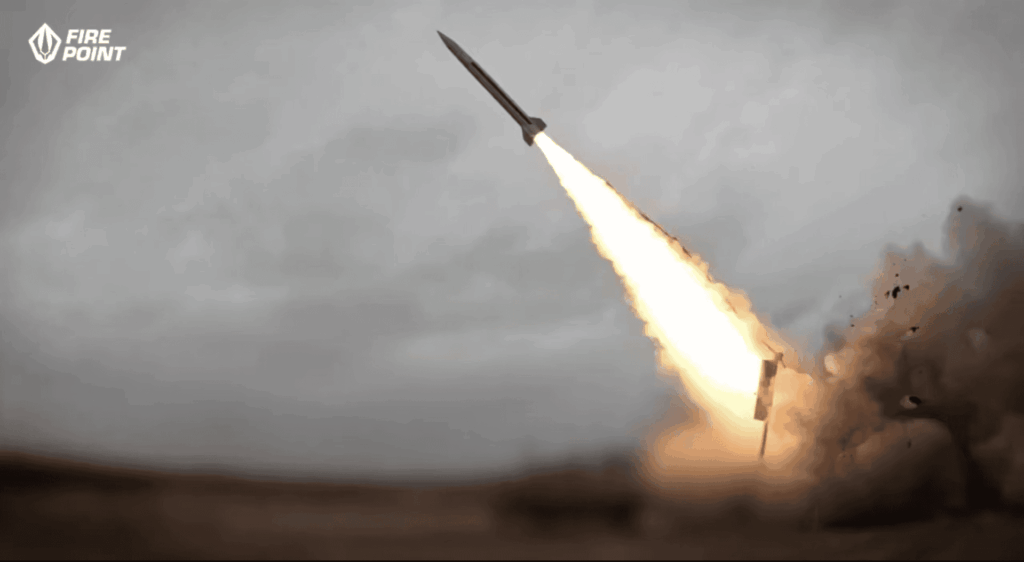
ukraine advertise its new ballistic missiles until factories can mass-produce ex-security officer says · post test launch fp-7 missile prototype fire point news ukrainian reports

Ukraine has finished its share of FREYJA, a joint European project to build a system against ballistic missiles, President Volodymyr Zelenskyy told journalists on 17 October, Ukrinform reported. He added that Kyiv wants to test the first system as soon as possible.

Ukraine still relies on US-made Patriot interceptors to stop Russian ballistic missiles. Zelenskyy told ABC News on 23 October that Ukraine had received only 24 of them from the US in three months, while it needs 350 a month on average. FREYJA can not close that gap soon, because the system is still in development.

Ukraine’s missile and launcher, partners’ radars and sensors

Zelenskyy said the partners’ share of the work, with 10 countries taking part, is still underway. He also said he had discussed the project with French President Emmanuel Macron, and he named Norway as a key partner.

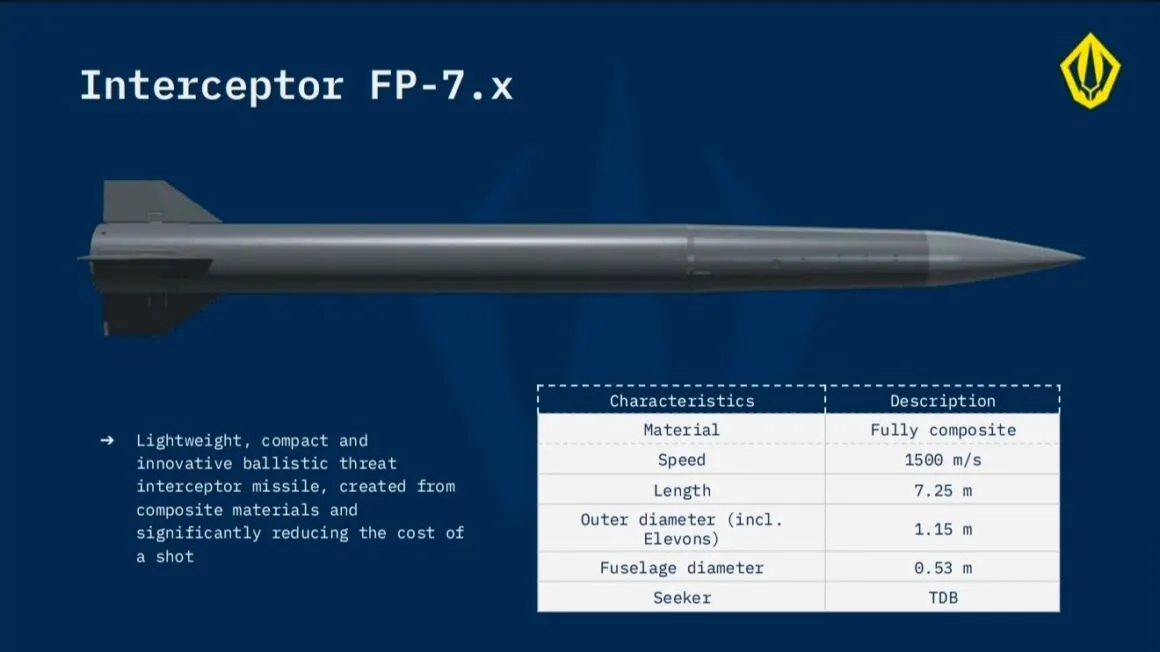
Fire Point concept graphic showing the FP-7.x interceptor missile beside a table of proposed specifications.
Explore further

Ukraine’s missile, Europe’s sensors—FREYJA enters active development on an early-2027 clock

Zelenskyy did not say what the partners still have to deliver. In August, he said Ukraine is capable of making the missile and launcher, while partners would supply critical components such as radars and sensors.

One part not made in Ukraine

In May, Fire Point co-founder and chief designer Denys Shtilerman said all components of the FP-7.x interceptor are made in Ukraine except one. “As for that one part we don’t manufacture in Ukraine, we’ve contracted a certain quantity of it. We already have it,” he said, but did not name the part.

In June, however, Shtilerman told the Financial Times that mass production depended on an infrared seeker Fire Point hoped to get from Germany’s Diehl Defence. Neither statement says whether the seeker is that one part.

Fire Point co-founder Iryna Terekh said in September that FREYJA was going through testing and technical integration in combat conditions in Ukraine. The company plans its first intercept of a ballistic target by mid-2027.

The official timeline has since moved closer. On 21 October, Zelenskyy wrote that officials had identified where to speed up so FREYJA reaches testing by the end of this year. A test is still a step short of an intercept.

❌