❌

Vue normale

  • ✇Euromaidan Press
  • Ukraine has tested near-space kill systems at least three times. A lawmaker wants them in production

    Kyiv is turning to near space for answers to two problems, Russia’s Oreshnik missile and its reliance on Starlink, The Guardian reported. Alongside the interceptor tests, Ukraine has put a test satellite for its own network into orbit, and its military says it struck the factory that builds rockets for Russia’s Starlink replacement. Zelenskyy said in October that Ukraine had received only 24 Patriot interceptors from the US in 90 days. Patriot could in theory target the Oreshnik’s separ
     

Ukraine has tested near-space kill systems at least three times. A lawmaker wants them in production

9 novembre 2026 à 07:56

Satellites in orbit. Illustrative image: Depositphotos

Kyiv is turning to near space for answers to two problems, Russia’s Oreshnik missile and its reliance on Starlink, The Guardian reported. Alongside the interceptor tests, Ukraine has put a test satellite for its own network into orbit, and its military says it struck the factory that builds rockets for Russia’s Starlink replacement.

Zelenskyy said in October that Ukraine had received only 24 Patriot interceptors from the US in 90 days. Patriot could in theory target the Oreshnik’s separated warheads, but in practice that is unlikely because the system can track and engage only a limited number of targets at once, Oleg Katkov, editor-in-chief of Defense Express, said.

“It is a priority”

“It is a priority,” said Fedir Venislavskyi, who heads the state security subcommittee of parliament’s defense committee.

“We’ve already demonstrated launches of exo-atmospheric systems and we are working to see if we can get that in production,” he said.

The Guardian did not say when the tests took place.

“The enemy is already threatening Ukrainian territory from international space via Oreshnik missiles,” Venislavskyi said. The missile climbs into near space, then releases several independently targetable warheads, and Moscow has used it at least three times, The Guardian noted. Ukraine’s Foreign Intelligence Service said in January that Russia planned serial production of the Oreshnik in 2026, at five or more a year.

On Starlink, Venislavskyi said Ukraine “saw communications drop and jeopardise our military’s command-and-control systems.” From 14 October, Starlink and its military version, Starshield, cut out on Ukrainian platforms moving faster than about 161 km/h, until Zelenskyy said speeds were restored on 24 October. Earlier that month, Ukraine’s Himera and Denmark’s GomSpace launched Obria Nano, a test satellite for a planned sovereign network of reportedly about 245 satellites, The Guardian wrote.

Hitting Russia’s space industry

On 15 August, Ukraine’s General Staff said its forces struck Samara’s Progress Rocket and Space Center, maker of the Soyuz-2 rockets that carry Russia’s Rassvet satellites. Samara Oblast Governor Vyacheslav Fedorishchev claimed a missile hit an unnamed industrial enterprise. Separately, Fire Point co-founder Denys Shtilerman wrote on X in August that the company plans a full-scale launch of its own anti-ballistic interceptor by mid-2027.

At least 100 satellites, fast but maybe not as fast as Starlink: a Ukrainian firm sizes up a satellite network for Ukraine’s military

5 novembre 2026 à 04:50

OBRIA NANO

A satellite network meant to give Ukraine’s military a link run by a Ukrainian operator would need at least 100 satellites for basic coverage in its first phase, Himera’s CEO told Ukrainian defense outlet Oboronka. Private companies paid for the first test satellite, and the later stages would need far more money, he said.

Ukraine’s drones fly on satellite links it does not own. From 14 October, a speed cap on Starlink and its military version, Starshield, disrupted drone missions, adviser Serhii Beskrestnov said. Speeds returned on 24 October, the Defense Ministry reported. During the slowdown, one Ukrainian drone maker said it was rethinking an air-launched interceptor because of the speed cap. Until this interview, a domestic alternative had a test satellite its builders say is working, but no published schedule or price.

Heavier satellites, state users first

Each production satellite would weigh about 250 kg, against about 10 kg for the Obria Nano test unit, Himera co-founder and CEO Misha Rudominski said. The network will support full-fledged high-speed communications, he said, and it is designed for low-latency video and for terminals on moving vehicles. Whether it will match Starlink is yet to be seen.

Illustration of the Russian Rassvet satellites by Bureau 1440
Explore further

Russia’s Starlink rival lost a second satellite after it apparently sat idle for 103 days

Ukraine’s military, the government, and other institutions come first. The network won’t be able to serve as many subscribers at once as Starlink does in Ukraine any time soon, he told Oboronka, but that isn’t the project’s task.

One to two years in good conditions, potentially billions

In good conditions, full deployment could take one to two years, Rudominski said. Technological, production, logistical, and operational risks could affect that timeline. Without special arrangements, the queue for a SpaceX launch starts at 22 months, he said. He added that ground terminals are the narrowest bottleneck now, because everyone except SpaceX buys them from outside suppliers.

The next stages would need tens and hundreds of millions of euros, potentially billions, by his estimate. Meanwhile, the launch of the first test satellite used no state money. Private consortium members, including Himera and Denmark’s GomSpace, paid for it, he said.

One satellite, two names

Himera and GomSpace say Obria Nano launched on 1 October on SpaceX’s Transporter-18 rideshare. Tracking catalogs list one Ukrainian satellite from that mission, UASAT-Nano. Oboronka’s interview page gives that as Obria Nano’s registration name. However, UASAT-Nano is also the network another Ukrainian company, Stetman, is building with GomSpace. As of 30 October, neither Himera nor GomSpace had publicly explained how the two projects relate.

OBRIA NANO
Explore further

Two weeks before Starlink’s speed cap hit Ukraine’s drones, a Ukrainian test satellite went up on a SpaceX rocket

Two weeks before Starlink’s speed cap hit Ukraine’s drones, a Ukrainian test satellite went up on a SpaceX rocket

28 octobre 2026 à 04:21

OBRIA NANO

A test satellite for a future communications network under Ukrainian control is working in orbit, Ukraine’s Himera and Denmark’s GomSpace said on 27 October. The companies say it will work for Ukraine’s strategic security, and that the long-term aim is to rely less on foreign communications providers. Public launch records for the mission do not list a satellite by that name, though some of its objects are still unidentified.

Ukraine fights Russia on satellite links it doesn’t control, and the announcement comes two weeks after it saw what depending on an outside provider can cost. The satellite, the companies say, went up on 1 October, before that trouble began. Overnight on 14 October, Starlink and its military version, Starshield, began dropping links on fast-moving terminals, and Ukrainian officials said the cap disrupted drone missions. On 24 October, 10 days after the cap began, Ukraine’s Defense Ministry reported speeds restored. Who ordered the cap remains contested. That same day, Elon Musk wrote that Ukraine’s military had violated Starlink’s terms of service and that “that loophole was closed last week,” a claim a Ukrainian presidential adviser disputed.

What the companies say, and what launch records show

Obria Nano flew on SpaceX’s Transporter-18 rideshare mission, the release said. Aalborg-based GomSpace built it on Himera’s order, Himera co-founder and CEO Misha Rudominski wrote on Facebook. He added that the team received the first signals the next day and that the satellite is now working. Its tests are meant to inform the design of the full Obria system, the release said.

US President Donald Trump and Elon Musk in the Oval Office on 11 February 2025
Explore further

The Starlink hot potato: Musk points to Trump, Trump points to nobody, then credits Musk with the fix. The speed limit stays

No satellite called Obria Nano appears on SpaceX’s published list for the mission, The Insider found. Public tracking catalogs show one Ukrainian satellite from that launch, named UASAT-Nano. Another 26 objects from the mission are still listed with placeholder names and no confirmed owner. The outlet said it is unclear whether the two names refer to one satellite.

UASAT-Nano is the satellite network Stetman, another Ukrainian company, is building, and its founder said the network’s first test satellite would launch in October. In April, Stetman and GomSpace agreed to set up a joint venture called UASAT and planned a first launch for fall 2026. The Obria release does not mention Stetman or UASAT.

Production in Ukraine is the stated next step

Rudominski wrote that Himera’s next stage is to produce satellites and ground terminals in Ukraine. He called it important not only to use the technology but also to gradually build domestic expertise and manufacturing.

“For us, this project is about more than launching a satellite. It is an opportunity to lay the foundation for an independent communications network for Ukraine,” Rudominski said in the release.

In the long run, the network would cover all of Ukraine and complement European satellite networks, the release said. The network does not exist yet, and Himera has given no timeline.

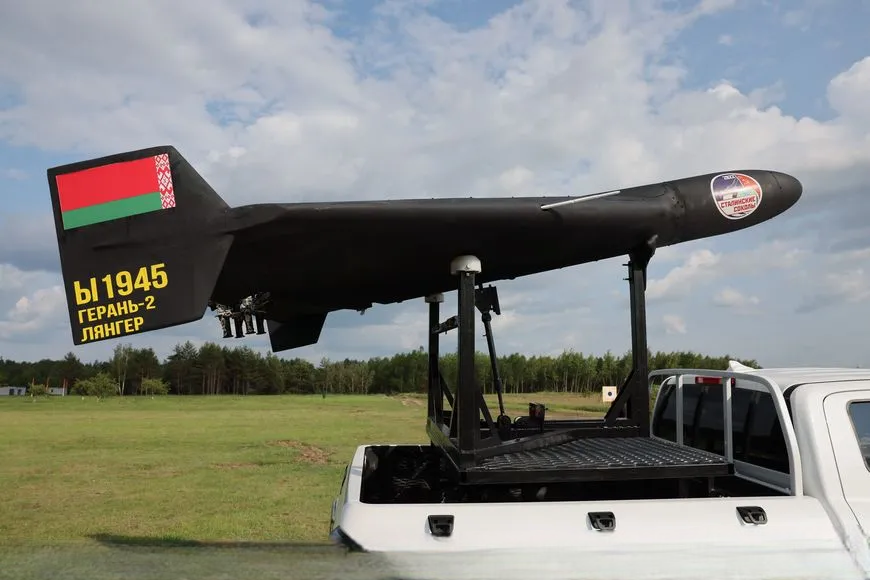
geran-2 (shahed-136) drone belarusian markings service military belta militarnyi російський безпілотник герань 2
Explore further

“Trump and Musk must be held accountable”: US senator warns Starlink network failing over Ukraine could cripple its shield against Russian missiles and drones

Replacing Starlink will not be quick. Lance Hunter, a political scientist at Augusta University, told Time that Ukraine cannot quickly swap out such technology, since diversifying it “takes a lot of time. It takes a lot of resources.” Meanwhile, one Ukrainian interceptor-drone maker has begun rethinking its air-launched designs after the slowdown.

❌