After years of investigation, the Justice Department appears to be intensifying a criminal inquiry into the immigration history of Ilhan Omar, a Minnesota Democrat, and her family.
After years of investigation, the Justice Department appears to be intensifying a criminal inquiry into the immigration history of Ilhan Omar, a Minnesota Democrat, and her family.
A Ukrainian drone sergeant who volunteered for the infantry held a frontline position for six months, ArmyInform reported. He saved three soldiers in that time, and in one fight he stopped a Russian advance after contact with command was lost. The agency did not say where or when.
Senior Sergeant Dmytro, call sign Berezen “March”, spent 20 years as a television director before the invasion. In the 152nd Separate Jaeger Brigade, he served as chief sergeant of a drone platoon, worked with
A Ukrainian drone sergeant who volunteered for the infantry held a frontline position for six months, ArmyInform reported. He saved three soldiers in that time, and in one fight he stopped a Russian advance after contact with command was lost. The agency did not say where or when.
Senior Sergeant Dmytro, call sign Berezen “March”, spent 20 years as a television director before the invasion. In the 152nd Separate Jaeger Brigade, he served as chief sergeant of a drone platoon, worked with three crews, and trained soldiers. When the need arose to reinforce the infantry, he volunteered to switch. ArmyInform did not say what created that need.
“I didn’t come here to a sanatorium. I’m in my third year of fighting, I know what this is. It was my choice,” Dmytro said
Two wounded, one firefight
One comrade was hit by a mine and lost a leg. As Dmytro treated him, Russian troops began moving toward the position. Another wounded soldier was trying to reach them, and contact with command was lost. He killed two Russian soldiers and halted their advance, ArmyInform reported. He said he barely thought about himself, because a breakthrough could have hurt the soldiers holding positions behind him.
Not everyone could be saved. One wounded comrade was about 200 meters away. Dmytro heard his voice on the radio but could not leave his position mid-fight. Over the six months, he saved three soldiers. Two left the position with him, and the third was evacuated wounded. No money, he said, is worth blood.
The vice president also cast doubt on whether the public execution of Maj. Nidal Malik Hasan, the 2009 Fort Hood gunman, would go forward as Pentagon officials have planned.
The vice president also cast doubt on whether the public execution of Maj. Nidal Malik Hasan, the 2009 Fort Hood gunman, would go forward as Pentagon officials have planned.
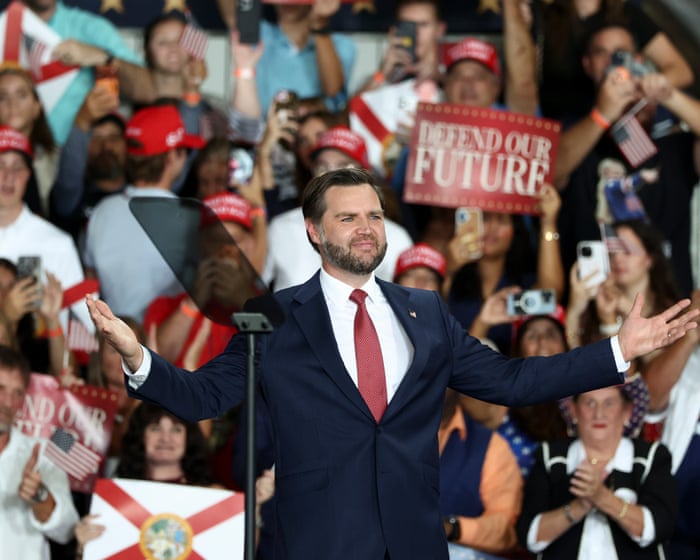
“If it’s through livestream, I’m not going to be watching it,” Vice President JD Vance said of the execution during a visit to Kentucky and Ohio on Friday.
Vice-president also says Adobe is barred from visa program that allows high-skilled workers to apply for US residencyMicrosoft is suspended from applying for permanent residency for workers employed through a US visa program for high-skilled workers, JD Vance announced on Thursday.The US vice-president accused the tech company of abusing the H-1B system, which allows those on the visa to work while they apply for and are in the process of obtaining a green card. Continue reading...
Vice-president also says Adobe is barred from visa program that allows high-skilled workers to apply for US residency
Microsoft is suspended from applying for permanent residency for workers employed through a US visa program for high-skilled workers, JD Vance announced on Thursday.
The US vice-president accused the tech company of abusing the H-1B system, which allows those on the visa to work while they apply for and are in the process of obtaining a green card.
“Our message to Microsoft is: You’re a great American company, but you’ve got to hire great American workers,” Vice President JD Vance said in Washington on Thursday.
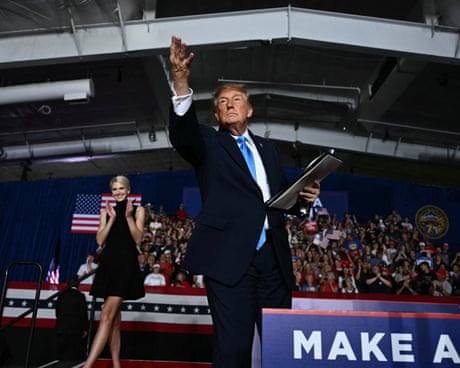
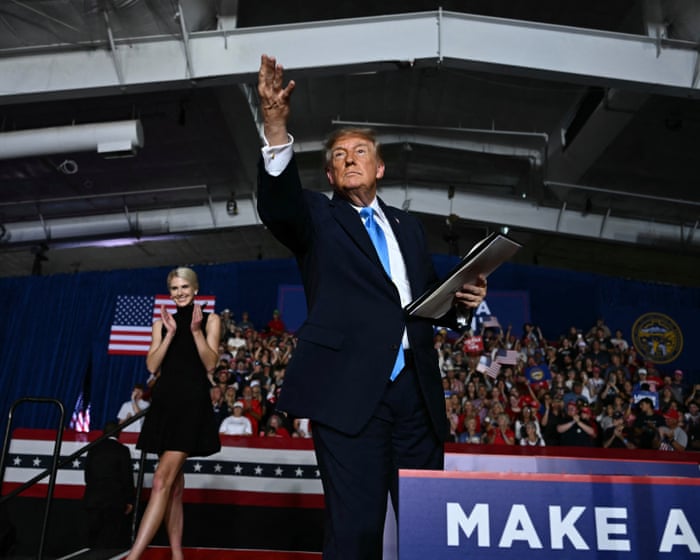
Listening to the president at a rally these days is a mix of deja vu and word salad, but his decade-long project of division remains abnormal and dangerousThis was originally published in This Week in Trumpland. Sign up to receive it in your inbox every WednesdayDonald Trump’s campaign rallies can be repetitive. Very repetitive. He calls himself the “greatest” president leading the “greatest” movement inside the “greatest” economy. He rails against “Dumocrats” for the “transgender mutilization”
Listening to the president at a rally these days is a mix of deja vu and word salad, but his decade-long project of division remains abnormal and dangerous
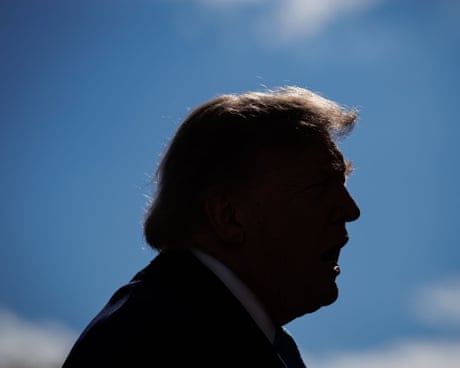
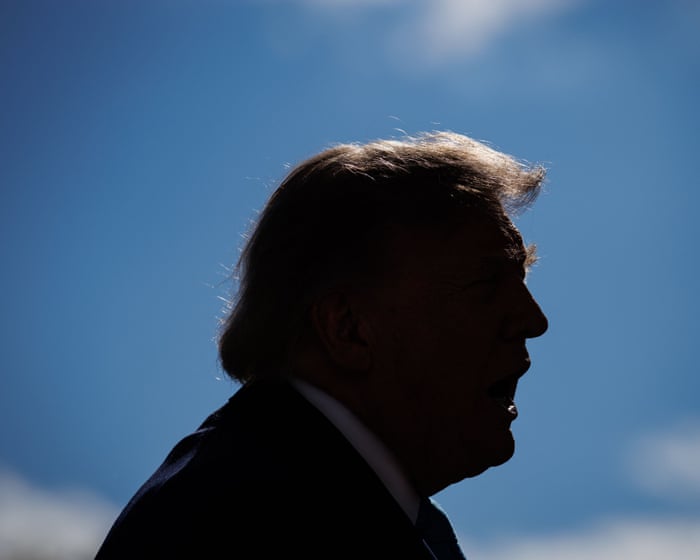
Donald Trump’s campaign rallies can be repetitive. Very repetitive. He calls himself the “greatest” president leading the “greatest” movement inside the “greatest” economy. He rails against “Dumocrats” for the “transgender mutilization” of children. He lambasts the “fake news” and reheats election lies. He describes illegal immigration as an “invasion” and recites the poem The Snake.
If we were all frogs being slowly boiled alive, we’ve now reached the stage of blackened toad. After a decade of this, presidential utterances that would once have caused outrage are met with a shrug. We are no longer shockable. Or so we thought.
Having seemingly written off the midterms, the Republican bigwigs are making their pitches for 2028. But the current commander-in-chief could be looking closer to homeThe US midterm elections are a month away and it’s looking rough for the Republicans. I wouldn’t discount devious schemes behind the scenes, but, on the face of it, the president and his entourage seem to be flailing. Donald Trump is desperately dangling money in front of voters and promising “a big surprise”. Meanwhile, the vice-p
Having seemingly written off the midterms, the Republican bigwigs are making their pitches for 2028. But the current commander-in-chief could be looking closer to home
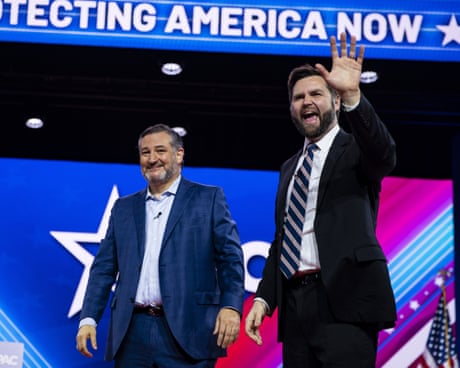
The US midterm elections are a month away and it’s looking rough for the Republicans. I wouldn’t discount devious schemes behind the scenes, but, on the face of it, the president and his entourage seem to be flailing. Donald Trump is desperately dangling money in front of voters and promising “a big surprise”. Meanwhile, the vice-president, JD Vance, and the GOP senator Ted Cruz seem more concerned with fighting over who will be Trump’s heir than with the midterms.
If the polls are to be believed, Vance is the frontrunner for the Republican presidential nomination in 2028. But while he may have great name recognition, Vance is also unlikable. According to the CNN analyst Harry Enten, he is one of the least popular vice-presidents in history. He’s also apparently made enemies within his own party, largely because of his scepticism about the Iran war. His detractors include Cruz, who told MS Now in August that Vance wasn’t a shoo-in for the nomination. The party, Cruz said, was still figuring out the best candidate and needed “to decide who we are, what do we believe”.
According to U.S. and British officials, 12 B-1 Air Force bombers from R.A.F. Fairford air base were withdrawn because of the risk of a drone attack ordered by Iran’s Islamic Revolutionary Guard Corps.
According to U.S. and British officials, 12 B-1 Air Force bombers from R.A.F. Fairford air base were withdrawn because of the risk of a drone attack ordered by Iran’s Islamic Revolutionary Guard Corps.
The vice-president’s recent remarks seek to maintain a posture of strength while they inadvertently expose political realitiesJD Vance has parachuted into the midterm election campaign on a rescue mission in a new guise: a risk management consultant. Speaking in the flat language of the expert hired to identify threats, weaknesses and losses affecting a business’s reputation, he has presented his executive summary for limiting vulnerabilities and a scenario for averting disaster.“There’s a lot o
The vice-president’s recent remarks seek to maintain a posture of strength while they inadvertently expose political realities
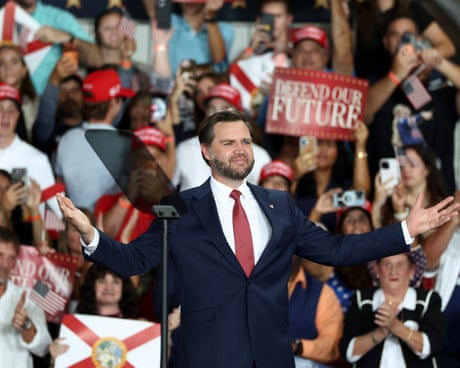
JD Vance has parachuted into the midterm election campaign on a rescue mission in a new guise: a risk management consultant. Speaking in the flat language of the expert hired to identify threats, weaknesses and losses affecting a business’s reputation, he has presented his executive summary for limiting vulnerabilities and a scenario for averting disaster.
“There’s a lot of good that’s been done, but there’s a lot of work left to do,” he informed his clients on 15 September about the words to use. “Give us another chance, or give us another couple of years, to continue to work on the amazing things that we’ve been doing for the past two years.” He turned the focus to harm reduction rather than total agreement and then shifted the equation to a negative binary choice. “Even if you don’t agree with us on every issue, the other party is consumed by craziness.”
This live blog is now closed.Sign up for the Breaking News US emailAsk our reporters your questions about the Iran war and the US midtermsAs the supreme court hears oral arguments this morning, it’s worth noting that if the justices side with Boulder or decide that the case is not in their jurisdiction, then it would continue in state court.But if the fossil fuel industry convinces the justices, the decision could apply not only to the Boulder case, but also to the many other climate cases broug
As the supreme court hears oral arguments this morning, it’s worth noting that if the justices side with Boulder or decide that the case is not in their jurisdiction, then it would continue in state court.
But if the fossil fuel industry convinces the justices, the decision could apply not only to the Boulder case, but also to the many other climate cases brought by state and local governments around the US that we mentioned earlier.
Considered Republican frontrunner for presidential election, Vance is cozying up to the movement – as it splitsJD Vance, widely considered to be the Republican frontrunner for the presidential election in 2028, is aligning himself with the Make America Healthy Again (Maha) movement as some say it is shedding its grassroots supporters in favor of political and corporate interests.The US vice-president has positioned himself as the inheritor of Make America Great Again (Maga), and attaching himsel
Considered Republican frontrunner for presidential election, Vance is cozying up to the movement – as it splits
JD Vance, widely considered to be the Republican frontrunner for the presidential election in 2028, is aligning himself with the Make America Healthy Again (Maha) movement as some say it is shedding its grassroots supporters in favor of political and corporate interests.
The US vice-president has positioned himself as the inheritor of Make America Great Again (Maga), and attaching himself to Maha, which many in the Trump administration believe helped to win the 2024 election, signals a greater overlap between the two movements as the administration’s popularity plummets amid the war in Iran and rising prices.

 Connexion