Connexion
“Huge increase” in Russian assault groups trying to break through to Dobropillia, but they are using familiar tactics, staff sergeant says
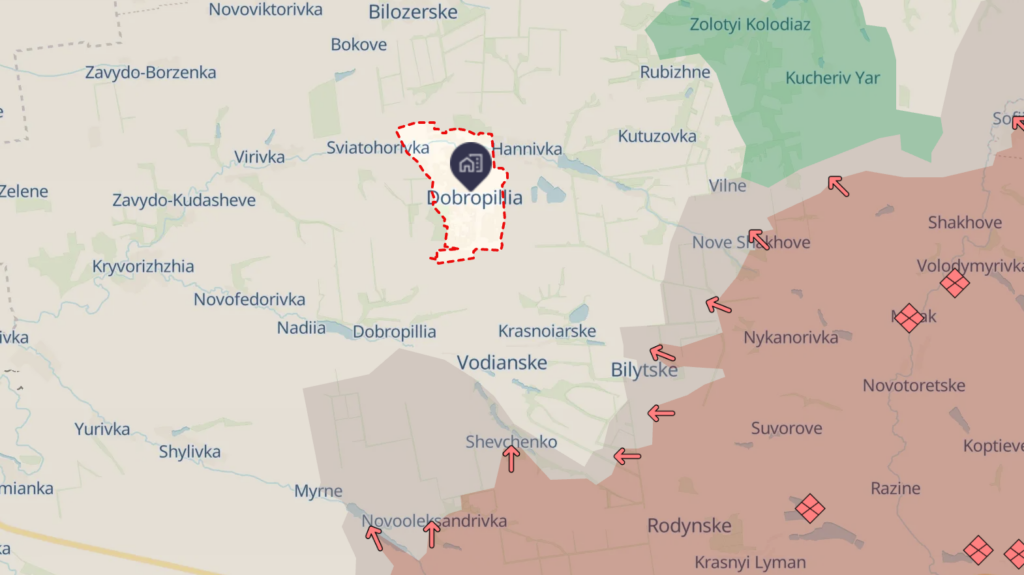
Russian forces have stepped up their attempts to break through toward Dobropillia in recent weeks, staff sergeant Dmytro Davydenko of the Svoboda Battalion headquarters said on the Suspilne Studio broadcast on 14 September.
Dobropillia is an important transportation hub in northern Donetsk Oblast, with a key road connecting it to Kramatorsk. Russian forces are using every possible factor, including weather conditions, to seize Dobropillia as part of their efforts to capture the entire Donetsk Oblast.
He noted that Russian forces may be taking advantage of the “greenery” to move as many troops as possible closer to the settlement and then enter Dobropillia when the weather deteriorates, potentially leading to urban combat.
The actions may be part of a tactic Russia has used before, but Ukraine has taken it into account
“Right now, there is a huge increase in the number of mobile groups moving in this direction. Sometimes we simply cannot keep up with engaging those we detect because there is a very large number of movements advancing in all directions right now,” Dmytro said.
Russian forces may use poor weather conditions to attempt something similar to what they did in Pokrovsk, when they tried to bring in a large number of troops using mechanized columns, the staff sergeant said. He added that the Ukrainian military had “drawn certain conclusions” and created obstacles for Russian forces along the routes to Dobropillia: the roads have either been destroyed, mined, or blocked.
The number of assault troops has increased, but Russia faces limitations
Russia can increase the number of troops in the area, but its capabilities are limited, Davydenko said. He explained that one drone operator cannot simultaneously support 20–30 assault groups on different axes, so an increase in the number of Russian troops is unlikely to result in a “critical onslaught.”
“To bring in an even larger number of fighters, I don’t know how well they will manage that, because there is the factor of the physical ability to bring this number of people to the staging point and then lead this large number of people along the route,” Davydenko said.
The Kremlin revives its push toward Dobropillia
Russia prioritized offensive operations toward Pokrovsk and Dobropillia to encircle Ukraine’s fortress belt in Donetsk Oblast from the southwest, but the timeline for such an encirclement is “extremely unrealistic,” the Institute for the Study of War (ISW) said in its 7 August report.
The fortress belt consists of four fortified cities that have formed the backbone of Ukraine’s defense in Donetsk Oblast since 2022: Kostiantynivka, Druzhkivka, Kramatorsk, and Sloviansk. Dobropillia sits at its southwestern corner.
The city initially became a target of Russian strikes as Russian forces advanced toward Pokrovsk, and later became a target for capture. On 11 August 2025, Russian forces managed to approach Dobropillia and cut the Dobropillia–Kramatorsk highway in the opening days of their offensive. Ukrainian forces later reported that they had encircled and eliminated these troops.
In spring and summer 2026, Russia would “almost certainly” attempt to repeat its success in Dobropillia, predicted Francis Farrell for the Kyiv Independent. That is what happened. On 26 July, reports emerged that Russia was once again massing around Dobropillia, using quad bikes and motorcycles, following the same infiltration pattern as in 2025.
Read also
-
Ukraine strikes two Russian S-400 launchers in Bryansk. The same systems were used to attack Kyiv overnight.
-
Kyiv’s arms industry wants to kill the export fee. Parliament just refused to route that money to the army
-
Ukraine kept this strike drone secret for two years—its maker says it has destroyed more than 350 Russian systems