Vue normale

  • ✇Euromaidan Press
  • Russian air attack interrupts lessons on first day of school in Ukraine

    Ukrainian president Volodymyr Zelenskyy marked the start of the academic year with children at a Kyiv Oblast school rebuilt after Russian forces destroyed it in 2022, before an air attack forced their first lessons into the shelter on 1 September 2026, the Kyiv Oblast Military Administration said. Knowledge Day, Ukraine’s traditional start of the academic year, fell during the full-scale invasion for the fifth time. Russia’s war now determines whether children can learn
     

Russian air attack interrupts lessons on first day of school in Ukraine

1 septembre 2026 à 12:04

President Volodymyr Zelenskyy watches as a pupil in an embroidered shirt speaks at a school event decorated with Ukrainian-colored balloons.

Ukrainian president Volodymyr Zelenskyy marked the start of the academic year with children at a Kyiv Oblast school rebuilt after Russian forces destroyed it in 2022, before an air attack forced their first lessons into the shelter on 1 September 2026, the Kyiv Oblast Military Administration said.

Knowledge Day, Ukraine’s traditional start of the academic year, fell during the full-scale invasion for the fifth time. Russia’s war now determines whether children can learn alongside their classmates: local security and shelter access govern classroom returns, while about 200,000 pupils near the front will remain fully remote.

Around three million pupils began the 2026–2027 academic year, including roughly 240,000 first-graders, 10% fewer than a year earlier, Member of Parliament Iryna Borzova of the Verkhovna Rada’s Committee on Youth and Sports told Ukrinform. Most will learn in person or through a blended format, but some 200,000 children near the front will study entirely online, she said.

More than 82% of school pupils and preschoolers can access shelters, Education Minister Andrii Butenko said. The government has allocated UAH 6 billion this year to expand access to shelters and other educational safety infrastructure.

Russian forces destroyed the school Zelenskyy visited in March 2022. It reopened only last autumn with a shelter and backup power, according to the Kyiv Oblast Military Administration.
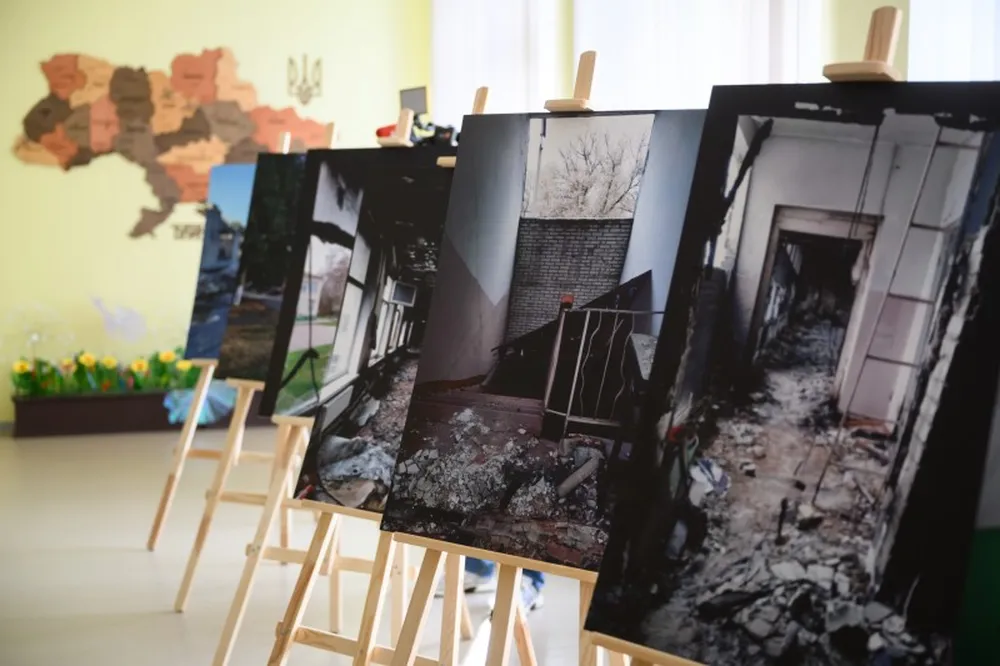
Photographs of burned and rubble-filled school interiors displayed on easels inside the rebuilt school.
An exhibition shows damage inflicted when Russian forces destroyed the Kyiv Oblast school in March 2022. The school reopened in autumn 2025. Photo: Office of the President of Ukraine

Zelenskyy said Russia had spent the preceding two weeks attacking infrastructure partly to disrupt the start of the academic year.

Ahead of Knowledge Day, Kyiv Oblast Military Administration head Tymur Tkachenko advised schools in high-risk communities not to hold mass opening ceremonies. Each school was to decide whether to proceed based on the security situation in its community.

“First and foremost, there must be safety,” Tkachenko said. If a ceremony went ahead, he recommended holding it directly in a shelter where possible. For events outside shelters, attendance was not to exceed the capacity of the nearest protective facility, and schools were told to avoid large gatherings of pupils, parents, and staff.

How Russia’s invasion has devastated Ukrainian education

Ukraine’s 2026 Knowledge Day began after six consecutive days of Russian attacks on Kyiv and its surrounding region, culminating overnight in a massed missile and drone strike. Eight people were killed, and seven were injured, including three children, while civilian infrastructure was damaged across five Kyiv districts.

Russia’s invasion has turned school safety and reconstruction into central parts of Ukraine's education policy. By September 2024, more than 3,500 educational institutions had been damaged and nearly 400 destroyed, with the World Bank estimating that almost $14 billion would be needed to rebuild them.

Attacks on Ukraine’s energy system have also left classrooms without heat or electricity, forcing prolonged holidays and renewed distance learning.

  • ✇Euromaidan Press
  • Every Russian attack on Kyiv costs the city about $12 million. They now come almost twice in week
    Each Russian attack on Kyiv costs the city budget about $12 million. Russian strikes have already damaged more than four thousand buildings in the capital, Mayor Vitali Klitschko said in answer to a Novyny.LIVE journalist. Russian forces now strike Kyiv with ballistic and cruise missiles or drones on average almost twice a week. The latest massed attack, on the night of 20 August, killed at least 16 people in Kyiv and the region. The cumulative damage keeps growing
     

Every Russian attack on Kyiv costs the city about $12 million. They now come almost twice in week

23 août 2026 à 15:10

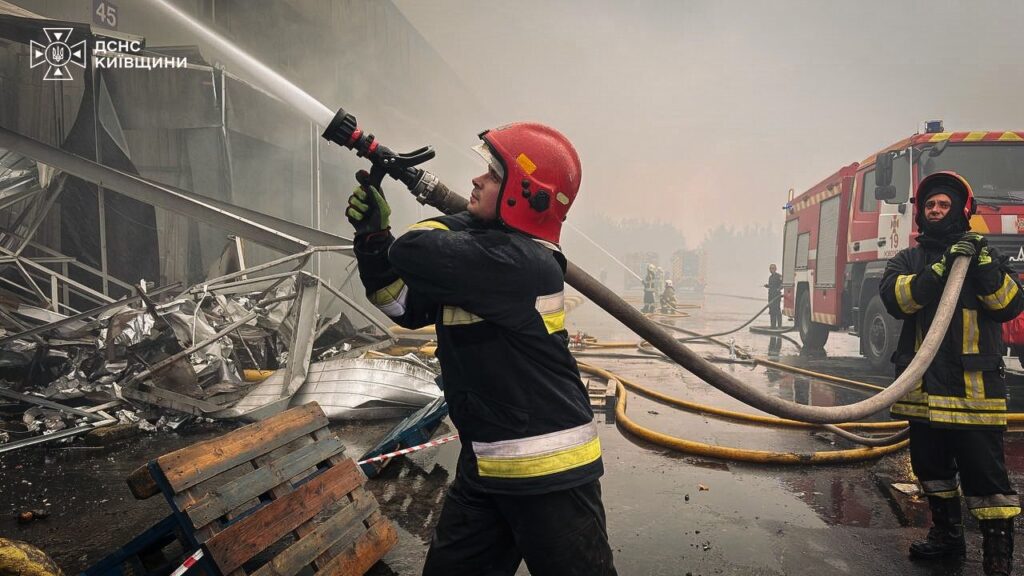
Ukrainian firefighters respond to a blaze at warehouses hit by a Russian drone strike in Kyiv Oblast’s Brovary district, 18 August 2026. Photo: Ukraine's State Emergency Service

Each Russian attack on Kyiv costs the city budget about $12 million. Russian strikes have already damaged more than four thousand buildings in the capital, Mayor Vitali Klitschko said in answer to a Novyny.LIVE journalist.

Russian forces now strike Kyiv with ballistic and cruise missiles or drones on average almost twice a week. The latest massed attack, on the night of 20 August, killed at least 16 people in Kyiv and the region.

The cumulative damage keeps growing

The toll on the city's housing is vast. More than four thousand buildings in Kyiv have been damaged by Russian strikes, Klitschko continued, with each attack adding to a repair bill the city carries alongside the human losses.

New shelters are planned, but old money went unspent

Kyiv plans to expand its shelter network. By the end of 2026, the city intends to install new mobile shelters, placed first in districts and locations that lack other accessible cover, Klitschko stated.

The plan follows a failure that the mayor acknowledged. Last year, Kyiv allocated $12 million for mobile shelters, but the district administrations did not use the money. It was returned to the city budget.

The capital also still lacks enough professional bomb shelters capable of better protecting people during missile strikes, he added. This gap persists as tens of thousands of Kyiv residents shelter in metro stations through the attacks.

The city is building a backup heating system

Meanwhile, Kyiv is preparing for winter under fire. The city has completed more than 50% of planned work to create a backup heating system, with readiness at some sites already reaching 90%, the Kyiv mayor added.

Russia has struck Ukraine's energy and heating infrastructure each winter of the war. A backup system is Kyiv's insurance that a successful strike on one heat source does not leave districts frozen, part of the same preparation for the heating season that Ukraine's government is racing to complete nationally before the cold.

Ukraine’s parliament advanced a Finnish-style shelter bill: everyone must be able to reach one within 10 minutes

19 août 2026 à 14:57

Russian missile drone attacks civilians Ukraine

Ukraine has moved to guarantee its people places to hide amid Russia's terror. The Ukrainian parliament has passed a bill on shelters in the first reading, introduced by the opposition European Solidarity faction, with 296 MPs voting for the legislation on measures to ensure citizens' safety.

The bill responds to a sheltering crisis that Russia's escalating strikes have created, as the invading army cannot achieve full occupation of Ukraine. As Russia intensifies its attacks on Ukrainian cities, tens of thousands of Kyiv residents now have to sleep in metro stations each night, and in Kharkiv, the underground has become a vast cover for tens of thousands.

The bill draws on the Finnish model

The legislation draws on a country known for its civil defense. It adopts Finnish experience on ensuring citizens' access to shelters and strengthens the responsibility of central and local authorities for maintaining and funding them, according to the European Solidarity.

The faction framed shelters as the top protective priority.

"We understand that the issue of bomb shelters, the issue of shelters, is becoming problem number one for protecting the civilian population," faction co-chair Iryna Herashchenko said.

The Ukrainian deputy emphasized the importance of considering the bill before the budget process begins.

What the bill requires

The bill sets concrete standards for shelters. It defines mandatory requirements, such as drinking water, medicine, sanitation facilities, a designated responsible person, and placement within 10 minutes' reach of people.

The 10-minute rule is the core of it.

"Shelters must be where there are concentrations of people, so they can reach them in 10 minutes," MP Viktoriia Siumar said.

The bill also guarantees unimpeded access to shelters during martial law, requires regular inspections of their condition, strengthens accountability for their upkeep, and supports the expansion of the civil-defense network, including through modular structures.

❌