❌

Vue normale

  • ✇Euromaidan Press
  • This is how Ukraine finally blew up the Kerch Bridge
    Ukraine finally dropped part of the strategic Kerch Bridge on 17 November The complex strike operation involved several new capabilities Now Russian logistics into occupied southern Ukraine are partially throttled After years of trying, Ukrainian forces finally dropped a portion of the strategic Kerch Bridge connecting southern Russia to occupied Crimea over the narrow Kerch Strait overnight on 17 November, a day after a first strike knocked one of its arches askew. Paralle
     

This is how Ukraine finally blew up the Kerch Bridge

Par : David Axe
17 novembre 2026 à 18:13

The partially destroyed Kerch Bridge.

  • Ukraine finally dropped part of the strategic Kerch Bridge on 17 November
  • The complex strike operation involved several new capabilities
  • Now Russian logistics into occupied southern Ukraine are partially throttled

After years of trying, Ukrainian forces finally dropped a portion of the strategic Kerch Bridge connecting southern Russia to occupied Crimea over the narrow Kerch Strait overnight on 17 November, a day after a first strike knocked one of its arches askew.

Parallel spans carry—or carried—vehicles and trains back and forth, helping feed, fuel, and supply Russian forces in Crimea. There are other supply lines for Russian forces in occupied southern Ukraine, but the 19-km bridge—which Russia built after seizing Crimea in 2014 and opened in 2018, at a cost of about $3.7 billion—is or was one of the main ones.

Now it's half wrecked, with the vehicle span severed in the middle, the train span damaged, and wreckage blocking the ship channel beneath the bridge for as long as it takes for Russia to mount a major repair and salvage effort. An effort that the Russians may have to attempt under further Ukrainian attack.

Grateful to the Security Service of Ukraine, all units of Ukraine’s Defense Forces involved, Ukraine’s Minister of Defense, the Commander-in-Chief of the Armed Forces of Ukraine and the General Staff, and all our weapons manufacturers for an unprecedented operation in response to… pic.twitter.com/pgUxGrE61K

— Volodymyr Zelenskyy / Володимир Зеленський (@ZelenskyyUa) November 17, 2026

"Today, everyone can see the consequences for the main military crossing from Russian territory into our Ukrainian Crimea," Ukrainian President Volodymyr Zelenskyy wrote. "This is the result of the seventh stage of an operation carried out over several weeks, developed and coordinated by the Security Service of Ukraine together with the General Staff of the Armed Forces of Ukraine."

Ukraine has attacked the Kerch Bridge at least once a year every year since 2022, striking with a truck bomb, drones, missiles, and underwater explosives. None of those attacks inflicted nearly as much damage as the 16 and 17 November strikes. For the most recent and most successful raid, Ukraine mobilized many of its best deep strike forces, including some brand-new capabilities such as jet-propelled drones and operator-guided cruise missiles.

The view from a remote-controlled FP-5 as it nears the Kerch Bridge.
The view from a remote-controlled FP-5 as it nears the Kerch Bridge. Fire Point capture.

New drones and missiles

Three stand out:

  1. the new Ruta cruise missile from Dutch firm Destinus
  2. a new jet-propelled version of Ukrainian firm Antonov's An-196 Liutyi attack drone
  3. and a new variant of Kyiv-based Fire Point's FP-5 Flamingo cruise missile that a remote operator directly steers via a low-lag radio signal.

In all, various drone units from the Ukrainian army, navy, and special services may have launched hundreds of drones and missiles over a period of nearly a month in order to first clear a path through Russian air defenses—and then strike the bridge.

"Our warriors gradually destroyed air defense systems, radars, electronic warfare equipment, and other designated targets on the way to the final objective," Zelenskyy wrote. For this, the president added, they used 11 different kinds of drone and missile, including Palianytsias, Mich-2000s, Rutas, Neptunes, and the jet-propelled Liutyis, also known as An-197s.

Once the Russian defenses were sufficiently degraded, drones and missiles took aim at the bridge. "At the key stage, the Palianytsia drones performed exceptionally well, striking the road section of the bridge," Zelenskyy wrote, "while Neptune missiles, Ruta drones, and FP-5 drones struck the railway section."

Official videos revealed that the FP-5s weren't the usual versions of the heavyweight cruise missile, which hauls a 1,150-kg warhead as far as 3,000 km. Normally, the Flamingo navigates by way of an internal inertial system that, while helpfully self-contained, tends to drift over long distances—and also results in the missile cruising at an altitude of several hundred feet, high enough to make it an easy target for Russian air defenses.

The Kerch bridge after its road span collapsed into the strait, with only the railway arch still standing, filmed by a thermal camera, Russian-occupied Crimea, 17 November 2026
Explore further

Missile-drones, cruise missiles, and a Flamingo guided to the last second: Kyiv’s account of the night Russia’s Kerch bridge lost its road

The Flamingos that struck the Kerch Bridge were steered by remote operators seeing what the missiles saw through forward-looking cameras. That makes the missiles more accurate, and probably helps them fly lower—and past Russian defenses. The downside of direct remote control is that it demands a stable and low-lag radio connection, possibly via a mesh radio network made up of many interconnected drones receiving and sending signals.

The apparent mesh radio network did its job. "Using Flamingo, our warriors carried out a precision-guided strike—and the communications uplink worked flawlessly until the very last seconds," Zelenskyy stated.

What happens next depends on how quickly the Russians can begin repairing the bridge, and whether the Ukrainians continue striking. In any event, "the destruction of the Kerch Bridge will save many Ukrainian lives, both on the front and in the occupied territories," mapper Ukraine Control Map noted.
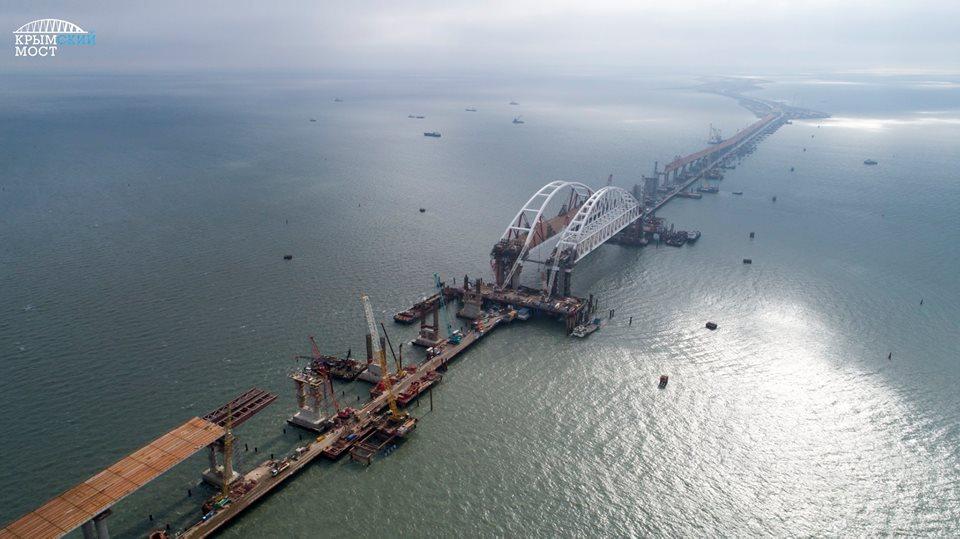
Kerch bridge construction 2017
Explore further

Ukraine struck Russia’s Kerch bridge again. The EU firms that helped build it barely suffered.

Missile-drones, cruise missiles, and a Flamingo guided to the last second: Kyiv’s account of the night Russia’s Kerch bridge lost its road

17 novembre 2026 à 08:48

The Kerch bridge after its road span collapsed into the strait, with only the railway arch still standing, filmed by a thermal camera, Russian-occupied Crimea, 17 November 2026

A weeks-long Ukrainian operation with missiles and drones brought down the road span of Russia's Kerch bridge, Ukraine's Security Service (SBU) said. President Volodymyr Zelenskyy listed the weapons, while Russia restarted trains on one track across the bridge and opened a terrorism case. Drones also hit the highway near a second bridge on Russia's overland route to Crimea.

Russia strikes Ukraine's infrastructure every day, including bridges in Kyiv, Dnipro, Zaporizhzhia, and Odesa Oblast, Zelenskyy said. He called the Kerch bridge Russia's main military crossing into Russian-occupied Crimea. The arch carrying its road over the shipping lane fell overnight, a day after a strike on 16 November. Russia's other road into Crimea runs from Rostov through occupied southern Ukraine, and drones hit it again this morning near a bridge in Rostov Oblast.

Seven stages, 11 weapons

The road span fell in the seventh stage of an operation the SBU and Ukraine's General Staff ran for several weeks, Zelenskyy said. Stage by stage, he said, Ukrainian forces knocked out air defense systems, radars, and electronic warfare equipment on the way to the bridge. The weapons used were Dovbush, Vendetta, Da Vinci, Sichen, MICH 2000, Ruta, Palianytsia, An-197, FP-1, FP-5 Flamingo, and R-360 Neptune.

Grateful to the Security Service of Ukraine, all units of Ukraine’s Defense Forces involved, Ukraine’s Minister of Defense, the Commander-in-Chief of the Armed Forces of Ukraine and the General Staff, and all our weapons manufacturers for an unprecedented operation in response to… pic.twitter.com/pgUxGrE61K

— Volodymyr Zelenskyy / Володимир Зеленський (@ZelenskyyUa) November 17, 2026

At the key stage today, Palianytsia missile-drones hit the road section, while Neptune missiles, Ruta, and FP-5 Flamingos hit the railway section, Zelenskyy said. Using a Flamingo, Ukrainian forces carried out a guided strike, and the link held until the last seconds, he added. Ukraine repeatedly offered Russia steps to de-escalate and heard only loud refusals, he said.

"But we also remind Russia that war will always return to where it began," Zelenskyy said.

Map of the strike on the Kerch bridge and the drone attack near the Mius River bridge in Rostov Oblast, 17 November 2026

SBU: its fourth strike on the bridge

The SBU says the operation took about a month and had seven stages. The SBU carried out some of the strikes on the bridge on its own, and other Ukrainian forces joined at the final stage. The SBU's Alpha special forces then hit the road section with Palianytsia missile-drones, and the span fell into the water. One of the bridge's two steel arches and the road span beneath it are completely destroyed, the SBU says, and the rail section was also damaged, according to preliminary information.

This is the SBU's fourth strike on the bridge, the agency says. In October 2022, it blew up a truck packed with explosives on the bridge. In July 2023, its Sea Baby naval drones attacked the supports, and in June 2025, it set off explosives under water.

The Kerch bridge after the road section’s arch collapsed into the sea following a Ukrainian strike, occupied Crimea, 17 November 2026. Top left: the moment of one of the overnight strikes. Bottom right: the bridge seen from Kerch in the morning, with only the rail arch standing
Explore further

One arch left standing: Ukraine’s second strike in two days sends the road span of Russia’s Kerch bridge into the sea

The SBU's 34-second video includes thermal drone footage of the bridge after the strike. It shows the rail arch standing alone over the strait, with the road span gone.

Missile maker claims seven Ruta hits

Destinus, which builds Ruta missiles in the Netherlands, gave its own account later on 17 November, Defence Blog reported.

"Last night's strikes damaged the bridge's upper load-bearing structure. Today, seven RUTA missiles hit the bridge, causing one span to collapse," the company wrote.

The company added that Ukraine used its LORD and Da Vinci drones against Russian air defenses. Da Vinci is Ukraine's name for the company's LORD drone, Defence Blog noted. The SBU credits Palianytsia missile-drones for the fallen road span, while Zelenskyy listed Ruta among the weapons that hit the rail section.

Trains run on one track, the road is "dead"

Ukraine's General Staff says the road part of the bridge is "dead" and no vehicle can cross it. The rail branch still stands, but its arch is damaged, the General Staff added.

Russia's Transport Ministry said rail traffic across the bridge has resumed on one track, while repairs continue on the second section. The Tavria train from Moscow left Taman, on the Russian side of the strait, for Kerch at 13:04 Moscow time, according to the ministry. Sergey Aksyonov, Crimea's Russian-installed head, said that passengers without cars can cross the Kerch Strait by ferry, and urged everyone to ignore "fakes."

The satellite image of the Crimean Bridge following a Ukrainian strike on 16 November. The bridge's arch is damaged and deformed. Source: Exilenova+
Explore further

Russia says Ukraine attacks Crimean Bridge again after 2023. Each strike burns costly S-400 missiles and strips occupied peninsula’s cover, expert says

The bridge's official Telegram channel posted at 22:54 Kyiv time on 16 November that road traffic was temporarily closed, and pointed readers to its channel on Russia's MAX messenger. It had posted nothing more on Telegram by mid-afternoon on 17 November. Russia's Investigative Committee opened a terrorism case into the attacks of 16 and 17 November. It said Ukraine used drones and damaged the bridge's structure, without mentioning missiles.

Drones hit the road near the Mius bridge again

Drones also struck the R-280 highway near the Mius River bridge in Russia's Rostov Oblast this morning. The roadway and metal guardrails were damaged, Rostov Governor Yuri Slyusar said, citing preliminary information. He reported no casualties. Traffic across the bridge has been suspended since 8 November, when drones damaged it.

A map of the Mius River bridge at km 97 of the R-280 highway in Rostov Oblast, Russia, a street-level view of the bridge, and Rostov Oblast Governor Yuri Slyusar's posts on the drone attack of 8 November 2026, with the posts machine-translated
Explore further

Russia was widening this bridge to four lanes for its Crimea road. Drones have now closed it

The R-280 links Rostov-on-Don with occupied Mariupol and is part of Russia's land route to Crimea. In June, Ukrainian drones hit the bridges at Chonhar and Henichesk, two of the crossings into Crimea from occupied southern Ukraine.

One arch left standing: Ukraine’s second strike in two days sends the road span of Russia’s Kerch bridge into the sea

17 novembre 2026 à 03:05

The Kerch bridge after the road section’s arch collapsed into the sea following a Ukrainian strike, occupied Crimea, 17 November 2026. Top left: the moment of one of the overnight strikes. Bottom right: the bridge seen from Kerch in the morning, with only the rail arch standing

The arch over the shipping channel on the road section of the Kerch Strait Bridge, which Russia built illegally to Russian-occupied Crimea, collapsed into the sea overnight on 17 November after a repeat Ukrainian attack with cruise missiles and drones, unofficial Ukrainian sources say. Morning photos posted by Ukrainian Telegram channels Exilenova+ and Supernova+ show the road span in the water, with only the rail arch still standing.

Since October, Russia has been firing ballistic missiles at Kyiv's bridges over the Dnipro, and the capital's mayor reported preliminary hits on two of them less than an hour before Crimea's occupation head reported this attack. Russia's own 19-km bridge across the Kerch Strait, built after it seized Crimea in 2014, is the main road and rail link from Russia to the peninsula. In June, Ukraine's drones knocked out the land crossings into Crimea from the occupied mainland but left the Kerch bridge standing, the peninsula's way out. The bridge has now been struck two days in a row, and its road span is in the sea.

What happened overnight

At 00:35 Kyiv time, Russian-installed Crimea governor Sergei Aksyonov said the bridge had been attacked again, and traffic was suspended. Crimea was under missile danger warnings three times during the night, Ukrainian military outlet Militarnyi reported. Shortly after 01:00, Ukrainian Telegram channel Dnipro Osint posted video of the moment of impact, a hit "straight into the arch." By morning, the arch was in the water.

Ukraine's former Interior Ministry adviser Anton Gerashchenko shared footage he described as a Ukrainian FP-5 Flamingo cruise missile seconds before it struck. Denys Shtilierman, co-founder of Flamingo maker Fire Point, dedicated the strike to the memory of two late colleagues. Russia's Defense Ministry claimed it downed 1,441 Ukrainian drones overnight, including over occupied Crimea, and mentioned no missiles. Ukraine's military had not commented by the morning.

Dnipro Osint later claimed the rail track was also damaged and that road traffic, rail traffic, and shipping through the Kerch Strait were halted. Four trains bound for Crimea were running 2.5 to 4 hours late as of 08:30 Moscow time, Russian Telegram channel Astra reported. Aksyonov claimed that a drone attack killed two people in Leninskyi district, the area around Kerch.

The bridge is the artery Russia uses to move fuel, ammunition, and troops onto the peninsula and onward to its forces across Ukraine's south. Russia began building it in February 2016 and opened the road section in May 2018 and the parallel rail section in December 2019. Ukraine had struck it three times before this week, with a truck bomb in October 2022, sea drones in July 2023, and underwater explosives in June 2025. "It all essentially comes down to the so-called Crimean Bridge," Navy spokesman Dmytro Pletenchuk said in June of Ukraine's campaign against Russian logistics in Crimea, using Russia's name for the Kerch Strait Bridge.

ukrainian strikes on 17 nov 2026 - kerch kursk salavat

The first strike, on 16 November

On 16 November, Aksyonov said the bridge had been struck and traffic would be limited until about midday. Later he said cars were moving in alternating directions and trains were running. A satellite image Exilenova+ posted that afternoon showed the deck damaged in at least two places and the arch deformed.

The satellite image of the Crimean Bridge following a Ukrainian strike on 16 November. The bridge's arch is damaged and deformed. Source: Exilenova+
Satellite image of the Crimean Bridge following a Ukrainian strike on 16 November. The bridge's arch is damaged and deformed. Source: Exilenova+

A before-and-after comparison from Ukrainian Telegram channel Krymsky Veter now shows one arch where there were two.

Undated view of the Kerch bridge, with smoke and a water plume beside it, before the 17 November attack (left), and the bridge on the morning of 17 November 2026 with its road arch gone (right)
Undated view of the Kerch bridge, with smoke and a water plume beside it, before the 17 November attack (left), and the bridge on the morning of 17 November 2026 with its road arch gone (right). Collage: Supernova+

Russia keeps hitting Kyiv's bridges

About an hour before Aksyonov's post, Kyiv Mayor Vitali Klitschko reported preliminary hits on the capital's Northern and Southern bridges during a ballistic missile attack. Since 1 October, Russia has been striking Kyiv's Dnipro crossings, the first such attacks since the full-scale invasion began.

Crimea's way out in summer

Between 7 and 13 June, Ukrainian drones hit the Chonhar bridge, the Henichesk–Arabat Spit crossing, and four bridges near Armiansk. Russian-installed officials then said no intact bridges remained at the peninsula's land entrances. At the Kerch crossing, Ukraine's drones targeted fuel and transport sites at both ends and the air defenses guarding the bridge. The bridge itself stayed standing, and on 26 June people queued at the strait to get off the peninsula over it.

Russia overnight

In Salavat, Bashkortostan, the Gazprom Neftekhim Salavat petrochemical complex was attacked and caught fire in several places, Exilenova+ said, and Supernova+ posted photos of the smoke. In Kursk, the 330 kV Sadovaya substation caught fire after explosions, Astra's OSINT analysis found and Exilenova+ reported. Moscow Mayor Sergei Sobyanin said about 800 drones flew toward the Moscow region overnight, with 321 downed near the city.

  • ✇Euromaidan Press
  • Successful Neptune, Flamingo, and Storm Shadow strikes doubled this fall, OSINT count shows
    Ukrainian forces carried out at least 10 successful strikes with Neptune, FP-5 Flamingo, and Storm Shadow cruise missiles in September and October 2026, up from five in July and August, the Institute for the Study of War (ISW) reported on 10 November, citing data from Ukrainian OSINT analyst Oko Gora. ISW assessed that Ukraine’s growing mix of long-range weapons will likely force Russia to prioritize between investing in counter-drone and missile defenses. Meanwhile, on 10 November, Rus
     

Successful Neptune, Flamingo, and Storm Shadow strikes doubled this fall, OSINT count shows

11 novembre 2026 à 08:57

Rusty Dagger (top) and RAACM (bottom) missiles

Ukrainian forces carried out at least 10 successful strikes with Neptune, FP-5 Flamingo, and Storm Shadow cruise missiles in September and October 2026, up from five in July and August, the Institute for the Study of War (ISW) reported on 10 November, citing data from Ukrainian OSINT analyst Oko Gora.

ISW assessed that Ukraine’s growing mix of long-range weapons will likely force Russia to prioritize between investing in counter-drone and missile defenses. Meanwhile, on 10 November, Russia’s Defense Ministry claimed its air defenses had shot down four Rusty Dagger cruise missiles.

Moscow claims it downed four Rusty Dagger missiles

The AGM-188A Rusty Dagger is a low-cost cruise missile developed by US firm Zone 5 Technologies for the US Air Force’s Extended Range Attack Munition program. Ukraine has used it since June, Naval News reported in July. Moscow’s shootdown claim cannot be independently verified.

For comparison: the frequency of successful strikes using Neptune, Flamingo and Storm Shadow missiles in 2025–2026.

🔴 Neptune – 30 strikes over 22 months; 🟢 Flamingo – 13 strikes over 16 months; 🟠 Storm Shadow (SS) – 14 strikes over 22 months.

Storm Shadow is included for… https://t.co/gXNBP0nROq pic.twitter.com/JdJ0aAswJR

— Oko Gora (@oko_gora_tg) November 8, 2026

Earlier, on the night of 30–31 October, drones and Neptunes hit the Kamensky plant in Rostov Oblast, the General Staff said. The plant makes solid rocket fuel for multiple rocket launchers and missiles. On the night of 6–7 November, Neptunes struck Proton-Elektrotex in Oryol, a maker of components for cruise missiles and Iskander-M ballistic missiles. Oryol Governor Andrei Klychkov claimed on his Max channel that production premises of an unnamed enterprise in the city were partially damaged in a massive missile attack, Gazeta.ru reported.

Both plants had been hit before: Kamensky in August, and Proton-Elektrotex on 23 October, the General Staff reported. Neptune alone accounted for 10 successful strikes in the three months before 7 November, Oko Gora wrote that day.

Russia must cover more ground, ISW says

Ukraine is better exploiting gaps opened by its campaign against Russian air defenses, ISW assessed. The wider mix forces Russia to deploy both counter-drone and surface-to-air missile systems across a larger area, the think tank wrote. Plants that have already invested in counter-drone defenses will have to commit new resources against missiles, it added.

ISW also tied a strike on the night of 9–10 November to that campaign. Ukrainian forces hit the 123rd Aircraft Repair Plant in Staraya Russa, Novgorod Oblast, which services A-50 early-warning aircraft, the General Staff reported. It did not say what weapon was used. The A-50 tracks aircraft and cruise missiles hundreds of kilometers away, the General Staff said.

❌