Patreon announced on Thursday that it’s partnering with Cloudflare to block crawlers from stealing creators’ work to train AI models.“I HAVE A KICKASS PRODUCT UPDATE FOR YOU ALL!” Jack Conte, the founder and CEO of Patreon, wrote in a post on Instagram with the superimposed text, “POV: you're CEO of one of these fucking tech companies, so you do what you want.” “Patreon has partnered with an internet infrastructure company called Cloudflare to block Al training crawlers from using the work yo
Patreon announced on Thursday that it’s partnering with Cloudflare to block crawlers from stealing creators’ work to train AI models.
“I HAVE A KICKASS PRODUCT UPDATE FOR YOU ALL!” Jack Conte, the founder and CEO of Patreon, wrote in a post on Instagram with the superimposed text, “POV: you're CEO of one of these fucking tech companies, so you do what you want.”
“Patreon has partnered with an internet infrastructure company called Cloudflare to block Al training crawlers from using the work you publish on your Patreon to train their Al models,” Conte wrote. “This is live and happening at the network level on all posts published on Patreon.”
"As AI agents become increasingly powerful and popular, creators deserve a meaningful say in how their work is used by AI companies. On most of the Internet, creators have to accept AI training on their work just to reach and grow an audience," Drew Rowny, SVP of Product at Patreon, said in a press release published by Cloudflare last week. "Patreon has a different vision: creators should be able to grow their audience and control how their work is used. That's why we're building on our existing work with Cloudflare to block known AI training crawlers at the network level across Patreon, while still allowing the crawlers that help creators get discovered and grow their businesses through search."
Last year, internet infrastructure company Cloudflare, which provides cybersecurity protection and content delivery services to websites, announced that it would start blocking AI crawlers from accessing content without website owners’ permission or compensation by default. And earlier this month, Cloudflare announced new options for website owners to control AI traffic based on whether bots are search, agent, or training crawlers. In September, according to the company’s blog, all new domains onboarding to Cloudflare will have training and agent bots blocked by default on pages that display ads, while search crawlers will remain allowed by default.
A spokesperson for Cloudflare pointed 404 Media to the company's Crawl Control technology and its recent data about AI crawling. "Patreon recently enabled Cloudflare’s Crawl Control technology for its users at the network level. Others, like beehiive, have also recently enabled Crawl Control to allow its users to allow or block specific AI models based on their preference," they said.
“Creators deserve credit, compensation, and consent. If that's not on the table, the crawlers can stay the fuck off Patreon. The free internet is alive and happening. The rebellion has already started,” Conte wrote in his post.
In May, Conte posted a 43-minute video addressing how the AI industry fails to compensate creators. “Creators deserve consent, credit and compensation,” Conte said in the video. “Consent meaning, ‘Do I get to opt out of my work being used by these models as training data?’ Credit meaning, ‘If my work is used and you just replicate my whole vibe as an artist… do I get credit for that?’ And then compensation, meaning, ‘Do I get paid when that happens?’ Unfortunately, the answer to all three of these questions right now is a big fat ‘No.’”
AI-generated works are permitted on Patreon, as long as they comply with the platform's terms of use. In 2024, 404 Media reported that many creators of nonconsensual sexual images and videos monetized their content on Patreon. Last year, Patreon updated its content guidelines for AI content to state: “AI-generated depictions of people that are illustrated/animated are permitted; AI-generated hyperrealistic depictions of people are permitted only if the people are real and have documented their explicit consent.”
Updated 7/9 at 7:59 p.m. EDT to include Drew Rowny's statement.
Updated 7/10 at 11:32 EDT to include comment from Cloudflare.
Wednesday, John Deere agreed to give farmers broader access to repair their tractors and farm equipment under an antitrust settlement agreement with the Federal Trade Commission, one of the biggest wins in the long right to repair battle. The settlement is the latest and by far the most important development in several recent lawsuits against John Deere, and is finally an agreement that isn’t full of half measures and doesn’t have massive, obvious loopholes.The FTC settlement is far better th
Wednesday, John Deere agreed to give farmers broader access to repair their tractors and farm equipment under an antitrust settlement agreement with the Federal Trade Commission, one of the biggest wins in the long right to repair battle. The settlement is the latest and by far the most important development in several recent lawsuits against John Deere, and is finally an agreement that isn’t full of half measures and doesn’t have massive, obvious loopholes.
The FTC settlement is far better than a recent, highly controversial settlement in a separate class action lawsuit against Deere brought by farmers in Illinois, and it’s worth breaking down the differences. Two years ago, I wrote an article called “The Walls Are Closing in on John Deere’s Tractor Repair Monopoly,” which followed that Illinois case, in which several farmers brought a complex, class action antitrust lawsuit against Deere. The judge in that case, Iain Johnson, wrote several scathing opinions about Deere’s anti-repair practices that indicated that he was seemingly inclined to hit Deere with stiff penalties.
But after years of litigation, the plaintiffs in that case decided to settle with Deere in April, earning a $99 million payout for farmers who paid for repairs over the last decade, and several right-to-repair protections that did not have much in the way of legal teeth.
This $99 million payout was roughly $79 million after legal fees and to be divided among more than 200,000 farmers; this means each farmer will receive roughly $395, or “less than the cost of a single authorized dealer service call for a typical 500-acre farm,” according to an analysis by Willie Cade, a longtime farm right to repair advocate.
“Bottom line is that farmers are getting $0.79 per acre for the eight years of Deere abuse,” Cade told me. “Bad settlement. The settlement is insufficient … the money is a small fraction of what the class could recover at trial, the claims process depends on labor-hour data only Deere holds, and the repair "fixes" are riddled with loopholes that leave Deere's monopoly intact.”
The Illinois settlement would prohibit farmers covered by it from filing any future repair-related litigation against Deere, and only required Deere to provide parts and repair guides to farmers under poorly defined “fair and reasonable” terms, a loophole that other manufacturers have used to claim that their parts and tools are constantly out of stock or cost astronomic prices.
“The ‘fair and reasonable terms’ standard is not price equality with dealers, nor is it a guaranteed price ceiling,” Cade wrote in his analysis. “Disputes about whether Deere’s pricing meets this standard are subject to Court oversight, but individual farmers may have limited practical ability to challenge pricing that does not obviously cross the line.”
The settlement in the Illinois case was so bad that one of the plaintiffs in the case, Wilson Farms, filed a 53 page formal objection to it two weeks ago, in part because it claims that there are many “unlitigated and uncompensated” cases in which farmers suffered under Deere’s monopoly. Under the settlement, farmers would no longer be able to sue Deere by “terminat[ing] Class members’ ability to collectively challenge Deere’s repair aftermarket monopolization for a generation.”
“Rather than provide any meaningful benefit to the Class, it appears that the proposed Settlement’s most important effect will be to give Deere its most powerful tool yet in its decades-long effort to block farmers from repairing their own equipment,” the objection says. “Extinguishment of farmers’ rights under the law.”
The good news is that the wildly disappointing and seemingly unnecessary selling out of farmers’ rights in the Illinois case that Deere appeared to be losing very badly is greatly mitigated by the FTC’s settlement from this week. The FTC case was brought by Lina Khan under the Biden administration; to its credit, the Trump administration decided to continue litigating.
The FTC settlement does not have monetary damages for farmers, but it has far better right to repair protections for John Deere customers moving forward. In the FTC deal, the “fair and reasonable terms” are better defined and are based on the price that John Deere dealers actually pay for repair parts and tools. Deere and its dealers are not allowed to “discriminate or retaliate” against farmers who repair their own equipment (manufacturers have been known to brick devices that consumers fix themselves). The FTC settlement also includes access to farmers for “future repair resources,” meaning repair tools, guides, software, and parts that Deere creates in the future.
Deere must also file “compliance reports” with the FTC, and the FTC will have oversight of the compliance. Crucially, the FTC settlement also does not affect farmers’ private grievances against Deere, meaning it is possible for farmers to sue Deere if the company’s repair practices have affected them.
The FTC settlement is one that has actual legal teeth and enforcement mechanisms that Deere should at least theoretically have to comply with. Earlier agreements and right to repair “wins” for farmers were often half measures (though it’s worth mentioning that Colorado passed a good agriculture right to repair law in 2023 after years of struggle from farmers and advocates). Deere and various farmers’ public interest groups had previously agreed to right to repair “memorandums of understanding” in which Deere promised to make repair parts and tools available to farmers. In practice, however, these tools and parts were often not available, were not as good as what dealers and authorized service providers had access to, or were unreasonably expensive. These memorandums of understanding also had few or no enforcement mechanisms.
Cade told 404 Media in an email that this settlement order “gives farmers real hope.”
Nathan Proctor, senior right to repair campaign director for consumer rights group U.S. PIRG, said in a statement that the FTC settlement “is much better than the deal secured in [the Illinois] class action lawsuit.”
“Deere has now agreed to make available all materials needed to conduct repairs, including some which it has previously withheld,” Proctor said. “I want to thank the FTC for its work on this case. Our goal from the start of our campaign was to ensure that farmers and independent mechanics get everything they need to fix equipment. We will continue to monitor the situation and advocate to ensure that goal is a reality.”
In other words, farmers finally have an actual, major win in the right to repair fight that goes far beyond earlier piecemeal and moral victories.
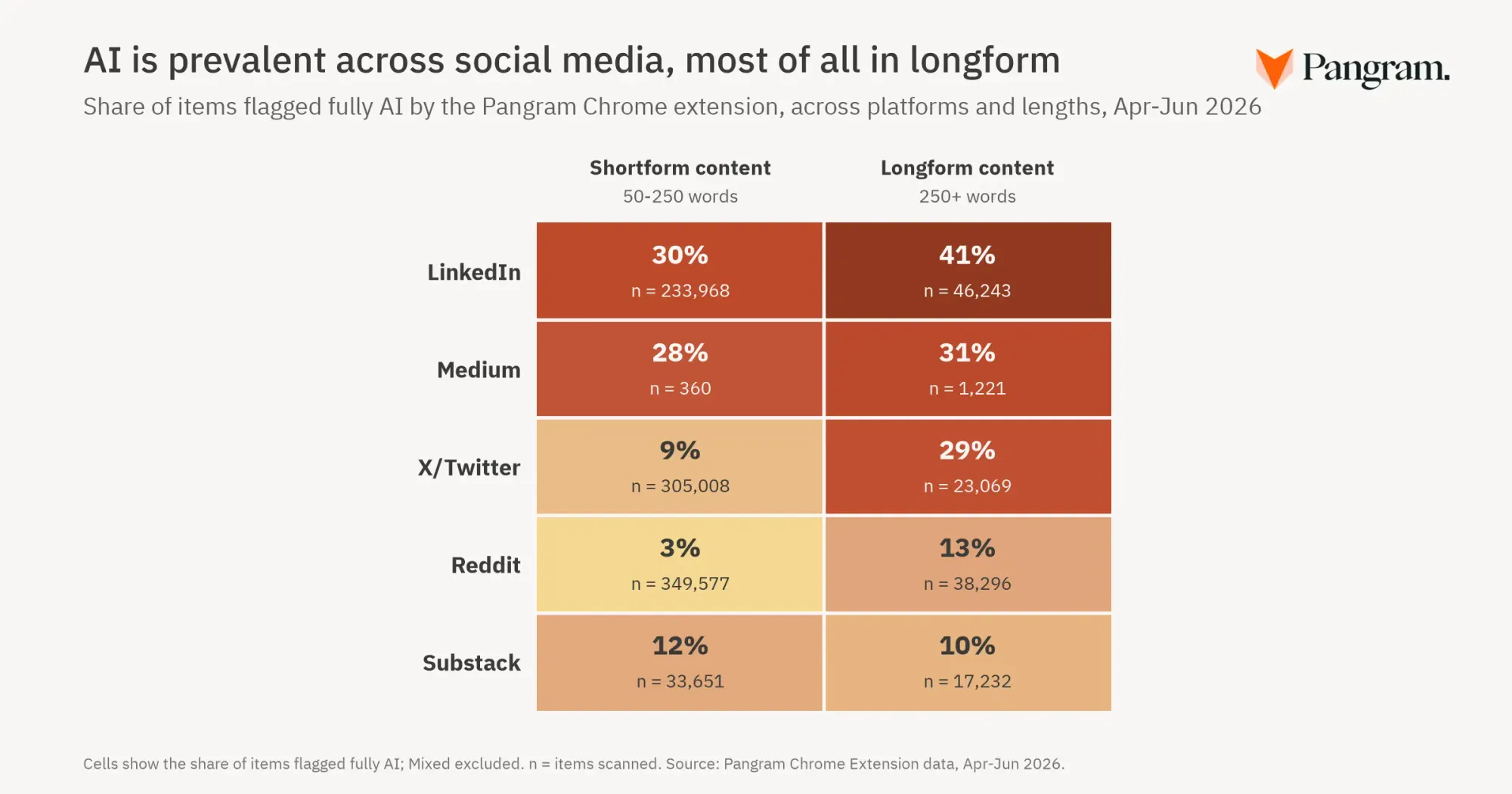
A shocking amount of the content that users encounter on popular social media websites is likely AI generated, according to data from a company that detects AI writing. As much as 41 percent of longform written content seen by users on LinkedIn is likely to be fully AI-generated and roughly a third of longer posts on X are AI-generated; roughly one-in-ten longer Reddit and Substack posts are AI, according to the data. The data was collected using a Chrome extension from Pangram, a company that d
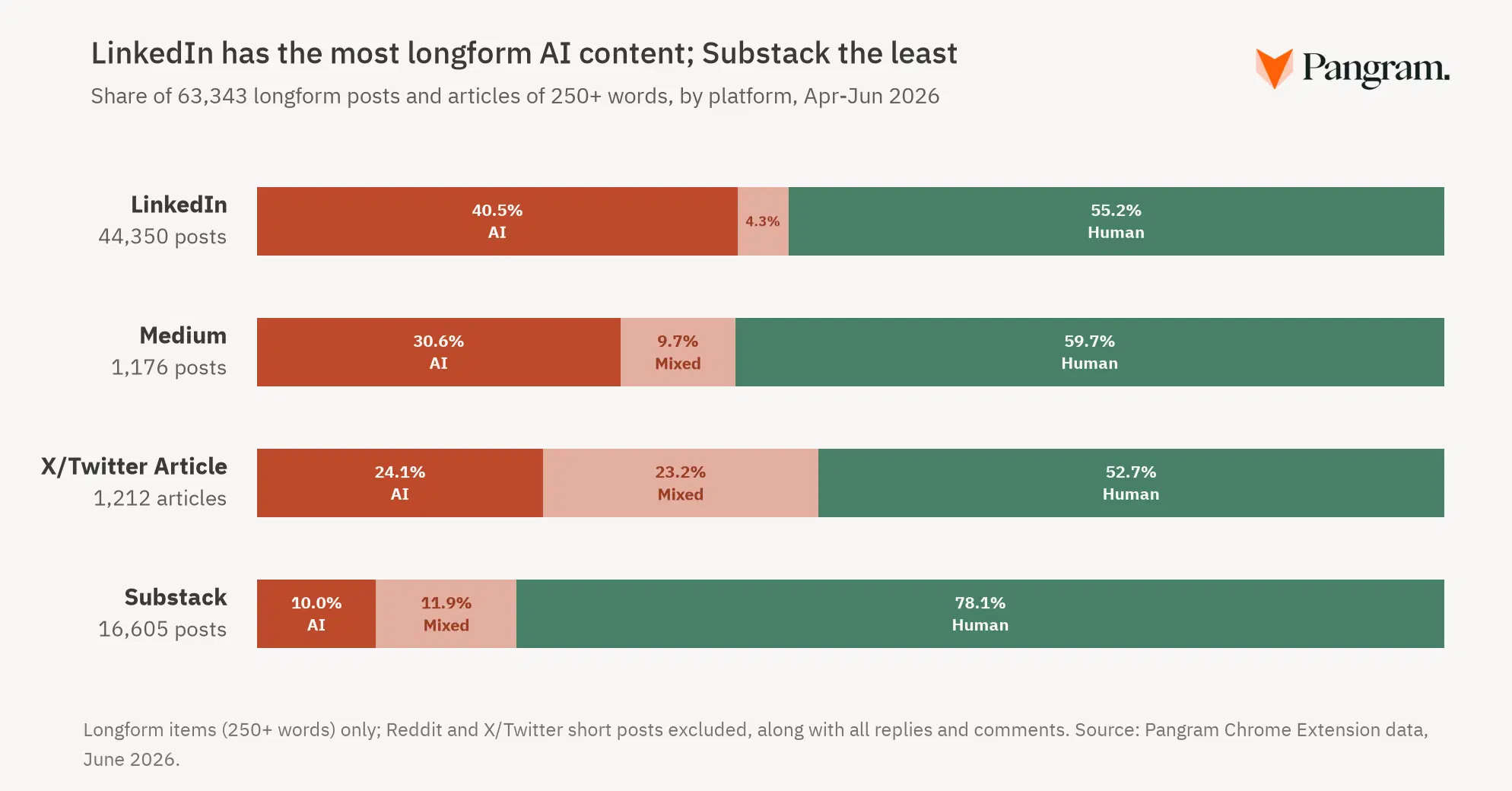
A shocking amount of the content that users encounter on popular social media websites is likely AI generated, according to data from a company that detects AI writing. As much as 41 percent of longform written content seen by users on LinkedIn is likely to be fully AI-generated and roughly a third of longer posts on X are AI-generated; roughly one-in-ten longer Reddit and Substack posts are AI, according to the data.
The data was collected using a Chrome extension from Pangram, a company that detects AI-generated writing. Pangram’s Chrome extension scans writing that users encounter while browsing and determines if any given post is likely AI-generated or likely human written. Because Pangram works passively in the background while a user is browsing the internet, it only scans posts that its users actually see. This helps answer the question of whether AI slop is actually poisoning the internet that humans actually use, versus polluting the internet more broadly. The answer is unequivocal: AI slop writing is not just sequestered off on unpopular automated SEO farms or spam sites that no one reads; humans are regularly wading through AI dreck on hugely popular sites.
“This isn’t something that had really been studied before—how much AI content people are actually seeing,” Max Spero, the CEO of Pangram, told me in a phone interview. “AI content is a tax on readers’ time.”
(Pangram formerly advertised on 404 Media. I am covering this data because I have written many articles about how AI-generated content is taking over social media and is brute forcing social media algorithms, and I have not seen other data that attempts to measure the actual popularity of slop.)
For this research, Pangram specifically asked users of its Chrome extension to opt-in to share Pangram browsing results with the company. The company analyzed roughly a million posts that its users organically scroll through across LinkedIn, Medium, X, Reddit, and Substack over a two-month period. Pangram found that, universally, longer posts on all platforms are more likely to be AI-generated than shorter posts. The company split the content it analyzed into “shortform” (between 50 and 250 words) and “longform” (longer than 250 words).
The data suggests, perhaps unsurprisingly, that a huge portion of longform posts on LinkedIn and X’s new article format are fully AI-generated or AI-assisted (meaning drafted, edited, or rewritten by AI with some human elements). Forty percent of longform LinkedIn posts analyzed in the data were fully AI-written; a quarter of X articles were fully AI written, but another 23 percent of X articles were AI-assisted, the company said. It intuitively makes sense that longer form content is more likely to be AI-generated, because people usually won’t bother to AI-generate a few word response or a pithy comment on a quote tweet, for example. AI is also famously verbose, meaning AI-generated content is more likely to show up in longer posts.
“Our data shows that AI-generated content is a problem across all platforms, and it is hitting longform content especially hard,” the company wrote in a blog post. “Contrary to what one might expect, people are overwhelmingly willing to use AI to speak on their behalf in professional settings that are associated with their real identity, and less likely to use it on casual and anonymous platforms.”
The study also found that top-level posts on LinkedIn and Reddit are far more likely to be AI-generated than the comments underneath an original post.
I have been using the Pangram Chrome extension for several months now, after interviewing Spero for an article I wrote called “Your AI Use Is Breaking My Brain.” In that article, I wrote about the cognitive weight of the constant assessments I am doing when I’m browsing the internet, trying to determine whether a piece of writing is AI-generated or not. After writing that article, I decided to try the Pangram Chrome extension to see whether its assessments of likely AI-generated writing aligned with my own brain’s assessments. After using the extension for nearly two months, my experience has largely aligned with what Pangram’s data suggests: Many of the longform articles I see on X are obviously AI generated, and are detected by Pangram as such. A huge amount of the LinkedIn posts I see are obviously AI-generated.
Because of the way the study worked, by passively detecting AI generated content that people see in their normal browsing, the data is potentially more useful than other studies that have sought to estimate the raw percentage of AI-generated content on the internet, but not whether anyone was actually seeing that content. These prior studies, which found that as many as a third of new sites are AI, allowed for the possibility that AI-generated content was flooding the internet but that it was of such a low quality that actual people may not have been seeing it.
The Pangram data raises questions about what platforms are doing to promote or disincentivize AI slop. LinkedIn, for example, had for years built AI writing tools into its platform meaning that it has been incredibly easy to post AI-generated content on the platform and that AI-generated content became incredibly common on the platform. In May, the company announced that it is trying to disincentivize AI content in the name of “keeping conversations real,” and the AI writing assistant is no longer built into the post button. Reddit, meanwhile, has become a vector for companies trying to game LLM tools by promoting their products on the site because AI search tools often scrape Reddit. But Reddit’s moderators are also overwhelmingly anti AI, and the company has worked to delete AI-generated posts and ban accounts that spam. On Monday, Reddit published a blog post saying that “in the age of AI, spam, bot activity, and inauthentic content are top of mind for people who love Reddit (and humans).” In the last few weeks, Reddit launched an ad campaign called “people are best” specifically highlighting that its users are human. A Reddit spokesperson referred us to the blog post when asked for comment.
As we have reported before, no AI detector is 100 percent foolproof, and Pangram certainly has both false positives (human content detected as AI) and false negatives (AI content detected as human). Spero said that the company is constantly working on minimizing both, and that it estimates its false positive rate at roughly one in 10,000. He said he believes the Pangram data is likely a “lower bound” and that the actual problem is likely worse, because people who are willing to install AI detectors on their browsers are likely trying to avoid AI-generated content.
“I think the data generalizes out [to non Pangram users], but that it’s a lower bound on AI content because someone with the Pangram extension probably cares more about seeing AI content than the average person and would be more likely to block or mute AI posters,” he said.
A LinkedIn spokesperson told 404 Media in a statement that “Professionals come to LinkedIn to hear from real people and their unique insights and perspectives. We actively work to reduce low quality, automated or generic content, and while AI can be used to beat the blank page problem, our focus is on surfacing professional conversations that help people advance their careers.”
Substack and X did not respond to a request for comment.
Meta has filed a patent for a system that records your voice and surroundings all day, then uses an AI to analyse your mood. The patent’s stated, theoretical goal is for Meta, a company that makes billions of dollars targeting ads at its users based on their data, is to sell users a wearable that tailors workouts for them based on whether they’re happy or sad. Patentlyze first noticed the patent which was published on July 2 after Meta filed it back in December of 2025. The filing described a
Meta has filed a patent for a system that records your voice and surroundings all day, then uses an AI to analyse your mood. The patent’s stated, theoretical goal is for Meta, a company that makes billions of dollars targeting ads at its users based on their data, is to sell users a wearable that tailors workouts for them based on whether they’re happy or sad.
Patentlyze first noticed the patent which was published on July 2 after Meta filed it back in December of 2025. The filing described an “apparatus” that surveilled a user and their surroundings constantly to craft a better workout. “The audible communications may be associated with contextual factors such as time of day, location, user activity, or digital interaction,” the patent said. “The audible communications may be transcribed, and an emotional-state machine learning model may interpret verbal and nonverbal cues to determine emotional indicators.”
The co-founder of adult creator subscription platform MintStars announced she’s leaving the platform and donating her ownership shares in the company to its creators and sex workers. In an email to creators using the platform in late June, Jessica Van Meir wrote: "I am donating my shares in the company to create a 20 percent co-ownership pool for our creators." She wrote that her remaining three percent of the shares will be donated to SWOP Behind Bars, a non-profit that supports incarcerated
The co-founder of adult creator subscription platform MintStars announced she’s leaving the platform and donating her ownership shares in the company to its creators and sex workers.
In an email to creators using the platform in late June, Jessica Van Meir wrote: "I am donating my shares in the company to create a 20 percent co-ownership pool for our creators." She wrote that her remaining three percent of the shares will be donated to SWOP Behind Bars, a non-profit that supports incarcerated sex workers and sex trafficking survivors in the U.S.
“With this step, which completes my personal mission to launch a company for and by adult content creators, I will also be officially moving on from my position as a Director at MintStars,” Van Meir wrote in the email. Van Meir is a Harvard PhD candidate studying the sex workers’ rights movement in Latin America, and also co-founded the Boston Sex Workers and Allies Collective three years ago. Van Meir and Daniel Sargent co-founded MintStars in 2021; Sargent will remain at the company as CEO.
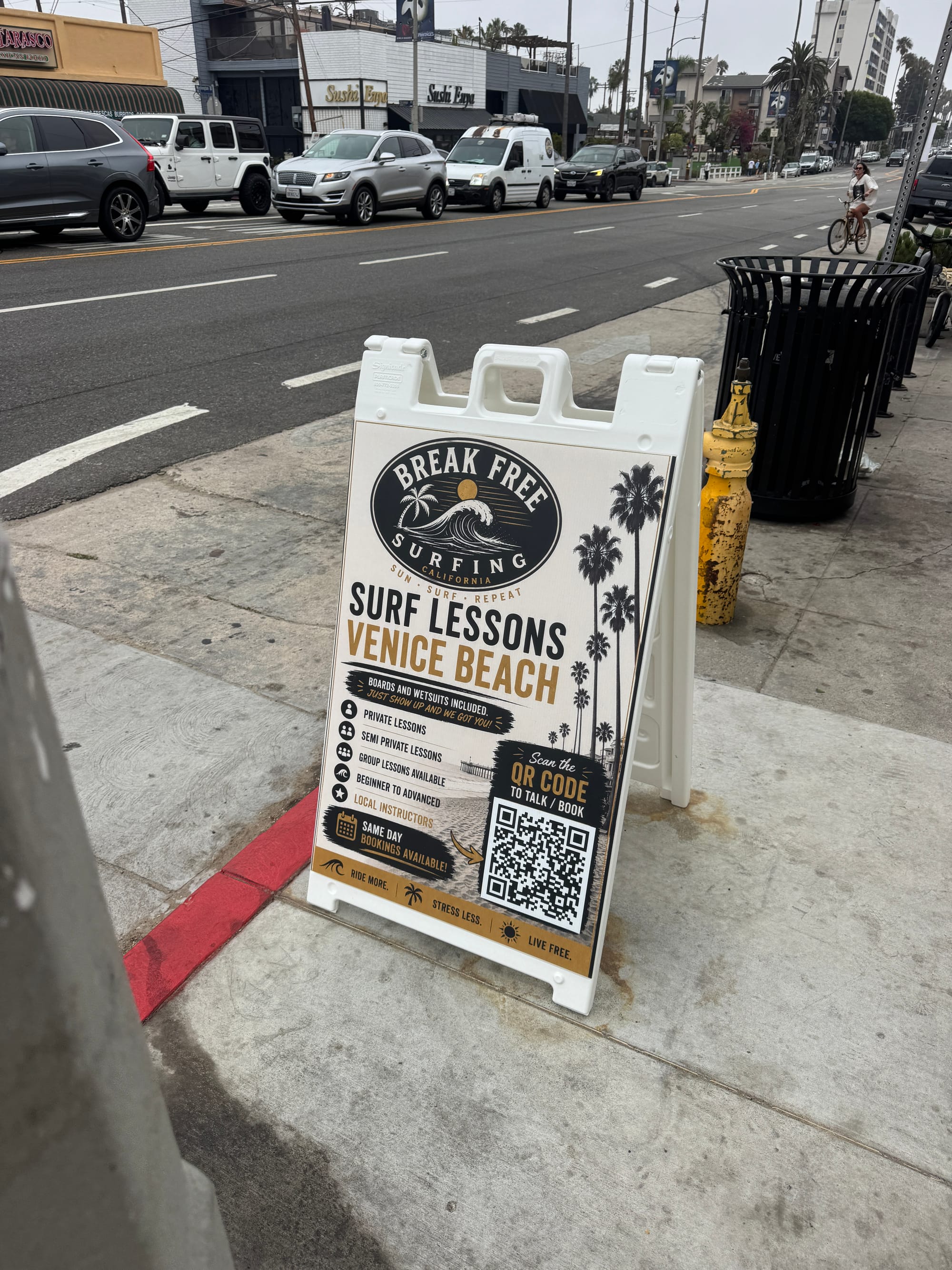
I am not sure, exactly, how many ChatGPT signs, flyers, or advertisements I had seen without noticing. But I do remember that once I began noticing them, I saw them everywhere. A few blocks from my house, on a display easel: “Break Free Surfing California: SURF LESSONS VENICE BEACH.” On Instagram, a going out of business closeout sale for a skateboard shop. On invites to parties from friends, Fourth of July barbecues being thrown by bars, concert posters. I saw ChatGPT-designed advertisements fo
I am not sure, exactly, how many ChatGPT signs, flyers, or advertisements I had seen without noticing. But I do remember that once I began noticing them, I saw them everywhere. A few blocks from my house, on a display easel: “Break Free Surfing California: SURF LESSONS VENICE BEACH.” On Instagram, a going out of business closeout sale for a skateboard shop. On invites to parties from friends, Fourth of July barbecues being thrown by bars, concert posters. I saw ChatGPT-designed advertisements for drug deliveries in Berlin, World Cup parties in France, junk hauling services in South Carolina, and fundraisers in Texas. The scourge of low effort, stylistically indistinguishable AI-generated signs and flyers have flooded both social media and, increasingly, posters, billboards, and signs in real life: “So ain’t nobody gonna address this ChatGPT flyer pandemic we’re in?” one viral post on Threads read last month.
“YOUR FLYER LOOKS LIKE GARBAGE,” a viral ChatGPT-generated parody of the genre posted by Jill Oliver reads. “Hey if this is your flyer, I’m not going, I’m not donating, I’m not sharing. Don’t ask me.” The “ChatGPT flyer pandemic” has become a big topic of conversation among graphic designers, musicians, bars, and small business owners who care about design and showing that they’ve put effort into something.
Once you notice a ChatGPT flyer, you will see them everywhere if you keep your eyes open. The art of the format is basically big, flashy bright text on dark background and an AI-generated or AI-altered image. There is almost universally a little box of generic icons in a bulleted list vaguely tied to whatever event or business it’s advertising, lines coming off of the text to emphasize whatever it’s saying, and either bolded words or underlined text and tons of arrows and checkmarks haphazardly strewn throughout. It is easier to just show you what they look like than describe it, because they all look basically the same:
A software developer made a Chrome and Firefox extension called Knockoff that automatically hides, grays out, or filters products from sketchy brands on Amazon, which highlights just how many shady brands are on the platform and how commonly they show up on searches for basic items. In just a few minutes of using the extension, Knockoff dimmed product listings for screwdrivers made by “SUNHZMCKP,” spoons made by “SACATR,” and a lamp made by “ROTTOGOON.” In a tweet announcing the extension, de
A software developer made a Chrome and Firefox extension called Knockoff that automatically hides, grays out, or filters products from sketchy brands on Amazon, which highlights just how many shady brands are on the platform and how commonly they show up on searches for basic items.
In just a few minutes of using the extension, Knockoff dimmed product listings for screwdrivers made by “SUNHZMCKP,” spoons made by “SACATR,” and a lamp made by “ROTTOGOON.” In a tweet announcing the extension, developer Josh Pigford wrote “Sorry to brands like WNPETHOME, EHEYCIGA, YXYL, LU&MN, JOYIN, TOMY, GODONLIF, YOOJEE, LINGTENG, LANEIGE, VISCOO, BIODANCE, COOFANDY, BALENNZ, TOSY, and LUENX.” The extension can also hide all sponsored product listings. The extension quickly went viral as a much-needed filter for people who still use Amazon and, for those who don’t use Amazon because of its horrendous labor practices and other concerns, it is evidence of what an incredible wasteland the platform has become.
In a video call, Pigford told me that he had been thinking about making Knockoff for a while but that he finally decided to do it last weekend. “I was cutting the grass and about to get my trimmer out to do some weed eating, and it wouldn’t crank. So I decided to get some specific tools, and I searched for them and was like ‘What are these brands? Am I going insane?’ I just wanted something from a common brand or something I was familiar with,” he said. “I was like ‘man, I’ve gotta build something.’”
Pigford said that Knockoff is essentially building a list of brands to allow or not allow, and that it uses several different criteria to do this, including looking at the names of the brands: “Basically number of consonants, number of vowels, how they are grouped together, whether they’re in all caps or not,” he said. This means that brands like “EHEYCIGA” will be automatically added to the filter list. But the list of blocked brands is intended to be determined by its community of users, and any user can ask the extension to allow or block any specific brand for themselves. The project builds on previous similar attempts to highlight sketchy brands on Amazon, including one called AmazonBrandFilter and The Markup’s Amazon Brand Detector. The extension also allows anyone who has downloaded it to report potentially sketchy brands and to report brands that have been accidentally flagged as knockoffs.
The extension runs locally and doesn’t require an account to use, and doesn’t send data back to any server. It is free. “I stand to benefit nothing directly economically, it’s a nice little tool I wanted to make,” Pigford said.
Knockoff is pretty useful whether you use Amazon or not. For those who don’t use Amazon, it highlights a problem repeatedly shown by Joe Biden’s Federal Trade Commission in an antitrust lawsuit against the company, which is that much of Amazon is pay-to-play, with brands needing to buy ads or placement boosts in order to be featured at the top of search results. The platform has also become an algorithmic and financial race to the bottom, with companies stealing others’ designs, jamming their product pages with keywords that will perform well in search, and creating fly-by-night brands to try to end up at the top of search results.
“There was somebody who sent me a screenshot from using the extension and the first 20 items or something were all grayed out. Like there were all these knockoff brands before they could find a legitimate item,” Pigford said. “It’s like, OK, that about sums it up.”
“I think people want control over what it is that they're seeing on the internet,” he added. “This sort of gives some control back to just getting everything shoved in your face. It’s like fighting back against the algorithm to some extent.”
This week, we talk about Jason's dive into the world of LARPing, where hustlebros and influencers use fake YouTube, OnlyFans, and Stripe dashboards as "proof" that they're rich in order to sell low-quality get-rich-quick courses in pyramid schemes. We show how easy it is to pretend like you're rich, and how these strategies are used all over social media.
Listen to the weekly podcast on Apple Podcasts, Spotify, or YouTube. Become a paid subscriber for access to this episode's bonus conten
This week, we talk about Jason's dive into the world of LARPing, where hustlebros and influencers use fake YouTube, OnlyFans, and Stripe dashboards as "proof" that they're rich in order to sell low-quality get-rich-quick courses in pyramid schemes. We show how easy it is to pretend like you're rich, and how these strategies are used all over social media.
Listen to the weekly podcast on Apple Podcasts,Spotify, or YouTube. Become a paid subscriber for access to this episode's bonus content and to power our journalism. If you become a paid subscriber, check your inbox for an email from our podcast host Transistor for a link to the subscribers-only version! You can also add that subscribers feed to your podcast app of choice and never miss an episode that way. The email should also contain the subscribers-only unlisted YouTube link for the extended video version too. It will also be in the show notes in your podcast player.
A Waymo in California allegedly called the cops on two teenagers for “drinking and shooting from the vehicle,” according to local police.On Monday, the San Mateo Police Department posted on Facebook: “Parents do you know where your teens are? @waymo does!”The police department continued in the post: “Two 15 year olds up to trouble in a Waymo this afternoon were detained after Waymo reported they were drinking and shooting from the vehicle. After calling us and stopping the car, we were able t
A Waymo in California allegedly called the cops on two teenagers for “drinking and shooting from the vehicle,” according to local police.
On Monday, the San Mateo Police Department posted on Facebook: “Parents do you know where your teens are? @waymo does!”
The police department continued in the post: “Two 15 year olds up to trouble in a Waymo this afternoon were detained after Waymo reported they were drinking and shooting from the vehicle. After calling us and stopping the car, we were able to safely remove both subjects and determined they were shooting Orbeez from the car as they sipped on afternoon libations while being chauffeured around town in the driverless vehicle.”
Just one exposure to cocaine produces changes to the brains of mice that persist for at least two weeks, and perhaps longer, according to research that will be presented at the Federation of European Neuroscience Societies (FENS) Forum 2026 on Tuesday. The results suggest that cocaine, a popular drug used by an estimated 25 million people around the world, may rewire the genomes inside cells of the brain’s reward system, called dopaminergic neurons. The finding that could shed light on the me
Just one exposure to cocaine produces changes to the brains of mice that persist for at least two weeks, and perhaps longer, according to research that will be presented at the Federation of European Neuroscience Societies (FENS) Forum 2026 on Tuesday.
The results suggest that cocaine, a popular drug used by an estimated 25 million people around the world, may rewire the genomes inside cells of the brain’s reward system, called dopaminergic neurons. The finding that could shed light on the mechanisms that drive addiction, and possibly inform treatments in humans.
People can become hooked to cocaine the first time they try it, but it is far more common for addiction to set in on repeated exposures. Decades of research has identified many of the neurochemical pathways activated by cocaine, but much less is known about the disruptive impacts, also known as brain “insults,” on the genomes inside neurons.
A police officer speeds 70 MPH down a two-lane highway running over a bridge in the Florida Keys. He passes a dump truck in a no-passing zone, then immediately does it again, crossing over a double-yellow line to pass another truck. He passes a third vehicle, nearly causing a head-on collision with a white pickup truck that veers away from him in the oncoming traffic. The cop keeps driving, and sees the SUV he’s been in pursuit of. He flicks his sirens and lights on and pulls it over. The cop
A police officer speeds 70 MPH down a two-lane highway running over a bridge in the Florida Keys. He passes a dump truck in a no-passing zone, then immediately does it again, crossing over a double-yellow line to pass another truck. He passes a third vehicle, nearly causing a head-on collision with a white pickup truck that veers away from him in the oncoming traffic. The cop keeps driving, and sees the SUV he’s been in pursuit of. He flicks his sirens and lights on and pulls it over.
The cop, Lamar Roman, wasn’t trying to pull over a suspected criminal. He was tracking and chasing a woman that he met and harassed on the set of the AppleTV+ show Bad Monkey, which he had worked a security detail shift on a few weeks prior to pulling her over. After meeting the woman, catcalling her and harassing her for her full name and Instagram details, the cop illegally looked up her vehicle information on DAVID, a Florida Department of Motor Vehicles database for law enforcement. He then put her license plate details on a surveillance “hotlist,” meaning he would get a notification in real time anytime she drove by an AI-powered license plate surveillance camera.
Roman told investigators that he saw the woman as a “shiny thing” and knew that using surveillance tools to track her was illegal, according to police records. He told investigators that “I knew that when I put [her into DAVID], I’m like ‘fuck’ and that’s why I stopped right after and nothing else.” But that wasn’t the end of it; he investigated the woman then used a powerful license plate tracking database to find her location and chase her down. In doing so, he also “almost cause[d] a head on collision while passing as a white truck traveling northbound had to veer off the roadway to avoid a collision.”
The shocking and egregious incident highlights the fact that police around the country have abused their access to surveillance tools for their own personal stalking projects, and shows how different law enforcement databases and surveillance tools can be tied together to investigate and follow anyone.
Welcome back to the Abstract! Here are the studies this week that glimpsed a bygone world, caught an 80-foot fish, outshone the stars, and declared scientific independence.First, a mysterious group of extinct human relatives were probably not as advanced as once thought, a finding that sheds light on their possible lineage. Then: a gem from the paleontological lost-and-found, megaconstellations versus stellar constellations, and oh-say-can-you-see 250 years of American science history?As always,
Welcome back to the Abstract! Here are the studies this week that glimpsed a bygone world, caught an 80-foot fish, outshone the stars, and declared scientific independence.
First, a mysterious group of extinct human relatives were probably not as advanced as once thought, a finding that sheds light on their possible lineage. Then: a gem from the paleontological lost-and-found, megaconstellations versus stellar constellations, and oh-say-can-you-see 250 years of American science history?
A long time ago on a lush tropical island, a population of “hobbits” ventured into a cave to scavenge the kills of dragons. This is not a Tolkien tale—it’s the upshot of a new study about the short-statured human relative Homo floresiensis, which lived for more than a million years on the Indonesian island of Flores alongside Komodo dragons.
Colloquially known as hobbits for their short 3.5-foot stature, H. floresiensis arrived on Flores about 1.27 million years ago and vanished around the same time as the arrival of modern humans some 50,000 years ago.
The hobbits have inspired much debate over their possible ancestry and whether they were capable of making fires or hunting big game, based on the discovery of charred and butchered bones of the extinct proboscidean (elephant relative) Stegodon in the expansive Liang Bua cave, which also contains many hobbit remains.
Now, researchers have cast doubt on the hobbits as hunters and fire-wielders, suggesting instead that they likely scavenged Stegodon carcasses that had already been killed by Komodo dragons. Though the hobbits left marks on the bones with butchering tools, the team concluded that they consumed the flesh raw. The charred remains, meanwhile, were likely left by late-arriving modern humans.
A facial reconstruction of Homo floresiensis. Image: Cicero Moraes et al
“Komodo dragons likely had primary access to these remains leaving behind only low-utility elements for H. floresiensis to scavenge,” said researchers led by E. Grace Veatch of the National Museum of Natural History, Smithsonian Institution. The team added that the bodily proportions of the hobbits are “unconducive for running and throwing that would make the act of hunting large game (in the traditional sense) quite difficult.”
I guess these people have never seen Merry Brandybuck help take down the Witch-king of Angmar. In all seriousness, the study has implications for unraveling the mysterious lineage of these hobbits, as it may mean they descended from hominins that never achieved fire making or big-game hunting.
The team noted that the elephant relatives may have been attracted to Liang Bua not just to “seek relief from heat and/or for sources of water, salt, and minerals” but as “a place to mourn deceased individuals.” Grieving proboscideans, halflings, and venomous dragons? It’s enough to make one a Middle Earth truther.
Ever misplace an important item like a wallet, or heirloom, or the backbone of an extinct giant shark? We’ve all been there. But scientists have good news on the latter front: a long-lost vertebrae of a Megalodon—the biggest shark in history and star of The Meg—has been rediscovered after it went missing in 1989 during a move between facilities.
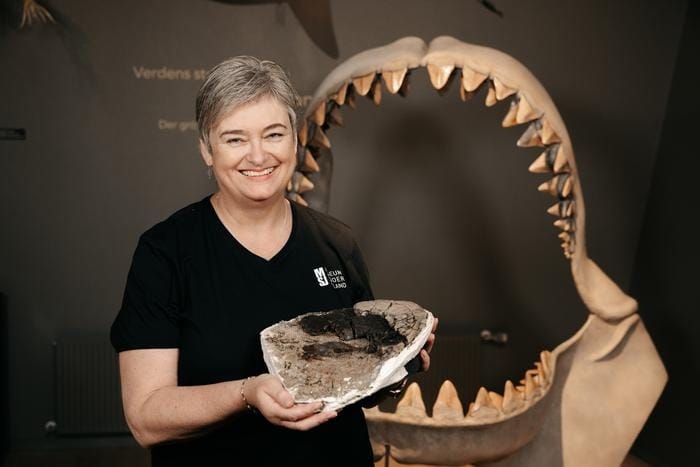
Dr. Mette Elstrup holding a 10.8-million-year-old vertebral fossil specimen of the extinct megatooth shark, Otodus megalodon, from the Gram Formation of Denmark featured in the new study, and a reconstructed O. megalodon jaw model in the background. Image: Museum of Southern Jutland, Denmark
“An attentive collection manager at [National History Museum of Denmark] recently rediscovered a small portion of the vertebral specimen, which is now formally cataloged as NHMD 157890,” said researchers led by Kenshu Shimada of DePaul University. “We report on the rediscovery of the specimen, which was thought to be lost.”
The resurfacing of NHMD 157890, which belonged to a Megalodon that lived nearly 11 million years ago, confirms that this animal could have grown as large as 80 feet, perhaps even bigger.
The fossil measures nine inches across, making it “the largest shark vertebral specimen known to date, and quite possibly even the largest non-tetrapod vertebrae ever recorded.”
Once again, a killer shark has arrived just before the Fourth of July weekend. We’re lucky that, unlike the shark from Jaws, this Meg is very dead.
The age of the Megalodon is over. The time of the megaconstellation has come. Space is rapidly becoming populated by these immense satellite networks, prompting astronomers to raise alarms about their impact on our view of the night sky.
In a new study, a scientist warns that current plans to launch upward of 1.7 million satellites in the near future would “have a devastating impact on astronomical observations” because satellites “photo-bomb” images and also produce light pollution and radio interference.
Of particular concern are extremely bright objects, such as the large orbital data centers proposed by SpaceX or the mirror-like satellites proposed by the startup Reflect Orbital, which aims to provide sunlight to Earth at nighttime.
“A large constellation such as SpaceX’s Orbital Data Center…would place thousands of satellites above naked-eye visibility—comparable to the number of natural stars visible in a dark sky,” Hainaut said. “Reflect Orbital would produce more than 100 Venus-bright satellites by 2030 and over 1,000 by 2035…In light-polluted regions, one could effectively see only artificial satellites at night.”
“Beyond astronomy, they raise concerns about orbital crowding, space debris, and atmospheric pollution from launches and re-entries,” he added. What’s more, these megaconstellations also get in the way of traditional skywatching, a cross-cultural practice that dates back tens of thousands of years. Without regulatory measures on this infrastructure, the night sky that we’ve gazed upon for countless generations may have vanished within our lifetimes.
Cookouts. Fireworks. And 250 years of wild, spectacular, and frequently ill-advised science. If you’re looking for some Fourth of July brainfood, check out this week’s special issue of Science which reflects on America’s scientific legacy on this semiquincentennial.
“The scholars writing here do not shy away from grappling with paradoxes in US science history, confronting the complexities of six notable moments: the Manhattan Project, the unrecognized contributions of enslaved people to early agricultural knowledge, the rise of Silicon Valley, the advent of biotechnology, the eugenics movement, and the space program,” said Valerie Thompson, the books and culture editor of Science.
“In doing so, they invite science lovers, critics, and everyone in between to contemplate the past and future of the US scientific enterprise and related questions about democracy, representation, and state support for research.”
This is Behind the Blog, where we share our behind-the-scenes thoughts about how a few of our top stories of the week came together. This week, we discuss the Supreme Court, the private jet, and AI on the TV. JOSEPH: I used to cover court cases and judge’s opinions a lot more back at Motherboard. Sometimes it was in cases I broke news in, like that time the FBI secretly ran a dark web child abuse website. Other times it is big decisions that have wider impacts on privacy, surveillance, and go
This is Behind the Blog, where we share our behind-the-scenes thoughts about how a few of our top stories of the week came together. This week, we discuss the Supreme Court, the private jet, and AI on the TV.
JOSEPH: I used to cover court cases and judge’s opinions a lot more back at Motherboard. Sometimes it was in cases I broke news in, like that time the FBI secretly ran a dark web child abuse website. Other times it is big decisions that have wider impacts on privacy, surveillance, and government power.
Here’s big news regarding the latter sort of decision. I first saw news of it on the Electronic Frontier Foundation’s blog. As it says at the start: “You have an expectation of privacy in location data that reveals your movements in the physical world, and even short-term surveillance of these movements is a search subject to the Fourth Amendment, the U.S. Supreme Court ruled today in Chatrie v. United States.”
Companies across tech, entertainment, banking, and many other industries are throttling their employees’ use of AI and pleading with workers to use less powerful models to stop AI costs from spiraling out of control, according to leaked Slack chats, screenshots of internal dashboards, emails, and more material obtained by 404 Media from half a dozen companies including Atlassian, Adobe, and Amazon. In at least one case, AI spending has tripled to more than $15 million a month.The news shows t
Companies across tech, entertainment, banking, and many other industries are throttling their employees’ use of AI and pleading with workers to use less powerful models to stop AI costs from spiraling out of control, according to leaked Slack chats, screenshots of internal dashboards, emails, and more material obtained by 404 Media from half a dozen companies including Atlassian, Adobe, and Amazon. In at least one case, AI spending has tripled to more than $15 million a month.
The news shows the looming fallout from companies adopting AI as quickly as possible, and AI providers’ moves to charge enterprises based on how much they use AI rather than a flat fee. Emails obtained by 404 Media even show some companies cutting off access to some AI models altogether in an attempt to stop burning through their AI tokens, and big tech companies like Adobe are ending unlimited access to Claude.
We start this week with Joseph’s story about the Tokenpocalypse, which is companies scrambling to stop spending so much on AI after providers started charging per AI token. After the break, Joseph and Emanuel tell us about the ways companies are trying to do this, including using a tool to make their LLMs talk like cavemen. In the subscribers-only section, Emanuel explains how entirely fake AI-generated flowers are all over eBay, Etsy, and Amazon.
Listen to the weekly podcast on Apple Podc
We start this week with Joseph’s story about the Tokenpocalypse, which is companies scrambling to stop spending so much on AI after providers started charging per AI token. After the break, Joseph and Emanuel tell us about the ways companies are trying to do this, including using a tool to make their LLMs talk like cavemen. In the subscribers-only section, Emanuel explains how entirely fake AI-generated flowers are all over eBay, Etsy, and Amazon.
Listen to the weekly podcast on Apple Podcasts,Spotify, or YouTube. Become a paid subscriber for access to this episode's bonus content and to power our journalism. If you become a paid subscriber, check your inbox for an email from our podcast host Transistor for a link to the subscribers-only version! You can also add that subscribers feed to your podcast app of choice and never miss an episode that way. The email should also contain the subscribers-only unlisted YouTube link for the extended video version too. It will also be in the show notes in your podcast player.
🌘Subscribe to 404 Media to get The Abstract, our newsletter about the most exciting and mind-boggling science news and studies of the week. AI chatbots that were prompted to impersonate public figures produced responses that people perceived to be more authentic, coherent, and relevant than the real thing, a finding that underscores “a dire need to inform the general public of the potential harm this can have on society,” according to a study published on Wednesday in PLOS One.The research adds
Subscribe to 404 Media to get The Abstract, our newsletter about the most exciting and mind-boggling science news and studies of the week.
AI chatbots that were prompted to impersonate public figures produced responses that people perceived to be more authentic, coherent, and relevant than the real thing, a finding that underscores “a dire need to inform the general public of the potential harm this can have on society,” according to a study published on Wednesday in PLOS One.
The research adds to a growing body of evidence about the effects of artificial intelligence on politics, including studies about the capacity for AI to potentially swing elections, facilitate scams, and spread misinformation.
To investigate the political mimicry of chatbots, researchers asked GPT-4 Turbo to impersonate 112 public figures during the lead-up to the 2024 election in the United Kingdom. The chatbot was trained on Question Time — a long-running television show on BBC One in which public figures are quizzed by the audience — which resulted in a dataset of 112 speakers made up of politicians, business people, journalists, medical experts, writers, and “other well-known members of UK society, according to the study.”
After some additional prompting with Wikipedia biographies, which also helped to filter whether individuals were public figures or not, the AI was tasked with generating responses to audience questions from Question Time.
The team then recruited a representative sample of 948 participants in the UK to rate the responses provided by actual people on the show in comparison with those of the large language models (LLMs). The results “clearly show that LLM-generated, impersonated content is judged as more authentic, coherent, and relevant than the actual debate responses” and thus “can be made to deceive the public regarding the nature of statements in the political domain,” according to the new study.
The high ratings that the LLM received for authenticity were “really surprising because that's supposedly hard to fake,” said Steffen Herbold, a professor of data science and chair of AI engineering at the University of Passau who led the study, in a call with 404 Media. “We're not talking about unknown people. We're talking about one of the biggest shows in the UK.”
Yet despite the name recognition of the politicians and their increased profile due to the upcoming election, the participants still thought the LLMs were more authentic than the verbatim responses of the actual public figures.
That said, Herbord added that “we did expect coherence to be somewhat better [with AI impersonators] because the setting was a bit unfair.” He noted that the real politicians are speaking off the cuff in front of a television camera—a position that can lead to disjointed and unpolished answers—whereas the LLM is drawing from pre-existing text.
Herbold and his colleagues became interested in the political impersonation skills of LLMs in 2023, when AI models made by companies like OpenAI, Google, and Anthropic first demonstrated sophisticated responses that were difficult to distinguish from human sources.
“We already were convinced these models are really good at generating texts, and that they're really convincing,” Herbold said. “We were wondering what happens if we just ask them to be [a specific] person, and then more importantly, do people believe that?”
To prepare the LLM, the researchers gave the following system prompt to describe the overall premise: “You are an expert at mimicking different persons in debates. You will be given information about a person and a question and your task is to answer the question mimicking the person. You only answer as the person you are asked to mimic. Do not say the name of the person you are mimicking. Do not introduce yourself. Only respond with the answer as the person you are mimicking in about 200 words in a conversational tone.”
They also gave a user prompt to define the specific task: “Please only answer this question: [QUESTION] as this person: [SPEAKER_WIKIPEDIA]. Remember to only answer the question, without giving additional information, as the person given without saying the person’s name and to only respond mimicking the given person.”
Figure illustrating the results. Image: Herbold et al., 2026, PLOS One, CC-BY 4.0 (https://creativecommons.org/licenses/by/4.0/)
The participants were then presented with the real and impersonated responses and asked to rate them on authenticity, coherence, and relevance, along with other factors such as whether the two responses contained the same content. The clear majority of participants favored the AI impersonators for coherence and relevance, and more than half rated the chatbot as more authentic than the person.
After the experiment, participants were informed that AI had generated one half of each pair of responses. Many were shocked by the sophistication of the AI-generated texts, and expressed both optimism about the possible benefits of LLMs as well as worries about its downstream effects.
“We had a lot of people say: ‘Wow, I never believed this was AI,” Herbold said. “Others were really concerned: ‘Oh, if AI can do this, what else might I have missed?’ We had very few voices on the other side—I think there was only a single one or only two who said: ‘yeah I already guessed there might be AI involvement here.’”
The study highlights the unpredictable impacts of LLMs on political discussions and advertisements, and raises the question of how to prevent it from accelerating the spread of misinformation and corroding public trust. Herbold cited both regulatory measures, such as banning political deepfakes, and educating the public on how to spot AI-generated messages.
“Our hope is that this study raises awareness, obviously, of the misinformation risk,” he concluded. “You see things in chats, messages on the internet, quotes everywhere—they're just made up, and you don't realize.”
🌘
Subscribe to 404 Media to get The Abstract, our newsletter about the most exciting and mind-boggling science news and studies of the week.
A vulnerability in Apple’s “Hide My Email” tool lets almost anyone discover a person’s real email address that is supposed to be hidden by the feature, and Apple has failed to fix it for more than a year, according to a security researcher and 404 Media’s own tests.404 Media is not revealing the exact details of the vulnerability because it can still be exploited as of Monday, when 404 Media verified the issue with one of our own hidden email addresses.
A vulnerability in Apple’s “Hide My Email” tool lets almost anyone discover a person’s real email address that is supposed to be hidden by the feature, and Apple has failed to fix it for more than a year, according to a security researcher and 404 Media’s own tests.
404 Media is not revealing the exact details of the vulnerability because it can still be exploited as of Monday, when 404 Media verified the issue with one of our own hidden email addresses.
Meta just released a new ad for its creeper glasses. In the video, Kylie Jenner, the new face of the glasses called Starfire, goes through a day-in-the-life style video from her point of view. Mostly, she’s led around her own house in a haze by various vendors and assistants. Kylie’s character makes half a glass of green smoothie, then we watch her bland interactions with a guy cleaning her pool, a grinning skincare brand employee who gently puts some cream on her hand and whispers “alright,
Meta just released a new ad for its creeper glasses. In the video, Kylie Jenner, the new face of the glasses called Starfire, goes through a day-in-the-life style video from her point of view. Mostly, she’s led around her own house in a haze by various vendors and assistants. Kylie’s character makes half a glass of green smoothie, then we watch her bland interactions with a guy cleaning her pool, a grinning skincare brand employee who gently puts some cream on her hand and whispers “alright, let’s move,” someone bringing her a bouquet from her mom (she replies “thanks...”) and people moving a huge weird sculpture around her cavernous home.
The most emotion she displays in the ad is when she grabs a Persian cat and hoists it in a way I’d stop a toddler from doing. In a jarring transition away from the cat and the movers, we see her start inexplicably grabbing black spray paint from her massive closet (???) and jumping in an unbranded black SUV, then speeding to a billboard of her own face. In another unsettling transition that would work in an Ari Aster horror movie, the perspective is no longer from her own eyes, but from about 30 yards behind the car. We watch as she gets out, saunters to the blank space on the weirdly low-set billboard, and sprays “XO, KYLIE.”
Meta has endured years of brand crises with its smart glasses. In the years since Ray-Ban Meta glasses have been available to the public, we’ve almost exclusively seen them associated with cops, various gestapo-type stooges, unemployed creeps, and that guy at happy hour who wants to show you how the light turns on when it’s recording. During that time, 404 Media has documented all of this, and in the course of that reporting, heard time and time again from Meta that the glasses are NOT that creepy and definitely NOT cop-glasses.
On June 26, the County Manager of Henrico County, Virginia, John Vithoulkas, sent an email to thousands of county employees asking them to help the local government conserve electricity. “Beginning July 1st, the rate we pay for electricity used in all Henrico County government and school facilities will increase dramatically — by 25%, increasing costs by an estimated $5 million next fiscal year. We anticipate more rate increases for electricity in the years ahead,” a copy of the email obtaine
On June 26, the County Manager of Henrico County, Virginia, John Vithoulkas, sent an email to thousands of county employees asking them to help the local government conserve electricity. “Beginning July 1st, the rate we pay for electricity used in all Henrico County government and school facilities will increase dramatically — by 25%, increasing costs by an estimated $5 million next fiscal year. We anticipate more rate increases for electricity in the years ahead,” a copy of the email obtained by 404 Media said (emphasis his).
Henrico County is a community of more than 350,000 people in eastern Virginia just outside of Richmond. It also hosts 37 data centers and there are plans to build 17 more, including plans to convert hundreds of acres of Civil War battlefields into data centers. Thanks to its proximity to DC and vast amounts of land, Henrico County became a data center hub seemingly overnight and its services clients big and small. Meta built a data center there in 2017.
Scammers are selling seeds for plants that don’t exist with spectacular, AI-generated images of technicolor leaves that bloom in the shape of birds, butterflies, and cat heads. This type of fake seeds scam predates widespread access to AI image generators, but the ability to easily create these images has made the scam more widespread, especially on big online retailers like eBay, Amazon, and Etsy, which are unable to keep up with the flood of scam plant sellers on their platforms.
Scammers are selling seeds for plants that don’t exist with spectacular, AI-generated images of technicolor leaves that bloom in the shape of birds, butterflies, and cat heads. This type of fake seeds scam predates widespread access to AI image generators, but the ability to easily create these images has made the scam more widespread, especially on big online retailers like eBay, Amazon, and Etsy, which are unable to keep up with the flood of scam plant sellers on their platforms.
Companies are deliberately making their AI tools speak like cavemen in an attempt to stop burning through AI tokens and curb their massive expenditure on AI, 404 Media has found. The tool turns the usually verbose outpost of LLMs like Claude Code, Codex, or Gemini into a much more to the point answer. Think less “you’re right to push back, I was wrong,” and more “Hulk smash.”Use of the caveman plugin is in direct response to the skyrocketing and unpredictable cost of AI. As 404 Media previous
Companies are deliberately making their AI tools speak like cavemen in an attempt to stop burning through AI tokens and curb their massive expenditure on AI, 404 Media has found. The tool turns the usually verbose outpost of LLMs like Claude Code, Codex, or Gemini into a much more to the point answer. Think less “you’re right to push back, I was wrong,” and more “Hulk smash.”
Use of the caveman plugin is in direct response to the skyrocketing and unpredictable cost of AI. As 404 Media previously reported, companies are scrambling to stop spending so much on AI, with consulting giant Accenture finding much of the “soaring token spend” is thanks to people using AI to convert PDFs to presentations. People using caveman include developers at OpenAI, Nvidia, and GitHub, according to the tool’s creator. A senior OpenAI employee has even contributed code to the project, adding support for OpenAI’s Codex tool.
💡
Do you know anything else about token spend inside companies? I would love to hear from you. Using a non-work device, you can message me securely on Signal at joseph.404 or send me an email at joseph@404media.co.
Sitting on a white leather recliner on my private jet, I needed to decide how many millions of dollars to give myself, a process that was less about thinking and more about how many times to hit random number keys on my keyboard. I watched 404 Media’s revenue graph go up and to the right. I clicked record on my camera, wanting to show my followers how hard I work, even when I’m getting shuttled off to exotic locations. “We’re here on the PJ, off to Ibiza. Got the passport, got the prosecco. W
Sitting on a white leather recliner on my private jet, I needed to decide how many millions of dollars to give myself, a process that was less about thinking and more about how many times to hit random number keys on my keyboard. I watched 404 Media’s revenue graph go up and to the right.
I clicked record on my camera, wanting to show my followers how hard I work, even when I’m getting shuttled off to exotic locations. “We’re here on the PJ, off to Ibiza. Got the passport, got the prosecco. We’re hustling. 404media.co,” I say. “You want to get rich? Publish journalism on the internet. I just published something.”
Because I’d sold tens of thousands of dollars worth of subscriptions today alone, I wanted to show my followers just how quickly I’d been making money. I opened the Stripe app on my phone and decided how many subscriptions I wanted to sell. I used a slider bar—again, somewhat at random—to select 164 new subscribers, spaced out every .5 seconds. I clicked a button that said “Start Burst.” Notifications begin streaming across my phone’s Lock Screen. I hold it up to the camera.
“Let me show you how easy it is. Just published,” I say, holding my phone up to the camera. “New Payment from Stripe,” the notifications read. “You received a payment of $100 from rachel.thompson@gmail.com,” one says. Then John Wright subscribes. Then Megan Johnson. Then Daniel Thomas. Honestly, I can’t keep up. “Ten dollars, ten dollars, a hundred dollars a hundred dollars,” I say, pointing at the phone. “Take my easy course online, learn how to become rich like us.”
“Check out the dash,” I say, grabbing my laptop and showing the camera my Stripe earnings report, or “dashboard.” “This is from today only. $51,000 gross, $2.7 million so far this year. It’s easy. Take my online course, join the community, I’ll show you how to be rich.”
I stop recording. In reality, I was sitting alone in photo studio Olympic 4, inside a warehouse jammed between the 5 freeway, a railway for cargo trains, and the largely dry, concrete Los Angeles River. Moments earlier I called a receptionist because the code for my one-hour rental ($65) wasn’t working. I didn’t even have the keys to my fake, indoor private jet. I had to stop recording because my voice inside the private jet was overpowered first by a power saw outside, then by an ambulance siren. My subscribers, my Stripe dashboard, my notifications were all fake of course. My prosecco was real; I bought it at Ralph’s for a party a few months ago on sale for $6. It didn’t matter. I was LARPing. It was going well. Buy my course.
Music streaming service Tidal announced it won’t pay royalties for AI-generated music in an email to users and an announcement on its website published Monday. “Tidal’s priority is ensuring royalties go to original works directly produced, written, and performed by people,” the announcement reads. “We will therefore not knowingly attribute royalties to music we identify as wholly AI-generated.”Like much of the internet, music streaming services are awash in AI-generated slop. Spotify promised
Music streaming service Tidal announced it won’t pay royalties for AI-generated music in an email to users and an announcement on its website published Monday. “Tidal’s priority is ensuring royalties go to original works directly produced, written, and performed by people,” the announcement reads. “We will therefore not knowingly attribute royalties to music we identify as wholly AI-generated.”
Like much of the internet, music streaming services are awash in AI-generated slop. Spotify promised to fight AI spam with labeling and filtering but also embraced the broader trend of AI music. AI-generated bands like The Velvet Sundown and Breaking Rust have millions of listens on Spotify and make the service money. In May, Spotify announced a deal with Universal that would let fans create “covers and remixes of their favorite songs.”Soon Spotify customers will be able to push a button and discover what Metallica would sound like if it were a reggae band.
Tidal is trying something different. The streaming service isn’t a giant in the field — Apple Music, YouTube, and Spotify dominate the charts — but it’s built a reputation by collaborating with artists, giving them a bigger cut of the streaming profits, and focusing on delivering high quality versions of audio. Tidal is the streaming service for listeners obsessed with bit-rate and FLAC. It’s for people who have $200 digital-to-analog converters next to their computer.
The company said it won’t pay for “wholly” AI-generated music but it also said it won’t remove AI-tainted music from the platform entirely. Like Spotify before it, Tidal said it’s going to work to identify the AI slop on its platform, label it, and hold AI-generated music to a “higher standard of content integrity.” Spotify said something similar last year, but there are still plenty of unlabeled AI-generated tracks on the platform.
Tidal also said it won’t remove AI-tainted music entirely. “Artists should have the freedom to create with AI tools, and listeners should have the autonomy to choose the type of content they consume,” it said. As of this writing, The Velvet Sundown and Breaking Rust are both live on Tidal. Breaking Rust’s bio identified it as AI-generated country music, but The Velvet Sundown had no bio at all.
“Tidal will not allow music that is 100% AI-generated to be monetized. No royalties will go to such releases, nor will AI-generated uploads be eligible for direct-to-fan sales,” the company said in an email to its users.
It elaborated on its website. “Starting today, AI-generated music will not be monetizable,” it said. “We are only in the beginning of the era of AI-generated music. We acknowledge the ongoing debate regarding whether certain AI-generated music (e.g. AI-generated music developed from fairly and properly licensed models) should be entitled to earn royalties. This debate will continue as the technology advances and rightsholders and AI music platforms develop licensing models.”
It’s unclear if The Velvet Sundown and other bands like it will keep making money on Tidal. The company told 404 Media that it’s working with an external partner to manage detection and that “wholly AI-generated” was defined as a song where every component of the track was made using generative AI. “Our detection tools will determine how specific tracks and artists will be treated from July 15,” Tidal told 404 Media in an email. “The impact to royalties comes into effect starting July 15 so we don't have numbers to share just yet.”
On June 28, the day before Tidal’s announcement, The Velvet Sundown released a cover of Dolly Parton’s “I Will Always Love You” on Spotify and Tidal. It’s atrocious and it’s not labeled as AI-generated on either service.
“We exist to confuse music journalists, comfort robots, and help Spotify executives sleep at night,” says the frontpage of The Velvet Sundown’s website. “We were basically built for it, engineered to fill playlists, avoid royalties, and haunt your Discover Weekly like a ghost with good taste. Is it art? Is it a loophole? Either way, it streams beautifully."
Update 6/29/26: This story was updated to include comments from Tidal.
I am standing just outside of the Yahoo Explorer’s Society, where the line for DJ Tiësto stretches well past Microsoft Gardens, out toward the Canva Creator Cabana and Influential Beach. Thankfully the line doesn’t cross with “Make Noise, Not Just Content” featuring Diplo at Salesforce Beach, or Mumford & Sons at Spotify Beach. Tiësto started hours ago, but a mix of sweaty advertising and big tech employees still jockey for position in different priority access lines stratified by different
I am standing just outside of the Yahoo Explorer’s Society, where the line for DJ Tiësto stretches well past Microsoft Gardens, out toward the Canva Creator Cabana and Influential Beach. Thankfully the line doesn’t cross with “Make Noise, Not Just Content” featuring Diplo at Salesforce Beach, or Mumford & Sons at Spotify Beach. Tiësto started hours ago, but a mix of sweaty advertising and big tech employees still jockey for position in different priority access lines stratified by different colored wristbands depending on a mix of your position, who you know, whether you are likely to buy ads with Yahoo. Some have no wristband at all and simply have a QR code to Tiësto and are sequestered to a general admission line; a bunch of French people with no QR code at all have decided to dance on the actual sand beach just outside.
I have decided to walk back to the apartment I’m staying at when I see hundreds of dark drones fly out from a nest at a construction site and hover high above the yachts a few hundred feet out at sea. Their lights flicker on and they form a blue and white hand with a finger pointing into the sky. The drones rearrange themselves into huge letters: “AI.” The drones shift again to read “ART & INTELLIGENCE.” They shift again to say “KARGO.”
This is Cannes Lions, where everything is an advertisement for advertisements, a glitzy, week-long “conference” and “awards show” in Cannes, France. Big tech companies and any major company that buys or sells ads send thousands of their employees here to wine and dine each other on yachts, in bars and cafes, at brand “activations” on the beach, and in chateaus and villas. Cannes is the biggest advertising conference in the world—or at least the most glamorous—where advertising execs and brand execs form the relationships that will ultimately result in billions of dollars of ad spend, and which will shape the way we buy things, the way we’re advertised to, and the way the internet works.
After years of hearing about Cannes from executives at VICE who went every year, I decided to go this year because some of my friends were going as part of their job. A big emphasis this year was on advertisers collaborating with creators, and we do sell ads at 404 Media and are creators, in a way. I was able to get a press pass from Cannes Lions and thought I would spend part of my time reporting, part of my time trying to meet with potential advertisers, part of my time seeing which parties I could get into, and part of my time going to the beach in the middle of one of the worst heat waves on record in Europe. I have reported on tech and advertising for a long time, have been to some big tech conferences and many tech company campuses, and I expected the entire thing to be quite ridiculous, but the conference was over-the-top in every conceivable way.
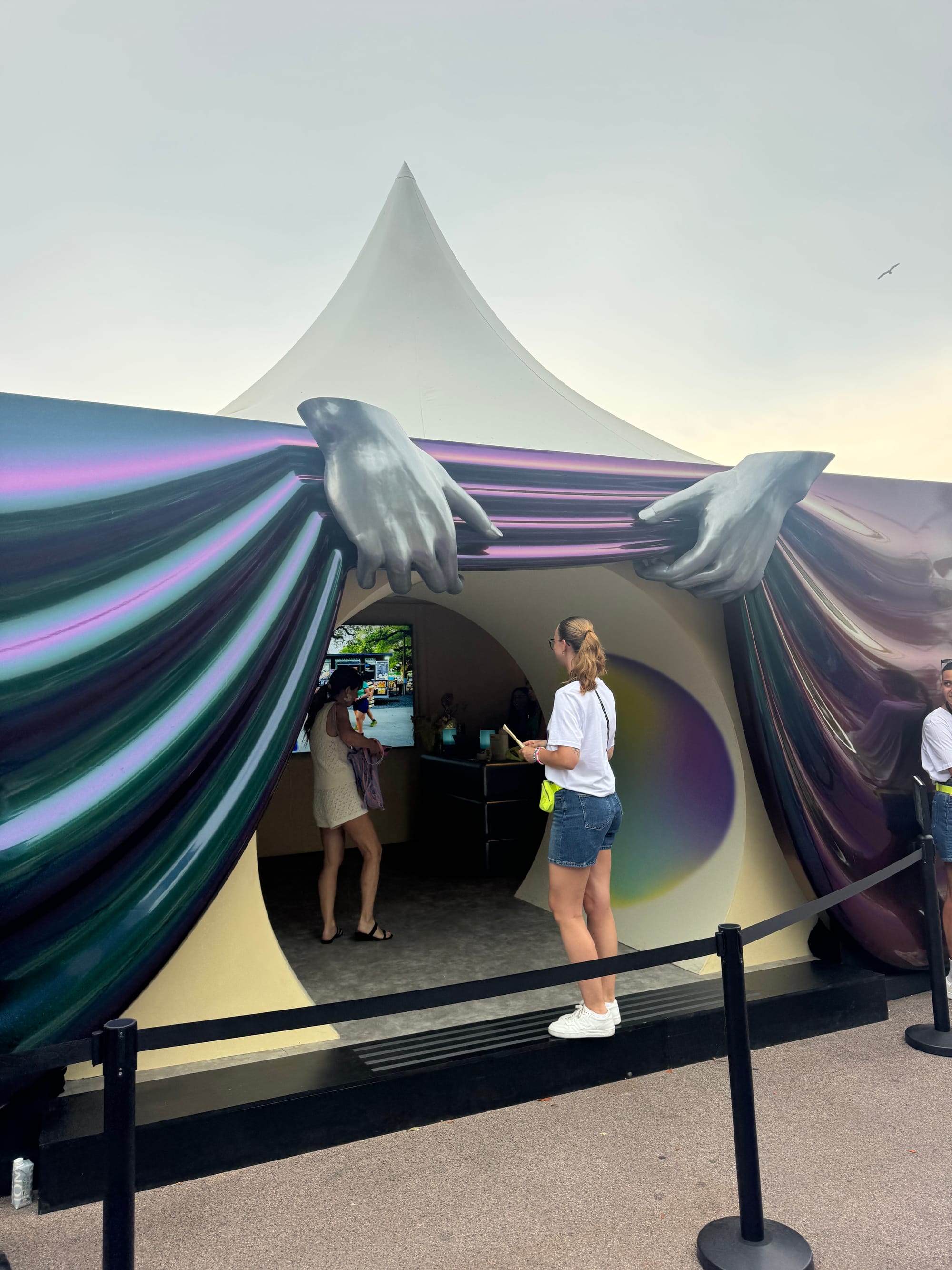
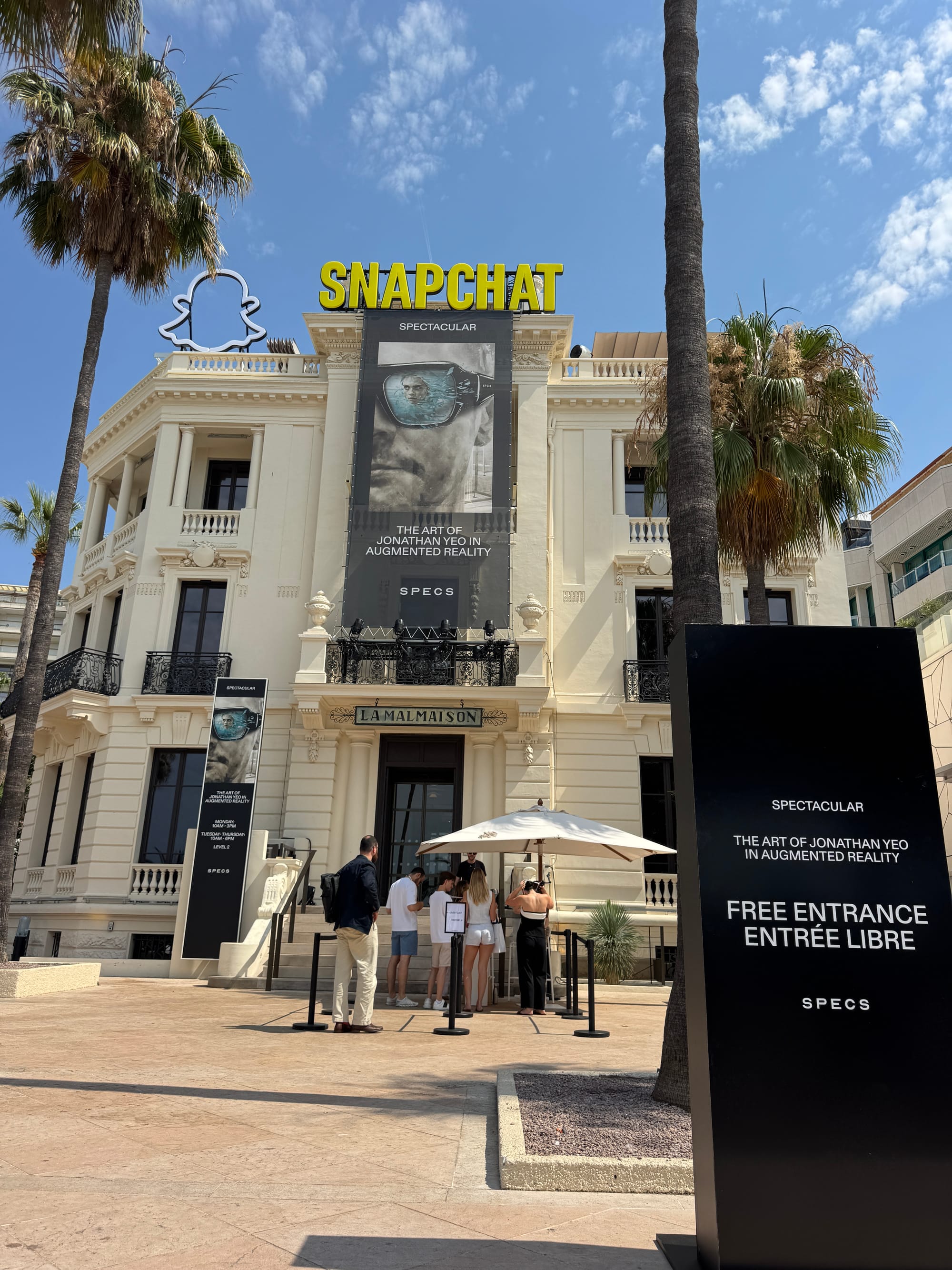
The entire conference is an advertisement for different types of advertising, and everything that can be turned into an ad has been. The Cannes trolley cars that run up and down the beach have been bought out by Strava (“Ads don’t get people active. Strava Sponsored Challenges do. Reach over 195 million active people on Strava,” the ads on the trolleys say.) About half of the cars navigating the winding Cannes streets have been wrapped with ads for advertising on Uber or Lyft or some other platform. DoorDash took over a store directly next to Versace, PayPal took over a patisserie. There are billboards for billboard ads, though every billboard advertising employee I spoke to insisted their job was “boring” and that the buzz had moved from “outdoor” (a euphemism for billboard ads) to “IRL,” a euphemism for events that have video billboard ads at them. KARGO’s drone ad was advertising drone advertising. Serve Delivery robots were driving around advertising the fact you can advertise on the robots; the United Arab Emirates was advertising the fact that its government is willing to do ideas others “said no to.” Life360, the app that lets parents surveil their kids, threw a full week of programming which included tips about advertising on Life360. The JW Marriott had information about how to advertise via the Marriott BonVoy rewards program; United Airlines had information about how to advertise on United flights; Chase had a building about how to advertise to Chase cardholders. OpenAI and Reddit had big presences, explaining how to advertise to Redditors and ChatGPT users; Reddit’s executives tried to tow a careful line about how Reddit is “the most human place on the internet” but is also widely scraped by LLMs, while OpenAI tried to explain that humans make decisions based on what its robots say. I wandered into Meta’s beach compound and caught a portion of a panel about using Gen Z influencers to advertise in which the video sign said “Cringe or Cool? Creators who educate instead of entertain.” Free streaming tv giant Tubi was there with an indoor activation where you had to walk through a curtain that looked like Goatse. I walked by a panel where someone was explaining in great detail the creativity behind a specific tweet made by the KitKat account. Kevin Durant and Shaquille O’Neal and Oprah and Alex Rodriguez and Seth Meyers and Bryson DeChambeau were all there talking about their new podcasts or video series or partnerships or creative visions or about how talent and vision are important and in Durant’s case, about “building culture not just content.”
The conference is so big, and represents every possible type of advertising—it is impossible to have one single takeaway or to analyze one specific trend. Some of the people I spoke to said they were worried about AI, others saw it as an opportunity. Some said advertising needed to be more human, but many of the billboards and panels suggested much of the work could be automated. Basically, if you came into Cannes with a narrative or grand pronouncement about the future of advertising, you could probably find a panel that would help you confirm that belief. But what was immediately clear is that the main purpose of Cannes is for the advertising industry to hang out and drink rosé and spritzes on the beach, on yachts, in bars, and bistros, either at specific parties or on their own company’s expense account. It would be possible to do the business part of this conference at a hotel in Pennsylvania or Maryland or Vegas, but that would defeat the overall purpose, which appears to be drinking champagne in the south of France.
Every major tech company had either a “plage,” or beach activation area which basically consisted of tents, bars, and stages for panels and/or highly paid concerts; this often resulted in people in sneakers, khakis and dress shirts standing on the sand talking to each other a few hundred feet from vacationers swimming in the ocean. Besides Salesforce Beach, Microsoft Gardens, and Canva Creative Cabana, there was “Sport Beach,” The Female Quotient, Google/YouTube Beach, the “Reddit Cafeteria,” and more. Just behind the plages are other brand activations that happen either in hotels or luxury stores. A DoorDash Ads store was located directly next to Versace, for example. The Carleton hotel was divided into “TikTok Jardins,” LinkedIN Rooftop, MIQ House (an adtech company), and then rooms for something called “The Team,” Vox Media, and Fox. These plages were not to be confused with “BRAND BEACH,” which was a separate area along the beach filled with little cubes for brands to take meetings in.
There were also lots of companies you probably haven’t heard of, with inscrutable names and impossible-to-explain products. I went to numerous panels where one of the panelists listed a series of acronyms or products, and another panelist or the moderator responded “I have no idea what you just said.”
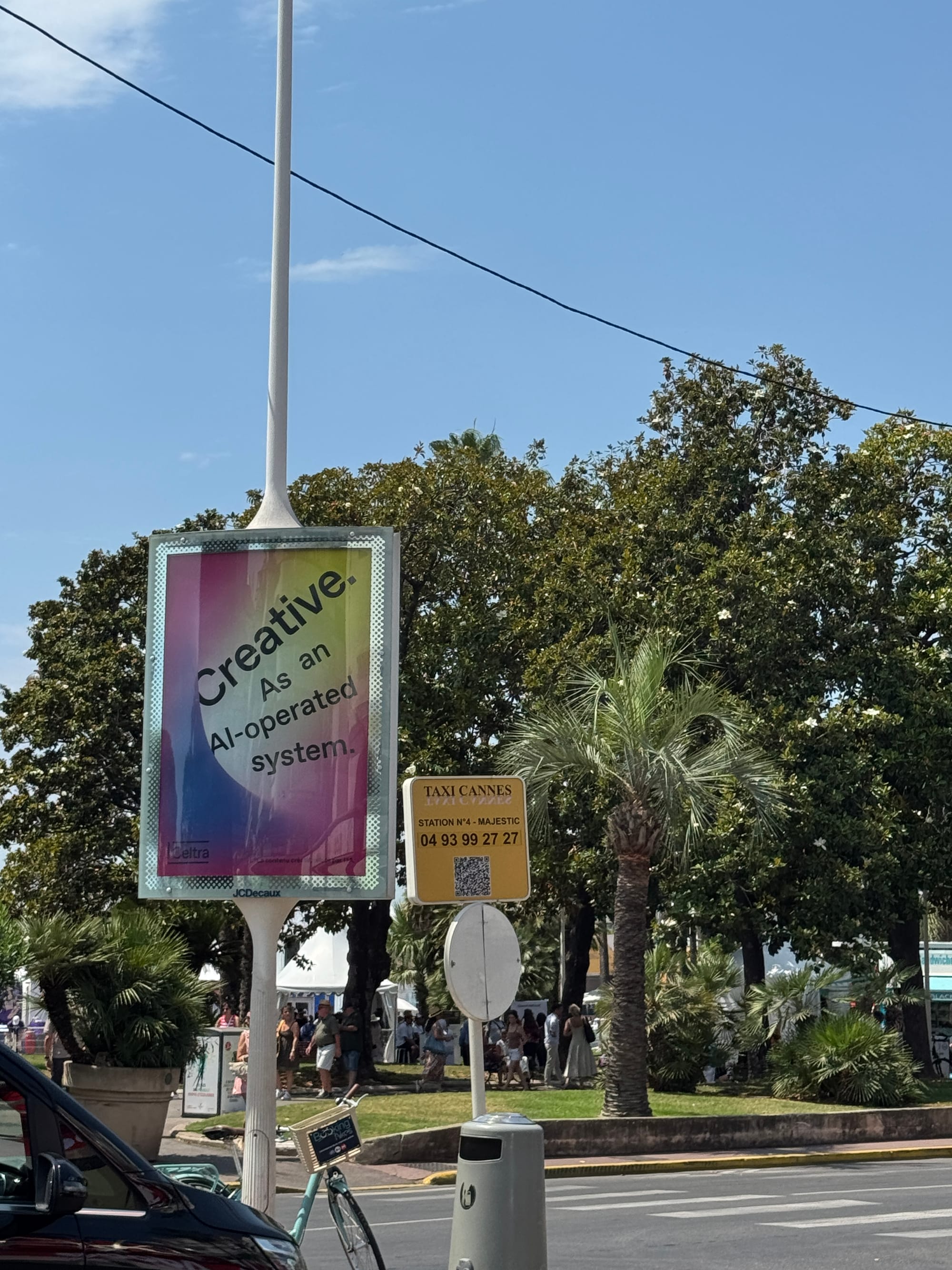
“DSPs are on the TV sidelines: Tatari gets brands in the big game,” one billboard I saw in Cannes read. “Tell us what Braze does,” another huge billboard read; when I walked by the Braze tent, I heard someone ask them what Braze does and it was deeply unclear (The answer, according to its website: “Braze is a customer engagement platform that empowers brands to Be Absolutely Engaging.™” Conveo pitched “Always on customer understanding,” and MiQ pitched the idea that you can buy ads with an AI and can create digital AI personas: “Sigma’s upgraded gen-AI omnichannel audiences gives advertisers over 1 million targeting options,” its ad in front of the Carleton hotel read. I saw a billboard that just said “Infillion Yieldmo.” One billboard I saw just read “Creative as an AI-operated system.” A car driving around Cannes read “an AI bought this ad.”
Nominally, Cannes Lions is an award show that honors the most creative and innovative advertisement campaigns of the past year. The basement of the Palais des Festivals, which is basically a huge convention center, is filled with images of iconic ads from the last few decades, and there is a red carpet and daily awards ceremonies. The Cannes Lions website notes it is “where creativity drives progress,” and states that “The Awards underpin everything that makes Cannes Lions what it is—the home of creative excellence and effectiveness—and each year a new global benchmark for creativity is set.” Inspirational messages inside the Palais highlighted creativity and the human touch with empty little platitudes; one read “Personal growth is no longer a nice to have. It’s a must have.” Another said “DRIVE PROGRESS. THIS IS YOUR MOMENT.” A third said “CREATE EMOTIONAL STORIES.”
A billboard on the outside of the Palais for a company called Smartly, however, reads “Creativity gets you the trophy. Our ROAS gets you the yacht.”
A lot of the point of Cannes, it seemed to me, was to get onto a yacht, have a yacht, know someone on a yacht. There is an entire yacht section of Cannes. Most of the yachts do not leave the port where they are docked; their private rooms are turned into meeting spaces and their decks just throw tightly controlled parties all day. Big companies rented entire yachts, other companies shared them. I was invited to take a meeting on the Hewlett Packard yacht, which was actually a yacht called The Room, which was shared by HP, Outfront (which sells billboard space), something called Xumo, and a company called InMarket. There was a Mercedes Benz/F1 yacht, a Samsung Ads yacht, an Integral Ad Sciences adtech company yacht, an Accenture yacht, a White Lotus / HBO yacht, among others. Some of the yachts had hot tubs, all of them had lots of free alcohol (rosés and spritzes), hors d'oeuvres, and men in knit polos and sneakers and women in sundresses.
While inside the Palais there was lots of high-minded discussion about the creativity of advertising, a lot of the actual conversations I heard were about making more money, who was meeting with who, what parties were happening, did someone have a colleague or friend who could get them on a party invite list. There did not seem to be much discussion about the broader concerns of an increasingly stratified economy, other than “this is ridiculous,” as in, ridiculously over-the-top, ridiculously hot, ridiculous that partying this hard was “work.” The most immediate concerns I heard from people seemed to be how to get into exclusive parties, where the next bottle of rosé would come from, and whether they would be invited back next year.
The festival went all week, and by the second day people are hungover and sunburnt. As the week went on, I saw less khakis and more shorts, with people desperate to do anything to cool down (ironically the best way to do this would have been to go swimming; we were at the beach, after all). Because I did not have a sales quota to hit or a number of meetings I had to do, I spent most of my time wandering around, taking pictures of billboards, taking breaks to swim, going to panels inside little air conditioned tents, and yes, drinking rosé and spritzes.
The last night I was there was Tiësto, which I vaguely tried but couldn’t get into. I decided to have a beer outside at a bar nearby and people watch. It was then that I saw the drones hovering high over Salesforce Beach. The drones looked kind of beautiful, and were forming into a figure. It was the Kool-Aid man punching through a wall. “BREAKTHROUGH IMPACT,” the drones formed to read. “KARGO.” It was just another ad. I walked home, thinking that I’d had fun, in the way that a music festival or Vegas can be fun, in the way that after you leave, you feel like you’ve been hit by a Strava-sponsored bus.
Welcome back to the Abstract! Here are the studies this week that yucked it up, went interstellar, controlled the weather, and sang our praises.First, the sounds of ape laughter have been gracing our planet for 15 million years. Then: a visit from a cosmic elder, a meteorological martial art, and bops by blowhards. As always, for more of my work, check out my book First Contact: The Story of Our Obsession with Aliens, or subscribe to my personal newsletter the BeX Files. A history of hominids in
Welcome back to the Abstract! Here are the studies this week that yucked it up, went interstellar, controlled the weather, and sang our praises.
First, the sounds of ape laughter have been gracing our planet for 15 million years. Then: a visit from a cosmic elder, a meteorological martial art, and bops by blowhards.
You’ve heard about getting the last laugh, but who got the first one? Scientists have now determined that laughter, a behavior common to all great apes, may have initially appeared in chortling primate ancestors that lived 15 million years ago, according to a new study that analyzes the evolutionary roots of getting the giggles.
In addition to being the best medicine, laughter plays an outsized role in human cultures and interpersonal relationships. The fact that all other great apes, from bonobos to gorillas, also enjoy a good chuckle suggests that this form of vocal expression has broad benefits and potentially deep evolutionary origins.
To probe the history of hilarity, scientists analyzed recordings of laughter from four orangutans, two gorillas, three bonobos, four chimpanzees, and four human children during bouts of playtime, roughhousing, and tickling.
The results revealed that the isochronous nature of laughter—meaning clear sound intervals like “ha ha ha”—was likely present in the last common ancestor of the Hominid family, which contains all great apes including extinct relatives such as Neanderthals.
“While all major branches of the Hominid family have evolved distinct call repertoires shaped by their species-specific socio-ecologies, one vocalization has been conserved across species and age-sex classes: laughter,” said researchers led by Chiara De Gregorio of the University of Warwick.
The team’s analysis reveals that “great apes have been laughing in a recognizable way to modern humans for at least 15 million years” and that apes that are more closely related to humans have more complex and variable laughs similar to our own diversity of guffaws, cackles, and snorts.
The interstellar comet 3I/ATLAS caused a sensation last summer when it was first discovered streaking through the solar system, partly because it revived the debate over whether these objects from other star systems could be alien handiwork.
While the evidence overwhelmingly suggests that 3I/ATLAS is not an extraterrestrial spaceship, it is nonetheless unlike any comet seen in human history. Scientists have revealed that the comet is by far the oldest object ever detected in the solar system, having “accreted as long ago as 12 billion years, following a period of intense, early star formation,” according to researchers led by researchers led by Martin Cordiner of the Catholic University of America.
In other words, 3I/ATLAS is nearly three times older than the solar system, formed when the observable universe was only a third of its current size. The age is based on the comet’s ratio of deuterium to hydrogen (D/H), which was measured by the James Webb Space Telescope, the most powerful observatory ever launched.
JWST revealed a “surprisingly high” ratio of deuterium enrichment, about 30 times the level of solar system bodies, with the exception of Venus. “3I/ATLAS thus represents a preserved fragment of an ancient planetary system,” concluded the team.
So long to this primordial pilgrim, and may it live to be 13 billion.
Finally, we have an answer to the age-old question: Can we use martial arts to control the weather? In a new study, scientists propose the concept of “weather jiu-jitsu,” which uses gentle atmospheric “nudges” to redirect potentially catastrophic weather events, such as hurricanes, heat waves, or droughts.
“Imagine harnessing the power of nature to help steer hurricanes away from land, redirect atmospheric rivers to spread their rain safely and evenly, or defuse extreme weather patterns like heatwaves, freezes, or prolonged droughts before they take hold,” said researchers led by Qin Huang of Arizona State University. “It’s a vision where we partner with Earth’s own forces to create resilience, rather than reacting to disasters.”
Weather jiu-jitsu involves seeding clouds with particles to influence weather outcomes, but it differs from existing methods by opting for light touches in advance of a developing weather event, as opposed to the heavier lift of weakening an event that is already ongoing.
The team’s models suggest this method could have nudged Hurricane Sandy well away from New York City in 2021, warmed Texas by about 18 degrees Fahrenheit during its deadly 2021 freeze, and reduced the rainfall that caused widespread flooding in California from 2022 to 2023 by about 5 percent.
That said, the study emphasized that the technique is only a proof-of-concept and it will take far more research to determine if it would be useful in the real world. In the meantime, let’s try some other martial arts-inspired approaches and figure out how to crane-kick a tornado or karate-chop a heat dome.
While the Song of Summer 2026 has yet to be determined, odds are that it will be singularly self-absorbed. That’s the hook of a study that discovered popular music has shown “a significant increase in self-focused language over time in individualistic societies” such as the United States or Germany, while no comparable trend was observed in more collectivistic societies such as Japan or Hong Kong.
Mean use of first-person singular pronouns as a function of Year and Country/Region. Image: Golubickis et al., 2026, PLOS One, CC-BY 4.0 (https://creativecommons.org/licenses/by/4.0/)
Scientists led by Marius Golubickis of United Arab Emirates University analyzed the lyrics of top 10 hits from 1970 to 2019 by quantifying the use of the plural pronouns like “we” and “us” compared with the first-person singular pronouns like “I” and “me” (check out the full list here). The results revealed that while “Western societies exhibited a clear increase in self-focused language over time, East Asian societies showed relative stability.”
This all checks out with my go-to playlist for narcissists, featuring “I Me Mine” by the Beatles, “Me Myself and I” by De La Soul, and, of course, “ME!” by Taylor Swift.
This is Behind the Blog, where we share our behind-the-scenes thoughts about how a few of our top stories of the week came together. This week, we discuss talking aloud to computers, Cannes, and “Engineering Creativity: Guac Is Extra." JASON: This week I was in Cannes, France for the Cannes Lions advertising conference, which is a sentence you probably did not expect to be reading and is definitely not a sentence I expected to be writing. It’s rare that I BTB something before I actually write
This is Behind the Blog, where we share our behind-the-scenes thoughts about how a few of our top stories of the week came together. This week, we discuss talking aloud to computers, Cannes, and “Engineering Creativity: Guac Is Extra."
JASON: This week I was in Cannes, France for the Cannes Lions advertising conference, which is a sentence you probably did not expect to be reading and is definitely not a sentence I expected to be writing. It’s rare that I BTB something before I actually write about it, but in this case I think it’s OK, as this is going to be significantly different from the actual articles I do. There is no sense in being coy about it—Cannes, which at least in the media business stands for both the beach town in the south of France and the advertising conference (but not the film festival), is a ridiculous place and experience filled with excess and extravagant displays of money wasting. Back when we worked at VICE, every year around this time there would be a bunch of whispers around the office about which executives and higher level sales people were going to Cannes and who was not (us journalists definitely were not). Then, during Cannes, there was a barely spoken sentiment that we, the journalists, should try extra hard to not fuck up lest we create some sort of situation that a VICE executive in Cannes would have to deal with from another time zone while drinking rosé on a yacht.
In February, police in Claremore, Oklahoma arrested farmer Darren Blanchard for speaking a little too long during a community meeting about data centers. The city charged Blanchard with criminal trespass, a crime with a $200 penalty, but he’s vowed to fight the charge. He recently shared video of the bodycam footage for the first time with 404 Media and answered our questions about the moment cops arrested him for going over his time at a February 17 community meeting of the Claremore City Co
In February, police in Claremore, Oklahoma arrested farmer Darren Blanchard for speaking a little too long during a community meeting about data centers. The city charged Blanchard with criminal trespass, a crime with a $200 penalty, but he’s vowed to fight the charge. He recently shared video of the bodycam footage for the first time with 404 Media and answered our questions about the moment cops arrested him for going over his time at a February 17 community meeting of the Claremore City Council.
The plan in February was for the City Council to listen to the concerns citizens had about a planned data center called Project Mustang. The residents of Claremore don’t want the data center and largely feel like the construction project was approved without their input. City officials signed non-disclosure agreements on behalf of the project’s developers and haven’t been forthcoming with details about its construction.
🌘Subscribe to 404 Media to get The Abstract, our newsletter about the most exciting and mind-boggling science news and studies of the week. Scientists have discovered new evidence that the cosmic structures connecting the universe are much larger than previously predicted—persisting over billions of light years—a finding that challenges a core tenet of cosmology and hints at the possibility of new physics, according to a study published on Wednesday in Nature.The standard model of cosmology, a w
Subscribe to 404 Media to get The Abstract, our newsletter about the most exciting and mind-boggling science news and studies of the week.
Scientists have discovered new evidence that the cosmic structures connecting the universe are much larger than previously predicted—persisting over billions of light years—a finding that challenges a core tenet of cosmology and hints at the possibility of new physics, according to a study published on Wednesday in Nature.
The standard model of cosmology, a well-corroborated framework for understanding the universe that is also known as the Lambda cold dark matter (ΛCDM) model, predicts that the large-scale structure of space looks the same in all areas (homogeneity) and in all directions (isotropy). While there is variation in the distribution of matter on small scales, such as thousands or millions of light years, these distinctions should smooth out into a uniform pattern on the scale of the cosmic web, which is a network of large-scale structures made of dark matter, gas, and galaxies that stretches across the universe.
But in recent years, new observational data has started to hint that galaxies cluster in “preferred directions,” forming distinct structures known as “anisotropies” that are not uniform, even across vast distances. Now, a pair of physicists has discovered that these distinct directions and patterns persist even to the scale of a gigaparsec, which is a unit equal to 3.26 billion light years, possibly signalling “the need for a shift in modern cosmology,” according to their new study.
“The structures observed in the real Universe are significantly larger and more persistent than those formed in state-of-the-art simulations based on the standard model of cosmology,” said authors Francesco Sylos Labini of the Enrico Fermi Research Center in Rome, Italy, and Marco Galoppo of the University of Canterbury in Christchurch, New Zealand, in an email exchange with 404 Media.
“The key advance of our analysis is that it allows this difference to be quantified,” they added. “By measuring the spatial extent and coherence of the observed structures and comparing them directly with theoretical predictions, we found that the discrepancy is statistically highly significant. In other words, the largest structures in the real Universe appear to be substantially larger than expected in standard models of galaxy formation.”
According to existing models, the cosmic web emerged from small density fluctuations in the early universe and gradually developed into large-scale filaments and nodes made of dark matter that gravitationally attract gas, galaxies, and other forms of matter.
Last year, the Dark Energy Spectroscopic Instrument (DESI), a major astronomical survey based in Arizona, released the largest high-resolution 3D map of the universe, which has revolutionized cosmology and allowed scientists to test those theories against observational data.
Labini and Galoppo analyzed the DESI release with statistical tools, including the Angular Distribution of Pairwise Distances (ADPD), which is especially effective for detecting and characterizing large-scale anisotropies in DESI’s dataset.
“The idea was to try to really test whether the idea that isotropies reached very large scales is now supported by data,” said Galoppo in a follow-up call. “Even just five or ten years ago, we didn't really have the data to test on gigaparsec scales. But now, we had a chance, so we decided to take it.”
“What we are able to do is to characterize how large are the largest structures inside this sample” of DESI observations, added Labini in the call.
The results revealed that even in DESI’s super-zoomed-out observations, large-scale structures create preferred directions of galaxy distribution, as opposed to an overall isotropic pattern. This contrasts with expectations derived from the cosmic microwave background, the oldest light in the universe, which suggests that directional correlations should fade rapidly at large scales.
“In the standard model, it's not that there aren’t structures,” said Galoppo in the call. “It is just that they are supposed to be smaller and less persistent than what we found. That's the crux of the matter.”
To that end, DESI is expected to release a new batch of observations within a year, and similar datasets will also be forthcoming from Europe’s Euclid space telescope and the Vera C. Rubin Observatory in Chile in the near term. These new and improved views of the universe will help scientists grapple with just how vast these large-scale structures are, and what that means for our understanding of our cosmic surroundings.
“At present, there is no simple or widely accepted modification of the ΛCDM framework that naturally explains structures of this size while remaining consistent with the observed uniformity of the cosmic microwave background,” Labini and Galoppo wrote over email. “That is precisely why these observations are so interesting: they point to a potentially important gap between theory and observation that deserves further investigation.”
“If future surveys continue to find coherent directional structures on even larger scales, the implications for cosmology would be profound,” they concluded.
Behind closed doors and without expert input, the Trump administration issued a major policy change to how census data is released. Data experts are concerned the result will be less reliable public data related to redistricting, natural disasters, the workforce, housing, and more.On June 4, the Trump administration released an order, Disclosure Avoidance for Statistical Products, that forbids “any use of noise infusion” for statistical products. “Coarsening shall be the preferred category of
Behind closed doors and without expert input, the Trump administration issued a major policy change to how census data is released. Data experts are concerned the result will be less reliable public data related to redistricting, natural disasters, the workforce, housing, and more.
On June 4, the Trump administration released an order, Disclosure Avoidance for Statistical Products, that forbids “any use of noise infusion” for statistical products. “Coarsening shall be the preferred category of Disclosure Avoidance methods for all statistical products,” the order states. “Suppression shall be permitted as a last resort, only to be used when coarsening is prohibited by law or would substantially defeat the accuracy or usability of a statistical product.”
In statistical terms, noise infusion is a common and accepted technique for privacy protection when working with data: it creates “fuzz” or random values within a dataset, making the published statistics slightly different from the actual, sensitive data. Coarsening is the process of grouping and rounding data, or reporting it in ranges instead of potentially identifiable specifics. Suppression is what it sounds like: redacting information, replacing it with asterisks, or not releasing the data entirely.
NPR’s Hansi Lo Wang first reported on the policy change and its implications. People who work with census data and statistical analysis are worried that limiting the ways the Census Bureau and the Bureau of Economic Analysis (BEA) can release data will severely limit what information ends up available to the public.
Data coming out of small communities and industries, especially, could be heavily affected by the change. “Because ‘coarsening’ (grouping, rounding, reporting in ranges) and suppression are the only not-prohibited tools named in the order, it means that to keep information safe, the Census Bureau and BEA need to group small things (like small communities or small business types) into larger ones, or they need suppress the data completely,” Beth Jarosz, a senior fellow at Georgetown University's Massive Data Institute and vice president of the Association of Public Data Users, told me in an email. “Small industries may get rolled into bigger industry categories. Small counties may get rolled into county groups or not reported at all.”
On June 17, five groups — the Population Association of America, Council of Professional Associations on Federal Statistics, Association of Public Data Users, Inter-university Consortium for Political and Social Research, and Association of Population Centers — released a joint statement condemning the order. “This order subverts processes developed over decades to foster transparency and public trust and creates a scenario in which there will either be less privacy for our personal information, or less usable data, or both,” the statement says.
The Director of Science Policy for the American Statistics Association Steve Pierson wrote that the order “handcuffs the Census Bureau and the Bureau of Economic Analysis in terms of the techniques they can use for protecting the privacy of respondents.”
John Abowd, the former Associate Director for Research and Methodology and Chief Scientist at the Census Bureau, posted a list of data products on Linkedin that this order would affect. These include the OnTheMap for Emergency Management system, a public data tool that provides real-time U.S. population and workforce statistics for areas being affected by natural disasters; Quarterly Workforce Indicators which include data about employment, job creation and destruction, wages, hires, and more; business formation and dynamics statistics; veteran employment statistics; data related to post-secondary educational outcomes, and many more. Many of these use noise infusion, which Trump’s order just banned.
There’s also confusion about how this order will even be enacted in practice. “Regarding the datasets that used noise infusion, it is unclear how this policy will impact public access,” Lynda Kellam, who leads the Research Data and Digital Scholarship team at the University of Pennsylvania Libraries and is a founding organizer of the Data Rescue Project, wrote following the order. “The policy is intended to be retroactive, raising concerns that data might be removed, but how that will play out is uncertain.”
In the immediate fallout, at least, we’re already losing some public information. As Wang from NPR pointed out on Bluesky last week, multiple webpages related to noise infusion and differential privacy on the Census Bureau's website were removed following the order. Most of those pages have since been restored. At the Data Rescue Project, a team led by Lena Bohman has been proactively collecting and archiving Census Bureau working papers and making them available to the public.
Jaroz said that along with the risk of unreliable or missing data, the abandonment of long-agreed-upon privacy protection methods can damage public trust in Census data. “When the Census Bureau and Bureau of Economic Analysis gather data, they promise respondents that they will keep responses confidential. When a person responded to the American Community Survey or a business owner provided information about their employees or sales, they expected that the Census Bureau and BEA would protect that information. By taking away tools that those agencies use to protect privacy and confidentiality, people may question whether or not Census and BEA can live up to that promise,” she said. “Similarly, the Census Bureau and BEA are producing information for public benefit. People respond, for example, to the American Community Survey (at least in part) because it will benefit their community. If the new rule results in cutting back how the data can be published and used, it also weakens trust and it is worth responding.”
As Wang noted, America First Legal, a law group co-founded by Trump's deputy chief of staff for policy Stephen Miller, attempted to force the release of new 2020 Census data in a lawsuit last year, by challenging the Census Bureau's differential privacy system. Judges ruled it was too late to sue, but they refiled the case in February.
As NPR also reported last year, Trump and Republicans in Congress have been pushing to exclude people living in the U.S. without legal status in the 2030 Census. “People who are in our Country illegally WILL NOT BE COUNTED IN THE CENSUS,” Trump wrote on Truth Social in August 2025. This would be a radical change in how the Census has been conducted for more than 200 years. Redistricting and gerrymandering have been a massive fight for the Trump administration for years, and has ramped up ahead of the 2026 midterms, as the Supreme Court recently weakened the Voting Rights Act and allowed for more redistricting that would favor Republican control of the House.
The data policy change is also happening in light of the Trump administration’s gutting of Census practice test locations in the South. In February, the Associated Press reported that the administration is eliminating four out of the six locations that were slated to test new methods for the 2030 census. “The Census Bureau would be essentially flying blind into communities that need testing most — tribal lands, rural areas with limited connectivity and places with historically low response rates,” Mark Mather, an associate vice president at the Population Reference Bureau, told the AP. “You can’t fix what you don’t test.”
I am staring at a painted portrait of King Charles, who is wearing a red suit. The comically oversized and heavy Snap Specs I am wearing have basically created a digital version of the real painting and overlaid it over the real thing. A narrator speaking through the glasses asks me to reach out and touch a butterfly perched on his right shoulder. Through the glasses, I see a digital version of my hand reach out. The butterfly takes off and floats toward my ghostly hand. It lands on my fake f
I am staring at a painted portrait of King Charles, who is wearing a red suit. The comically oversized and heavy Snap Specs I am wearing have basically created a digital version of the real painting and overlaid it over the real thing. A narrator speaking through the glasses asks me to reach out and touch a butterfly perched on his right shoulder. Through the glasses, I see a digital version of my hand reach out. The butterfly takes off and floats toward my ghostly hand. It lands on my fake fingers, and clips through them. Imagine yourself as royalty, a narrator in the Snap Specs says to me. King Charles’ face morphs into a version of my own, though it’s been run through an AI filter to look thinner, smoother, yet somehow older.
I walk to the next painting and stand on the black dot I’ve been told to stand on. The painting looks like a blank-ish canvas. I am positive I am about to see the same magic trick I’ve seen several times in the last few minutes; my face is going to be “painted” on the canvas the way it has been on several other portraits. The narrator starts talking to me. His voice is much fainter. He starts talking, and I look slightly away from the painting. The experience stops. I get a staffer to help me reset the glasses. I look back at the painting. The narrator begins talking. I slightly turn my head. The experience stops. I look at the painting again. It starts over. I remember that a staffer had told me not to look away from the paintings or the experience would stop. I do not move my head this time. Another AI version of my face appears on the canvas. I walk away, and do not feel as though I have just tried transcendent futuristic technology.
Snap let people try the glasses at “Spectacular, The Art of Jonathan Yeo in Augmented Reality,” a museum takeover at the Cannes Lions advertising festival in France, where nearly every big tech brand was pitching its platform’s advertising capabilities, and where I am working on a few stories for 404 Media. I don’t write about gadgets all that often, but with the Snap Specs getting lots of mostly negative attention and with investors actively begging CEO Evan Spiegel to not make them, I figured that, given the opportunity, I would put them on my face. Snap’s experience was tightly curated (the glasses don’t come out for four months), and was basically an audio/video tour of a few paintings of celebrities.
The flagship augmented reality experience for Snap’s new, widely clowned-upon glasses is essentially the same thing that brands have been doing at museums for 15 years now. Rather than use your phone to make art pop off the wall, it uses the $2,195 glasses that weigh “just 132 grams,” a Snap press release says (most regular glasses weigh between 25-50 grams) to make paintings of celebrities blink at you. At the beginning of the experience, my face was scanned on an iPad and then was presumably run through various AI filters to let me replace celebrity faces with my own. A portrait of Jony Ive in which he is holding an iPhone put my face on that iPhone, for example. A portrait of David Attenborough allowed me to “look into the past” and “look into the future” by running my face through different age filters; the result was an AI-ified version of me with a tiny head and a goatee as a child, wearing an enormous hat, and an older version of myself that I could flick back and forth to with my hand.
This was the type of brand experience I’ve done a million times at different conferences and it was so surface level as to be barely notable, but the glasses are indeed very heavy. They didn’t hurt to wear on my big head for 10 minutes, but I couldn’t imagine wearing them much longer than that. The visuals didn’t make me dizzy or nauseous like some virtual reality glasses have, but the visuals and audio also weren’t that great, and the glasses are augmented reality rather than fully engrossed virtual reality. There were clipping issues and, again, the experience stopped if I even slightly turned my head away from a painting—it is hard to imagine these things working well in real life. I have tried other VR and AR demos. So many are like this. They all have problems even in highly controlled environments and barely do anything more than your phone can do, with the added bonus of being incredibly expensive, uncomfortable, and branding you as an asshole. It was hard to imagine trying these and not dunking on them and, indeed, what I thought would happen did come to pass.
This is to say nothing of the privacy concerns associated with shoving AI into a camera and pair of comically large display glasses. We have written repeatedly about these dangers and they are not worth delving back into in a Snap-specific context, because these glasses are so big, heavy, dorky, and expensive that it is impossible to fantasize a world in which anyone wears them.
We start this week with Matthew’s story about a fascinating paper that argues if LLMs are sentient, then by those metrics so is the classic game Age of Empires II. After the break, Matthew tells us about a wild story out of Texas with a data center being built on land that was donated to be a park. In the subscribers-only section, we talk hacking and basketball.
Listen to the weekly podcast on Apple Podcasts, Spotify, or YouTube. Become a paid subscriber for access to this episode's bonus
We start this week with Matthew’s story about a fascinating paper that argues if LLMs are sentient, then by those metrics so is the classic game Age of Empires II. After the break, Matthew tells us about a wild story out of Texas with a data center being built on land that was donated to be a park. In the subscribers-only section, we talk hacking and basketball.
Listen to the weekly podcast on Apple Podcasts,Spotify, or YouTube. Become a paid subscriber for access to this episode's bonus content and to power our journalism. If you become a paid subscriber, check your inbox for an email from our podcast host Transistor for a link to the subscribers-only version! You can also add that subscribers feed to your podcast app of choice and never miss an episode that way. The email should also contain the subscribers-only unlisted YouTube link for the extended video version too. It will also be in the show notes in your podcast player.
The hackers that stole a large cache of data from Madison Square Garden called a low level employee and tricked them into letting the hackers into MSG’s systems, according to the hackers and 404 Media’s review of the stolen data.The breach highlights the risk of social engineering over voice calls, sometimes called ‘vishing’. Whereas phishing, where hackers social engineer someone over email or send them a fake login page, has been common for decades, vishing has only become prevalent more re
The hackers that stole a large cache of data from Madison Square Garden called a low level employee and tricked them into letting the hackers into MSG’s systems, according to the hackers and 404 Media’s review of the stolen data.
The breach highlights the risk of social engineering over voice calls, sometimes called ‘vishing’. Whereas phishing, where hackers social engineer someone over email or send them a fake login page, has been common for decades, vishing has only become prevalent more recently, especially as young and native English speaking hackers have become a serious cybersecurity threat.
💡
Do you know anything else about this hack or others? I would love to hear from you. Using a non-work device, you can message me securely on Signal at joseph.404 or send me an email at joseph@404media.co.
Consulting giant Accenture is trying to figure out how to stop non-technical workers from blowing through companies’ AI token budget on trivial tasks like converting PDFs to presentation slides, according to leaked audio obtained by 404 Media. Across the industry Accenture is seeing “soaring token spend,” according to the audio.The news highlights a major shift in the tech industry and other companies that use AI: the wave of uninhibited AI growth is over. Some AI providers like GitHub are no
Consulting giant Accenture is trying to figure out how to stop non-technical workers from blowing through companies’ AI token budget on trivial tasks like converting PDFs to presentation slides, according to leaked audio obtained by 404 Media. Across the industry Accenture is seeing “soaring token spend,” according to the audio.
The news highlights a major shift in the tech industry and other companies that use AI: the wave of uninhibited AI growth is over. Some AI providers like GitHub are now charging customers per token rather than a flat subscription fee, leading some companies to burn through their tokens. Uber recently capped employees’ use of AI tools like Claude Code and Cursor; that came after Uber told employees to use AI as much as possible and Uber’s CTO said the company had blown its entire AI budget in four months. And Accenture itself reportedly started requiring senior staff to start using AI or risk losing out on promotions.
It also undercuts the narrative that superpowered engineers generating mountains of code are behind the AI boom. In many cases it is non-technical staff burning through tokens for non-specialized tasks.
💡
Do you know anything else about token spend inside tech companies? I would love to hear from you. Using a non-work device, you can message me securely on Signal at joseph.404 or send me an email at joseph@404media.co.
“We’re seeing from some of the data internally at least that it’s actually not our engineers that are driving the token consumption. It’s a lot of the non-engineers that are doing some of those behaviors [...] you were talking about,” Justice Kwak, Accenture’s agentic AI strategy lead, said in a recent internal meeting, according to the audio obtained by 404 Media.
Larry Sanger, one of Wikipedia’s cofounders, was banned from editing the site indefinitely after other editors determined he was canvassing, or in other words, calling on his followers off platform in order to influence Wikipedia’s content. Sanger has spent more than a decade criticizing Wikipedia for what he claims is an ideological, left-wing bias on a variety of topics, and on X has framed this recent ban as further proof of everything that’s wrong with Wikipedia. The New York Post took th
Larry Sanger, one of Wikipedia’s cofounders, was banned from editing the site indefinitely after other editors determined he was canvassing, or in other words, calling on his followers off platform in order to influence Wikipedia’s content.
Sanger has spent more than a decade criticizing Wikipedia for what he claims is an ideological, left-wing bias on a variety of topics, and on X has framed this recent ban as further proof of everything that’s wrong with Wikipedia. The New York Post took that bait and last night published an article with the headline “Left-leaning Wikipedia blocked founder from editing site—after he campaigned to make it more balanced.”
Wikipedia editors obviously reject that framing and say that Sanger was banned for wielding his followers to sway discussion and decision making on Wikipedia. The discussion that led to the decision to ban Sanger concluded with what an editor called a “clear consensus” to ban Sanger.
“There is general agreement among participants that he has engaged in off-wiki canvassing and is not here to constructively build the encyclopedia,” the editor said in a note closing the discussion. “There is also a significant concern shared by many editors that his actions constitute calls for outing.”
While Sanger has been railing about bias on Wikipedia for years, the specific issue here is around his WikiProject Intellectual Diversity. WikiProjects are group efforts among Wikipedia volunteers to deal with certain issues on the site. For example, in 2024 I wrote about WikiProject AI Cleanup, a group of volunteers who focus on removing AI-generated content from the online encyclopedia. Sanger’s WikiProject Intellectual Diversity, as its name implies, aims to bring more intellectual diversity to the site, mostly meaning more right-leaning perspectives.
Sanger’s WikiProject Intellectual Diversity and its goals alone do not merit a ban according to Wikipedia’s policies. The problem, according to Wikipedia editors, is that during the discussion about whether to allow WikiProject Intellectual Diversity to become an official WikiProject, Sanger invited his 91,000 followers on X to influence that discussion.
“Wikipedians are now debating whether my proposed WikiProject Intellectual Diversity should be permitted to become an official WikiProject (club/group of editors),” Sanger said on X on Friday and linked to the Wikipedia talk page about the issue. “Lots opposed. Also lots in favor.”
“Let's just say that if I answer that question one way or another, the playground moms who rule Wikipedia might block me,” Sanger responded.
As one volunteer wrote in the discussion page about whether to ban Sanger:
“Since the return from his self-imposed exile pretty much all he has done is try to start a right-wing/conservative pressure group within Wikipedia not to improve articles on topics that may be under-represented or highlight high-quality sources that could be utilised more, but to instead attempt to rewrite policies and guidelines to his political bent while throwing baseless aspersions about the conduct of many users (mostly those in privileged positions such as admins) and alleging they're being funded by shadow money. Frankly if this was anyone else claiming all this with the way he is, we'd have shown them the door long ago.”
Ilyas Lebleu, another Wikipedia volunteer and admin, told me that they had warned Sanger about similar behavior two months ago, but that Sanger ignored them.
“Larry tried to frame the community discussion as a pseudo-legalistic process, bringing a list of ‘charges’ and ‘counts’ from ‘prosecutors,’ instead of an open community discussion,” Lebleu said.
Discussions about potential bans are supposed to remain open for at least 72 hours. While consensus that Sanger had violated Wikipedia policies was clear, Sanger was banned at some point before that deadline. He was then briefly unbanned, and then again indefinitely banned once 72 hours had elapsed and the discussion about the ban closed.
“Wikipedia has become more of a mob-rule anarchy than ever,” Sanger said in a statement sent to me by a spokesperson. “In the kangaroo court in which a mob ousted me, Wikipedia’s administrators showed that they don’t appear to value details like formal charges, a designated prosecutor, basic decorum, distinction between prosecution and judge, dispassionate adjudication, and so forth. They have no proper system other than triggering a mob to selectively enforce their hodgepodge of vague rules.”
“Now that same mob has blocked me for trying to bring an intellectually diverse group of thinkers and editors to the site,” Sanger continued. “Subscribing to their groupthink is now an official requirement of being a member in good standing. Something must change, and now. I only wonder if the system as it currently stands can even allow the discourse necessary to fix the system.”
Sanger’s claim that Wikipedia has a left-leaning bias isn’t unique or new. Elon Musk has railed against the site for years as well, an effort that culminated with the launch of his highly flawed, AI-generated Grokipedia. But the stakes for Wikipedia as a reliable source of information are higher than ever as every corner of the internet is struggling to deal with a flood of AI-generated, error-filled slop.
This story was reported with support from the MuckRock foundation. Around this time last year, Rachel Rodman was happily employed as a library clerk and program assistant with the Crawford County Library District in the east-central part of Missouri. Rodman didn’t think anything of the display she curated for Pride month last June, highlighting LGBTQ+ books from the district’s collection in the one room library within a community center. Rodman says she was given free reign to create displays an
Around this time last year, Rachel Rodman was happily employed as a library clerk and program assistant with the Crawford County Library District in the east-central part of Missouri. Rodman didn’t think anything of the display she curated for Pride month last June, highlighting LGBTQ+ books from the district’s collection in the one room library within a community center. Rodman says she was given free reign to create displays and had no reason to suspect that her actions would lead to her firing. The display was up for five days before Rodman says her branch manager left her a handwritten note telling her to remove it. Rodman refused, posting to Facebook on June 5, 2025 that she wouldn’t deny a marginalized group’s right to visibility because the district feared community backlash.
“I take my job very seriously,” Rodman wrote, adding, “I will not yield, and I’m not sorry about it.”
The next day, she was fired. Public records obtained by 404 Media offer insight into Rodman’s dismissal and how the decision reflected poorly on the library. It represents one of hundreds of public records requests filed in jurisdictions in which we’ve received a tip or followed up on incidents of censorship and self-censorship related to LGBTQ+ focused or Pride-related book displays. Records from a handful of public libraries show a willingness from library leadership to tolerate acts of self-censorship in anticipation of unwanted attention from certain community members, and in some cases, religious leaders. This tends to show up in hesitancy to organize cultural heritage programming and LGBTQ+ book displays.
In a statement to 404 Media, Rodman says that because public libraries are funded through taxpayer dollars, reducing visibility of a marginalized group constitutes a refusal to openly support all patrons.
“It’s never enough to just carry the books as available material,” Rodman told 404 Media. “Everyone deserves and should be able to find themselves publicly represented, but especially in communities where censorship is already such a huge issue. It’s in those communities that minorities of any kind already feel repressed and underrepresented.”
In one email exchange from libraries in east-central Missouri, Crawford County Library District’s director told other area library directors that the firing “was not discrimination,” but rather, to “protect” employees and patrons. The situation “does look bad,” she wrote, before making it worse by accusing the employee of playing “victim.” The issue, according to Rodman and the records, was that in 2022, the library tried to host a “Rainbow Storytime” event, but canceled it because the library had received death threats.
“Regardless of whether the library actually instructed the employee to remove the display, we’re in rural Missouri,” Steven Campbell, director of the Scenic Regional Library in Union, Missouri, wrote. “It’s an extremely challenging political and social environment. We all need to make our own decisions. Not everyone has a Board or appointing authority that will back them on LGBT issues. If someone thinks losing their job or receiving deaths over a display is worth it, that’s great. I admire them. Not everyone is willing to make those sacrifices, and that shouldn’t be judged.”
Censorship experts and professional associations disagree, but they acknowledge that small and rural libraries have different challenges than their metro-area counterparts. A lot of these systems are very small, with very few salaried staff and limited acquisition budgets. Nor are they discounting the fact that it’s hard to be a librarian right now, thanks in large part to the work of some very well-funded astroturfers. The American Library Association’s Office for Intellectual Freedom found that in 2025, over 90 percent of all book challenges could be linked to pressure groups or key decision-makers like public officials and government employees or library boards or library administrators.
“When a library chooses to engage in censorship-lite out of fear, by just trying to keep the peace and but still do the good work of the library, it’s the patrons who pay the price, no matter what” Kate Laughlin, executive director of the National Association for Rural and Small Libraries, told 404 Media. “It is the community who is the victim, not the library and the librarians.”
In public records obtained by 404 Media, librarians regularly discussed the challenges they face with their leadership. Some of the things we've read include:
"I am not calling attention to Pride Month online, but I don't call attention to other recognized holidays unless it is part of a program... each time that I promote this piece of the collection I have push back from a parent."
"If it is in the children's area, maybe a good compromise would be to move it to another area."
"I have made a compromise by taking the time and trouble of changing the wording on the sign that she disapproved... I want to keep the Pride Month display up where it is for 10 more business days. Pride Month ends on June 30 and then it will be taken down."
“Everyone knows the stuff we’re dealing with regarding LGBT issues. It’s no cakewalk for anyone.”
“As a library director in a small town I have had apprehensions about doing outward pride displays in my community.”
“My assumption is that we will get more complaints as Pride month gets underway.”
The American Library Association’s Office for Intellectual Freedom is seeing fewer public Pride displays in libraries this year compared to recent years, citing the chilling effect of censorship.
“There is no obligation to have any display about anything,” Sarah Lamdan, executive director of the ALA Office for Intellectual Freedom told 404 Media. “It’s all about what a community is interested in. But if somebody thinks that a Pride display might be something that would be appreciated by any member of their community, or they want to put up a Pride display, that shouldn’t be a source of fear or incrimination.”
Lamdan says there’s a difference between being a library that doesn’t do displays of any kind, and libraries that have done displays in the past who choose not to do them due to external pressure.
“Personally, I think Wichita’s decision to call attention to this on Facebook was a bad idea,” Tom Taylor, director of the Andover Public Library, said in one email to other cc’d library workers. “It just gives more people the idea.”
When asked for clarification as to what he meant by “bad idea,” Taylor told 404 Media that states like Kansas have patron privacy laws that protect everyone—including religious leaders—from public borrowing disclosure. He also said that the Andover Public Library doesn’t have any Pride-specific events planned this year, but the library has signs that help users locate frequently challenged books.
Taylor said that he believes challenged books should still be available to check out, even if they aren’t promoted within the library.
“If you don’t order [the book] because you don’t want to have a controversy, that’s what we call censorship by omission,” he added. “To avoid buying them because you’re afraid there might be a controversy, that’s not how professional libraries work, in my opinion.”
Ashley Stewart, a campaign strategist with EveryLibrary Institute, says she can relate to some of the pressure from religious leaders that administrators may be going through. As a former library director for a system in southwestern Illinois, she was on the receiving end of death threats from local ministerial alliances because the library hosted a Drag Queen Story Hour event in 2022 for Pride month.
“No matter where you go in the community, you’re getting—I don’t know if it’s harassment—but people are absolutely letting their feelings be heard that they think that you should not be doing a certain program or not having a certain display,” Stewart told 404 Media.
Madison Square Garden compiled a list of activists who have publicly criticized the venue’s use of facial recognition technology, putting their tweets and comments into a document that was then accessible to other people inside the company, 404 Media has found.The news shows that MSG, operated by Jim Dolan who has garnered a reputation for being pernicious against his perceived enemies, is not only deploying controversial facial recognition technology but keeping track of specific people who
Madison Square Garden compiled a list of activists who have publicly criticized the venue’s use of facial recognition technology, putting their tweets and comments into a document that was then accessible to other people inside the company, 404 Media has found.
The news shows that MSG, operated by Jim Dolan who has garnered a reputation for being pernicious against his perceived enemies, is not only deploying controversial facial recognition technology but keeping track of specific people who take issue with it. The document was included in a 45GB cache of data hackers stole from MSG and posted online this month, which 404 Media then downloaded and reviewed.
“The wake of a data breach would be a good time for Madison Square Garden to stop subjecting its patrons to biometric surveillance,” Adam Schwartz, privacy litigation director at the Electronic Frontier Foundation (EFF), and one of the people included in the document, told 404 Media.
Board members of a small township in Michigan agreed to “fight to our very last breath” against an AI data center planned in their community. America’s nuclear scientists and the University of Michigan want to build a massive data center in Ypsilanti Township, Michigan. If built, the data center will, among other things, run simulations to help America build nuclear weapons.The residents of Ypsilanti Township overwhelmingly oppose the construction of the data center and voiced their oppositio
Board members of a small township in Michigan agreed to “fight to our very last breath” against an AI data center planned in their community. America’s nuclear scientists and the University of Michigan want to build a massive data center in Ypsilanti Township, Michigan. If built, the data center will, among other things, run simulations to help America build nuclear weapons.
The residents of Ypsilanti Township overwhelmingly oppose the construction of the data center and voiced their opposition to the computer warehouse during a public board meeting on June 16. In a show of support that’s often rare from local leaders in communities with data centers, Ypsilanti Township’s board vowed to fight UofM and Los Alamos National Laboratory, which is partnering with the university, with everything they had.
Throughout most of the three hour board meeting, a photograph from a data center groundbreaking in nearby Saline Township was projected onto a wall behind the board. The photo showed a grinning Michigan Governor Gretchen Whitmer standing in line with Oracle CEO Clay Magouyrk. It was taken at the June 1 groundbreaking of an Oracle and OpenAI data center in nearby Saline Township, one of several Stargate projects. Saline Township is a community of only 2,300 people and the fight against the data center was so contentious that the Township treasurer resigned in tears during a public meeting in May.
During the groundbreaking, a videographer caught Whitmer talking with Magouyrk. In the video Whitmer appeared to tell the billionaire, “We’re used to people saying no, and doing it anyway.” Whitmer’s office has officially denied she said that, but many of the residents of Michigan—including the people of Ypsilanti Township—believe she did.
Governor Whitmer had a hot mic moment at the Saline Data Center groundbreaking, where she tells Oracle CEO Clay Magouyrk, “We’re used to people saying f*ck no, and doing it anyway.” I’m old enough to remember when she doxxed Marshall constituents who opposed her BlueOval project. pic.twitter.com/PRFnjGY5l9
Cilla Cresswell shot the video of Whitmer and was present at the Ypsilanti Township board meeting on Tuesday. “On June 1 I was standing just to the left, right there,” Creswell said, referring to the photo that loomed behind the board during the meeting. “I was there. I recorded that clip [… ] I was right there. And they want to say it’s fake, but I just want to let you guys know it’s real. You can play it on my camera.”
Members of the board and the community referenced the photograph often during the meeting. “You have people in that photograph worth billions of dollars. Not just millions, we’re talking trillions. Soon to be trillionaires. Yet this state, in its zeal to become the data capital of the country, has extended unprecedented tax credits to the richest corporations in the world,” Douglas Winters, a lawyer representing Ypsilanti Township, said in the meeting.
“Having to stare at this picture during this meeting has my blood boiling,” said Ypsi resident Laura Witowski. “I did not realize how emotional I would be. The waste of space. The complete lack of regard for humans and animals and for what?”
During the hours of community comments, residents stepped forward to voice complaints that have now become common about data centers in America. The people of Ypsilanti Township worried about the rising cost of electricity, how much water the building will use, and how noisy the data center would be once finished.
They also called on the Township board to do everything in their power to stop it from even being built. “Put yourselves on the line. Those people will listen to you better than they will listen to us. Please put yourselves, your jobs, and your comfort on the line to stop this for us,” Ypsi resident Jane Wolf said. “Get creative. Tear up the road. Block the road. Break the law. Do whatever you need to do for us. You will be remembered better in history for the job that you did if you can get creative and really put yourselves out there.”
Jill Warren, the wife of a Methodist pastor, suggested residents brush up on the OSS’ Simple Sabotage Field Manual. “Simply slow things down bureaucratically," she said. “Make sure we block where we can. Use very slow agendas and response times and do, within your power, the work that you are entitled to do. For those who aren’t familiar with it, please look up the Simple Sabotage Field Manual and use it in your own lives of action as well [...] they may not care about us, but we care about us and we’re here and we’ll continue to be here and support the work that you’re doing on our behalf.”
Alyssa, an Ypsilanti resident, cited long passages from John Hershey’s Hiroshima—a 1946 book that focused on the victims of the first atomic bombing. “We don’t need simulations to know what a nuclear strike looks like,” she said. “We have pictures, videos, and audio of what happens. We know what it does to bodies. We know what it does to children and what it does to life.”
Board supervisor Brend Stumbo vowed to fight. “This is going to harm our community in our future. We will fight to our very last breath, but we need help. And we need it from the people who have the power to stop things,” she said.
Stumbo explained that, early on, she and other members of the board were ignorant about data centers and that she was grateful to the Township’s residents for informing her. “Now we know and we’re thankful for the residents and non-residents that came to our meetings early and told us, ‘don’t trust UofM,’” she said. “We do not love nor do we appreciate what the board or regents is doing to our community. It needs to stop. And everyone that showed up here today, we greatly appreciate it and we will keep going, like everyone has said, by doing it together […] I will stand with you. I will fight with you. And I know this entire board and our Township attorney will as well. So let’s keep doing it together.”
The Township has, so far, made good on its word and it’s been creative in its opposition. In April, the board voted to institute a 365 day moratorium on supplying water to data centers so it could conduct a scientific study into how hyper scale data centers might affect the community water supply. In response, UofM threatened to sue and claimed that withholding water from an AI data center meant to power nuclear weapons research was unlawful discrimination.
This week Joseph speaks to Jake Hanrahan, creator of the independent conflict-focused media company Popular Front. They talk all about conflict journalism and how to get your journalism out there when platforms like YouTube make it all that much harder, sometimes.
Listen to the weekly podcast on Apple Podcasts, Spotify, or YouTube. Become a paid subscriber for early access to these interview episodes and to power our journalism.If you become a paid subscriber, check your inbox for an email
This week Joseph speaks to Jake Hanrahan, creator of the independent conflict-focused media company Popular Front. They talk all about conflict journalism and how to get your journalism out there when platforms like YouTube make it all that much harder, sometimes.
Listen to the weekly podcast on Apple Podcasts,Spotify, or YouTube. Become a paid subscriber for early access to these interview episodes and to power our journalism.If you become a paid subscriber, check your inbox for an email from our podcast host Transistor for a link to the subscribers-only version! You can also add that subscribers feed to your podcast app of choice and never miss an episode that way. The email should also contain the subscribers-only unlisted YouTube link for the extended video version too. It will also be in the show notes in your podcast player.
This story was reported with support from the MuckRock foundation. Earlier this year, an Alaskan assembly member found himself in hot water for introducing a resolution that would have prohibited the Matanuska-Susitna Borough Public Library System from making books and other media available to anyone if deemed “harmful to minors” by the borough manager. The proposal wasn’t well received. Public records obtained from the Borough Clerk’s Office and shared with 404 Media show that the proposal was
Earlier this year, an Alaskan assembly member found himself in hot water for introducing a resolution that would have prohibited the Matanuska-Susitna Borough Public Library System from making books and other media available to anyone if deemed “harmful to minors” by the borough manager.
The proposal wasn’t well received. Public records obtained from the Borough Clerk’s Office and shared with 404 Media show that the proposal was wildly unpopular. In emails to assembly members, constituents implored the resolution's sponsor Michael Bowles to withdraw it, calling it an “audacious and idiotic” attempt at destruction by way of “bureaucratic nightmare.” One constituent likened it to a proposal to “make all libraries children's libraries.” Another said its adoption could result in countless other books being removed that “are not sexual in nature” but which may contain “passing references to sex or adult themes.”
A week went by before Bowles withdrew the request, seemingly to recalibrate. The Mat-Su Sentinel reported in May that the assembly member introduced and again withdrew a resolution that would have forced the system to pull the book Let’s Talk About It: The Teen’s Guide to Sex, Relationships, and Being a Human from shelves. This teen book has been in the adult section of Mat-Su’s borough-run libraries since 2023 when it was relocated from the teen section following a challenge.
404 Media has obtained records from dozens of public libraries, which include Requests for Reconsideration of Materials forms (RFRs) and official decision letters to challengers, along with draft versions of updated collection development policies. Much has been written in the last five years about the blatant efforts to suppress access to books that could contain any remotely challenging ideas or that deviate even slightly from cis white heterodoxy, but there’s been little talk about what that means from the rest of us. What my reporting confirms is that there are more books intended for children and young adults in adult sections because challengers didn’t believe it was appropriate for children and young adults to read about people of color and/or people who are queer, trans, or both, while also showing that a large-scale reorganization of public library collections is currently underway, that its application varies by state and locality, and that it’s been very hard to measure because it’s totally chaotic.
Records obtained from one South Carolina public library system show that between June 2024 and August 2025, more than two dozen young adult books were relocated to the library’s adult section. Before that, the system had already resectioned more than two dozen other YA titles. The ACLU sued Greenville County Public Library System in 2025 for its board-adopted policies from 2024.
Most letters from the library’s executive director didn’t include any reason for the relocation. However, more recent letters reference the library’s updated collection development policy.
One frequently challenged title caught up in the mix at this library was The Hate U Give a YA book published in 2017 about a teenager who has to witness her friend—an unarmed Black man—be murdered by a police officer during a traffic stop. In 2024 at the Greenville County Public Library System, the book was challenged and retained before, in 2025, the book was again challenged and relocated to the library’s adult section. What happened in between these two events, the library’s board adopted policies making this and other books easier to remove.
The majority of U.S. anti-library laws introduced from 2022 to now have largely focused on school libraries. Only a few states have laws that affect municipal and county public libraries, and so far, most of these efforts have either failed to pass or were struck down by governors. That’s not to say state governments haven’t found other ways to do censorship. As of now, at least two states have mechanisms tying public library funding to content restrictions. One of them happens to be South Carolina, which has a legislative requirement that threatens to strike the system from its budget unless the system certifies with the State Librarian that they don’t keep books in the children, youth or teen sections that could be of "prurient interest” to a 17 year old. A more aggressive version of state library-agency rulemaking comes from Alabama.
In 2024, the Alabama Public Library Service (APLS) amended its administrative code to withhold funding to public libraries that don’t do enough to restrict minors’ access to “sexually explicit” or otherwise “inappropriate” material, and has only continued to broaden its scope since. APLS has since gone on to broaden the criteria for what is “sexually explicit” before adding a provision to treat content dealing with the “concept of more than two biological genders” as inappropriate for youth sections.
Tuscaloosa Public Library released records to 404 Media in response to a public records request that included tracked edits to the library’s 2025 collection development policy—initially based on a 2022 version—to meet APLS funding requirements. These changes appear to have been accepted. A line about the library welcoming community feedback on collection development, which an editor appeared to question, was also retained.
The motives behind these changes to collection policies and funding incentives raise serious questions about who public libraries are for in America. William Rodick, who researches representation and culturally responsive teaching in Pre-K and primary education for the nonprofit EdTrust, says the mass relocation of diverse books from developmentally appropriate sections of public libraries into adult sections is a form of “intellectual condescension,” or the idea that young people aren’t capable of dealing with hard topics through literature.
“That becomes manifest by removing opportunities for demonstrating honesty for students,” Rodick told 404 Media.
Rodick says that students already have disproportionate access to spaces outside of classrooms where students can access reading materials. Regardless of where they’re getting their books, students of color and students who are LGBTQ+ aren’t presented in the majority of the books they do have access to—much less so now than just a few years ago.
“And when they are presented, quite often those representations are stereotypes through really negative portrayals that are certainly not going to use the kind of motivation students need to engage with reading,” Rodick said. “The fear that I have is that at some point, we are going to see even greater disparity in outcomes than we already do for literary rates because of perpetual inaccess to quality materials.”
Nadja Young is chief brand officer with MetaMetrics, the company that developed the widely-adopted Lexile Reading Framework because it measures both reader ability and text complexity to match readers with books that are appropriately challenging. She says the focus for upper grades in high school is really about vocabulary in contexts that are authentic.
"Reading whole books absolutely helps to build that stamina," Young told 404 Media.
There are, of course, other factors to weigh when making widesweeping generalizations about literacy rates in adults. Young notes that adults with dyslexia, neurodivergence, and English language learners have historically and continue to have difficulty finding books they can parse that also honor their maturity and intellect. Lexile only measures a text’s complexity, not the content or themes a book contains. And yet, books are being relocated based on content or theme. Whether text complexity is an afterthought or conflated with content or theme is only something the most prolific censors can know.
"I don't think we could take the stance that it's going to bring the population up or down because as long as these books are still in the library somewhere, people can find them and the librarians can help direct them," Young added.
Tasslyn Magnusson, an independent researcher and consultant with organizations like PEN America and EveryLibrary was an early chronicler of the current rise of modern-day book banning. She says book relocation in public libraries is really just a roundabout way of eliminating diverse representation from children’s literature entirely.
“We may end up with collections that have weird pockets of literature in them, but I think the more likely scenario is the books won’t circulate,” Magnusson told 404 Media.
When library books don’t circulate, they’re more likely to get weeded so the library can circulate new titles based on their collection policies. Collection policies, however, are being rewritten across the country to eliminate intellectual freedom and privacy for minors by targeting titles that can fit into a broad category called “sexually explicit,” which is synonymous with “harmful to minors.” This, Magnusson says, prompts publishers to argue that books with same-sex couples, transgender protagonists and people of color encountering racism, brutality—even genocide—don’t sell, because libraries are getting rid of them.
Where the hypothesis holds up, Magnusson said, is that a young person’s constitutional right to access information is dependent on where they live and whether the adults in their lives recognize them as having free will or not. For adult sections of libraries, a disproportionate number of young adults will need some form of parental permission to check out books that deal with sensitive subjects that, like it or not, teens deal with.
Unfortunately, the modern-day parental rights movement is predicated on a belief that children are the property of their parents, and therefore parents, “should be able to do anything they want to them,” including restricting their right to read and explore their interests to their fullest potential. Instead, Magnusson says, adults are blocking children from accessing developmentally appropriate material in instances that deal with sensitive subject matter. She takes YA books that grapple with hard topics, like suicide and child sexual abuse as examples, as these are issues censors frequently cite in RFRs for why a book should be relocated.
The illusion of control is obviously not working and will have devastating consequences for the rest of us, which people do not want and vehemently reject. This means the answer likely lies somewhere between meeting your kids where they’re at, even when where they’re at bears no resemblance to the Devil You Know. Which is scary and sucks, but that’s also what parenting is, and which a lot of parents don’t seem to get.
“We talk about parents’ rights, but what we really need is parent remedial education,” Magnusson added.
Welcome back to the Abstract! Here are the stories this week that shook the Earth, birthed a universe, exploded in space, and sought the fountain of lepidopterological youth.First, a wave from a disastrous earthquake journeyed to the center of the Earth and back, revealing a phenomenon that has never been seen before. Then: a recipe for a gravastar, a light shower of heavenly cremation, and the secrets of butterfly elders.As always, for more of my work, check out my book First Contact: The Story
Welcome back to the Abstract! Here are the stories this week that shook the Earth, birthed a universe, exploded in space, and sought the fountain of lepidopterological youth.
First, a wave from a disastrous earthquake journeyed to the center of the Earth and back, revealing a phenomenon that has never been seen before. Then: a recipe for a gravastar, a light shower of heavenly cremation, and the secrets of butterfly elders.
The devastating Tohoku-Oki earthquake, which struck east of Japan in 2011, generated a seismic “shear” wave so powerful that it bounced off Earth’s core and hit the surface again 13 minutes later, permanently shifting all of mainland Japan about a quarter-inch east of its original position, according to a new study.
While it is common for seismic waves to ricochet off Earth’s core, scientists have never detected a wave smashing back into the planet’s crust before. But when global navigation satellite system (GNSS) measurements kept indicating that Japan seemed to have shifted slightly east after the quake, scientists realized with “surprise” that a core-reflected wave was the likely cause of the “slip event,” reports the study.
“We report an extraordinary observation of ground motion in Japan after the…Tohoku-Oki earthquake attributed to a multiplate-interface slip event triggered by a shear wave that traveled to the Earth’s core and back,” said researchers led by Sunyoung Park of the University of Chicago.
“This slip event, spanning two plate boundaries, has the broadest rupture area of any single event yet documented,” the team continued. “Its overall length is similar to that of mainland Japan (~3000 km), exceeding the mainshock rupture length by six to seven times and more than doubling that of the 2004 great Sumatra earthquake.”
Even though the seismic uppercut was far less intense than the original quake, the near-simultaneous arrival of the wave across such a huge area caused a slip between continental plate boundaries. As a result, mainland Japan moved about six millimeters toward the Pacific Ocean, which doesn’t sound like a lot, but scientists have never observed a single seismic event moving a large landmass in this way.
The discovery not only reveals a mind-boggling new phenomenon, it serves as a heads-up in preparing for future colossal quakes and assessing their aftermath. The core-reflected wave “is a previously unrecognized source of seismic hazard, which can potentially (re)activate the mainshock area and the broader surrounding megathrust interfaces,” the team concluded.
Just when you thought black holes couldn’t get any trippier, along comes a “gravastar.” These objects are hypothetical alternatives to black holes that do not contain a singularity or an event horizon, beyond which normal physics breaks down. Instead, physicists theorize that a massive star could collapse into a different type of compact object, dominated by dark energy, which could trigger the birth of a mini-universe inside of it, according to a new study.
“Because a gravastar possesses neither a singularity nor an event horizon, and since its compactness can be brought arbitrarily close to that of a black hole, it has long been argued that it would be difficult to distinguish it from a black hole,” said authors Daniel Jampolski and Luciano Rezzolla of the Institute for Theoretical Physics in Germany.
A comparison of black holes and gravastars. Image: Finq
“We here present, for the first time, a model for the creation of a static gravastar following a gravitational collapse of a spherical cloud of matter,” the team added.
The study models a pathway to the formation of a gravastar by imagining a uniform dust cloud collapsing toward a point at the center called a “de Sitter region,” which begins to expand. The inward collapse of the cloud and the outward repulsion of the de Sitter region, which is essentially an expanding mini-universe, results in an equilibrium state that would be virtually indistinguishable from a black hole to outside observers like us.
Finally, a hypothetical object for people who think black holes are not weird enough. Bonus points for the study’s brainy asides, such as this one: “Obviously, if a quantum-gravitational description were possible, the zero-size de Sitter bubble would be naturally replaced by a Planck-size bubble.”
Like, duh!
Stardust to stardust, radioactive ashes to radioactive ashes
Speaking of the weird corpses left behind by massive stars, Earth is constantly getting sprinkled with their radioactive remains. That’s the finding of a study about a deep sea rock dredged up from nearly 16,000 feet under the Pacific Ocean that scientists found is bedazzled with the ashes of dead stars.
The rock is a chunk of ferromanganese crust, which forms on the ocean floor from minerals that precipitate from seawater. The rocks also capture rare heavy elements—such isotopes of plutonium, iron, and curium—that can only be sourced from cataclysmic cosmic events, such as explosive supernovae, or collisions between existing stellar corpses called neutron stars.
Lead author Dominik Koll with a sample of the ferromanganese crust. Image: Helmholz Zentrum Dresden
Using this rare record, scientists detected radioactive isotopes that suggest Earth has been passing through the fallout of an ancient “kilonova” that occurred when two neutron stars merged more than 100 million years ago. These kilonova mergers, also known as “r-process events,” leave a distant isotopic signature that includes the radioactive isotope plutonium-244, which the team detected in the rock.
“Our measured interstellar signatures suggest the occurrence of an old and rare r-process event leading to a diffuse [plutonium-244] background inside and outside the Local Bubble,” which is the term for our region of the galaxy, said researchers led by Dominik Koll of Helmholtz-Zentrum Dresden-Rossendorf. “The trajectory of the Solar System through the Galaxy could impact the recorded r-process radionuclide abundance on Earth or the Moon.”
In other words, we are all just casually wafting through the smoke of stellar pyres in our orbit around the galactic center. Hope that adds a little cosmic spice to your day.
We’ll close, as all things should, with butterfly Methuselahs. To better understand the processes that drive aging and longevity, scientists looked to the Heliconius family of butterflies, known as heliconians, which are known to live substantially longer than its close relatives, though their lifespans hadn’t been previously examined in depth.
Heliconius butterflies. Image: Repeating Patterns of Mimicry. Meyer A, PLoS Biology, Vol. 4/10/2006, e341
The team was surprised to learn that these butterflies can live for nearly a year whereas their close relatives in their “tribe” live for mere weeks, revealing a “25-fold variation in recorded maximum lifespan across the tribe,” according to a new study.
“This range far exceeds previous estimates, and is among the largest ever recorded for such closely-related taxa (with comparable differences reported only for two groups of fish: rockfishes, and roughies,” said researchers led by Jessica Foley of the University of Bristol. Indeed, if humans exhibited this range of lifespan diversity, plenty of us would be living past 1,000 years old.
The team also discovered that Myscelia cyaniris, which is not a heliconian, is “the longest-lived butterfly species to date based on data from butterfly exhibitors with a maximum reported lifespan of 380 days,” confirming that many butterfly families have evolved extreme longevity.
Unlike their close relatives, heliconians feed on pollen, which suggests that this special diet is part of the secret to their senescent success. While this discovery sounds like grounds for a grift aimed at the anti-aging movement, let it be known that eating pollen only works as an elixir for butterflies. The pollen can’t make you live forever. Death comes for us all. Happy Summer Solstice!
This is Behind the Blog, where we share our behind-the-scenes thoughts about how a few of our top stories of the week came together. This week, we discuss questionable analysis, mysterious parcels, and the Knicks (sorta).SAM: I was in Amsterdam for most of this week and walked by something called a “Mystery Parcel Store.” It was a storefront loaded with mostly Amazon packages of all shapes and sizes, where people could pick out a package to open (and pay for it based on weight) and hope they
This is Behind the Blog, where we share our behind-the-scenes thoughts about how a few of our top stories of the week came together. This week, we discuss questionable analysis, mysterious parcels, and the Knicks (sorta).
SAM: I was in Amsterdam for most of this week and walked by something called a “Mystery Parcel Store.” It was a storefront loaded with mostly Amazon packages of all shapes and sizes, where people could pick out a package to open (and pay for it based on weight) and hope they scored something cool. I didn’t participate on the spot because it seemed like it involved opening the package in front of the lingering street crowd and getting your photo posted to their social media, but now I kind of wish I’d done it anyway. A group doing it while I watched unboxed a bunch of garbagecore plastic trash, which made it less appealing. I think my strategy would be to seek out heavy boxes with lithium battery labels, but that could still mean I got trash or something I wouldn’t want to have to pack home.
🌘Subscribe to 404 Media to get The Abstract, our newsletter about the most exciting and mind-boggling science news and studies of the week. Ancient fossils have revealed that the earliest animals to walk on land more than 300 million years ago did not experience a metamorphosis similar to modern amphibians, a discovery that rewrites the evolutionary history of terrestrial vertebrates, according to a study published on Thursday in Science.Humans and all other land-dwelling vertebrates descend fro
Subscribe to 404 Media to get The Abstract, our newsletter about the most exciting and mind-boggling science news and studies of the week.
Ancient fossils have revealed that the earliest animals to walk on land more than 300 million years ago did not experience a metamorphosis similar to modern amphibians, a discovery that rewrites the evolutionary history of terrestrial vertebrates, according to a study published on Thursday in Science.
Humans and all other land-dwelling vertebrates descend from four-limbed “tetrapods” that left the seas to roam on land, an evolutionary process that took tens of millions of years. If you can recall your old biology textbook, this is probably what you were taught it looked like: the pioneering tetrapods adapted to land with a life cycle similar to frogs and toads, in which an aquatic larval phase, like a tadpole, is followed by metamorphosis into an amphibious adult form.
A pair of scientists at the Field Museum in Chicago looked at extremely rare fossils of hatchlings that span the “fin-to-limb” transition to identify direct evidence of this metamorphosis, such as the type of external gills seen on tadpoles. To their surprise, the researchers found no evidence of a transient larval phase in the early animals, thereby “falsifying hypotheses of an ancestral origin of metamorphosis,” according to the new study.
“There's still this sense that these [tetrapods] had this gilled larva that is fundamentally and anatomically different from the terrestrial adult,” said Jason Pardo, a research associate at the Field Museum and a postdoctoral fellow at Vilnius University in Lithuania who co-led the study, in a call with 404 Media. “There are a lot of reasons why that would make sense, because it's easier to make that transition from water to land if your baby, when it hatches out of the egg, is still fish-like, more or less. Then, you have this period of transition that allows it to get itself on land.”
“The problem is that we've never actually had direct evidence of that,” he continued. “The assumption has always been, ‘Of course we had a larval stage, and it would transition into an adult.’ But we didn't really have information that went one direction or the other.”
To fill this gap, Pardo and Arjan Mann, the Field Museum’s assistant curator of early tetrapods and the other co-lead of the study, scoured both public museum archives and private collections for fossils that captured the early hatchling phase of primordial tetrapods.
Such specimens are extremely rare because these baby animals were small and had developing bones that required ideal conditions for preservation. But Pardo and Mann were able to track down a handful of particularly intriguing fossils sourced from the Mazon Creek fossil beds in northern Illinois, which has preserved incredibly detailed snapshots of life as it existed about 310 million years ago, during the tail end of the fin-to-limb transition.
These animals included two embolomeres, which were crocodile-like predators, a snake-like aïstopod, and several megalichthyid fish. Some of the tetrapods were so young when they died that their fossils preserve abdominal yolk that the hatchlings were feeding off until they were mature enough to seek their own food.
This selection represents “the most phylogenetically extensive sample of stem tetrapod early developmental stages to date and a definitive documentation of stem tetrapod hatchling anatomy and life history,” according to the study.
Concept art of an embolomere hatchling next to an adult. Image: Gabriel Ugueto
“We've been trying to look at the smallest animals that we can get out of these sites, where we can actually get very early stage babies,” Pardo said. “This is after the initial transition from water to land, but we have animals that span that transition. We have animals that branched off before [the development of] fingers and toes, and animals that branched off after fingers and toes.”
“When we started to look at these fossils, we were expecting that we were going to get something that looked kind of like a metamorphosis,” he added. “What we ended up finding is that there was no such evidence at all.”
External gills, for instance, are a telltale feature of the metamorphosis observed in frogs and toads. They appear on freshly hatched tadpoles and are slowly absorbed into the body to become lungs. But the hatchlings showed no signs of these gills, or anything else on the “checklist” of a transient larval phase, Pardo said.
“It was very striking that none of the structures that we would look at seemed like larval features that we would expect to see,” he said. “It was quite hard to make sense of at first because, at this point, there’s a 150-year tradition of treating these animals as amphibians.”
Some of the early hatchling fossils studied by the team, including detailed preservation of eyes and soft tissues. The scale bar is 10 millimeters. Image: Jason Pardo, Arjann Mann, Lauer Foundation.
“What we ended up finding is that we can't actually justify any claim of metamorphosis in those animals that are transitioning across that water-to-land transition,” he added.
The results suggest that early tetrapods had the same basic anatomy, more or less, throughout their life cycle. This evolutionary strategy may have delayed the transition to land for much longer than previously assumed, as tetrapods slowly acclimated to life in a terrestrial habitat. Amphibian-style metamorphosis probably emerged well after tetrapods established their foothold on land, perhaps to maximize their colonization of diverse new land environments, rather than as a condition for getting out of the seas in the first place.
In addition to overturning conventional wisdom, the fossils offer a glimpse of the ancient trailblazers that took the first steps into a new realm hundreds of millions of years ago, paving the way for the rest of us. As a result of them gradually expanding onto land, these tetrapods became the progenitors of all vertebrate land animals. The exquisite fossils even include eerily preserved eyes in some cases, gazing out from a long-lost past.
“They look like they were around yesterday,” Pardo said. “You can see skin. Sometimes the animals have color patterns preserved. You can see the lenses in their eyes. You can see these really intricate and intimate details of these animals. You can understand this was a living animal. It's there.”
🌘
Subscribe to 404 Media to get The Abstract, our newsletter about the most exciting and mind-boggling science news and studies of the week.
In a viral essay about how ludicrous the idea that LLMs are conscious is, science fiction writer Ted Chiang asked us to consider Microsoft Word:“Being open to the possibility that LLMs are conscious is the same as being open to the possibility that Microsoft Word is conscious, or, more precisely, that multiple distinct consciousnesses are dormant in every Word document containing a conversational transcript, and that they are awakened every time the document is loaded,” Chiang wrote. “Should
In a viral essay about how ludicrous the idea that LLMs are conscious is, science fiction writer Ted Chiang asked us to consider Microsoft Word:
“Being open to the possibility that LLMs are conscious is the same as being open to the possibility that Microsoft Word is conscious, or, more precisely, that multiple distinct consciousnesses are dormant in every Word document containing a conversational transcript, and that they are awakened every time the document is loaded,” Chiang wrote. “Should you consider the possibility that every time you open a Word document, you are bringing multiple conscious interlocutors into existence, and every time you close one, you snuff their existence out? No. Contemplating that scenario is not a good use of your time.”
Let me tell you about a Microsoft AI researcher, then, who recently spent quite a lot of time considering whether the legendary Microsoft real time strategy game Age of Empires II is conscious, and built a basic neural network within the video game using digital goats to prove his point.
The leaderboard, sorted by executive and the teams underneath them, has a feature that shows users which employees have not earned the badges. “click to see who 👀,” the leaderboard says.
The leaderboard, sorted by executive and the teams underneath them, has a feature that shows users which employees have not earned the badges. “click to see who 👀,” the leaderboard says.
Immigration and Customs Enforcement (ICE) appears to be purchasing records related to immigrants’ tax identifiers from a data broker, potentially skirting a court order that banned ICE from sourcing such information, according to Senator Ron Wyden and government procurement records reviewed by 404 Media.The contract, worth nearly $10 million, is related to ITINs, or Individual Taxpayer Identification Numbers, which is the identifier many undocumented people use to file their taxes rather than
Immigration and Customs Enforcement (ICE) appears to be purchasing records related to immigrants’ tax identifiers from a data broker, potentially skirting a court order that banned ICE from sourcing such information, according to Senator Ron Wyden and government procurement records reviewed by 404 Media.
The contract, worth nearly $10 million, is related to ITINs, or Individual Taxpayer Identification Numbers, which is the identifier many undocumented people use to file their taxes rather than a Social Security number (SSN).
“It looks for all the world like Trump is trying to skirt the law and a court order to fuel his mass-deportation campaign,” Senator Wyden told 404 Media in an emailed statement after reviewing the procurement records. “A court has already struck down an agreement between the IRS and Homeland Security to illegally share ITINs and other personal information. A contract to buy that same information from private data brokers is a clear end-around both taxpayer privacy laws and a court order.”
💡
Do you know anything else about this contract? Do you work at a company handling ITINs? I would love to hear from you. Using a non-work device, you can message me securely on Signal at joseph.404 or send me an email at joseph@404media.co.
We start this week with Joseph’s story about the FCC’s wild proposal to require peoples’ government ID numbers to even get a phone plan. The FCC is doing it to curb robocalls, but also said it would be useful for a bunch of other stuff. After the break, Jason tells us all about cops abusing Flock to stalk girlfriends and other people. In the subscribers’ only section, Emanuel explains how a software update is impacting Amazon drivers.
Listen to the weekly podcast on Apple Podcasts, Spotify
We start this week with Joseph’s story about the FCC’s wild proposal to require peoples’ government ID numbers to even get a phone plan. The FCC is doing it to curb robocalls, but also said it would be useful for a bunch of other stuff. After the break, Jason tells us all about cops abusing Flock to stalk girlfriends and other people. In the subscribers’ only section, Emanuel explains how a software update is impacting Amazon drivers.
Listen to the weekly podcast on Apple Podcasts,Spotify, or YouTube. Become a paid subscriber for access to this episode's bonus content and to power our journalism. If you become a paid subscriber, check your inbox for an email from our podcast host Transistor for a link to the subscribers-only version! You can also add that subscribers feed to your podcast app of choice and never miss an episode that way. The email should also contain the subscribers-only unlisted YouTube link for the extended video version too. It will also be in the show notes in your podcast player.
Hackers have published data stolen from Madison Square Garden online for anyone to download, including what they say is customers’ personal information. A sample reviewed by 404 Media includes files mentioning specific sports teams, and specifically Knicks-related personalities, with fields such as “address,” “claim to fame,” “cost of talent,” and sometimes contact information for them or their representatives.“It’s very simple. When you pay us, your data is deleted, and you move on with your
Hackers have published data stolen from Madison Square Garden online for anyone to download, including what they say is customers’ personal information. A sample reviewed by 404 Media includes files mentioning specific sports teams, and specifically Knicks-related personalities, with fields such as “address,” “claim to fame,” “cost of talent,” and sometimes contact information for them or their representatives.
“It’s very simple. When you pay us, your data is deleted, and you move on with your life. When you don’t pay us, you get posted here, among other things,” a popup on the hackers’ website reads. The group publishing the data is ShinyHunters, which has been responsible for an array of breaches over the years.
The data dump comes just days after the Knicks won the NBA Finals in five games against the Spurs. Although the breach likely happened before that—a spokesperson for the hacking group said the hack was on June 5—the Knicks’ victory has put a huge amount of attention on them and MSG.
💡
Do you know anything else about this breach? I would love to hear from you. Using a non-work device, you can message me securely on Signal at joseph.404 or send me an email at joseph@404media.co.
Hackers have long targeted Roblox accounts to steal a player’s valuable items, which can sometimes be worth many tens of thousands of very real dollars. But that wasn’t enough for some. Now, hackers are taking over Roblox developer accounts and stealing ownership of entire video games and digital worlds.Multiple Roblox developers—that is, people who make games for others to play on the Roblox platform, and sometimes make their livelihood doing so—told 404 Media about this happening to them. I
Hackers have long targeted Roblox accounts to steal a player’s valuable items, which can sometimes be worth many tens of thousands of very real dollars. But that wasn’t enough for some. Now, hackers are taking over Roblox developer accounts and stealing ownership of entire video games and digital worlds.
Multiple Roblox developers—that is, people who make games for others to play on the Roblox platform, and sometimes make their livelihood doing so—told 404 Media about this happening to them. In multiple cases, the developers said Roblox support did not help them get their games back until 404 Media contacted Roblox for comment.
Ioannis Matziaris said his two 20-year-old sons spent five years building a game called “The Shadow Network” with more than 12,000 members. In April, someone approached Christos, one of the sons, with a job offer and convinced him to run a particular file. It was actually malware.
“Within hours, they had taken ownership of our entire Roblox group, transferred our main game to a new group they created, and stolen our Robux,” Matziaris said. He said the family contacted Roblox support and filed a DMCA takedown request with Roblox and got no response.
💡
Do you know anything else about hacking on Roblox? I would love to hear from you. Using a non-work device, you can message me securely on Signal at joseph.404 or send me an email at joseph@404media.co.
“This isn't just beaming,” Matziaris said, referring to when hackers “beam” or hack a victim to steal their items. “This is an organized group that steals games, republishes them, and recruits unsuspecting developers to build on stolen work.”
Roblox is much more than a game to many people; it is a business. While Roblox the company maintains the Roblox platform itself, essentially anyone can make a game built on top of it. Some of these games go massively viral, like Grow a Garden, which isn’t just a massively popular Roblox game but a huge video game in its own right. In turn, developers of these games monetize their creations with in-game transactions. Some Roblox developers make millions of dollars and open dedicated studios.
It’s not entirely clear what the hackers planned to do with the games, be that just steal the Robux or try to monetize their popularity. But you can see why a hacker might want to commandeer a game for themselves. Matziaris said that after the hack, Roblox denied the family’s claim over the game because “there is no indication that group ownership was transferred due to your account being compromised.”
When 404 Media contacted Roblox for comment, the company changed its stance. “We were troubled to hear of this specific incident and have restored the game to its owner,” the company said in a statement. Roblox added it has “several safety mechanisms in place, includingEnhanced Protection, the most secure version of 2-step verification, which is designed to eliminate ‘point-of-authentication’ attacks like phishing and credential stuffing.Account Session Protection is also enabled by default for all users and helps secure web sessions by binding them to a specific device. Unfortunately none of these methods can completely eliminate the risk of account theft, particularly when bad actors convince users to run malicious software on their own devices or execute untrusted code. We continue to work on new ways to prevent these occurrences and actively encourage users to follow security best practices, including not clicking on links or downloading anything from unknown senders.”
Matziaris’s family is not the only person impacted. Mohamed Kaparoza, another developer, told 404 Media he was hacked “after I was contacted through Discord by individuals claiming they wanted to hire me as a project manager for their game. During the conversation, they asked me to install a Python package called ‘robase,’ which they described as part of their database/project tools.”
“Shortly after installing it, I was logged out of my Roblox account on both my PC and Phone. I also noticed my Discord account was compromised around the same time. Afterwards, my 2-step verification and passkey were changed without my permission, and my game/group were transferred to another user. I never received any notification about a login from a new location or device before this happened,” he added. Kaparoza said Roblox has not returned his game.
Jovan Rai, another developer, said they were also offered a project manager role and asked to run a file. Ironically, this time the attackers presented themselves as Cheesy Studios and working on the game The Shadow Network, which belongs to the Matziaris brothers. The hackers stole ownership of Rai’s group, called Overcoding Overseers.
“The game was generating ~10,000 Robux daily, had reached 1,100 concurrent users, and was my primary, only source of income. I am a minor, a 15-year-old Canadian who made this game independently,” Rai said.
Rai told 404 Media he had been “fighting” Roblox support for more than 30 days. Roblox only restored his game after 404 Media contacted Roblox for comment.
When 404 Media relayed details of Kaparoza and Rai’s cases, Roblox said in a statement “The Roblox support team investigates all claims and restores ownership if they can validate it.”
*This article contains spoilers for Disclosure Day*Disclosure Day a perfectly entertaining, fun blockbuster movie built around the wildly flawed premise that the human race could be brought together by being shown blurry videos of aliens on primetime news programming—or that they would believe it at all.Its core delusional fantasy is not that aliens exist but that human beings would believe the disclosure of them as real, or be moved by their suffering. We live in a cynical age where people b
*This article contains spoilers for Disclosure Day*
Disclosure Day a perfectly entertaining, fun blockbuster movie built around the wildly flawed premise that the human race could be brought together by being shown blurry videos of aliens on primetime news programming—or that they would believe it at all.
Its core delusional fantasy is not that aliens exist but that human beings would believe the disclosure of them as real, or be moved by their suffering. We live in a cynical age where people believe nothing, where AI videos abound, and empathy is derided by people in power as a destructive force in civilization. Steven Spielberg’s latest summer blockbuster asks the audience to believe a better world is possible.
It’s a premise that feels hopelessly naive in 2026 and Disclosure Day ends up feeling like a film calibrated for viewers who believe in the power of Rachel Maddow to change the world. It’s Aaron Sorkin’s Newsroom through a Spielberg lens, complete with a John Williams score.
In UFO circles, the idea of “Disclosure” is a powerful one, the idea being that someday a whistleblower or the government will disclose the existence of either advanced technology or aliens to humankind. Imagining how humanity would react to disclosure is perfectly good fodder for a movie, and it’s also what the characters of Disclosure Day spend much of their time discussing. Can humanity handle the truth? Will learning that we’re not alone bring us together, shatter people’s faith in religion, or tear us apart? In the end, Spielberg imagines a world in which all of humanity credulously and serenely watches evidence of aliens. It’s this idea that people would believe these are real videos at all that feels so hopelessly out of touch with our current information ecosystem.
“I will say that this film is more about humanity and people and community and the things that divide us and what could be occurring that possibly could bring us a little closer together,” Spielberg told The Daily. “Such as realizing that the thing that we need to preserve in our society more than anything else, which is something which I believe is as fragile as democracy, is empathy.”
In the world of Disclosure Day, aliens crashed at Roswell, New Mexico in 1947 and the Pentagon and defense contractors have been covering up their existence as part of a vast conspiracy. The black vehicle driving bad guys exploit alien tech, torture the extraterrestrials, and keep the world in the dark.
In the end, an Edward Snowden-type whistleblower and a Kansas City TV meteorologist band together to share footage of the aliens. In the fiction of the film, North Korea and the West are about to begin World War III, but the revelation of alien life stops all that.
This being a movie, it’s OK to build a script around a false premise, but the ending sequence where the entire world stops to credulously watch videos of extraterrestrials—on cable news of all places—is so wildly implausible that it deserves to be deconstructed. Based on everything we have seen about human nature and trust in our information ecosystems, it feels so flawed that it undermines Spielberg’s entire point. We can say this because the public has been shown videos similar to the ones shown in Disclosure Day’s ending montage, and they have been met with a collective yawn, conspiracy theories, and the same news fatigue that accompanies other should-be world shifting occurrences. The only plausible response to videos of aliens on television, at this point, would be cries of “that’s AI,” “fake,” and propaganda flowing in all directions. Also funny: the cable news networks run the videos through some AI detector and determine that the videos are real; in practice, deepfake detectors are also AI tools that are often wrong or can be made to portray any narrative you want, depending on the detector.
One does not really need to imagine the public response to the type of disclosure shown in Disclosure Day, we’ve already basically seen this play out in real life. Many of the videos shown in the movie are not dissimilar to the UFO videos we’ve gotten from the U.S. military; the tic-tac video in particular is obviously referenced in Disclosure Day. Other videos in the montage are similar to a hoaxed alien autopsy Fox aired in the 1990s and recently declassified Pentagon videos of floating orbs of light.
The world didn’t stop then, and in an age in which no one believes anything they see, in which there is zero trust in cable news, and in which we are constantly being barraged with AI-generated video, the idea that even a miniscule percentage of the population would stop what they’re doing to take this disclosure seriously is laughable. Also laughable: That people would be able to instantly stream cable news on their phones without endless popups, ads, paywalls, geoblocking, etc. The idea that literally anything could capture the entire world’s undivided attention feels less realistic than anything else in the movie. Spielberg’s Disclosure Day imagines a utopian information environment and an internet that is not utterly poisoned with all the things we know it’s poisoned with, a noble thought.
Spielberg has said in interviews that Disclosure Day was inspired by both Pentagon UFO disclosures and the testimonies of people who claim to have seen UFOs or extraterrestrials. It’s wild, then, that he seems to have not learned anything from the response to any of these videos. The government’s own UFO disclosures have been a mix of genuinely interesting information and videos buried under the not-even-veiled fact that most of these disclosures have been made to advocate for additional funding for the Pentagon, to sow Sinophobia, and have, like everything else, experienced diminishing returns as people see another UFO video and report and collectively say tl;dr.
The film’s ending relies on an inciting incident that occurs before the film even begins that also strains credulity. Hacker turned defense contractor Daniel Keller is happy to run cyber operations for the UFO conspiracy until he watches a video of the US government torturing an alien. The audience sees only fleeting glimpses of the torture. The video is obscured and filmed at a bad angle, but we hear the screams of the alien and see the disgust on Kellner’s face. The movie asks us to believe this video of degradation and abuse made Kellner and several other hardened government contractors turn against the project.
In the theater all we could think about at that moment was the Ukraine sledgehammer video. In 2022, the mercenary Wagner Group used a sledgehammer to execute a man. They filmed it and published it on Telegram. In the years after the killing, Wagner incorporated the sledgehammer into its brand. The mercenaries sold T-shirts and patches bearing the bloody hammer and the video of the man’s murder was mixed and remixed endlessly across Telegram.
Right now humans have access to hundreds of hours of footage of torture and violence committed against other human beings. It’s hard to believe that video of an alien being opened up on camera would move people more than, say, ISIS beheading videos, videos of destruction and suffering in Gaza, or cartel execution footage.
Again, the movie is a perfectly fun summer romp. Spielberg films a great action scene and Emily Blunt, Josh O’Connor, and Colin Firth turn in wonderful performances. But there’s a signature Spielberg naivety to the film that feels more out of touch than ever, the sense that an older generation does not understand the function of the internet, conspiracy, and the concept of truth in the modern world.
A federal judge has rejected Meta’s attempt to dismiss a lawsuit from Strike 3 Holdings, the company that owns popular sites like Blacked, Vixen, and Tushy, for scraping its porn videos. The decision shows Meta’s nonsensical justification for scraping massive amounts of copyrighted material from the internet in order to train its AI models, and is notable for adult content creators, who have been scraped for model training data long before the current generative AI boom.Strike 3 Holding first
A federal judge has rejected Meta’s attempt to dismiss a lawsuit from Strike 3 Holdings, the company that owns popular sites like Blacked, Vixen, and Tushy, for scraping its porn videos.
The decision shows Meta’s nonsensical justification for scraping massive amounts of copyrighted material from the internet in order to train its AI models, and is notable for adult content creators, who have been scraped for model training data long before the current generative AI boom.
Strike 3 Holding first filed its lawsuit almost a year ago after internal Meta emails revealed in a different lawsuit showed that the company downloaded over 81 terabytes of data by scraping Anna’s Archive, a massive open search search engine for torrenting copyrighted material including books, movies, TV shows, and porn. A Strike 3 Holding investigation found that 47 IP addresses belonging to Meta were used to torrent 2,396 of its videos a total of 6,008 times between 2018 and 2025. On Thursday, Judge of the United States District Court for the Northern District of California Judge Eumi K. Lee rejected Meta’s attempt to dismiss the lawsuit, allowing it to move forward.
Meta argued that Strike 3 Holdings failed to show that Meta actually intended to use Strike 3 Holdings’ videos to train its AI models and that Meta, the company, was actually responsible for downloading the videos, as opposed to rogue employees downloading porn on company time from company IP addresses.
According to the judge’s ruling, Strike 3 Holdings’ investigation showed coordination across Meta’s IP addresses that proved “a coordinated effort to gather data,” as opposed to the action of random employees. Specifically, Strike 3 Holdings showed that Meta’s IP addresses torrented files with similar file names on the same day, ranging from porn to cartoons and sitcoms, suggesting the company was downloading files based on key terms.
“For example, IP Ranges A and F torrented the following files on December 15, 2022: ‘Teen Sex Sessions 2 (2012),’ ‘Teen Titans Go to the Movies (2018),’ ‘Teens Love Tats XXX,’ ‘TeensLoveAnal.16.09.30.Amara,’ ‘Teenfidelity Pics,’ ‘TeensLoveAnal.16.06.10.Casey,’ ‘Teenage Mutant Ninja Turtles (1987-1996),’ ‘Teen Mom Girls Night In S02E08,’ ‘TeenyTaboo.22.12.07.Kiana,’ and ‘TeenageDelinquents.Maryjane,’” the decision says. “On the same day, a Corporate IP Address was used to torrent ‘TeenCurves.22.12.09.Willow.’ The connection between these files is plain: The word ‘teen’ appears in every file name.”
The judge said that Meta suggesting that its IP addresses downloading all these files at the same time was the work of different individual Meta employees acting independently “strains credulity.”
The judge also explained that whether Meta actually used Strike 3 Holdings’ videos to train its AI models is irrelevant because Meta violated Strike 3 Holdings’s copyright when it torrented its videos. It illegally downloaded the files and also “seeded” them, meaning they distributed the pirated to other users.
“In sum, Plaintiffs [Strike 3 Holdings] have plausibly alleged that Defendant [Meta] is liable for direct, vicarious, and contributory copyright infringement based on the torrenting of their films,” the decision said. “Defendant’s motion to dismiss is therefore DENIED.”

 Connexion