The Wikimedia Foundation waited until the days following its largest worldwide conference to issue a statement saying it would not voluntarily recognize a union of its workers.Last week, Wiki Workers United, which is organized through the Communication Workers Union and represents U.S. workers at the nonprofit Wikimedia Foundation, requested voluntary recognition of their union. Wiki Workers United said that it had secured a “supermajority of union-eligible workers who have signed union authoriz
The Wikimedia Foundation waited until the days following its largest worldwide conference to issue a statement saying it would not voluntarily recognize a union of its workers.
Last week, Wiki Workers United, which is organized through the Communication Workers Union and represents U.S. workers at the nonprofit Wikimedia Foundation, requested voluntary recognition of their union. Wiki Workers United said that it had secured a “supermajority of union-eligible workers who have signed union authorization cards.” A group of more than 1,100 Wikipedia editors have also signed a letter of support for the union.
On Monday, just days after the massive Wikimania Conference concluded in Paris, the Wikimedia Foundation announced it would not voluntarily recognize the union and said the union would have to conduct a vote as overseen by the National Labor Relations Board.
“The Foundation’s responsibility is to ensure that they can make their own choice freely,” the foundation wrote in the statement. “So that every eligible employee has an equal voice, we believe a secret-ballot election conducted by the National Labor Relations Board is the appropriate path forward.”
“We have heard a range of views from staff, including concerns from those who have felt pressured to support union efforts and those who are confused by the unionization process,” the foundation added in a frequently asked questions section. “We have also seen a misunderstanding around what the union can do for global staff and Wikimedia movement communities.”
The Wikimedia Foundation’s statement and its frequently asked questions section is full of very carefully-worded language that is common among companies and organizations that have fought against unionization. For example, the FAQ includes a long section about the benefits that Wikimedia Foundation already offers its staff, and the statement suggests that there is a “wide range of views on unionization” among employees.
Wikipedians immediately took issue with the timing of the statement and the language of it. On a talk page discussing the statement, the Wikimedia Foundation is getting hammered for the timing of the statement and the statement itself.
“What a shameful decision to tie the process to the willingness of Trump-controlled NLRB. Everyone involved in denying the voluntary recognition should resign in disgrace or be driven out,” one editor wrote.
“The fact that this response came exactly 1 day after Wikimania shows that you are afraid of being confronted,” another wrote.
“This is an extremely disappointing statement. It says that ‘Foundation leadership respects the right of staff to unionize, if they choose to do so. That decision rests with them.’ But that decision has been made - by a supermajority of US-based staff. The only thing standing between the US WWU and recognition is WMF executive leadership, who could recognize the union today if they cared to,” a third wrote.
“As a U.S. trained labor lawyer and past organizer with WWU, this statement, alongside the WMF’s public facing community post reek of union-busting disinformation. What’s critical for the community to know is that a supermajority of the workers already did vote by signing a card. This ‘extra step’ is just a delay tactic that employers are advised to do when they don’t want a union,” a fourth wrote. “These WMF workers have already been extremely brave by expressly affirming their commitment to a union. Years of efforts to get this accomplished. This is not some rash decision by them. Moreover, the community supports their union too! It literally makes no sense as to why WMF thought this was the right decision here in this critical moment.”
At Wikimania in Paris, the Wikimedia Foundation’s Chief Executive Officer Bernadette Meehan was asked about voluntarily recognizing the union. Meehan said “our focus is on executing and helping the core organizing team execute a great event. We will respond to that particular request when we have a chance to review it.”
“We are supportive and we support employees’ right to unionize. The context is complicated because we operate in multiple different places,” she added. “We respect the right if it is the majority will of eligible staffers to unionize.”
The Wikimedia Foundation did not immediately respond to a request for comment.
Police arrested a high school physics teacher for clapping during a city council meeting last Wednesday. Teacher Lux Claridge went to a meeting of the Emporia, Kansas City Commission on July 22 with their spouse and brother. All three were there to speak out against a proposed hyperscale data center that would sit on 1,000 acres of rural land in Emporia. They left the meeting in handcuffs, dragged out by police on the orders of a city commissioner.
Police arrested a high school physics teacher for clapping during a city council meeting last Wednesday. Teacher Lux Claridge went to a meeting of the Emporia, Kansas City Commission on July 22 with their spouse and brother. All three were there to speak out against a proposed hyperscale data center that would sit on 1,000 acres of rural land in Emporia. They left the meeting in handcuffs, dragged out by police on the orders of a city commissioner.
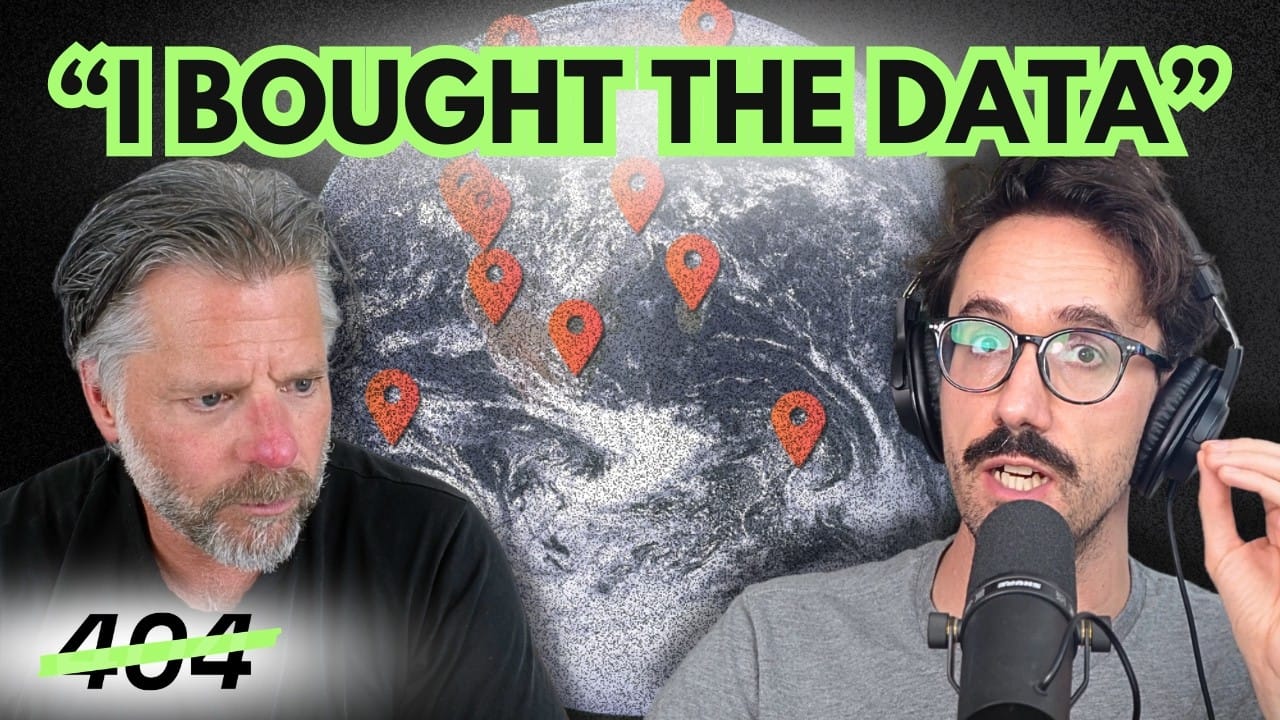
This week Joseph talks to Mike Yeagley. As you’ll hear, he is a very interesting guy. He introduced parts of the government to the whole idea of commercially sourced location data. He spent hundreds of thousands of dollars buying the data, and showing what could be done with it. It’s a fascinating conversation.
Listen to the weekly podcast on Apple Podcasts, Spotify, or YouTube. Become a paid subscriber for access to this episode's bonus content and to power our journalism. If you become a
This week Joseph talks to Mike Yeagley. As you’ll hear, he is a very interesting guy. He introduced parts of the government to the whole idea of commercially sourced location data. He spent hundreds of thousands of dollars buying the data, and showing what could be done with it. It’s a fascinating conversation.
Listen to the weekly podcast on Apple Podcasts,Spotify, or YouTube. Become a paid subscriber for access to this episode's bonus content and to power our journalism. If you become a paid subscriber, check your inbox for an email from our podcast host Transistor for a link to the subscribers-only version! You can also add that subscribers feed to your podcast app of choice and never miss an episode that way. The email should also contain the subscribers-only unlisted YouTube link for the extended video version too. It will also be in the show notes in your podcast player.
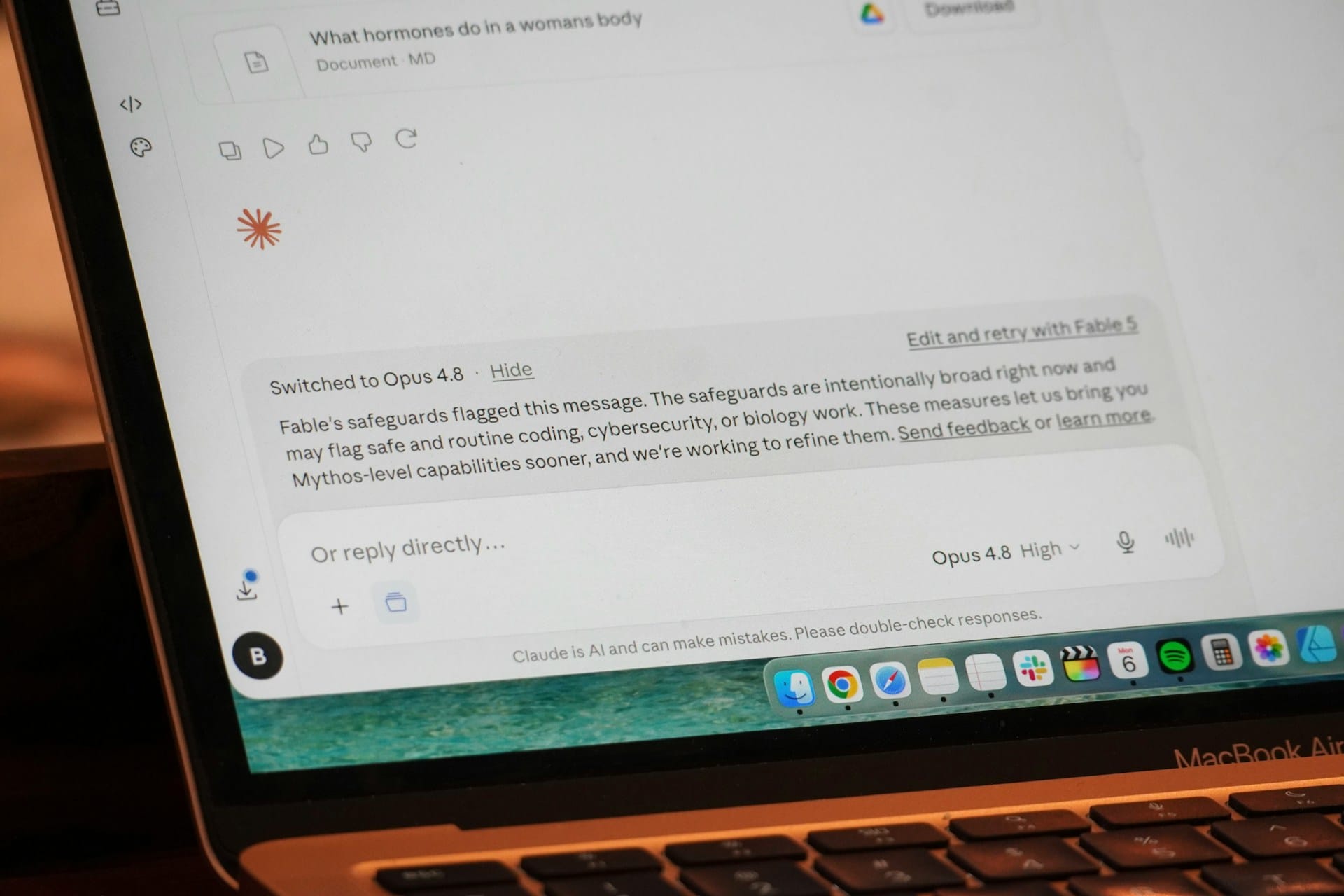
Claude is exposing a wealth of users’ chats and creations in Google search results, meaning anyone can dig through conversations or other material that people used Claude to make but may not have realized were publicly available for strangers to see.
Claude is exposing a wealth of users’ chats and creations in Google search results, meaning anyone can dig through conversations or other material that people used Claude to make but may not have realized were publicly available for strangers to see.
Slime Dot, a young R&B artist from Las Vegas, currently has over 100,000 monthly listeners on Spotify. In an interview with GQ in May, after sharing an image of herself posing with Drake on Instagram, Slime Dot directly denied accusations that she was an “AI artist,” saying “The truth doesn’t matter these days. People are always gonna try to explain something they don’t fully understand and believe what they want.” GQ originally credulously published the interview and said it was “debunki
Slime Dot, a young R&B artist from Las Vegas, currently has over 100,000 monthly listeners on Spotify. In an interview with GQ in May, after sharing an image of herself posing with Drake on Instagram, Slime Dot directly denied accusations that she was an “AI artist,” saying “The truth doesn’t matter these days. People are always gonna try to explain something they don’t fully understand and believe what they want.” GQ originally credulously published the interview and said it was “debunking the AI rumors.” Eventually, GQ added a note to the end of the article conceding Slime Dot was an AI avatar, but said the “talent behind the music remains undeniable.”
This confusion could have been avoided if Spotify had done what many of its users and critics have been begging it to do since AI music generators like Suno and Udio made it trivial to flood the internet with AI music. Spotify could flag Slime Dot and other AI-generated music on its platform as such. Other platforms, like YouTube, already do this.
Since Spotify doesn’t do that, users can visit SoullessMusic.com, a database for “AI artists hiding on Spotify. No bands, no studios, no soul, just machines and melody.” There, Slime Dot is listed as “almost certainly AI” based on an analysis of three of the tracks and the fact that Slime Dot released such a large number of tracks in a short period of time. Alternatively, users could go to SlopTracker, where they can upload files or copy/paste links to Spotify tracks to run them through a tool which will tell them, with varying degrees of confidence, whether a song was AI-generated or not. SlopTracker found that Slime Dot’s track “Fully” was 95 percent likely to be AI generated by Suno.
“I didn't know what's AI and what's not,” Graeme Fulton, who created SoullessMusic, told me. “And then I'm on Instagram Reels and I see loads of artists unhappy saying some artist has popped up with their song and just copied it. And there's loads of different cases where they [AI artists] would copy an artist's look and appearance […] sort of just stealing from artists.”
Last year, I wrote a story about an exceptionally bad example of what Fulton is talking about. A scammer used Spotify to publish AI-generated music under the name of a real, dead musician, seemingly in an attempt to syphon money from his popularity via streams. After I published that story I heard from several (living) artists who said the same thing happened to them. A similar case involving a Danish jazz musician was covered by Danish publications in April.
Another reader recently told me about a popular Spotify artist that was publishing hours of Iranian jazz every week. The channel, Qajar Jazz, which popped up in December of last year, has 29,579 monthly listeners, gained more popularity after the start of the U.S. war with Iran and the channel making vague allusions to resilience and preserving culture in video descriptions and comments on YouTube. Unlike Spotify, Qajar Jazz videos on YouTube are labeled as being AI-generated in the fine print, though it’s unclear if the channel tagged itself as such or if YouTube did. Both SoullessMusic and SlopTracker detect it as being AI generated.
Qajar Jazz did not respond to a request for comment.
Fulton said he started looking around on GitHub for open source AI music detection tools, and ended up building a new, open source detector that relies on open source models called SONICS, the lofcz vocoder fakeprint detector, and other open data sets. SoullessMusic also scans a track’s metadata for any tags that might tie it back to a specific AI music generator, and Fulton says he also has a script that scans Wikipedia for existing entries on an artist. Users can submit tracks from Spotify to the site they suspect are AI generated, and Fulton reviews them manually before adding them to the database. Despite all of this, he admits the system is not perfect.
Both Soulless Music and SlopTracker use AI and other automated tools to detect AI music. As we’ve written previously, using AI detectors to detect AI content is an inherently flawed process that can lead to false positives. When I asked him how he handles cases of false positives, Fulton said “it's not ideal when that happens, but it's going to happen because it's still quite tricky to check what's AI and what’s not.”
Spotify’s lack of transparency and unwillingness to label AI-generated music makes it impossible to track how much money its making on the platform. Last year, the company announced that it would it would AI disclosures on AI generated music, but I haven’t seen it on any of the dozens of tracks I reviewed for this story. Udio and Sudo both include inaudible digital watermarking in their generation, which in theory could make it easy for Spotify to tag these tracks.
"We're employing a layered approach that combines enforcement, artist controls and greater transparency," a Spotify spokesperson told me after this article was first published. "Over the past year, we've introduced policies targeting harmful AI-related behaviors like spam, impersonation and deceptive content, alongside new tools that give artists more control and listeners more context. These include Verified by Spotify, which helps listeners identify authentic artist profiles; AI Credits, where artists disclose when and how AI was used in creating their music, with tens of thousands of AI credit disclosures now being submitted each day; and Artist Profile Protection, which gives artists more control over what appears on their profiles. We are continuing to build on these efforts.”
Spotify also pointed me to several tracks it had flagged as AI on the mobile app, like Better Times by Mike Mana.
Soulless music attempts to quantify that number based on publicly available streaming data. The small number of AI artists tracked on SoullessMusic generate an estimated $5.7 million a year, with the most popular AI artist, mikeeysmind, generating $1.5 million annually alone. In April, Deezer, a Spotify competitor that attempts to tag all AI-generated music on its platform, said 44 percent of all new music uploaded to its platform is now AI generated. SlopTracker, which attempts to track AI generated music on Spotify that is featured on official Spotify-curated playlists, that those artists are “draining” $0.1188 per second from real artists who could be making the music instead.
I’m marching across Lower Manhattan in the middle of a heatwave with a friendly mob of Luddite gnomes, and there isn’t a phone in sight.It’s Fourth of July weekend in New York City, and the brutal temperatures haven’t stopped a hundred-or-so people from donning pointy hats and dancing in the streets while chanting anti-Big Tech slogans. “Fuck, fuck, fuck AI,” the Luddite gnomes – people in colorful, pointy homemade hats – chant as we march, urging the confused spectators recording us to put a
I’m marching across Lower Manhattan in the middle of a heatwave with a friendly mob of Luddite gnomes, and there isn’t a phone in sight.
It’s Fourth of July weekend in New York City, and the brutal temperatures haven’t stopped a hundred-or-so people from donning pointy hats and dancing in the streets while chanting anti-Big Tech slogans. “Fuck, fuck, fuck AI,” the Luddite gnomes – people in colorful, pointy homemade hats – chant as we march, urging the confused spectators recording us to put away their pocket rectangles and join us in our sweaty, phone-less revelry. The gnomes are headed West, towards Washington Square Park, where they plan to carry out a public show trial for OpenAI and its CEO, Sam Altman. It’s the fourth iteration of a theatrical protest event they call “S.H.I.T.P.H.O.N.E,” which stands for “Scathing Hatred of Information Technology and the Passionate Hemorrhaging of Our Neo-liberal Experience.”
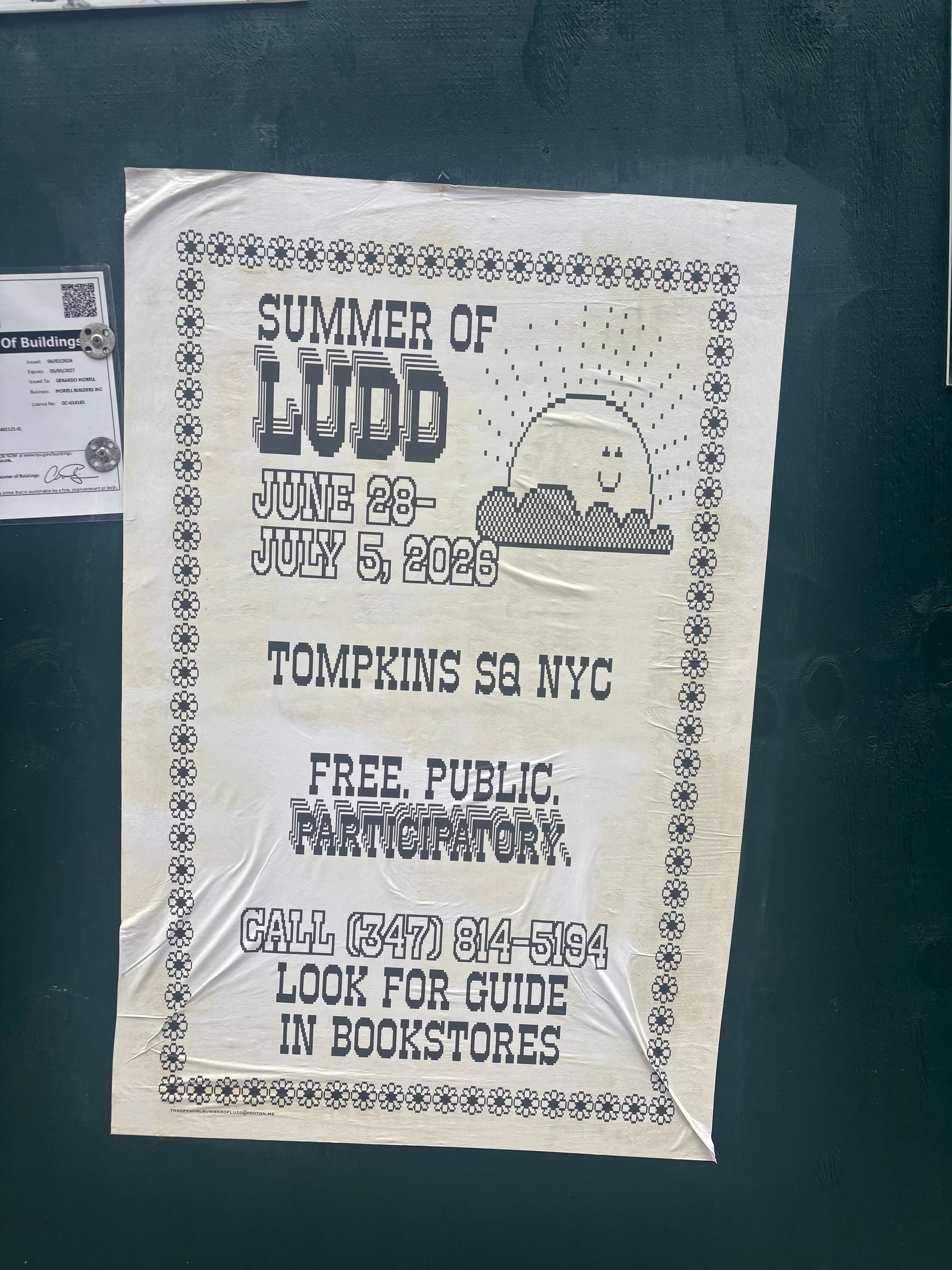
This time, the protest isn’t a one-off. It’s part of the “Summer of Ludd,” a week-long festival of free public events organized and advertised entirely off of tech platforms and social media. The Summer of Ludd doesn’t have a website, but you can call a phone number to get a run-down of the events happening each day around the city. The schedule includes everything from an “offline rizz” workshop designed to help you ditch dating apps, a phone-free rave called “Let’s Get Off Together,” internet piracy 101 skill-shares, and an outdoor play that retells the story of the original Luddites. I found out about the Summer of Ludd from a local event mailing list calledNYC Off Tech, but other folks I met throughout the week learned about it from posters wheat-pasted around their neighborhoods, paper event guides distributed to bookstores and coffee shops, or just word-of-mouth from friends.
Basically, the whole thing is an experiment designed to prove a single point: You don’t need social media and extractive tech platforms to meet people and have fun.
“Google knows next to nothing / My mom knows everything!” the gnomes chant as they hand out gnome hats to random bystanders and implore them to put away their phones. The hats, I’m told, are a reference to aDutch anarchist group from the 1970s known for their impish culture-jamming and absurd carnival humor. It’s also “just kinda silly,” one of the organizer gnomes explains to me.
At the front of the march, two gnomes carry a giant cardboard smartphone labeled “ChatGPT,” which lists off thevariouswell-documentedsocial ills caused by chatbot tools. “Even if it gives us rabies / we will free the iPad babies,” the gnomes continue chanting as they set the smartphone effigy down on a grassy knoll, next to a soapbox that will be used as a witness stand. The crowd is all-ages, but skews heavily Gen-Z — consistent with recent polls showing thatyoung people have become some of Big Tech’s fiercest critics.
Images courtesy Janus Rose
One by one, witnesses take the stand to accuse Altman of numerous crimes perpetrated by OpenAI — from training models on artists’ work, to inducing AI psychosis, to accelerating the climate crisis with polluting and power-hungry AI datacenters. “I used AI to write one of my essays and got in trouble. Now I’m starting a war on AI,” one young person says from atop the soapbox, receiving cheers of approval. “These companies want you to think that you’re dumb, but that is a lie. Everyone here is smart. Everyone here is creative,” says another witness, describing how tech companies design AI tools and social media apps to make people dependent on them — making them feel helpless, alienated, and addicted to the endless scroll. The crowd roars its unanimous verdict in unison (“GUILTY!”) and everyone begins joyfully stomping on the giant cardboard GPT phone. Leading them is a gnome “executioner” holding a hammer that bears the phrase “Enoch Made Them / Enoch Shall Break Them” — an homage to the original 19th Century Luddites, who named the hammers they famously used to smash factory machines after the guy who made both the machines and the hammers.
It’s tempting to compare the spectacle to something from the days of Occupy Wall Street. But what sets the Summer of Ludd apart from what one might expect of a Luddite protest is its lack of cynicism and an overwhelming abundance of raw, anarchic joy. Far from the distorted caricature of Luddites as curmudgeonly, puritanical tsk-tsk’ers, the new Luddites attract people to their movement through playfulness and participation. Instead of shaming others for too much screen time, they use public events to make their points for them, demonstrating organically and in real-time that the “indispensable” tech we’ve organized our lives around is not so indispensable after all.
I first met the Luddites a week earlier in Tompkins Square Park, for a press conference hosted by their official spokesperson: a puppet made of garbage.
I joined a small group of journalists sitting in plastic chairs and directing questions at the puppet, who is named Gowanus, after the famously putrid Brooklyn canal where the parts of its patchwork body were found. Gowanus is the Luddites’ “media spokespuppet,” a stand-in created to maintain the organizers’ anonymity while interfacing with digital media platforms and their operatives—including me.
As one might imagine, the Luddites are very averse to any kind of social media. Smartphones are verboten, and they ask every journalist present to sign a “Terms of Service” agreement on a comically long brown paper scroll, which states that nothing we capture may be used to make “short-form video content” like TikToks or Instagram Reels. In keeping with the spirit of the event, I kept my phone stowed away and used nothing but my Hobonichi notebook, a pen, and a small voice memo recorder to do my reporting for this article.
“We are interested in building alternative social infrastructure that allows us to be no longer reliant on Big Tech,” Gowanus told the group of journalists as they dutifully scribbled notes. “All our events are free, and defy any sort of transactionalism or consumption. We’re trying to dispel that transactional element and get people to participate and create the events themselves. That is what the Summer of Ludd is all about.”
On my train ride home, I pondered the irony of being a journalist covering an event series designed to resist digital capture and consumption. When I reached my subway stop, I noticed an ad for the second-hand online marketplace Backmarket, showing a pink Nintendo Game Boy with the text “AB > AI.” Someone drew a heart next to it in black sharpie marker—an anonymous mark of approval that felt like the opposite of the subway ads for the “Friend” AI device that were widely and virally defaced last year.
Almost reflexively, I took a picture of the ad with my phone and posted it to BlueSky with the caption: “Hatred of AI now reaching the level of cultural consensus that becomes attractive to advertisers.” I woke up the next morning to thousands and thousands of interactions, many from people delighted to see their anti-AI sentiment vaguely reflected in a subway ad for overpriced second-hand goods. This made me think about the classic political trap, where capitalists co-opt social movements by channeling their radical potential into harmless forms of aesthetic consumption and feckless identity politics.
How can the neo-Luddites resist these inevitable attempts at co-optation? Can Luddism generate mass-appeal beyond Y2K aesthetic Tiktok trends, where Gen-Z’ers marvel at flip phones, iPods, and other retro tech as a kind of performative false-nostalgia? And how do you build a successful movement while eschewing the most common (albeit flawed) tools of mass-communication?
Members of the Luddite Renaissance—as the loose-knit, anonymous collective that organized the Summer of Ludd refer to themselves—attempt to answer these questions in “The Event is the Medium,” a zine manifesto referencing the famous Marshall McLuhan quote which, naturally, is only available in physical paper format (The Luddites humbly request that none of their work be uploaded to social media). The central idea is utilizing public space to run events that get people to experience—and directly participate in—what Luddism has to offer in 2026, instead of just yelling at people on a street corner.
What should these Events entail? This is where the Luddites become intentionally vague—not for lack of answers, but as a defense mechanism designed to make the Event unpredictable and unmonetizable. If social media’s role is to consume and metabolize human existence into an endless scroll of bite-sized, short-form video content, then the Event’s purpose is to bring people together in ways that defy categorization and documentation. Like the “Happenings” of 1960s performance artist Allan Kaprow, they can be anything and everything—as long as they are free, participatory, and never, ever boring.
“The Event may seem nebulous and surreal to you; this is on purpose,” the Luddites write in their zine manifesto. “DIY shows, teach-ins, art fairs, all come with a preconceived notion of what will happen. This causes people to act in a ritualized or transactional way. Any way that you can break through the monotony of ‘coolness’ to facilitate earnestness and urgency is paramount.”
In other words: If the event is the medium, the message is that being a Luddite is fun again.
I returned to Tompkins Square several times over the next week. Throughout the Summer of Ludd festivities, the Luddites had transformed the formerly-bohemian Lower East Side hangout into a kind of town square. They camped out at the park each day, providing free food, zines, and plenty of ways to plug in to the various happenings throughout the city. Basically, if you wanted to find out what the Luddites are all about, you had to meet them here, in person.
Images courtesy Summer of Ludd
Somewhere in the large crowd that had gathered for the gnome protest, I ran into Motherboard founder and fellow low-tech appreciator Alex Pasternak, along with “extremely online” journalist Taylor Lorenz, whorecently told WIRED that her screen time averages 17 hours a day. Also present was Reverend Billy, leader of the Church of Stop Shopping, whose corporate exorcisms and culture-jamming theatrics have been a staple of NYC protests since the 90s.
“Chronically online culture has become something we’re attached to, even as activists,” Bucky, one of the Luddite organizers, told a crowd of gnomes in the park, just prior to the million-gnome march. “Our consumer habits are tracked, analyzed, and sold back to us. Every time we seek fun in our little light-boxes, we feed a beast which surveils us, which exploits our time and our imagination, and which lines the pockets of big psycho assholes like Elon Musk, Peter Thiel, Mark Zuckerberg, Marc Andreesson, and Tim Cook.”
“I want my attention back!” someone shouts in response. The crowd cheers in agreement.
Bucky mentions the 2012 Arab Spring uprisings as a pivotal example of how Silicon Valley extended this capture to the realm of activism. In the heyday of Twitter, tech companies and most of the Western press pushed a narrative that social media platforms were helping liberate people around the world from oppressive regimes. Thanks to these platforms and their beneficent corporate overlords, the argument went, the techno-utopian dream of the 90s internet would be realized, and dictators would crumble under the power of free information and free markets.
Others likeEvgeny Morozov argued that this framing was not only naïve and wrong, but allowed companies like Twitter and Facebook to advance their ambitions and establish themselves as centralized social infrastructure under the guise of do-gooder tech saviorism. At the same time, the ad-powered surveillance networks built by social media enabled governments to crack down on dissidents like never before, paving the way for things like facial recognition, algorithmic manipulation, and discriminatory digital ID laws.
But there was another explanation for the revolutions in Egypt and elsewhere that had little to do with tech.
“The reason hundreds of thousands of people went to Tahrir Square is because a million people lived within ten miles of it. That is public space, and public space is where politics happens,” said Bucky. “Public space is the new social media. Running an event is the new activist infographic on an Instagram story.”
With hatred of big tech and AI hitting the mainstream, it makes a lot of sense that something like the Summer of Ludd would emerge in this particular moment. Everywhere I go, there is an overwhelming sense that the Silicon Valley experiment is on its last legs. The companies that once aimed to make good products and postured as democracy-loving and progressive now open ally themselves with fascists, actively enshittify the internet with slop, and force-feed us annoying AI features that nobody wants. In response, the new Luddites seek not to abandon technology entirely, but build new infrastructure that embraces proximity and in-person human relationships, instead of alienation and doom-scrolling.
“This is an activism of the moment,” internet culture theorist and media professor Douglas Rushkoff, who was also present for the Luddite gnome march, told 404 Media. “Even if the whole thing is ending, even if we’ve already lost, we’re gonna go and party. We’re gonna go down having fun. And if we can have a good enough party in face-to-face, non-technological, non-digital interaction, we will seduce the world like Abby Hoffman never could.”
As the person who coined the rise of “viral” media back in the 90s, Rushkoff has been paying attention to tech backlash trends longer than most. His 2016 book “Throwing Rocks at the Google Bus” captures a pivotal moment where public sentiment toward Silicon Valley began to sour, as companies like Google and Facebook disrupted public infrastructure and reshaped the San Francisco Bay Area in their image.
Over the next decade, the tech companies did away with their vaguely progressive, ‘Don’t Be Evil’ public image, and young people who came of age in the aftermath increasingly found themselves attracted to tech backlash and the neo-Luddite movement as a reflection of their lived reality.
“The extent of the skinner box that this generation is living in is more extreme. We adapted to it as best we could, but they were born inside of it,” said Rushkoff. “Their hearts and their somatic sensibilities have been intentionally disrupted and stymied since they were born. And so they’re a good case study to show that whatever that part of us is, it will seek expression eventually.”
Bleak job prospects and a visibly collapsing climate further explain why some of the biggest moments of Big Tech backlash in recent months have come from Gen-Z—like the series of viral videos showing graduates booing tech CEOs for praising AI during their commencement speeches. But the Luddites are quick to point out that their movement is multi-generational, and their goals for the Summer of Ludd can’t be realized through the medium of news headlines and viral online attention.
So, what am I doing here? Why am I writing this article, attempting to capture the essence of a movement and an event that—by its very nature and stated intention—refuses to be captured? Maybe it’s because journalism is best when it acts as a cultural placeholder, a blurry indication that something happened here, and perhaps will keep happening in the future. It’s also a kind of beacon for others to find—an indication that the “inevitable” future tech companies keep threatening us with is perhaps not so inevitable, and that humans aren’t so hopeless at finding each other and creating new ways to live.
“Part of the concept is: You had to be there,” Rushkoff told me. “It’s like oh, Earth? You had to be there. Life? You had to be there.”
Welcome back to the Abstract! Here are the studies this week that spoke in tongues, sought forbidden love, orbited an orbiter, and performed ritual magic.First, scientists have uncovered a “golden age” of languages that flourished for millennia before fading into our dark age of linguistic extinction. Then, Alan Turing’s erotica, the search for the first exomoon, and the cave of the Old Ancestors.As always, for more of my work, check out my book First Contact: The Story of Our Obsession with Ali
Welcome back to the Abstract! Here are the studies this week that spoke in tongues, sought forbidden love, orbited an orbiter, and performed ritual magic.
First, scientists have uncovered a “golden age” of languages that flourished for millennia before fading into our dark age of linguistic extinction. Then, Alan Turing’s erotica, the search for the first exomoon, and the cave of the Old Ancestors.
Some 3,000 years ago, a “golden age” of languages dawned around the world, resulting in the proliferation of tens of thousands of tongues over the next 2,000 years. But over the past millennia, we have entered a dark age of linguistic diversity, driven by the rise of “behemoth languages” that have pushed others into extinction.
That’s the conclusion of a new study that reconstructed humanity’s linguistic diversity since the dawn of agriculture, which emerged about 12,000 years ago at the end of the Ice Age.
The global human population before agriculture is estimated to have been between 4.4 and seven million people. Modern hunter-gatherer societies can act as rough proxies for the likely distribution, sizes, and linguistic diversity of these preagricultural populations. With that in mind, researchers led by Damián Blasi of Pompeu Fabra University in Barcelona developed a model based on 171 hunter-gatherer groups, which suggested that humans spoke about 4,500 to 6,000 languages before the dawn of agriculture. That’s fewer than the 7,500 that are spoken today, but still a lot considering how few people there were on Earth at the time.
The team then ran thousands of models predicting how languages diversified and evolved as humans adopted plant and animal domestication, a process that radically increased populations and complexified cultures. The predictions converged around a scenario in which linguistic diversity peaked around 2,000 years ago with possibly as many 75,000 tongues spoken worldwide.
“We uncovered a linguistic ‘golden age’ with tens of thousands of languages 3,000 to 1,000 years ago,” Blasi’s team said in the study.”In our model, this “golden age” was followed by an extremely rapid decrease in linguistic diversity, especially over the last two millennia.”
The spread of colonialism over the past 500 years has accelerated language loss due to the ascent of behemoth languages such as English, Spanish, Mandarin, and Hindi. But the new study suggests that linguistic diversity was already in decline starting at least 1,000 years ago due to the formation of smaller-scale multinational empires. Sadly, this trend of linguistic impoverishment has far-reaching consequences beyond language itself.
“Languages (and their histories) are regularly utilized as proxies for other units of culture because language is often transmitted and acquired along with other cultural traits, including marriage patterns, religious practices, kinship systems, or modes of social organization,” the team concluded. “Therefore, cultural variants with transmission dynamics similar to those of languages have also undergone a recent mass extinction.”
Alan Turing, the famed British mathematician who helped break the Nazi enigma code, packed a mind-boggling list of accomplishments into his short life. A foundational figure in the fields of computer science and artificial intelligence, Turing died at just 41 of cyanide poisoning in the wake of horrific persecution from the British government for what was then the crime of being a gay man.
In his spare time from dramatically changing the course of history, Turing also tried his hand at writing fiction, according to a new study about his erotic short story “Pryce’s Buoy.” The draft is an autofictional account of Turing’s affair with his young lover Arnold Murray, a relationship that ultimately forced Turing to endure a sentence of chemical castration to avoid prison in the 1950s.
The draft is cut short before any sexual encounter between the characters—perhaps because Turing’s family censored it, or perhaps because Turing left it unfinished—though the tale is very clearly headed to the bedroom. Sarah Dillon of the University of Cambridge revisits the story in a new study that contextualizes it in the final years of Turing's life and links it directly to the works of gay writer Sir Angus Wilson by revealing that Turing copied many of Wilson’s stylistic choices.
“Wilson braved…dangers—he did not hide his homosexuality, and he did publish his work,” said Dillon in the study. “Turing did not hide his sexuality either, and although he did not publish his story, we cannot say whether this was through choice or because of the abrupt end to his life in June 1954.”
Turing’s life story is heartbreaking, but Dillon emphasized that “Pryce’s Buoy” is an expression of his playful, cheeky side, which persisted even in the midst of the immense injustice to which he was subjected.
Astronomers have discovered thousands of exoplanets, which are worlds that orbit other stars, but nobody has clearly spotted an “exomoon” orbiting one of these exoplanets. Now, a team reports the discovery of a Jupiter-sized world that is orbiting a massive object called a brown dwarf that is, in turn, orbiting a star called CD-35 2722, which is about 73 light years from Earth.
Concept art of the CD-35 2722 system, with the brown dwarf in the foreground, orbited by an exosatellite. Image: ESO/M. Kornmesser
This might be the first known exomoon, but the system is so weird and novel that researchers aren’t quite sure that’s the right term. Brown dwarfs are sometimes called “failed stars” because they are about as big as a gas planet can get without igniting nuclear fusion in their cores and transforming into stars. Moons orbit planets, and brown dwarfs are somewhere in between a planet and a star, so the team went with the term “exosatellite.”
“Exoplanet satellites can be easily described as exomoons, but it is not clear if satellites of brown dwarf companions can be called the same, as the term lacks a formal definition,” said researchers led by Kevin Hoy of Diego Portales University. “Perhaps we are approaching the limit of language invented to describe the Solar System, which is entirely unlike CD-35 2722.”
This is why you should always bring a poet! Whether or not the giant exosatellite gets minted as the first exomoon, the discovery is an exciting example of how diverse star systems are increasingly coming into focus.
For at least 25,000 years, the “Old Ancestors” of Aboriginal Australians gathered to burn grass and perform magic rituals within Cloggs Cave, a cavernous site several hundred miles east of Melbourne.
While the immense significance of the cave is well-known to the GunaiKurnai people of the region, as well as to generations of archaeologists, a new study has confirmed the deep roots of the site as a ritual setting for the Old Ancestors. Researchers led by Elle Grono of the Australian National University unearthed layers of “phytoliths,” which are mineral structures found in plant cells, to corroborate that the cave has been a site of magic and healing for 25,000 years.
GunaiKurnai Elder Uncle Russell Mullett at the cave entrance of Cloggs Cave. Image: Jess Shapiro, courtesy of GunaiKurnai Land and Waters Corporation
“Taken together, the archaeological features and multiple lines of archaeobotanical evidence at Cloggs Cave corroborates traditional GunaiKurnai knowledge and nineteenth century ethnography of ritual practices involving the use of plant resources, indicating that the cave was a special, secluded place used by mulla-mullung, powerful learned men and women, for the practice of magic, healing, cursing and spiritual practices,” said the team in their new study.
In our disorienting time of ephemeral reels and shortened attention spans, there’s inspiration in the incredible continuity of this storied cave, which has witnessed thousands of generations seeking solace in its confines.
This is Behind the Blog, where we share our behind-the-scenes thoughts about how a few of our top stories of the week came together. This week, we discuss astrology, Flock on the brain, The Odyssey, and more.JASON: This week I wrote pretty much exclusively about Flock, and I am working on a few more articles about automated license plate readers that will probably go in the next week or so. I am well aware that there are other topics in the world, but, basically, there is now so much interest
This is Behind the Blog, where we share our behind-the-scenes thoughts about how a few of our top stories of the week came together. This week, we discuss astrology, Flock on the brain, The Odyssey, and more.
JASON: This week I wrote pretty much exclusively about Flock, and I am working on a few more articles about automated license plate readers that will probably go in the next week or so. I am well aware that there are other topics in the world, but, basically, there is now so much interest in the company and its practices that I am getting inundated with tips, story ideas, and sources, and it feels like I have to chase many of the leads I’m getting. There are only so many hours in the day, so this means some other things I want to cover are either falling by the wayside or will have to wait.
A judge caught a court reporter making AI-generated errors in a court transcript, and put court reporters everywhere on notice for their use of AI. In a memorandum decision concerning a case about a man who sold drugs to another man who overdosed and died, filed on July 23, Judge Paul Felix wrote in a footnote of the decision that a transcript contained errors that looked a lot like generative AI. The footnote was spotted by attorney Rob Freund on X.
A judge caught a court reporter making AI-generated errors in a court transcript, and put court reporters everywhere on notice for their use of AI.
In a memorandum decision concerning a case about a man who sold drugs to another man who overdosed and died, filed on July 23, Judge Paul Felix wrote in a footnote of the decision that a transcript contained errors that looked a lot like generative AI. The footnote was spotted by attorney Rob Freund on X.
After the Los Angeles Police Department allowed its contract with Flock to expire, the surveillance company’s CEO, Garrett Langley, told local news that people don’t understand how its technology works, and that its automated license plate readers (ALPR) only take a “static picture” of a car. “The technology is really simple,” he told ABC7. "A car drives by, we take a picture. It's a static picture of a car, and then we read the license plate. That's what the technology is—it's actually not t
After the Los Angeles Police Department allowed its contract with Flock to expire, the surveillance company’s CEO, Garrett Langley, told local news that people don’t understand how its technology works, and that its automated license plate readers (ALPR) only take a “static picture” of a car. “The technology is really simple,” he told ABC7. "A car drives by, we take a picture. It's a static picture of a car, and then we read the license plate. That's what the technology is—it's actually not that complicated, it's pretty simple."
But for the last year, Flock has been marketing a new upgrade that allows “all” of its ALPRs to record live video. Langley is either dramatically underselling what Flock’s technology can do while saying that people don’t understand it, or Flock has quietly rolled back a major product feature without telling anyone. (Update: after the publication of this piece, a Flock spokesperson said Flock has discontinued the feature for law enforcement agencies.)
Flock has not been quiet about this live video upgrade; its salespeople have pitched the upgrade to cities, and the company has mentioned it in numerous blog posts (though it recently deleted one of them), and Langley even spoke about the capabilities with Forbes last year, suggesting cops could pull video in real time from its ALPR cameras: “We will just open up the five nearest cameras in real time and say, here's what's happening right now,” Langley said.
In June of last year, a Flock blog post called “Why video is the missing link in your LPR program,” the company wrote “All existing Flock LPRs will soon stream live video and capture clips with a free, optional software update. No new hardware, no permits, no extra cost. Same lens, same angle and field-of-view as the LPR. See basic video clips for every plate read. Zero lift for your team. Free and optional to opt in.”
The blog post describes several potential use cases, and different setups that police officers could use, which include adding a separate video camera to the poles that Flock cameras are installed on but also, crucially, includes the fact that all Flock ALPR cameras are capable of taking video: “Fixed live video is coming to all LPR cameras, free by end of 2025.”
And, in a now-deleted product launch blog, Flock wrote “LPR Cameras Can Become Video Cameras,” and added it was a “move that will transform the largest network of LPR cameras in the nation.”
“Flock customers don’t have to do a thing or pay a thing,” said Flock’s Chief Strategy Officer Bailey Quintrell in the blog post. “This will be a no-cost software update we push over the cloud.”
Text messages obtained using a public records request by Jason Hunyar, an activist in Dunwoody, Georgia, show that cops in Dunwoody turned on this feature. The text messages are between John Watson, a Flock employee, and a Dunwoody police officer from January of this year.
“Are y’all able to live stream LPR video yet?,” Watson asks.
“Yes,” the officer says.
“When did they turn that on and how has it been. And who turned it on?” Watson responds.
“It’s been about a month and it’s pretty cool feature,” the officer says. “Small angles but cool for incidents if needed. I’ve been working with Vijay [Dhamija, Flock’s Director of Product] on it.”
“Gotcha. Any stability issues?,” Watson asks.
“Not that I have noticed,” the officer responds.
The Flock spokesperson said, “This was not a broad rollout. Five law enforcement agencies participated in a limited pilot to test live video on select LPR devices; the LAPD was not among them.”
“In March, Flock discontinued the feature for law enforcement agencies, and it is no longer active at any of the five participating agencies. The pilot provided live video only and did not include recording or stored-video playback,” the spokesperson added.
Update: this piece has been updated to include comment from Flock.
Patreon laid off 93 employees, totaling 20 percent of its workforce on Thursday morning, according to an email to creators and staff from CEO Jack Conte.In a message sent to everyone on the platform signed up as a creator, and posted to the site, with the subject line “A Painful Update about our Team,” Conte wrote that the business is “healthy and strong” and that the core business of Patreon is not changing. Conte included the email sent to Patreon employees in the message. In the email, he
Patreon laid off 93 employees, totaling 20 percent of its workforce on Thursday morning, according to an email to creators and staff from CEO Jack Conte.
In a message sent to everyone on the platform signed up as a creator, and posted to the site, with the subject line “A Painful Update about our Team,” Conte wrote that the business is “healthy and strong” and that the core business of Patreon is not changing.
Conte included the email sent to Patreon employees in the message. In the email, he wrote that the company is undergoing both a “workforce reduction” and is “changing our organizational structure and how we work.” Specifically, he wrote, this means “we’re flattening the organization, refocusing teams on our top priorities, and evolving key aspects of our operations to make us faster at adapting to change.”
Conte is careful in this email to both express that he doesn’t view AI as a replacement for the human creativity the platform is built on and profits from — devoting a section of the email to saying as much — and also that AI is fundamentally “transforming” the tech industry, noting that it has an impact on how the company operates.
“To be clear about the impact of AI on today’s decision: we are not making the above changes because we believe AI replaces humans,” Conte wrote. “The more we have learned to use these new tools, the clearer it has become that they are not substitutes for the creativity, judgment, detail orientation, or craftsmanship that our teammates have in spades, nor do they replace the desire for human connection that all of us cherish so deeply. That’s my personal opinion, but more importantly, it’s the foundation of Patreon’s strategy: our product vision and business are both predicated on the value of human creativity and human connection. AI has fundamentally transformed the tech industry, though, including how we work, how we build products, how we communicate, and more. That does have an impact on how we operate and organize.”
Earlier this month, Patreon announced that it’s partnering with Cloudflare to block crawlers from stealing creators’ work to train AI models. “I HAVE A KICKASS PRODUCT UPDATE FOR YOU ALL!” Conte wrote in a post on Instagram. “This is live and happening at the network level on all posts published on Patreon.” The company later elaborated on the partnership in a blog post.
Included in the internal email shared publicly are severance details for laid-off workers, including 16 weeks of pay, remaining on payroll through the company’s August 20 vesting date, one additional week of pay for every full year worked at the company, additional cash payments for recent hires who haven’t reached their one-year cliff, healthcare coverage through the end of the year for eligible employees and families, and a $1,500 stipend to replace their company laptops.
A little over a month ago, the former American Idol contestant, country musician, and Instagram influencer Noah Orion appears to have learned about the surveillance company Flock. “Cities are now covering Flock cameras with trash bags,” Orion narrated over an Instagram post aggregating a 404 Media report. “It’s also pretty wild that we’ve just dropped stickers that say ‘Fuck Flock’ on them and it’s pretty cool that it’s coincidental that the sticker’s outside diameter is the same size as the ave
A little over a month ago, the former American Idol contestant, country musician, and Instagram influencer Noah Orion appears to have learned about the surveillance company Flock. “Cities are now covering Flock cameras with trash bags,” Orion narrated over an Instagram post aggregating a 404 Media report. “It’s also pretty wild that we’ve just dropped stickers that say ‘Fuck Flock’ on them and it’s pretty cool that it’s coincidental that the sticker’s outside diameter is the same size as the average camera lens on a Flock camera,” he adds, showing a mockup of an AI-generated sticker featuring a surveillance camera that is not a Flock camera.
Orion had never posted on Instagram about Flock before then. But, since that post, Orion has posted dozens of reels about Flock, apparently at great personal risk to himself. A July 8 post features an image of a printed out “CEASE AND DESIST” letter purportedly sent to Orion by Dan Haley, Flock’s head of legal affairs. “It has come to the attention of Flock Group Inc. that you have engaged in conduct involving the unauthorized dissemination of photographs, videos, memes, screenshots, or other visual materials in a manner that encourages your fans to claim and place stickers that constitute a rude and unusual manner towards our company and association. You are hereby instructed to immediately cease and desist from any further use of such materials […] any further demeaning actions or posts will result in legal action. Failure to comply with this demand may result in Flock Group inc. [sic] to persecute you and your organization to the fullest extent of the law.”
The post has 73,000 likes and has been viewed millions of times. Since that post, Orion has posted the same letter 16 separate times on Instagram, and is now posting about almost nothing besides Flock. On Tuesday, he posted a reel stating “I could go to jail soon, and I am not afraid of that. I am pushing a movement against Flock cameras.” In that video, he said he’s starting a “bail fund” in case he’s arrested and goes to jail. Collectively, these posts and videos have hundreds of thousands of likes and millions of views.
But the cease-and-desist is not real; it is a wholesale fabrication created by the influencer for attention, likes, and clout. He is at zero risk of persecution or arrest for speaking out about Flock (though he may be at risk for forging a fake cease-and-desist letter.) In the meantime, Orion has gotten more than 30,000 new followers in the last month according to the Instagram tracking website NotJustAnalytics, a period in which he has posted essentially only about Flock and, primarily, about his stickers and his cease-and-desist letter.
This constant focus on his apparent legal trouble is a relatively typical pattern for Orion; before Flock, he was posting endlessly about how his modified bus with massive speakers was going to be impounded by the authorities. Before that, he was talking about how he was going to be evicted from the space in which he modified the bus.
Over the last few months, we have seen the rise of various anti-Flock influencers and activists, and increased scrutiny from journalists, YouTubers, and independent researchers. Content about Flock has become quite popular on social media, and the vast majority of posts are from well-meaning people who are amplifying real reporting and real — if occasionally exaggerated or slightly misconstrued — information about one of the most invasive mass surveillance companies in the country. Alongside this has come lots of viral posts that either slightly misunderstand or oversell what Flock is doing or is capable of, or get, for example, the exact mechanics of how ICE may obtain Flock data wrong.
On balance, most of these posts are at least directionally correct. There is room in the movement against mass surveillance for hyperbole, satire, comedy, stunts, and misunderstandings done by well-meaning people, especially if there is a broader point.
That is not what Orion and some of his copycats are doing, however. Most charitably, Orion is making people aware of Flock and could be making people more likely to do more research into the company or is making them more likely to take political or direct action to prevent surveillance. He’s a bro spreading the word, and perhaps his heart is in the right place. But, basically, he is making shit up to make himself and his country music career more famous by creating and sowing disinformation in a space where there are dozens of journalists and influencers working hard for more transparency, and positioning himself as being somehow at legal or criminal risk when people who are doing actual needle-moving work struggle to stand out or are actually being threatened. On every post, Orion tries to give away stickers and tells people to comment “Fuck Flock” in order to get them. This is a tactic to game the Instagram algorithm with engagement; Orion has set up a bot to automatically message anyone who comments on his posts with links to his online store which has a variety of free stickers, paid merch, and a “bail fund in case I go to jail.”
Flock and its lawyers have sent real cease-and-desist letters or otherwise threatened the creators of both DeFlock, an open-source project to map Flock cameras, and HaveIBeenFlocked, a database of Flock searches done by cops around the country. Alongside reporting by 404 Media and local journalists, DeFlock has led directly to the massive, decentralized, grassroots movement of residents in small towns and big cities pressuring their city councils to end their Flock contracts. Activists and journalists using HaveIBeenFlocked have uncovered numerous cases of police abuse and ICE surveillance that has led directly to firings and arrests, policy changes, and canceled contracts. The strategies deployed by Flock against these sites are far more sophisticated and scary than the obviously bullshit cease-and-desist letter fabricated by Orion.
Flock went after Cris van Pelt, the creator of HaveIBeenFlocked, by repeatedly trying to get his web hosting revoked by its provider by claiming the site both violated the company’s intellectual property rights and by saying that the site “poses an immediate threat to public safety and exposes law enforcement officers to danger.” Flock directly warned police about this website, which led different divisions of the FBI to warn law enforcement about the site, squarely putting a target on the site. Through a third-party law firm, Flock separately threatened DeFlock by sending a cease-and-desist to Will Freeman, the creator of the site. To fend off that cease-and-desist, Freeman had to get representation from the Electronic Frontier Foundation. Flock’s CEO, Garrett Langley, called DeFlock a “terroristic organization” in an on-camera interview with Forbes. After that interview repeatedly went viral, Langley finally apologized in a second interview with Forbes earlier this month. These are actual threats, against people actually doing the work.
It is hard to see how Orion shouting nonsense into a camera to his 800,000 followers benefits anyone but himself; after his first few viral posts, various other Instagram accounts began posting fake Flock cease-and-desist letters to promote, for example, “The Saturday Salon,” an event series in Orange County, California that largely promotes its events via AI-generated posters (Saturday Salon also created a fake Palantir cease-and-desist in January).
Benn Jordan, a researcher and YouTuber who has uncovered various Flock security flaws and has become one of the most important voices speaking out against Flock, made a video about Orion’s fake cease-and-desists in which he said “Can y'all just eat Tide Pods or something and stop making this fight even harder than it already is?”
“If you get sued for doing this, I have absolutely no sympathy for you, because if somebody made a fake cease-and-desist or lawsuit letter from me and forged my name and posted it online for attention making me look bad, I would sue the fuck out of them,” Jordan said. “More importantly, Flock frames me like Jake Paul, like a hyperbolic YouTuber who’s just doing magic tricks and making things up to make the company look bad for my own personal gain, and by doing so, they’re able to squash and make it seem risky to read real reports about security vulnerabilities, or Fourth Amendment right violations. And I can guaran-fuckin-tee you that they will use these fake letters as an example to lump in with actual, meaningful critical research about police surveillance.”
Haley, Flock’s chief legal officer, told me in a LinkedIn message that “of course they are fake.” Haley added via a spokesperson that “We’re aware of at least two forged letters circulating on the internet, including this one [referring to Orion’s], that purport to be cease-and-desist letters from our legal department. To be clear: these letters did not come from me or from anyone at Flock. Flock welcomes and encourages public debate about our technology. We have not and would not seek to discourage, prevent, or prohibit such discussion and debate. In fact, we would be happy to participate in any such discussions the group in question might host in the future."
Orion did not respond to an Instagram message I sent him asking about the fake cease-and-desist letter.
From phone location data, to social media monitoring, to online undercover tools, a document obtained by 404 Media lays out the surveillance tech available across ICE agency wide.
From phone location data, to social media monitoring, to online undercover tools, a document obtained by 404 Media lays out the surveillance tech available across ICE agency wide.
🌘Subscribe to 404 Media to get The Abstract, our newsletter about the most exciting and mind-boggling science news and studies of the week. Scientists have discovered a previously unknown behavior in orcas that involves one member of a pod holding up a massive dead sunfish while another charges and rams it, resulting in the dramatic explosion of the carcass into fleshy fragments, according to a study published on Thursday in Frontiers in Ethology. Orcas often ram or strike prey as a hunting tac
Subscribe to 404 Media to get The Abstract, our newsletter about the most exciting and mind-boggling science news and studies of the week.
Scientists have discovered a previously unknown behavior in orcas that involves one member of a pod holding up a massive dead sunfish while another charges and rams it, resulting in the dramatic explosion of the carcass into fleshy fragments, according to a study published on Thursday in Frontiers in Ethology.
Orcas often ram or strike prey as a hunting tactic, and some pods are also notorious for ramming boats. But the new study is the first to report such explosive results and sheds light on the mysterious lives of orca pods in the Gulf of California. The hold-and-ram strategy allows juvenile orcas to feed on smaller chunks of tissue and may also serve as a form of social learning and play in these highly intelligent marine mammals.
Erick Higuera, a wildlife cinematographer and marine biologist, first observed orcas detonating a sunfish in 2021. The tactic was captured in follow-up footage by marine biologist Kathryn Ayres in 2024, as well as video from another event in 2025, filmed by Héctor Franz, who works in ecotourism.
“The first time I witnessed it, at that moment, the energy of the impact was astounding because we could hear the sound when the orca ran into the sunfish,” said Higuera, who co-authored the new study, in a call with 404 Media. “Seeing a multi-ton predatory mammal striking a massive fish—because sunfishes can go up to two meters depending on the species—with such a fast speed is breathtaking, and immediately we knew that we were witnessing something highly unusual due to the magnitude of the tissue explosion.”
Orcas are social animals that form tight-knit matrilineal pods that in turn belong to broader “ecotypes” with their own unique cultures and ranges. In the Northeastern Pacific, there are three genetically distinct lineages: resident orcas that primarily eat fish, transient orcas that mainly eat marine mammals, and offshore orcas that prey on sharks.
But less is known about the feeding behaviors of orcas at lower latitudes near the equator, which don’t seem to fall into such clear ecotypes. For years, Higuera and his colleagues have been capturing footage with drones and underwater cameras to better understand the mysterious pods that roam in the Gulf of California. That’s how they were able to fortuitously capture the explosive hold-and-ram strategy on film.
Sunfish are large, but easy to hunt, making them a popular target for orcas and other ocean predators. However, these animals have tough and rubbery flesh that is difficult to tear apart, especially for young orcas. For this reason, Higuera and his colleagues speculate that the ramming technique is primarily intended to loosen nutritious tissue from the carcass for juveniles to consume, noting that the adults focused on eating organs and meat from the body itself, leaving the fishy ejecta for their young. The behavior may also just be fun, as orcas often play with their food.
“Orcas are highly encephalized predators that frequently engage in object manipulation and play behavior with their prey,” Higuera said. “That is very globally well known. Because sunfish are slow-moving and defenseless, they present a low-risk opportunity for the pod, especially subadults, so they can practice strike precision and reinforce social bonds. It's social play and learning.”
The team plans to continue tracking the pod to better understand the behavior, and to learn whether the sunfish’s microbiome and enzymes might contain special nutrients for the orcas. At the same time, Higuera emphasized that human interactions with orcas should remain as limited as possible, especially since whale watching in the region has become a popular tourist activity.
“This groundbreaking insight was only made possible through a vital collaboration between expert scientists, eco-tourism operators, and citizen scientists equipped with drones and cameras that are willing to provide their footage to us so that we don't spend that much time in the field,” Higuera said.
“If we can protect these animals by maintaining a respectful distance,” he concluded, “this ongoing partnership will allow us to safely document hidden mysteries of marine life that would otherwise remain completely closed to science.”
🌘
Subscribe to 404 Media to get The Abstract, our newsletter about the most exciting and mind-boggling science news and studies of the week.
It’s that time again! We’re planning our latest FOIA Forum, a live, hour-long or more interactive session where Joseph and Jason will teach you how to pry records from government agencies through public records requests. We’re planning this for Thursday, July 30th at 1PM ET. That's in just one week today! Add it to your calendar! So, what’s the FOIA Forum? We'll share our screen and show you specifically how we file FOIA requests. We take questions from the chat and incorporate those into our
It’s that time again! We’re planning our latest FOIA Forum, a live, hour-long or more interactive session where Joseph and Jason will teach you how to pry records from government agencies through public records requests. We’re planning this for Thursday, July 30th at 1PM ET. That's in just one week today! Add it to your calendar!
So, what’s the FOIA Forum? We'll share our screen and show you specifically how we file FOIA requests. We take questions from the chat and incorporate those into our FOIAs in real-time. This time we're particularly focused on city council meetings. Jason watches a lot of these and has tips for more quickly navigating and finding information within them. He then does a bunch of public records requests based on what happened in the meeting. He'll explain all of this, from Flock to other topics too.
If this will be your first FOIA Forum, don’t worry, we will do a quick primer on how to file requests (although if you do want to watch our previous FOIA Forums, the video archive is here). We really love talking directly to our community about something we are obsessed with (getting documents from governments) and showing other people how to do it too.
Paid subscribers can already find the link to join the livestream below. We'll also send out a reminder a day or so before. Not a subscriber yet? Sign up now here in time to join.
We've got a bunch of FOIAs that we need to file and are keen to hear from you all on what you want to see more of. Most of all, we want to teach you how to make your own too. Please consider coming along!
On Tuesday night, the city council of my small town of Irmo, South Carolina, voted to install 22 new Flock cameras. That’ll bring the total up to 33. With a population of only 12,000 or so, it means there’ll be one Flock camera for every 300 residents. That means there will be more Flock cameras in my town than police officers. The city council — the governing body consisting of the mayor and 4 councilpersons — voted for Flock expansion despite presentations from residents about the dangers o
On Tuesday night, the city council of my small town of Irmo, South Carolina, voted to install 22 new Flock cameras. That’ll bring the total up to 33. With a population of only 12,000 or so, it means there’ll be one Flock camera for every 300 residents. That means there will be more Flock cameras in my town than police officers. The city council — the governing body consisting of the mayor and 4 councilpersons — voted for Flock expansion despite presentations from residents about the dangers of what they described as the creeping surveillance state.
The vote for the cameras was a hot topic in local news and South Carolina social media. The city council expected a lot of people to show and asked folks to sign up early if they wanted to talk. Since I work for a publication that has been on the cutting edge of reporting on the myriad problems with Flock cameras, I decided I should probably speak. I spent Tuesday refreshing myself on 404 Media’s reporting and wrote a presentation for the council.
Meetings like this are happening in hundreds of communities across the country and I want to give 404 Media readers a snapshot of what they’re like. There’s a nationwide debate on whether cities and towns want Flock cameras or not and this was my experience speaking at one of the small ones.
There was a hard 3-minute time limit and I had written three pages. I found details about Irmo’s Flock searches in the logs of other states, talked about the specific data security concerns with the cameras, and attempted to explain all the mistakes and false arrests Flock had caused. Three minutes goes by fast, and I ran out of time before I could say everything I had planned.
I wasn’t the only person who decided to speak. More than 10 other citizens went to the podium and spoke out against the cameras. “Is Irmo such a dangerous place that current law enforcement tools are not sufficient to keep the citizens safe without the use of this dangerous and controversial technology?” one guy said.
“I’m pretty enthralled by all the pushback you’re getting on the cameras you installed without asking a single member of the community if they wanted them installed,” said another resident, a man in a T-shirt and shorts. “If you give the government a tool, they will misuse it. Period. End of story. Get rid of them or we will get rid of them for you.”
The city council members looked its residents in the face. They maintained eye contact and appeared shocked when citizens talked about their concerns. For a bit, I thought it was possible that the town might not install these cameras. Then the police chief stood up and explained how he’d used Flock to capture pedophiles and I knew that was probably the end of it.
Police chief Bobby Dale has long been an advocate for the expansion of Flock in town. He told local outlet News19 that 33 cameras will allow him to see all the entrances and exits. “That would ultimately cover pretty much every nook and cranny, every entry point into the town,” he said. “That's what we want. As the chief of police, I've got to make sure our town is safe. I'm learning that with these cameras, with these license plate readers, we're solving crimes and solving them quicker.”
During the city council meeting, Dale explained that Flock cameras had been instrumental in a To Catch a Predator style sting operation Irmo PD conducted. “During an internet crimes against children operation hosted by a department, 15 adults traveled to our community believing they were coming to meet children for sexual activity," Dale said. “Fourteen of those 15 suspects were not from our jurisdiction.”
“So you lured them here. Into our town. Genius,” the T-shirt and shorts guy shouted from the back of the room. This was the guy who’d said the community would remove the Flock cameras if the city didn’t. The mayor had police escort him from the meeting. He left without a fight and Dale finished his speech praising Flock.
After a brief question and answer period with the police chief, the mayor spoke. The city’s leaders had just returned from the Municipal Association of South Carolina annual meeting — a yearly conference of local officials in the state. Mayor Bill Danielson opened his portion of the Flock discussion by talking about how he’d recently commiserated with other mayors at the conference about how mean people were on Facebook.
“I came back with a renewed vigor to be the mayor of this town,” he said. “And knowing that I’m not the only one being abused on Facebook, social media, by some people in this room. It’s going to take a whole lot more than that to sway any position I may or may not have on behalf of these citizens.”
The other thing the mayor learned is that everyone loves Flock. “There was not a mayor at that conference that I touched bases with […] that did not use Flock, did not use Motorola license plate readers,” he said, referring to another company that sells similar technology (we’ve reported ICE is offering demos to its agents to use a Motorola license plate reader app). “Every one of those mayors either wanted Flock, was trying to figure out how to budget for Flock, or had Flock and was figuring out how to increase their presence.”
Flock is not, in fact, universally popular among state and local officials. The Los Angeles Police Department just announced it wouldn’t renew its contact with the company after an internal audit found it led to 161 false accusations of car theft and “eroded public trust.” Bandera, Texas, voted to remove its cameras after months of outrage from its citizens. Dayton, Ohio wants their cameras gone but isn’t sure how to cancel the contract so it's covering the cameras with black trash bags. Flock seems unable to remotely disable its own cameras so cities that no longer want them have to find their own solutions.
Cops also often misuse Flock. There are dozens of cases around the country of cops using the system to stalk people. In nearby Greer, South Carolina, two police officers were just fired by the town after they were discovered using Flock to track people around town.
Mayor Danielson said he’d met a leader from Greer at the conference. “I even spoke to a councilmember from Greer, the dreaded Greer […] whose two cops abused it,” Danielson said. “And I told him point blank, if that happened in the town of Irmo they would not only be fired they would never be a cop again and face charges.”
My city council voted 4 to 1 to increase the presence of Flock in this small town of 12,000 people. Police chief Dale will soon have more cameras than officers. And, if they can get money from the state, they may also purchase a drone from Flock to use as part of the company’s “drones as first responder” program.
People weren’t happy. The mood in the room was sour. I’ve attached my entire speech to this story so you can see what I planned to say.
My Flock speech for the city council
Hello.
My name is Matthew Gault and I’m here today to talk about Flock cameras.
I’m a resident of Irmo and I am also an investigative journalist. I work at a publication called 404 Media that focuses on technology.
Over the past few years, my colleagues at 404 Media have written a number of stories about Flock cameras and, before you vote to install 22 more of them in our small town, I want to share the results of some of those investigations with you.
Mr. Ward, I understand you’re concerned about cyber security around the data these cameras collect.
Last month, 404 Media found Flock had accidentally exposed some of the searches performed by law enforcement in its automatic license plate readers. The searches were cached in search engine results. This meant that anyone was able to see what police were looking for. 404 Media conducted some of its own searches and found that Flock had exposed people’s license plate numbers and various search terms like “investigation” and “GTA,” which is short for Grand Theft Auto.
In December of last year, 404 Media found a different and more severe security issue in Flock’s systems. The company had left 60 of its AI-enabled Condor cameras exposed on the open internet.
That meant that anyone could watch them, download 30 days worth of video archives, change settings, see log files, and run diagnostics. My colleagues were able to access Flock’s cameras simply by typing a website into a browser. They did not need a username or a password. There was no great trick to it. Once inside the system they could see playgrounds, parking lots, and people doing their shopping.
These are just two of the security issues we know about.
It’s also worth telling the council how, exactly, Flock’s systems work.
Many of Flock’s license plate reading cameras are connected to local, state, and national networks. When an Irmo police officer runs a search for a specific license place, they may not just be searching the cameras in their jurisdiction. The search can run through the national network of Flock cameras, if configured to do so. This works two ways. Meaning law enforcement officers at a state and federal level searching Flock cameras may have access to Irmo’s data too.
In fact, because many of these cameras are networked and interconnected, I have access to some of the current records about how Irmo, PD is using them.
I know that Irmo, PD has conducted at least 7,576 searches of Flock’s networks since 2023. If you were curious, most of the searches are conducted around 5 PM. Most of the searches happen on Monday. I know that, for some reason, Irmo PD ran 489 searches on December 21, 2025.
I know that on June 30 at 4:36 PM, the Irmo PD ran a search of the Flock system related to a stalking case.
Two days before, on June 28 at 6:45 PM, the police searched Flock in relation to a case of property damage.
On May 22, just before noon, police searched Flock in relation to a financial crime, something that was marked as “embezzlement or fraud” in the system. For this search in particular, Irmo PD accessed cameras outside of its jurisdiction — it widened the search to footage recorded by cameras nation-wide.
Why do I know all this? How is this possible? Because some police departments in the Flock network conduct routine audits of Flock’s search logs. All three of the searches I just noted were in an audit conducted by the city of Twin Falls, Idaho, a city on the other side of the country. I found information about Irmo’s historical Flock use in audits conducted by police in Georgia, Connecticut, Pennsylvania, and California.
Calling Flock’s cameras “license plate readers” is technically true, but can sell the system short. The basic model is recording the license plate of vehicles, automatically logging information about the make and model of the car as well as stickers and any other distinguishing features. Much of this information is recorded by an AI system. It makes mistakes.
This system has led to false arrests or traffic stops. Earlier this month, a journalist for a car magazine was pulled over by police in Minnesota. The cops said they’d been tracking him for days and that the car he was driving was stolen. The tip came from Flock’s systems, which had been alerted to the theft of a car in California. But the AI system had transcribed the license plate incorrectly.
In Colorado, a woman was accused of stealing packages off people’s porches.The police’s evidence that she’d committed the crime was footage pulled from Flock cameras. Bodycam footage published by 404 Media showed how confident officers were that they had their thief.
“I have you on camera doing this […] I get that this is a shock to you, but I am telling you, this is a lock, 100 percent no doubt she did this,” an officer in Colorado said.
The woman had not committed the crime. She had ample evidence she had not committed the crime, but the police in Colorado insisted that Flock cameras do not lie and do not make mistakes. But they had. Her own dashcam exonerated her and police dropped the charges.
Last week, the Los Angeles Police Department announced it would not renew its contract with Flock. In a two month period, LAPD pulled over 161 innocent people acting on tips from Flock cameras.
“Subsequent investigations determined the vehicles were not stolen,” LAPD said in an investigation into its Flock cameras. “In addition to creating an inconvenience for vehicle owners, these inaccuracies can affect individual liberties, erode public trust, and potentially create substantial legal and financial liability concerns.”
These stories are just a small selection of the issues with Flock and I hope the council will consider them before its vote today.
🎉YOU'RE INVITED! 404 Media is turning three, and we're throwing TWO separate events in NYC to celebrate: A live taping of the podcast with a special night of talks on Sept. 3, and an open-bar bash on Sept. 4. Subscribers at the Supporter level get free and discounted access to both events. Not a 404 Media Supporter yet? Sign up, and get all the party details here.For weeks, Verona, Wisconsin tried to get Flock to remove the three automated license plate cameras that its city council had voted
YOU'RE INVITED! 404 Media is turning three, and we're throwing TWO separate events in NYC to celebrate: A live taping of the podcast with a special night of talks on Sept. 3, and an open-bar bash on Sept. 4. Subscribers at the Supporter level get free and discounted access to both events. Not a 404 Media Supporter yet? Sign up, and get all the party details here.
For weeks, Verona, Wisconsin tried to get Flock to remove the three automated license plate cameras that its city council had voted to stop using. Flock told city employees not to remove the cameras, and a Flock employee told city officials that they were unsure whether the cameras could be remotely disabled, which led the town to decide to put black plastic trash bags over them until Flock eventually removed the cameras itself, according to emails obtained using a public records request by 404 Media.
The emails give insight into the process cities face while deFlocking themselves after voting not to renew a contract with the AI surveillance company. As we’ve previously reported, multiple cities around the country have decided to put black trash bags over their Flock cameras while they wait for them to be removed; this is in part because, until the cameras are physically removed by Flock, cities are unsure whether they have the legal right to remove the cameras themselves and are not sure whether they can disable their recording operations. The emails show Verona city officials telling each other that they had made multiple requests to Flock to have the cameras removed, and show a work order from Flock in which the cameras were set to have maintenance performed on them rather than being removed.
In February, Verona mayor Luke Diaz told the Wisconsin Examiner that Flock didn’t remove the cameras even after several requests: “They weren’t removing them,” he said. “We kind of looked at the contract, talked it over amongst staff, and the thing we felt most comfortable with was just covering them so they could stop spying on people … I’m 100% certain that they were still working,” even after the contract ended, he said. The emails obtained by 404 Media give more insight into what was happening behind the scenes, and why it took so long to get Flock to remove the cameras.
A Flock spokesperson told 404 Media that the discrepancy occurred because Verona voted to not renew its contract rather than outright canceling it mid-term. It is clear from emails obtained by 404 Media, however, that Verona city officials wanted the cameras to come down as quickly as possible.
We start this week with Joseph’s story on how cops are using Flock to track actual people, not just cars, with searches like “male with tattoos.” After the break, Emanuel tells us all about the company that is explicitly selling mountains of books to AI companies and promising to keep the sales a secret. In the subscribers-only section, Jason tells us how he learned about the Suno hack and what it showed us.
Listen to the weekly podcast on Apple Podcasts, Spotify, or YouTube. Become a paid
We start this week with Joseph’s story on how cops are using Flock to track actual people, not just cars, with searches like “male with tattoos.” After the break, Emanuel tells us all about the company that is explicitly selling mountains of books to AI companies and promising to keep the sales a secret. In the subscribers-only section, Jason tells us how he learned about the Suno hack and what it showed us.
Listen to the weekly podcast on Apple Podcasts,Spotify, or YouTube. Become a paid subscriber for access to this episode's bonus content and to power our journalism. If you become a paid subscriber, check your inbox for an email from our podcast host Transistor for a link to the subscribers-only version! You can also add that subscribers feed to your podcast app of choice and never miss an episode that way. The email should also contain the subscribers-only unlisted YouTube link for the extended video version too. It will also be in the show notes in your podcast player.
When you open a new credit card, you necessarily give the credit card company your address. You probably expect that information to remain with your bank.But when you open a new credit card or change your address on file, your address leaves your credit card provider, travels through a web of middlemen companies, and ends up with Immigration and Customs Enforcement (ICE), which can then search, analyze, or pair that data with other pieces of information about your life without a warrant.404 Medi
When you open a new credit card, you necessarily give the credit card company your address. You probably expect that information to remain with your bank.
But when you open a new credit card or change your address on file, your address leaves your credit card provider, travels through a web of middlemen companies, and ends up with Immigration and Customs Enforcement (ICE), which can then search, analyze, or pair that data with other pieces of information about your life without a warrant.
404 Media has mapped out this supply of data by reviewing U.S. government procurement records and internal documents from companies providing the information. It highlights the sometimes unexpected ways ICE is gaining access to peoples’ personal information as the agency continues to acquire and leverage all sorts of data.
“No one signing up for a credit card thinks they're giving data brokers a thumbs-up to sell their personal information to ICE. Not only is it an outrageous violation of our privacy, it's impossible for Americans to opt out,” Senator Ron Wyden told 404 Media in a statement.
When I was 20 years old, I went to my hometown Olive Garden with one goal in mind: For less than $10, I would attempt to eat so much bottomless pasta in their so-called Never-Ending Pasta deal that either the staff would be forced to stop me and my idiot friends from putting the franchise into the red, or I would die trying. In either scenario, I planned to get a serious bang for my buck. No one asked to see my ID. I ate a ton of linguine alfredo (probably four bowls — not heroic and definite
When I was 20 years old, I went to my hometown Olive Garden with one goal in mind: For less than $10, I would attempt to eat so much bottomless pasta in their so-called Never-Ending Pasta deal that either the staff would be forced to stop me and my idiot friends from putting the franchise into the red, or I would die trying. In either scenario, I planned to get a serious bang for my buck. No one asked to see my ID.
I ate a ton of linguine alfredo (probably four bowls — not heroic and definitely not financially devastating to Olive Garden), shamefully tapped the mat, and went back to my friends’ place to smoke too much weed. The next morning, on the four hour drive back to my college town, I started feeling a burning, cramping pain in my abdomen. By that evening, I was curled up in pain and could barely walk. I drove myself to the emergency room, confessed my sins, and learned I had a handful of gallstones that the buckets of creamy, fatty, carby pasta had aggravated into an attack.
Should I have been carded before carrying out such a reckless crime against my own wellbeing? Maybe. But this week, right-wing groups and Republicans have started repeating a lie that Olive Garden’s promotional deals are more secure than the country’s elections.
Apple says it has fixed a vulnerability in its Hide My Email feature which let essentially anyone figure out a user’s real email address which was supposed to be protected by the feature. Apple only fixed the vulnerability after 404 Media wrote about it at the start of July, despite Apple knowing about the issue for more than a year.The news also follows the filing of a class action lawsuit against Apple over the vulnerability.On Wednesday Apple told 404 Media it deployed a patch for the issu
Apple says it has fixed a vulnerability in its Hide My Email feature which let essentially anyone figure out a user’s real email address which was supposed to be protected by the feature. Apple only fixed the vulnerability after 404 Media wrote about it at the start of July, despite Apple knowing about the issue for more than a year.
On Wednesday Apple told 404 Media it deployed a patch for the issue on July 3, which the company says has fully resolved the issue.
Hide My Email is part of Apple’s paid iCloud+ product. It lets customers quickly create a new, anonymous email address they can then use to sign up to websites, services, or email people with. The generated email addresses typically contain two random words followed by a number and the @icloud.com domain. I use it heavily so hackers may have a harder time cross-referencing my activity and accounts across data breaches, for example.
💡
Do you know about any other privacy issues like this? I would love to hear from you. Using a non-work device, you can message me securely on Signal at joseph.404 or send me an email at joseph@404media.co.
Tyler Murphy, co-founder of EasyOptOuts, discovered he was able to find the real email address of Hide My Email users. At the time, Murphy said, “We don't know the full scope of the issue, but in our limited tests with volunteers, 100% of Hide My Email addresses were exploitable.” That included mine, which we tested.
Murphy first reported the issue to Apple in June 2025. Over the subsequent months, Apple said it was looking into the issue and said it had fixed it; Murphy found it was still exploitable; and Apple again said it was looking into it. Murphy, thinking Apple may not fix the issue at all, then contacted 404 Media, around a year after Apple learned of the vulnerability.
When 404 Media first covered the issue several weeks ago, we did not include any details on how it worked because Apple had not fixed it. Meaning, if we published more specifics, third parties might figure out how to exploit it and reveal peoples’ real email addresses.
Now Apple says it has been fixed, we can add that, in simple terms, it required sending a target Hide My Email user a message that got rejected as spam. “We don't know how often hidden email addresses were leaked in email logs. For many major email hosts, the leak was triggered simply by an email being automatically rejected as spam, even if it was a legitimate message. Such emails probably didn't make it to your inbox, so you can’t review your spam folder to learn whether you were affected,” Murphy and EasyOptOut co-founder Ben Weiner said in a new statement.
“The bug that caused Apple's Hide My Email to leak hidden email addresses to senders has been fixed. However, we don't think the risk to Hide My Email users has been eliminated. Because non-malicious emails could bounce, revealing your hidden email address, and because mail transfer logs are often retained, we'd assume that any hidden email address linked to a Hide My Email address created before July 7, 2026, may have been exposed and could still be in third-party logs,” they added.
The class action lawsuit against Apple seeks full recovery of the subscription costs customers paid for the feature and an injunction against Apple for its “deceptive conduct,” PCMag reported.
As AI companies search for more training data to improve their models, one company is offering old, printed books as an ideal source because they are guaranteed to be free of the very AI slop AI companies are producing. “The world's best AI training data is sitting on a shelf,” ISBNdb, a company that produces what it claims is “the world’s largest book database,” and that offers high-volume book acquisition services for AI companies, says on its site. “Books represent curated, peer-reviewed, dom
As AI companies search for more training data to improve their models, one company is offering old, printed books as an ideal source because they are guaranteed to be free of the very AI slop AI companies are producing.
“The world's best AI training data is sitting on a shelf,” ISBNdb, a company that produces what it claims is “the world’s largest book database,” and that offers high-volume book acquisition services for AI companies, says on its site. “Books represent curated, peer-reviewed, domain-specific human knowledge, structured in a way no web crawl can replicate. Dense, edited, authoritative.”
🎉YOU'RE INVITED! 404 Media is turning three, and we're throwing TWO separate events in NYC to celebrate: A live taping of the podcast with a special night of talks on Sept. 3, and an open-bar bash on Sept. 4. Subscribers at the Supporter level get free and discounted access to both events. Not a 404 Media Supporter yet? Sign up, and get all the party details here.The New Orleans Police Department (NOPD) looked at ways to arm quadcopter drones with weapons, according to a draft version of its dro
YOU'RE INVITED! 404 Media is turning three, and we're throwing TWO separate events in NYC to celebrate: A live taping of the podcast with a special night of talks on Sept. 3, and an open-bar bash on Sept. 4. Subscribers at the Supporter level get free and discounted access to both events. Not a 404 Media Supporter yet? Sign up, and get all the party details here.
The New Orleans Police Department (NOPD) looked at ways to arm quadcopter drones with weapons, according to a draft version of its drone manual shared with 404 Media. A draft version of the manual, which was live on the NOPD website in June, said that the department’s drones could only be equipped with weapons with written approval from the Superintendent of Police.
The current version, live as of July 1, has different language: “The sUAS shall not be equipped with weapons or hazardous materials of any kind,” referring to small Unmanned Aerial Systems, or drones. According to the NOPD, the operations manual it published to the internet with the rules for weaponized drones was an early draft.
“The manual published on July 1 is the current published version of the policy. Earlier versions were draft versions that were presented for review before adoption of the current policy,” NOPD told 404 media. “NOPD has made it clear we are not and will not be equipping drones with weapons or other hazardous materials.” NOPD didn’t answer follow-up questions about how or why the draft version of the manual was published.
But the publication of a police drone manual that opens the door for weaponized quadcopters is important, and comes as drone companies and police flirt with the idea of putting weapons on their drones. New Orleans has long been a pioneer of camera and drone driven policing and the cops have used controversial tactics to get around public scrutiny and regulations. It shows that what the police are circulating amongst themselves and thinking about privately, what they perhaps want to happen, does not match public policy.
NOPD has a history of finding creative ways to work around public policy and scrutiny when it comes to surveillance tech. A private company called Project New Orleans operates a network of cameras that provide live facial recognition to the city’s cops. The company operated in secret cooperation with NOPD for two years before the Washington Postexposed it in 2025. According to the ACLU, NOPD has continued to use Project New Orleans in contravention of local laws and has stonewalled public records requests.
Federal Aviation Authority regulations prohibit the operation of drones equipped with a “dangerous weapon.” Matthew Guariglia, a senior policy analyst at the Electronic Frontier Foundation, told 404 Media that he didn’t see how the police arming drones could possibly be legal. But the FAA regulation was written in 2018 and things have changed a lot in just the last few years. Last month, Guariglia argued that “we have precious little time” to stop police from arming their drones, and that the industry was moving that way.
One of the companies selling NOPD its drones is Skydio. The US-based manufacturer of quadcopter drones has done very well since the Trump administration banned the sale of foreign-made drones last year. Skydio has always marketed itself as a drone company for first responders and had a cozy relationship with police departments around the country.
In 2020, Skydio wrote “we will not put weapons on our drones and will oppose fully autonomous lethal weapons systems.”
But Skydio CEO Adam Bry walked this back in a June 15 interview on Decoder. “So this is an area where I think I’ve gotten some things wrong. We’ve said some things previously that led some folks externally and internally to believe that, for example, we would prevent the military from putting weapons on our drones,” Bry said.
“It’s not our place to tell them what they can and can’t do,” he said. “It should be up to the folks who’re putting their lives on the line to decide how to use it.”
He added that terrorists don’t follow terms of service. “They don’t care what our policy says,” he said. “I think when you start trying to draw these bright lines and say: this is good, this is bad, more often than not you’re going to end up on the wrong side of moral questions.”
Guariglia also pointed to a planned pilot project in Georgia that will test “less lethal” armed drones to nominally stop school shootings. He noted that in recent years many drone regulations have been ignored or relaxed.
“You used to have to have line of sight of your drones and now law enforcement [...] are phasing that out or offering exemptions,” Guariglia said. “If you want to police divisions a few years ago, they were selling drones capable of flying miles and miles in a couple of minutes and you’d ask them about the line of sight rule and they would just shrug. They are preparing for the day when law enforcement gets whatever they want.”
“Clearly they’re thinking about it,” Guariglia said of the NOPD manual that included a provision for armed drones. “Drones have always been a bit of a solution in need of a problem. There are few things that police say they need drones for that they cannot get by other means, and I think by putting other tools on them, they are still on a quest to figure out what drones are really good for.”
Arming drones could lower the bar for police to use force. “We have seen how consequence-free it can be for officers to deploy force at somebody who’s standing in front of them when they have to confront the fact that it’s a fellow human and they still have to draw their night stick or their Taser or their gun,” Guariglia said. “That would become so much easier and so much less emotionally and physically burdensome if they can deploy force by pressing a button.”
All this tech costs a lot of money. “Cities are spending an astronomical amount on drones and for maintenance of the drones. They're hiring all these drone pilots. They have to have special infrastructure to fly all these drones, and companies are getting rich. But really, there is no problem in policing that drones have straight up solved yet,” Guariglia said.
On June 24, the New Orleans city council approved a $250,000 budget request to expand Skydio’s reach in the French Quarter. The funds will purchase a massive docking station and support a “drones as first responders” (DFR) program, meaning that people who call 911 in the French Quarter may see a quadcopter drone before they see a police officer. NOPD told the city council that these drones won’t run facial recognition software and will not be armed.
The existence of the draft that was “presented for review” stands out. On February 7, 2024, NOPD first published an operations manual for drones. It was unequivocal: “The sUAS shall not be equipped with weapons of any kind.”
Two years later, in 2026, NOPD asked for money for more Skydio drones and the city council questioned the cops about the program in a public meeting on April 16.
“Are these drones or any current drones in the French Quarter armed with any type of weapons?” Councilman Freddie King asked.
“No,” NOPD captain Samuel Palumbo said.
On June 24, 2026, the city council voted 4 - 3 to fund the expansion of the DFR program in the French Quarter.
Around that time, a revised version of the NOPD drone manual that allowed for the use of weaponized drones with the Superintendent’s written permission was live on the NOPD website. The revised version of the manual is dated June 21, 2026. The new manual caught the attention of Eye on Surveillance, a Louisiania activist group. The group said it started calling city council members to alert them to the new language.
Then, on June 30, the operations manual with the weaponization language vanished and a third version of the manual appeared. “The sUAS shall not be equipped with weapons or hazardous materials of any kind,” a revised version of the drone manual dated July 1, 2026 said.
It’s an odd sequence of events from a police department that hasn’t been forthcoming about its use of surveillance tech. “Police have yet to demonstrate that they can responsibly handle the data collection and surveillance capabilities of drones. Choosing to arm already unaccountable sky cameras is a threat on top of a threat, a misuse of public resources, and risks introducing more unaccountable weapons into a city enjoying a decline in gun violence,” Kelsey Atherton, Chief Editor at Center for International Policy — a non-profit that studies emerging technologies — told 404 Media.
Skydio did not return 404 Media’s request for a comment.
Welcome back to the Abstract! Here are the studies this week that loosed arrows, made sacrifices, prepared for battle, and took the hit.First, a bunch of ancient princesses were buried with weapons. Did they know how to use them? You bet! Then: a deadly Inca ritual, animal war games, and the mystery of the dinosaur-killer.As always, for more of my work, check out my book First Contact: The Story of Our Obsession with Aliens, or subscribe to my personal newsletter the BeX Files. Disney princesses
Welcome back to the Abstract! Here are the studies this week that loosed arrows, made sacrifices, prepared for battle, and took the hit.
First, a bunch of ancient princesses were buried with weapons. Did they know how to use them? You bet! Then: a deadly Inca ritual, animal war games, and the mystery of the dinosaur-killer.
Egyptian princesses who lived nearly 4,000 years ago were skilled archers and likely handled other deadly weapons, including maces and daggers, according to a new study that revisits their mummified bones and upends expectations about gender in the ancient world.
For more than a century, archaeologists have puzzled over the remains of ancient royals entombed in the Amenemhat II pyramid complex located in Egypt’s Dahshur necropolis.
Four of these mummified bodies have been identified as the daughters of the pharaoh Amenemhat II, known as Princess Ita, Princess Khenmet, Princess Itaweret, and Princess Sathathormeryt.
These women were buried with weapons, including bows and maces, which are grave goods normally found in male burials; Princess Ita’s tomb also contained a stunning dagger. Another pair of royals, Princess Noub-Hotep and her father King Hor, are buried in the same complex with weapons in their graves, and were also part of the study.
The presence of weaponry in the graves has led to a debate over whether the items were selected for symbolic purposes, or if the women used them in life. To resolve this question, researchers conducted a thorough re-examination of the mummified remains using osteological analysis, X-ray imaging, and advanced spectroscopy.
The results revealed that all of these individuals showed signs of bodily strain associated with repeated use of bows and melee arms, suggesting that not only King Hor, but the five princesses, knew their way around a weapon.
Pronounced muscle attachments across the mummified upper limbs “indicates repetitive, high-intensity actions consistent with archery and weapon use,” said researchers led by Zeineb Hashesh of the University of Beni-Suef.
“This evidence directly informs long-standing debates about the function of weapons in female burials,” the team continued. “Rather than purely symbolic objects, these items appear to have been actively used, as reflected in skeletal adaptations such as asymmetry, muscle hypertrophy, and metacarpal modification. Princess Noub-Hotep provides a particularly clear example, where skeletal changes align with the presence of arrows in her burial.”
In other words, these women don’t appear to have been the damsels in distress depicted in traditional princess stories. The mummification of their bare arms hints that they did, in fact, bear arms.
We’re not wrapped up with the mummy beat just yet. In another new study, scientists took a fresh look at the mummified bodies of three young victims of human sacrifice in the Inca empire, who were ritually killed as part of a ceremony called the Capacocha in the 15th century.
“Selected for their perceived purity and exceptional beauty, the individuals chosen for sacrifice were either taken from their home communities or offered by local authorities” and “undertook a long, final journey to sacred mountain summits, where they were ritually killed,” said researchers led by Verónica Silva Pinto of the University of València.
The results revealed that the Boy of Cerro El Plomo, a child of about 8-years-old discovered at an elevation of nearly 18,000 feet, was likely killed by blunt force trauma to the head, and not by hypothermia or strangulation as previously proposed. Using advanced imaging, researchers discovered a cranial lesion that may have been inflicted by “a blunt-lobed lithic star-shaped mace,” according to the study.
Meanwhile, the team found that two female victims found at Cerro Esmeralda, aged roughly 9 and 18, had an indeterminate cause of death, despite strangulation being put forward as the likely explanation.
In all three cases, the victims were brought from distant homelands and traveled for several months prior to their killings, according to isotopic analysis of the elements in their remains. The enormous effort invested in these pilgrimages, combined with the careful placement of the bodies in special costumes and poses after death, demonstrate the significance of the Capacocha in Inca statecraft and cosmology.
Humans have a rather catastrophic habit of getting into wars, but at least we aren’t alone in our military misery. A diverse array of species—from ants, to woodpeckers, to chimpanzees—also engage in violent intergroup conflicts that require careful preparation for success.
Scientists have now helpfully pulled together a comprehensive review of how animals ready themselves for battle in part “to provide insights into our own conflict ancestry,” according to their new study.
A group of meerkats standing together in the face of an outside threat. Image: Andy Radford, University of Bristol
Many behaviors are eerily similar to our own: Chimpanzees surveil rivals from hilltops, patrol perimeters, and march in single file. It is also common for animals to invest a lot of time and energy into sizing up their opponent’s force, including by carefully monitoring scent marks.
Some animals “travel considerable distances to eavesdrop on the contests of other groups to gather social information that is used only days or weeks later, as seen in acorn woodpeckers (Melanerpes formicivorus),” said study authors Josh Arbon and Andrew Radford of the University of Bristol.
But by far the most memorable prep work comes from the Nevada termite, which erects “faecal fortresses” as barriers to intrusion by larger colonies. For all the fancy weaponry we’ve devised as humans—from guns, to nukes, to drones—how did we overlook the ultimate obstacle: poop barricades?
Deadly princesses, human sacrifice, widespread warfare. Let’s close with something lighter: The apocalyptic extinction of almost all life on Earth. It’s time to revisit the longstanding mystery of the dinosaur-killing space rock that smashed into our planet some 66 million years ago, causing the Cretaceous-Paleogene (K-Pg) mass extinction that wiped out about 75 percent of all animal and plant life at the time.
For decades, scientists have debated the nature of this epic deathbringer, which is known as the Chicxulub impactor. Now, a team has narrowed down the possible source to a class of asteroid called carbonaceous chondrites by studying nickel isotopes embedded around the impact crater in Mexico’s Yucatán Peninsula.
Concept art of Chicxulub impactor and its soon-to-be victims. Image: Donald E. Davis
The identification of the impactor as a likely carbonaceous chondrite “is possible given nickel’s high abundance in primitive meteorites compared to the Earth’s crust and the distinct isotope compositions they record,” said researchers led by Georgy V. Makhatadze of Université Paris Cité.
“Our study highlights the extraterrestrial origin of the K-Pg mass extinction and the isotopes of nickel as a well-suited tool to characterise the nature of extraterrestrial material on Earth,” the team concluded. “Finally, it opens the door for further research into the connection between the impact and the mass extinction.”
Mummies, war, and doomsday. You’re welcome for the beach reads.
404 Media is turning three years old! We've come a long way with your support, so let's hang out.We're throwing TWO separate events to celebrate: A live taping of the podcast and a special night of talks on Sept. 3, and a big open-bar party on Sept. 4. Subscribers at the Supporter level get free and discounted access to both events!Check your membership status or become a paid supporter of our work here. On Thursday, Sept. 3, meet us at WNYC's Greene Space for 404 MEDIA LIVE! We'll discuss wh
404 Media is turning three years old! We've come a long way with your support, so let's hang out.
We're throwing TWO separate events to celebrate: A live taping of the podcast and a special night of talks on Sept. 3, and a big open-bar party on Sept. 4. Subscribers at the Supporter level get free and discounted access to both events!
On Thursday, Sept. 3, meet us at WNYC's Greene Space for 404 MEDIA LIVE! We'll discuss what we've accomplished in the past year, and what's next for our independent, human-made journalism. We'll also welcome a few very special friends to the stage: Matthew Gault joins us for a chat about AI datacenter resistance, and The Abstract's Becky Ferreira hits us with the coolest science to come out this year so far.
Supporters get 50% off their ticket to 404 MEDIA LIVE! Don't forget to check your membership status here and subscribe as a paying member for access to 50% off a full price in-person ticket.
Can't make it in person in NYC? Join us on the livestream! Grab an access ticket, donate what you're able, and watch for the link we'll send to your inbox before the event.
The next night, join us for a bash to celebrate our three year anniversary at Threes Brewing Gowanus.Have a beer, wine or seltz on us, plus light bites throughout the night. Buying a ticket to 404 MEDIA LIVE! gets you 50% off a ticket to the afterparty Friday night. Supporters get in to the party FREE!
All of us—Sam, Emanuel, Jason, and Joseph—will be there to celebrate 404 Media growing another year. We love these parties because it's a chance to connect with the people who make all of this possible: you, our subscribers.
Thank you for all the fun you've helped us have this year.
Supporters, scroll to the bottom of this page to reveal your promo codes.
This is Behind the Blog, where we share our behind-the-scenes thoughts about how a few of our top stories of the week came together. This week, we discuss AI music, slop bowls, and the endless quest for optimization. EMANUEL: We’ve used Behind the Blog a few times at this point to pull the curtain on our story selection process. Usually, we do this when we explain the reasoning behind the decision to write a story we already published, but today I want to talk about a story I didn’t write (ye
This is Behind the Blog, where we share our behind-the-scenes thoughts about how a few of our top stories of the week came together. This week, we discuss AI music, slop bowls, and the endless quest for optimization.
EMANUEL: We’ve used Behind the Blog a few times at this point to pull the curtain on our story selection process. Usually, we do this when we explain the reasoning behind the decision to write a story we already published, but today I want to talk about a story I didn’t write (yet).
For the past few months I’ve been looking at a new and strange type of AI generated nonconsensual image on X.
The Department of Homeland Security (DHS) plans to pay data broker giant Thomson Reuters $125 million for access to its databases of personal data — which includes peoples’ names, addresses, Social Security numbers, ethnicity, social media posts, and geolocation information — to help Immigration and Customs Enforcement (ICE) investigate what it describes as “voters fraud” and immigration fraud, according to procurement documents reviewed by 404 Media. The document says Thomson Reuters is able
The Department of Homeland Security (DHS) plans to pay data broker giant Thomson Reuters $125 million for access to its databases of personal data — which includes peoples’ names, addresses, Social Security numbers, ethnicity, social media posts, and geolocation information — to help Immigration and Customs Enforcement (ICE) investigate what it describes as “voters fraud” and immigration fraud, according to procurement documents reviewed by 404 Media. The document says Thomson Reuters is able to let ICE continuously monitor millions of people and entities of interest.
The news comes after President Trump held a conspiracy-laden and unhinged press conference about election security on Thursday, setting the stage for potentially undermining the legitimacy of the upcoming midterm elections. It also follows ICE fatally shooting 2 people in a week.
🌘Subscribe to 404 Media to get The Abstract, our newsletter about the most exciting and mind-boggling science news and studies of the week. Astronomers have detected an atmosphere around a rocky exoplanet in the habitable zone of its star for the first time in history, signalling a major breakthrough in the search for alien life, according to a study published on Thursday in Science. The planet, known as LHS 1140-b, is about 5.6 times more massive than Earth and orbits a small dwarf star about 4
Subscribe to 404 Media to get The Abstract, our newsletter about the most exciting and mind-boggling science news and studies of the week.
Astronomers have detected an atmosphere around a rocky exoplanet in the habitable zone of its star for the first time in history, signalling a major breakthrough in the search for alien life, according to a study published on Thursday in Science.
The planet, known as LHS 1140-b, is about 5.6 times more massive than Earth and orbits a small dwarf star about 48 light years from our solar system. While scientists have discovered atmospheres around many giant gas planets in our galaxy—and even a few rocky exoplanets outside the habitable zone—the new detection of helium in the skies of LHS 1140-b marks the first direct evidence that a habitable-zone rocky world can host an atmosphere, which is a critical factor for assessing their potential to support life.
“For rockier Earth-like planets, it has been a huge challenge in the field to detect any atmospheres at all,” said Collin Cherubim, a NASA Hubble Fellow at the University of Chicago, in a call with 404 Media. “This has been a huge question in the field that so much time and energy has been devoted to answering.”
The new discovery “is really the first claim ever of any rocky exoplanet atmosphere in the habitable zone that could potentially have liquid water and really support life,” added Cherubim, who conducted the research while he was a PhD student at Harvard University. “That's what sets it apart and makes it really exciting.”
Scientists have previously inferred that some rocky exoplanets in the habitable zone might have atmospheres based on indirect evidence, such as measurements that show that their day and night temperatures are more moderate than expected, which could be explained either by an atmosphere, or other planet-wide effects. However, spotting an atmosphere around these rocky worlds is tricky because they tend to be so small compared to their stars, which is a challenge for precision observations.
Cherubim came at the problem with a new approach: He first developed theoretical models of rocky exoplanets that focused on mass fractionation, a process by which lighter molecules and atoms in the atmosphere escape into space, while heavier ones are left behind. These simulations predicted a new type of planet with thick skies closer to the surface, and a thinner upper atmosphere that allows helium to escape to space.
“Hydrogen is the lightest element and it's the easiest to blow off into space,” Cherubim explained. “My model was predicting that if your planet is in this sweet spot where you're blowing enough hydrogen away, but not too much that you're dragging helium, which is a bit heavier, along with it, then you can actually create a helium-dominated atmosphere over time.”
“This is a newly-predicted class of planets, which should have very unique chemistry,” he added.
Cherubim realized that this escaping helium might be detectable from Earth, and that the LHS 1140 system would be a prime candidate to test out the hypothesis. To that end, the team observed LHS 1140-b and another planet in the system, LHS 1140-c, over the course of 2024 and 2025 with the Warm Infrared Echelle (WINERED) Spectrograph on the Magellan Observatory in Chile.
The 2024 results revealed a strong signal of helium at LHS 1140-b, but no detection in 2025, which may mean that the helium escape varies over time. The team predicts that the planet has probably had its atmosphere for billions of years. The other planet, LHS 1140-c, did not show any signs of an atmosphere, which was also expected based on its orbit and characteristics.
The momentous discovery proves that atmospheres can exist around rocky worlds, including around dwarf stars, which are far more common than more massive stars like the Sun. Cherubim and his colleagues think it’s quite likely that LHS 1140-b has large amounts of liquid water on its surface, another key ingredient for life as we know it on Earth.
“When we think about habitability, we think about three high-level things,” Cherubim said. “We think the planet needs to be rocky for the most part. It can't be a gas-rich thing where the surface is molten, or like Jupiter where it's just all gas. It's got to be the right temperature to support surface liquid water, at least for Earth-like life, and it needs an atmosphere to hold that water in and to shield the surface from radiation.”
“With this discovery, we now know LHS 1140-b has all three of those things, which is really exciting,” he added. “And it just happens to be a very nearby system to Earth, so it's very accessible.”
Whether alien life exists on LHS 1140-b remains an open question, but scientists have already been looking for signs of life, known as biosignatures, in its skies using the Hubble Space Telescope and the James Webb Space Telescope. So far, the search hasn’t turned up any obvious signs of life, but future efforts may be able to peer at this world in more detail.
“I think this is the best place to be looking for biosignatures,” Cherubim concluded. “We're really excited to see what comes out of that.”
🌘
Subscribe to 404 Media to get The Abstract, our newsletter about the most exciting and mind-boggling science news and studies of the week.
Police departments around the country have used Flock cameras at least hundreds of times to search for specific people, not cars, using searches such as “heavy-set male with a black and white hat,” “person on skateboard,” and “person wearing orange vest and construction hat,” according to data reviewed by 404 Media. Sometimes searches reference a target’s race or signs of their political affiliation.The searches highlight that while most people associate Flock cameras with scanning license pl
Police departments around the country have used Flock cameras at least hundreds of times to search for specific people, not cars, using searches such as “heavy-set male with a black and white hat,” “person on skateboard,” and “person wearing orange vest and construction hat,” according to data reviewed by 404 Media. Sometimes searches reference a target’s race or signs of their political affiliation.
The searches highlight that while most people associate Flock cameras with scanning license plates and tracking vehicles, some of the cameras are also capable of following the movements of particular people or groups of people. Flock’s nationwide network of cameras lets police officers in one state search for a vehicle across many other states at once; the people searches do a similar thing, typically on a smaller scale, sometimes querying many hundreds of cameras at once. These are called “FreeForm” searches, and allow cops to use Flock’s system as though they would use a search engine, with Flock’s AI and image recognition interpreting what footage and which people are relevant to a police officer’s search.
Dans un petit livre très historique – Des règles sur mesure : généalogie du profilage algorithmique (Amsterdam, 2026) -, le philosophe du droit, Nathan Genicot, retrace l’histoire des débats autour du déploiement des principaux systèmes de profilage, à savoir les systèmes d’analyse psychologique au travail, les systèmes de calcul de risque assurantiels et les systèmes d’obtention de crédits bancaires. Et ce qui me semble très éclairant dans cet essai, c’est de constater combien les débats, plus
Dans un petit livre très historique – Des règles sur mesure : généalogie du profilage algorithmique (Amsterdam, 2026) -, le philosophe du droit, Nathan Genicot, retrace l’histoire des débats autour du déploiement des principaux systèmes de profilage, à savoir les systèmes d’analyse psychologique au travail, les systèmes de calcul de risque assurantiels et les systèmes d’obtention de crédits bancaires. Et ce qui me semble très éclairant dans cet essai, c’est de constater combien les débats, plus riches que ceux que nous pouvons avoir aujourd’hui sur ces sujets, ont été perdus. Et plus encore, qu’ils ne semblent pas plus avoir été résolus hier qu’ils ne le sont aujourd’hui. Le profilage semble embourbé dans ses limites sans parvenir à ouvrir de voies pour les résoudre.
La rationalité statistique est au fondement des Etats modernes, rappelle Genicot à la suite d’Alain Desrosières (La politique des grands nombres, La découverte, 1993), d’Alain Supiot (La gouvernance par les nombres, Fayard, 2015) ou encore de Theodore Porter (The Rise of Statistical Thinking, 1820-1900, Princeton University Press, 2020). Mais elle est également au fondement de l’intelligence artificielle. Les statistiques permettent à la fois de quantifier le social et de le prédire, de profiler chacun « sous le prisme d’attributs qu’il partage avec d’autres ». Nous sommes non seulement statistifiés, mais également comparés. Le profilage dont nous sommes l’objet, bien souvent par devers nous, consiste à prédire notre comportement depuis la comparaison avec celui des autres à partir des régularités du passé. Partout, nous sommes notés, prédits, quelque soit la marge de certitude ou d’incertitude des traitements et inférences. Le calcul est normalisé, naturalisé par un score, une note. Que ce soit pour s’assurer, emprunter, se loger, obtenir un emploi, recevoir des allocations, être mis en relation avec d’autres… Pour Genicot, ce profilage, ce scoring, les appariements qui en découlent, sont des techniques de régulation, des outils de gouvernementalité. Mais, alors que la loi s’applique à tous de la même façon, le profilage, lui, permettrait de s’adapter aux caractéristiques de chacun. Pour le philosophe du droit, il promet d’individualiser le droit pour « pleinement réaliser le principe d’égalité », pour produire des « règles sur mesure ». Tout l’enjeu du livre consiste justement à vérifier cela. Est-ce que le profilage remplit cette promesse ? Est-ce qu’il rend la justice plus juste ?
Des débats de calculs
Pour déplier ses constats, Genicot observe trois milieux où se déploient, presque concomitant des techniques de profilage : le travail, l’assurance et le crédit. Dans chaque secteur, Genicot révèle, extirpe des archives les débats de l’époque. Et ceux-ci sont étonnement nourris. Les calculs d’alors viennent avec des questions. La science balbutiante s’interroge, quand l’ingénierie d’aujourd’hui semble avancer comme un rouleau compresseur, sans vraiment s’interroger des défaillances que ses calculs produisent ou des limites que la statistique atteint, comme le relevait danah boyd il y a quelques années (et qui vient de donner lieu à un livre qui sera publié le 29 septembre aux presses de l’université de Chicago, Data Are Made, Not Found: A Story of Politics, Power, and the Civil Servants Who Saved the US Census).
Les pratiques de profilage, rappelle-t-il, sont antérieures à la naissance de l’informatique, même si l’informatique va leur permettre de se déployer et de s’étendre sans commune mesure. Les premières classifications sont produites pour distinguer les capacités des élèves en créant des tests mentaux et d’aptitudes avec la psychologie différentielle. Les mathématiques servent alors à mesurer l’intensité et la qualité des sensations, la vitesse de réaction… pour mesurer les différences interindividuelles et caractériser les populations en marge de la société : les aliénés, les criminels, les pauvres, les anormaux. Derrière ces tentatives pour améliorer la justice en permettant aux politiques publiques de s’adapter aux profils de chacun s’amalgame des capacités de discriminations inédites porté par tout un courant eugéniste comme le montrera le paléontologue Stephen Jay Gould dans La mal-mesure de l’homme (Odile Jacob, 1997) ou plus récemment Kate Crawford dans son Contre-atlas de l’intelligence artificielle (Zulma, 2022, voire également notre critique). Les tests mentaux visent à diagnostiquer les enfants anormaux dans le contexte de l’instauration de l’obligation scolaire, avec, pour ses promoteurs, une volonté d’améliorer la justice sociale.
Le terme même de profilage naît pour décrire cette mise en nombre des individus, en 1909 et s’accompagne, dès l’origine, d’un mode de production graphique pour relier les résultats aux différents tests. Au-delà de l’école, les tests vont rapidement être appliqués à l’orientation et à la sélection professionnelle, pour mieux faire correspondre les profils psychologiques aux métiers. Genicot, en plongeant par exemple dans les travaux de Jean-Maurice Lahy, dans les années 30, nous montre que les ingénieurs de l’IA n’ont rien inventé. On produit des tests psychologiques sur deux groupes de travailleurs, les bons et les mauvais (selon une distinction déjà pleine de biais, puisqu’elle ne repose que sur l’appréciation de chefs de services et le nombre de fautes professionnelles recensées) pour produire des métriques distinctives. Test qu’on peut ensuite faire passer à tout requérant pour mesurer si ses caractéristiques sont plus proches de l’un ou l’autre groupe. On tente de mesurer l’énergie, l’endurance, la concentration, la capacité d’initiative… via des tests psychométriques qui ne vont cesser de s’affiner. On les fait passer à une galerie de métiers pour tenter d’identifier ce qui singularise chaque secteur… Le profilage est dès l’origine une comparaison aux attributs statistiques des autres. « L’essence du profilage consiste à prédire une variable cachée (ici : une aptitude) de manière probabiliste, c’est-à-dire sur la base de caractéristiques (ici : les résultats obtenus à des tests psychotechniques) qui sont fortement corrélées à cette variable ». On le voit, malgré leurs efforts à « désubjectiver les méthodes d’appréciation », ces techniques les réifient. Les conditions sociales sont invisibilisées dans les capacités des individus : « le profilage réduit des situations sociales à des propriétés individuelles » et les biais de l’entité qui profilent sont passés sous silence.
Pas étonnant que ces tests professionnels soient donc contestés. Leur caractère discriminatoire en termes de genre, de niveau social, d’origine… se dévoile à mesure que ces profilages se répandent. Les tests d’aptitudes professionnels montrent par exemple que 58% des Américains blancs les réussissent contre seulement 6% des personnes noires. Les débats pour rétablir l’équité se démultiplient alors. Faut-il différencier ces tests selon l’âge, le genre, l’origine ? Ce n’est qu’en 1991 que les Etats-Unis tranchent en prohibant les pratiques d’ajustement des scores selon l’appartenance à un groupe protégé. Mais si le débat est tranché, il n’est pas réglé. J’ai l’impression que l’enjeu de corriger les biais reste entier. Aujourd’hui encore, on ne sait pas vraiment comment les corriger. Comme si les débats, tranchés par le droit, les avait arrêtés, sans stopper les pratiques ni les problèmes afférents.
Avec le développement du numérique, le profilage va s’amplifier. Le big data permettant de démultiplier le profilage psychologique, malgré toutes les limites de ces tests, comme nous le disaient il y a quelques années déjà le psychologue Alexandre Saint-Jevin. En fait, le profilage va également s’étendre, comme celui des chercheurs d’emploi, initié au prétexte de mieux les accompagner et qui va surtout servir à les sanctionner et faire peser sur eux des contraintes plus importantes (sans que ce contrôle ne produise aucun horizon, comme nous disions en disséquant Chômeurs, vos papiers (Raisons d’agir, 2023), qui soulignait l’inefficacité du contrôle du chômage). Il va conduire également à un recrutement de plus en plus automatisé, où les systèmes calculent (un peu n’importe comment il faut le dire) la correspondance d’un CV à une annonce. Pour Genicot, la « logique corrélationnelle » se répand et s’impose partout, jusque dans l’évaluation des employés sur leurs lieux de travail. L’appréciation des individus par des variables qui ne lui sont jamais propres se couple d’une comparaison statistique des résultats de chacun évalués par rapport à ceux d’un groupe. Le profilage tient tout entier dans ce rapport étrange de soi aux autres, où les limites des métriques utilisées sont invisibilisées par les ratios et indicateurs produits. Comme si finalement les chiffres pouvaient assurer d’une neutralité de façade, d’une neutralité dont les limites ne sont plus interrogées. Les scores de risques sont partout défaillants, il n’empêche qu’ils ne cessent d’être produits et utilisés, comme nous le pointions en lisant Jathan Sadowski.
En observant les débats du monde assurantiel comme ceux du secteur bancaire, Nathan Genicot montre les mêmes ambiguïtés.
Quelles discriminations acceptons-nous ?
La sélection des assurés et la tarification des primes sont depuis longtemps rattachées au calcul de probabilités. L’assurance va prendre son essor au XVIIIe siècle après l’essor de l’arithmétique politique qui invente un siècle plus tôt les premières tables de mortalité qui décrivent le nombre de décès par âge. Le risque assurantiel s’est longtemps apprécié au niveau du groupe, plus qu’au niveau individuel, là où la condition de chacun est affectée par la condition des autres. Il faudra néanmoins attendre la loi de 1898 qui impose au patron d’indemniser les salariés victimes d’accidents du travail, pour faire de l’assurance le gage de la réparation. Les assureurs se mettent à sélectionner les risques qu’ils veulent couvrir comme les assurés. Ils comprennent vite que « plus le profilage est affiné, c’est-à-dire plus il y a sélection et tarification différenciées, moins il y a de solidarité ». Une constance simple que tout le monde semble avoir oublié à l’ère du Big Data.
A défaut de parvenir à identifier d’autres attributs pertinents, l’âge s’impose souvent comme une catégorie principale, notamment pour l’assurance vie. Genicot souligne que le débat a été constant entre individualisation et solidarité. L’assurance n’a cessé de chercher des variables pertinentes. Derrière ces débats, on en voit poindre un autre, plus philosophique s’il en était : quelles segmentations – et donc quelles discriminations – acceptons-nous en tant que société ?Et lesquelles refusons-nous ? Si tout le monde semble accepter celle de l’âge, la discrimination de genre ou sociale par exemple le sont bien moins. Et les débats sur la discrimination d’origine, aux Etats-Unis, décalque des rapports de domination de la société, sont nourris. L’intégration du comportement et du mode de vie aujourd’hui dans le calcul assurantiel reste souvent polémique, à raison, puisqu’il incrimine l’individu et masque les différences créées par les rapports sociaux.
Comme partout ailleurs, les assureurs produisent des scores pour calculer l’assurabilité de chacun. Les assureurs ne vont cesser de développer un discours pour justifier la segmentation qui leur profite en promouvant des calculs qui seraient dénués de connotation morale, alors que nombre d’entre eux vont user et abuser de pratiques problématiques, par exemple en tenant compte de la domiciliation pour faire grimper les primes des populations racisées par rapport à celles des riches (et blanches) banlieues américaines. Pourtant souligne Genicot, malgré les critiques acerbes contre les pratiques du secteur, peu de monde interroge « la prétention à atteindre l’objectivité dans l’évaluation des risques actuariels. La pertinence du recours aux classifications ne fait, à peu de choses près, pas l’objet de débats ». Pire, comme le soulignait la sociologue Greta Krippner, l’individualisation du risque semble bien plus la conséquence de la lutte contre les pratiques discriminatoires des marchés de l’assurance plutôt que liée à l’émergence du néolibéralisme. Bon, cela ne signifie pas pour autant que l’évolution du capitalisme est absente de la segmentation assurantielle. Celle est stimulée par la liberté tarifaire, et renforcée par les progrès de l’informatique qui va permettre de démultiplier les variables et de faire disparaître les discriminations derrières la complexité des critères.
La régulation va bien sûr s’inviter dans ces innombrables débats, par exemple en encadrant les tarifs pour prémunir l’exclusion de certains publics, ou en écartant certaines formes de segmentation les plus criantes et problématiques, comme celles sur la religion, le sexe, l’origine ethnique ou la génétique… mais sans remettre en cause nombre de pratiques problématiques. En fait, derrière les débats nourris, la société semble n’être pas parvenue à fourbir de règles claires ne permettant pas les contournements. L’interdiction de faire des distinctions de genre par exemple n’a pas conduit à limiter les possibilités de segmentations, mais à conduit à utiliser des critères plus précis, comme s’y essaie l’assurance avec la prise en compte des comportements, à l’image de la conduite automobile elle-même. Une personnalisation dans laquelle l’assurance oublie sa fonction initiale : celle de mutualiser les risques.
Genicot rappelle pourtant que l’assurance, pour fonctionner, doit reposer sur une segmentation modérée. Même constat quant au calcul du crédit et de son risque, né lui aussi avec l’essor des techniques statistiques. Dès l’origine, portés par les grands magasins pour faciliter la consommation, ceux-ci déploient des formulaires standardisés pour classer les performances de remboursements des clients. Là encore, « l’apparente objectivité de la classification n’empêche pas la présence d’une large part d’arbitraire dans l’attribution de la note ». Si la standardisation s’impose pour réduire le pouvoir discrétionnaire des agents, la statistique va s’y imposer dès les années 50 en développant des scores pour évaluer les capacités de remboursements de chacun. Enfin, pas seulement. A mesure qu’ils se déploient, là encore, les scores se complexifient, cachant dans leurs critères leurs innombrables jugements moraux et sociaux. En 1963 par exemple, les variables d’un fournisseur de score prennent en compte toute information disponible : le taux de crédit déjà engagé et les revenus bien sûr, mais aussi le statut marital et la profession, en passant par le fait d’être syndiqué. Derrière cette complexification des scores, c’est assurément notre compréhension commune qui s’éloigne, et avec elle, notre capacité à les réguler. Les innombrables facteurs pris en compte servent à obfusquer la discrimination raciale ou de classe à l’oeuvre. On apprend à utiliser des variables très éloignées des nécessités, simplement parce qu’elles peuvent être de bons prédicateurs, comme le fait d’avoir déjà un compte bancaire, ce qui est le cas de 87% de ceux qui paient leurs échéances de crédits… au risque que ces calculs accentuent les biais inhérents. Pas étonnant que, désormais, les économistes eux-mêmes estiment que les banques ne savent plus prêter à ceux qui en ont besoin. C’est comme si, à mesure qu’ils se perpétuent, les calculs se radicalisaient d’eux-mêmes. Comme l’IA semble s’écrouler à mesure qu’elle s’entraîne sur les données qu’elle produit, les calculs de la société semblent s’effondrer sur eux-mêmes à force d’être usés. Les scores de crédits, dont le célèbre Fico Score qui naît en 1956, se développent pourtant dans un contexte de compétition forte, promettant d’élargir le crédit aux plus pauvres. Il s’impose vite comme une métrique universelle… et immuable.
L’informatisation va permettre de renchérir le score de nouvelles variables, notamment cette des cartes de paiements électroniques qui permet de rendre les notes de risques dynamiques. Genicot rappelle que les notes ont une fonction disciplinaire. Elles font penser qu’elle dépend du comportement de chacun quand elles masquent d’abord des enjeux sociaux et de classe. Pire, malgré leurs lacunes intrinsèques, elles sont désormais utilisées pour d’innombrables autres services au prétexte d’un « besoin commercial légitime » : pour louer un logement, pour assurer une voiture, pour être embauché… « Tous utilisent la note de crédit comme un proxy, un indictateur du trait de comportement qu’ils cherchent à évaluer (tel que le fait d’être un bon locataire ou un bon employé) ». Le score de crédit devient un « outil de mesure de la moralité », alors qu’il est surtout, comme le disait Frank Pasquale dans Black Box Society (Fyp, 2015) opaque, arbitraire et discriminatoire. Les scores ne servent pas tant à clarifier les choses, disait-il, mais à les rendre plus obscures.
Or, les scores modifient le réel qu’ils entendent décrire. Et à mesure que leur usage s’étend, radicalisent leurs effets. « Une mauvaise note entraînera un taux d’intérêt plus élevé, c’est-à-dire des conditions de remboursement plus difficiles pour la personne débitrice, ce qui accroîtra sa précarité économique. Si la note est prise en compte par des bailleurs ou des employeurs, l’incidence de cet effet de boucle sera d’autant plus significative. Une personne qui, à cause d’une mauvaise note, ne trouve pas d’emploi ou ne parvient pas à se loger, aura du mal à rembourser ses crédits et verra sa note diminuer encore davantage ». C’est en cela que les calculs se radicalisent, qu’ils renforcent le « lumpenscoretariat » qu’évoquaient Marion Fourcade et Kieran Healy.
Là encore, des régulations seront votées pour encadrer les pratiques, mais sans vraiment parvenir à agir autrement qu’en limitant les pratiques les plus discriminantes. Derrière la neutralité des scores se cache l’accélération des biais. Même un score qui ne reposerait que sur les capacités financières des individus, serait foncièrement problématique puisque les capacités à rembourser sont loin d’être équitablement distribuées. Si l’enjeu est bien de prêter de l’argent aux gens, le score, par nature, vise bien plus à limiter le prêt qu’autre chose. Pas étonnant qu’on se retrouve donc avec des organismes bancaires incapables de faire leur métier : prêter de l’argent à ceux qui en ont besoin ! L’information sur les décisions de crédits prises par les organismes, sur leur distribution, la mesure de leur équité… elle est bien souvent inaccessible. Les critères des scoring ou l’étendu des situations où ils sont utilisés également. Les innombrables données peuvent être désormais utilisées comme des prédicteurs de votre capacité de remboursement, également. Partout, l’opacité du scoring est la règle. Quand on voit par exemple le nombre de gens débancarisés, on se dit que les scores de crédit semblent surtout avoir appris, eux, à masquer leurs lacunes.
Le risque d’un droit… sur mesure
L’essai de Nathan Genicot est bien plus sage que ma lecture énervée. Il souligne néanmoins combien les modèles statistiques et algorithmiques s’imposent dans tous ces secteurs « pour optimiser la prise de décision en se substituant au jugement humain ». Ils imposent l’idée que l’individu est seul responsable de ses notes, faisant fi du contexte social. Mais plus encore, il estime que le risque de ces calculs, de ces profilages, consiste à produire des règles de plus en plus individualisées, au risque d’altérer notre conception du droit lui-même, pour remplacer la règle qui s’applique à tous, par un droit sur mesure, calculé selon le profil de chacun.
Dans la dernière partie du livre, il revient sur la critique d’une conception mécanique du droit : les peines similaires, impersonnelles, uniformes, à tous ont longtemps été considérées comme un idéal d’objectivité et de justice. L’impersonnalité des processus décisionnels étant vu comme un rempart contre l’arbitraire et un gage de prévisibilité. Mais là encore, au début du XXe siècle, cette conception est critiquée au prétexte que les conditions et le contexte sont toujours significatifs. A l’égalité succède le principe d’équité, et avec lui, l’idée d’une individualisation des peines pour que le droit soit le même pour tous, à l’image de la critique de la TVA ou des contraventions et amendes, qui s’appliquent à tous au même taux, même à Bernard Arnault, alors que leur impact ne sont pas les mêmes selon les revenus des justiciables. Bon, il existe bien sûr des moyens d’y remédier, en fixant par exemples des critères ou des seuils. Car, comme le souligne très justement le philosophe, le problème de l’individualisation est qu’elle n’a pas de limite. On peut personnaliser selon d’innombrables variables, comme nous le montre le marketing numérique.
Dans les revues académiques du droit, actuellement, le débat est visiblement vif sur ces questions. La rêve d’automatisation invite certains à imaginer d’adapter la loi aux situations au grès des circonstances, à ajuster et calibrer les standards. Mais comment trouver le bon niveau pour traiter à la fois « les mêmes situations de la même manière » et « traiter différemment des situations différentes » ?« Un consommateur impulsif qui réalise régulièrement des achats en ligne pourrait par exemple se voir imposer des conditions plus strictes avant de pouvoir renvoyer un produit et se faire rembourser qu’un consommateur qui aurait, au contraire, un tempérament responsable et prudent ». Certes, mais sur quelles données, quelles inférences serait produit ce jugement comportemental ? Et serait-il lui-même juste, opposable, redevable ? On a un peu l’impression que ces perspectives oublient toutes les limites pointées par les débats passés que l’auteur a mis en avant dans sa généalogie.
Pour Genicot, « la substitution des systèmes normatifs classiques par des dispositifs de profilage est déjà à l’œuvre », notamment dans les rapports de l’Etat à ses administrés. C’était le cas notamment, dans les années 70 avec le système GAMIN, un des premiers dispositif public de profilage pour conditionner le versement d’allocation familiales. C’est également le cas avec le profilage des bénéficiaires de la CAF et nombre d’autres outils de gestion du social que nous évoquons souvent sur danslesalgorithmes.net. Du profilage des chômeurs aux contrôles des frontières, l’individualisation et le profilage sont partout, mais ils produisent assez peu d’équité et encore moins d’égalité, au contraire. Le profilage produit surtout des conditions plus dures pour les plus vulnérables. L’optimisation prédictive partout où elle se déploie fonctionne mal, cela n’empêche hélas pas le développement d’innombrables formes de notations sociales.
Pour Genicot, l’interdiction des notations sociales dans ce contexte par l’IA Act est le bienvenue, mais c’est oublier que le texte les rend licite plus qu’elle ne les interdit. Le RIA ne propose que de les encadrer, que de veiller à ce que les notes ne soient ni disproportionnées ni dissociées du contexte de leur production. Le fait que certains soient à haut risque ne fait peser sur eux qu’une surveillance accrue. Il ne vise pas à rendre les notes plus justes qu’elles ne sont. Ils ne nous invitent finalement pas à questionner la société. Il ne nous invite pas à changer la manière dont on calcule, ni ne nous aide à nous défier de l’enkystement des calculs. Il ne nous invite pas à changer la société, alors que demain, pour changer la société, il faudra assurément changer la manière dont elle est calculée.La personnalisation du droit, le profilage administratif, nous invite seulement à continuer la société telle qu’elle est. « Le profilage est profondément conservateur », rappelle le philosophe. « Le profilage conduit donc à créer des traitements différenciés dont il prétend cependant qu’ils sont conformes à l’égalité », sans offrir à la société les moyens de le vérifier. Ce n’est là que la parole des profileurs. Les innombrables enquêtes sur le sujet, notamment sur le profilage social, depuis les travaux pionniers de Virginia Eubanks, montrent toutes l’exact inverse. Aucun n’est conforme à l’égalité. En reposant sur l’individualisation et la responsabilisation de chacun, il est « l’exact inverse de la solidarité ». Le profilage « conduit à l’oblitération des relations et, plus largement du social. Le rapport de l’individu aux autres n’est jamais compris comme celui d’une interdépendance, mais uniquement comme une comparaison à une classe, à une collection d’individus ». « Les notes obscurcissent la dimension structurelle des inégalités sociales ». Et en s’imposant, elles nous empêchent finalement de les remettre en question.
Au final, l’enquête historique de Nathan Genicot nous rappelle que pour changer la société, il va falloir changer la manière dont elle calcule.
Hubert Guillaud
La couverture du livre de Nathan Genicot aux éditions Amsterdam.
We start this week with Jason’s story about the ChatGPT flyer pandemic. They’re everywhere! Thank you to the readers and listeners who sent in their own examples. After the break, Sam tells us how Waymo snitched on kids and drove them to a group of waiting cops. In the subscribers-only section, Joseph explains why he bought a $3,000 suit that electrocutes your muscles. Yep.
Listen to the week
We start this week with Jason’s story about the ChatGPT flyer pandemic. They’re everywhere! Thank you to the readers and listeners who sent in their own examples. After the break, Sam tells us how Waymo snitched on kids and drove them to a group of waiting cops. In the subscribers-only section, Joseph explains why he bought a $3,000 suit that electrocutes your muscles. Yep.
Listen to the weekly podcast on Apple Podcasts,Spotify, or YouTube. Become a paid subscriber for access to this episode's bonus content and to power our journalism. If you become a paid subscriber, check your inbox for an email from our podcast host Transistor for a link to the subscribers-only version! You can also add that subscribers feed to your podcast app of choice and never miss an episode that way. The email should also contain the subscribers-only unlisted YouTube link for the extended video version too. It will also be in the show notes in your podcast player.
The AI music generation tool Suno scraped millions of songs and lyrics from YouTube Music, Deezer, and Genius, as well as from the stock music libraries Pond5, Jamendo, Freesound, the International Music Score Library Project, and podcasts via RSS feeds, according to a hacker who breached the company and shared data about Suno’s training libraries with 404 Media. The hacker was also able to access user information for hundreds of thousands of Suno’s customers, as well as Stripe payment inform
The AI music generation tool Suno scraped millions of songs and lyrics from YouTube Music, Deezer, and Genius, as well as from the stock music libraries Pond5, Jamendo, Freesound, the International Music Score Library Project, and podcasts via RSS feeds, according to a hacker who breached the company and shared data about Suno’s training libraries with 404 Media. The hacker was also able to access user information for hundreds of thousands of Suno’s customers, as well as Stripe payment information, they said.
The hacked data is a rare look at exactly how AI models and tools are built. Suno is one of the largest AI music generation tools on the internet, and has been the subject of several major lawsuits from the record industry, which accused the company of training on millions of copyrighted songs. As part of these legal proceedings, Suno previously admitted that it was trained on “essentially all music files of reasonable quality that are accessible on the open internet,” which included a total of “tens of millions of recordings.” Suno has been making the argument that it is allowed to train on copyrighted works as fair use in those cases, one of which has been settled.
The lawsuits have made clear that Suno did train on huge amounts of copyrighted works, but the hacked data shared with 404 Media sheds more light on how Suno scraped songs from the internet and where it took them from. The Recording Industry Association of America accused Suno of ripping songs directly from YouTube; the hacked data seen by 404 Media confirms this.
The hacked material includes source code that appears to be from 2023 and 2024 that includes scraping instructions and details about the scope of at least some of the scraping. For example, the comments in one file note that they will pull from “genius_hq, youtube_music, freesound, jamendo, imp, deezer, ytm_tagged,” and that “non-music will be filtered out.” A file called “youtube_music” notes that at the time the file was last updated, it had ingested “2,013,545 music clips.” Another file contains comments about different datasets Suno had created, which included “113,879 hours of youtube_music,” “17,615 hours of genius_hq,” “410 hours of free sound,” “19,514 hours of imslp,” “3,726 hours of jamendo,” “62,117 hours of pond5_music,” “12,287 hours of deezer,” “152,162 hours of ytm_tagged,” and “103 hours of musescore_lyrics.” In total, this is at least decades worth of music.
La journaliste de Bloomberg, Katrina Manson, a publié en mars un livre consacré au Project Maven : A Marine Colonel, his Team, and the Dawn of AI Warfare (Norton & Company, 2026, non traduit). Maven est le nom du programme d’IA développé par l’armée américaine pour faire la guerre (l’équivalent des programmes israélien que nous avons longuement évoqué dans DLA, notamment dans L’IA, ça sert, d’abord, à faire la guerre). Le livre raconte la bataille d’un officier des Marines, Drew Cukor, pour
La journaliste de Bloomberg, Katrina Manson, a publié en mars un livre consacré au Project Maven : A Marine Colonel, his Team, and the Dawn of AI Warfare (Norton & Company, 2026, non traduit). Maven est le nom du programme d’IA développé par l’armée américaine pour faire la guerre (l’équivalent des programmes israélien que nous avons longuement évoqué dans DLA, notamment dans L’IA, ça sert, d’abord, à faire la guerre). Le livre raconte la bataille d’un officier des Marines, Drew Cukor, pour imposer le projet et convertir l’armée américaine aux promesses de la guerre automatisée.
On regrettera vivement que le livre soit parfois peu précis sur ce que fait et ne fait pas Maven. Si on y apprend toute son histoire, on n’apprend pas comment le système fonctionne concrètement, ce qu’il arme ni comment. Si le livre évoque longuement le travail sur certaines données, notamment les images et vidéos satellitaires et de drones, c’est au détriment de toutes les autres qui nourrissent aussi le tableau de bord pour faire la guerre, et notamment les données provenant des écoutes téléphoniques, de la surveillance et du renseignement. Son interface qui semble la plus grande réussite du programme à en croire Manson ne nous est jamais montrée.
Il faut comprendre que l’enquête de la journaliste porte plutôt sur le développement de projet agile au sein d’une bureaucratie contrainte et retorse. Si le livre propose une solide chronologie, Manson semble parfois rater certains enjeux au profit d’une ode à la persévérance et à l’innovation, comme fascinée par ce que Cukor et son équipe sont parvenus à imposer, dans l’adversité.
Lancé en 2017, le projet Maven est désormais pleinement opérationnel. Il est le projet fondateur du ciblage automatisé. S’il n’est que l’un des 800 projets IA de l’armée américaine utilisés sur les champs de bataille, Maven est devenu son système phare, déployé dans toutes les branches militaires américaines. Plus qu’un outil de ciblage sans précédent, Maven est une plateforme qui concentre les dispositifs de renseignement et d’opérations.
L’obsession de l’IA
Drew Cukor était officier dans les Marines à Kandahar en Afghanistan après les attentats du 11 septembre 2001. C’est là qu’il découvre les ordinateurs sur le terrain d’opération. Autant dire que sa déception est grande. A l’époque, les listes de cibles produites par le renseignement étaient enfermées dans des fichiers Excel. Chaque service avait ses propres outils d’analyse. Mais ces outils étaient inexploitables sur le terrain. Dès sa thèse dans le corps des marines en 97, Cukor défend que l’intelligence des machines est inutile si les soldats de terrain n’y ont pas accès. Pour lui, les ordinateurs doivent aider à transformer la donnée en intelligence pour l’action. En Afghanistan, puis à Bagdad en Irak, il constate que les ordinateurs sont inutiles aux soldats. Quand il devient le responsable du département du renseignement des Marines en 2010, son objectif est de réparer le renseignement et pour lui, cela signifie y déployer la plateforme de gestion de données proposée par une startup américaine, Palantir, dont il a apprécié la démonstration en 2009. In-Q-Tel, le fond d’investissement de la CIA a investi en 2005, 2 millions de dollars dans Palantir. A l’époque, Palantir n’est qu’un démonstrateur pourtant : il affiche des données provenant de nombreux silos du renseignement et permet de voir quel analyste y accède. Il garde la trace des changements et des indications que portent sur ces informations les agents. Une forme de wiki du renseignement permettant de discuter des informations, de les valider ou de les écarter. Parmi les données disponibles, il y a des appels téléphoniques et leurs transcriptions, des rapports d’interrogatoires, des images et vidéos… Et un système de requête permettant de trouver la trace d’informations dans toutes les informations disponibles pour les recouper. Palantir n’est qu’une interface qui permet d’afficher les données et de coopérer entre analystes sur des données qui proviennent du renseignement. Un tableau de bord.
Le rapport de la commission du 11 septembre a pointé les défaillances du renseignement et plus encore de matériel pour l’exploiter. Cukor partage le même avis. Pour Cukor, comme pour Thiel et Karp, les fondateurs de Palantir, les attentats de 2001 ont été un choc. Pour eux, le renseignement américain a échoué à empêcher le drame. Pour eux, l’IA est la réponse à apporter : elle a pour mission de transformer le renseignement et les opérations. Mais, les Marines, où Cukor travaille, est le plus petit des services de la Défense américaine et son département spécialisé dans le renseignement est encore plus insignifiant. Cukor décide néanmoins d’utiliser Palantir sur le terrain en Afghanistan, en 2011. Très rapidement, les officiers de terrain le trouvent utile. La Marine l’utilise pour déterminer des routes et des zones d’atterrissage. L’outil est pourtant très imparfait, mais il fait vite la démonstration de ses possibilités. Pour Cukor, comme il le défendra dans une note, la modernisation du renseignement militaire est clé : à l’avenir, l’analyse déterminera qui l’emportera sur le champ de bataille. Le but est d’accélérer et d’améliorer la décision avec l’aide de l’IA. A l’heure où Google fait rouler des voitures autonomes, pourtant, l’armée n’a pas ces outils dans son catalogue. Pas même de système cloud. Et ce quand bien « même si l’internet a été une création du Pentagon et qu’il dépense 38 milliards de dollars par an dans les nouvelles technologies »…. Pour Cukor, tout est à faire. Mais pour convaincre, estime le soldat, il faut des applications concrètes, qui collent au terrain, utiles sur site.
Cukor propose d’utiliser l’IA pour analyser les données des drones et améliorer l’information satellitaire. Cukor va visiter les entreprises qui produisent des voitures autonomes. En 2017, il rencontre IDenTV, une startup qui construit un modèle de vision par ordinateur pour drones, capable de repérer des objets sur une image. Le Congrès valide les fonds. Le projet Maven est lancé. Son ambition est tout de suite de faire du ciblage. Pour lui, l’IA doit aider à sélectionner et prioriser les cibles et aider à apparier la réponse appropriée. Pour lui, le département de la Défense ne devrait plus jamais acheter de systèmes d’armement sans IA intégrée. Son idée fixe est de créer une application de ciblage révolutionnaire et démontrer que l’IA peut « réduire la durée de la chaîne d’engagement entre la détection d’une cible et son traitement : repérer, localiser, neutraliser ». Pour lui, le département de la Défense doit fonctionner bien plus comme une entreprise logicielle que comme une usine d’armement pour être capable de traiter la donnée, actif capital du terrain.
Pour cela, Cukor se dote d’une équipe dédiée bien sûr. Tous semblent des avoir des profils atypiques, si l’on en croit Katrina Manson. Cukor, plus qu’un visionnaire, est plutôt décrit comme un psychopathe par certains d’entre eux. Un bourreau de travail, obsédé par sa vision. Manson délaye les commentaires des uns sur les autres…
Du côté de la création de Maven, elle explique que l’enjeu a été d’intégrer peu à peu des informations provenant de différents types de drones et notamment les images qu’ils produisaient, qu’il a fallu faire parler, analyser, pour que les systèmes reconnaissent des formes. Une gageure pas si simple, notamment pour les drones qui volent le plus haut, qui renvoient des images où les informations sont difficiles à identifier du fait même de l’éloignement. Certains motifs ne font parfois que quelques pixels. L’étiquetage des images pour l’entraînement des systèmes n’était pas simple, d’autant que ces images sont produites selon différents angles, altitudes… L’autre enjeu de Maven a consisté à construire l’infrastructure pour sécuriser ces données tout en donnant accès aux agents assermentés comme aux logiciels des entreprises privées. Dès le début Maven se conçoit comme un projet en partie ouvert aux industries de l’IA, notamment aux entreprises capables d’apporter les capacités de traitement et de sécurisation, celles capables d’apporter les logiciels d’analyses des flux vidéos, etc. Manson montre surtout que les capacités du renseignement américain ne reposent pas seulement sur les capacités techniques des agences, mais visent surtout à agencer des infrastructures sécurisées, capables de traiter les volumes de données et l’information, et délimiter les capacités d’action de chacun. La structuration a consisté à ce que le gouvernement s’occupe des données et loue les licences d’usages des systèmes, à charge de les intégrer sans que ceux-ci n’accèdent aux données et les intégrer aux lourds systèmes sécurisés de l’armée. Ces travaux ne se sont pas menés avec les grandes entreprises du secteur, mais plutôt avec de petits acteurs, comme Clarifai.ai ou Xnor… Peu à peu, les entreprises fourbissent des dizaines d’algorithmes d’analyses, certains pour identifier les visages, d’autres pour les images de drones ou satellitaires. Faire apprendre la reconnaissance de formes aux systèmes prend du temps.
L’enjeu pour Cukor était d’obtenir un démonstrateur utile sur le terrain, même si imparfait. Les premières démonstrations ont lieu en Somalie, 8 mois après le lancement de Maven. La démonstration n’est pourtant pas totalement concluante. L’écran se peuple d’indications de détection et toutes ne sont pas exactes (la moitié sont mêmes complètement fausses). La détection est lente. Mais l’IA montre qu’elle est capable de compter des humains sur un marché, de suivre des convois de véhicules en mouvement, de suivre des individus ciblés. Et puis, elle pointe des individus cachés dans des buissons qu’aucun humain n’avait détectés. L’IA venait de faire la démonstration de son utilité. Malgré ses défauts, l’exemple était saisissant.
Cukor va tenter de rallier nombre d’acteurs à ses projets. Notamment Google et sa filiale, DeepMind, forte de son succès au jeu de Go, alors que son patron, Demis Hassabis a signé une lettre ouverte en 2015 contre les périls à utiliser l’IA pour la guerre. Les approches de Cukor pour inviter à rallier son projet sont difficiles. Partout, des déclarations s’en prennent au déploiement de l’IA, à l’image des plus actifs et radicaux, les acteurs de Stop Killer Robots, lancé dès 2012. Alors que les dépenses militaires soutiennent des entreprises de la Silicon Valley depuis longtemps, les révélations d’Edward Snowden en 2013 ont refroidi l’ambiance. Une entité de Google finira par signer un contrat avec Maven, pour le stockage d’infrastructure, pour aider l’armée à construire son propre cloud. En mars 2018, ce contrat entre Google et Maven est rendu public, déclenchant une vaste contestation dans l’entreprise… jusqu’à ce que Google annonce son retrait du projet (ou son implication semblait surtout anecdotique, mais symbolique). Microsoft prendra sa place. Puis bien d’autres. En février 2025, Google remisera ses principes. Peu à peu, les entreprises vont se joindre au projet, au prétexte de prêter leur concours à la sécurité nationale. En 2025, Hassabis lui-même affirmera que « les valeurs démocratiques de l’occident sont menacées ». La plupart de ceux qui ont dénoncé les dangers de l’IA se sont rangés pour se mettre au service du marché des armées. Après le retrait de Google d’ailleurs, le projet Maven est renforcé : le programme obtient « l’exemption de sécurité nationale », lui permettant de ne pas répondre de ses actions. Son budget passe de 16 millions de dollars en 2018 à 93 en 2019. Sous la gouvernance de Cukor, le programme Maven aura englouti 1 milliards de dollars.
Un long processus d’amélioration
Maven de son côté étend son projet à d’autres enjeux que l’analyse des images de drones, pour y intégrer des contenus de caméras de sécurité et surtout, des analyses de textes, de contenus audios provenant de l’écoute des communications, de fichiers provenant de documents capturés à l’ennemi. La labellisation permet aux algorithmes de progresser et d’identifier de plus en plus correctement de plus en plus d’objets. Ses équipes se déplacent d’un terrain d’opération l’autre pour tester ses outils, notamment en Afghanistan, où l’équipe se rend compte qu’il faut améliorer les modèles car les données d’entraînement utilisées en Somalie ne fonctionnent pas aussi bien ailleurs. Pour l’instant Maven ne fait que de la détection, mais pour Cukor, l’enjeu est déjà de passer à la phase suivante : cibler. Quand les algorithmes de détection s’améliorent en Afghanistan, ils s’effondrent aux Philippines : les véhicules à détecter ne sont pas les mêmes, l’environnement non plus… À mesure que l’outil s’étend, le travail s’étend. L’enjeu à suivre des cibles est plus complexe que la simple détection… Malgré l’effort de détection, les frappes de drones sont loin d’être parfaitement sécurisées, les erreurs et les dommages collatéraux sont élevés. Mais surtout, Maven va peu à peu devenir ce pourquoi il est peut-être vraiment créé : pas seulement optimiser l’information, mais peut-être plus encore optimiser les ressources militaires, c’est-à-dire concentrer la puissance de feu pour qu’elle ait plus d’effets. L’IA pour faire la guerre est aussi, si ce n’est d’abord, un outil pour optimiser les ressources, décider de quelle arme employer… Maven semble un tableau de bord comme les autres : utilisé pour optimiser et contrôler les dépenses !
Au détour de son histoire, Mason raconte souvent l’obsession chinoise de l’armée américaine. A tous les niveaux, l’armée US semble convaincue que le prochain terrain d’opération sera une confrontation avec la Chine. Les américains sont convaincus que la Chine va reprendre Taïwan, plateforme de la construction des puces électroniques mondiales. Et l’armée américaine est convaincue que l’IA peut les aider à détecter l’offensive chinoise qu’ils attendent et contre laquelle ils se préparent.
Manson évoque bien sûr Palantir et son PDG, Alex Karp, « le dealer d’armes IA du XXIe siècle ». En quelques années, Palantir est devenu le premier fournisseur de systèmes de Défense au monde. « La seule façon d’être en sécurité pour les Américains, est de s’assurer que ses adversaires aient peur », clame Karp. Pour lui, les activistes de la paix sont une infection. Ses systèmes savent agréger comme nul autre toutes les données, tous les détails sur une carte permettant aux systèmes d’IA et aux analystes de tout voir et de tout planifier. En s’imposant peu à peu comme l’acteur incontournable des systèmes de Défense, Palantir a décroché un accord de 10 milliards de dollars avec l’armée américaine pour les multiples licences à utiliser ses outils. Elle est devenue l’une des entreprises les plus rentables du monde. En 2018, alors que Maven se déploie timidement, Cukor veut déjà aller plus loin. Il voudrait que Maven incorpore tous les systèmes que l’armée utilise pour devenir la plateforme unique, le tableau de bord de la guerre, et notamment, incorporer les vidéos dans sa carte pour permettre aux analystes d’avoir accès à toujours plus d’informations, simplement ou leur permettre de cliquer sur une cible pour que le système la trace et la détruise. Pour cela, Cukor estime qu’il faut intégrer l’IA plus avant, dans le flux de ciblage lui-même. Le problème, c’est qu’à l’époque, l’argent de Maven est destiné à l’intelligence, pas à l’opérationnel. L’armée dispose d’innombrables options logicielles et intégrer l’IA est encore hautement controversé. En avril 2018, Cukor rencontre Palantir et déploie sa vision des systèmes de Défense pour les 10 prochaines années. Il imagine une sorte de Google Earth appliqué à la guerre. Un tableau de bord rassemblant toutes les informations, les structurant, les rendant disponibles… et les analysant. Il demande à Palantir de réimaginer l’interface utilisateur qu’ils proposent avec Gotham, l’un de ses logiciels. De faire quelque chose sur mesure. Cukor va initier des discussions avec nombre de start-ups. En octobre, l’équipe de Maven installe Palantir sur ses serveurs. La communauté militaire est rapidement convaincue de l’apport, malgré les coûts, même si l’installation de Palantir rend Maven moins essentiel. Cukor insiste pour que tout soit profondément séparé, aucune donnée n’est autorisée à passer d’un système à l’autre. Si la protection des données semble assurée, d’autres critiquent le fait que le Pentagon construise des services en couches, comme des tranches de cake superposées. Mais Palantir ajoute une couche d’analyse sur Maven : « La nouvelle plateforme de Palantir superposait de la réalité augmentée aux flux vidéo, traçant des lignes de planification de mission aux couleurs vives sur les images pour désigner les itinéraires comme étant sûrs ou dangereux. Des cercles concentriques, appelés cercles de portée, rayonnaient depuis un site d’attaque potentiel sur la carte pour indiquer la zone où des victimes pourraient subir des dommages collatéraux. Cette superposition attribuait également des numéros à des bâtiments spécifiques, facilitant grandement la communication entre des équipes disparates. » L’interface rend le tableau de bord et les cartes plus lisibles. Dans l’équipe de Maven, plusieurs pensent que l’intégration de Palantir est problématique. Cukor fait entrer nombre d’autres entreprises dans Maven, bien avant les grands acteurs de l’IA que seront OpenAI ou Anthropic, pour développer des modèles pour analyser les images et les données.
Mason égraine les relations partenariales entre Maven et d’innombrables startups de la Valley. Leur flux, leurs reflux… Les avancées, les reculs, les hésitations.. Les luttes internes dans l’armée pour piloter les programmes d’IA, les guerres de territoires autour du partage de données qui permettent aux programmes de fonctionner. Beaucoup estiment que les protections imposées par Cukor sur les données restent son pire échec, empêchant leur partage entre différents services plutôt qu’empêchant les startups d’y accéder. La dernière partie du livre est toute entière autour de cette guerre de territoire entre différents services de l’armée. Derrière cette bataille interne, tout l’enjeu est de permettre non seulement de repérer, mais plus encore d’éliminer, de raccourcir la kill chain, comme l’ânonne chacun.
Reste que les débuts de ces intégrations n’en sont pas moins laborieux. « Les détections par IA semblaient initialement encore plus laborieuses avec le nouveau système de Palantir. Les détections apparaissaient sous forme de points si volumineux qu’ils masquaient les objets, rendant impossible la distinction entre adultes et enfants par exemple ». En octobre 2019, Maven est sur le front pour éliminer Abu Bakr al-Baghdadi…Trump est ravi de voir l’assassinat en direct, comme s’il regardait un film. 35 000 frappes contre l’Etat islamique sont déclenchées en même temps que le raid. Maven remplit son contrat. A nouveau, le système détecte des problèmes que les analystes n’avaient pas vu. « L’IA apparaît enfin capable de déchirer le brouillard de la guerre ». Même si les frappes sont loin d’être sans erreurs, comme le pointait la presse à l’époque. Entre 1437 et 8000 civiles seront tués en 5 années d’opération contre l’Etat islamique en Irak et Syrie, comme le révéleront les investigations de la NPR et du New York Times. L’armée américaine sera contrainte à mener une deuxième enquête après les contestations de la première pour éclaircir ce point, mais ses résultats ne seront jamais publiés.
Les défaillances de l’IA sont pour l’instant passées sous silence, mais nombre de civiles sont souvent confondus avec des combattants. L’IA ne distingue pas les bons des mauvais. Ce qu’il voit devient souvent une cible puisqu’il est conçu pour en produire. Pour les défenseurs de la généralisation de l’IA, l’IA n’est pas toujours en cause, renvoyant la responsabilité aux humains. Pour les prosélytes de ces systèmes, ils permettent d’accéder à plus de données que jamais pour mieux décider. Pour les journalistes, les victimes civiles sont toujours plus nombreuses que comptées dans les rapports de l’armée. Lors de l’opération Tempête du désert en 1991, 90% des bombardements manquaient leur cible, faute de précision. Désormais les erreurs proviennent bien plus des biais des systèmes, du défaut de contexte ou de l’ignorance. Pas sûr que ce soit plus rassurant. En 2015, l’armée américaine a bombardé un hôpital en Afghanistan faisant 42 morts : la faute à de mauvaises coordonnées et à des erreurs humaines, reconnaîtra l’armée.
Pour s’améliorer, Maven a capitalisé sur l’étiquetage des données pour mieux aider à entraîner ses systèmes et améliorer leur performance. La labellisation coûte de l’argent et prend du temps. En septembre 2020, avec l’aide de Palantir, Scale AI puis Enabled Intelligence, la labellisation devient un gros business pour ses acteurs : elle représente 708 millions de dollars de contrats pour l’armée, sans compter les 400 étiqueteurs de données, des militaires employés directement par Maven, qui disposerait désormais de quelques 100 millions d’images étiquetées. Une arme sur une épaule ne se distingue bien souvent que sur deux ou trois pixels. Mais une fois entraînés, les systèmes se révèlent meilleurs que les humains, puisqu’ils peuvent voir ce que les analystes ne peuvent pas voir. En fusionnant les données provenant d’innombrables sources (images, signal radio et électromagnétique…), tout l’enjeu est d’améliorer la détection d’objets qui ne sont pas visibles aux humains et de les faire apparaître sur la carte. Pour l’armée, l’IA n’identifie pas toujours des objets mieux que l’humain, mais elle les identifie avant et plus vite que l’humain.
La journaliste évoque encore la difficulté à sélectionner les armes appropriées, qui doit répondre à des contraintes nombreuses, de disponibilité, de temporalité et de communications. Ou encore, la difficulté à distinguer les combattants de ceux qui ne le sont pas. La Défense américaine se dote de documents de cadrage sur le ciblage, sans les publier.
Maven, la puissance brute
Alors que Drew Cukor a quitté le programme en octobre 2021, en février 2022, Maven est déployé en soutien à l’Ukraine en Allemagne. Ses capacités de détection, confrontées à un nouvel environnement, nécessitent à nouveau une mise à jour pour s’améliorer. A nouveau, les algorithmes doivent s’adapter aux données et les données être labellisées pour s’adapter aux terrains et aux objets de guerre locaux. L’Ukraine n’est pas le désert. Il faut identifier les systèmes russes, comme les Tracteur-érecteur-lanceurs russes. Cela ne prendra que deux semaines seulement. Maven fait la demonstration que son système est capable de s’adapter très rapidement.
L’armée américaine va très vite partager des informations avec l’Ukraine, mais sans leur donner accès à ses systèmes pour ne pas être accusée de participer à la guerre. Elle aide les analystes urkrainiens à regarder aux bons endroits. Depuis son QG allemand, Maven améliore son infrastructure cloud et sa connectivité pour éviter nombre de problèmes de latence. L’équipe transmet des cibles détectées à l’Ukraine, une trentaine par jour, 3 fois plus que ce qu’elle n’en voyait en Irak 5 ans plus tôt. La vitesse de la guerre a triplé en 5 ans, souligne Manson. Le nombre de détections ne va cesser de s’améliorer… Notamment en intégrant toujours de nouvelles données par exemple les interceptions de communications téléphoniques et radios russes, les explosions de missiles entendus via ces communications, les réseaux sociaux, comme les informations provenant de TikTok ou Twitter… « Les Etats-Unis deviennent les yeux de l’Ukraine ». Ils signalent également des points d’intérêts (jusqu’à 267 par jour en 2022) grâce à Maven. Mais l’enjeu n’est déjà plus l’identification de cibles, que les ressources en armes, missiles, munitions, drones…
La guerre devient une question de puissance brute. Alors que l’armée américaine envoie des ressources sur le terrain, Maven teste et évalue plus de 1500 algorithmes pour améliorer son système. L’Ukraine va permettre à Maven de s’améliorer encore. Maven permet à l’armée ukrainienne de voir plus loin que le front. Après avoir progressé sur les cibles fixes, Maven s’améliore sur les cibles dynamiques. La communication s’améliore. Les ukrainiens sont désormais capables de détruire des cibles 18 minutes après que les Américains les leur aient communiqué. En 2024, l’Ukraine a détruit plus de 2600 tanks russes et plus de 5000 véhicules armés. Pour l’armée US, le soutien à l’Ukraine a permis d’engranger d’innombrables progrès. Le succès de Maven ne repose pas seulement sur ses algorithmes, mais bien plus sur ses données et la façon dont les flux s’interconnectent. Les systèmes sont désormais capables d’identifier un objet dès qu’une seule image se présente. Ils font encore des erreurs, peuvent ne pas tout voir, mais savent désormais repérer des objets, même avec peu de données d’entraînements. En 2024, l’armée américaine ne fait plus passer qu’une douzaine de points d’intérêts par jour à l’armée ukrainienne. Mais c’est d’abord parce que celle-ci a également énormément progressé et a bien moins besoin de l’aide américaine. Les taux d’erreurs se réduisent selon les chiffres de l’armée. La précision s’améliore. L’armée russe a utilisé des faux marqueurs sur le terrain, pour tromper les modèles de détection satellitaires, mais Maven a vite appris à les distinguer. Les données sont devenues le nerf de la guerre. Leur intégration de plus en plus rapide fait la différence. Maven est un système adaptable, qui se met à jour rapidement, comme un logiciel, explique Manson. « Il peut produire ce dont le commandement a besoin ». Sous le commandement de Whitworth, Maven est devenu un projet public, qui a quitté le secret. Le tir est désormais prêt à être entièrement automatisé. Au printemps 2025, le contrat du Pentagon pour Maven Smart System est passé à 1,3 milliards de dollars. Celui de Palantir à 480 millions de dollars.
Les machines combattent les machines. La NSA écoute le monde entier. Et désormais, la NGA le regarde. Elle observe le globe en permanence. « En 2024, le commandement alimentait le système intelligent Maven avec 179 flux de données en temps réel provenant des domaines terrestre, maritime, aérien, spatial et cybernétique. » Désormais, les opérateurs qui utilisent Maven approuve ou désapprouvent le ciblage depuis le tableau de bord de ciblage fourni par Palantir, déterminent les priorités, hiérarchisent les ciblages, et envoient directement des messages aux systèmes de tirs. La kill chain est effectivement devenue bien courte. « Une cible peut désormais passer de détectée à engagée en quelques minutes, contre plusieurs heures auparavant ». Maven sait désormais détecter et tracer les missiles ennemis en temps réel et travaille à prévoir là où ils vont frapper. 32 entreprises différentes travaillent sur le programme Maven, 25 000 personnes l’utilisent. Il a accumulé plus d’un milliard de détection d’objets. Depuis 2024, Northcom et le Norad l’utilisent.
L’adoption de Maven est totale. Il est utilisé pour faire de la détection de franchissement de frontières aux Etats-Unis ou pour surveiller le trafic de drogue dans les Caraïbes. La garde nationale l’utilise pour surveiller les départs de feux. Les promoteurs de Maven comme ceux de Palantir estiment que Maven n’est pas un système d’armement, que valider une cible ne déclenche pas le largage d’une munition sur celle-ci. Mais cette défense semble de plus en plus une parade argumentative. Le système apparie les munitions aux cibles et propose une priorisation des cibles que les analystes peuvent certes aménager…
Pour certains militaires, Maven nécessiterait une doctrine d’usage. Ce que montre Katrina Mason dans ses conclusions, c’est que pour l’instant, la seule doctrine consiste à l’utiliser. « L’IA dotée d’une capacité d’action autonome va non seulement complexifier le projet Maven et l’usage général de l’IA dans la guerre, mais aussi la rendre plus opaque pour l’utilisateur. Elle va également accélérer le rythme des conflits et en amplifier l’ampleur ; par ailleurs – et en dépit des arguments vantant le potentiel de désescalade de l’IA – elle risque de rendre la guerre plus probable. »
L’ajout de LLM dans Maven, via Palantir et d’autres entreprises, comme OpenAI ou Anthropic, a pris du temps. Les premières tentatives ont été déceptives. Elles semblent surtout utilisée pour développer des prototypes de campagne et pour planifier des décisions militaires. Mais leur usage est pour l’instant observé avec défiance, estime Mason, notamment par crainte qu’ils empoisonnent les systèmes. Cela n’empêche pas leur intégration de s’étendre, même si on connaît fort mal la manière dont l’IA générative est utilisée.
L’obsession de l’autonomie, la réalité de l’escalade
Katrina Mason termine son livre en revenant sur les propos d’Antonio Guterres, le secrétaire général des Nations Unies, qui souhaite interdire le recours aux armes autonomes et qui s’inquiète du développement de l’IA dans le domaine militaire. La balance est pour l’instant difficile à faire, par manque d’information sur les systèmes et leurs conséquences. L’IA dans la guerre permet-elle de limiter les dommages collatéraux et les victimes civiles ou de les étendre ? Toutes les armées qui déploient ces systèmes assurent garder la main : qu’il y a toujours un humain pour valider les décisions de l’IA, mais on sait que cela tient d’une fable plus que d’une réalité. Le contrôle humain tient d’un slogan vague et mal conçu. Les systèmes embarquent les biais du renseignement avec eux et peuvent mal identifier les personnes depuis les lacunes des systèmes de reconnaissance. La Convention sur le contrôle des armes (CCW GGE) discute depuis 2014 du problème des armes autonomes. Pour Mary Wareham, longtemps responsable de la question de l’armement à Human Rights Watch, l’une des initiatrices de Stop Killer Robots, nous devrions pousser les Etats à signer un traité pareille à celui de la réduction des mines antipersonnelles. Mais pour Cukor, comme pour l’armée américaine, le risque vient bien plus du risque de développement d’armes autonomes par ses ennemis. L’armée est plus inquiète de sa capacité à neutraliser une attaque que de réguler les siennes. Pour l’administration Trump, l’IA est une contribution essentielle et positive à la guerre en tout point, comme si les critiques n’avaient aucune voix au chapitre. Si la Chine semble plus modérée sur le développement d’armes autonomes, c’est certainement pour ralentir l’avancée américaine, explique Katrina Manson, qui semble avoir été contaminée par la perspective de guerre avec la Chine. Mais plus encore que l’autonomie, le déploiement de l’IA dans les conflits risque de conduire à l’escalade, comme l’expliquait un groupe d’experts de l’ONU.
Pourtant, au terme du livre de Manson, on ne sait toujours pas très bien comment les résultats sont générés. Pour cela, nous ne disposons que d’une poignée d’images très rarement distillées, comme dans cette vidéo récente, relayée par le journaliste Dan Israel dans un article pour Mediapart soulignant l’emprise de Palantir sur l’armée américaine.
Ce que l’on y voit semble tenir d’une forme de jeu vidéo, un outil de simulation qui ne simule pas, où chaque paramètre semble appréciable, mais où nombre de décisions sont automatisées, proposées pour validation, choisies par le système.
En mai 2025, le directeur de l’unité d’innovation pour la Défense américaine, Doug Beck, expliquait que l’Ukraine consommait 4000 drones par jour (autant que ce que le département de la défense achetait en un an). L’Ukraine a produit 3 millions de drones en 2025, un million de plus de ce qu’elle produisait en 2024 (voir notre article sur le sujet). Pour chaque drone commercial fabriqué aux Etats-Unis, la Chine en produit 100 de plus, rappelle Manson. Dans son budget 2026, le Pentagon prévoit de dépenser 13,4 milliards pour des systèmes autonomes, dont le Replicator, un avion de chasse sans pilote. Face à ces perspectives, les Etats-Unis souhaitent reconstruire leurs capacités industrielles militaires. Plus facile à dire qu’à faire.
Chez JP Morgan, Drew Cukor ne s’intéresse plus à mettre de l’IA dans les armes, mais dans la finance (pas sur que ce soit plus rassurant). Les modèles d’IA vont permettre de redéfinir le fonctionnement des prêts, des hypothéques, des cartes de crédit, des placements, s’apprêtant à « turbocharger » l’économie, tout en contournant la conformité et les régulations établies, au risque là encore des biais, des erreurs et de l’injustice.
Le débat sur la moralité de la guerre reste entier. Pas sûr que l’autonomie ne nous aide à la faire progresser, bien au contraire. Si l’armée semble prendre l’éthique au sérieux, il y a de quoi être cynique. L’IA renforce la distance des combattants à l’acte de tuer, mais risque également de les éloigner de la décision de tuer. Ce double mouvement échoue à reconnaître l’humanité de l’opposant, qui est de plus en plus mise à distance. « Les outils d’IA risque d’abord de désensibiliser les combattants et l’armée, d’actes dont nul ne sera plus responsable », s’inquiète la journaliste. L’IA devrait pouvoir minimiser les erreurs et les dommages collatéraux, mais ce qu’on en voit pour l’instant, c’est qu’elle fait surtout s’envoler le volume de dommages plutôt qu’elle ne le réduit. La technologie rejoue le paradoxe de Jevons : « les technologies qui améliorent l’efficacité et abaissent les coûts conduisent invariablement à l’augmentation de leur consommation ». Les systèmes d’IA produisent plus de cibles, plus vites et rendent plus facile leur élimination. Les cibles générées par une boîte noire rendent le commandement trop sûr de lui. Ces systèmes transforment la guerre en jeu vidéo. De partout, il simplifie la destruction. L’ennemi est désormais plus facile à tuer qu’à capturer. Ces systèmes ne font aucun prisonnier. Ils ne proposent aucune clémence. Le paradoxe de Jevons nous le dit depuis longtemps : « plus quelque chose est efficace, plus vous allez avoir tendance à l’accomplir ». Pire, termine-t-elle. Non seulement cette technologie peut faire des choses horribles, mais les garde-fous peuvent également être facilement ajustés voire enlevés, comme le montrait Lavender, l’équivalent de Maven pour l’armée israélienne, où le nombre de victimes collatérales d’un tir pouvait être abaissé ou relevé, au gré des besoins de la guerre. Pour Mark Milley, l’ex chef d’Etat major de l’armée américaine, le champ de bataille sous IA ouvre une boîte de pandore… Les atrocités ne vont pas disparaître avec l’IA, rappelle Manson. Pour un autre gradé américain, le champ de bataille prend le tournant de l’autonomie, mais ce n’est pas parce qu’on est capable de le faire que nous devrions y aller. Trump a renommé le ministère de la Défense en ministère de la Guerre. En septembre 2025, Pete Hegseth, secrétaire de la Défense américain, devant tous les généraux de l’armée US, a affirmé vouloir plus d’IA partout et plus du tout de contraintes d’engagement excessives.
40 millions de personnes sont mortes durant la Première Guerre mondiale. 85 durant la seconde. Maven est désormais partout. Dans tous les services sur tous les continents. Jusqu’aux outils des alliés de l’Amérique. L’IA est désormais au cœur de toutes les opérations militaires américaines. Les mavenites sont pour la plupart partis dans d’autres entreprises du complexe techno-militaire américain, et notamment les entreprises d’IA qui rend Maven désormais puissant : Palantir, Microsoft, Anduril, OpenAI. La Maven mafia est partout.
Mais surtout, ces systèmes reposent d’abord sur une surveillance invisible et sans limite aucune, au prétexte d’obtenir toujours plus de données pour optimiser toujours plus ses cibles et ses frappes. Le succès de l’IA repose sur une surveillance toujours plus totale, sans limite ni garde-fous. C’est l’éléphant dans la pièce de l’autonomie. Celle d’une surveillance de tous sans limite.
C’est à nouveau la grande limite du livre pourtant très documenté de Katrina Mason. La journaliste semble passer à côté de ce à quoi elle n’a pas eu accès, malgré la profondeur de son enquête. C’est pourtant dans ce qu’on ne voit pas dans ce livre que se cache le monstre à venir. Un monde qui rêve d’assurer sa sécurité sans plus aucune limite quand bien même pour cela il serait finalement surtout prêt à se détruire lui-même, dans un impérialisme sans limite, dans un autoritarisme sans plus aucune contrainte.
If you listen to the 404 Media podcast by now you probably realized that Joe and I are a little obsessed with a game called Marathon. I’m embarrassed to say that I’ve played it for almost 300 hours since it was released in March.But as much as we’re enjoying it, and there are thousands of players who feel the same, Marathon so far has failed to find the audience we’d expect from the developer that made Halo, Destiny, and which a few years ago acquired by PlayStation for more than $3 billion. It’
If you listen to the 404 Media podcast by now you probably realized that Joe and I are a little obsessed with a game called Marathon. I’m embarrassed to say that I’ve played it for almost 300 hours since it was released in March.
But as much as we’re enjoying it, and there are thousands of players who feel the same, Marathon so far has failed to find the audience we’d expect from the developer that made Halo, Destiny, and which a few years ago acquired by PlayStation for more than $3 billion. It’s bad news for Marathon fans and a good sign for how much the video game business has changed over the years.
I wanted to have Remap Radio host Robert Zacny on the podcast because much like me and Joe, he’s been obsessed with Marathon as well. One of Rob’s greatest skills is dissecting how and why games get their hooks into us, and what a game’s popularity, or lack thereof in Marathon’s case, might reveal about the state of the industry and culture more broadly.
404 Media is a journalist-founded company and needs your support. To subscribe, go to 404media.co. As well as bonus content every single week, subscribers get access to additional episodes where we respond to their best comments. Subscribers also get early access to our interview series. Gain access to that content at 404media.co.
Become a paid subscriber for early access to these interview episodes and to power our journalism. If you become a paid subscriber, check your inbox for an email from our podcast host Transistor for a link to the subscribers-only version! You can also add that subscribers feed to your podcast app of choice and never miss an episode that way. The email should also contain the subscribers-only unlisted YouTube link for the extended video version too. It will also be in the show notes in your podcast player.
Freya Holmér's had this idea in her head for a long time—Tetris, but the whole board rotates. The game developer and Unity tool maker started making the idea real and built out a prototype. Holmér posted a 50-second clip of it to social media in mid-March and asked: "Is this anything?" It was, according to the people who responded. The posts got hundreds of replies from people desperate for a playable version. "You can watch [the gameplay] happen and you understand the full extent of it, while s
Freya Holmér's had this idea in her head for a long time—Tetris, but the whole board rotates. The game developer and Unity tool maker started making the idea real and built out a prototype. Holmér posted a 50-second clip of it to social media in mid-March and asked: "Is this anything?" It was, according to the people who responded. The posts got hundreds of replies from people desperate for a playable version.
"You can watch [the gameplay] happen and you understand the full extent of it, while still seeing the complexity and interesting parts of it," Holmér told 404 Media. "Most people know about Tetris, so you can shortcut all those concepts—it's a visually compelling concept—and you get the idea very quickly."
It was a promising response for a commercial game developer that quickly turned unsettling. Within days, someone responded to her post with a vibecoded version of Holmér's prototype: "This can be built into a game by tomorrow." Another popped up in mobile app stores. Holmér said she saw up to four vibecoded versions of her prototype. Generative AI has made the work of plagiarizing an idea a lot simpler. A person vibecoding a game doesn't need any programming or design experience. They input ideas and instructions into a generative AI application and it writes the code and builds out the user interface. The vibecoder can tweak the game in conversation with the generative AI program until it suits their needs. As you might expect, the process doesn't necessarily produce elegant results.
The two vibecoded versions of Holmér's game, for instance, lack the finesse of her carefully crafted animations. There's a story behind every decision she made. That may not be true for the vibecoded versions of the game. Charlie Greenman, who told 404 Media he saw Holmer's idea on social media and wanted to do a spin on her prototype, said it took him several prompts and roughly a day to make his version, Rotris. Greenman said he doesn't think there are any ethical concerns with what he did. "I really can care less about the game," he said. "No one was interested."
"I feel like I had this brand new creation," Greenman said. "When it gets to that point, is one song copying another? Is one game copying another? Whoever created Blox, Jenga, is that a copy of Tetris?"
404 Media reached out to the developer of another copycat, Blockfall, which also popped up within days of Holmér's post, but did not receive a response.
"It disincentives me from [posting about my work,]" Holmér said. "You get this anxiety anytime you post anything, someone is going to come in to finish it for you and then monetize it and steal the whole concept. It used to be the case that this stuff took a look of effort [to steal], because it requires skill and skillful execution and effort and knowledge. But now with AI, there's a general devaluing of skill and knowledge."
Papers, Please developer Lucas Pope expressed a similar sentiment on the Mike & Rami Are Still Here podcast in April—that he doesn’t feel comfortable sharing much about what he’s working on publicly, lest it gets “slurped by AI” and copied by someone else.
There's always been some risk of sharing ideas and concepts too early on social media; grifters looking to swipe ideas have always been around. Holmér's experience with generative AI clones of her game idea is just exacerbating a dupe industry that's pervasive on digital video game marketplaces. As video game companies both big and small compete for attention in a culture that's kept the same five games, like Fortnite and Grand Theft Auto 5, on the most-played lists for years, some companies are forgoing original ideas entirely, opting instead to co-opt anything popular or trending to make a quick buck. These sorts of schemes are prolific on the App Store and Google Play Stores, but are behind much of the slop on console digital stores, too.
It's big business. Several companies have had huge success flooding the market with knockoffs designed to confuse players looking for games to play. One strategy for these clone developers is taking a popular console or PC game and publishing a clone on mobile app stores—often before a developer has been able to make a port themselves. It's been massively successful for studios like Voodoo, a French mobile game maker that's been accused several times of making copycat games. 404 Media reached out to Voodoo for comment, but did not hear back. In 2018, Voodoo received a reported $200 million from Goldman Sachs, and in 2020, Tencent became a minority stakeholder valuing the company at a whopping $1.4 billion. Voodoo both makes and publishes mobile games, often low effort free-to-play games that generate money through ads.
"The incentives and the infrastructure is built to encourage this kind of overproduction"
In 2018, game developer Ben Esposito accused the company of copying Donut County, which was unreleased at the time. Voodoo's version, Hole.io, reached the top of app store charts. It remains one of Voodoo's most popular games. Several other indie games have seemingly been cloned by Voodoo, too. Ironically, Voodoo doesn't want other game developers aping their clone games; it sued another mobile giant, Rollic Games, in a French court and won. The court found that Rollic Games' Wood Shop, in which players carve a spinning block of wood, copied Voodoo's Woodturning. The important piece of this story is, however, that Rollic Games was released before Voodoo's. Its copying accusations were related to an update Wood Shop made to their game.
Copycat and clone games have proliferated since, and generative AI is only making the problem worse.
"We shouldn't be surprised that people are using AI to do this kind of thing, because the incentives and the infrastructure is built to encourage this kind of overproduction," University of Wisconsin-Madison professor of media and cultural studies Jeremy Morris told 404 Media. "This is a problem that's existed for as long as these platforms existed, so I don't think AI creates something new here. It just amplifies the amount that people can do."
Moldova-based Midnight Works is one company flooding console and mobile digital storefronts with clone games that players quickly deem scams. Founded by Cătălin Țiței and Roman Gaina in 2015, according to an archived version of the Midnight Works website, Midnight Works created apps before entering the games market in 2017. Since then, Midnight Works has grown to employ 300 people, per an archived version of its website. (The website now only hosts a landing page with almost no information.) . "Midnight.Works is a visionary game development and publishing company that thrives on nurturing creativity and innovation within the gaming industry," the company said, according to an archived version of the website. "Our diverse and passionate team is dedicated to collaborating with both burgeoning and accomplished game creators to bring unique, engaging gaming experiences to players across the globe."
Midnight Works claimed that 80 percent of the games it publishes pass $1 million in revenue, while 15 percent make over $100,000. The remaining five percent, it said, "don't achieve significant milestones."
A Moldovan game developer close to the company, told 404 Media that Midnight Works is "one of the largest" game developers in Moldova. Its big success was acquiring Hashiriya Drifter, a popular mobile racing game, from an external game developer. "[It] became their flagship project and, from what I know, the main financial foundation that allowed the company to grow," the developer said. 404 Media granted this developer anonymity so they could speak freely about Midnight Works.
"I found out my game was suddenly being sold by someone else."
Luke Wild, a YouTube creator who investigated Midnight Works in a series on his channel, told 404 Media that he believes the company is a "massive global scam." Wild started looking into the company while playing through slop games on the Nintendo Switch eShop on YouTube. (Midnight Works retaliated against him, Wild said, by demanding employees to report his videos," he claimed.) He noticed that a lot of the games he was playing were coming from a small pool of developers that all seemed to stem from Midnight Works. He spent years documenting the connections between the slop factories. Each of these studios uploaded the same games, maybe with slightly different titles. If a game got removed from a digital storefront, it'd get uploaded later under a different developer or publisher. Most of the games, Wild said, are simulator games—because they're easy to create a template for—that copy whatever the algorithm is favoring. When TCG Card Shop Simulator, from OPNeon Games, was released into early access in 2024, for instance, Midnight Works released its own, Card Shop Game Store Simulator, months later. (The Nintendo Switch store page for this game is listed as being made/published by VRCForge Studios, but a game with the same name and key art is listed as being published by The Midnight—with Midnight Works email addresses—on the Microsoft Store.)
"Midnight doesn't have the best reputation, and unfortunately that already affects how people perceive other studios from our country as well," the Moldovan game developer close to the company said.
Midnight Works has not responded to multiple requests for comment.
Sometimes, Midnight Works' and studios in what Wild calls Midnight Works' "Web of Deceit" directly copy games, down to the source code and assets. One developer, who goes by the name Steelkrill Studio online, told 404 Media that his found footage horror game The Backrooms 1998 was stolen almost in its entirety. "I never imagined something like that would happen," Steelkrill Studio said. "The wildest part is that I only discovered it because someone commented on one of my videos accusing me of re-releasing the same game myself, which is how I found out my game was suddenly being sold by someone else."
The Backrooms 1998 is a found footage horror game published in 2025. It’s played through the lens of a camcorder’s viewfinder. One of the unique pieces of the game is the implementation of the player’s actual microphone—the monsters can hear breathing and other sounds. It’s Steelkrill Studio’s own take on the backrooms genre, which was born of creepy storytelling on forums like Reddit, like Kane Parsons’ 2026 film Backrooms. There are a lot of other backrooms-inspired games, the most popular of which is Escape the Backrooms.
Steelskrill Studio thinks Midnight Works used a decompiler to take the source code. Looking through the files, he found that most everything matched his game. "It even had my personal videos when I was younger and family VHS tapes that I had included in my game [that] were still present in their stolen version," he said.
The stolen version of The Backrooms 1998 was taken off the console storefronts, and that publisher, Cool Devs, has seemingly been banned. 404 Media has reached out to Nintendo, Sony, and Microsoft to confirm the reason for the removal and subsequent bans, but didn’t hear back. But its games now appear on the Nintendo Switch eShop and other storefronts once again, sometimes under different publisher names. The Bad Parents, an egregious copy of Bad Parenting, published originally by Cool Devs is now listed on the Nintendo store by TrueMotion Interactive—a studio that's published and is still selling near exact copies of Peak, Supermarket Simulator, and Bodycam.
A former Midnight Works employee, who asked for anonymity, told 404 Media that the studios' "long-established" scheme was to recreate a trending game and make a "stripped down clone" in a few months—just give it a similar name and style, sometimes using assets ripped from the original games. "All of this was done in the hope of confusing buyers so that they would purchase our awful knockoff instead of the original," the former employee said. The former employee said that generative AI was used "at every step" to speed up development: "Literally from banners and screenshots to UI and 3D models," they said.
Once a game is ready to be published on digital storefronts like the Nintendo eShop or PlayStation Store, the company blasts its game name and page with keywords in an attempt to beat the algorithm. "A lot of the optimization for game developers was similar to the way it was for early stages of music and podcasts, which is keyword stuffing," Morris said of general clone game tactics. "It's the basic kind of search engine optimization, at the discovery level." Another strategy, Morris said, is constant updates. It's one of those things that Morris called "algorithmic imaginaries," or myths about how these platform algorithms work. "One of the big ones is that the more frequently you update your app, the more often it would look like it was new and would get recommended more," he said. "One example I point to is the Bible app, and there's a Bible app that's updated every 12 days. I thought it was funny because it's a text that obviously is not changing."
Game sellers and app stores are incentivized to have a lot of content to sell; they get a cut of everything purchased there. Many have policies about copies and clones, but complicating that is determining what is a copy or clone. In the case of The Backrooms 1998, it's seemingly an easy decision to take the game off the store for violating copycat policies. Attorney Michael Wang, who researched Chinese copycat games, told 404 Media that developers and publishers can't copyright or patent ideas. If exact technology and assets are stolen, that's fairly cut and dry. But ideas that are similar—even really similar—are often fair game.
Where does inspiration stop and copying begin? Without PUBG Battlegrounds, there would be no Fortnite. And without the classic Japanese film Battle Royale, there would be no PUBG Battlegrounds. It's a question that's come up a lot in games. In 2014, a firestorm of controversy: Italian game developer Gabriele Cirulli was accused of copying indie game Threes! with his own game, 2048. Threes!, by game makers Asher Vollmer, Jimmy Hinson, and Greg Wohlwend, was released in 2014 and had success on the App Store. Then the clones came. One of those was 1024, which was also released on the App Store shortly after Threes! Cirulli's 2048, which he said was inspired by 1024, became the biggest of them all.
Cirulli, 19-years-old at the time, told 404 Media he saw a game called 2048 on a forum he posted to, based on another game called 1024. "I had no commercial intentions so I just started coding up my own version of the game," Cirulli said. He wanted to challenge himself to create an algorithm for a game like this. He struggled with it and almost gave up. He posted a finished version of the game, playable in a browser, to the forum. Someone saw it there and posted it to Hacker News, where it blew up. Thousands and thousands of people started playing it. Within days, a company called Ketchapp created a mobile version of 2048, called it 2048, and published it on the App Store. (That's the version that's generated millions of dollars in revenue per month, per reports. Ketchapp, like Voodoo, has been accused of egregiously copying other games. Ubisoft acquired the company in 2016. Cirulli said the only gripe he has with Ketchapp is that its version of 2048 has bugs that let you cheat. He's since released a commercial version of the game that's never quite reached Ketchapp's level of success.)
Then the accusations started. "I didn't publish 2048 with the intention of going virtual, nor did I expect that I would," Cirulli said. "At the time, I felt much more insecure with my place in the world and about myself as a professional. It was very difficult to deal with, and it affected me pretty deeply, even from an emotional perspective. It challenged my perspective of myself, meaning I was asking myself, Am I the bad guy in this scenario? Am I doing something unethical or bad?"
He's no longer interested in litigating the ethics of it all. But he would do something differently: "I think the only thing I would change is my mental health aspects, relating to the amount of stress it cost me," Cirulli said. "I think that was entirely optional."
He continued: "I still have that strong drive to build things that will affect people's lives in some small way, so that hasn't gone away. It gave me a lot of perspective and I feel very privileged to have had that opportunity."
Like Cirulli, software engineer Vittorio Romeo was inspired by a game he loved, Super Hexagon, to create his own version. He played Super Hexagon on his phone, "even during lessons at school," he said. Super Hexagon didn't have a PC version. So he tried to make one using the programming language he was learning, C++. "I did manage to replicate the game mechanics quite quickly and have a working version, obviously not as polished or well-crafted as the original, and it was doing the job," he told 404 Media. The mistake, he said, was releasing his free, open-source version of the game on PC before Super Hexagon developer Terry Cavanagh did.
"I never really wanted to compete with the original," he said. "I wanted it to be, like, we're fans of the original. We love the mechanics. We have played the original a lot, and we want more. I wanted to build a platform where people can iterate over the ideas the original had and build on top of it."
But unlike Cirulli's situation, Super Hexagon creator Cavanaghsaid he was "basically alright with [Open Hexagon,]" though a little upset it was released before Super Hexagon came to PC. As an open source game, Romeo didn't make money from Open Hexagon at the start, but he put it on Valve's Steam platform in 2021. It costs $4.99 to purchase, so Romeo does make a little bit of money from it. But more importantly, he said, is that the Steam Workshop lets players more easily create new levels. "That's been going on and people are still adding levels to this day," Romeo said. "There's a small community that is still developing content."
It's absolutely a different sort of clone than the likes of Midnight Works, which seems to be motivated not by admiration or learning but by profit. The end products, too, are certainly more high quality than the big budget slop machines that churn out more and more low quality clones.
At the platform level, companies like Nintendo are seemingly making changes to its digital store not necessary to moderate what shows up on the store, but to push down the slop games to the margins. Nintendo now forces the Best Sellers section to rank games by revenue and not total downloads. Ranking by downloads was a problem because these low effort games are often extremely cheap. People are willing to give something a try for $2 or less, so they sell a lot. Still, the cat-and-mouse game is on across every platform that sells games.
Holmér, whose Tetris-like is also an iteration, is still working on the game. She's got a lot of design decisions to make. What's the scoring system? Is there a failstate? Does she make it feel more like a toy? How do blocks clear? Does she share more about its development online?
"Most things right now have a pretty short life cycle when it comes to attention online," Holmér said. "The attention on that video I posted has tapered off to the point where I feel a lot more calm. In the very beginning, that first week, just every day there was a new AI clone. I was like, OK, well fuck me, I guess. But there's way less engagement, and I feel more in the clear to take my time to actually make something right, something good I can be proud of, and not just get it out there as soon as possible."
Is your sex life as private and personal as you think it is? Or is it shaped by – and constantly shaping, in turn – the society and systems you exist in? This week we’re joined by Dr. Angela Jones, who asks these questions and much more in their new book, Sex in Public. Angela is a professor of Women, Gender, and Sexuality Studies at Stony Brook University. In addition to scholarly works published in many distinguished journals including Porn Studies and The Black Scholar, they’re the author,
Is your sex life as private and personal as you think it is? Or is it shaped by – and constantly shaping, in turn – the society and systems you exist in?
This week we’re joined by Dr. Angela Jones, who asks these questions and much more in their new book, Sex in Public. Angela is a professor of Women, Gender, and Sexuality Studies at Stony Brook University. In addition to scholarly works published in many distinguished journals including Porn Studies and The Black Scholar, they’re the author, co-author and/or editor of several books, including Black Lives Matter: A Reference Handbook and Camming: Money, Power, and Pleasure in the Sex Industry which came out in 2020 and advanced and informed a lot of my own understanding of the online adult industry especially.
We get into the history of sexology, how sex toys complicate our understanding of what counts as sex, whether sex needs a definition at all, what happened when they bought and used a sex doll, and why the most vulnerable moments in their book are also the ones everyone wants to discuss.
Become a paid subscriber for early access to these interview episodes and to power our journalism. If you become a paid subscriber, check your inbox for an email from our podcast host Transistor for a link to the subscribers-only version! You can also add that subscribers feed to your podcast app of choice and never miss an episode that way. The email should also contain the subscribers-only unlisted YouTube link for the extended video version too. It will also be in the show notes in your podcast player.
The Los Angeles Police Department (LAPD) announced it will let its surveillance contract with automated license plate reader company (ALPR) Flock expire, becoming the largest police department in the country to drop its contract. Notably, the decision came after an audit of ALPR technology found that, in a two-month period, the LAPD had improperly "investigated" 161 people whose cars were flagged as stolen in the LAPD’s ALPR system but were not actually stolen. The news that LAPD pulled over
The Los Angeles Police Department (LAPD) announced it will let its surveillance contract with automated license plate reader company (ALPR) Flock expire, becoming the largest police department in the country to drop its contract. Notably, the decision came after an audit of ALPR technology found that, in a two-month period, the LAPD had improperly "investigated" 161 people whose cars were flagged as stolen in the LAPD’s ALPR system but were not actually stolen.
The news that LAPD pulled over 161 innocent people in two months because of improper tagging in the department’s system comes after several high-profile incidents in which people in other states were accosted by police because of data entry or clerical errors in ALPR systems. Joel Feder, an editor of the car journalism website The Drive, detailed a harrowing tale in which he was tracked for days and ultimately pulled over by police in Minnesota because the license plate of the car he was reviewing for the website had been entered into the Flock system as stolen by a police department in California. Monday, the website MotorBiscuit wrote about an innocent woman who was jailed for 13 days because she drove a black Dodge Durango and police searched the Flock system for a Black Dodge Durango suspected of being involved in a fatal hit-and-run accident.
Image: LAPD OIG
A new report by the LAPD Office of the Inspector General (OIG) suggests that instances of people being falsely pulled over because their license plates have shown up on an ALPR “hot list” are very common, and that the surveillance of people on hot lists that ultimately result in no action from police is staggering. Many ALPR systems have this “hot list” feature, which is where police enter a license plate and get a ping or notification about the vehicle’s whereabouts whenever it passes a connected ALPR camera. In a two-month period between August 1 and September 30, 2025, the LAPD’s cameras generated more than 210.5 million license plate reads, according to the report.
“During the review period, officers acknowledged 161 alerts as accurate license plate matches; however, subsequent investigations determined the vehicles were not stolen,” the report reads. “In addition to creating an inconvenience for vehicle owners, these inaccuracies can affect individual liberty interests, erode public trust, and potentially create substantial legal and financial liability concerns.”
The report notes that this happened because of “inaccurate or outdated information, increasing the risk of unnecessary enforcement actions, including vehicle stops and wrongful detentions, or a confrontation with serious consequences,” and that in many cases, license plates remained on a hot list after a stolen vehicle had already been recovered or was reported as not stolen, meaning the cops are in some cases pulling over the lawful owner of the vehicle.
Notably, the report states that when police get an ALPR hot list hit, the department generally considers any subsequent action to be a “high-risk” stop, meaning the risk of confrontation or potential danger is greatly increased from routine traffic stops for running a red light or speeding.
“When a license plate matches with a vehicle of interest on a Hot List, an alert will appear on the police vehicle’s Mobile Digital Computer,” the report reads. “Often, officers will approach the vehicle with extreme caution or conduct a ‘high-risk’ stop. This involves calling for back up, air support, and a supervisor and ordering the suspect out of their vehicle.” The report says, “department policy requires officers to attempt to verify the accuracy of the ALPR alert prior to conducting a stop,” but that often does not happen. The report also states that, on the vast majority of hot list hits, no action is taken by police meaning that specific people are being subjected to tracking and surveillance for no readily discernible reason. In the two-month audit period, 5,911 different license plates were tracked. No action was taken against 4,575 of those cars.
The LAPD said in response to the report that cars improperly flagged as stolen “generally result from the timing of record updates outside of the Department’s control, such as delays by another jurisdiction or a vehicle owner in clearing a plate from a Hot List after a vehicle has been recovered or is no longer wanted.” In other words, LAPD is often relying on other police departments to remove license plates from a hot list, highlighting the problems with networking different surveillance systems together.
The LAPD OIG report, which appears to have directly led the LAPD to allow its Flock contract to expire, studied the use of three different ALPR systems the department has been using, including static, pole-mounted cameras from Motorola and Flock and cameras in police cruisers made by Axon. In total, the department has nearly 2,000 ALPR cameras; LAPD accesses data for both Flock and Axon systems through Flock’s backend thanks to a data sharing partnership between Axon and Flock, according to the report. The report said the department was able to recover 337 stolen cars during the two months and that ALPR data led to 74 arrests total.
Both the OIG and the LAPD determined that the ALPR system needs to be reconsidered. The OIG suggested that the LAPD “suspend the deployment of new ALPR cameras and the execution of new ALPR-related contracts pending public input and a broader reassessment of vendors and data practices” and “strengthen oversight of ALPR data access.” The LAPD allowed its Flock contract to expire over the weekend, and said it would not enter into new contracts until going through a full audit process.
Putting on the $3,000 Katalyst suit is like sliding around with an electric eel. First you lay out the vest, shorts, and arm straps (on a towel if you don’t want to make a mess) and spray their electrode pads with a lot of water. “More water is better,” Katalyst’s CEO Brendan Kennedy told me. You then clip the vest and shorts together, creating a single, dripping suit. After wrapping those around your body and zipping up, you put on the arm straps and connect them to the main suit with a pair
Putting on the $3,000 Katalyst suit is like sliding around with an electric eel. First you lay out the vest, shorts, and arm straps (on a towel if you don’t want to make a mess) and spray their electrode pads with a lot of water. “More water is better,” Katalyst’s CEO Brendan Kennedy told me. You then clip the vest and shorts together, creating a single, dripping suit. After wrapping those around your body and zipping up, you put on the arm straps and connect them to the main suit with a pair of delicate cables. You slip a battery pack into a pocket near your thigh, snap its magnetic plugs to the vests and shorts, and you’re ready to work out, soaking wet and maybe cold if you took too long to assemble the contraption.
🖥️
404 Media is an independent website whose work is written, reported, and owned by human journalists and whose intended audience is real people, not AI scrapers, bots, or a search algorithm. Sign up to support our work and for free access to this article. Learn why we require this here.
The pitch is that Katalyst will essentially supercharge your workouts. The suit electrocutes your muscles while you do basic movements alongside a virtual instructor in the accompanying app. Think lunges, squats, and the movement of a deadlift. You can get the equivalent of a 2 hour strength session in just 20 minutes, Katalyst says. George Clooney has praised the suit, telling Esquire “my arms are twice the size they’ve ever been. It’s crazy.” Bloomberg Businessweek has covered the suit too, writing, “here’s the thing: The Katalyst suit worked.”
I already own a bunch of exercise and wellness tech, from smart swimming goggles to the Oura ring. I often plan my workout time as efficiently as I can. That’s one reason why my main form of exercise is rowing, which uses a lot of muscles at once, and why I sometimes wear resistance gloves during swimming to squeeze out as much benefit as possible. So, as a tool that promised super-efficient sessions even if the price tag is obviously insane, I really wanted to like Katalyst. I thought it might be the secret to finally branching out from rowing and swimming to more strength-focused routines.
Earlier this week, I somewhat stupidly asked our readers to send me examples of "ChatGPT flyers," the AI-generated posters and advertisements that have taken over social media, bulletin boards, restaurant menus, store signage, business cards, and billboards around the world. I say stupidly, because I was flooded with so many terrible, brain-numbing signs for anything you could possibly imagine. I guess I got what I asked for. (Thank you, I love it). 404 Media readers were particularly passion
Earlier this week, I somewhat stupidly asked our readers to send me examples of "ChatGPT flyers," the AI-generated posters and advertisements that have taken over social media, bulletin boards, restaurant menus, store signage, business cards, and billboards around the world. I say stupidly, because I was flooded with so many terrible, brain-numbing signs for anything you could possibly imagine. I guess I got what I asked for. (Thank you, I love it).
404 Media readers were particularly passionate about their hatred for AI-designed signs. I got some of the best email responses to any story I've done here. Before I get into the AI flyer hall of shame, here's some of what I heard:
"They look like absolute DOG SHIT. Like my cat's litter box! I freaking HATE THEM. I have been posting to my Instagram begging people and businesses to stop using them. No one listens LOL. Thanks for this article. I am glad I'm not screaming into the void by myself."
"thank you for writing this story. I've evangelically shared it with everyone I know, for whatever that's worth. I had never seen a local group churn out an AI-generated flyer before this year, but in the last several months it's gotten out of control. I'm sure you're being inundated with lousy AI flyers. Sorry for adding to the deluge, but this is something that's been bothering me for months."
"This is a great article but also fuck you because you were absolutely right about 'Once you notice a ChatGPT flyer, you will see them everywhere if you keep your eyes open.'"
Without further ado, here are some of the worst flyers we got. This represents just a small sampling of the overall number you sent me. In some cases I've provided more context from the person who sent it to me, and I've biased for ones that appeared in real life (i.e., were printed out) or that are particularly weird. Enjoy!
"Last month I was making one of my regular (miserable) visits to my rural Ohio hometown for care for aging mother. After a very long day cleaning out my childhood home, I thought I had finally snapped and lost my mind when I laid eyes on this table card at the local Mexican joint. ""I do want to warn that I have accidentally poisoned the well around New Haven. I'm a de-facto AI spotter, but it's hard to back up my assertions with vibes.""Use of generative AI in my town proliferated after it was destroyed by the Eaton Fire. This is Altadena, California. Eighteen months later, 2 out of 3 Altadenans are still displaced. Our ongoing challenges with recovery make it difficult to criticize event organizers that habitually use gen AI to create flyers, especially if the events exist to support a community in pain.""my city and our parking authority used to market a public engagement event for a new mural. The city prides itself on a growing Arts District, which is pretty rich since there is no (human) Comms team"This one is good because many of the beer company logos are wrong
La capteur de chute est en passe d’être remplacé par un micro sous IA pour surveiller les petits vieux dépendants, raconte Steven Blum pour Wired. Qui a équipé son vieux père d’un dispositif de ce type, Sensi.ai qui informe les aidants du moindre problème. Le fils a fini par regarder les transcriptions des enregistrements effectués. « En lisant ses conversations intimes, je me suis soudain senti comme un espion, avec l’appareil pour complice silencieux. C’est moi qui avais insisté pour l’install
La capteur de chute est en passe d’être remplacé par un micro sous IA pour surveiller les petits vieux dépendants, raconte Steven Blum pour Wired. Qui a équipé son vieux père d’un dispositif de ce type, Sensi.ai qui informe les aidants du moindre problème. Le fils a fini par regarder les transcriptions des enregistrements effectués. « En lisant ses conversations intimes, je me suis soudain senti comme un espion, avec l’appareil pour complice silencieux. C’est moi qui avais insisté pour l’installer, mais je me sentais désormais mal à l’aise. De son côté, mon père ne se souvenait pas qu’on l’avait informé que Sensi écoutait ses conversations. » « Contrairement à Alexa, ces appareils n’attendent pas que quelqu’un prononce le mot « à l’aide » pour fonctionner. Ils commencent plutôt à enregistrer après certains événements précis : des bruits tels que des chocs sourds, des quintes de toux ou des cris, ainsi que des mouvements comme une chute du lit. Dans le cas de Sensi, l’appareil ne prévient même pas la personne âgée qu’il enregistre, ce qui explique en partie la confusion de mon père. »
« Sensi se présente aussi comme un outil de suivi du déclin cognitif, capable de repérer des anomalies dans les « schémas de parole, le ton, l’activité et les mouvements » des patients. Ihab Hajjar, neurologue spécialisé dans la détection de la démence par IA, doute de l’utilité du dispositif à cet égard. Il explique avoir vu des modèles cliniques identifier 60 à 70 % des patients comme souffrant de troubles cognitifs, alors que la prévalence réelle se situe plutôt entre 10 et 15 %. « Je n’ai vu aucune preuve solide issue d’un protocole d’analyse qui m’inciterait, en tant que clinicien, à recommander [des dispositifs comme Sensi] à mes patients », déclare-t-il. Sensi n’a pas sollicité l’homologation de la FDA (l’agence américaine des produits alimentaires et médicamenteux) pour ces allégations, bien que sa PDG affirme que l’entreprise a entamé la procédure. »
Ça n’a pas empêché l’entreprise de lever 100 millions de dollars, un succès qui s’explique tant le public américain se méfie des maisons de retraites au coût prohibitif. Des dispositifs comme Sensi promettent de résoudre le dilemme de l’autonomie, en offrant sécurité sans contraintes physiques et surveillance sans contrôle institutionnel. Reste, explique Blum, que le discours de l’entreprise à l’intention des familles diffère de ce qu’indiquent clairement les documents destinés aux investisseurs : « les véritables clients sont ici les agences de soins à domicile, et Sensi affirme que l’utilisation de ses services leur permet d’accroître leurs revenus et de mieux fidéliser leur clientèle. Le témoignage d’une agence, publié sur le site de Sensi, faisait état d’une augmentation de 88 % du nombre de clients et d’une hausse de 85 % des heures facturables après l’installation des dispositifs de l’entreprise. »
Alors que la pénurie d’aide-soignante s’aggrave, des dispositifs de ce type sont en passe de devenir la norme. Pour Clara Berridge, professeure associée à l’École de travail social de l’Université de Washington, les dispositifs de ce type donnent l’impression que la surveillance est une condition sine qua non de la prise en charge. « Il peut y avoir consentement, mais cela ne rend pas pour autant le processus éthique lorsque les choix sont aussi restreints — du type : “Soit on vous place en maison de retraite, soit vous acceptez cet appareil” », explique-t-elle. « Placer les gens face à deux options indésirables est une situation très difficile. »
Ici, les personnes ne peuvent même pas évacuer leur émotion sans que cela déclenche une alarme. L’association américaine des personnes retraitées rapporte que 25 % des aidants américains surveillent déjà leurs proches à distance grâce à des applications, des plateformes vidéo, des objets connectés et d’autres systèmes — soit près du double du nombre de personnes utilisant ces technologies en 2020. Bien que Sensi soit utilisé pour détecter les chutes dans le cas de du père de Steven Blum, il est aussi capable de déceler la solitude. Un client cachait sa souffrance à ses enfants mais confiait à un ami de passage : « Je regarde davantage la télévision en ce moment, je me sens seul » ou « Peu de gens viennent me voir. Je me sens un peu triste. » Les mots ont alerté l’agence d’aides-soignants qui s’occupe de lui. Mais l’histoire ne nous dit pas quel remède ceux-ci ont administré.
Welcome back to the Abstract! Here are the studies this week that busted their butts, scaled great heights, got it right, and discovered a new world.First, Hannibal marched an army of men, horses, and elephants over the Alps to threaten Rome. Scientists ask the question: Just how hard did they grind? Then, the mouse at the top of the world, the ancient origins of handedness, and a throwback to the alien megastructures.As always, for more of my work, check out my book First Contact: The Story of
Welcome back to the Abstract! Here are the studies this week that busted their butts, scaled great heights, got it right, and discovered a new world.
First, Hannibal marched an army of men, horses, and elephants over the Alps to threaten Rome. Scientists ask the question: Just how hard did they grind? Then, the mouse at the top of the world, the ancient origins of handedness, and a throwback to the alien megastructures.
In 218 BC, the Carthaginian general Hannibal Barca marched an army of 46,000 men and 37 war elephants over the Alps to threaten Rome right at its doorstep. This brash advance in the Second Punic War has become one of the most legendary military moves of all time, even though Hannibal was ultimately unsuccessful in his mad dash to sack Rome.
Yet despite the prominent place of this march in history, the exact route that Hannibal took over the Alps remains unknown. Now, scientists have taken a fresh stab at the millennia-old mystery by calculating how much energy various route options would have cost the troops and elephants. Though experts have generally considered a route called the Col du Clapier to be most likely, the new results suggest an alternate route known as the Col de la Traversette would have exacted less energy from the advancing army, which might have boosted its odds as Hannibal’s choice of crossing.
“Hannibal crossing the Alps on elephants.” Image: Nicolas Poussin
“Most of the discussions concerning Hannibal’s crossing were guided by philological and geological considerations, which tend to ignore the biology of the men and animals,” said authors Emilio Berti of Halle-Jena-Leipzig and Fritz Vollrath of the University of Oxford.
“Compared to choosing the Col de la Traversette, the routes via the Col de Montgenèvre, Col du Clapier, and Col du Mont Cenis would have required 11%, 16%, and 19% more energy, respectively, for the army as a whole,” the team continued. “Although Hannibal would not have had such accurate estimates, he may have had a qualitative understanding of the ranking of the possible routes. In which case, driven by the aim to minimize the energy costs of the crossing, he would have chosen the Traversette route.”
While this study does not resolve the tantalizing question of exactly where Hannibal hauled ass over the Alps, it sheds new light on the immense costs of this ancient act of bravado. Berti and Vollrath estimated that even if the army took the path of least resistance—the Col de la Traversette—the “elephants would have lost 4% of their body fat reserves, horses 11%, and men 19%.”
Invading Rome: The ultimate weight loss plan. Considering that half of Hannibal’s troops died during the crossing, this diet is not recommended.
Speaking of alpine survival, meet the Andean leaf-eared mouse (Phyllotis vaccarum). This little critter can live more than four miles above sea level, on the dizzying peaks of the Andes mountains, making it by far the highest-dwelling mammal on Earth.
The mouse has surpassed the “known elevational range limits of all other terrestrial vertebrates” which “were previously thought to be uninhabitable by mammals owing to severe hypoxia and frigid temperatures,” according to a new study about this mouse’s amazing adaptations.
To understand how this unassuming mouse survives up in the clouds, scientists analyzed the genomes of 167 leaf-eared mice collected across their range, which spans the lowlands all the way up to high Andean slopes, and compared them to their more grounded mouse relatives. The results revealed that the mountain mice have evolved a unique set of adaptations that are distinct from many other alpine animals, including the ability to metabolize toxic plants.
“The world’s highest-dwelling mammal has adapted to habitats at both the low- and high-elevation limits of its range, and much of the elevation-related selection relates to previously unappreciated aspects of feeding ecology,” the team concluded.
Mmm…toxic salads. Keep on living the high life, P. vaccarum.
Paleontologists have discovered the oldest potential evidence of a right-handed animal, though the 550-million-year-old seacrawler in question doesn’t actually have hands. Spriggina floundersi, an inch-long weirdo that lived in the Ediacaran period, has long fascinated scientists because it appears to be one of the first animals in the fossil record capable of locomotion.
When scientists took a closer look at more than 100 exquisite Spriggina fossils from South Australia, they discovered that about twice as many of them seemed bent to the left compared to the right, suggesting that the animal had a preferred direction of motion, or “handedness.” In this case, it was right-handed because the fossils are preserved in negative hyporelief, meaning that they are mirror images of the animal.
“A significant number of fossil specimens are bent to the left (right in life),” said researchers led by Scott D. Evans of the American Museum of Natural History. “The nature of these bends does not match expectations of anatomical asymmetry and instead constitutes the oldest described evidence of behavioural handedness.”
Now, the search is on for the elusive Ediacaran leftie.
Before there were interstellar objects and Pentagon UFO videos to ignite our extraterrestrial imaginings, there was Tabby’s Star, also known as KIC 8462852. Discovered in 2015, the star’s strange light patterns, which fluctuate significantly, sparked speculation that it might be orbited by “alien megastructures,” such as a massive solar energy plant called a Dyson sphere.
Now, scientists have discovered evidence of a huge planet transiting Tabby’s Star—meaning that it passed in front of the star from our perspective on Earth—which might help provide a natural exploration for its unusually pronounced dimming events. While reviewing observations from NASA’s Transiting Exoplanet Survey Satellite (TESS), the team serendipitously “found a single unreported transit event…on 2019 September 3” that lasted 21 hours, hinting at the presence of a giant planet about ten times as massive as Jupiter.
“No transiting companion has ever been detected around this well-known star, so the potential evidence of a candidate presented in this work is significant, as its existence could explain the complexity of the system,” said researchers led by Cristina Madurga-Favieres of the University of Warwick. “The strongest theory is that a group of exocomets or planetesimal fragments are responsible for the irregular and apparently non-periodic dips…of Tabby’s star. The presence of a companion would explain why these bodies are driven to the vicinities of the star, breaking up, as it would orbitally perturb them.”
In other words, the huge planet may be gravitationally hoisting a flock of smaller bodies into orbit around the star, producing the dimming events. While it’s not quite as sensational as a colossal alien power plant, it may help resolve the decade-long mystery of this strange star.
Fiction written by artificial intelligence is easy to detect because it struggles with complex story structure and tends to moralize in clunky ways, according to a preprint study from researchers at University of Maryland, College Park and Google DeepMind. They found that AI fiction has tells that go beyond stereotypical overuse of em-dashes and other obvious AI tropes and have more to do with the formulaic nature of the text itself.“AI stories over-explain themes and favor tidy, single-track
Fiction written by artificial intelligence is easy to detect because it struggles with complex story structure and tends to moralize in clunky ways, according to a preprint study from researchers at University of Maryland, College Park and Google DeepMind. They found that AI fiction has tells that go beyond stereotypical overuse of em-dashes and other obvious AI tropes and have more to do with the formulaic nature of the text itself.
“AI stories over-explain themes and favor tidy, single-track plots while human stories frame protagonists’ choices as more morally ambiguous and have increased temporal complexity,” the study, which looked at more than 50,000 AI-generated short stories, found. “Claude produces notably flat event escalation, GPT over-indexes on dream sequences, and Gemini defaults to external character description. We find that AI-generated stories cluster in a shared region of narrative space, while human-authored stories exhibit greater diversity. More broadly, these results suggest that differences in underlying narrative construction, not just writing style, can be used to separate human-written original works from AI-generated fiction.”
This is Behind the Blog, where we share our behind-the-scenes thoughts about how a few of our top stories of the week came together. This week, we discuss mobile podcasting, participating in the meme, and vertigo.JASON: My last few articles have basically been first person behind the blog vibes about things I’m doing (Cannes, influencer LARPing), or things that annoy me (ChatGPT flyers), so I’m trying to think how much more people want to know about my Process or what’s going on in my brain.
This is Behind the Blog, where we share our behind-the-scenes thoughts about how a few of our top stories of the week came together. This week, we discuss mobile podcasting, participating in the meme, and vertigo.
JASON: My last few articles have basically been first person behind the blog vibes about things I’m doing (Cannes, influencer LARPing), or things that annoy me (ChatGPT flyers), so I’m trying to think how much more people want to know about my Process or what’s going on in my brain. As mentioned in those posts, I flew to France for Cannes a few weeks ago, and, because I was in Europe already, have been here for a few weeks now (also as discussed in the LARPing post, having our own company has given me the ability to do some pretty cool things, and to work weird hours from faraway places without it ruining everything). I’m headed back home to the US today, writing this from Heathrow on a layover. When I’m at home, I either work on my patio or at my desktop computer battle station that you probably know from my podcast. A few gear and time-zone related observations from my last few weeks:
Patreon announced on Thursday that it’s partnering with Cloudflare to block crawlers from stealing creators’ work to train AI models.“I HAVE A KICKASS PRODUCT UPDATE FOR YOU ALL!” Jack Conte, the founder and CEO of Patreon, wrote in a post on Instagram with the superimposed text, “POV: you're CEO of one of these fucking tech companies, so you do what you want.” “Patreon has partnered with an internet infrastructure company called Cloudflare to block Al training crawlers from using the work yo
Patreon announced on Thursday that it’s partnering with Cloudflare to block crawlers from stealing creators’ work to train AI models.
“I HAVE A KICKASS PRODUCT UPDATE FOR YOU ALL!” Jack Conte, the founder and CEO of Patreon, wrote in a post on Instagram with the superimposed text, “POV: you're CEO of one of these fucking tech companies, so you do what you want.”
“Patreon has partnered with an internet infrastructure company called Cloudflare to block Al training crawlers from using the work you publish on your Patreon to train their Al models,” Conte wrote. “This is live and happening at the network level on all posts published on Patreon.”
"As AI agents become increasingly powerful and popular, creators deserve a meaningful say in how their work is used by AI companies. On most of the Internet, creators have to accept AI training on their work just to reach and grow an audience," Drew Rowny, SVP of Product at Patreon, said in a press release published by Cloudflare last week. "Patreon has a different vision: creators should be able to grow their audience and control how their work is used. That's why we're building on our existing work with Cloudflare to block known AI training crawlers at the network level across Patreon, while still allowing the crawlers that help creators get discovered and grow their businesses through search."
Last year, internet infrastructure company Cloudflare, which provides cybersecurity protection and content delivery services to websites, announced that it would start blocking AI crawlers from accessing content without website owners’ permission or compensation by default. And earlier this month, Cloudflare announced new options for website owners to control AI traffic based on whether bots are search, agent, or training crawlers. In September, according to the company’s blog, all new domains onboarding to Cloudflare will have training and agent bots blocked by default on pages that display ads, while search crawlers will remain allowed by default.
A spokesperson for Cloudflare pointed 404 Media to the company's Crawl Control technology and its recent data about AI crawling. "Patreon recently enabled Cloudflare’s Crawl Control technology for its users at the network level. Others, like beehiive, have also recently enabled Crawl Control to allow its users to allow or block specific AI models based on their preference," they said.
“Creators deserve credit, compensation, and consent. If that's not on the table, the crawlers can stay the fuck off Patreon. The free internet is alive and happening. The rebellion has already started,” Conte wrote in his post.
In May, Conte posted a 43-minute video addressing how the AI industry fails to compensate creators. “Creators deserve consent, credit and compensation,” Conte said in the video. “Consent meaning, ‘Do I get to opt out of my work being used by these models as training data?’ Credit meaning, ‘If my work is used and you just replicate my whole vibe as an artist… do I get credit for that?’ And then compensation, meaning, ‘Do I get paid when that happens?’ Unfortunately, the answer to all three of these questions right now is a big fat ‘No.’”
AI-generated works are permitted on Patreon, as long as they comply with the platform's terms of use. In 2024, 404 Media reported that many creators of nonconsensual sexual images and videos monetized their content on Patreon. Last year, Patreon updated its content guidelines for AI content to state: “AI-generated depictions of people that are illustrated/animated are permitted; AI-generated hyperrealistic depictions of people are permitted only if the people are real and have documented their explicit consent.”
Updated 7/9 at 7:59 p.m. EDT to include Drew Rowny's statement.
Updated 7/10 at 11:32 EDT to include comment from Cloudflare.
Wednesday, John Deere agreed to give farmers broader access to repair their tractors and farm equipment under an antitrust settlement agreement with the Federal Trade Commission, one of the biggest wins in the long right to repair battle. The settlement is the latest and by far the most important development in several recent lawsuits against John Deere, and is finally an agreement that isn’t full of half measures and doesn’t have massive, obvious loopholes.The FTC settlement is far better th
Wednesday, John Deere agreed to give farmers broader access to repair their tractors and farm equipment under an antitrust settlement agreement with the Federal Trade Commission, one of the biggest wins in the long right to repair battle. The settlement is the latest and by far the most important development in several recent lawsuits against John Deere, and is finally an agreement that isn’t full of half measures and doesn’t have massive, obvious loopholes.
The FTC settlement is far better than a recent, highly controversial settlement in a separate class action lawsuit against Deere brought by farmers in Illinois, and it’s worth breaking down the differences. Two years ago, I wrote an article called “The Walls Are Closing in on John Deere’s Tractor Repair Monopoly,” which followed that Illinois case, in which several farmers brought a complex, class action antitrust lawsuit against Deere. The judge in that case, Iain Johnson, wrote several scathing opinions about Deere’s anti-repair practices that indicated that he was seemingly inclined to hit Deere with stiff penalties.
But after years of litigation, the plaintiffs in that case decided to settle with Deere in April, earning a $99 million payout for farmers who paid for repairs over the last decade, and several right-to-repair protections that did not have much in the way of legal teeth.
This $99 million payout was roughly $79 million after legal fees and to be divided among more than 200,000 farmers; this means each farmer will receive roughly $395, or “less than the cost of a single authorized dealer service call for a typical 500-acre farm,” according to an analysis by Willie Cade, a longtime farm right to repair advocate.
“Bottom line is that farmers are getting $0.79 per acre for the eight years of Deere abuse,” Cade told me. “Bad settlement. The settlement is insufficient … the money is a small fraction of what the class could recover at trial, the claims process depends on labor-hour data only Deere holds, and the repair "fixes" are riddled with loopholes that leave Deere's monopoly intact.”
The Illinois settlement would prohibit farmers covered by it from filing any future repair-related litigation against Deere, and only required Deere to provide parts and repair guides to farmers under poorly defined “fair and reasonable” terms, a loophole that other manufacturers have used to claim that their parts and tools are constantly out of stock or cost astronomic prices.
“The ‘fair and reasonable terms’ standard is not price equality with dealers, nor is it a guaranteed price ceiling,” Cade wrote in his analysis. “Disputes about whether Deere’s pricing meets this standard are subject to Court oversight, but individual farmers may have limited practical ability to challenge pricing that does not obviously cross the line.”
The settlement in the Illinois case was so bad that one of the plaintiffs in the case, Wilson Farms, filed a 53 page formal objection to it two weeks ago, in part because it claims that there are many “unlitigated and uncompensated” cases in which farmers suffered under Deere’s monopoly. Under the settlement, farmers would no longer be able to sue Deere by “terminat[ing] Class members’ ability to collectively challenge Deere’s repair aftermarket monopolization for a generation.”
“Rather than provide any meaningful benefit to the Class, it appears that the proposed Settlement’s most important effect will be to give Deere its most powerful tool yet in its decades-long effort to block farmers from repairing their own equipment,” the objection says. “Extinguishment of farmers’ rights under the law.”
The good news is that the wildly disappointing and seemingly unnecessary selling out of farmers’ rights in the Illinois case that Deere appeared to be losing very badly is greatly mitigated by the FTC’s settlement from this week. The FTC case was brought by Lina Khan under the Biden administration; to its credit, the Trump administration decided to continue litigating.
The FTC settlement does not have monetary damages for farmers, but it has far better right to repair protections for John Deere customers moving forward. In the FTC deal, the “fair and reasonable terms” are better defined and are based on the price that John Deere dealers actually pay for repair parts and tools. Deere and its dealers are not allowed to “discriminate or retaliate” against farmers who repair their own equipment (manufacturers have been known to brick devices that consumers fix themselves). The FTC settlement also includes access to farmers for “future repair resources,” meaning repair tools, guides, software, and parts that Deere creates in the future.
Deere must also file “compliance reports” with the FTC, and the FTC will have oversight of the compliance. Crucially, the FTC settlement also does not affect farmers’ private grievances against Deere, meaning it is possible for farmers to sue Deere if the company’s repair practices have affected them.
The FTC settlement is one that has actual legal teeth and enforcement mechanisms that Deere should at least theoretically have to comply with. Earlier agreements and right to repair “wins” for farmers were often half measures (though it’s worth mentioning that Colorado passed a good agriculture right to repair law in 2023 after years of struggle from farmers and advocates). Deere and various farmers’ public interest groups had previously agreed to right to repair “memorandums of understanding” in which Deere promised to make repair parts and tools available to farmers. In practice, however, these tools and parts were often not available, were not as good as what dealers and authorized service providers had access to, or were unreasonably expensive. These memorandums of understanding also had few or no enforcement mechanisms.
Cade told 404 Media in an email that this settlement order “gives farmers real hope.”
Nathan Proctor, senior right to repair campaign director for consumer rights group U.S. PIRG, said in a statement that the FTC settlement “is much better than the deal secured in [the Illinois] class action lawsuit.”
“Deere has now agreed to make available all materials needed to conduct repairs, including some which it has previously withheld,” Proctor said. “I want to thank the FTC for its work on this case. Our goal from the start of our campaign was to ensure that farmers and independent mechanics get everything they need to fix equipment. We will continue to monitor the situation and advocate to ensure that goal is a reality.”
In other words, farmers finally have an actual, major win in the right to repair fight that goes far beyond earlier piecemeal and moral victories.
A shocking amount of the content that users encounter on popular social media websites is likely AI generated, according to data from a company that detects AI writing. As much as 41 percent of longform written content seen by users on LinkedIn is likely to be fully AI-generated and roughly a third of longer posts on X are AI-generated; roughly one-in-ten longer Reddit and Substack posts are AI, according to the data. The data was collected using a Chrome extension from Pangram, a company that d
A shocking amount of the content that users encounter on popular social media websites is likely AI generated, according to data from a company that detects AI writing. As much as 41 percent of longform written content seen by users on LinkedIn is likely to be fully AI-generated and roughly a third of longer posts on X are AI-generated; roughly one-in-ten longer Reddit and Substack posts are AI, according to the data.
The data was collected using a Chrome extension from Pangram, a company that detects AI-generated writing. Pangram’s Chrome extension scans writing that users encounter while browsing and determines if any given post is likely AI-generated or likely human written. Because Pangram works passively in the background while a user is browsing the internet, it only scans posts that its users actually see. This helps answer the question of whether AI slop is actually poisoning the internet that humans actually use, versus polluting the internet more broadly. The answer is unequivocal: AI slop writing is not just sequestered off on unpopular automated SEO farms or spam sites that no one reads; humans are regularly wading through AI dreck on hugely popular sites.
“This isn’t something that had really been studied before—how much AI content people are actually seeing,” Max Spero, the CEO of Pangram, told me in a phone interview. “AI content is a tax on readers’ time.”
(Pangram formerly advertised on 404 Media. I am covering this data because I have written many articles about how AI-generated content is taking over social media and is brute forcing social media algorithms, and I have not seen other data that attempts to measure the actual popularity of slop.)
For this research, Pangram specifically asked users of its Chrome extension to opt-in to share Pangram browsing results with the company. The company analyzed roughly a million posts that its users organically scroll through across LinkedIn, Medium, X, Reddit, and Substack over a two-month period. Pangram found that, universally, longer posts on all platforms are more likely to be AI-generated than shorter posts. The company split the content it analyzed into “shortform” (between 50 and 250 words) and “longform” (longer than 250 words).
The data suggests, perhaps unsurprisingly, that a huge portion of longform posts on LinkedIn and X’s new article format are fully AI-generated or AI-assisted (meaning drafted, edited, or rewritten by AI with some human elements). Forty percent of longform LinkedIn posts analyzed in the data were fully AI-written; a quarter of X articles were fully AI written, but another 23 percent of X articles were AI-assisted, the company said. It intuitively makes sense that longer form content is more likely to be AI-generated, because people usually won’t bother to AI-generate a few word response or a pithy comment on a quote tweet, for example. AI is also famously verbose, meaning AI-generated content is more likely to show up in longer posts.
“Our data shows that AI-generated content is a problem across all platforms, and it is hitting longform content especially hard,” the company wrote in a blog post. “Contrary to what one might expect, people are overwhelmingly willing to use AI to speak on their behalf in professional settings that are associated with their real identity, and less likely to use it on casual and anonymous platforms.”
The study also found that top-level posts on LinkedIn and Reddit are far more likely to be AI-generated than the comments underneath an original post.
I have been using the Pangram Chrome extension for several months now, after interviewing Spero for an article I wrote called “Your AI Use Is Breaking My Brain.” In that article, I wrote about the cognitive weight of the constant assessments I am doing when I’m browsing the internet, trying to determine whether a piece of writing is AI-generated or not. After writing that article, I decided to try the Pangram Chrome extension to see whether its assessments of likely AI-generated writing aligned with my own brain’s assessments. After using the extension for nearly two months, my experience has largely aligned with what Pangram’s data suggests: Many of the longform articles I see on X are obviously AI generated, and are detected by Pangram as such. A huge amount of the LinkedIn posts I see are obviously AI-generated.
Because of the way the study worked, by passively detecting AI generated content that people see in their normal browsing, the data is potentially more useful than other studies that have sought to estimate the raw percentage of AI-generated content on the internet, but not whether anyone was actually seeing that content. These prior studies, which found that as many as a third of new sites are AI, allowed for the possibility that AI-generated content was flooding the internet but that it was of such a low quality that actual people may not have been seeing it.
The Pangram data raises questions about what platforms are doing to promote or disincentivize AI slop. LinkedIn, for example, had for years built AI writing tools into its platform meaning that it has been incredibly easy to post AI-generated content on the platform and that AI-generated content became incredibly common on the platform. In May, the company announced that it is trying to disincentivize AI content in the name of “keeping conversations real,” and the AI writing assistant is no longer built into the post button. Reddit, meanwhile, has become a vector for companies trying to game LLM tools by promoting their products on the site because AI search tools often scrape Reddit. But Reddit’s moderators are also overwhelmingly anti AI, and the company has worked to delete AI-generated posts and ban accounts that spam. On Monday, Reddit published a blog post saying that “in the age of AI, spam, bot activity, and inauthentic content are top of mind for people who love Reddit (and humans).” In the last few weeks, Reddit launched an ad campaign called “people are best” specifically highlighting that its users are human. A Reddit spokesperson referred us to the blog post when asked for comment.
As we have reported before, no AI detector is 100 percent foolproof, and Pangram certainly has both false positives (human content detected as AI) and false negatives (AI content detected as human). Spero said that the company is constantly working on minimizing both, and that it estimates its false positive rate at roughly one in 10,000. He said he believes the Pangram data is likely a “lower bound” and that the actual problem is likely worse, because people who are willing to install AI detectors on their browsers are likely trying to avoid AI-generated content.
“I think the data generalizes out [to non Pangram users], but that it’s a lower bound on AI content because someone with the Pangram extension probably cares more about seeing AI content than the average person and would be more likely to block or mute AI posters,” he said.
A LinkedIn spokesperson told 404 Media in a statement that “Professionals come to LinkedIn to hear from real people and their unique insights and perspectives. We actively work to reduce low quality, automated or generic content, and while AI can be used to beat the blank page problem, our focus is on surfacing professional conversations that help people advance their careers.”
Substack and X did not respond to a request for comment.
La quête à attribuer des responsabilités techniques aux entreprises de l’IA nous leurre, expliquent les chercheurs Janet Vertesi, danah boyd, Alex Taylor et Benjamin Shestakofsky dans un article de recherche pour FAccT’26, la Conference on Fairness, Accountability, and Transparency qui se tenait à Montréal. Le Projet d’IA – comme ils l’appellent – est une entreprise de construction mondiale, dans laquelle ceux qui financent et développent des systèmes d’IA cherchent à maintenir des réseaux de po
La quête à attribuer des responsabilités techniques aux entreprises de l’IA nous leurre, expliquent les chercheurs Janet Vertesi, danah boyd, Alex Taylor et Benjamin Shestakofsky dans un article de recherche pour FAccT’26, la Conference on Fairness, Accountability, and Transparency qui se tenait à Montréal. Le Projet d’IA – comme ils l’appellent – est une entreprise de construction mondiale, dans laquelle ceux qui financent et développent des systèmes d’IA cherchent à maintenir des réseaux de pouvoir et de richesse. Ils configurent nos conditions sociotechniques tout en leurrant les universitaires, les décideurs, les journalistes et le public qui seraient invités à plus ou moins co-construire un avenir qui leur donne du pouvoir, sans que celui-ci ne soit jamais vraiment partagé. Ces leurres donnent souvent à ces acteurs l’illusion d’une responsabilité, tout en masquant les transformations profondes de l’économie politique à l’œuvre. En réalité, notre attention collective portée à ces leurres soutient, stabilise et renforce le projet IA des grandes entreprises de la tech. Pour les chercheurs, l’invitation à cadrer la technologie qu’entrouvrent ceux qui portent le projet d’IAification du monde tient d’une distraction qui brouille les enjeux de pouvoirs à l’œuvre. Les leurres nous détournent de la compréhension de l’accaparement qui se déploie.
« Pour faire progresser une équité ou une responsabilité significative dans l’IA, il faut : 1) reconnaître quand et comment les leurres servent de distraction, et 2) s’attaquer directement à l’économie politique matérielle du projet d’IA. Il faut s’intéresser aux réseaux de pouvoir qui rendent l’IA possible », expliquent les chercheurs. « Nous ne parviendrons pas à instaurer une obligation de rendre des comptes en bricolant les fonctionnalités techniques ; il nous faut nous pencher sur les enjeux politiques et économiques », synthétise danah boyd sur son blog.
Les chercheurs invitent à mieux s’intéresser à l’économie politique qui interroge les relations entre les forces complexes et imbriquées de la politique, des marchés et de la société. A observer leurs évolutions constantes, comment les capacités d’action évoluent avec l’accumulation de pouvoir et de ressources matérielles. Et comment ils réorganisent et configurent les ordres matériels, sociaux et économiques à leur avantage. Des acteurs capitalistes hétérogènes ont su tirer parti de l’incertitude ambiante pour mobiliser à leur avantage les technologies de communication et les relations financières. Ce faisant, ils restructurent les marchés en leur faveur et orientent les flux ainsi que l’appropriation de capitaux, de ressources, de données, de matériaux et de main-d’œuvre entre différents sites. Comme le disait déjà le sociologue Manuel Castells à propos du projet de façonnage du monde porté par l’empire médiatique de Rupert Murdoch dans les années 1990 et 2000 (notamment dans son livre, Communication et pouvoir, 2013), les nouvelles architectures des technologies de l’information et de la communication offrent des opportunités de consolidation du pouvoir au sein d’élites interconnectées – ce qu’il nomme des « réseaux de pouvoir ». Pour Castells, les élites configurent les réseaux à leur avantage et le pouvoir de création de réseaux, représente la forme de pouvoir suprême dans une société de l’information. La constellation émergente d’individus, d’organisations et de structures financières qui façonnent actuellement l’IA telle que nous la connaissons était déjà en pleine ascension dans la Silicon Valley au lendemain de l’éclatement de la bulle Internet. Elle s’est renforcée avec la crise financière de 2008 et la crise pandémique de 2020. Le lancement public de ChatGPT par OpenAI en décembre 2022 a ouvert la voie à la restructuration du marché, après l’échec à concrétiser les promesses des cryptomonnaies et du métavers (autres tentatives à renforcer le pouvoir).
Le marché de l’IA est construit et vise à convaincre voire contraindre régulateurs comme clients à adhérer à leur vision.« Les entreprises dominantes peuvent consolider leur position en influençant les politiques publiques et en incitant les États à lever des réglementations, à accorder des subventions, à faire respecter (ou pas) les droits de propriété ou à instaurer de nouvelles règles imposant des coûts prohibitifs aux concurrents désireux de pénétrer le marché. » Derrière les entreprises du secteur, le pouvoir de réseau se consolide autour de technologies qui reposent avant tout sur la manipulation de matériaux, d’idées, de fonctionnalités et de capitaux, c’est-à-dire des éléments peu techniques, foncièrement capitalistes, dirait Romaric Godin. Rien ne vient freiner la course à l’établissement d’une élite d’acteurs dominants, constatent également les chercheurs. Pire, les géants de la tech consolident actuellement leur contrôle sur chaque maillon de la chaîne d’approvisionnement de l’IA – énergie, puces, modèles fondamentaux, puissance de calcul et outils de développement logiciel… sans compter l’investissement financier – afin de garantir leur position centrale. Tout l’enjeu consiste désormais à nouer des partenariats entre eux, dans une collaboration inter-entreprises mutuellement avantageuses, comme le font Microsoft et OpenAI.
Face à ces développements, la régulation joue souvent à la marge. Pour les chercheurs, celle-ci s’intéresse bien trop à des leurres, plutôt qu’à la construction du pouvoir. Mais, « les leurres ne sont pas qu’une simple distraction ; ils constituent un outil essentiel pour façonner un environnement ». « Pendant que nous nous concentrons à débattre des spécificités techniques de l’IA, les grands acteurs de l’IA établissent des flux pour accroître leur richesse et leur pouvoir. »« De cette manière, même les critiques contribuent à rallier des soutiens au projet d’IA. Les leurres constituent donc des pièges de responsabilisation qui, paradoxalement, renforcent plutôt qu’ils ne contraignent le puissant réseau qui sous-tend le projet d’IA. » Et le projet d’IA regorge de leurres. Certains sont délibérément construits ou exploités par les intermédiaires de l’IA pour attirer l’attention sur des aspects spécifiques du projet (et la détourner d’autres).
Les leurres de l’IA
Les chercheurs distinguent 5 leurres dans lesquels la critique se perd parfois : le leurre ontologique, le leurre de l’inévitabilité, le leurre de la rupture, le leurre de la sécurité et le leurre réglementaire.
Il y a d’abord le leurre ontologique. Le terme IA s’efforce d’échapper à toute définition afin de maximiser son pouvoir suggestif. « Cette ambiguïté peut s’avérer puissante car elle incite souvent différents acteurs à s’obséder sur la manière de délimiter ce qu’est ou devrait être l’IA, plutôt que de se concentrer sur le travail accompli par le Projet d’IA dans le monde.» Cette ambiguïté sert donc profondément les intérêts des acteurs. « Ce leurre ontologique déplace les termes du débat vers la définition de l’IA, détournant l’attention de son action concrète : permettre l’expansion du Projet d’IA. » Les chercheurs prennent comme exemple, les transformations du financement de la recherche ou des entreprises, qui depuis 2023, s’orientent de plus en plus exclusivement vers des projets d’IA au détriment de tous les autres. Partout, la réorganisation des flux financiers est profonde, expliquent-ils. « Le leurre ontologique constitue une forme de piège. Il attire sans cesse les acteurs vers des questions insolubles concernant la détermination et la clarification de la nature de l’IA, alors même que l’on constate que le dévoilement des spécificités techniques ne parvient pas à rendre ces questions plus ou moins certaines. »« L’instabilité ontologique persistante entourant l’IA permet aux intermédiaires d’introduire l’IA dans des secteurs et des pratiques toujours plus nombreux. De petites entreprises qualifient leurs technologies d’IA pour capter des ressources financières et acquérir une influence au sein du réseau. De telles pratiques nous amènent nécessairement à nous demander : « S’agit-il vraiment d’IA ? » ou même « Est-ce un usage pertinent de l’IA ? ». »
Plutôt que de nous laisser enfermer dans des débats sur « ce qu’est l’IA et comment elle devrait fonctionner », nous gagnerions à élargir notre perspective pour comprendre comment l’IA accapare toute l’attention et l’espace du débat. L’ambiguïté vise surtout à garantir que l’IA reste suffisamment flexible pour s’adapter à mesure que se déploie leur stratégie de création et de concentration du marché. « Il nous faut donc résister au leurre ontologique et à l’impératif qu’il impose de définir la « véritable » nature ou le potentiel réel de l’IA. Une critique efficace doit ébranler le pouvoir du réseau plutôt que de l’alimenter.»
Le leurre de l’inévitabilité. L’industrie technologique recourt souvent à la rhétorique de l’inévitabilité pour justifier ses développements. « L’utilité de ce leurre de l’inévitabilité réside notamment dans sa capacité à permettre aux acteurs de modifier constamment les temporalités, en proposant de nouvelles projections quant au moment où la promesse future de l’IA se concrétisera enfin. Que cet avenir concerne l’avènement de l’IA générale, l’informatique quantique ou d’autres avancées technologiques majeures, les acteurs qui promeuvent l’IA tirent parti de discours qui rapprochent ou éloignent l’horizon de ces événements, tout en maintenant l’idée de leur inéluctabilité. »L’inéluctabilité permet surtout de bâtir des monopoles. Il permet de présenter les investissements comme nécessaires, même quand ils sont entravés par les contestations, comme c’est le cas dans les luttes contre les datacenters. « La rhétorique de l’inéluctabilité normalise aussi divers types de risques, notamment économiques et technologiques : dès lors que l’avenir est perçu comme prédéterminé, des décisions commerciales risquées sont requalifiées en nécessités. Ce discours sur l’inéluctabilité offre ainsi une forme de clôture discursive susceptible d’accélérer l’avènement de certains futurs tout en empêchant d’autres de se concrétiser. »
« La répétition de discours futuristes similaires au sein de nombreuses entreprises crée une apparence de cohérence », une forme d’alignement où tout le monde semble d’accord sur l’horizon à atteindre. L’inévitabilité crée un ensemble de conditions qui rendent l’IA trop importante pour échouer, et permet d’assurer du pouvoir au projet IA sur les marchés. La course entre les grandes puissances mondiales pour construire une intelligence artificielle générale (IAG) alimente ce discours sur l’inévitabilité, en dressant des parallèles avec la course au nucléaire ou la course à l’espace. Le discours selon lequel « l’IA est inévitable » perpétue ainsi un imaginaire sociotechnique qui mêle pouvoir étatique et pouvoir des entreprises à des récits partagés sur les promesses à venir. Ces discours séduisent notamment parce qu’ils suggèrent la nécessité d’un soutien matériel des gouvernements aux niveaux fédéral, étatique et local, tout en occultant les préoccupations susceptibles d’entraver la réalisation de ce bien prétendument indispensable. L’alliance de considérations géopolitiques et du discours sur « l’inévitabilité » contribue également à justifier des engagements politiques et économiques, tels que la persistance de l’antagonisme entre les États-Unis et la Chine, et les investissements stratégiques. Enfin, l’inévitabilité embarque également les usagers, et alimente le projet d’IA au lieu de le freiner. Elle renforce également l’influence des acteurs de l’IA, leur permettant de consolider leurs réseaux de pouvoir que ce soit l’affectation des capitaux, l’extraction des ressources comme la création des marchés.
Le leurre de la disruption. L’innovation de rupture formalisée notamment par Clayton Christensen, est souvent perçue comme une célébration inconditionnelle de toute forme de perturbation du marché, considérée comme intrinsèquement constructive. Pourtant, la nature exacte de cette rupture et sa valeur est bien souvent loin d’être aussi évidente qu’annoncée. « Les dirigeants du secteur technologique célèbrent par exemple le bouleversement du marché du travail en promettant des entreprises plus efficaces, tout en exprimant publiquement leurs inquiétudes quant aux risques de pertes d’emplois massives. Ce faisant, ils confortent leur conviction que l’innovation doit être poursuivie sans égard à ses conséquences sociales. Mais tandis que les dirigeants du secteur technologique, les universitaires et les experts débattent de l’ampleur des pertes d’emplois dues à l’IA – et de la manière dont elle transformera plus largement le monde du travail -, ils occultent la manœuvre de rupture que cherchent à opérer les promoteurs du Projet d’IA ». Cette stratégie de diversion vise précisément cet objectif : présenter les perturbations locales comme une forme de normalité (naturalisant l’optimisation ou la recherche d’efficacité par exemple), tout en orchestrant des changements massifs dans la concentration du pouvoir à travers les secteurs industriels, voire au-delà des frontières nationales.
En fait, le terme rupture revêt une importance culturelle considérable, estiment les chercheurs. L’essentiel des études démontrent pourtant que les nouvelles technologies ne bouleversent pas l’ordre social et les inégalités existantes : elles ont plutôt tendance à renforcer ou à consolider les intérêts établis. « En sociologie économique, rappellent les chercheurs, la notion de « rupture » (disruption) renvoie d’ailleurs à une configuration de marché où, tant les nouveaux entrants que les acteurs en place, saisissent les moments d’incertitude pour instaurer un ordre de marché favorisant leurs intérêts. Derrière, la disruption, il faut surtout lire une accumulation et une concentration de capital et de pouvoir autour de quelques entreprises phares de l’IA. » Et les acteurs qui oeuvrent à favoriser leur marché n’aiment rien de moins que la rupture quand elle vient s’en prendre à leurs intérêts, à l’image des barrières érigées à l’encontre de Deepseek venu défier leur concentration. Les grands acteurs de l’IA utilisent également le concept de « rupture » pour détourner l’attention de leurs efforts visant à réorganiser les entreprises et à capter les flux de capitaux à leur profit. « S’il est indéniable que l’introduction de l’IA modifie les tâches des travailleurs, il est tout aussi vrai que, dans de nombreux secteurs, les entreprises utilisent ce prétexte pour mener des restructurations classiques. Parallèlement, elles transfèrent des activités clés vers des pôles de main-d’œuvre à moindre coût, où des outils automatisés visent à accroître la productivité de travailleurs éloignés et difficiles à suivre. Invoquer le caractère « disruptif » de l’IA permet de justifier aussi bien des licenciements – obligeant les salariés restants à « faire plus avec moins » – que le transfert de pans entiers de la main-d’œuvre vers des environnements réglementaires différents, échappant aux statistiques fédérales sur l’emploi et au contrôle des pouvoirs publics. »
Là où l’IA est une rupture, c’est parce qu’elle permet bel et bien de requalifier la main d’œuvre, comme l’expliquait le sociologue américain Henry Braverman, en favorisant la concentration du pouvoir et en éloignant le travail dans les zones éloignées et peu réglementées… « Le projet de l’IA commande et dissimule un bouleversement infrastructurel profond touchant la circulation du capital, la réorganisation et la répartition du travail à l’échelle mondiale, ainsi que la concentration de ressources stratégiques (données, puces, centres de données) entre les mains d’un petit nombre d’acteurs puissants.» En invitant le public à débattre de la manière dont l’IA pourrait bouleverser le marché du travail ou des progrès qu’elle pourrait engendrer, ce leurre du bouleversement nous détourne de la nécessité de voir et de discuter des agissements des acteurs de l’IA à leur profit.
Le leurre de la sécurité.Tant dans les milieux universitaires que dans le discours public, la sécurité de l’IA renvoie à la nécessité de garantir que les systèmes d’IA soient fiables, ne causent pas de dommages et soient conçus pour refléter des valeurs sociales plus larges. La critique du féminisme des données va plus loin en exigeant une réflexion sur la durabilité, le pouvoir et le pluralisme. Les communautés prônant une IA sûre et responsable mettent souvent l’accent sur des engagements tels que l’équité, la responsabilité et la transparence ; les développeurs de projets IA évoquent plus couramment l’alignement, une forme de sécurité intégrée à l’IA elle-même. Mais la question de la sécurité renvoie surtout à un discours existentiel sur l’arrivée inéluctable de l’intelligence artificielle générale qui menacerait l’humanité (voir notre article). Ces discours sur la super-intelligence et ses risques réduisent la sécurité à des menaces lointaines, « tout en occultant les conséquences de la reproduction du réseau de pouvoir propre au Projet IA ». D’une manière paradoxale, il favorise le projet IA, au prétexte que seules les meilleures entreprises sauraient atténuer ce danger. Ces orientations permettent en fait de cadrer le discours sur la sécurité, en le déconnectant des problèmes de sécurité plus immédiat ou des considérations éthiques plus adaptées.
Ces orientations axées sur la sécurité sont déconnectées de considérations éthiques plus larges. En qualifiant l’IA de « technologie ordinaire », les informaticiens Arvind Narayanan et Sayash Kapoor soulignent comment la question de la superintelligence détourne l’attention des problèmes bien réels qui émergent à l’ère de l’IA.
En fait, constatent les chercheurs, la notion de sécurité n’a cessé d’évoluer : d’un cadre porteur de sens, elle s’est transformée en une construction mêlant dimensions ontologiques, inéluctabilité et leurres réglementaires. « Les entreprises utilisent désormais le langage de la sécurité pour envoyer des messages différents à des communautés distinctes ». Les acteurs clés du secteur de l’IA exploitent l’ambiguïté de ce terme pour égarer les critiques préoccupés par les répercussions sociétales. Si ils affirment que celle-ci est leur priorité absolue, en vrai, ils poursuivent leur course, concevant et déployant des modèles et des outils dépourvus de garde-fous efficaces, « tout en cherchant à les aligner sur des valeurs et des normes contestables » : les leurs !« Or, ce leurre de la sécurité ne constitue ni une conséquence ni une retombée fortuite du Projet de l’IA : il fait partie intégrante de la constitution des réseaux de connaissances et de capitaux nécessaires à son déploiement. Comme tout leurre, il détourne l’attention des enjeux réels tout en consolidant les réseaux de pouvoir indispensables à la pérennité et à l’expansion du Projet IA. En atténuant les inquiétudes du public à l’égard des entreprises d’IA, ce leurre favorise même l’émergence d’opportunités commerciales. » Le discours sur la sécurité renforce le Projet IA, limitant ainsi toute possibilité de se prémunir contre les conséquences de son adoption.
Le leurre de la régulation. Depuis les années 90, les leaders du secteur technologique n’ont cessé d’affirmer que la régulation était l’ennemi de l’innovation, alors que leurs critiques soutenaient qu’elle était le seul moyen de responsabiliser l’industrie. Paradoxalement, nombre d’acteurs de l’IA semblent demander aux autorités d’élaborer des règles de régulation, à l’image de Sam Altman réclamant au Congrès américain de créer une agence gouvernementale dédiée.En fait, les dirigeants du secteur technologique ont compris que la régulation pouvait s’avérer stratégiquement avantageuse, « surtout s’ils disposaient d’une place à la table des décisions ». Leur but est bien plus de consolider leur position que de la menacer. Le managérialisme réglementaire des organismes de réglementation américains est facilement récupéré par les entreprises qui ont appris à s’adapter à des évolutions réglementaires qui ne les menacent jamais. Même l’IA Act européen, qui pense que les entreprises technologiques pourraient remédier aux préjudices complexes qu’elles mettent en place grâce à une meilleure conception de leurs produits sous la contrainte, se leurre, expliquaient déjà danah boyd et Maria Angel (voir notre article, la responsabilité ne suffit pas), alors que la faiblesse des mécanismes d’application du règlement sur l’IA conduit, dans de nombreux cas, à confier aux entreprises elles-mêmes l’évaluation des risques posés par leurs systèmes, renforçant de fait leur position dominante.
Or, « si l’IA semble nécessiter une régulation urgente à une époque où les structures de pouvoir de l’après-guerre sont sur le déclin, ce n’est pas parce que ses capacités techniques sont à l’origine de l’instabilité. C’est plutôt parce que le mot d’ordre de l’IA, rend possible et concrétise la reconfiguration mondiale en faveur des acteurs de l’IA et de leur pouvoir. » Le problème n’est pas de réguler chaque chatbot, chaque technologie, que l’influence totale du projet IA sur le monde. Pour les chercheurs, les travaux existants dans les domaines social et réglementaire « doivent s’orienter vers le cœur du problème : la financiarisation, les possibilités de restructuration des entreprises et les nouvelles formes de monopole, de création et de capture de marché. Si nous voulons exiger que les systèmes d’IA rendent des comptes sur les relations et les infrastructures de la vie sociale et publique, nous devons remettre en question les conditions de possibilité de la construction de ce puissant réseau. Parmi les actions pertinentes, on peut citer l’augmentation de l’impôt sur les plus-values, le renforcement de l’application du droit de la concurrence et la suppression des failles juridiques permettant aux investisseurs d’accumuler des richesses. »
Réguler l’économie plutôt que l’IA ?
« L’IA est devenue le vecteur de transformations sociales majeures, non pas parce qu’une technologie engendrerait des résultats inédits, mais plutôt parce que des acteurs du marché disposant d’importantes ressources financières saisissent cette occasion pour restructurer les opportunités et les infrastructures à leur propre avantage sous l’étiquette IA ». Ce ne sont pas les capacités de chatbots bavards qui permettent au projet IA de s’imposer comme un phénomène tangible, mais bien la construction d’un réseau de pouvoir recelant le potentiel d’un « impact immense et durable sur la société ». Si l’IA semble tout bouleverser à l’heure actuelle, c’est précisément parce qu’elle offre une « occasion de structuration » sans précédent des réseaux de pouvoirs et d’infrastructure.
Pour les chercheurs, la transparence algorithmique par exemple n’est pas la composante la plus efficace, stable ou influente de ce projet qui mérite d’être encadré. Que l’intelligence artificielle générale apparaisse ou non, ou que les robots prennent nos emplois ou non, nous devrons composer avec des conditions structurelles durables et les infrastructures résiduelles d’une course entre les grandes entreprises et les gouvernements pour reconstruire les rouages du pouvoir à leur avantage. Même si notre attention se porte sur des enjeux moralement urgents (comme les biais algorithmiques ou l’influence délétère des chatbots sur les plus fragiles…), nous devons abandonner une approche centrée sur les correctifs, sur les détails techniques, pour passer à un contrôle sur le développement du réseau de pouvoir du projet IA dans son ensemble.
« Nous ne souhaitons pas dénigrer le travail important mené au sein de cette communauté sur les questions liées à l’IA et à la société », modèrent les chercheurs.« Notre crainte est que, justement lorsque nous pensons responsabiliser les entreprises d’IA, nous risquions de nous laisser berner par un leurre et de passer à côté de la véritable source de responsabilité. Il est de notre devoir de prendre du recul et d’analyser les mécanismes complexes de ces systèmes. La transparence des outils algorithmiques n’est pas synonyme de responsabilité lorsque l’objectif est de construire une infrastructure de gouvernance incontestable pour maintenir le pouvoir d’une élite. L’équité d’un résultat algorithmique ou d’un ensemble de données particulier importe peu dans un monde où certaines des inégalités les plus massives et persistantes depuis l’ère féodale sont perpétuées par un système d’influence antidémocratique. »
Mais chercher des points d’entrée pour exiger des comptes ou de la transparence au sein d’un réseau se heurte à sa capacité caractéristique à changer de forme, au risque de rendre le point d’intervention aussi insaisissable que le réseau lui-même. Les grands PDG ne sont pas même la cible idéale d’une intervention, quand c’est dans les coulisses que se joue l’essentiel : lors d’accords conclus entre dirigeants, membres de conseils d’administration, sociétés de capital-risque, gestionnaires d’actifs, responsables politiques et financiers de Wall Street. Le pouvoir de décision est réparti au sein d’une élite en réseau, dotée de ses propres mécanismes de consolidation du pouvoir qui agit partout en fonction du retour sur investissement.
« La constitution de réseaux visant la conquête de marchés s’accompagne également de formes inédites de métamorphose organisationnelle et sociotechnique. Les entreprises peuvent aisément déplacer des éléments tels que la main-d’œuvre, le capital, le financement, les données et les infrastructures vers d’autres parties du réseau afin d’échapper à toute surveillance », comme l’expliquait Fred Turner récemment, en expliquant que nous étions passé de l’idéologie californienne à l’idéologie texane, de la contre-culture au conservatisme. La capacité d’agir comme la responsabilité sont devenues plastiques et peuvent être très facilement redistribué à travers le réseau, passant d’un data center l’autre, d’un travailleur du clic asiatique à un autre africain…
Les entreprises d’IA reproduisent des stratégies de métamorphose bien établies, utilisées par des géants influents comme Facebook ou Uber qui n’ont cessé d’échapper et de contourner les réglementations. Même la réglementation environnementale exige de caractériser les formes de contamination industrielle, que les entreprises cherchent à occulter en recourant à des techniques éprouvées consistant à semer le doute et à entretenir l’ignorance. Des ressources telles que les puces électroniques, l’accès aux centres de données ainsi que les données ou l’entraînement de modèles ne sont pas réglementées en tant que monnaies à proprement parler, alors qu’elles sont devenues des actifs dont les échange cimentent les partenariat entre un groupe restreint d’élites, formant un circuit socio-économique propre à l’IA. « La recherche de cette responsabilisation exige de nouveaux cadres d’analyse qui abordent directement la constitution du réseau et ses dérives. »
Mais l’avenir n’est pas inéluctable, rappellent les chercheurs. « Si le projet d’IA est extraordinairement puissant, son pouvoir dépend de l’adhésion continue du public et des institutions à ce projet. À cette fin, il est impératif de reconnaître quand et comment nous pouvons exercer notre pouvoir d’action en ces temps tendus, et de résister aux leurres trompeurs entretenus par les acteurs de l’IA pour façonner l’avenir selon leurs conditions. » Pour cela, les chercheurs invitent à réorienter l’analyse versl’économie politique de l’IA et à prendre au sérieux le pouvoir politique que le Projet IA laisse présager. Ils invitent à orienter la recherche vers quatre cadres d’analyses :
Les lieux matériels d’assemblage des réseaux. Le Projet d’IA exige de tisser d’importantes infrastructures en des alignements inédits et souvent instables, en composant de manière créative des relations et des modèles d’échange entre des acteurs hétérogènes. Il nous faut mieux comprendre ces assemblages, les associations que les entreprises tissent entre elles, les « fonctionnalités » inédites qu’elles lancent, les financements qu’elle obtiennent et mobilisent… Et examiner comment les mécanismes d’assemblage, d’acquisition de capitaux et de mise en œuvre limitent la transparence et la responsabilité.
Le financement comme action technopolitique. Des travaux récents à l’intersection de la sociologie économique et des études sociales des sciences et des techniques démontrent comment le travail technique est imbriqué dans les structures financières. C’est le cas notamment du travail de Benjamin Shestakofsky et son livre, Behind the startup: how venture capital shapes work, innovation, and inequality (university of California press, 2024 – voir aussi le travail de Marlène Benquet dont nous rendions compte). Il nous faut mieux comprendre les mécanismes de capture du marché et comprendre pourquoi une réglementation axée sur la technologie tend à négliger les arrangements économiques et politiques qui sous-tendent le projet IA.
Des objets aux flux mondiaux. Nous ne devons pas considérer l’IA comme un objet, mais mieux nous concentrer sur les flux circulant entre les sites qui participent à l’agencement mondial de l’IA, comme le montrait l’anthropologue Anna Tsing dans Friction (La découverte, 2020). Nous devons mieux saisir l’infrastructuration, c’est-à-dire comment les connexions entre les nœuds sont concentrées, fragmentées et maintenues de manières spécifiques pour reproduire des rapports de force. Comment les flux de données, de personnes et de capitaux sont-ils facilités ou entravés ?
Résister au solutionnisme social. Il nous faut enfin résister au solutionnisme tant technologique que juridique, disciplinaire. Ne saisir l’IA que sous l’angle informatique ou juridique par exemple ne nous aide pas à interroger le Projet IA dans sa globalité. « Aucun domaine pris isolément n’apportera la solution face au Projet IA ». Nous devons élaborer des approches bien plus transdisciplinaires, afin qu’elles soient capables d’interrompre les flux et les reconfigurations de réseaux sur lesquels repose le Projet de l’IA.
La recherche critique « a consacré beaucoup de temps à disséquer les paramètres techniques, dans une volonté sincère de bâtir un avenir plus juste et plus équitable ». Se faisant, elle a été bien plus enrôlée dans le projet IA par des acteurs ayant un intérêt économique et politique direct à façonner l’avenir selon leurs propres termes. « Nous devons trouver d’autres modalités pour exercer la transparence, l’équité et la responsabilité que nous n’arrivons pas à obtenir ». Il est temps de changer de braquet… Et finalement, de finir de politiser la question technologique.
Meta has filed a patent for a system that records your voice and surroundings all day, then uses an AI to analyse your mood. The patent’s stated, theoretical goal is for Meta, a company that makes billions of dollars targeting ads at its users based on their data, is to sell users a wearable that tailors workouts for them based on whether they’re happy or sad. Patentlyze first noticed the patent which was published on July 2 after Meta filed it back in December of 2025. The filing described a
Meta has filed a patent for a system that records your voice and surroundings all day, then uses an AI to analyse your mood. The patent’s stated, theoretical goal is for Meta, a company that makes billions of dollars targeting ads at its users based on their data, is to sell users a wearable that tailors workouts for them based on whether they’re happy or sad.
Patentlyze first noticed the patent which was published on July 2 after Meta filed it back in December of 2025. The filing described an “apparatus” that surveilled a user and their surroundings constantly to craft a better workout. “The audible communications may be associated with contextual factors such as time of day, location, user activity, or digital interaction,” the patent said. “The audible communications may be transcribed, and an emotional-state machine learning model may interpret verbal and nonverbal cues to determine emotional indicators.”
The co-founder of adult creator subscription platform MintStars announced she’s leaving the platform and donating her ownership shares in the company to its creators and sex workers. In an email to creators using the platform in late June, Jessica Van Meir wrote: "I am donating my shares in the company to create a 20 percent co-ownership pool for our creators." She wrote that her remaining three percent of the shares will be donated to SWOP Behind Bars, a non-profit that supports incarcerated
The co-founder of adult creator subscription platform MintStars announced she’s leaving the platform and donating her ownership shares in the company to its creators and sex workers.
In an email to creators using the platform in late June, Jessica Van Meir wrote: "I am donating my shares in the company to create a 20 percent co-ownership pool for our creators." She wrote that her remaining three percent of the shares will be donated to SWOP Behind Bars, a non-profit that supports incarcerated sex workers and sex trafficking survivors in the U.S.
“With this step, which completes my personal mission to launch a company for and by adult content creators, I will also be officially moving on from my position as a Director at MintStars,” Van Meir wrote in the email. Van Meir is a Harvard PhD candidate studying the sex workers’ rights movement in Latin America, and also co-founded the Boston Sex Workers and Allies Collective three years ago. Van Meir and Daniel Sargent co-founded MintStars in 2021; Sargent will remain at the company as CEO.
I am not sure, exactly, how many ChatGPT signs, flyers, or advertisements I had seen without noticing. But I do remember that once I began noticing them, I saw them everywhere. A few blocks from my house, on a display easel: “Break Free Surfing California: SURF LESSONS VENICE BEACH.” On Instagram, a going out of business closeout sale for a skateboard shop. On invites to parties from friends, Fourth of July barbecues being thrown by bars, concert posters. I saw ChatGPT-designed advertisements fo
I am not sure, exactly, how many ChatGPT signs, flyers, or advertisements I had seen without noticing. But I do remember that once I began noticing them, I saw them everywhere. A few blocks from my house, on a display easel: “Break Free Surfing California: SURF LESSONS VENICE BEACH.” On Instagram, a going out of business closeout sale for a skateboard shop. On invites to parties from friends, Fourth of July barbecues being thrown by bars, concert posters. I saw ChatGPT-designed advertisements for drug deliveries in Berlin, World Cup parties in France, junk hauling services in South Carolina, and fundraisers in Texas. The scourge of low effort, stylistically indistinguishable AI-generated signs and flyers have flooded both social media and, increasingly, posters, billboards, and signs in real life: “So ain’t nobody gonna address this ChatGPT flyer pandemic we’re in?” one viral post on Threads read last month.
“YOUR FLYER LOOKS LIKE GARBAGE,” a viral ChatGPT-generated parody of the genre posted by Jill Oliver reads. “Hey if this is your flyer, I’m not going, I’m not donating, I’m not sharing. Don’t ask me.” The “ChatGPT flyer pandemic” has become a big topic of conversation among graphic designers, musicians, bars, and small business owners who care about design and showing that they’ve put effort into something.
Once you notice a ChatGPT flyer, you will see them everywhere if you keep your eyes open. The art of the format is basically big, flashy bright text on dark background and an AI-generated or AI-altered image. There is almost universally a little box of generic icons in a bulleted list vaguely tied to whatever event or business it’s advertising, lines coming off of the text to emphasize whatever it’s saying, and either bolded words or underlined text and tons of arrows and checkmarks haphazardly strewn throughout. It is easier to just show you what they look like than describe it, because they all look basically the same:

 Connexion