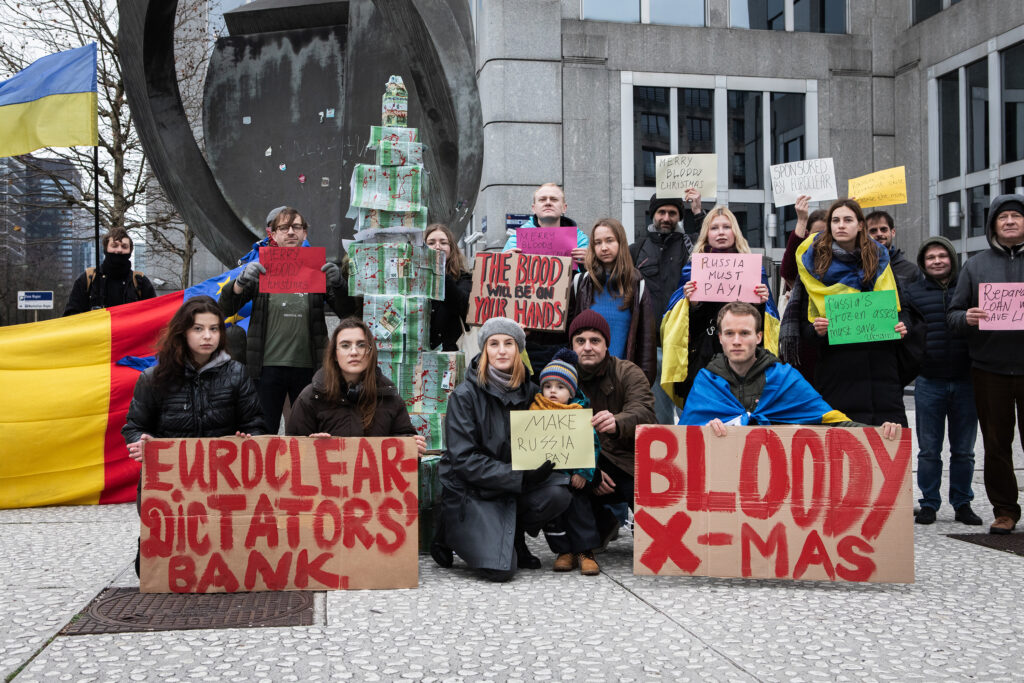
On 14 December, protesters gathered outside Euroclear headquarters with a Christmas tree that looked like it was made of blood-stained banknotes—a symbol of the Belgian profits from holding €200 billion in frozen Russian assets.
The actions were organized by the International Center for Ukrainian Victory, European Network in Solidarity with Ukraine, and Frozen Assets Action.
Two days earlier, activists rallied outside the European Commission under the banner “Ukraini
On 14 December, protesters gathered outside Euroclear headquarters with a Christmas tree that looked like it was made of blood-stained banknotes—a symbol of the Belgian profits from holding €200 billion in frozen Russian assets.
The actions were organized by the International Center for Ukrainian Victory, European Network in Solidarity with Ukraine, and Frozen Assets Action.
Two days earlier, activists rallied outside the European Commission under the banner “Ukrainian lives over profit.” Signs read “Belgium hesitates, Russia kills” and “Is De Wever the next Orbán?”—a reference to Belgian Prime Minister Bart De Wever, who on 2 December called Ukrainian victory “a fairy tale, a complete illusion.”
“Europe stands with Ukraine, Belgium stands with profits”—activists rally outside the European Commission ahead of the 18 December vote on frozen Russian assets, Brussels, 12 December 2025. Photo: Anastasiia Varvarina
Belgium’s opposition could derail a European Council vote on 18 December to approve a reparations loan backed by profits from frozen Russian state assets. If the vote fails, European taxpayers—not Russia—would foot the bill for Ukraine’s defense funding.
Protesters with Ukrainian, Belgian, EU, and free Belarus flags outside the European Commission, Brussels, 12 December 2025. Photo: Anastasiia Varvarina
Euroclear earns substantial revenue simply by holding the assets. Every month the decision is delayed, that revenue continues to flow.
The “blood money Christmas tree”—activists highlight Euroclear’s profits from frozen Russian assets while Ukraine pays in lives, Brussels, 14 December 2025. Photo: Anastasiia Varvarina
“As a father, I cannot stand by while Ukrainian children are murdered and deported by Russia. Belgium has a moral choice to make: protect Russian money, or protect Ukrainian children,” said Antonio Albaladejo Román, who lives in Brussels.
Protesters demand the use of frozen Russian assets for Ukraine outside the European Commission, Brussels, 12 December 2025. Photo: Anastasiia Varvarina
The stakes extend beyond December. In January, the EU’s annual vote to extend sanctions on Russia requires unanimous approval from all 27 member states. Hungary has already announced it will veto. Without sanctions extension, the frozen assets argument becomes moot—and Russia regains access to billions.
Activists with signs reading “Is De Wever the next Orbán?” and “Faisons payer la Russie” (“Make Russia pay”) outside the European Commission, Brussels, 12 December 2025. Photo: Anastasiia Varvarina
The Brussels protests are part of a wider campaign across European capitals. Actions took place in Prague, Warsaw, Vienna, Stockholm, and Copenhagen in the lead-up to the 18 December vote.
Activists are calling on supporters to sign petitions, contact Belgian embassies, and pressure PM De Wever directly on social media using #MakeRussiaPay and #UnblockReparationLoan.
“Make Russia pay” Euroclear protest, Brussels, 14 December 2025. Photo: Anastasiia Varvarina
With those words, De Wever signaled Belgium’s intention to block a European Council decision on 18 December that would unlock frozen Russian assets to fund Ukraine’s defense for the next two years. The alternative? European taxpayers pay instead.
Right now, about €200 billion in Russian assets sit frozen in European financial institutions—most of it at Euroclear, a Belgian clearinghouse. The proposed loan would use profits from these assets to arm Ukraine against the co
With those words, De Wever signaled Belgium’s intention to block a European Council decision on 18 December that would unlock frozen Russian assets to fund Ukraine’s defense for the next two years. The alternative? European taxpayers pay instead.
Right now, about €200 billion in Russian assets sit frozen in European financial institutions—most of it at Euroclear, a Belgian clearinghouse. The proposed loan would use profits from these assets to arm Ukraine against the country that invaded it.
Belgium is blocking this.
If the decision fails, every other funding model—including those proposed by European Commission President Ursula von der Leyen—draws directly from EU budgets. German, French, Dutch, and Belgian taxpayers would cover costs that Russia’s frozen money could pay.
Russia understands the stakes. Two years of stable defense funding would let Ukraine plan strategically rather than scramble month-to-month. Moscow is throwing everything at derailing this vote.
Follow the money
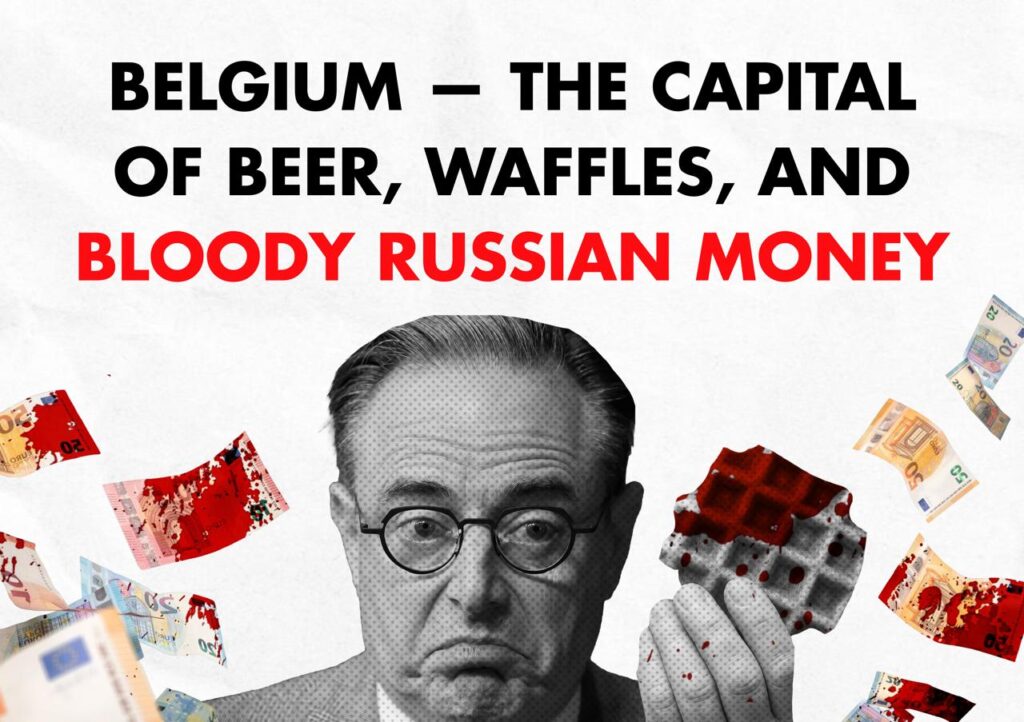
Why is Belgium blocking a decision that would cost its taxpayers nothing? The answer is quite simple: because Euroclear earns substantial revenue simply by holding frozen Russian assets.
Every month, the decision is delayed, and the revenue continues to flow. De Wever is effectively protecting an institution profiting from inaction while Ukrainian cities burn.
When legal arguments collapsed under scrutiny from Belgian, French, and international experts, Brussels found a new excuse: using the assets would “undermine Trump’s and Russia’s peace plan.”
“At the very moment when Russia is intensifying its hybrid attacks on Belgium—from drones to cyber operations—our government should have stood firm,” said Michael Desloover, a volunteer with NGO Promote Ukraine. “Instead, we gave in to pressure. Russia should pay for the destruction it continues to inflict, not European taxpayers.”
Michal Majzner of the Občanský rozcestník initiative, which campaigns for confiscating Russian assets and establishing a European-led sky shield for Ukraine, is blunt:
“The Belgian Prime Minister is worried about Russia’s future and about money. Shouldn’t he be worried about Europe instead? Without defense, there is no Euroclear, no Belgium, no Europe as we know it. Capitulation is not a policy.”
Olena Kuzhym, coordinator of the Ukrainian-European Advocacy Group in Belgium:
“Presenting a Russian victory as somehow ‘desirable’ is not only factually wrong but also morally indefensible. Bart De Wever continues to use manipulative narratives to secure his political position, and his opposition to the reparations loan is driven more by calculations of power than by principle. Profiting from tax revenues on frozen Russian assets while undermining support for Ukraine is a morally corrosive stance, unworthy of a country that claims to support Ukrainians.”
“I find the actions of the Belgian government very hypocritical,” Olena Halushka, co-founder of the International Center for Ukrainian Victory, said.
“On one hand, they stress that they defend the rule of law; on the other hand, they explicitly say that countries with nuclear weapons must be given full impunity for committing genocide, crimes against humanity, and war crimes.”
She added: “I have the feeling that an increasing number of people in Europe are tired of a prolonged 1938—they want 1939.”
The January trap
If the 18 December vote fails, a worse scenario unfolds in January: the annual EU-wide vote to extend sanctions on Russia requires unanimous approval from all 27 member states.
Without an extension of the sanctions, the frozen assets argument becomes moot—and Russia regains access to billions, while Europe loses its only leverage.
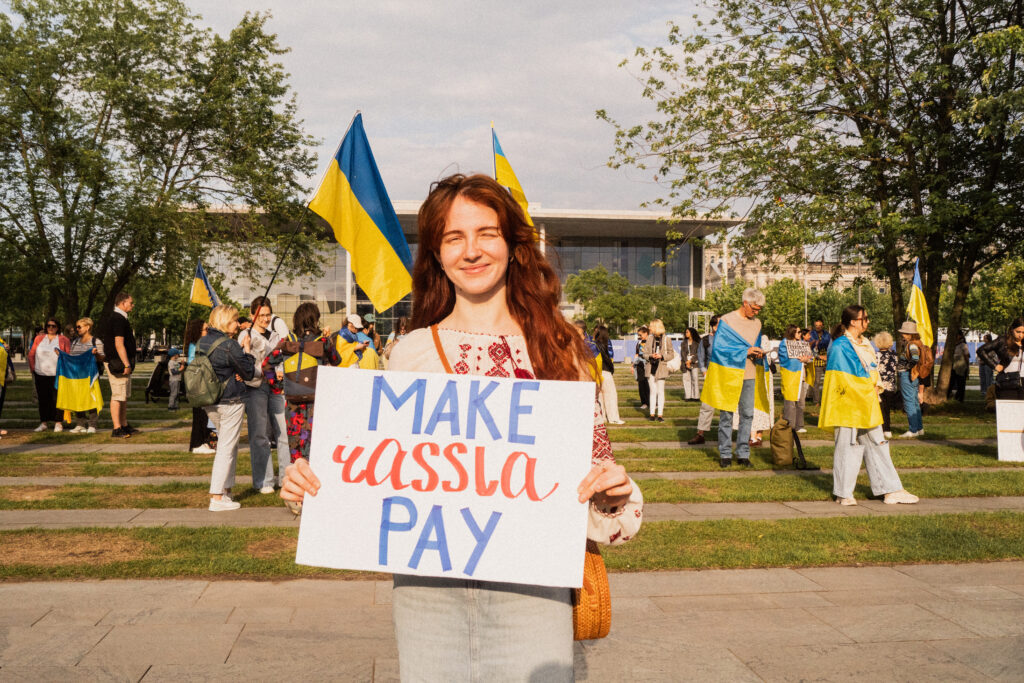
Outside the German Chancellery in Berlin in June 2024, a Ukrainian activist joins global protests urging governments to unfreeze Russian assets. Photo: International Center for Ukrainian Victory
What you can do
1. Amplify pressure on social media
Publish a post calling on Belgium to unblock the reparations loan.
Hashtags: #MakeRussiaPay #UnblockReparationLoan
Tag PM Bart De Wever and coalition MPs.
2. Sign the petition
Petition to the Prime Minister and the Belgian government on the Belgian portal
3. Contact Belgian embassies, politicians, and Bart De Wever
Send a letter to the Ambassador in your country, members of the Belgian parliament, or directly to Prime Minister Bart De Wever, calling on him to show leadership for European and Belgian security and support the approval of the reparations loan. To amplify the effect, also publish your letter on social media.
4. Civil society is the power
If you represent a Belgian civil society organization, sign the joint letter calling on the government to unblock the loan.
Vlada Dumenko is the Head of Communications at the International Center for Ukrainian Victory and the co-coordinator of the global “Belgium, stop blocking the Reparations Loan” rallies.
Editor's note. The opinions expressed in our Opinion section belong to their authors. Euromaidan Press' editorial team may or may not share them.

 Connexion