❌

Vue normale

Ukraine’s drone pilot calls it his proudest strike: cheap FPV drone detonating over two tons of explosives packed inside Russian mine-clearer
7 octobre 2026 à 18:25

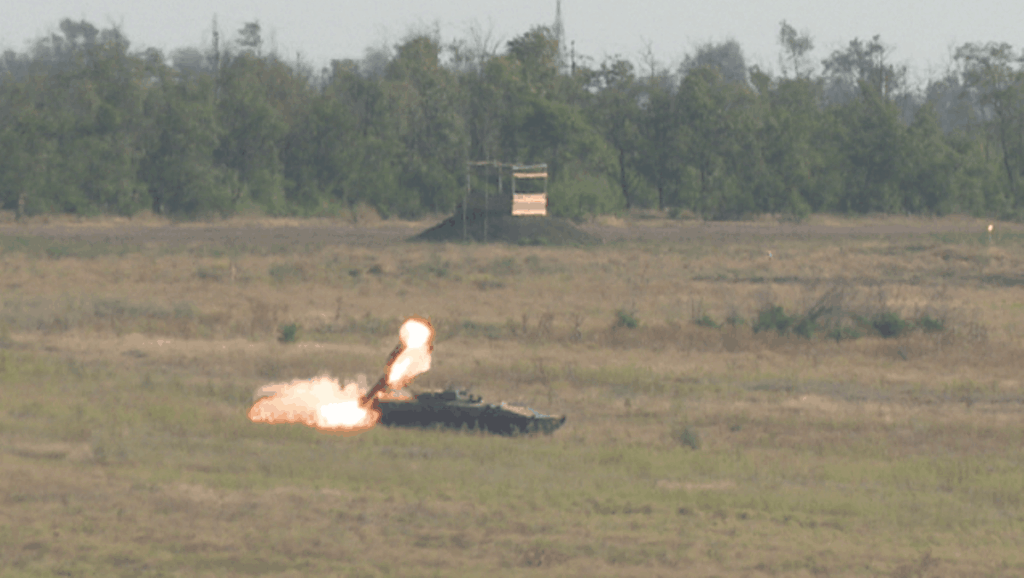
A UR-77 mine-clearing vehicle. Photo: Ukraine's Defense Ministry

"Skipper", an FPV company commander in Ukraine's 413th Raid Unmanned Systems Regiment, has described destroying a Russian UR-77 mine-clearing vehicle with drones during the 2023 counteroffensive as the strike he is proudest of, according to Army TV.

The UR-77, nicknamed "Zmiy Horynych" after a fire-breathing serpent of Slavic folklore, carries a rocket-fired line charge to blow paths through minefields, as per Militarnyi. Each charge carries more than two tons of explosives, which is why a cheap FPV hit can trigger a blast far larger than the drone itself.

"It exploded so hard that I thought it was a small nuclear blast. There are more than two tons of plastic explosive inside, and when it went off after the second hit, it was something unbelievable," Skipper says.

Skipper joined the army at the start of the full-scale invasion and moved from infantry and aerial reconnaissance to commanding an FPV unit. His regiment now operates on the Zaporizhzhia front, where FPV drones conduct combat missions.

From sailing yachts to FPV drones

In civilian life, Skipper was a sailing instructor, and he says the sport partly helps in military work, especially his knowledge of navigation and radio communication. He is convinced that a technological edge can be one of the keys to victory.

He counts the UR-77 strike among his unit's early work, from a time when few Ukrainian units were using FPV drones at all, he says. The hit came during hard fighting in the counteroffensive, when his crews were among the first to work the FPV niche.

Russia turns a mine-clearer into a wrecking tool

The UR-77 was built in the 1970s for a different war, one of fast tank thrusts that needed enemy minefields cleared quickly. Its base rides on the chassis of the 2S1 Gvozdika self-propelled howitzer, and its charge can cut a lane six meters wide, with some anti-personnel mines detonated across a band up to 15 meters wide.

Modern combat changed that role. The classic mine-clearing use remains, but Russia now more often turns these machines on Ukrainian fortifications, using the line charge to flatten defenses rather than open a path.

  • ✇Euromaidan Press
  • Russia paid with more than 46,000 casualties, and the front moved the other way, ISW finds
    Russia lost almost 300 km² of Ukrainian territory on net between March and September 2026, and it likely gained no ground in September despite its heaviest casualties of the year, the Institute for the Study of War (ISW) assessed. Ukraine's Operation Vivaldi accounts for much of the swing. The think tank notes that Ukraine's secrecy around such counterattacks makes exact monthly tallies hard. Russia has pressed attacks along the entire front through 2026, accepting mass casualties for m
     

Russia paid with more than 46,000 casualties, and the front moved the other way, ISW finds

2 octobre 2026 à 06:09

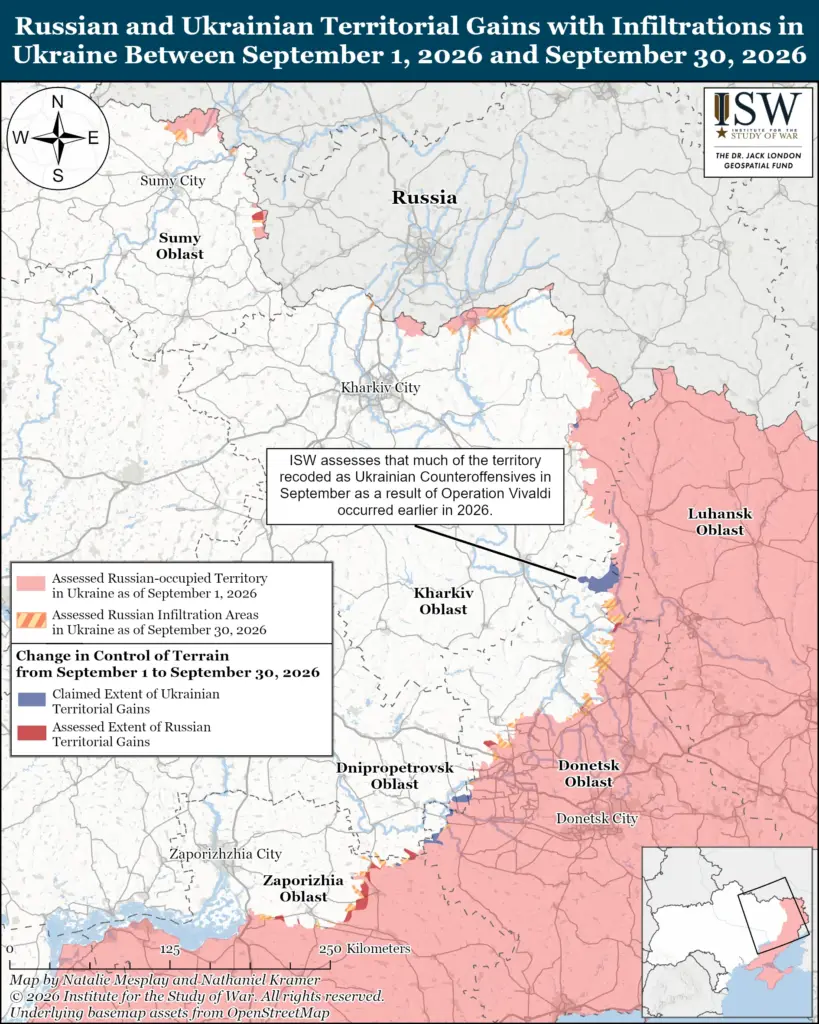
russia paid more than 46000 casualties front moved other way isw finds · post russian ukrainian territorial gains including infiltrations ukraine between 1 30 2026 russian-territorial-gains-in-ukraine-including-infiltrations-sep-1-to-sep-30-2026 news reports

Russia lost almost 300 km² of Ukrainian territory on net between March and September 2026, and it likely gained no ground in September despite its heaviest casualties of the year, the Institute for the Study of War (ISW) assessed. Ukraine's Operation Vivaldi accounts for much of the swing. The think tank notes that Ukraine's secrecy around such counterattacks makes exact monthly tallies hard.

Russia has pressed attacks along the entire front through 2026, accepting mass casualties for marginal ground, and its battlefield year has already been called its worst since 2023. Its losses have been outpacing its recruitment for months.

Russia came out behind in September

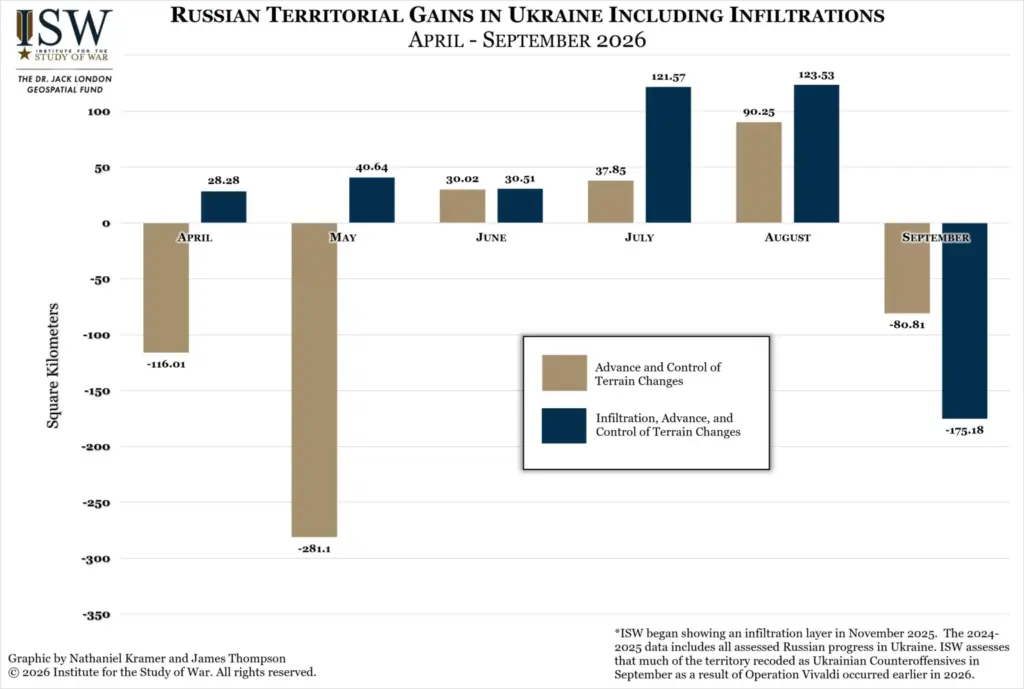
Russian forces seized 175.54 km² in September but lost 256.35 km², a net loss of 80.81 km², or minus 2.69 km² a day, ISW calculated. The balance stayed negative when Russian infiltrations into areas Russia does not control are counted: Russia seized or infiltrated 143.2 km² but lost 318.38 km², a net loss of 175.18 km².

Russian territorial gains in Ukraine with and without infiltrations, April–September 2026.
Russian territorial gains in Ukraine with and without infiltrations, April–September 2026. Graphic: ISW

The September figures include at least 147 km² near Lyman that Ukraine liberated over earlier months, but that ISW recorded only once details of Operation Vivaldi emerged in September. The operation already disrupted Russia's plan to encircle the Fortress Belt cities from the Lyman and Dobropillia directions.

Ukraine's Third Army Corps commander Brigadier General Andrii Biletskyi announcing "Operation Vivaldi," 15 September 2026. Screenshot from video: Ukraine's Third Army Corps
Explore further

Ukraine’s Vivaldi counteroffensive disrupts Russia’s plan to encircle Donetsk Fortress Belt – ISW

Almost 300 km² lost since March

Russia's rate of seizing territory dropped sharply in March 2026 and has stayed low, or even negative, since, ISW found. After controlling for the gains Ukraine made during Vivaldi, Russia lost control of 293.59 km² net across the front since March. Counting infiltrations, it gained a presence in only 174.44 km² over the same period.

ISW's monthly chart shows net Russian losses of 116.01 km² in April and 281.1 km² in May, modest gains in June, July, and August, and a net loss again in September. Oleksandr Syrskyi, then Ukraine's commander-in-chief, reported in June that Ukrainian forces had recaptured 100 km² in May.

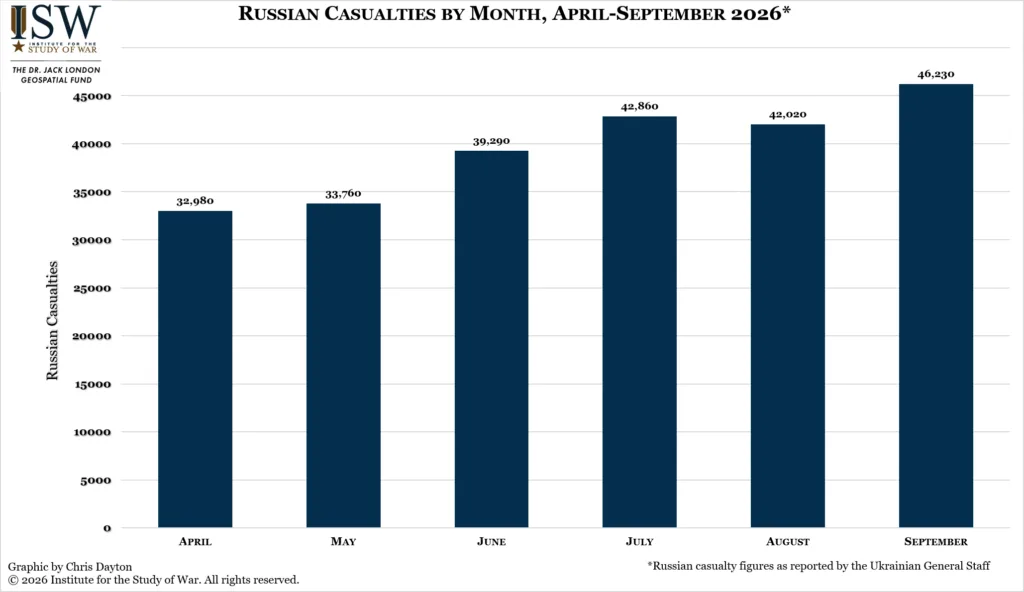
Russian casualties by month as reported by Ukraine's General Staff, April–September 2026.
Russian casualties by month as reported by Ukraine's General Staff, April–September 2026. Graphic: ISW

More than 46,000 casualties for no ground

Russian forces suffered 46,230 casualties in September, Ukraine's General Staff reported. It is the third straight month above 40,000 and the highest monthly toll of 2026, by Kyiv's count. Monthly Russian casualties have climbed from 32,980 in April to 42,860 in July and 42,020 in August, ISW's chart shows.

Russia keeps suffering heavy personnel losses while making extremely limited or even net-negative territorial gains, ISW said, and its current force generation system still recruits fewer soldiers than it needs to replace them.

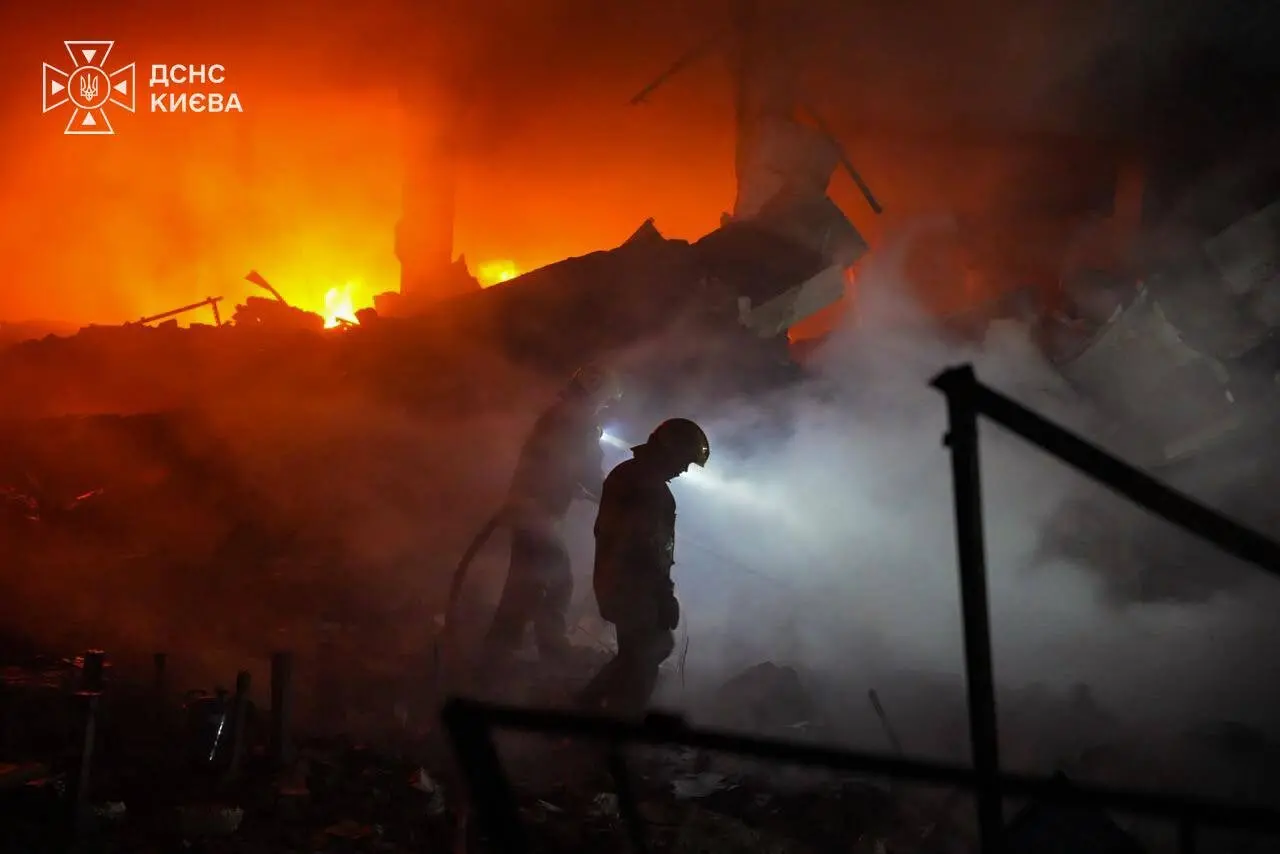
kyiv strike
Explore further

Russia’s mass drone attacks on Ukraine have a goal—likely Ukraine’s capitulation by spring 2027, ISW says

Ukraine's effective operational security around Vivaldi, likely to continue in future counterattacks, will make meaningful month-to-month assessments of Russian gains and losses hard, the think tank added.

  • ✇Euromaidan Press
  • Russia spreads false encirclement claims from Dobropillia to Kharkiv — ISW
    Within 24 hours of claiming Ukrainian troops were surrounded near Dobropillia, Russia’s Defense Ministry and pro-war channels expanded the narrative to several supposed encirclements in northern Kharkiv Oblast. Evidence supports none of that, the Institute for the Study of War (ISW) has said. The claims come as Ukrainian forces make gains in several frontline sectors, according to ISW. Near Dobropillia, Russian bloggers described the ability to fire on supply roads rather than troops su
     

Russia spreads false encirclement claims from Dobropillia to Kharkiv — ISW

24 septembre 2026 à 14:43

Two masked soldiers in camouflage crouch in a narrow trench. The soldier in front holds a rifle and wears a Russian flag patch.

Within 24 hours of claiming Ukrainian troops were surrounded near Dobropillia, Russia’s Defense Ministry and pro-war channels expanded the narrative to several supposed encirclements in northern Kharkiv Oblast. Evidence supports none of that, the Institute for the Study of War (ISW) has said.

The claims come as Ukrainian forces make gains in several frontline sectors, according to ISW. Near Dobropillia, Russian bloggers described the ability to fire on supply roads rather than troops surrounding the town. At the same time, Ukrainian forces said they had prevented Russia from physically cutting the routes.

Russia’s Defense Ministry claimed its forces had captured Krasnyi Yar and Potykhonove northeast of Kharkiv. Pro-war bloggers then claimed Russian troops threatened to trap Ukrainian units near Riznykove and had already surrounded others near Rublene. One asserted that roughly 1,500 Ukrainian soldiers were encircled across 460 square kilometers.

ISW found no evidence for those claims. A Ukrainian brigade spokesperson said Russian forces were still shelling settlements they claimed to hold and described positions in the area as heavily intermingled, with no clear front line.

Around Dobropillia, the Kremlin-linked Rybar channel claimed Russian troops were infiltrating toward nearby settlements and making tactical gains south of the town. It did not claim Russian forces had secured those settlements or show an encirclement on its map, ISW noted.

Another Russian blogger said neither side currently had the forces needed to establish and sustain a genuine encirclement.

Russia’s push toward Dobropillia continues

Russia’s Defense Ministry had claimed on 22 September that its troops surrounded Dobropillia, a transport hub on the approach to Ukraine’s fortified cities in Donetsk Oblast.

ISW found no evidence for that claim and linked its timing to the UN General Assembly and Ukraine’s recent battlefield gains. A Ukrainian officer said Russian troops had made no major advances near the town.

Russian assaults continue despite that setback. A Ukrainian staff sergeant reported a sharp increase in the number of small groups trying to reach Dobropillia. On 23 September, Ukraine’s 1st Azov Corps said its forces had prevented Russian troops from physically cutting supply routes toward Dobropillia and Druzhkivka.

  • ✇Euromaidan Press
  • Ukraine’s Vivaldi counteroffensive disrupts Russia’s plan to encircle Donetsk Fortress Belt – ISW
    Ukraine’s Operation Vivaldi has disrupted Russia’s plan to encircle Ukraine’s heavily fortified “Fortress Belt” in Donetsk Oblast, the Institute for the Study of War (ISW) assessed, adding that Ukrainian forces have likely made additional gains beyond those publicly disclosed by Kyiv. The assessment comes a day after Ukraine’s Third Army Corps publicly confirmed that it is conducting a counteroffensive against Russian forces north and northwest of Lyman. ISW said the Ukrainian gains hav
     

Ukraine’s Vivaldi counteroffensive disrupts Russia’s plan to encircle Donetsk Fortress Belt – ISW

16 septembre 2026 à 07:07

Ukraine's Third Army Corps commander Brigadier General Andrii Biletskyi announcing "Operation Vivaldi," 15 September 2026. Screenshot from video: Ukraine's Third Army Corps

Ukraine’s Operation Vivaldi has disrupted Russia’s plan to encircle Ukraine’s heavily fortified “Fortress Belt” in Donetsk Oblast, the Institute for the Study of War (ISW) assessed, adding that Ukrainian forces have likely made additional gains beyond those publicly disclosed by Kyiv.

The assessment comes a day after Ukraine’s Third Army Corps publicly confirmed that it is conducting a counteroffensive against Russian forces north and northwest of Lyman. ISW said the Ukrainian gains have rendered Russia's plan to encircle the Fortress Belt from the north and south unfeasible.

Third Army Corps commander Brigadier General Andrii Biletskyi said on 15 September that Ukrainian forces had cleared Russian infiltrators from several settlements and liberated Serednie. The corps said its forces had cleared 75 square kilometers of Russian infiltrators and de-occupied another 10 square kilometers during the first phase of the operation.

Biletskyi said the operation, dubbed “Vivaldi,” was conducted under information silence and warned that the first phase was only one of four planned “seasons.”

Ukraine’s gains appear larger than initially disclosed

ISW assessed that Ukrainian forces have likely made additional gains beyond those announced by Biletskyi, with Russian sources beginning to acknowledge the deterioration of their position in the area.

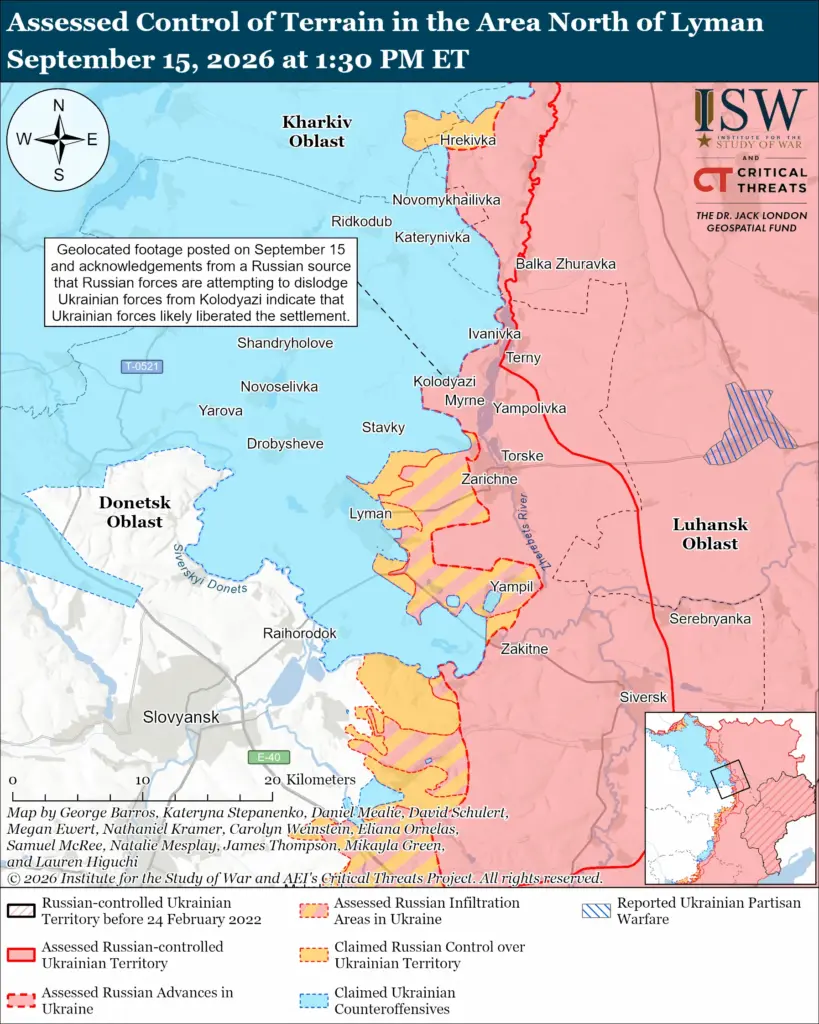
In particular, Russian forces have been shelling Ukrainian positions in Kolodyazi, northeast of Lyman, according to geolocated footage. A prominent Russian milblogger also acknowledged that Russian forces were trying to push Ukrainian troops out of Kolodyazi – what ISW described as a “coy acknowledgement” that Ukrainian forces have likely liberated the settlement.

Russian sources have continued to report worsening conditions for Russian forces both north and south of Kolodyazi.

ISW also corroborated the Third Army Corps’ account of growing Russian logistical problems, noting that Ukrainian strikes have disrupted supplies for Russian forces in the Borova and Lyman directions. The corps said the pressure was severe enough that Russia moved some logistics and support elements across the state border into Russia’s Voronezh Oblast.

Soldiers of Ukraine's Third Army Corps. Photo: Ukraine's Third Army Corps
Explore further

“Only the first season” – Ukraine unveils secret counteroffensive in a region Russia has been trying to seize for 12 years

Vivaldi disrupts Russia’s plan for the Fortress Belt

The operation’s broader significance lies in its effect on Russia’s campaign in Donetsk.

Russia has made capturing the remaining Ukrainian-held parts of Donetsk Oblast a central military objective, with its forces seeking to advance toward the heavily fortified cities of the Donetsk “Fortress Belt” from several directions.

The Russian military had also sought to create a northern route around the Fortress Belt through the Lyman area. ISW now assesses that Ukraine’s gains north of Lyman have made that plan unfeasible.

The institute said the Ukrainian counteroffensive will delay Russia’s planned offensive toward Sloviansk, the major objective Moscow had been expected to pursue after capturing Lyman.

Map: ISW

Russian sources acknowledge setbacks

According to ISW, a prominent Kremlin-affiliated Russian milblogger similarly acknowledged that Ukraine’s gains will delay the Russian offensive toward Sloviansk and warned that the northern flank of Russian forces operating southeast of Lyman and east of Kramatorsk is now vulnerable to Ukrainian counterattacks and interdiction.

The Russian milblogger also claimed that Russian forces had lost positions south of Lyman and were struggling to recapture positions inside the city itself.

Russian sources have blamed the setbacks on the military’s culture of producing “beautiful reports” – exaggerated accounts of battlefield advances that can distort higher-level operational planning.

Another prominent milblogger reportedly claimed that some Russian commanders were attempting to conceal losses by rapidly assembling assault groups from inadequately trained personnel to retake lost positions.

Russia still presses its offensive elsewhere

Despite the setbacks around Lyman, ISW said Russian forces continue prioritizing frontal attacks against the Fortress Belt from the south and efforts to encircle it from the southwest, rather than advancing toward the cities from the east.

The institute said Russia may still be adjusting to the loss of the Lyman salient and the initiative in the area. It also assessed that Russian forces could seek to cut Ukrainian ground lines of communication to the Fortress Belt from the west.

For Ukraine, meanwhile, the counteroffensive is also undermining Russia’s ability to present advances in Donetsk as evidence of battlefield momentum.

And the full extent of Vivaldi remains unknown.

Biletskyi said the 85 square kilometers publicly disclosed by the corps represented only the first “season” of the operation, invoking Vivaldi’s Four Seasons.

“Vivaldi, as is known, has four seasons. And this is only the first one,” Biletskyi said on 15 September.

“Only the first season” – Ukraine unveils secret counteroffensive in a region Russia has been trying to seize for 12 years

15 septembre 2026 à 16:34

Soldiers of Ukraine's Third Army Corps. Photo: Ukraine's Third Army Corps

Ukraine’s Third Army Corps has revealed details of an offensive operation in northern Donetsk Oblast, saying its forces cleared Russian infiltrators from several settlements and liberated the village of Serednie.

Russia has made seizing the entirety of Donetsk Oblast both a battlefield and diplomatic priority of its invasion of Ukraine, repeatedly trying to break through heavily fortified Ukrainian defensive lines while demanding that Kyiv withdraw from the remaining Ukrainian-held territory in negotiations. Despite years of fighting and sustained Russian assaults, Moscow has failed to capture the entire oblast, and Ukraine is now conducting an offensive of its own.

The operation, dubbed “Vivaldi,” was conducted under a period of information silence and involved Ukrainian drone, reconnaissance, special operations, infantry, and other units working under a unified tactical command. The corps said the first phase cleared 75 square kilometers of Russian infiltrators and liberated another 10 square kilometers of territory.

The announcement was made by Third Army Corps commander Brigadier General Andrii Biletskyi on 15 September. 

Ukraine targets Russian infiltration

According to the corps, the operation focused initially on Russian troops that had infiltrated Ukrainian positions and settlements in the area.

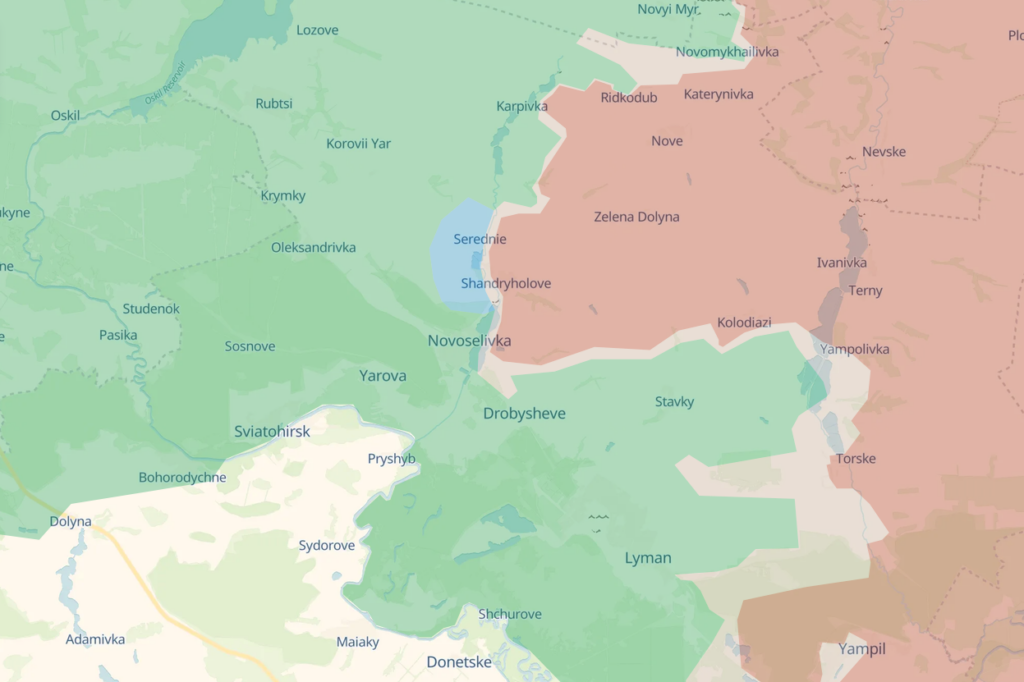
Ukrainian forces cleared Novoselivka, Oleksandrivka, Yarova, the outskirts of Korovyi Yar, and liberated Serednie, the corps said. It described the total area cleared or retaken as 85 square kilometers.

The operation brought together units from the 60th and 125th Mechanized Brigades, the Third Assault Brigade, the KRAKEN special unit, and other formations of the Third Army Corps, alongside attached units from the 66th Mechanized Brigade, Ukraine’s Special Operations Forces, the military intelligence unit Artan, and the State Border Guard Service.

The corps said the operation was coordinated by a joint headquarters that brought special operations and reconnaissance units under a single tactical plan specifically to counter Russian infiltrators, whom it referred to as “flagovtyky.”

Frontline situation around Serednie, northern Donetsk Oblast, Ukraine, 15 September 2026. Map: DeepState

Russian logistics pushed back across the border

The Ukrainian operation also targeted Russian logistics supporting the front.

The corps said its drone units cut Russian supply routes and struck fuel infrastructure and storage facilities that had been supporting Russian forces.

According to the Ukrainian military, Russian forces subsequently moved the supply of fuel and lubricants out of Ukraine and into Russia’s Voronezh Oblast after a pipeline and fuel depots were destroyed.

The corps claimed Russian forces lost around 1,500 personnel during this phase of the operation, as well as more than 12,000 drones and hundreds of armored vehicles, artillery systems, and other vehicles.

‘This is only the first season’

Biletskyi said the operation’s ultimate objective has been the subject of speculation in open sources, with some reports suggesting Ukrainian forces could be seeking to reach the Chornyi Zherebets River.

He declined to confirm that objective, instead emphasizing the name of the operation.

“Our operation is called Vivaldi. And Vivaldi, as is known, has four seasons. And this is only the first one,” Biletskyi said.

The remarks suggest Ukraine does not consider the actions revealed on 15 September to be a standalone tactical operation, although the corps did not disclose what its next phase will involve.

The Third Army Corps said further details would be released in subsequent official statements.

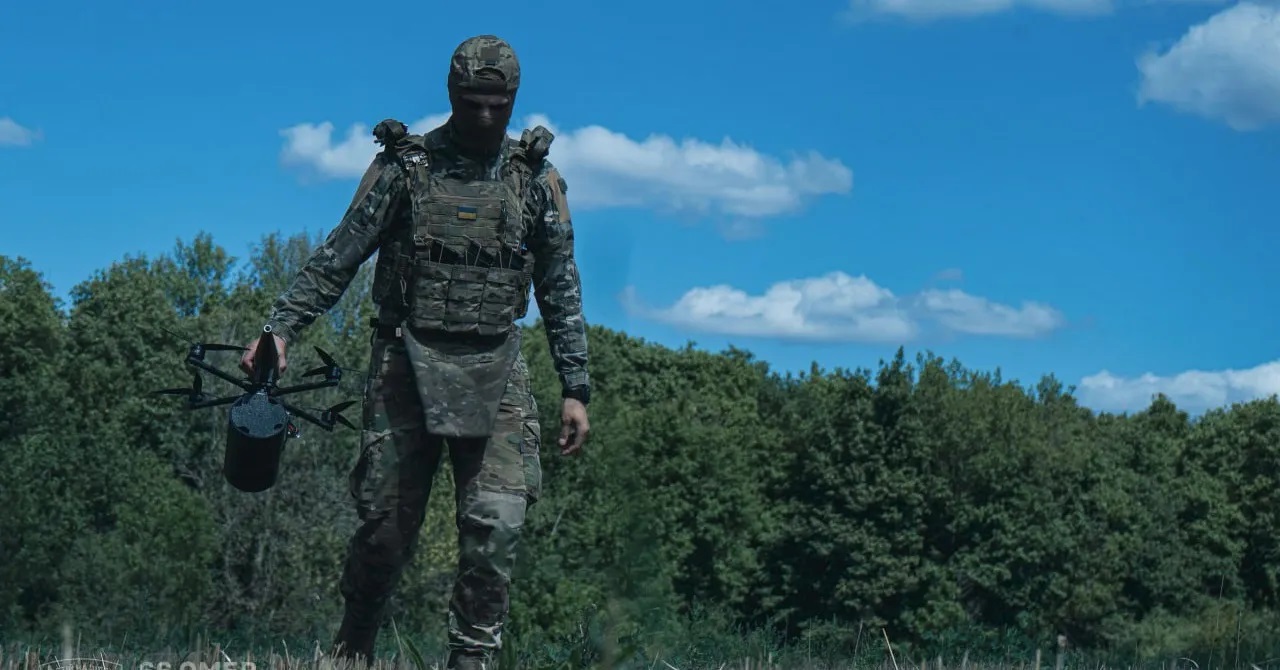
A Ukrainian soldier carries an FPV drone.
Explore further

Ukraine’s secret counteroffensive takes the pressure off Sloviansk

Donetsk remains Russia’s main territorial objective

Donetsk Oblast is central to Russia’s territorial demands in Ukraine. Moscow claims the entire oblast as Russian territory despite not controlling all of it, and has demanded that Ukraine withdraw from the remaining Ukrainian-held territory in Donetsk as part of peace talks.

The Donbas region – consisting of Donetsk and neighboring Luhansk oblasts – has been a battleground since Russia’s 2014 invasion, and capturing the remaining Ukrainian-held territory has remained the Kremlin’s core objective throughout the full-scale invasion since 2022.

❌