Vue normale

Zelenskyy meets team from Raytheon, US company that builds Patriots, and says Ukraine is now negotiating joint interceptor production

23 juillet 2026 à 17:52

Ukrainian President Volodymyr Zelenskyy met with a delegation from the US company Raytheon, led by Vice President Joseph DeAntona on 23 July 2026. Source: Ukraine's Presidential Office

Ukraine's president has taken the question of Patriot production to the company that builds the missile.  Volodymyr Zelenskyy met a team from the American defense company Raytheon and said Ukraine is negotiating joint production of interceptors for the Patriot air defense systems, one of the country's key air defenses, he announced.

The meeting is the first direct, publicly reported contact between Zelenskyy and Raytheon since US President Donald Trump pledged at the Ankara's NATO summit on 8 July to grant Ukraine a license to manufacture Patriots.

At the Farnborough Airshow this week, senior executives from Raytheon parent RTX and from Lockheed Martin described talks on Ukrainian Patriot production as "early days" and said they were awaiting US government guidance on licensing.

Zelenskyy's meeting, led by Raytheon Vice President Joseph Deantona, is the Ukrainian side pushing that process forward directly with the company rather than waiting on it.

Zelenskyy ties talks back to Ankara

Raytheon is a powerful defense company whose equipment Ukraine has long used to protect people from Russian attacks, Zelenskyy said at the meeting, thanking the team for its readiness to take the partnership to a new level, specifically on joint production of Patriot interceptors.

The sides also discussed other areas of cooperation, including non-offensive military equipment, and agreed that Ukrainian teams at the government level and in the private sector should stay in contact with Raytheon to work out the details of the partnership.

Interceptor shortage is reason for urgency

The Patriot interceptor is the weapon Ukraine most needs and can least produce, which is what makes any production deal so consequential and its timeline so pressing. Ukraine's interception rate against ballistic missiles was roughly 40% in June, against 89% for air threats overall, and only Patriots reliably engage the ballistic and hypersonic missiles in Russia's massed strikes.

The gap between negotiation and missile is the catch. Independent estimates put the first Ukrainian-built interceptors well over a year away, and the deepest bottleneck is a Boeing guidance component made in only two places on Earth.

For the near term, Zelenskyy has been clear that the missiles that matter come from existing American stocks.

He told NATO's United States envoy this week that increased interceptor deliveries through the PURL mechanism are "the key priority, because Russia's massed strikes do not stop." The Raytheon talks are about the year after this one, while the PURL deliveries are about tonight.

Two companies that actually build Patriots describe Ukrainian production as “just started,” while Russia is firing ballistic missiles every night

23 juillet 2026 à 09:53

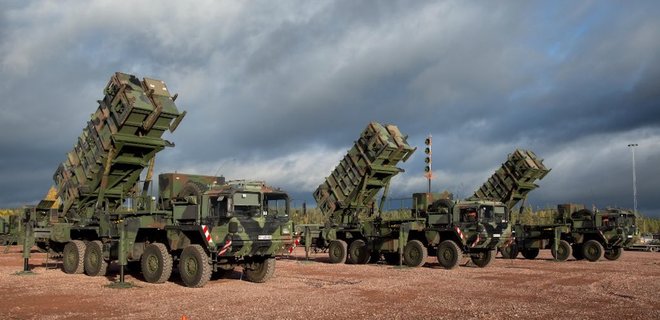
germany urges nato neutralize russian uavs factories patriot air defense system's launchers dutch ministry ukraine news ukrainian reports

The companies that actually build the Patriot say the deal with Ukraine has barely started. RTX, the parent company of Raytheon, is studying how to proceed after US President Donald Trump announced the US would grant a license, a senior executive said Monday, cautioning that talks are still early, Breaking Defense reported from the Farnborough Airshow near London.

The manufacturer's account confirms the gap between Trump's promise and any actual missile. Trump announced at the NATO summit in Ankara on 8 July that the US would let Ukraine manufacture Patriots, but did not actually grant the license, and Lockheed Martin and RTX, the two firms that build the system, had not been informed. Two weeks later, at Farnborough, both companies described the process as just beginning.

"That process has just started. And we'll of course be following the US government's lead" on licensing, said Tom Laliberty, Raytheon's president of land and air defense systems.

The Patriot is not one product but several, which is why "a license" is not a single act. The system consists of an RTX radar and other subsystems, as well as interceptors built by both RTX and Lockheed Martin. RTX makes the GEM-T interceptor. Lockheed Martin makes the PAC-3, and both can engage air and missile threats.

Manufacturers describe separate tracks, all early

Laliberty laid out where Ukrainian involvement could enter, and none of it is close to a decision. There are different levels at which RTX's supply chain could be engaged, he said, pointing to partners worldwide that produce components, operate maintenance facilities, and, in some cases, assemble complete missiles.

The feasibility studies and the licensing work would run in parallel, he added, and then "hopefully something of all that will yield the ability for Ukraine to get the right level of support that they desire for increased Patriot production.”

Lockheed Martin's account matched it. Tim Cahill, President of Missiles and Fire Control at Lockheed Martin, said "it's early" and that discussions were underway with the US Army.

“We’re going to support the US Army and the [Trump] administration on what they want to go do. I believe they are evaluating options, and we will support each of those options and do what needs to be done based upon that,” he said.

Gap is measured against war that will not wait

The manufacturers' caution matters because the timeline they describe collides with the calendar Russia is setting. Ukraine's interception rate against ballistic missiles was roughly 40% in June, against 89% for air threats overall, and Russia's massed strikes continue nightly.

Independent estimates put the first Ukrainian-built interceptors far off. Lieutenant General Ben Hodges, former Commanding General of US Army Europe, told Euromaidan Press he is "pretty certain it will not produce anything in the next three to six months.

Through-line is promise still catching up to reality

What the manufacturers confirmed on Monday is that, despite all the political momentum since Ankara, the license that would let Ukraine build its own Patriots is, in their words, still in its early days.

The missiles Ukraine needs tonight will keep coming, if they come, from existing American stocks through PURL, not from a Ukrainian production line that does not yet exist.

❌