Vue lecture

Euractiv: Italy and Greece win a fur pass for Russia inside the EU’s newest sanctions round

euractiv italy greece win fur pass russia inside eu's newest sanctions round · post sable sobol-sable ukraine news ukrainian reports

Just three months after blocking it, the European Union has cleared raw Russian sable pelts to return to its market, according to Euractiv. The reversal sits inside the sanctions package Brussels adopted last week, after Italy and Greece pushed for the exemption. Coats made from the fur stay barred from the bloc.

The EU first hit Moscow with sanctions over its 2014 seizure of Crimea, then rolled out numbered packages every few months after the 2022 full-scale invasion to choke the revenue bankrolling the war, even as analysts keep debating how fast the measures actually bite. Russia uses export revenue to help finance its all-out war against Ukraine.

A reprieve tucked into the toughest package yet

The bloc had caught sable in its sanctions net only in April. Now the exemption rides inside the 21st package of measures Brussels adopted last week, the round it promoted as its heaviest economic hit on Moscow to date. The change appears in the bloc's published sanctions text.

Euractiv says the European Commission defended the carve-out on supply grounds. It argued that Russia dominates the global sable market and that European makers have few alternative suppliers.

"Apparently, it's very difficult to get them anywhere else," a senior EU official told Euractiv. 

The sable is a small carnivorous animal from the forests of northern Asia, and its pelt is considered exceptionally soft and prized by luxury fashion houses. A single coat can run into the hundreds of thousands of euros. 

An EU diplomat told Euractiv that Italy and Greece drove the lobbying, the two biggest buyers of Russian pelts inside the bloc.
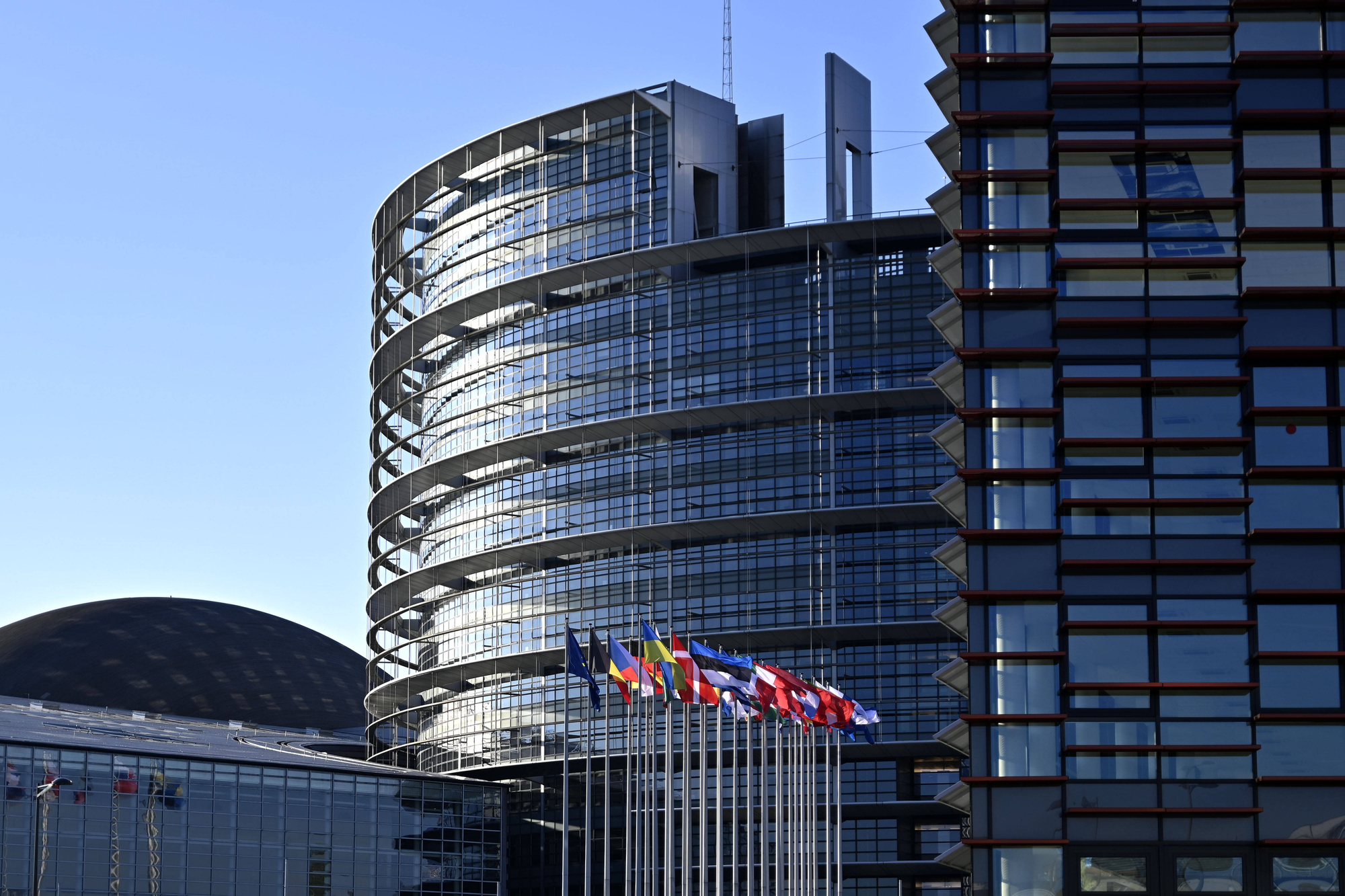
eu adopts largest sanctions package russia 218 names 100+ banks crypto platforms among those list · post flags member states ukraine well flag fly front parliament strasbourg eastnewsua news ukrainian
Explore further

EU adopts largest sanctions package on Russia: 218 names and 100+ banks and crypto platforms among those on the list

Coats stay out as Europe debates its own farms

The sanctions still block finished fur garments in both directions — barred from entering the bloc and from reaching Russian buyers, The EU’s wider luxury-goods restrictions also cover products such as diamonds and caviar. Greece's fur producers, clustered around Kastoria and Siatista, fought those wartime measures in 2022, warning they would kill the industry. 

It lands as Brussels weighs a bloc-wide ban on its own fur farming, after a citizens' initiative demanded an end to the practice. Only a few EU countries, including Spain, Greece, Hungary, Finland, and Poland, still have active fur farms.

  •  

Russia’s ship strikes stall Ukraine’s grain corridor. The damage is moving inland

Russia’s strikes on civilian cargo ships have brought traffic through Ukraine’s Black Sea grain corridor—the route that carries the overwhelming share of the country’s farm exports—to a near-standstill at the peak of harvest.

Traders are buying less grain from farmers, prices are climbing, and Ukraine’s state railway has begun restricting grain shipments to Odesa’s ports. The UN Security Council meets on 27 July at Kyiv’s request.

This is not a blanket shutdown. The orders name specific shipments and destinations, and they hold until further notice.

Russian strikes drive the ships away

The corridor has not been formally closed. Shipowners simply stopped sending vessels in. Agriculture Minister Taras Vysotskyi said four or five ships entered Ukraine’s ports on 21 July and none by 22 July—the owners’ own decision, he stressed, not any Ukrainian restriction on navigation, he told Latifundist.

What stopped them was a run of Russian missile and drone strikes on the ships themselves. Foreign Minister Andrii Sybiha said no vessel passed through the corridor on 22 July and that Russia had bombed at least three civilian cargo ships in the preceding days, killing and wounding dozens of crew.

“Russia is holding global food security hostage,” Sybiha wrote, comparing the campaign to Iran’s targeting of energy routes in the Strait of Hormuz.

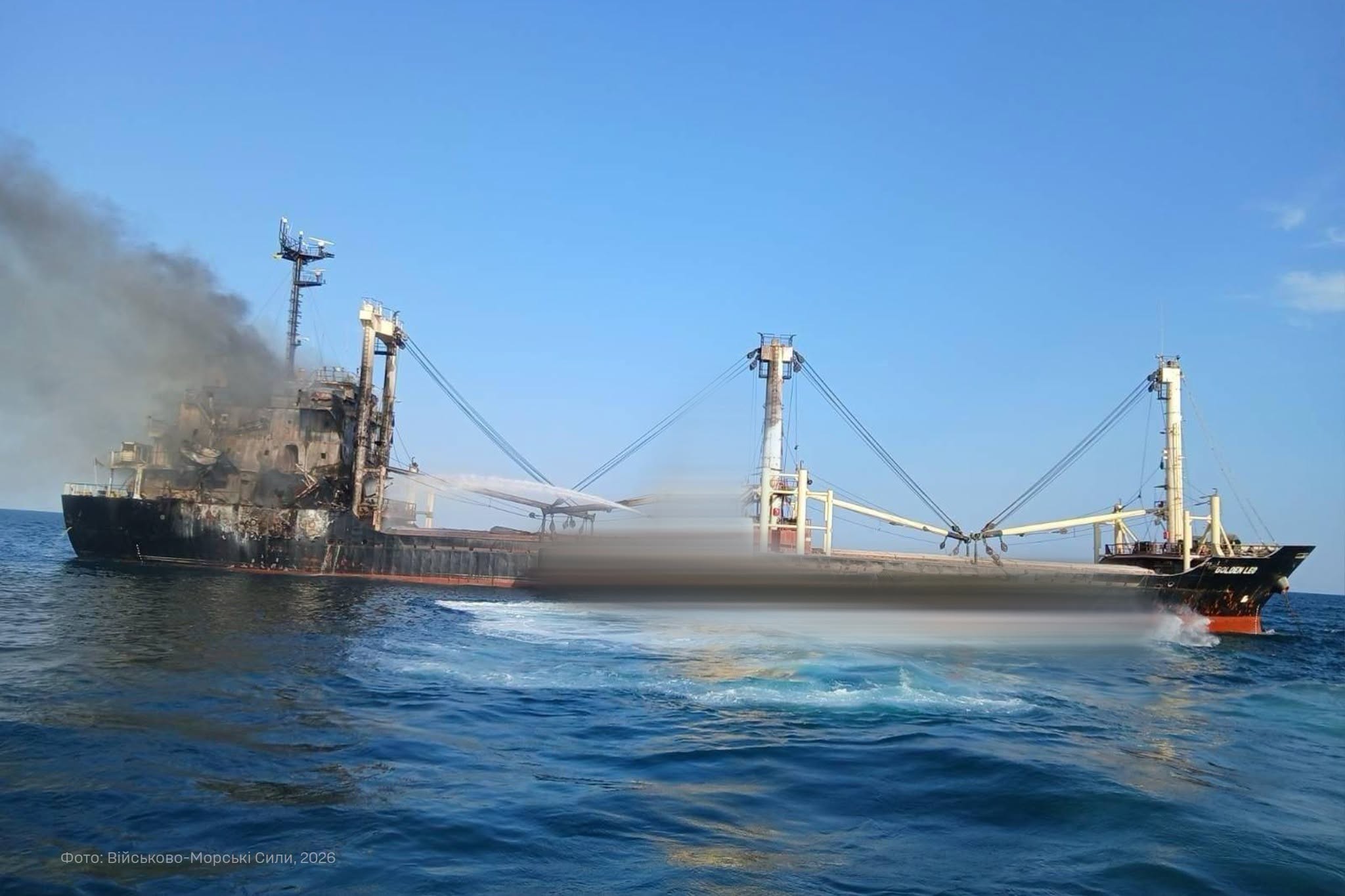
The deadliest single strike came on 19 July, when three cruise missiles hit the Golden Leo, a Turkish-owned bulk carrier, as it left Odesa loaded with grain, killing ten.

ten dead russia strikes turkish-owned bulk carrier off odesa · post civilian golden leo ablaze after russian missiles hit left cargo corn black sea 19 2026 ukraine's navy struck foreign-flagged
Explore further

Ten dead as Russia strikes a Turkish-owned bulk carrier off Odesa

Over the past month, Russian strikes have damaged 28 ships bound to or from Greater Odesa’s ports, about 11–12% of the traffic, killing 21 seafarers and wounding 34, according to Andrii Klymenko’s tally at the Institute of Black Sea Strategic Studies monitoring group.

The image shows a train in Ukraine on fire, hit by a Russian drone. Source: Oleksii Kuleba

The disruption reaches Ukraine’s railways

Ukraine’s state railway has restricted grain shipments to Odesa’s ports, its restriction register shows. All freight to the Chornomorska-Export station serving the Odesa Port Plant was halted from 24 July. Barley bound for Louis Dreyfus Commodities Ukraine, one of the country’s three largest grain exporters, was restricted from 25 July, and wheat for the same firm from 26 July.

This is not a blanket shutdown. The orders name specific shipments and destinations, and they hold until further notice. The register gives no reason or volume, and Ukrzaliznytsia has not linked the orders to the shipping stoppage.

The squeeze on farmers predates the rail orders. Ukrainian traders were already cutting purchases from growers by 15 July, S&P Global reported, and one market source put cancellations at 30–40% of the shipowners due to call in late July and early August. “We won’t be trading as vessels cannot arrive at the port,” one Ukrainian seller told S&P Global.

Prices moved. December wheat on the Chicago exchange gained about $17 a metric ton in the week to 17 July, reaching $257, with the Black Sea escalation named as one of the drivers, AHDB reported. Russia and Ukraine together are forecast to supply more than 30% of the world’s wheat exports in 2026/27.

Who pays if the grain stops moving

Prolonged disruption would land hardest far from Ukraine. Egypt bought 2.4 million metric tons of Ukrainian wheat between July 2025 and February 2026; with Algeria and Indonesia, it took 60% of Ukraine’s wheat, while China, Türkiye, Libya, and Saudi Arabia bought 80% of its barley, USDA figures show.

The overland and river routes cannot make up the difference. Low water levels are limiting the Danube, Vysotskyi told Delo, and nothing can replace Ukraine’s deepwater ports in the medium term. If the delays hold, he said, Ukraine may have to store an extra 10 to 12 million metric tons of grain it cannot ship.

  •  

Fondation Pierre-Luc Dubois : des équipements à des hockeyeurs

Par l’entremise de Charle-Édouard D’Astous, la Fondation Pierre-Luc Dubois a remis 20 équipements de hockey à des jeunes de Sainte-Anne-des-Monts, le 24 juillet dernier, quelques semaines après la tenue de son tournoi de golf au Club Bic-sur-Mer.

Le défenseur rimouskois du Lightning de Tampa Bay a récemment rejoint les rangs de la Fondation, qui cherche à rendre la pratique du hockey plus accessible aux jeunes par le prêt et la remise d’équipements.

Dubois a annoncé, au début de juillet, l’arrivée de son ami d’enfance au sein de son organisation.

La Fondation a remis pour plus de 80 000 $ en équipements neufs au cours de la dernière année dans la région et prévoit poursuivre ses efforts au même rythme au cours de la prochaine année.

Son tournoi de golf, présenté le 8 juillet au Club Bic-sur-Mer, a d’ailleurs permis d’amasser 72 000 $ en 2026. L’événement porte maintenant le nom de Tournoi de golf Dubois/D’Astous.

La Fondation Pierre-Luc Dubois conserve toutefois son appellation. L’organisme, qui a pris la relève de la Fondation Vincent Lecavalier en 2020, travaille également avec la Fondation Le But afin de récupérer et de redistribuer des équipements de hockey et d’aider davantage de jeunes à pratiquer ce sport.

  •  
❌