❌

Vue lecture

Ukraine just caught a Geran-5 at 425 km/h—the jet drone that has often outrun Ukrainian interceptor drones since January

A Ukrainian interceptor drone chases a Russian Geran-5 jet-powered drone. September 2026.

Ukraine's air defenders now have purpose-built interceptors for Russia's jet-powered attack drones—weapons whose speed and altitude make them difficult for conventional defenses to catch, Militarnyi reported. A crew from the 1020th Anti-Aircraft Missile and Artillery Regiment downed a Geran-5 over Chernihiv Oblast with a newly delivered interceptor, according to the Serhiy Prytula Foundation.

Russia's long-range drone and missile attacks have become central to its effort to wear down Ukraine's air defenses and grid before winter, and the war in the sky now turns on which side scales its answer faster.

The Chernihiv intercept

The crew, callsign Yastrub (Hawk), made its first successful engagement with the new interceptor, hitting the jet drone at 425 km/h and above 3 km, the foundation said, releasing footage of the strike. The Prytula Foundation supplied the interceptors and said it has contracted several manufacturers to counter the jet threat.

"Our task is to scale this up and strengthen units," it said.

Why it kept slipping through

Russia first used the Geran-5 in January 2026. HUR's own specifications put its warhead at 90 kg, cruise speed at 450–600 km/h, and range at 950 km, with a ceiling of 6 km. That mix of jet speed and high altitude kept it clear of machine guns, shoulder-fired missiles, and the cheap interceptors built to swat slower piston-engine Shaheds.

Ukraine's military intelligence estimates Russian plants now turn out around 3,000 jet-powered Geran-4 and Geran-5 drones a month, according to HUR. A monitoring Telegram channel, Polkovnyk HSh, reports a newer variant that steers by ground imagery instead of satellites, which would blunt jamming—though HUR has not confirmed it and lists no such system among the drone's components. Separately, Russia moved the jet engine inside the fuselage, a change aimed at more speed and range.

russia hits kharkiv high-rise overnight injuring 43 people strikes central kyiv dnipro broad daylight · post firefighter tackles blaze two-story house after russian drone attack ukraine 28 2026 zelenskyy news
Explore further

After Russia hits Kyiv’s Academy of Sciences with jet-powered drone, the Kremlin says Ukraine must “pay a price”

Where the fight stands

Ukraine intercepts about 55% of Russia's jet drones, against more than 90% of the older models, President Volodymyr Zelenskyy said on 26 September. Since the start of September, Russia had launched more than 2,730 jet drones, and Ukraine had downed or suppressed more than 1,500, he added. Zelenskyy also said Russia plans to spend $12 billion in 2027 on jet drones and loitering munitions alone. Ukraine already has several interceptor prototypes in combat use, and the 1020th crew's kill is one of several jet Geran intercepts Ukrainian units and drone makers have logged this month.

  •  

Ukraine kept this strike drone secret for two years—its maker says it has destroyed more than 350 Russian systems

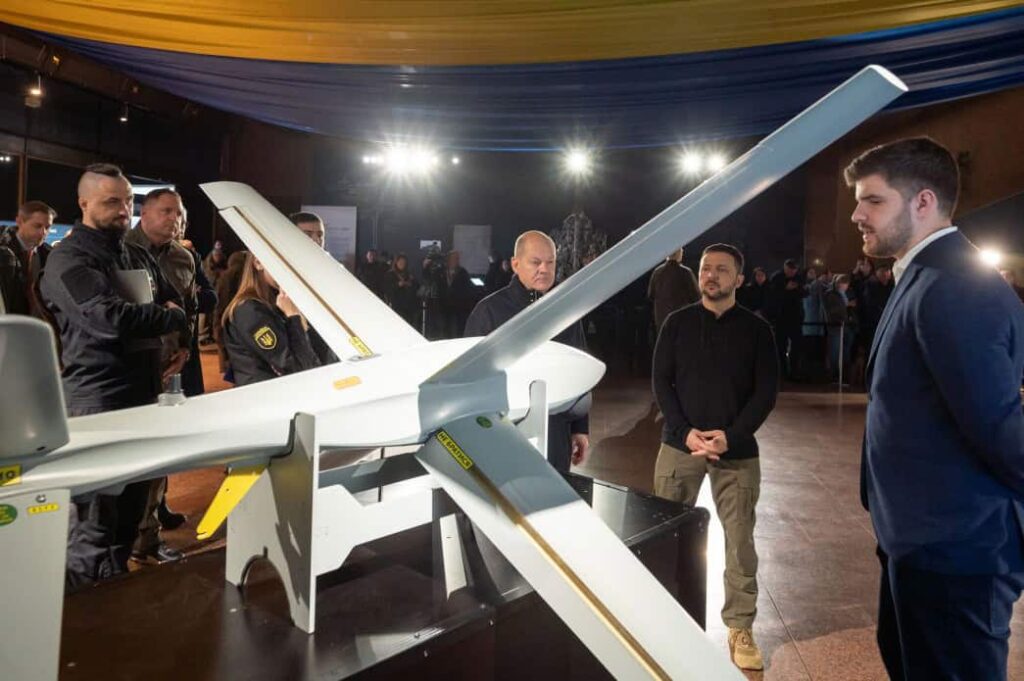
RAM-2X strike drone.

A Ukrainian drone maker has revealed it built a strike weapon it kept classified, deputy director Andrii Rymaruk told Radio NV. For two years, Ukrspecsystems, known for manufacturing Ukraine's SHARK reconnaissance drones, hid its connection to the RAM-2X strike drone, even as crews used it to hunt Russia's costly air defenses and missile launchers deep behind the front. By 2025, it had quietly become the Defense Forces' flagship mid-strike drone.

Ukraine's war on Russia's air defenses increasingly runs on drones its own industry builds and fields in secret, revealed only once they have already destroyed the enemy's costliest launchers and radars. Holding one back that long lets its crews rack up strikes before Moscow can study the weapon and build a counter—and this maker went public only once wrecked drones had reached Russian hands.

Why come out now

The RAM-2X first flew in combat in early 2024, but the maker kept its role secret. Rymaruk said the company wanted the drone and its crews to finish the job first—destroy what needed destroying—before talking. Once shot-down units reached the enemy and turned up on social media, silence no longer protected anything. So after two years, Ukrspecsystems unveiled the drone at the MSPO defense expo in Kielce, Poland.

What it kills

This is a mid-strike drone—a loitering munition that flies deep behind the lines, circles, and dives into its target. Its victims include S-400 and S-300 air defenses, the systems Russia uses to shoot down aircraft, and Iskander launchers that fire ballistic missiles at Ukrainian cities.

Rymaruk put the RAM-2X's own tally at more than 350 Russian systems destroyed since 2024, while Defender Media, which interviewed him, reported more than 1,000 targets over two years. Ukrspecsystems credits the wider RAM series, which reaches back to a fixed-wing model supplied from late 2022, with more than 450 target engagements, over 400 of them against air defenses. Today, it destroys 50 to 60 pieces of Russian equipment a month.

How far, how many

The drone has grown fast. It flew 140 km in 2024 and now hits targets up to 180 km, almost 230 km in good conditions, and a crew from the 429th Achilles unmanned-systems brigade set a range record at 215.5 km. It has spread from a few crews to about 100 military units and 250 trained teams, and one operator can fly it from anywhere in Ukraine. It also works in pairs with the SHARK-M reconnaissance drone—one finds the target, the other kills it. In July, Ukrainians crowdfunded 30 of the drones for military intelligence and the security service through Serhii Prytula's foundation.

  •  

For first time, foreign government is funding Ukrainian drone school: Canada picks foundation that has already bought Ukraine nearly $50M in drones

Andrii Shuvalov, CEO of the Serhii Prytula Foundation, during a meeting with Eric Andresen, Defense Attaché at the Embassy of Canada to Ukraine. Source: The Serhii Prytula Foundation

For the first time, a foreign government is paying to build a Ukrainian drone-training program. Under its Military Training and Cooperation Program, Canada has funded a 24-month course for FPV and fixed-wing drone operators at the training center of the Serhii Prytula Foundation, one of Ukraine's largest charities, the foundation said.

The money buys a system. Canada is paying to build a training cycle that can be scaled and copied, the instructors, methods, standards, and infrastructure behind the courses, so it can keep pace with a technology that changes by the month.

The arrangement runs both ways: Canada, which was slow to adopt the FPV drones now dominating the battlefield, gains access to the combat experience of the country that leads the world in drone warfare.

Canada buys a training system

The deal recognizes what Ukraine's front-line schools have built.

"This is recognition not only of our experience but of the quality and standards of our training," said Andrii Shuvalov, CEO of the Serhii Prytula Foundation.

Both sides gain from the deal

Canada's military attaché framed it as an exchange, not simply aid.

"This is a mutually beneficial partnership. Ukrainian service members will train with leading instructors, and Canada will benefit from Ukraine's deep combat and training experience," said Colonel Eric Andresen.

The problem the program targets is one every modern army now faces: technology evolves so fast that training has to keep pace, or fall behind.

The foundation brings the scale

The problem the program targets is one every modern army now faces: technology evolves so fast that training has to keep pace, or fall behind.

The Prytula Foundation, founded by the volunteer and public figure Serhii Prytula, is a credible partner given its track record. It has bought roughly $39 million in strike drones and $10 million in reconnaissance drones for Ukraine's forces, along with about $8.6 million in vehicles and some $1.9 million each in optics and communications gear, spending that has put it among the country's biggest private suppliers of the war.

  •  
❌