❌

Vue lecture

Pentagon brings in Ukrainian jamming maker to do to its candidate drones what Russia does to Ukraine’s, and see which survives

The testing of drones at Fort Carson in Colorado. Source: Unwave

A Ukrainian jamming-systems maker went to a US Army base to do to candidate drones what Russia does to Ukraine's: flood them with electronic warfare (EW) and see which survives. Unwave company has tested four of its EW systems at Fort Carson in Colorado as part of the Pentagon's Drone Dominance program and has been asked to continue supporting it.

The Pentagon is using Drone Dominance to choose the drones it will buy at scale, more than 200,000 by 2027, and it needs to know they work under jamming, the condition that decides most drone fights in Ukraine.

So it brought in a Ukrainian electronic-warfare maker to supply that jamming, turning Ukraine's hard-won counter-drone experience into the test bench for American hardware. It follows a pattern in which US defense efforts adopt Ukrainian battlefield models.

Ukraine brings the jamming

From 24 August to 2 September, Unwave's team worked at the base, running scenarios that pitted its jammers against drones tasked with protecting fixed positions, moving vehicles, and infrastructure.

The crews operated from three separate positionsat short and long range to compare how drones from different manufacturers held up.

"Our mission was to create conditions as close to the real battlefield as possible," the company said, adding that it judged the tasks successfully completed but could not detail the scenarios for security reasons.

In all, 14 drone makers and three electronic-warfare firms took part.

Four systems on show

Unwave brought four:

  • VIHA, which it calls Ukraine's first tactical-operational jammer for directed suppression of drones
  • BOOMBOX, built to shield troops and positions from FPV and drop-drones
  • SHATRO, for vehicles
  • CHOVEN-2, a multi-frequency amplifier for cars.

Its participation was organized by Revenant Technologies, a US firm that specializes in bringing combat-proven defense tech to the American market, and helped design the scenarios using its ties to Ukraine and frontline experience.

A foothold in the US market

For Unwave, the value is a door into the alliance's security architecture. The event showed the importance of Ukrainian, American, and European specialists testing together, the company said, and "such interaction will help integrate Ukrainian technologies into the security architecture of our allies."

  •  

A bottle of flammable liquid in Poland, a nuclear option on a Russian wish-list—the hunt for Starlink widens

Starlink

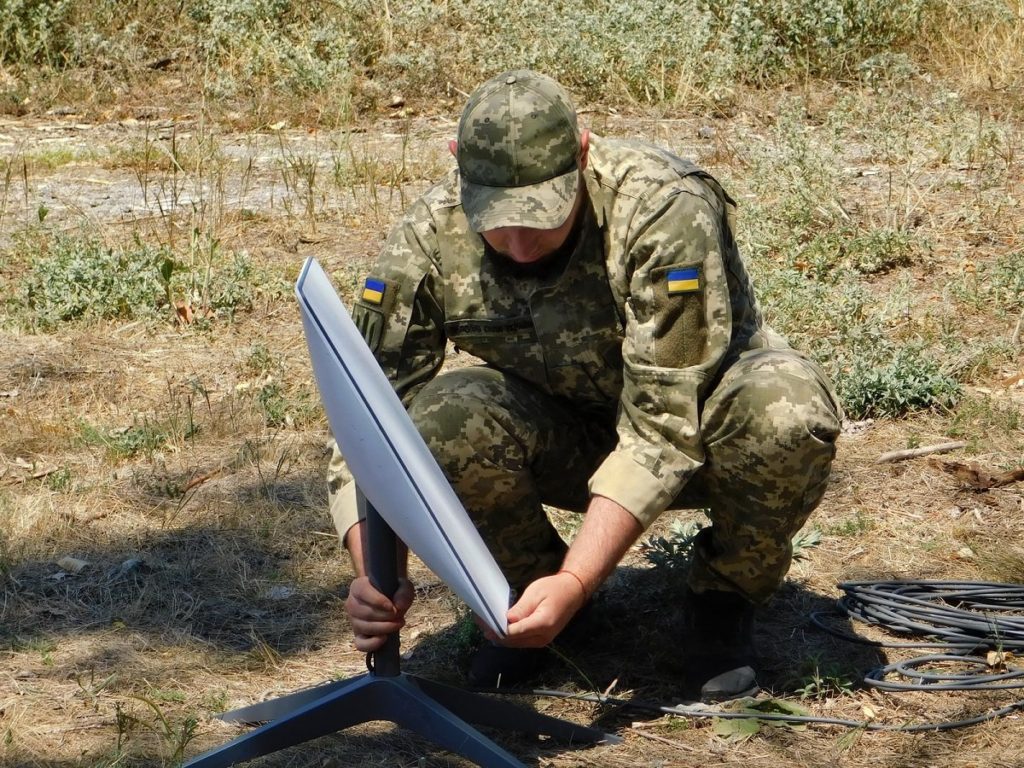
A Russian academic and an ultranationalist media owner have drawn up a menu of ways to knock out Starlink, the satellite network keeping Ukraine's drones and troops online, the Ukrainian defense outlet Militarnyi reported. The ideas run from jamming to a nuclear blast in space, and come as Poland investigates a suspicious fire at a Starlink ground station serving Ukraine.

Satellite internet is the nervous system of the drone war. Since a terminal cutoff early this year gutted Russian frontline coordination, Moscow's search for a workaround has widened from the spectrum to orbit—and from the battlefield toward the infrastructure that keeps the network alive.

The scenarios

Sergei Glazyev of the Russian Academy of Sciences and Konstantin Malofeyev, founder of the Russian outlet Tsargrad, laid out the proposals. Glazyev's list runs from cutting communication cables on land and undersea to crippling data centers and downing reconnaissance and command aircraft, whatever their nationality. Without American and British spotters, planners, and analysts, he claims, Ukraine's army would go blind. Glazyev's core argument is that Starlink satellites are not geostationary—nothing hangs over Ukraine, so the entire constellation must be struck at once.

For electronic warfare, they push wider use of the Volna Kupol Garant, a roughly $1.5 million system that beams a signal to briefly deafen a passing Starlink satellite over what its developers claim is up to 20 km². Kinetic options follow—the A-235 Nudol and S-500 Prometheus interceptors—though they call spending one costly missile on one cheap satellite "insane extravagance." A third idea scatters metal pellets to spark what the authors call the Kessler effect—a debris cascade that would destroy everything at that altitude.

The bluntest proposal detonates a nuclear device in space, its pulse frying electronics on low-orbit satellites. The authors admit this would also wreck Russia's own Rassvet network, which orbits at a similar altitude. "We can no longer hit Musk's creation for free," they write, "but it's still the optimal option. The legal consequences are unimportant."

Video still from Bureau 1440's recent launch of 16 Rassvet satellites into low earth orbit
Explore further

Russia’s answer to Starlink was written off as a failure—its satellites are still climbing

A station burns in Poland

On 23 September, fire destroyed the distribution panel of a ground Starlink station in Wola Krobowska that feeds Poland and Ukraine. Poland's Deputy Prime Minister Krzysztof Gawkowski said sabotage could not be ruled out and that the pattern matched Russian services' modus operandi. A bottle of flammable liquid was found beside the burned distribution panel, according to sources cited by RMF24. Exatel, which the minister named as the station's operator, said it only subleases the land and transmits data there, and neither operates nor owns the infrastructure.

  •  

Ukraine arrests two suspects accused of extorting foreign defense supplier

Ukraine arrests two suspects accused of extorting foreign defense supplier

The Security Service of Ukraine (SBU) has arrested two individuals in Kyiv accused of attempting to extort $200,000 from a European defense company, potentially jeopardizing the delivery of electronic warfare (EW) systems to Ukraine's military, the SBU reported on June 14.

The suspects allegedly demanded the payment in exchange for facilitating the successful testing and adoption of five radio electronic warfare systems provided to Ukraine at no cost, according to statements released by the SBU and the Prosecutor General's Office.

The devices, supplied by a private foreign manufacturer, were financed by Ukraine's international partners. The producer had already delivered five systems to Ukraine, with additional contracts possible if the equipment performed well in combat conditions, the SBU said.

According to investigators, the suspects falsely claimed to have influence within Ukraine's Defense Ministry and promised to use their connections to ensure positive evaluations of the equipment.

"Under the guise of having contacts within the ministry, the men demanded $200,000 from the company in exchange for ensuring no obstacles during official trials of the equipment," the Prosecutor General's Office said in a statement.

Both men have been formally charged under Ukraine's Criminal Code for alleged obstruction of the Armed Forces and receiving unlawful benefits through influence peddling. The charges carry a possible sentence of up to eight years in prison and asset confiscation.

The arrests were made as part of a broader investigation led by the SBU and conducted under the procedural oversight of the Specialized Defense Prosecutor's Office. Authorities say the investigation is ongoing to identify all individuals involved.

Ukraine continues to rely heavily on international military assistance as it defends against Russia's full-scale invasion, now in its fourth year. Ukraine uses EW systems during Russian attacks on its cities and on the front line.

Kyiv and its Western partners launched an electronic warfare coalition in April, which consists of 11 countries and comes on top of other eight Western coalitions to support Ukraine. Other similar initiatives include an artillery coalition, a fighter jet coalition, and a demining coalition, organized within the framework of the Ramstein format.

From buffer zone to new front: Russia pushes deeper into Sumy Oblast
In March 2025, as Ukrainian forces made their final retreat from Sudzha in Russia’s Kursk Oblast, new grey spots began to appear on open-source maps on the other side of the state border, in Ukraine’s Sumy Oblast. For the first time since 2022, when Moscow’s forces retreated
Ukraine arrests two suspects accused of extorting foreign defense supplierThe Kyiv IndependentFrancis Farrell
Ukraine arrests two suspects accused of extorting foreign defense supplier
  •  
❌