Vue lecture

Ukraine’s secret counteroffensive is more successful than we thought

Par : David Axe

  • Ukraine's quiet counteroffensive north of Lyman has produced dramatic results since April
  • Now two Russian regiments are in danger of encirclement
  • Escape is still likely for the Russians, but their retreat buys time for the Ukrainian defenders of Lyman and nearby Sloviansk

Ukraine secret eastern counteroffensive seems to have been even more successful than some observers reported. It's possible that, in the sector just north of the town of Lyman in eastern Ukraine's Donetsk Oblast, the Ukrainian 3rd Army Corps is just a few kilometers short of encircling two Russian regiments.

That doesn't mean the Russian units can't escape. After all, there isn't a contiguous line of Ukrainian forces—nor a contiguous line of Russian forces for that matter—anywhere along the 1,200-km disputed gray zone that threads across eastern and southern Ukraine.
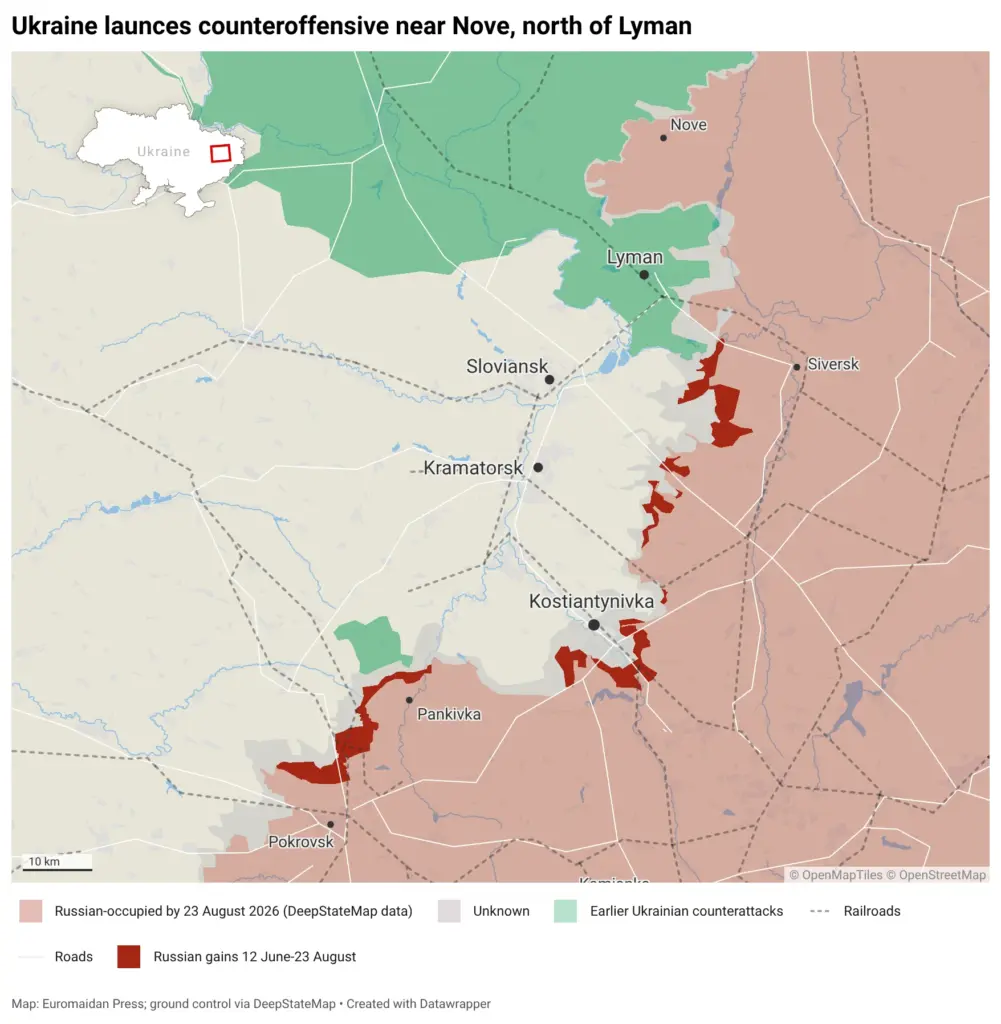
Situation near Nove as of 23 August
Situation near Nove as of 23 August. Map: Euromaidan Press

But the closing pincer around elements of the Russian 2nd and 144th Motor Rifle Divisions could strain the Russians' logistics and compel the Russians to reconsolidate in order to preserve their combat power—by retreating east. That would take a lot of pressure off Lyman and, by extension, also take a lot of pressure off Sloviansk and Kramatorsk, the last two big free cities in Donetsk.

Lyman, which lies 15 km northeast of Sloviansk—the northernmost of the free cities—is the main obstacle between at least six Russian regiments and Sloviansk. The Russians have been inching toward Sloviansk and Kramatorsk from several directions for months now, racing against the coming winter to position forces for a possible siege of the twin cities next year. Winter in Ukraine punishes any attacker by depriving them of the leafy tree canopy that can conceal infiltrating troops during warmer months.

According to the most recent map from analyst and mapper Thorkill, one of the more reliable observers of unit-level action in Ukraine, the Ukrainian 3rd Assault Brigade is just a few kilometers away from linking up with the 60th Mechanized Brigade in or around the village of Kolodyazi.

Sytuacja w rejonie Nowego (Łyman), część II.

Jednym z odcinków frontu w Donbasie, na którym wojska ukraińskie prowadzą obecnie działania zaczepne, jest rejon Kateryniwka - Nowe – Zełena Dolyna, na północ od Łymanu. Od połowy maja 2026 r. pozycje rosyjskiej 144 Dywizji Strzelców… pic.twitter.com/AIvInwHGX3

— Thorkill (@Thorkill65) August 25, 2026

Galloping advance

If true, that means the 3rd Assault Brigade and adjacent units from the 3rd Army Corps have carried out one of the more successful Ukrainian counteroffensives in memory. In April they first exploited gaps in Russian defenses north of the village of Nove. In May and June they advanced toward the village. In July they captured it.

After that, the attacking Ukrainians kept pushing south into the right flank of a 10-km-by-10-km salient that advancing Russian regiments created as they maneuvered around Lyman from the north, aiming to surround the town instead of directly assaulting it on their way toward Sloviansk.

Leaving their flank exposed, the Russians trying to encircle Lyman found themselves at risk of encirclement, instead. If the 3rd Assault Brigade or 60th Mechanized Brigade—together possessing thousands of troops, on paper—can march through Kolodyazi, they will have closed a ring of loose Ukrainian control around at least two Russian regiments, also with potentially thousands of troops.

Emphasis on loose control. Again, there aren't enough Ukrainian forces on the ground north of Lyman to prevent any "encircled" Russians from retreating back to the east. But that retreat would represent a major victory for the Ukrainian defenders north and east of Sloviansk. "The fall of this salient [north of Lyman] would significantly delay the fall of Lyman," analyst and mapper AMK Mapping predicted.

Situational update on the Lyman direction:

The Ukrainian counterattacks north of Lyman are now entering their fourth month, as they come closer and closer to cutting off the Russian salient. Two pincers have been formed, which are both dangerously close to cutting the Russians… pic.twitter.com/mu2kZ4S3Jv

— AMK Mapping 🇳🇿 (@AMK_Mapping_) August 26, 2026

No one expects the Russians to halt their offensive toward Sloviansk and Kramatorsk. But in potentially taking two steps forward and one step back in their northerly march on the free cities, the Russians sacrifice time. Time the Ukrainians can use to stiffen their defenses in Sloviansk and Kramatorsk and evacuate more of the tens of thousands of civilians who remain in the cities despite the constant danger from Russian drones and bombs.

The possible extent of the Ukrainian gains north of Lyman—a 10-km march since April—is impressive given Russia's overall advantage in manpower and firepower in the east. Equally impressive is the operational security, or OPSEC, that cloaked the offensive until now. Sure, there were a few videos of action around Nove that hinted at a major Ukrainian action.

But the units involved exercised surprising discipline, and prevented too much information from leaking. "Someone in the 3rd Corps responsible for [OPSEC] is actually trying to do their job diligently and has quite effectively cut off information," Thorkill noted. The secrecy may have facilitated the Ukrainian advance by delaying any sense of panic among the Russian commanders who are responsible for reinforcing the Lyman salient, but who also tend to ignore bad news as long as possible because they know it could reflect poorly on them.

News of the counteroffensive is now available for all to see, even if official Ukrainian sources have yet to confirm it. That may mean time is running out for the 3rd Army Corps to close its pincer before the Russians retreat or reinforce. AMK Mapping has already seen some evidence of a "partial withdrawal from the most vulnerable positions in the salient.
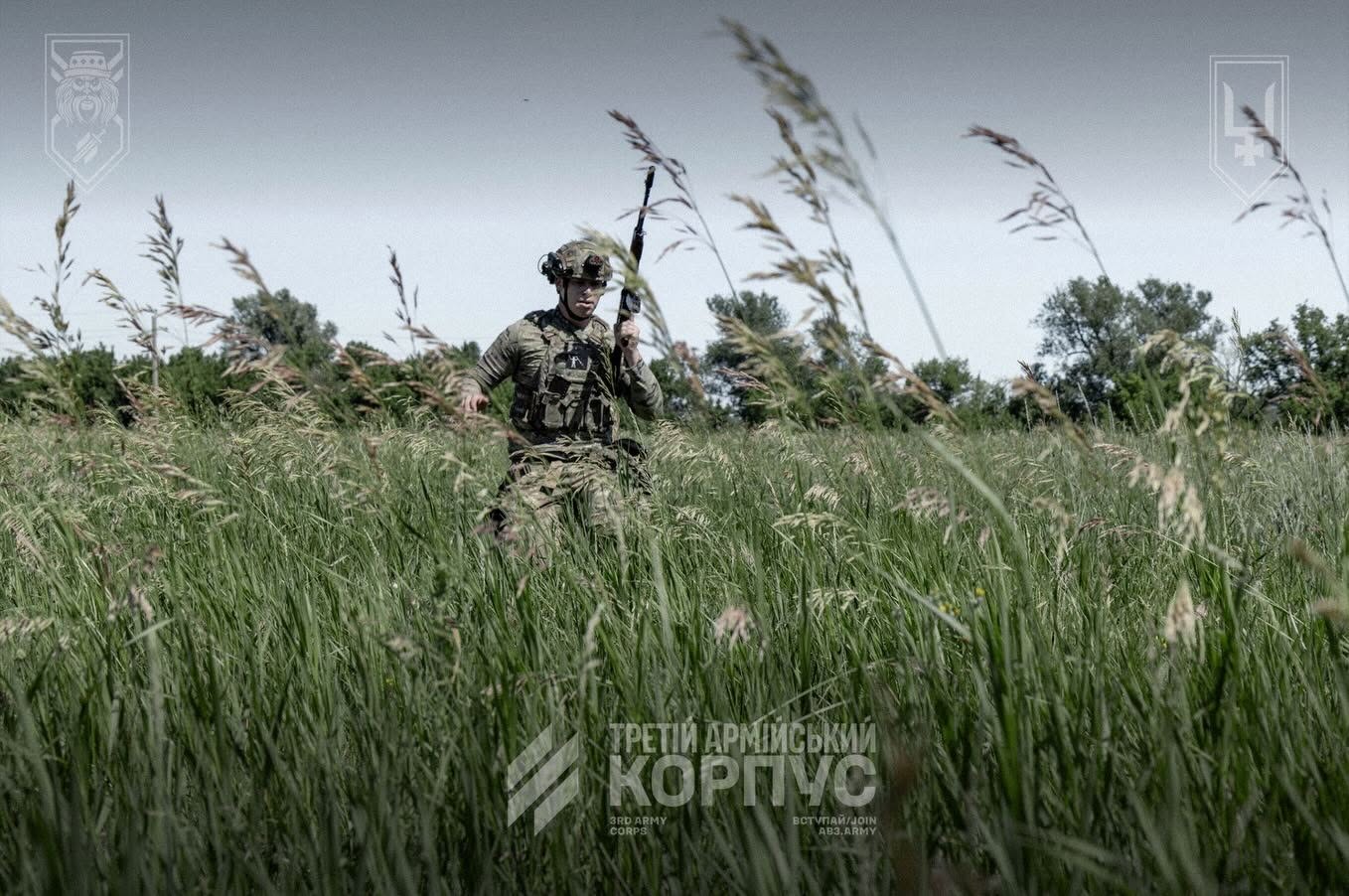

A 53rd Mechanized Brigade trooper.
Explore further

Can Ukrainian forces save Sloviansk and Kramatorsk?

  •  

Ukraine’s secret counteroffensive takes the pressure off Sloviansk

Par : David Axe

A Ukrainian soldier carries an FPV drone.

  • Without much fanfare, Ukrainian forces have been counterattacking north of Lyman in eastern Ukraine's Donetsk Oblast
  • The Ukrainian advance takes some pressure off the free city of Sloviansk, just 20 km to the southwest
  • The problem is: the Russians are advancing toward Sloviansk and Kramatorsk from several other directions

Russian forces are fighting against time to close a pincer around the last free cities in eastern Ukraine. The deadline: the coming winter, which will strip the leaves from the trees and leave any attacking force exposed to overhead surveillance and attack.

But in one key sector, Ukrainian forces are spoiling the coordinated Russian operation to partially surround Sloviansk and neighboring Kramatorsk. With admirable operational security, or OPSEC, a clutch of Ukrainian brigades under the 3rd Army Corps hasn't just blunted the advance of the Russian Center Group of Forces—it has pushed the Russians back.

This Ukrainian counterattack along the axis through the town of Lyman, ongoing since May, has largely escaped widespread notice. Yes, there is some scant video evidence of Ukrainian attacks. And yes, a few analysts have adjusted their maps to account for apparent Ukrainian advances, especially in the direction of Nove, a Russian-occupied village 15 km north of Lyman, which itself lies 15 km north of Sloviansk.

Ukrainian 🇺🇦 forces have been conducting for weeks two unnoticed counter-attacks in two directions of the frontline.

With barely any geolocation, the Ukrainians kept a good level of OPSEC and the russians have been reluctant to publish videos from these areas.

In the Ivanivka… pic.twitter.com/hNJy4YhkxG

— Clément Molin (@clement_molin) June 10, 2026

But for the most part, Ukrainian and Russian sources have avoided talking about Lyman. "The Ukrainians kept a good level of OPSEC and the Russians have been reluctant to publish videos from these areas" depicting their retreats, analyst and mapper Clément Molin noted in June, just a few weeks after the Ukrainians attacked toward Nove.

Molin, for one, expects the OPSEC to lift in the coming days. "By the end of the month, we should have an official update on the good results of a Ukrainian offensive that has largely remained secret," he wrote on Monday.

Situation near Nove as of 23 August
Situation near Nove as of 23 August. Map: Euromaidan Press

April offensive

The Ukrainians' limited counteroffensive around Lyman apparently kicked off on in mid-April. One of the first attacks that left any real evidence occurred on 22 May, when a small Ukrainian mechanized force—perhaps from the 60th or 66th Mechanized Brigade, the 77th Air Assault Brigade, or the Presidential Brigade—attacked in armored trucks and M-113, Stryker, and BTR-4 armored personnel carriers. Heavy bomber drones flew top cover.

The Russian 144th Motor Rifle Division fought back with its own drones. Interceptor drones took aim at the bombers. First-person-view and heavy bomber drones blasted at least one BTR-4, hitting it before and after it dropped off its infantry passengers. Drones struck some of the disembarked Ukrainian infantry.

How many Ukrainian troops survived and entrenched in new positions on 22 May is unclear. Regardless, the Ukrainian 3rd Army Corps wasn't done with Nove. Attacks continued. And sometime after the 22 May assault on Nove, "the Ukrainians managed to consolidate their gains," Molin concluded after scrutinizing a few videos and some satellite imagery.

By early July, Ukrainian forces had succeeded in "operationally encircl[ing] the Russian forces defending the village of Nove," according to analyst and mapper Thorkill. "Fierce fighting is currently underway to expel the Russians from that locality," Thorkill reported at the time.

Sytuacja w rejonie Nowego (Łyman).

Jednym z odcinków frontu w Donbasie, na którym wojska ukraińskie prowadzą obecnie działania zaczepne, jest rejon wsi: Nowe – Zełena Dolyna, na północ od Łymanu. Od połowy maja 2026 r. pozycje rosyjskiej 144 Dywizji Strzelców Zmotoryzowanych… pic.twitter.com/2EJQgz4eps

— Thorkill (@Thorkill65) July 8, 2026

The aim of the Ukrainian counterattacks is obvious. The 3rd Army Corps intends to put pressure on the northern right flank of 10 km-by-10-km salient jutting into the battleground north of Lyman. The Russian 144th Motor Rifle Division has been pouring troops into the salient, clearly intending to surround and isolate Lyman instead of directly assaulting it—all in order to clear a path toward Sloviansk.

Salients are risky for both sides, however. The farther the Russians extend their Lyman salient, the more exposed they are on their flanks. The Ukrainians know this. And even if the 3rd Army Corps can't fully cut across the salient in order to surround the Russians inside of it, the corps can at least take advantage of the salient's exposed flanks.

Capturing Nove, on the very northern edge of the salient, could allow the Ukrainians to bring to bear more artillery and drones on the Russians south of Nove. The 3rd Army Corps doesn't have to fully encircle the Russian troops closest to Lyman in order to hammer them with withering firepower.

Soldiers of Ukraine's 79th Air Assault Brigade.
Explore further

Ukraine’s quiet counteroffensive took 745 square km. Russia’s dead Starlink is how

Just how successful the 3rd Army Corps has been in its local counteroffensive could become clearer very soon. That won't spell lasting relief for Sloviansk and Kramatorsk, however. Fighting against the clock as summer begins turning into fall and then winter, the Russians are slowly advancing toward the twin cities from several directions.

The siege of Kramatorsk and Sloviansk is coming. Perhaps not this year, but surely by 2027. To fully safeguard the twin cities, the Ukrainians would need to duplicate their success north of Lyman along several other directions.

That's a big ask of a Ukrainian force that's overall still outnumbered and outgunned.

  •  

Russia turns failed drone defenses into grounds for state control of company assets

putin at the eastern economic forum in vladivostok on 5 september 2025

Russian President Vladimir Putin has made inadequate drone defenses and slow repairs grounds for putting private assets under state management. His 24 August security decree opens a new way to government control over Russia’s economy.

It expands a mechanism Russia has used against foreign-owned businesses since 2023, according to research by Nektorov, Saveliev and Partners (NSP), a Russian law firm that tracks state takeovers.

The text does not specify what counts as “ineffective” drone protection or how quickly a facility must be restored.

A business need not lose a facility before the measure can apply. Decree No. 604 allows action over late security measures, safety violations, conduct that endangers normal operations, ineffective counter-drone steps, or delayed restoration.

The text does not specify what counts as “ineffective” drone protection or how quickly a facility must be restored. Covered sectors include energy, industry, communications, utilities, transport, logistics, and life-support infrastructure, plus any sites deemed important to Russia’s security or economic stability.

Foreign controllers are also covered, including foreign organizations and citizens controlling Russian companies. Temporary management can reach all or part of an entity’s Russian property, securities, stakes in Russian companies, and other property rights—the rule is not limited to the damaged or vulnerable facility alone.

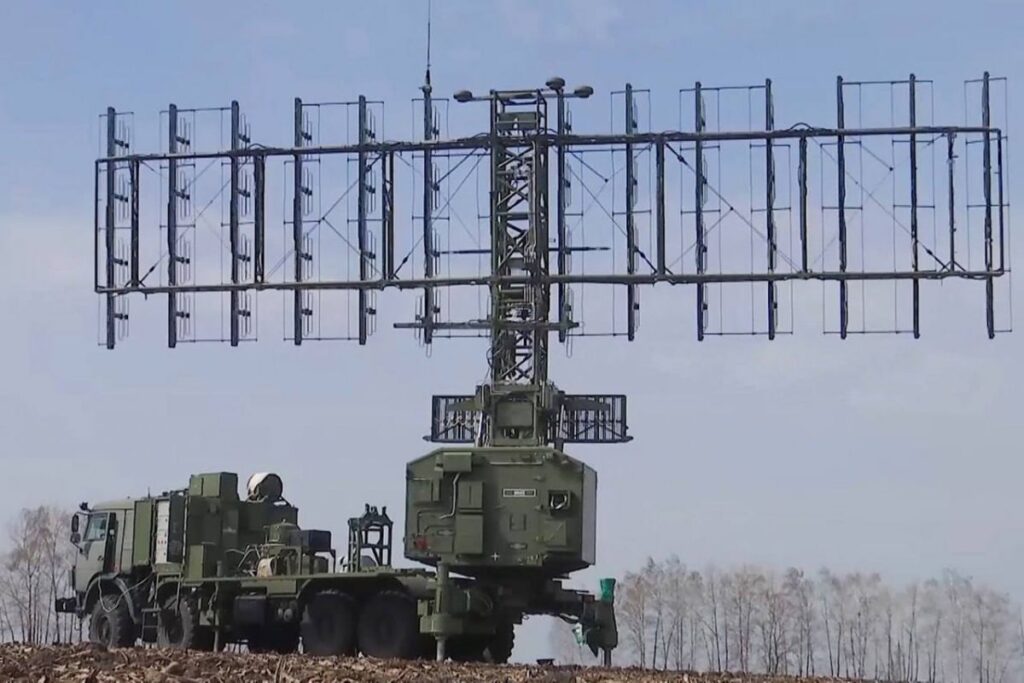
russian mobile air-fefense radar
A mobile Russian air-defense radar pictured in April 2024. Russia’s new decree lets the state take control of wider company assets when drone defenses are deemed inadequate. Photo: United Russia.

“Temporary” control has no deadline

At the same time, the text mentions no automatic return deadline. Putin must instruct the government to begin temporary management and then end it. By default, the Federal Property Management Agency assumes the owner’s powers, except for the right to dispose of the assets. The assets’ costs will be covered from its income.

Interfax published Denis Manturov’s remarks. The first deputy prime minister said the measure would be used selectively for specific security tasks and would leave formal ownership unchanged.

Komsomolskaya Pravda’s Alexander Kots raised a practical problem: Russian law, he wrote, gives businesses no instructions for defending sites against drones or cruise missiles, while barriers require extensive approvals, and private guards cannot easily be given weapons more powerful than shotguns.

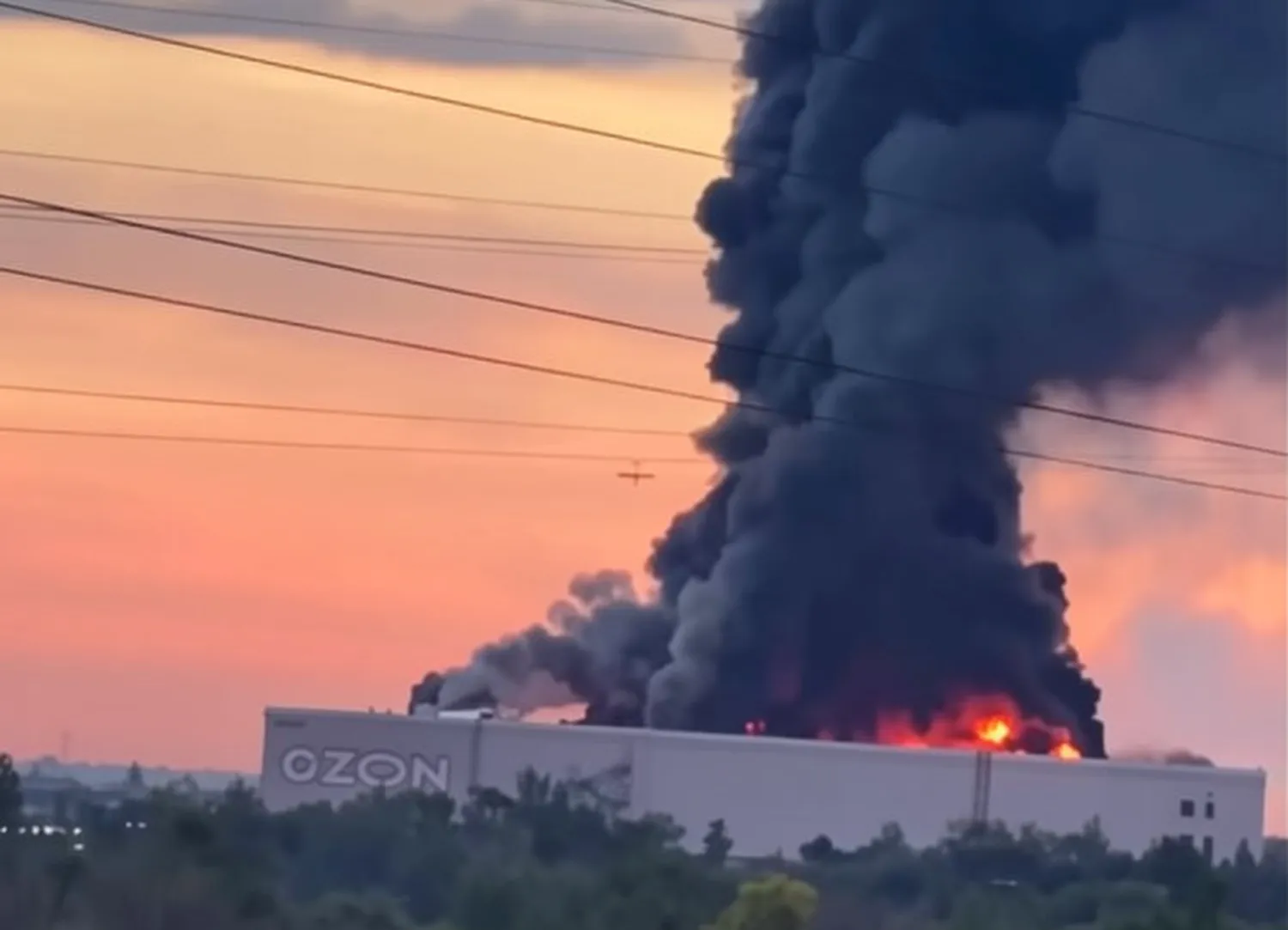
The decree followed weeks of Ukrainian attacks on Russian refineries, ports, and warehouses. Ozon reported six disruptions at its facilities after 22 August. The listed retailer’s shares fell as much as 29.09% from Friday’s close on Monday, after five weeks of strikes on privately held Wildberries.

Thick black smoke and flames rise from an Ozon warehouse in Chapayevsk, Russia, at sunset.
Explore further

Why did Ozon fall as much as 29% while Russia’s market lost 2.9%?

Refining hit two-decade lows as strikes forced Russia to import gasoline, while a sixth Ust-Luga attack since March struck the country’s largest Baltic port.

NSP’s nationalization study records more than 100 cases since 2022 and about 6.5 trillion rubles (about $78 billion) in seized assets. It says cases averaged one court hearing and roughly two months.

The NSP temporary-management table lists several foreign-owned businesses placed under “temporary” management from 2023 whose owners still lack access because the arrangements remain indefinite.

  •  

Ukraine finally hit three Russian Kalibr ships on 12 August. On the 19th, an untouched one hit Kyiv

Par : David Axe

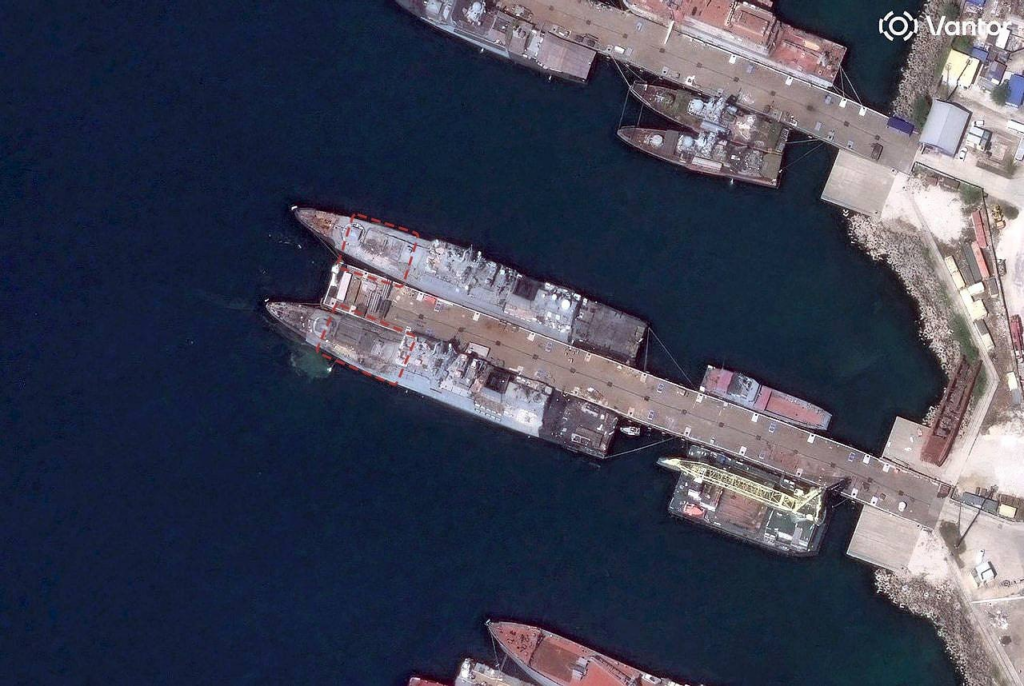
Possible damage to two frigates in Novorossiysk.

  • After months of trying, Ukrainian forces may have finally hit some of the Russian Black Sea Fleet's Kalibr missile-armed warships
  • The 2,500-km Kalibr is often in the mix when Russian forces bombard Ukrainian cities
  • Hitting any Kalibr shooter is a win for Ukraine, but Russia still has no less than four intact Kalibr-compatible ships on the Black Sea

The Russian navy still has enough missile-armed warships in its battered Black Sea Fleet to sustain Kalibr cruise missile attacks on Ukrainian cities, if recent launches are any indication.

Overnight on 19 August, an unscathed Russian corvette lobbed eight Kalibrs at Ukraine. Seven were intercepted. The eighth struck the Antonov Aircraft Plant in Kyiv, according to the open-source monitor OSINT Warfare, in an attack that killed 15 overall. Ukrainian commanders had hoped that wouldn't be possible. A week earlier, they thought they had knocked the Kalibr shooters out of the fight.

Overnight on 12 August, Ukrainian drones and missiles targeted the Black Sea Fleet's main anchorage in Novorossiysk in southern Russia. Russians on the ground recorded fireballs billowing into the night sky, seemingly indicating significant damage to the port or its moored warships, potentially including the Black Sea Fleet's seven or eight surviving frigates, corvettes, and submarines that are compatible with the 2,500-km Kalibr.

The Ukrainian general staff in Kyiv claimed its forces had struck three Kalibr carriers—the frigates Admiral Makarov and Admiral Essen and a Buyan-M corvette—as well as a lightly armed guard ship. But the uncertainty was, and still is, high. Even the general staff stressed its munitions had inflicted "varying degrees" of damage "according to preliminary information."

"Information is being clarified," the general staff stressed.

Footage shows eight 3M14 Kalibr cruise missiles being launched from a Buyan-M-class corvette at the Novorossiysk Naval Base in Russia’s Krasnodar Krai. https://t.co/fiQ0qhUhZ0 pic.twitter.com/GShALhfh4a

— OSINTWarfare (@OSINTWarfare) August 19, 2026

When the sun rose over the following days, commercial satellites snapped high-resolution photos of Novorossiysk, helping analysts assess damage from the 12 August strikes. The photos were hard to interpret. Yes, there were dark patches on the hulls of the two frigates and single corvette, but the discoloration didn't necessarily indicate drone or missile damage—to say nothing of confirming serious damage.

The pro-Ukraine Conflict Intelligence Team concluded Admiral Makarov and Admiral Essen "sustained damage in the area of their launchers," potentially impacting the ships' ability to fire Kalibrs.

A later battle-damage assessment by OSINT account Absolutely Reliable Source said both frigates had suffered critical damage. It assessed that direct hits on Admiral Essen destroyed its eight-cell 3S14 vertical launch system for Kalibr missiles, while strikes on Admiral Makarov caused an internal detonation and burned out its 3S14 launch cells. The account said both ships had lost their strike capability and would require extensive repairs.

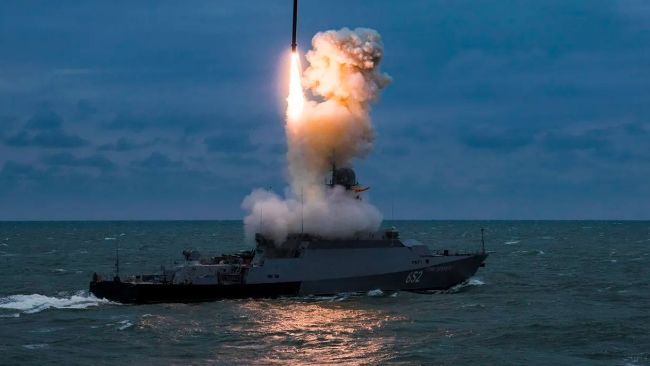
A Kalibr cruise missile launching from a Russian warship in the Black Sea
Launch of a Kalibr cruise missile from a Russian warship. Photo: Russian MoD

Uncertainty

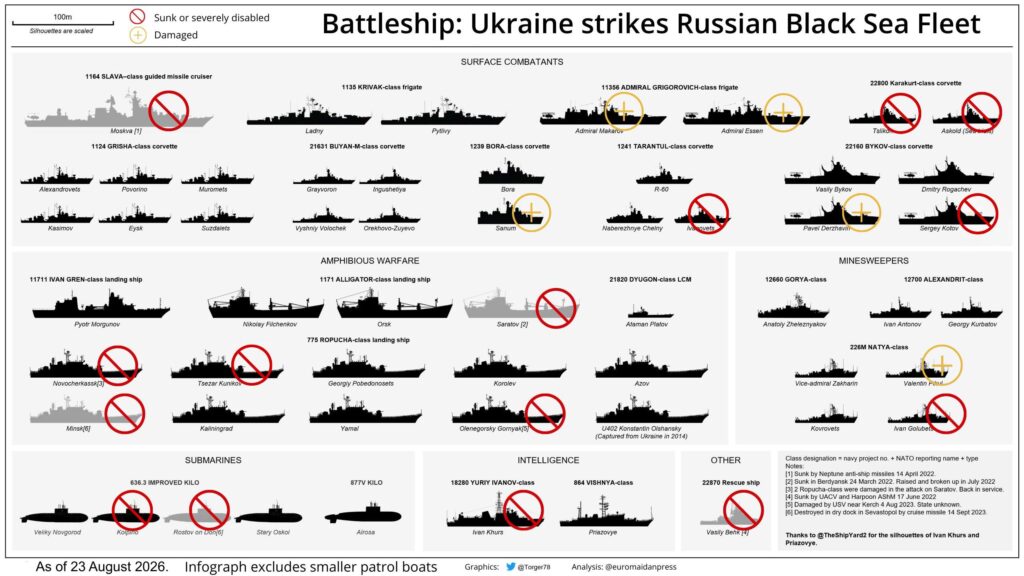
Caution was prudent. In the first three years of Russia's wider war on Ukraine, Ukrainian forces succeeded in destroying or damaging around two dozen of the roughly 85 large ships in the Black Sea Fleet. Perhaps most notably, a pair of Ukrainian Neptune cruise missiles holed and sank the Russian missile cruiser Moskva in April 2022.

Russian Black Sea Fleet battleship warship destroyed Ukraine
Russian Black Sea Fleet warships destroyed or damaged by Ukraine. Infographic by Euromaidan Press, based on Torger78 on X

But the strikes mostly missed the Kalibr carriers. Yes, the Ukrainians took out a Kalibr-armed Improved Kilo-class submarine in September 2023 and a Karakurt-class corvette, also armed with Kalibrs, in November 2023. But that left at least seven Kalibr shooters in the Black Sea Fleet. Eight if the Russians have managed to repair the Improved Kilo that apparently suffered some damage from a Ukrainian one-way unmanned attack submarine back in December.

It wasn't for a lack of trying that Ukrainian forces failed to eliminate, or even seriously dent, the Black Sea Fleet's Kalibr capacity prior to the 12 August raid on Novorossiysk. On 22 May, Fire Point FP-1 drones operated by the Ukrainian 414th Separate Unmanned Strike Aviation System Brigade motored the roughly 430 km to Novorossiysk and spotted a warship moored to a pier.

all 20+ russian kinzhal hypersonic missiles targeting kyiv intercepted patriot since may 2023 russia's mig-31k aircraft carrying missile illustrative mounted mig-31
Explore further

Putin’s Mach-10 wonder weapon misses by 30 meters. Russia stopped building it in April.

The 414th Brigade believed it was Admiral Essen—and also believed it may have hit the ship. "The frigate Admiral Essen … entered the strike zone," the brigade crowed. "Damage level unknown."

In fact, it seems the ship the propeller-driven FP-1 barreled toward, and potentially struck with its warhead, wasn't Admiral Essen. The vessel in the FP-1's video feed, relayed via satellite or a mesh radio network, appeared to be a derelict Krivak-class frigate. Not Admiral Essen.

It was yet another near miss. Earlier, on 6 April, FP-1s dove down on Admiral Makarov. The Ukrainian Unmanned Systems Forces posted footage from the FP-1s' forward-facing thermal cameras that indicated the drones got close to Admiral Makarov. But the footage didn't point to an obvious hit.

Overhead satellite imagery from later on 6 April seemingly told a more complete story. The drones may have left a scorch mark on the frigate's bow, but there was no sign of structural damage. If the 12 August raid really did inflict meaningful damage on Admiral Makarov and Admiral Essen and a Buyan-M, it represented a profound reversal for Ukrainian forces. After trying and trying again for months, they'd finally hit some of the ships that really mattered among the survivors of the Black Sea Fleet.

Ukrainian Navy CB90 assault boats sailing Black Sea patrol operations coastal defense against Russian drones
Explore further

Ukraine may have just lost its first Swedish assault boat—to a Russian jet drone

The problem for the Ukrainians is that, even if three Kalibr shooters are temporarily out of the fight, there are still four, possibly five, Kalibr shooters left. And that's enough to sustain frequent attacks on Ukrainian cities. A single Buyan-M corvette can fire eight Kalibrs at a time. And eight, as it turns out, is a typical number of Kalibrs in the mix when Russian air, sea, and ground forces launch their combined drone and missile barrages.

The Black Sea Fleet reminded everyone of that uncomfortable fact overnight on 19 August. A Buyan-M corvette at Novorossiysk fired eight Kalibrs—exactly one magazine—into a barrage that also carried Onyx and Zircon missiles, Iskander-M and KN-23 ballistic missiles, three dozen air-launched cruise missiles, and 168 drones. Ukrainian air defenses stopped seven of the eight Kalibrs. They could not stop the ballistic missiles, and the eighth Kalibr got through to the Antonov plant, which had already been hit that night by Iskanders and Zircons.

If the attack on 12 August actually did eliminate or even just temporarily sideline three Kalibr carriers, it still represents a partial victory for Ukraine. It's likely no fewer than four shooters remain. And given how long it took Ukrainian deep strike forces to maybe damage Admiral Makarov and Admiral Essen and that Buyan-M, the Black Sea Fleet may be able to continue blasting away at Ukrainian cities for many months to come.

  •  
❌