Vue lecture

Ukraine’s top commander scrapped more than 30 obsolete General Staff orders, freeing field commanders from paperwork built for different war

ukraine draws up new target list its long-range drones—and vows keep firing · post commander-in-chief armed forces mykhailo drapatyi (center) chief general staff ihor skybiuk (right) meeting 26 2026 right

Ukraine's top commander has scrapped more than 30 obsolete General Staff orders, clearing out paperwork built for a different war. The cuts ended decade-old training, shooting, and fitness rules and freed commanders from formal reporting that had lost its point, said Vitalii Sarantsev, communications chief of the 14th Army Corps, who announced the move on Facebook.

The army had been carrying a rulebook written for a lower-intensity war. Many of the canceled orders date back to the Anti-Terrorist Operation and Joint Forces Operation of 2016 to 2020, the years of trench fighting in the Donbas before Russia's full-scale invasion, and they clashed with the standards Ukrainian units developed under fire after 2022.

Canceling them removes those legal conflicts and hands commanders back the time the old reporting consumed. It fits the broader push by Drapatyi, the new commander-in-chief, to strip Soviet-era habits out of the force.

The cuts target decade-old rules

Among the scrapped documents are old training programs, outdated firing courses, and physical-training concepts roughly ten years old, according to Sarantsev, along with dozens of interim amendments that, he said, only cluttered the army's legal framework.

"Long-obsolete instructions that had existed only on paper for years, requiring formal reports, check boxes, and tables, were scrapped," he wrote.

Commanders lose the busywork

The change reaches down to daily command. Field commanders no longer have to file reports or run activities to standards eight to ten years old that no longer fit how the war is fought, Sarantsev said, freeing their time to work with their units rather than on paperwork.

He called the decision "a good, big fall cleanup," saying the army was shedding outdated ballast to work faster and with less bureaucracy.

The purge fits a wider reform

Drapatyi took over as commander-in-chief in July, replacing Oleksandr Syrskyi after six days of protests, with a mandate to carry Ukraine's corps overhaul forward and a reputation for favoring the Western military playbook over Soviet-era practice. On 2 September, he published a set of leadership principles that put service members first, and he has since moved on to the NCO corps as well.

  •  

Evacuation is “force majeure that no one is ready for” in most Ukrainian units, and robots are too slow to fix it, commander says

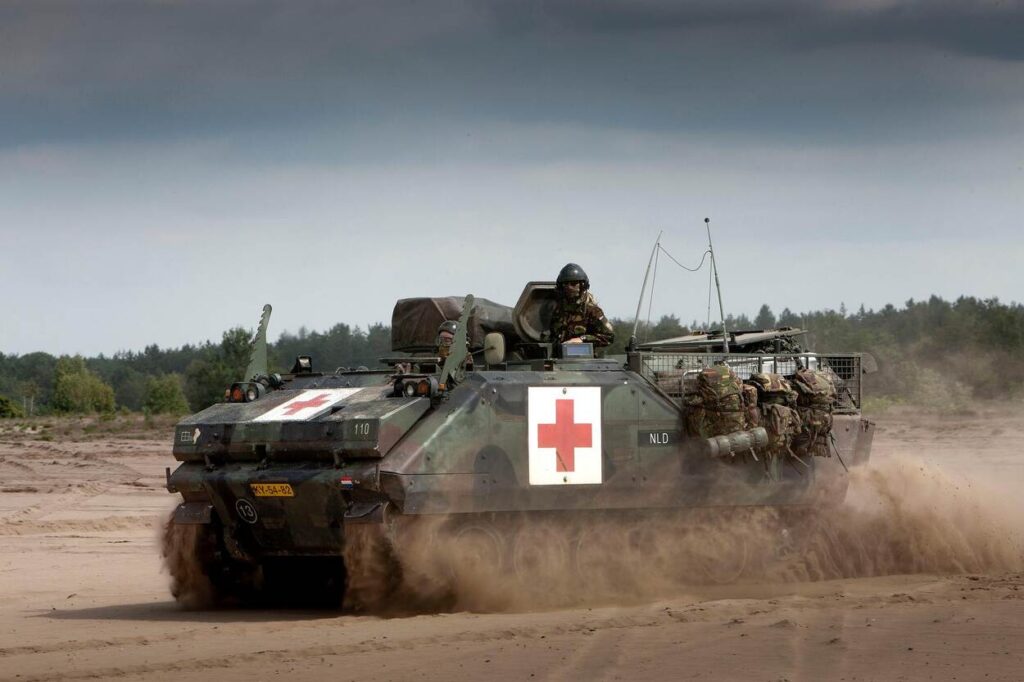
A Ukrainian officer says the army still has no proper system for getting its wounded off the battlefield. Tetiana Chornovov, the commander of a platoon of anti-tank guided missile systems, has called for systemic reform of casualty evacuation in Ukraine's Armed Forces, saying that in the fifth year of the full-scale war, evacuating soldiers from the battlefield remains in most units "a force majeure that no one is ready for."

Most Ukrainian units lack dedicated evacuation groups and specialized armored transport, so evacuations happen in chaos with improvised means, with exceptions only in individual brigades, she says.

Amid public debate over whether ground robots can do the job, Chornovol argues the problem is larger than any single technology, and that the absence of a reliable way out shapes how soldiers fight.

The psychological stakes

Chornovol said the certainty of rescue matters as much as the rescue itself.

"You can't imagine how the existence of professional evac groups would improve the psychological atmosphere at the front. Everyone wants to hope that someone will come for them, will save them," she said.

Her own fear is concrete. Fighting in her fifth year, she said her greatest fear is "that something happens to my people and we'll be helpless, because the evacuation problems will be my problems, and in a small platoon I can't allocate resources to create my own evac group."

One evacuation, seven casualties

Chornovol has backed her argument with a case from a year ago, when her Stuhna anti-tank missile crew was subordinated to a neighboring brigade. At four in the morning, she was told of one killed and one wounded by an enemy chemical-weapons strike, with the evacuation placed entirely on her crew despite weak coordination and unfamiliar terrain.

The rescue attempts compounded the toll.

"My combat vehicle with excellent electronic warfare and an anti-mine grader, which set out for the evacuation, blew up on an anti-tank magnetic mine dropped from a drone," she recalled.

The grader saved lives, but four of her best soldiers were badly concussed. A second vehicle from the brigade, with one of her men as a guide, hit another anti-tank mine, but without a grader: "the mine exploded under the hood, the driver lost his legs, the others were concussed." A third vehicle made it through by luck and took out the wounded and the dead.

"So one evacuation, seven casualties. One severe, without legs," she said, noting the brigade simply had no normal evac group or evac protocol.

She organized the Stuhna evacuation herself, bringing in border guards to control the road, waiting for a window in drone flights, and repairing the electronic-warfare gear stripped from the first knocked-out vehicle.

What Chornovol wants built

Chornovol believes that creating separate staffed evacuation units within brigades is the most necessary reform now, each with an autonomous team and special transport.

"There should be the best drivers, with salaries like assault troops, but also medics, pilots, EW specialists, sappers to defuse mines dropped by drones, and pros: hunters with shotguns to down drones," she said.

On equipment, she argued against relying on ground robots, which she agrees are too slow for evacuation and often easy targets for enemy drones. The main transport, she said, should be a small, fast, lightly-armored vehicle with an anti-mine bottom, light enough to survive the anti-tank mines the enemy drops.

"For a platoon, such equipment is too much, but I don't understand why the whole brigade we were attached to didn't have such an evac vehicle," she said.

She nearly lost five of her men, she added, because of the absence of adequate evacuation approaches and proper light-armored vehicles in the army, asking why the National Guard has them for evacuation while the Armed Forces do not.

  •  
❌