❌

Vue lecture

The EU sanctioned Russia’s Starlink rival but not the company that builds it. Experts call that the gap that matters
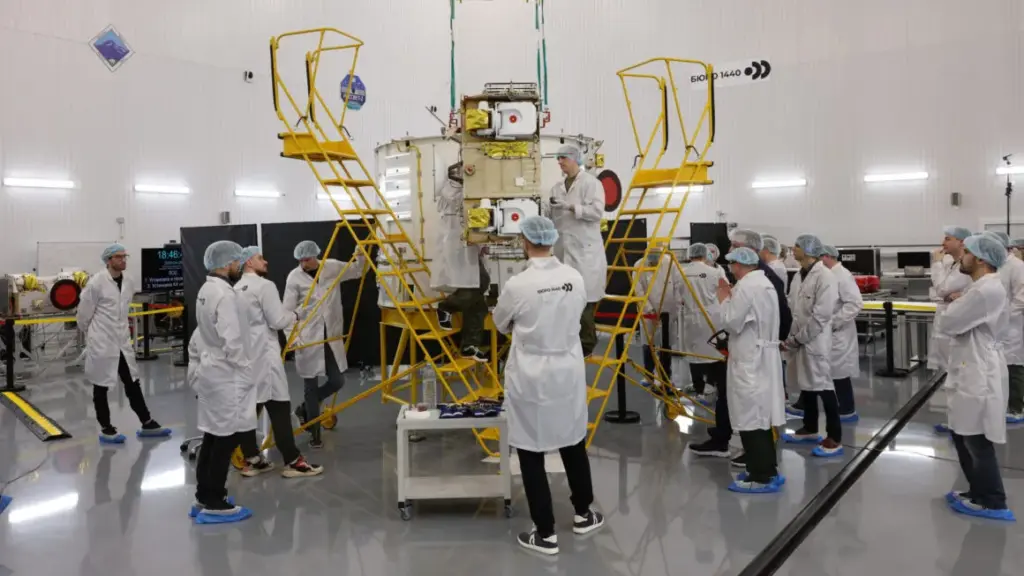
Employees of Russian company Bureau 1440 work on a Rassvet communications satellite.

The company that actually assembles Russia's homegrown answer to Starlink has been left off every Western sanctions list, a US research group and a Ukrainian anti-corruption watchdog separately told Euromaidan Press this month.

Both landed on the same gap—the manufacturer, Bureau 1440, and its leaders remain untouched by the West, even though Kyiv has already placed the firm on Ukraine's own sanctions list. They differ on how much a Western designation would achieve, not on where the opening is.

The company no Western government has sanctioned

Rassvet is Russia's low-Earth-orbit satellite constellation, built by the private firm Bureau 1440 to give Moscow's troops communications independent of SpaceX. Bureau 1440 launched its first 16 satellites in March 2026, building the network after SpaceX cut off the Russian units' unauthorized Starlink access. C4ADS, a US-based research organization, confirmed to Euromaidan Press that Bureau 1440 and its leadership sit outside every Western sanctions regime, and called designating the manufacturer the single most visible and effective step available.

Viktoriia Vyshnivska, a senior analyst at the Independent Anti-Corruption Commission (NAKO), a Ukrainian watchdog, was more measured. "We shouldn't expect a magical effect," she said, but sanctions would make the Western boards and components Bureau 1440 depends on harder and costlier to source. Many of those goods are already banned under EU export controls, she noted—yet the manufacturer itself remains off the lists.

The EU named the network but not the firm

The EU has already moved once. Its 21st sanctions package, adopted on 23 July, targeted the Rassvet network but stopped short of the manufacturer, leaving Bureau 1440 and its chief executive off the lists. On 28 August, Ukrainian Foreign Minister Andrii Sybiha said Kyiv had sent a formal note to the UN's telecom agency requesting that Ukraine be excluded from Rassvet's coverage. Days later, he urged EU ministers to sanction the project. Ukraine gave partners a list of nine entities tied to it, Militarnyi reported, citing sources.

For years Ukraine could find, jam, or knock out the communication links Russian forces leaned on. Rassvet may be the first it cannot. Vyshnivska put the useful window to slow it at about a year. Russia, by Ukrainian calculations, needs five to eight years to see it through.

Euromaidan Press examined how Russia built Rassvet, and how far it still has to go.

  •  

Russia’s Starlink rival falters as latest satellite batch stalls in low orbit, ISW says

Employees of Russian company Bureau 1440 work on a Rassvet communications satellite.

The Rassvet communications satellites Moscow launched in July are likely to have shorter operational lifespans than planned because atmospheric drag increases at their current altitudes, the Institute for the Study of War (ISW) reported.

Moscow accelerated Rassvet’s deployment after its forces lost unauthorized Starlink access in February. A complete network could support battlefield communications and remotely controlled strikes against Ukraine, but existing satellites provide only brief connectivity windows. The latest setback will likely delay continuous coverage, ISW assessed.

Russian forces had relied heavily on unauthorized Starlink terminals for frontline communications, drone operations, and command-and-control. Ukraine and SpaceX blocked them on 5 February, disrupting Russian communications and assaults across several sectors. A Russian-controlled network could reduce Moscow’s dependence on SpaceX and illicit supply chains for terminals.

None of the 16 satellites launched on 19 July had reached 550 kilometers as of 31 August, according to N2YO tracking data cited by ISW. Many remained between 300 and 400 kilometers, some were gradually losing altitude, and at least two were reportedly heading toward atmospheric reentry.

ISW identified 550 kilometers as the altitude reached by the successful first-batch satellites, while reporting 870 kilometers as Rassvet’s intended operational altitude. At lower altitudes, satellites must use more fuel to counter greater atmospheric drag, shortening their operating lives.

Of the 32 Rassvet satellites launched in 2026, only 12—all from the first batch launched on 24 March—reached sustainable altitudes. They remained at roughly 550 kilometers and provided two daily connectivity windows over Ukraine totaling up to 90 minutes, ISW reported.

Russia needs at least 200–300 working satellites for stable, round-the-clock coverage, presidential defense-technology adviser Serhii “Flash” Beskrestnov assessed. Bureau 1440 plans “dozens” more launches and “hundreds” more satellites, but Russia depends on the scarce, costly Soyuz-2.1b rocket.

Only six to eight Soyuz-2.1b launches of all types have occurred since 2022, limiting Russia to a maximum of 128 Rassvet satellites over four years at that rate, ISW assessed.

Ukraine struck the Progress Space Rocket Center, which builds Soyuz-type vehicles, on 14–15 August and attempted to strike Plesetsk Cosmodrome on 23 August, ISW noted. Both Rassvet batches launched from Plesetsk, showing Ukraine can threaten the rockets and launch infrastructure required to expand the constellation, the institute assessed.

What is Rassvet?

Rassvet, meaning “Dawn,” is a low-Earth-orbit broadband constellation developed by Bureau 1440 as Russia’s domestic alternative to Starlink. Its 5G-based satellites are intended to provide high-speed, low-latency internet independently of SpaceX.

Although initially designed for civilian communications, a mature network could provide Russian forces with battlefield connectivity, command-and-control links, and connections to long-range drones. Moscow aims to place 292 satellites in orbit by the end of 2027 and 924 by 2035.

  •  
❌