Vue lecture

Ukraine’s chief prosecutor fled. Politicians still choose the man who can prosecute them.
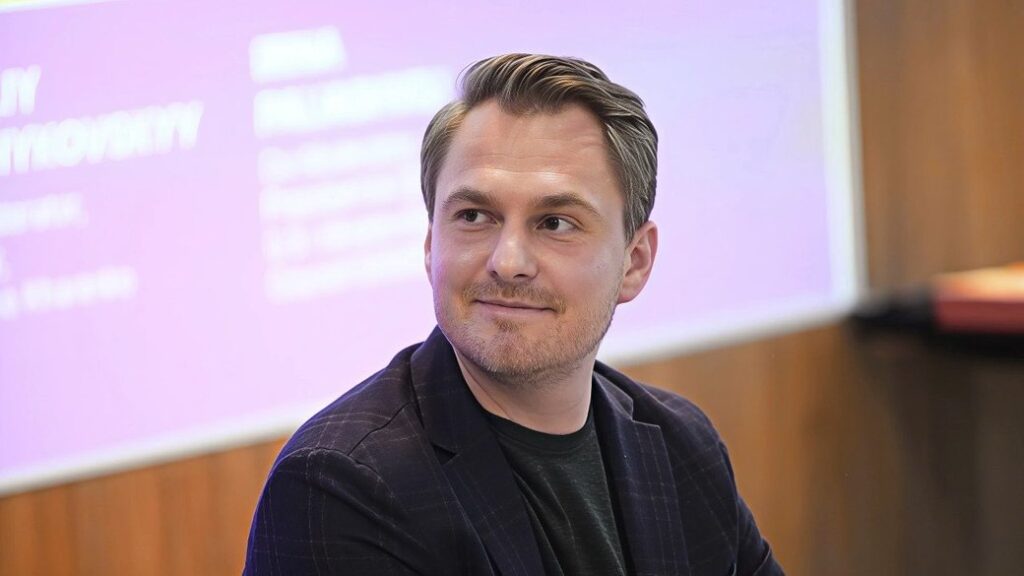
Ruslan Kravchenko, former Prosecutor General of Ukraine. Facebook

At 2:30 in the morning of 14 September, one week after he first claimed his innocence and then resigned, Ukraine's prosecutor general Ruslan Kravchenko crossed the border and left the country. Hours before he went, he used his office to sign a criminal suspicion against the chief of the anti-corruption bureau investigating him. His wife had crossed a day earlier.

Such was the unglorious fate of President Zelenskyy's man, the prosecutor general who in July 2025 nearly leashed Ukraine's independent anti-corruption agencies. Saved by mass street protests, the anti-graft institutions built after the Euromaidan revolution rebounded, and went first after President Zelenskyy's friend Tymur Mindich, then after his right hand Andriy Yermak.

And now they had reached the prosecutor general himself: in Ukraine, the one official who can veto any anti-corruption case against a member of parliament.

"For the first time in Ukraine, after a suspicion was announced, it was the prosecutor who fled abroad, not the suspect," anti-corruption campaigner Daria Kaleniuk wrote as it happened.
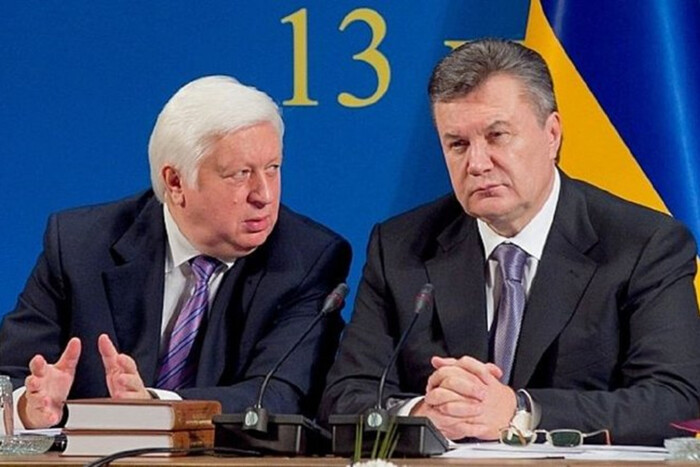
Victor Pshonka Yanukovych
Victor Pshonka, the prosecutor general who helped Yanukovych consolidate authoritarian power (left) and ex-President Viktor Yanukovych. Photo from open sources

Things are, of course, far better than in 2014, when then Prosecutor General Pshonka criminalized the Euromaidan revolution and pursued the political rivals of then President Yanukovych, before both fled to Russia. Papers later found in Pshonka's abandoned mansion, published by Ukrainska Pravda, showed his office drawing up plans to arrest MPs and open thousands of criminal cases against Maidan activists, using prosecution, in the office's own notes, as a political instrument.

But things are still not as good as in 2019, the one time the office worked the other way. That year Ukraine's new chief prosecutor, Ruslan Riaboshapka, named fresh suspects in the PrivatBank case, which ran into Ihor Kolomoisky, the oligarch whose television channel had helped put Zelenskyy in office. He also refused to sign charges against Zelenskyy's political opponent Petro Poroshenko, calling them groundless.
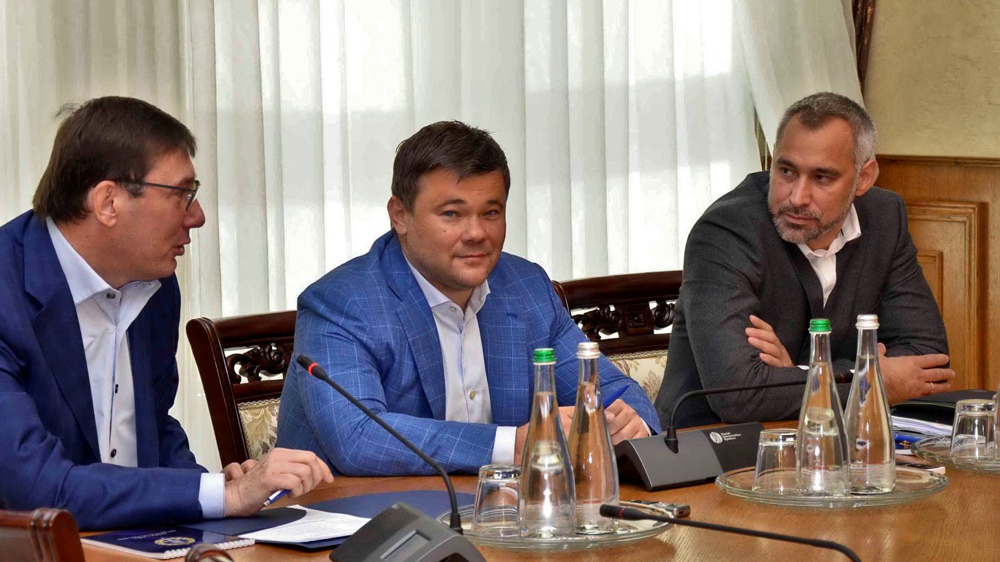
Ukraine launches large-scale reform for its post-Soviet prosecutor's offices system
Head of president's office Andriy Bohdan (C) presents Ruslan Riaiboshapka (R) as a new Prosecutor General together with previous PG Yuriy Lutsenko. Kyiv, 30 August 2019. Photo: gp.gov.ua

Signature-gathering for Riaboshapka's dismissal began the next day. Parliament removed him in March 2020, and his successor rolled back the reforms he had tried to launch. David Arakhamia, the head of Zelenskyy's parliamentary faction, later named the refusal to charge Poroshenko as the last drop.

It keeps repeating. The official whose job is to hold the powerful to account ends up serving them instead.

Of the prosecutors general who followed Riaboshapka, two left under a cloud.

Andriy Kostin resigned in 2024 after investigators exposed a nationwide market in fake disability certificates used to dodge mobilization, a scheme that reached prosecutors inside his own service. And now Kravchenko, whom Ukraine's anti-corruption agencies had begun investigating over the alleged protection of an international network of fraudulent call centers.

2023: Ukrainian Prosecutor General Andrii Kostin during a meeting with Ukrainian representatives of law enforcement agencies in Kherson Oblast.

It keeps repeating. The official whose job is to hold the powerful to account ends up serving them instead. The problem is structural, and so is the fix: the same mechanism behind Ukraine's working post-Euromaidan reforms. A bill to have independent experts vet candidates for the Prosecutor General exists; it has sat in parliament since June, untouched.

Whether Zelenskyy's Servant of the People party, which holds the Rada majority, will let it move is unclear. What hangs on the answer is whether Ukraine finishes becoming a state of law, or stays a state of protection.

Unlimited power, total political control

Iryna Korzhenkova
Iryna Korzhenkova, parliamentary analyst at Chesno

For the office meant to guarantee that everyone, including those in power, is equal before the law, real powers are necessary. The problem in Ukraine, said Iryna Korzhenkova, a parliamentary analyst at the Chesno movement for political transparency, is that those powers come bundled with total political control.

The president appoints the prosecutor general with the Rada's consent, under a procedure that provides neither transparent selection nor any assessment of competence. He can be dismissed by a simple 226-vote majority. No prosecutor general has served a full term, and the average tenure is under two years.

"The position that is supposed to keep politicians in check works as their insurance policy instead," Korzhenkova told Euromaidan Press.

Capturing the office is a tempting political prize. Under Article 482-2 of the Criminal Procedure Code, only the prosecutor general can register a criminal case against a sitting MP, and only he can approve a search, a wiretap, or a detention against one.

Since MPs lost their formal immunity in 2020, in the same reform that handed the prosecutor general sole power to open cases against them, this has become a kind of modified immunity: one politically appointed person can decline to open a case, and no court can challenge the refusal. This was the case in 2020, when then Prosecutor General Iryna Venediktova rejected a draft suspicion against an MP handed to her by NABU, reversing only under public pressure.
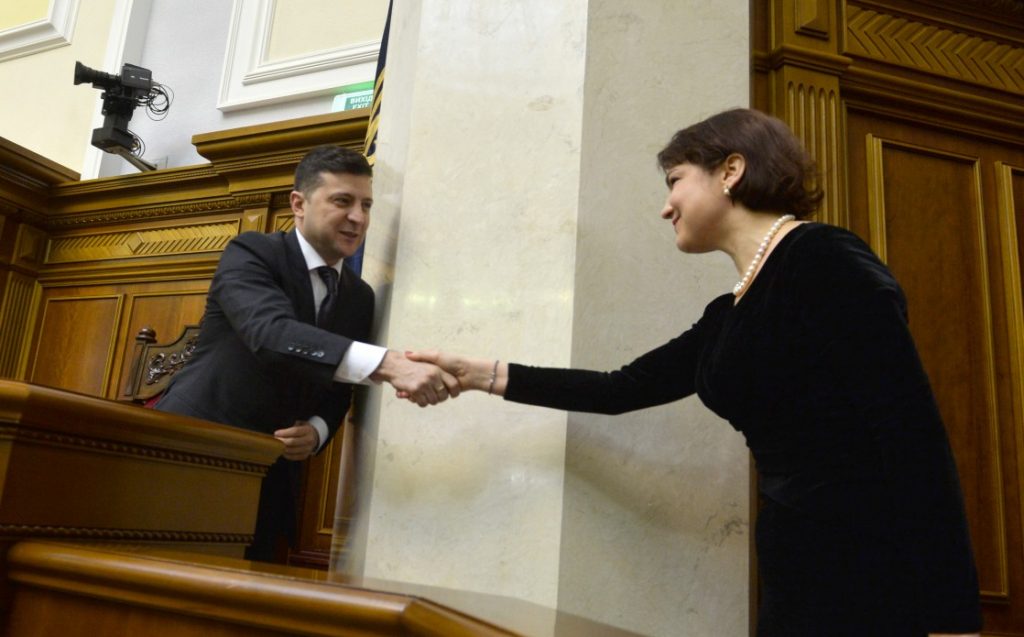
President Zelenskyy shakes hands with Iryna Venediktova, newly appointed Prosecutor General. Photo: president.gov.ua
March 2020: President Zelenskyy shakes hands with Iryna Venediktova, newly appointed Prosecutor General. Photo: president.gov.ua

So valuable is the office that in 2016 parliament stripped out the need for a law degree altogether, to fit the president's man, Poroshenko ally Yuriy Lutsenko; the press called it "the personal law of Lutsenko."

His appointment came as the old guard crushed a reform born on the wings of Euromaidan: a team of reformist prosecutors who had just exposed the "diamond prosecutors," senior officials caught with bags of cash and gems linked to the sitting prosecutor general, was purged, and the case died.

Explore further

How Ukraine’s old guard killed the prosecution reform

A demand the EU has made since 2014

Depoliticizing this chair has been an EU condition for Ukraine's membership path since 2014, and a live one since negotiations on the Fundamentals cluster, the first stage of accession talks and the one covering rule of law, opened in June.

This is why the day that Kravchenko fled, the EU issued a reminder that Ukraine promised to reform the Prosecutor General's Office and introduce a contest for the chair.

"The prosecutor general is the gateway to the criminal justice system for everyone in power," Korzhenkova explained.

Today, that gateway is held by the political majority: appointed by Zelenskyy, dismissable by his Servant of the People party, which controls parliament. Any case against that majority has to pass a filter the majority appoints.

EU summit Ukraine cyprus zelenskyy
Ukrainian President Volodymyr Zelenskyy, European Commission President Ursula von der Leyen, and European Council President António Costa meet during the informal EU summit in Cyprus, 23 April 2026. Credit: President.gov.ua

The EU's interest in prying the office loose is twofold, she said.

  1. Brussels sends Ukraine money and must be sure that money stolen gets prosecuted;
  2. and it has watched the reform reverse in Poland and Bulgaria, which is why it now wants the guarantees written in before the fact.

The internal price is steeper still: war raises the cost of a dependent prosecution, with defense procurement, mobilization, and aid flows all resting on it.

Europe's own standard, set out by the Council of Europe in its 2014 charter on prosecutors, prescribes no single model. Governments may have a hand in choosing the prosecutor general, so long as the method earns public confidence and the term is stable enough to make the office "independent of political changes."

On dismissal it is blunter: protection from "arbitrary or politically motivated dismissal" is "particularly relevant" for prosecutors general, and the law "should clearly define the conditions of their pre-term dismissal."

Ukraine fails at both ends, and, as Korzhenkova puts it, no version that leaves the president's discretion untouched can meet that standard.

The international expert lifehack
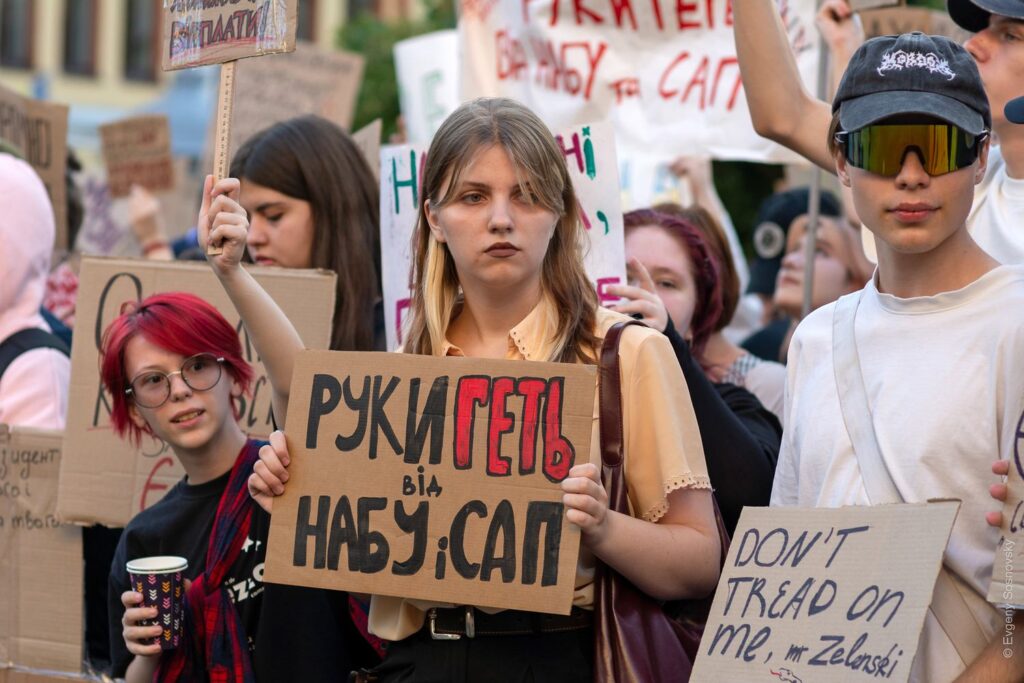
Ukraine protests against corruption NABU SAPO Zelenskyy Kyiv
"Hands off NABU and SAPO," says a cardboard poster of a young woman at protests against a law to curb the independence of Ukraine's anti-corruption agencies in Kyiv, late July 2025. Photo: Evgeny Sosnovsky

But how do you clean an office when cronyism runs through the class that appoints it? Ukraine has a partial answer, from the part of its post-Euromaidan reforms that worked.

The directors of the National Anti-Corruption Bureau (NABU), Special Anti-Corruption Prosecutor's Office (SAPO), and the National Agency on Corruption Prevention are chosen through open competitions in which a panel of independent experts, foreign ones among them with a decisive vote, can veto compromised candidates.

The Ukrainian half of a commission can be captured. The foreigners with a decisive vote are the part no Ukrainian official can phone up and instruct.

The success of those agencies, now breaking up the very rings of cronyism they were built to reach, is why the Venice Commission and Ukraine's Western partners have consistently defended the model.

In a 2021 joint statement, the EU, US, and partner embassies called the international experts' role "temporary but crucial," aimed at resisting "the influence of vested interests." When Zelenskyy's team moved to strip NABU and SAPO of their independence in July 2025, the G7 ambassadors publicly welcomed the reversal that restored it.

Those independently selected agencies produced Operation Midas, the case that reached Mindich and forced out Yermak, and, weeks later, Operation Forrest Gump.
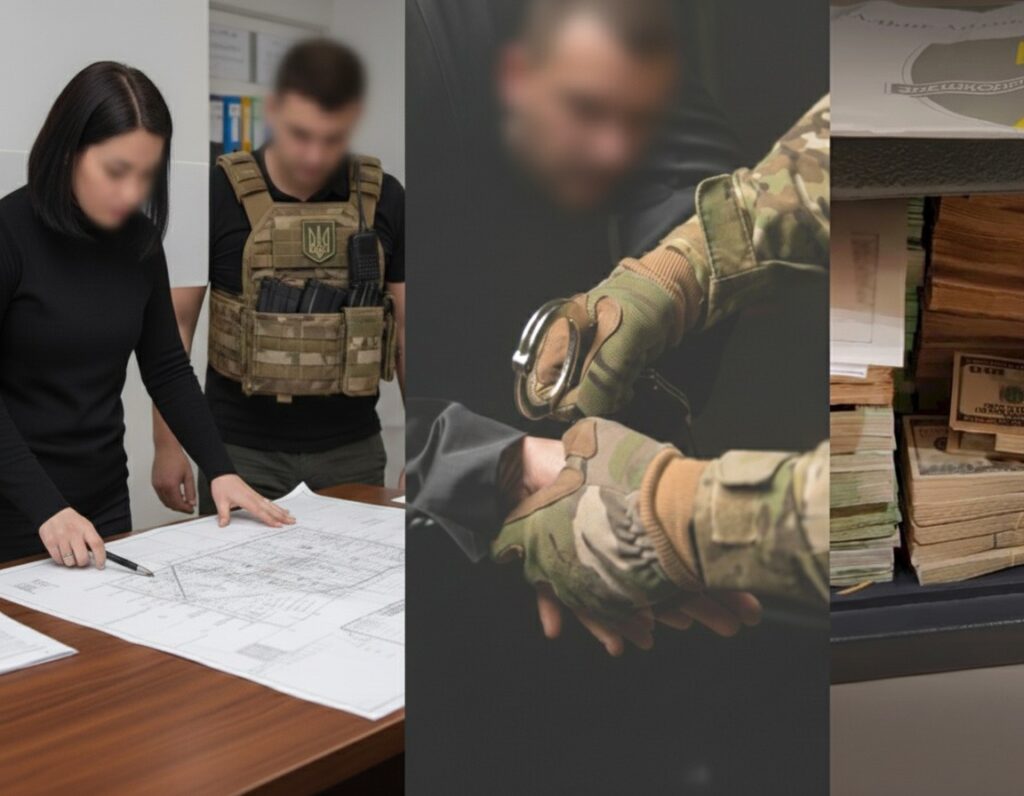
Composite image showing NABU anti-corruption operation: investigators reviewing documents at table, tactical officer conducting search, and stacks of seized currency bills from November 2025 raids into alleged $100 million kickback scheme at Energoatom nuclear operator
Composite image depicting NABU investigators examining documents, conducting searches, and seizing cash during raids targeting corruption schemes during Operation Midas. November 2025.

The High Anti-Corruption Court (HACC), created in 2018 through the same kind of expert council, reaches officials the courts never could: it convicted the highest-ranking judge in the country, Vsevolod Kniaziev, over part of a $2.7 million bribe. Before it existed, all of Ukraine's general courts together had delivered roughly 40 verdicts in NABU and SAPO cases; in seven years the specialized court has delivered 431, against 601 people, and for the first time a sitting MP drew a real prison term.
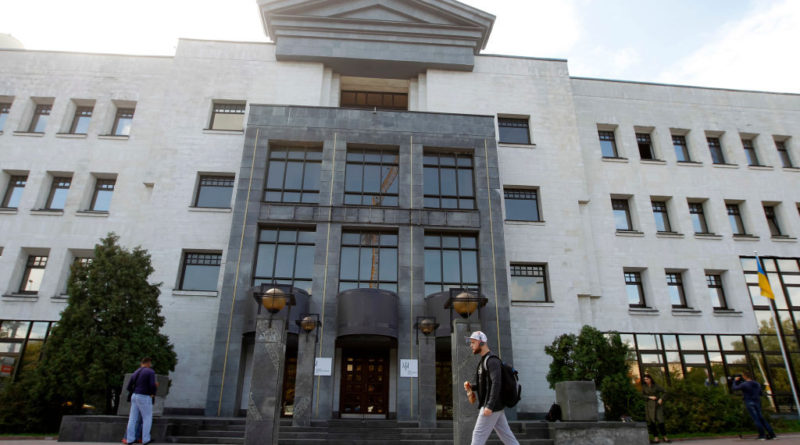
The High Anti-Corruption Court of Ukraine
Explore further

Ukraine’s Anti-Corruption Court is breaking the cycle of impunity

The foreign vote is not a hypothetical safeguard. At an August hearing for Olha Stefanishyna, the former deputy prime minister for European integration, a SAPO prosecutor read out messages in which, they say, she steered the very commissions that select Ukraine's watchdog agencies. To the head of the 2022 panel choosing the NABU director: "Do what you want, I need numbers 60 and 62 from the list. Postpone the sessions, I shouldn't have to think for you." Her influence reached three commissions at once.

ukraine anti-corruption
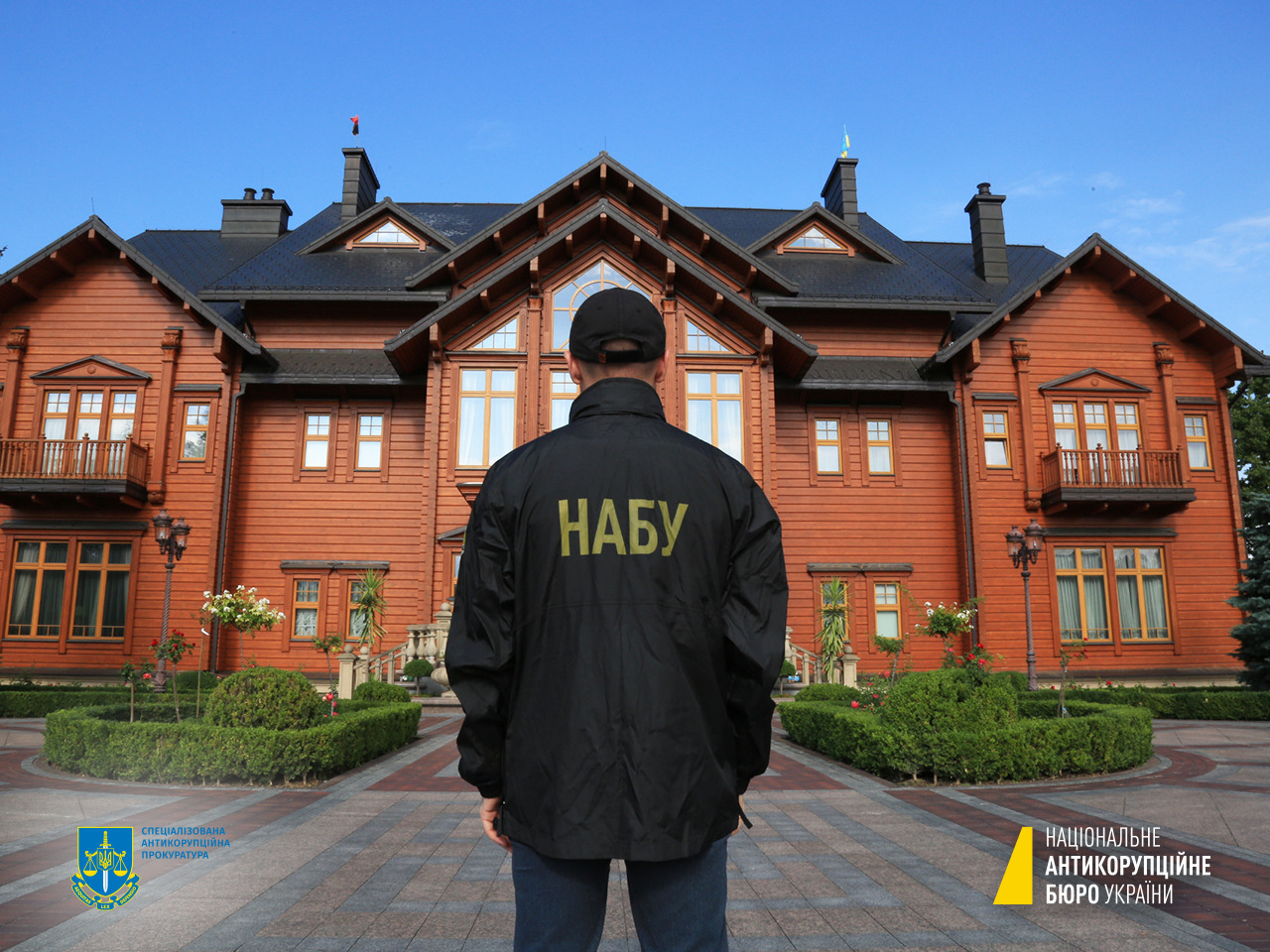
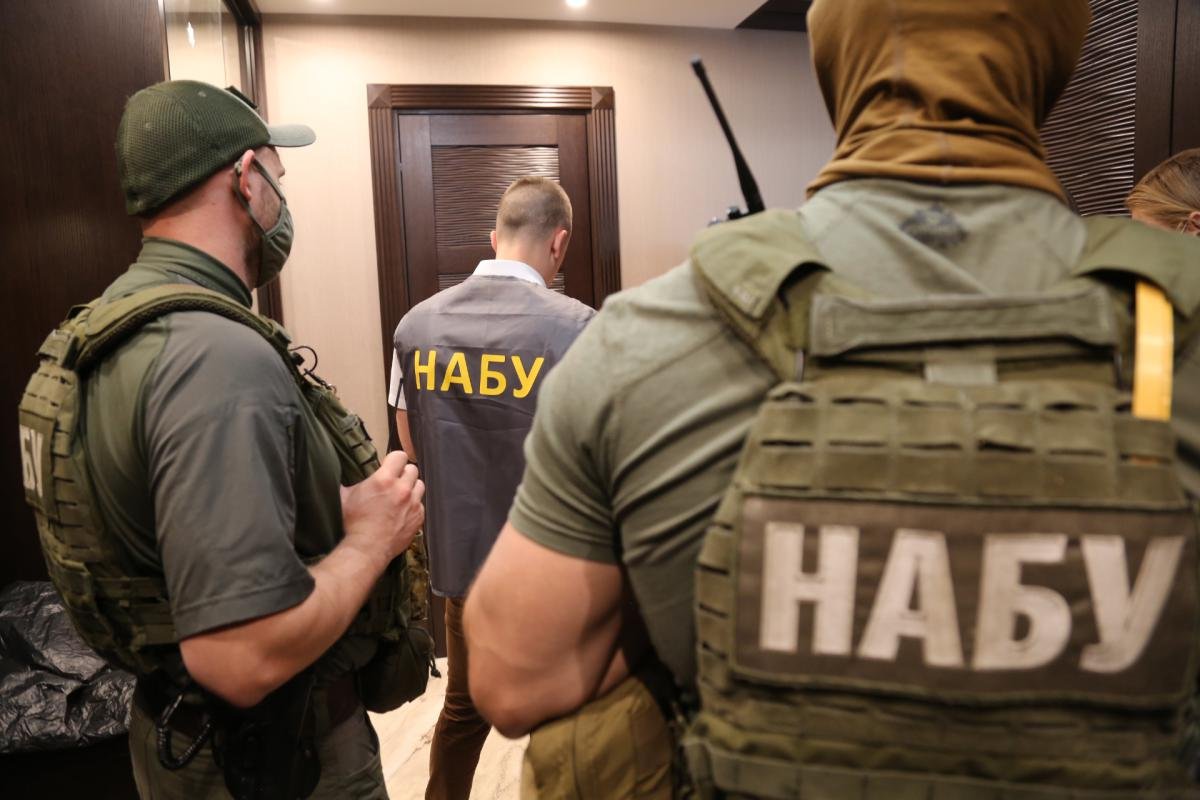
In 2015, the National Anti-Corruption Bureau and the Specialized Anti-Corruption Prosecutor’s Office were established in Ukraine to fight the top-level corruption. In 2019, the High Anti-Corruption Court completed the chain. The NABU agents are in the photo. Photo: nabu.gov.ua

She calls the case a storm in a teacup, and the charges are unproven. But it is the reformers' own argument: the Ukrainian half of a commission can be captured. The foreigners with a decisive vote are the part no Ukrainian official can phone up and instruct.

The model is no panacea, Korzhenkova warns:

"The international experts are not the motor of reform. They are a circuit breaker. They can keep out the worse candidate. They cannot make those in power want to do better."

The anti-corruption court convicts, but whether the guilty serve time is another matter. Of its 398 convictions in seven years, more than half were settled by plea bargain, others ended in fines or suspended sentences, and a stack of cases had simply run out the clock before any verdict. As of the last public tally, in spring 2026, only about 80 of the convicted had actually drawn real jail time.

For years, the court sat short of judges, which Ekonomichna Pravda read as quietly convenient for those in power: an understaffed court slows cases and lets them lapse without the visible fight of dismantling it. Most of the vacancies were only filled in August 2026, when the EU tied the appointments to money Ukraine needed.

What the bill would do, and the perennial objection

Ukraine's Prosecutor General Ruslan Kravchenko has resigned. Photo: Facebook
Ukraine's former Prosecutor General Ruslan Kravchenko. Photo: his facebook

Full depoliticization would mean amending the constitution, which martial law rules out, and the EU mandates no specific route. So the reformers' instrument is an ordinary law, bill 15343.

It adds a filter to the current system: the president would pick not freely, as now, but from candidates pre-selected by an open competition run by a six-member commission, three of them vetted by Ukraine's international partners. Four votes choose a candidate, two of them the internationals'.

And it moves the power to discipline and dismiss a sitting prosecutor general to the High Council of Justice, the body that governs Ukraine's judges, itself reformed in 2021 through the same international-expert vetting, and the one disciplinary body not under the prosecutor general's own control.

If the mechanism works, and Ukraine has used it for its anti-corruption prosecution, bureau, and court, the obvious question is why the prosecutor general was left out.

The answer is not constitutional, though a constitutional objection has been raised. A legal analysis on the site Sud.ua argued the model has no analog in most of the EU and breaks the constitution: the president is reduced to a technical executor of the commission's choice, and the judges' council is handed power over the head of the prosecution, which is not the judiciary. Foreign experts with a veto over a constitutional office, one commentator wrote, are a gift to any populist and to Moscow.
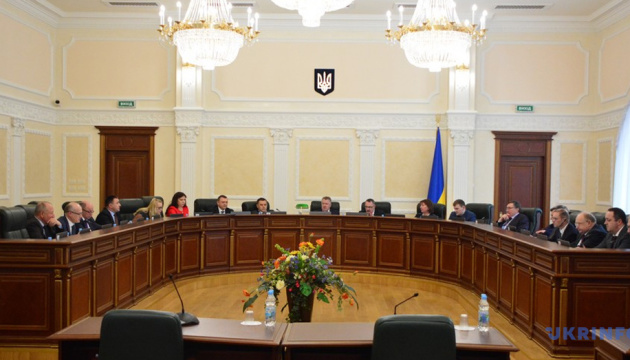
The High Council of Justice, the key body of the judicial government, was considered the main enemy of real reform and was relaunched in 2021. Photo: ukrinform.ua

But this is the argument Ukraine's powerful always reach for when the anti-corruption bodies get close.

In 2020, when NABU accused the judge Pavlo Vovk of running a scheme to seize control of the courts, the same sovereignty-and-separation-of-powers reasoning was deployed to shield him, and EP reported at the time that the prosecutor general's own office was accused of moving to disrupt the case against him. The office meant to prosecute the powerful was protecting them instead, which is the whole reason reformers want it taken out of political hands.

There is no legal reason the reform cannot be done, Korzhenkova says. The same constitutional objections applied to the Constitutional Court and the High Council of Justice, both reformed through international vetting; the filter was added anyway.

"The constitutional argument suddenly appeared only for the prosecutor general," she said.

The real reason for the stall is political: the prosecutor general is the last great lever that decides who gets prosecuted, and the majority that would have to give up control of it is the same majority those prosecutions would reach.

The Rada's own tempo shows it. To save the system from a scandal, it found 317 votes to dismiss Kravchenko in a single day and installed an acting prosecutor general by decree. To limit the system, it has left the bill untouched for three months; in early September the relevant committee declined even to put it on the agenda, and moved only after individual MPs pushed.

At least 50 members of the current parliament, Chesno documents, are themselves under criminal suspicion.

What happens now
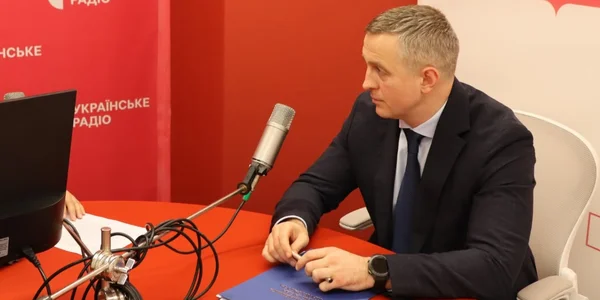
Kravchenko's replacement Anton Kovalskyi has worked in prosecution for 15 years. Photo: Khmelnytskyi regional prosecutor's office

The interim answer is Anton Kovalskyi, the Khmelnytskyi Oblast chief prosecutor, appointed acting prosecutor general by decree on 17 September, chosen the old way: hand-picked, from at least four candidates, with no public account of why him.

The Anti-Corruption Action Center laid out the rest in a dossier: property registered to relatives, a wife from Russia whose year-old sole proprietorship reported earnings of over UAH 500,000 ($11k) a month, a deputy whose father-in-law fled to Russia and was convicted in absentia of collaboration.

Asked whether the reform bill would have produced a different result, Korzhenkova declined to guess, and said the guessing is the problem. "I don't know, and neither does anyone else, and that is exactly it."

Under an open competition, his selection would have been vetted by international experts; everyone could have submitted data on the candidates.

The bill would not have guaranteed a good prosecutor general, but it would at least have made the appointed one checkable. This is what the Rada majority is, for now, declining to allow.

The case that finally reached Kravchenko had a name. NABU and SAPO called it Carthage: a scheme, run out of the Prosecutor General's Office itself, to shield a network of fraudulent call centers, with five officials handed suspicions.

Carthage put investigators inside his building, and Carthage he was answering when, on his way out, he turned the office's power to prosecute the man using it against him and signed a suspicion against Semen Kryvonos, the NABU director.
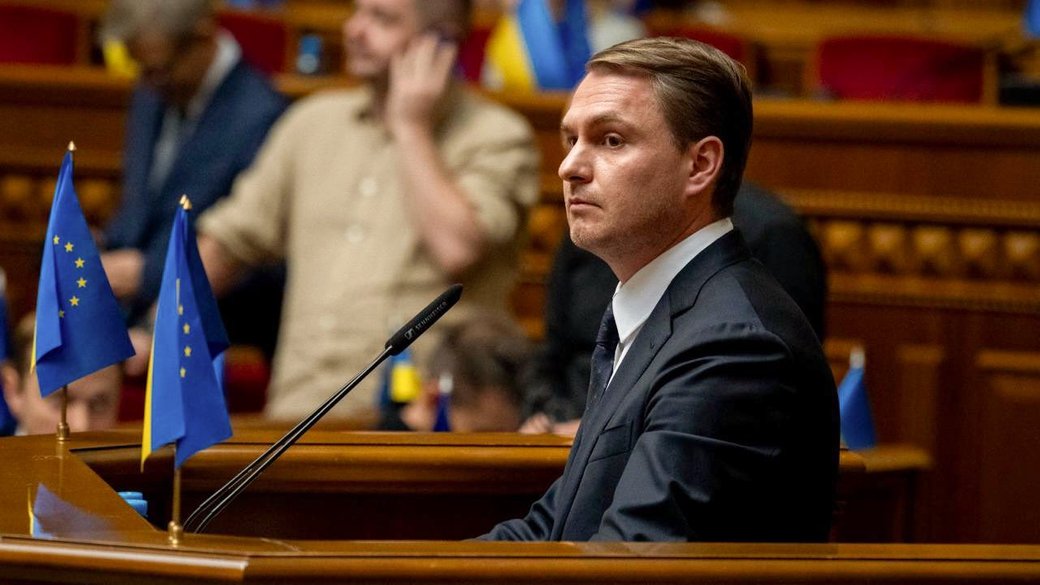
Ukraine's Prosecutor General Ruslan Kravchenko has resigned. Photo: Facebook
Explore further

Ukraine’s prosecutor general resigns as the watchdogs he was appointed to leash close in

Kryvonos says it never reached him; the office itself later conceded that the suspicion was legally void.

Kravchenko's last act as prosecutor general was a business trip he wrote for himself, five days in Paris for a hearing of the PACE parliamentary network, and he left by car on 13 September. He was due back on the 18th. He did not return, and his former office says it does not know whether he has asked for asylum in the EU.

Ukraine has spent a decade building institutions that reach the powerful. The prosecutor general's office is the one it never got to. The man who ran it signed his own exit papers and was across the border by half past two in the morning.

  •  

Zelenskyy suspends prosecutor general who charged the bureau probing his own office

Ruslan Kravchenko speaks beside a large Ukrainian flag at a housing-rehabilitation event in Irpin in June 2023.

Ukrainian President Volodymyr Zelenskyy suspended Ruslan Kravchenko from the post of prosecutor general by decree on 14 September. The decree came hours after Kravchenko announced criminal accusations against Semen Kryvonos, director of Ukraine's National Anti-Corruption Bureau (NABU), which is investigating Kravchenko's office.

Zelenskyy's suspension comes amid a conflict between the Prosecutor General's Office and Ukraine's anti-corruption bodies: NABU, which investigates high-level corruption, and SAPO, which prosecutes NABU's cases. Their independence is central to Ukraine's post-Euromaidan reforms and EU accession.

Zelenskyy's decree gave no reason and cited martial-law powers allowing the president to suspend officials appointed under his authority, Censor reported.

Davyd Arakhamia, parliamentary leader of Zelenskyy's Servant of the People party, said lawmakers would vote on 15 September on a submission from Zelenskyy, who urged the Rada to back the dismissal without delay. The law enforcement committee backed it the same afternoon. Kravchenko submitted his resignation on 7 September.

Kravchenko was abroad on what his office called an official trip to a 16 September conference on Ukrainian children in Paris, organized by the Parliamentary Assembly of the Council of Europe. Yet a spokesperson for the assembly told the Kyiv Independent that neither Kravchenko nor anyone from his office would take part, and that he would not appear as a speaker or a participant, and Censor's sources say he registered the trip as a business trip to Brussels.

The NGO Anti-Corruption Action Center alleged that he signed the notices in exchange for being let out of the country, and that the trip was possible only with Zelenskyy's permission. It published no evidence.

Ukraine's Prosecutor General Ruslan Kravchenko has resigned. Photo: Facebook
Explore further

Ukraine’s prosecutor general resigns as the watchdogs he was appointed to leash close in

What Kravchenko accused anti-corruption officials of

Before his suspension, Kravchenko said he had signed notices of suspicion against Kryvonos, NABU’s director, and an unnamed associate of SAPO head Oleksandr Klymenko.

A notice of suspicion is a formal pretrial accusation that generally confers suspect status upon service of the notice. Kravchenko accused Kryvonos of forging documents to obtain an illicit benefit on an especially large scale and arranging a fictitious adoption to avoid legal liability. The second alleges that the unnamed associate tried to influence anti-corruption judges, offered them bribes, and helped others evade mobilization.

Kravchenko linked the notices to Operation Carthage, claiming NABU and SAPO used its searches to obtain and remove case files concerning their personnel.

wiretaps mocking codename seized playbook—ukraine's anti-graft bureau reaches president's office again · post national anti-corruption (nabu) officers during search forest gump operation 19 2026 nabu ukraine news ukrainian reports
Explore further

“If you’re gonna f*ck, f*ck a queen, if you’re gonna steal, steal a million”: Ukraine’s anti-corruption bureau says senior official ran criminal ring inside Prosecutor General’s Office

NABU and SAPO rejected the allegations, denied taking files or seeking immunity, and called Kravchenko's actions a continuation of a "systemic attack" on independent anti-corruption agencies. Since Kryvonos had not been served, the agencies described the announcement as public rather than procedural.

What Operation Carthage is investigating

At the center of Operation Carthage is Serhii Kropyva, deputy head of the Prosecutor General's Office international cooperation department, whom NABU and SAPO accuse of running a bribery scheme that protected fraudulent call centers and laundered the proceeds.

Kropyva was remanded in custody with bail set at UAH 120 million ($2.7 million) while NABU and SAPO searched the Prosecutor General's Office premises. NABU has not named Kravchenko as a suspect, and he denies protecting the call centers or receiving criminal proceeds.

Kudrytskyi
Explore further

Ukraine detains energy chief who brought in $1.5 billion from the West

The dispute between Kravchenko and the two agencies also revives a broader struggle over their independence from the prosecutor general. In July 2025, parliament placed NABU and SAPO under greater control by the prosecutor general, triggering Ukraine’s first major wartime street protests and Western pressure before lawmakers restored their formal independence.

The European Commission reiterated on 14 September that both the protection of agencies and the reform of the Prosecutor General’s Office, including the competitive selection of its head, are part of Ukraine’s EU accession commitments.

  •  

Ukraine reported hitting warships and an oil terminal in a Russian port city whose mayor claimed only falling debris

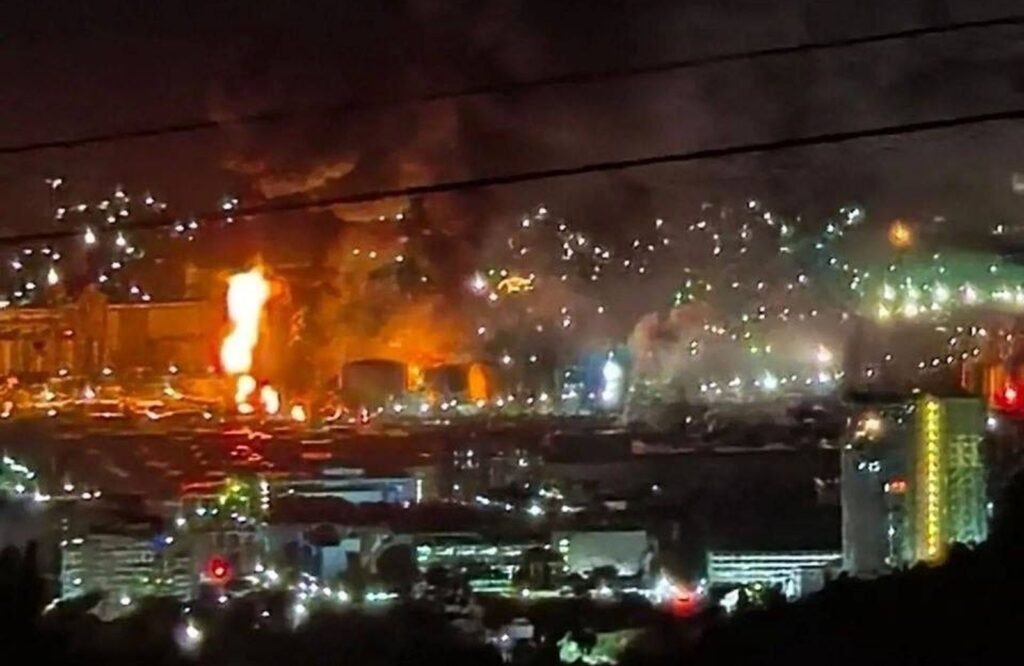
ukraine reported hitting warships oil-shipping terminal where local authority only fires falling debris · post fire port novorossiysk russia 9 2026 пожежа в порту новоросійська вересня джерело exilenova+ news ukrainian

Ukrainian drones set a fuel-oil terminal on fire in the port of Novorossiysk again overnight on 9 September, monitoring channels reported. Novorossiysk's mayor claimed drone debris came down on enterprise grounds in the Russian city. Ukraine's military later reported strikes on the naval base there, including on warships that carry cruise missiles.

Russia keeps attacking Ukrainian cities and the power grid with missiles and drones as winter closes in, and because Ukraine's air defenses cannot stop every ballistic salvo in its final seconds, the launch platforms and the fuel and export money that sustain them sit among the few targets Kyiv can act on directly.

Analysts placed the fire on a fuel-oil terminal

Ukrainian defense news outlet Militarnyi located the strike through geospatial intelligence (GEOINT) analysis, which matches published photos and video against satellite imagery and maps. That work showed drones hitting the mazut (fuel-oil) terminal inside the port in Krasnodar Krai. Fire broke out on the terminal grounds, and at least one storage tank took damage. Around midnight, residents began reporting the sound of drones overhead, Russian air defense fire, and explosions.

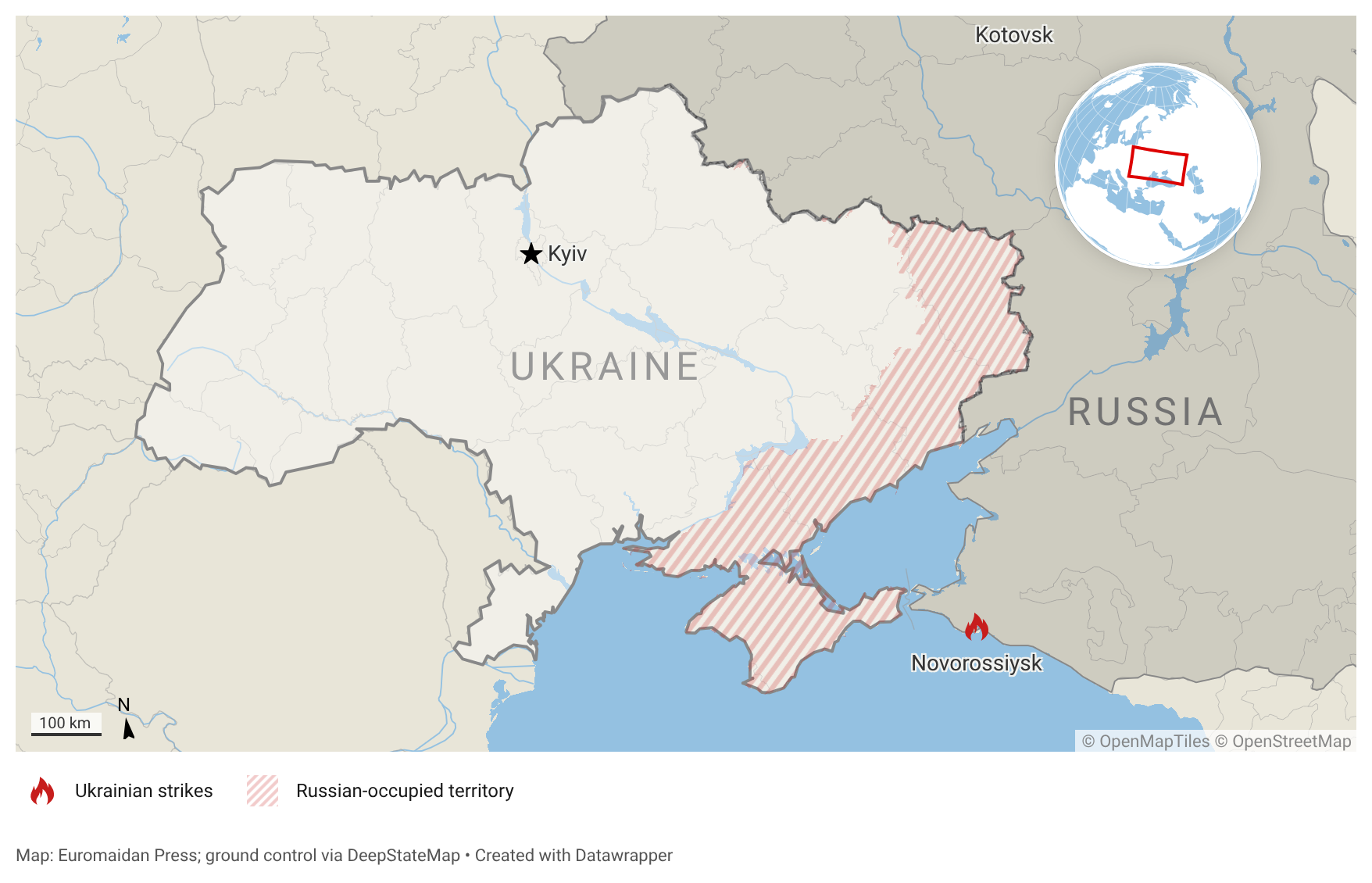
novorossiysk on the map

The Ukrainian Telegram channel Exilenova+ started posting videos of the attack on the port around midnight, further into the morning sharing more footage of the fire at the fuel-oil terminal. Russian news Telegram channel Astra wrote of fires on the grounds of several enterprises and near a residential building, with a column of dark smoke in eyewitness video. Its analyst then established from that footage that the burning object was the Novorossiysk Fuel Oil Terminal. Astra called the work open-source intelligence (OSINT) analysis, meaning conclusions drawn from publicly available imagery and records.

Satellites feeding NASA's Fire Information for Resource Management System (FIRMS), which flags heat sources from orbit, recorded several seats of fire in Novorossiysk after the night raid. An OSINT reading of eyewitness video also placed a fire at an apartment building in the city.

ukraine reported hitting warships oil-shipping terminal where local authority only fires falling debris · post geolocation strike port infrastructure novorossiysk russia 9 2026 based nasa firms data esri геолокація ураження
Geolocation of the strike on port infrastructure in Novorossiysk, Russia, 9 September 2026, based on NASA FIRMS data and an ESRI map. Map: Militarnyi

Novorossiysk mayor Andrei Kravchenko claimed overnight that air defenses were still fighting off the drone attack. He stated that drone debris had come down at several enterprises and near a residential building, and claimed that preliminary information showed no casualties. Kravchenko later acknowledged hits on enterprises while describing the cause as "falling debris."

Night fires in Novorossiysk during the UDF attack. pic.twitter.com/Jr85ypYrOz

— Exilenova+ (@Exilenova_plus) September 9, 2026

Ukrainian drones and missiles hit the same naval base overnight on 12 August, damaging Kalibr-carrying frigates and stopping all three of the port's grain terminals.

Ukraine's account named ships, the harbor, and the terminal

Robert Brovdi, callsign Madyar, commands Ukraine's Unmanned Systems Forces, the military branch that runs the country's drone units. He said Ukrainian Defense Forces struck the Russian naval base at Novorossiysk in a combined operation overnight, and that the Russians lost several military vessels there, missile carriers among them.

Ukrainian President Volodymyr Zelenskyy confirmed strikes on Novorossiysk and Krasnodar Krai around midday. He said Ukraine hit a terminal used for shipping oil, military harbor facilities, and warships, including carriers of Kalibr cruise missiles.

No independent assessment of damage to the vessels had emerged by midday, and Russia's defense ministry did not address the naval base.

Novorossiysk after the night attack. Locals report a large number of attackers at night, and the port infrastructure has been destroyed. pic.twitter.com/junTmDn0tp

— Exilenova+ (@Exilenova_plus) September 9, 2026

The port Ukraine keeps returning to

The targeted terminal stores and transships fuel oil, a heavy refinery product, along with light petroleum products, and its throughput runs to about 4 million tons a year. It belongs to the Novorossiysk Commercial Sea Port, the largest seaport in Russia, and counts among the leading enterprises of the city's transport hub.

Novorossiysk has come under repeated drone attack as one of Russia's biggest export gateways, whose work directly funds the war against Ukraine. Disruption there has already pushed oil supplies from Russia's western ports 15% below plan. Russia's fleet sheltered in the port after Ukrainian strikes pushed it out of occupied Crimea. Novorossiysk lies more than 300 km from the front line.

  •  

Ukraine’s prosecutor general resigns as the watchdogs he was appointed to leash close in

Ukraine's Prosecutor General Ruslan Kravchenko has resigned. Photo: Facebook

Ukraine's Prosecutor General Ruslan Kravchenko resigned on 7 September, hours after publicly defending himself, as anti-corruption investigators closed in on an alleged criminal organization operating inside his own office.

"I do not want the position of prosecutor general to be used as an instrument of political confrontation," Kravchenko said, announcing his departure on Telegram. "My position regarding the charges remains unchanged"—a denial he has held throughout, including in a 6 September statement rejecting any role in protecting the call centers.

President Volodymyr Zelenskyy confirmed the resignation on the evening of 7 September. "I had a fairly long meeting with the prosecutor general; he submitted the relevant resignation letter, and the submission will be sent to the Verkhovna Rada," Zelenskyy said, adding that he had spent the day on personnel matters and had also met the heads of the National Anti-Corruption Bureau (NABU) and the Specialized Anti-Corruption Prosecutor's Office (SAPO). The resignation is not final until parliament acts on it.

It reads as a scandal. It is closer to the opposite.

Kravchenko was appointed in June 2025, as the anti-corruption agencies were pressing toward figures close to the president—and his appointment came alongside the draft law, No. 12414, that would have put NABU and SAPO under his control. That law triggered the first street protests since Russia's invasion; within ten days, parliament reversed the part stripping the agencies' independence.

The provisions handing Kravchenko a personnel monopoly over the prosecution service were never repealed.

national anti-corruption bureau of Ukraine
Explore further

Ukraine’s anti-corruption cops just beat the president—but the fight’s not over

Since then, those agencies have forced out Andriy Yermak, the second-most-powerful man in the country. Now they have reached the prosecutor general—whose office kept, even after the capture law was reversed, a personnel monopoly over the prosecution service.

The corruption is not new. What is new is that it is being caught, and that being caught now costs the powerful their offices. The story of the past year is not that Ukraine is coming apart, but that its watchdogs have stopped being toothless.

What Operation Carthage found

On 5 September, NABU and SAPO announced they had uncovered a criminal organization run, investigators say, by a department head inside the Prosecutor General's Office. Its members allegedly took regular bribes from fraudulent call centers—operations that defraud victims in Ukraine and abroad—in exchange for shielding them from prosecution, then laundered the money through property, assets registered to other people, and associates' bank accounts.

The group was formed in mid-2025 and recruited serving prosecutors and associates, NABU and SAPO said. Over 20 million hryvnias (about $449,000) went on property, jewelry, and other high-value assets, according to NABU.

NABU described the organization as run by the head of a department inside the Prosecutor General's Office. Sources told Ukrainska Pravda that the official is Serhii Kropyva, deputy head of the office's International Legal Cooperation Department. He was remanded in custody on 6 September with bail set at 120 million hryvnias (about $2.7 million).

In recordings released by NABU, a figure using the codename "Chancellor," reported to be Kropyva, is described as protected by a "boss." Two details identify that boss: the patronymic "Andriiovych," and a previous job leading the State Tax Service. Ruslan Andriiovych Kravchenko ran the State Tax Service from December 2024 until he became prosecutor general in June 2025. The investigation understands the "boss" to be Kravchenko, the Kyiv Independent reported.

NABU has not publicly named Kravchenko as a suspect. He denies instructing anyone to protect illegal call centers or using his office to shield them. He resigned nonetheless.

nabu
Explore further

Ukraine’s anti-corruption agencies target Prosecutor General’s Office official linked to fraudulent call centers

The searches, and the surveillance files

NABU searches also reached the offices of Kravchenko himself, his deputy Mariia Vdovychenko, and the head of the Odesa Regional Military Administration, Oleh Kiper. Kravchenko defended the handling of those searches at a 7 September press conference—the same day he resigned.

The investigation into the Prosecutor General's Office is the latest in a widening confrontation between Ukraine's anti-corruption bodies and the institutions around the presidency. When NABU announced the case, it described a senior official running a criminal ring from inside the office meant to prosecute exactly such crimes.

Why it matters

The Prosecutor General's Office is one of the institutions Kyiv relies on to supervise—and, critics say, to restrain—NABU's investigations into figures close to the president. That an investigation reached the prosecutor general himself is a measure of how far the anti-corruption bodies have pushed against that restraint, not a sign they have failed.

It caps a run of accountability cases since July 2025 that would have been unthinkable earlier in the war.

In June 2025, NABU charged Deputy Prime Minister Oleksiy Chernyshov—the only official at Zelenskyy's private birthday during lockdown—with a $24 million land scheme, the first case to reach the president's "family."

The attempt to capture the agencies came weeks later, and failed: in November, Operation Midas exposed a $100 million scheme that forced out Zelenskyy's chief of staff and two ministers, one of them later detained at the border. Other resonant cases include Operation Forest Gump, targeting officials inside the President's Office. Now Carthage has reached the prosecutor general himself.

The pattern that looks like a government in crisis is also a state where stealing at the top is no longer safe—and where the public has twice in a year come into the streets over how power is used: in July 2025 to defend NABU and SAPO, and in July 2026 for a sacked minister.

Kravchenko took office in June 2025. He is the second prosecutor general to leave under a cloud in three years, after Andriy Kostin.

nabu
Explore further

First real crash test for Ukraine’s anti-corruption institutions

  •  
❌