❌

Vue lecture

Russian armor joins some bad-weather assaults toward Sloviansk, and still gets nowhere, Ukrainian soldier says
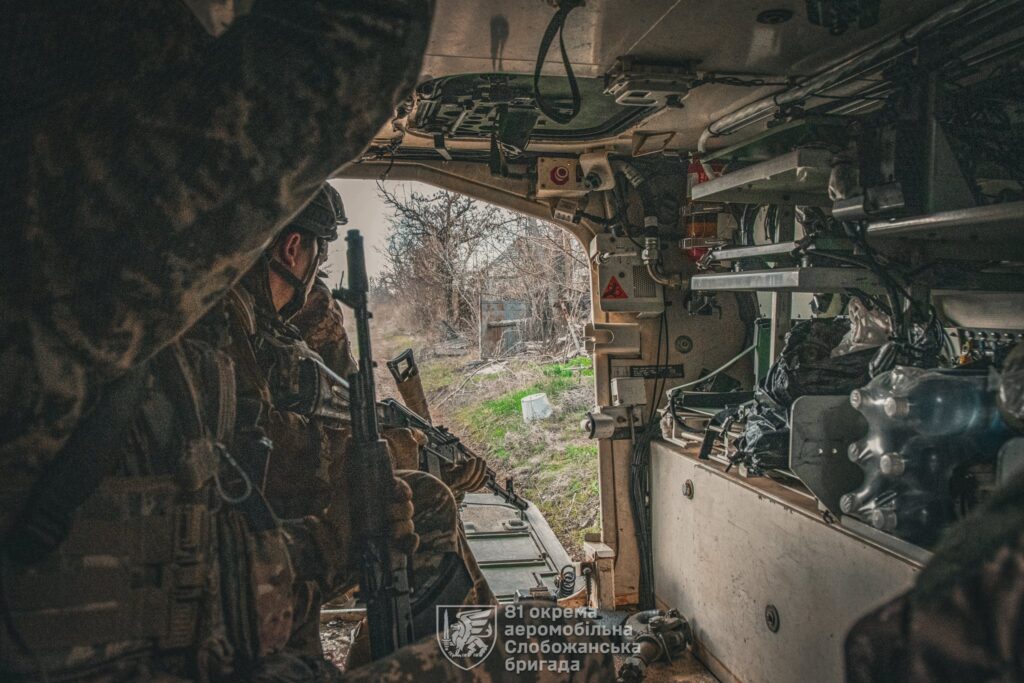
Soldiers of the 81st Airmobile Brigade inside an armored vehicle.

Russia uses bad weather for relatively larger assaults toward Sloviansk, the Institute for the Study of War (ISW) said. On 18 November, it cited a Ukrainian soldier: Russia wants to break into Mykolaivka, a town east of the city. From there, Russian troops would try to slip into the city itself, he said. Urban areas likely suit their infiltration tactics, ISW assessed.

Russia wants the rest of Donetsk Oblast, whatever it costs. At the US-brokered talks in Abu Dhabi on 10 November, Moscow still wanted Ukraine to hand over the part of the oblast Kyiv holds. That part includes Sloviansk and Kramatorsk, two cities of the Fortress Belt, a chain of fortified Donbas cities. Russia keeps sending troops forward despite the losses. Ukraine's General Staff counted 1,970 Russian troops killed or wounded along the whole front on 18 November alone.

Bad weather covers bigger assaults

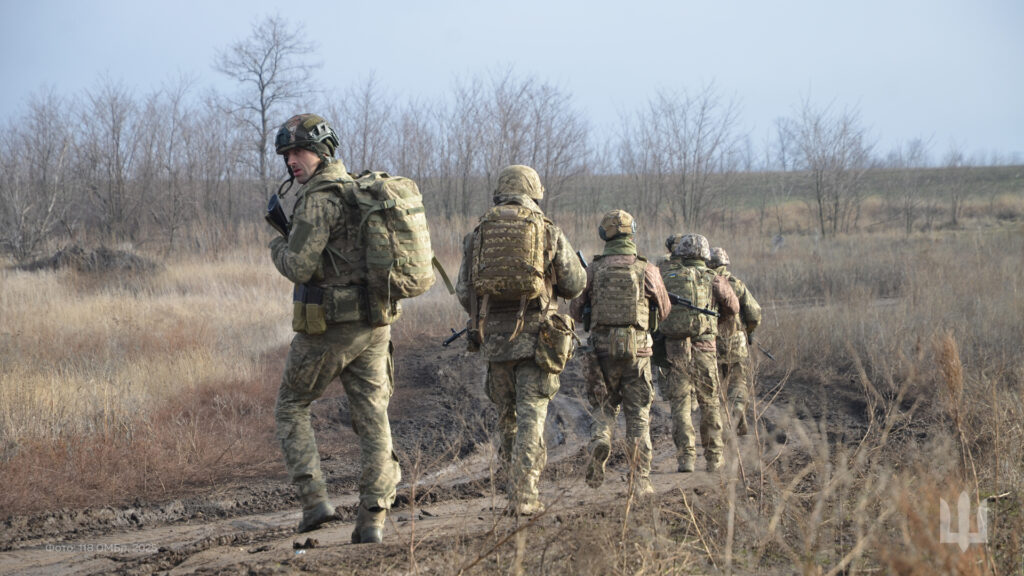
Russian troops attack constantly, Stanislav Krasnov of the 81st Airmobile Brigade, the soldier ISW cited, told Ukraine's United News telethon. They often try mass assaults in bad weather and sometimes bring in armor, he said. They use cars and motorcycles all the time, and their target is still Sloviansk, he added.

"This is their main goal now: to advance into Mykolaivka to force street fighting on us. To gradually infiltrate Sloviansk itself and fight such battles here. But … they are getting nowhere," Krasnov said.

Ukraine's General Staff reported 12 Russian attempts to advance on the Sloviansk axis on 18 November. They came near Pyskunivka, Kryva Luka, Yampil, and Mykolaivka. A day earlier, it counted three attacks near Yampil and Ozerne. Late on 18 November, the Ukrainian mapping project DeepState said Russian troops had advanced near Rai-Oleksandrivka, east of Sloviansk.

Russian-held and contested ground south and east of Kramatorsk, from Kostiantynivka to Rai-Oleksandrivka, Donetsk Oblast, as mapped by ISW on 18 November 2026
Russian-held and contested ground south and east of Kramatorsk, from Kostiantynivka to Rai-Oleksandrivka, Donetsk Oblast, as mapped by ISW on 18 November 2026. Map: ISW

Why Russia wants the fight inside the city

Russian forces likely find cities, with their basements and ruined buildings, better for infiltration missions, ISW assessed. Open fields leave them without cover or concealment, the think tank noted.

The front east of Sloviansk, Donetsk Oblast, as mapped by analyst Clément Molin, 12 November 2026
The front east of Sloviansk, Donetsk Oblast, as mapped by analyst Clément Molin, 12 November 2026. Map: Clément Molin/X

On 12 November, analyst Clément Molin argued that Ukraine had stabilized the front east of Sloviansk. He credited reinforcements and a new commander of the city's defense, Brigadier General Andrii Biletskyi. He also wrote that Russian infiltrations continued, but that there had been no recent reports of Russian troops slipping into the town of Mykolaivka.

The destroyed city of Avdiivka. Credit: Konstiantyn Liberov via Instagram
Explore further

Putin has new plan for Ukraine’s fortress city — and he may be counting on Trump to make it happen, expert says

Dozens of Molniya drones a day

Russia also uses Molniya drones very widely, Krasnov said. The fixed-wing drones can carry a heavy load, and Russia sends them against both vehicles and infantry, he explained.

"The Russians fire them, you could say, like from a machine gun," Krasnov said. Many dozens fly every day, but Ukrainian forces shoot most of them down, and only a small share reaches its target, he added.

  •  

Russia’s defense minister congratulated a division on taking Mala Tokmachka. A year later, that division is still trying

Soldiers of Ukraine’s 118th Separate Mechanized Brigade, which defends Mala Tokmachka, walk across a field. Illustrative photo: 118th Separate Mechanized Brigade

Ukrainian troops have cleared most of Mala Tokmachka, a front-line village in Zaporizhzhia Oblast that Moscow declared captured almost a year ago, Ukrainian military observer Kostiantyn Mashovets reported on 5 November. Russian forces keep trying to encircle the nearby town of Orikhiv from both flanks but have made no significant progress, he wrote. The Institute for the Study of War (ISW) relayed his account and assessed that Ukrainian forces recently advanced in western Zaporizhzhia Oblast.

Russia keeps sending troops at Ukraine’s defenses while presenting itself to Washington as a partner for peace. The Kremlin uses limited humanitarian deals, such as the recent ceasefire in occupied Oleshky, to court the Trump administration and extract concessions in future negotiations, ISW assessed. Washington has pitched an energy truce as a step toward talks. On the ground, Ukraine took back more land than it lost in October. Mala Tokmachka shows how far Russia’s victory claims stray from the map. The village guards the approaches to Orikhiv, a key hub of Ukraine’s defense on the road to the regional capital, and Russia has failed to take it for more than 1,500 days.

Two small Russian groups left in the village

Ukrainian forces once again sharply reduced the Russian infantry presence in Mala Tokmachka, Mashovets wrote. Only two small Russian groups remain there. One holds out in the basements of the village’s ruined penal colony, the other in a couple of buildings near the local branch of Nova Poshta, Ukraine’s main parcel service. Russian assault groups that had clung to the village’s southeastern edge have pulled back toward Bilohiria or to an area about 2 km northeast of it.

Current situation in the area of Mala Tokmachka, Zaporizhzhia Oblast
Current situation in the area of Mala Tokmachka, Zaporizhzhia Oblast. Map: DeepState

Orikhiv itself holds just one active Russian group of perhaps five or six infantrymen, on its southeastern outskirts, by Mashovets’ estimate. West of the town, Ukrainian forces firmly hold Novoandriivka and Novopavlivka. Still, Russian troops wedged up to 1.8 km into Ukrainian lines north of Nesterianka. Between Robotyne and Novodanylivka, they took at least half of the Uspenivka gully.

Ukrainian soldiers. Source: 95th Separate Airborne Assault Polissya Brigade
Explore further

Fog blinds Ukrainian drones. Russia resumes mechanized assaults in the south after months-long pause, military officials say

The division Moscow congratulated is still fighting there

Russia has claimed Mala Tokmachka twice. Its Defense Ministry first announced control in March 2022, but Ukrainian troops were back by that summer. Moscow announced the village’s “liberation” again in November 2025, and Defense Minister Andrei Belousov congratulated the 42nd Guards Motorized Rifle Division on the capture, The Moscow Times reported.

Assessed control of terrain in the Orikhiv direction, Zaporizhzhia Oblast, Ukraine, as of 5 November 2026
Assessed control of terrain in the Orikhiv direction, Zaporizhzhia Oblast, Ukraine, as of 5 November 2026. Map: Institute for the Study of War

That division is still in the fight. Mashovets listed the 42nd among the main forces of Russia’s 58th Army on the Orikhiv axis, operating in the center and on the right flank. Units of two Chechen Akhmat regiments may be reinforcing it, he added. The army’s goal is to wipe out Ukraine’s Orikhiv defense area and reach the near approaches to the city of Zaporizhzhia.

Infiltrators on the dry reservoir bed further west

About 30 km west of Orikhiv, Russia is trying to restart its advance north along the Dnipro River. Small Russian infantry and sabotage groups use the bed of the Kakhovka Reservoir, drained after Russia blew up the Kakhovka dam in 2023, to bypass Ukrainian defenses in the river marshes and move toward Malokaterynivka, Mashovets wrote. Russian troops also pushed about 2 km east of Stepnohirsk. Ukraine’s General Staff reported a Russian attack toward nearby Lukianivske on 5 November.

Russian commanders still see a deep envelopment of Orikhiv from both flanks as the key to storming it, Mashovets assessed. So far, the results are small.

“The fairly obvious stepping-up of the forward units of Russia’s 58th Army over at least the past month and a half has not brought its command any significant (operational) results,” Mashovets wrote.

  •  
❌