❌

Vue normale

To scale up air defense without straining the front, Ukraine enlists business. In under year nearly 100 companies have joined, their crews downing 60-plus targets

14 octobre 2026 à 20:17

Ukraine's mobile gun team. Photo: Ukraine's Air Force via Facebook

Ukraine is handing its factories the right to shoot back at the Russian drones hunting them. Nearly 100 companies have joined Ukraine’s experimental program that allows private enterprises to operate their own air defenses, granting them authority to conduct air defense operations and form their own crews, the Defense Ministry says.

Russian drones strike Ukrainian factories, warehouses and power sites so relentlessly that the state cannot shield every one, so the Defense Ministry is enlisting the businesses being hit to defend themselves.

The program has grown quickly, from 24 companies in April to 81 by mid-September and nearly 100 now, and its crews have already destroyed a substantial number of Russian aerial targets.

The companies range from operators of critical infrastructure to state and private firms across the economy. The project is carried out under a Cabinet resolution dated 19 November 2025, which mobilizes enterprise resources to support Ukraine’s defense against air threats.

Civilian crews that answer to the Air Force, not themselves

These teams do not fire into a shared sky on their own. About 50 air-defense groups have been formed and are operating under the relevant Air Force commands, and crews from six enterprises are already carrying out combat missions, the ministry says. The rest are training or finishing preparation before they join.

As of 14 October, the groups have downed more than 60 aerial targets, mostly Russian drones, using interceptor drones and automated turrets with heavy machine guns, according to the ministry. The Air Force command sets each group’s targets based on its weapons and tasks, and, jointly with the company, defines its sector, personnel, and equipment.

Who pays, and who pulls the trigger

The arrangement splits cost and control. Some weapons the enterprises buy with their own money, holding end-user status, while a company can also ask the Air Force to lend arms and ammunition from military stocks.

Private air defense is one layer of a multi-tiered shield, meant to protect industrial capacity, critical infrastructure and civilian staff from systematic drone attacks. The crews began combat work in 2026.

Planned capacity of 12,000 interceptors a year, under 100 seconds to target: US firm pitches a low-cost drone killer

14 octobre 2026 à 09:21

Launch of the Vespid Mk 1 using a solid-fuel booster.

US defense-tech company CHAOS Industries introduced its Vespid interceptor family in Washington on 12 October, as the Association of the US Army (AUSA) annual meeting opened there, the company announced. CHAOS pitches the drones as low-cost defense against small and mid-size drones and one-way attack munitions. The company expects initial production capacity of 12,000 interceptors a year, expandable to 50,000 as demand grows.

The pitch lands as Russia moves its strike drones to jet power. Russia has stopped building the Geran-3, an earlier jet model, and makes about 3,000 faster Geran-4s and Geran-5s a month, Ukraine’s military intelligence (HUR) told Militarnyi in August. In mid-September, Ukrainian President Volodymyr Zelenskyy said two Ukrainian companies had passed combat tests with interceptors against such drones, while 67 were still working on them. Ukrainian defense outlet Defense Express measured the new US drones against exactly that threat.

One to carry, one to launch in batches

The Mk 1 made its first public appearance on 12 October aboard a Forterra MESA autonomous ground vehicle, Army Recognition reported. It fires from tubes on launchers such as the 10-round ISS Aerospace HAL10. It takes midcourse guidance from CHAOS radars or external command systems, then an AI-assisted infrared seeker handles the final approach, the company says. An electric ducted fan rather than a jet engine drives it, which CHAOS says cuts cost and logistics compared with turbojet interceptors.

The smaller Mk 0 is man-portable and needs no operator input once fired, its product page says. Both are rated to reach a target in under 100 seconds, with a listed range of 10+ km. Defense Express called that range a serious weakness that more launchers around a city could offset.

Modular FPV drone interceptor “Mangal” by Phantom Defence. September 2026.
Explore further

Most drone interceptors ram or explode. This Ukrainian one just throws a net—six shots to a module

CHAOS lists cruise speeds of 100 m/s (360 km/h) for the Mk 0 and 150 m/s (540 km/h) for the Mk 1. Defense Express said those speeds may be enough to intercept the Geran-4 and Geran-5, which it puts at 340 km/h and 450–600 km/h.

Ukrainian makers say their interceptors already down jet Gerans

Wild Hornets’ Sting interceptors downed several of the slower jet-powered Geran-3s in November 2025. An unnamed Wild Hornets representative told NV, in an interview published on 22 September, that the company’s new interceptor had destroyed about ten Geran-4s and several Geran-5s in limited use. The company plans mass production within a month of finishing combat tests.

On 12 October, former Defense Minister Mykhailo Fedorov said he and Pavlo Yelizarov, commander of Lasar’s Group, had created a new interceptor with troops and engineers. He said it downed two Geran-5s headed for Kyiv.

Crews from Lasar’s Group, which Fedorov has called a National Guard special unit, flew those combat tests, he said. Separately, Fedorov reported in August that a Ukrainian jet interceptor with a top speed above 600 km/h had entered combat testing.

1,125 Kyiv residents injured in Russian attacks since the start of 2026, more than a third of them in five weeks from late August, Kyiv health chief says

14 octobre 2026 à 09:03

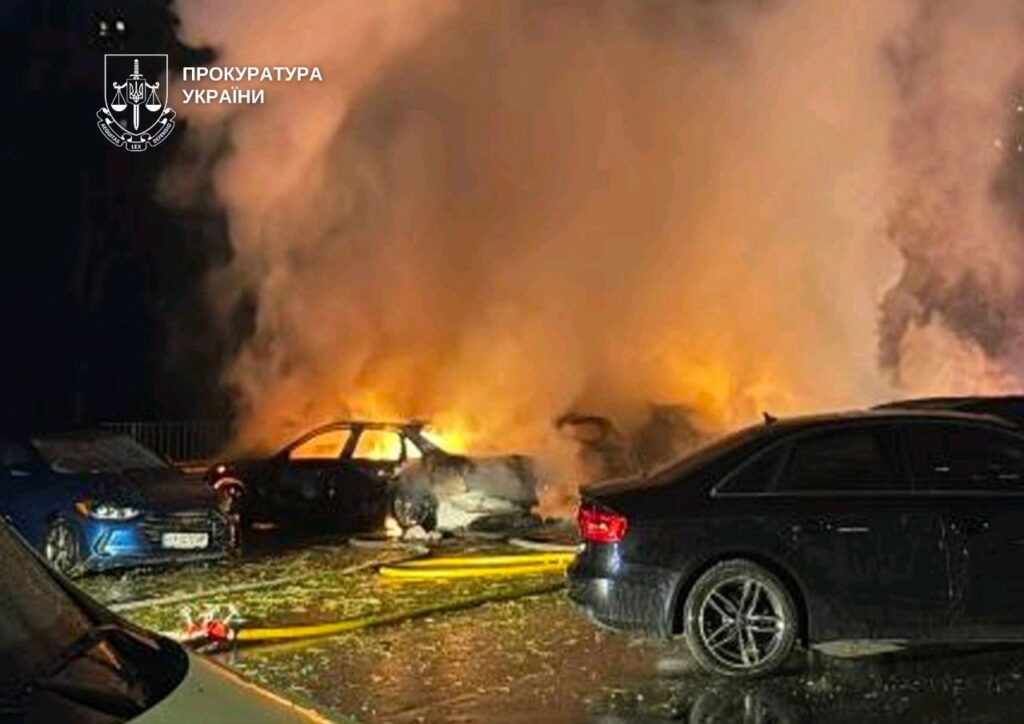
Cars burning outside a 25-story apartment building in Kyiv after a Russian drone strike

Russian attacks have injured 1,125 Kyiv residents since the start of 2026. Of these, 379 people, or nearly 34%, were injured in just five weeks, from 27 August to 7 October, Tetiana Mostepan, director of the Kyiv City State Administration’s Department of Health, said in an interview published on 13 October.

Russian air attacks on Kyiv have intensified since late August. Air attacks occur both day and night, and Russian drones target not only military facilities but also civilian buildings, including apartments. As a result, the number of casualties is also increasing. More than 40% of emergency medical responses to attacks this year occurred between late August and early October, Mostepan noted.

During this period, the capital’s emergency medical teams responded to 782 calls related to the attacks, the department director said. She also released data showing that 138 medical facilities in Kyiv have been damaged since the start of Russia’s full-scale invasion, including 47 this year.

“And when we talk about statistics, I always emphasize that behind every number is a human life. These are people who have been injured, as well as medical workers who respond to attack sites to save them,” Mostepan said.

People giving first aid to two women injured in a Russian drone strike in Kyiv
People giving first aid to two women injured in the Russian drone strike, Kyiv, 8 September 2026. Photo: Zelenskyy's Telegram

Russian attacks on Kyiv have become more frequent

Russia attacked Kyiv with drones throughout the day, Suspilne Kyiv reported on 27 August. Air raid alerts were issued 12 times in the capital, drone debris was found in five districts, and at least four people were injured, the report said. Russian forces used about 140 attack drones against Ukraine throughout the day, more than 100 of them jet-powered, the Ukrainian Air Force reported at the time.

At least 38 people were killed and dozens injured in a Russian drone strike on an ammunition depot in the Bucha district near Kyiv, triggering a massive fire and hours of explosions in a residential area, CNN reported. The attack in the Bucha district came amid near-constant Russian airstrikes, which continued into Sunday, the outlet reported.

Russian forces were likely seeking to exhaust Ukraine’s air defenses, disrupt civilians’ daily lives, and increase the scale of destruction, analysts at the Institute for the Study of War (ISW) said, citing CNN’s reporting.

On 8 September, NATO Secretary General Mark Rutte stressed the urgent need to strengthen support for Ukraine, particularly by providing air defense systems. Delays in delivering assistance cost human lives, he said.

On 1 October, a Russian drone struck a school in Kyiv’s Solomianskyi district while 104 children were inside, Suspilne reported. Students and school staff took shelter, so no one was injured, the report said.

Aftermath of the Russian attack on a school in Kyiv’s Solomianskyi district, 1 October 2026. Suspilne News/Oleksandr Mahula
Aftermath of the Russian attack on a school in Kyiv’s Solomianskyi district, 1 October 2026. Photo: Suspilne News/Oleksandr Mahula

Russian attacks continue after Trump’s announcement of an energy ceasefire

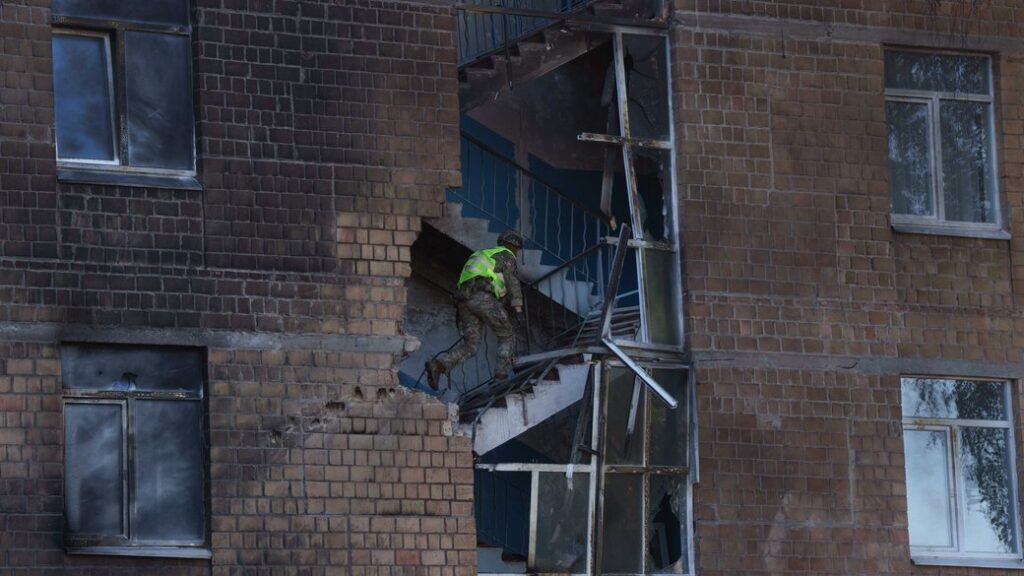
Following US President Donald Trump’s announcement of an energy ceasefire, Russia continued striking Ukraine’s energy infrastructure, including in Kyiv. On 13 October, Russian ballistic missiles struck Kyiv, hitting a thermal power plant in the second attack in 24 hours without advance warning from Ukraine’s allies, Zelenskyy said. The evening and morning strikes killed four people in Kyiv, three of them women in a high-rise in Desnianskyi district, Kyiv prosecutors said.

Aftermath of the Russian attack on Kyiv overnight into 14 October 2026
Aftermath of the attack on Kyiv on the night of 14 October 2026. Photo: Kyiv State Emergency Service

Russia attacked energy and critical infrastructure in Kyiv, Kyiv Oblast, and Kharkiv with 39 ballistic missiles and more than 120 attack drones, Ukrainian President Volodymyr Zelenskyy said on 14 October. At least 600,000 people were left without electricity, he said. Later that day, an accident on the grid cut power to part of Kyiv’s right bank, energy company DTEK said.

❌