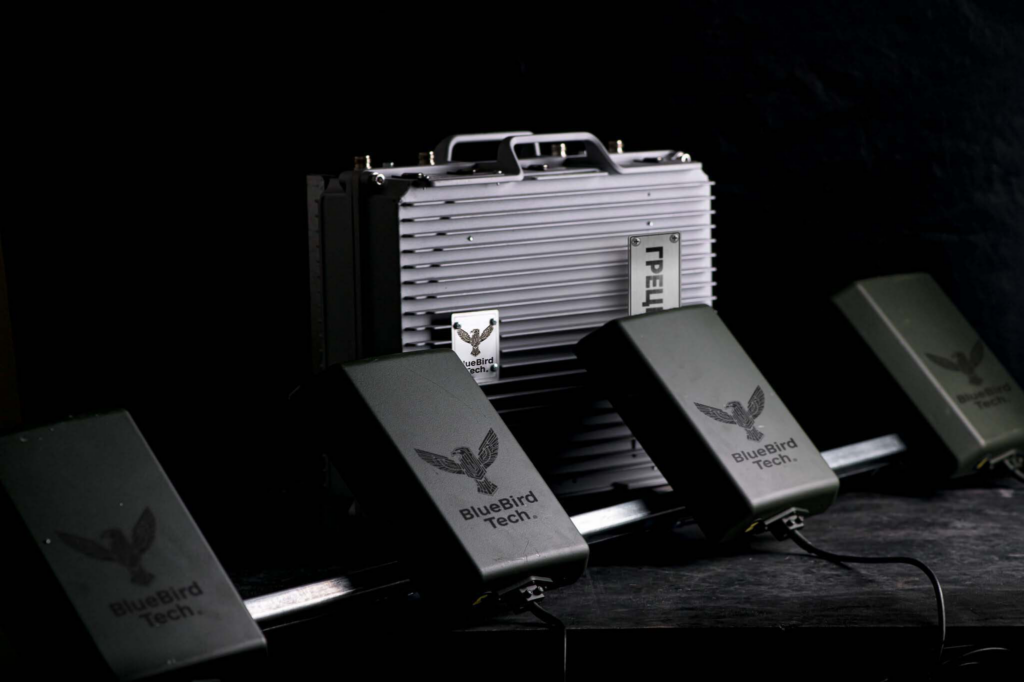
Ukrainian defense-tech firm BlueBird Tech has begun renting out its Hrets electronic-warfare jammers by the day, in what it calls Ukraine's first such service, the company said on 29 September 2026. Electronic-warfare gear—the devices that scramble the radio links attack drones rely on—is normally bought outright, renting lets a user take a system for a single mission or test it before committing.
The pull is a war where cheap first-person-view (FPV) drones have made portable jamming a
Ukrainian defense-tech firm BlueBird Tech has begun renting out its Hrets electronic-warfare jammers by the day, in what it calls Ukraine's first such service, the company said on 29 September 2026. Electronic-warfare gear—the devices that scramble the radio links attack drones rely on—is normally bought outright, renting lets a user take a system for a single mission or test it before committing.
The pull is a war where cheap first-person-view (FPV) drones have made portable jamming a routine need, one many users face only for a stint.
How renting works
After paperwork and a deposit equal to the device's full price, the system is handed over, and that handover counts as day one. Each day's rent is then drawn from the deposit, return the system working and undamaged and the renter gets back what is left. Keep it long enough that the fees add up to the full price, and the jammer passes to the renter automatically. Renting is open to individuals, companies, charities, and volunteer groups.
Three models, and what each one jams
The Hrets XL is a modular FPV jammer built from two to 10 working modules, priced case by case. The vehicle-mounted Hrets 4MC is an anti-drop system that jams DJI Mavic-type quadcopters—the drones Russian forces use to drop munitions—for about $56 a day. The lightweight Hrets 4M jams FPV drones at a stated 70 to 400 meters for about $67 a day. One Ukrainian firm has even packed detection, decoding, and jamming of an FPV signal into a single device.
Bulgaria donated 110 BTR-60 armored personnel carriers, too thinly armored to carry infantry into a drone war
Ukraine's 3rd Army Corps fills them with anti-tank mines, drives them by remote control, and detonates them inside Russian bunkers
A jet with a glide bomb does the same job. It costs a hundred times more
Bulgaria gave Ukraine 110 BTR-60 armored personnel carriers. They are 1960s vehicles, too thinly armored to carry infantry anywhere near a front line patrolled by expl
Bulgaria donated 110 BTR-60 armored personnel carriers, too thinly armored to carry infantry into a drone war
Ukraine's 3rd Army Corps fills them with anti-tank mines, drives them by remote control, and detonates them inside Russian bunkers
A jet with a glide bomb does the same job. It costs a hundred times more
Bulgaria gave Ukraine 110 BTR-60 armored personnel carriers. They are 1960s vehicles, too thinly armored to carry infantry anywhere near a front line patrolled by explosive drones. So Ukraine's 3rd Army Corps found another use for them during Operation Vivaldi, its counteroffensive north of Lyman. Fill one with anti-tank mines, rig it for remote control, drive it at a Russian bunker, and set it off.
Packing potentially dozens of TM-62 anti-tank mines, the speedy BTR-60s become what's called vehicle-borne improvised explosive devices, or VBIEDs. Once a favorite weapon of insurgents battling US forces in Iraq and Afghanistan, VBIEDs have found a new niche in Russia's wider war on Ukraine as unmanned demolition systems.
"To break through the enemy's defenses, the 3rd Army Corps employed its own invention, Soviet BTR-60s converted into robotic kamikaze complexes," the corps stated. "They were used to demolish the enemy's strongest fortifications." If an enemy strongpoint is too heavily protected to bomb from the air but exposed to attack from the ground, send in a VBIED.
Білецький: «Противник був введений в оману і проспав справжній удар»
Третій армійський корпус звільнив Нове, Рідкодуб і Катеринівку та відновив контроль над Карпівкою і Новомихайлівкою. Втрати противника — 2000 живою силою, понад 250 росіян захоплені в полон. Так закінчився… pic.twitter.com/GSV4LFG3gj
The Russians were the first to deploy vehicular IEDs in the current war, but the Ukrainians may have mastered the tactic. It's one thing to rig an explosives-filled MT-LB tractor or T-55 tank to roll straight forward without direct human control, as the Russians once did. It's another to rig an explosive BTR-60 to maneuver before going off, as the 3rd Army Corps' VBIEDs clearly did.
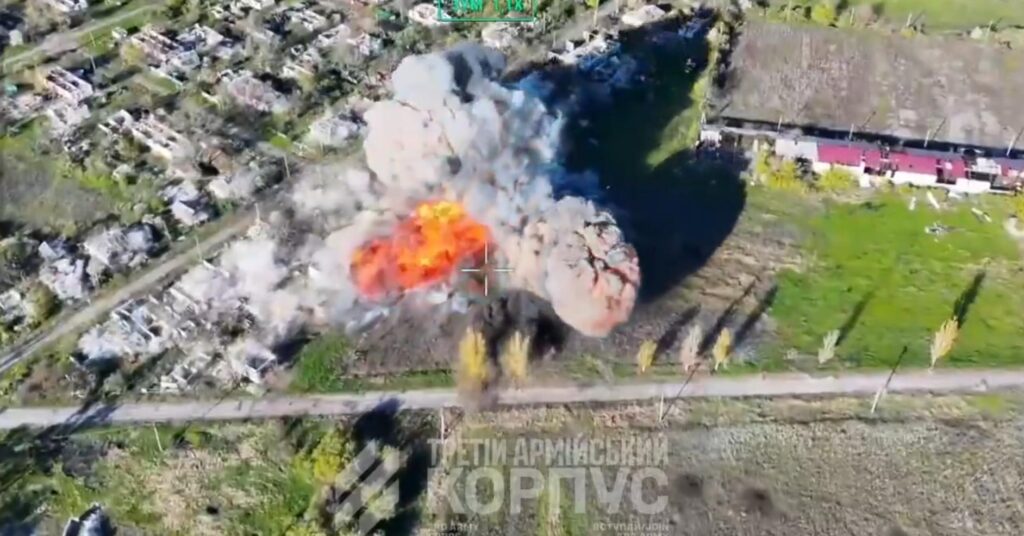
On 28 September, announcing the close of Vivaldi's third phase, the 3rd Army Corps released drone footage depicting one of the explosive BTRs blasting a Russian strongpoint north of the town of Lyman. The sheer scale of the explosion is testimony to the VBIED's destructive potential. And the trail the BTR leaves in the grass in the heavily edited video indicates the Ukrainians can steer their VBIEDs around obstacles and guide them to precision strikes.
A BTR-60 VBIED explodes. 3rd Army Corps capture.
Why it gets there
A slow wheeled vehicle crossing open ground toward a fortified position should not survive the trip. In most sectors it would not. What makes the tactic work north of Lyman is a condition the 3rd Army Corps built into Vivaldi before its assault groups moved: Ukrainian air defense and electronic warfare threw a protective dome over the battle area, blinding Russian drones so they could not read the operation's design or strike what was moving through it.
Ukraine liberates area above Lyman in Operation Vivaldi. Map: Euromaidan Press
Robots have played critical roles in each phase of Vivaldi. Surveillance drones have watched from overhead. One-way attack drones have pummeled Russian positions and supply lines. Heavy bomber drones have not only dropped bombs, they've also airlifted explosive unmanned ground vehicles into position so the UGVs can roll right through the front doors of Russian bunkers.
The self-exploding BTR-60s are too big to airlift, but that's the point. A small UGV might carry a few tens of kilograms of explosives. A remote-controlled BTR-60 can easily haul hundreds of kilograms.
Explore further
Ukraine outfoxes Russia near Donetsk’s fortress belt with Soviet BTR-60s rebuilt as kamikaze robots, storms a key hub and takes 250 Russian prisoners
The arithmetic
It's not impossible to take out a VBIED before it strikes, of course. Mines, anti-tank missiles, and even concentrated gunfire can stop a vehicular bomb in its tracks. But losing one of the aged BTR-60s costs Ukraine very little. The vehicles are too thinly armored for use as front-line infantry transports anyway. You might as well convert them into bombs.
That is the whole case for the tactic. A manned fighter jet lobbing a precision glide bomb is the preferred approach to bunker-busting. But it costs tens of thousands of dollars an hour to keep a jet in the air, and a single glide bomb can cost tens of thousands or even hundreds of thousands of dollars. It's unclear how much it costs to convert a BTR into a VBIED. It could be just a few thousand.
And it reduces Russian fortifications without risking any Ukrainian lives. That's the philosophy underpinning all of the 3rd Army Corps' robot-first tactics. "This is exactly the direction of the corps' development set by Brig. Gen. Andrii Biletskyi," the corps stated, "to reduce the number of fighters in the most dangerous areas and replace them with robots."
Vivaldi began in mid-April under an information blackout that held for five months. The corps says it has regained control of 176 sq km across three of a planned four phases, around half of that de-occupied outright, and taken more than 250 Russian prisoners. Those figures are the corps' own and have not been independently verified.
Sometimes the robots doing that work are 60-year-old APCs modified for an explosive one-way mission.
Explore further
Ukraine retook 240 square km north of Lyman and nobody reported it for three months
🎧 Édition du 29 sept 2026 :– NVIDIA veut sécuriser les agents IA– Les modèles chinois dominent OpenRouter– Google remplace les Gems par des skills– JustWatch lance son propre service de streaming– Des humains examinent certaines requêtes Copilot « 120 secondes de Tech », un regard sur le quotidien de l’actualité numérique proposé par Bruno Guglielminetti ================ Pour […]
🎧 Édition du 29 sept 2026 :– NVIDIA veut sécuriser les agents IA– Les modèles chinois dominent OpenRouter– Google remplace les Gems par des skills– JustWatch lance son propre service de streaming– Des humains examinent certaines requêtes Copilot « 120 secondes de Tech », un regard sur le quotidien de l’actualité numérique proposé par Bruno Guglielminetti ================ Pour […]

 Connexion