❌

Vue normale

  • ✇Euromaidan Press
  • Estonia quarantines emails from Russian domains over cyberattack risk

    Estonia is automatically diverting emails using Russia’s .ru internet domain into quarantine for additional security checks before they reach state institutions connected to the country’s secure government network, Justice and Digital Affairs Minister Liisa Pakosta told Estonia's public broadcaster ERR. The measure is intended to protect Estonian government computer systems amid a post-2022 surge in cyberattacks that officials link to Russia. It applies only to institut
     

Estonia quarantines emails from Russian domains over cyberattack risk

2 septembre 2026 à 11:18

Abstract illustration of computer code and binary numbers glowing blue and green against a dark background.

Estonia is automatically diverting emails using Russia’s .ru internet domain into quarantine for additional security checks before they reach state institutions connected to the country’s secure government network, Justice and Digital Affairs Minister Liisa Pakosta told Estonia's public broadcaster ERR.

The measure is intended to protect Estonian government computer systems amid a post-2022 surge in cyberattacks that officials link to Russia. It applies only to institutions operating inside the secure state network, leaving local governments and some state bodies outside.

Many Estonian residents, particularly Russian speakers, still use .ru email services, ERR noted. Because the filter is triggered solely by the address ending, legitimate messages will be screened alongside potentially malicious ones and may take longer to arrive.

Pakosta said the safeguard was necessary because cyberattacks against Estonia had increased “exponentially” since 2022 and that many were linked to Russia. She said such attacks had not succeeded against Estonia, while major public-sector cyberattacks had succeeded in both Latvia and Lithuania.

The rerouting is automatic and handled centrally, so agencies do not need to take any action, Pakosta said. A large proportion of state institutions have already moved behind the government’s unified cyber shield, while the transition continues.

Pakosta described the quarantine as one small measure within Estonia’s wider cybersecurity work. Estonia’s courts have gone further, saying they will ask parties in legal proceedings to stop using .ru addresses for official communication, according to ERR.

How the Baltic states are hardening against Russia

Estonia's email quarantine forms part of a broader Baltic effort to limit Russian influence and strengthen defenses against military, cyber, and covert threats.

Estonia, Latvia, and Lithuania are constructing a Baltic Defense Line, a planned network of bunkers, anti-tank ditches, and other barriers, along their borders with Russia and Belarus. Latvia has also banned imports of Russian and Belarusian books, clothing, toys, and other goods.

The threat extends beyond cyberattacks: an Estonian court found that Russia’s military intelligence agency, the GRU, ordered the 2024 firebombing of a Ukrainian restaurant in Tallinn, part of a wider Russian sabotage campaign targeting European supporters of Ukraine.

  • ✇Euromaidan Press
  • A masked figure got into a Polish drone-parts plant—Poland now suspects a foreign spy service set the fire
    A fire at a Polish plant that makes drone parts for Ukraine's and Poland's militaries is being investigated as possible sabotage by a foreign intelligence service, Militarnyi reported. Poland's National Prosecutor's Office opened the case on two counts: foreign-intelligence activity against the country and a terrorist offense. Fires and break-ins like this fit a widening pattern — the factories and supply lines that keep Ukraine armed are increasingly targets far from t
     

A masked figure got into a Polish drone-parts plant—Poland now suspects a foreign spy service set the fire

2 septembre 2026 à 09:13

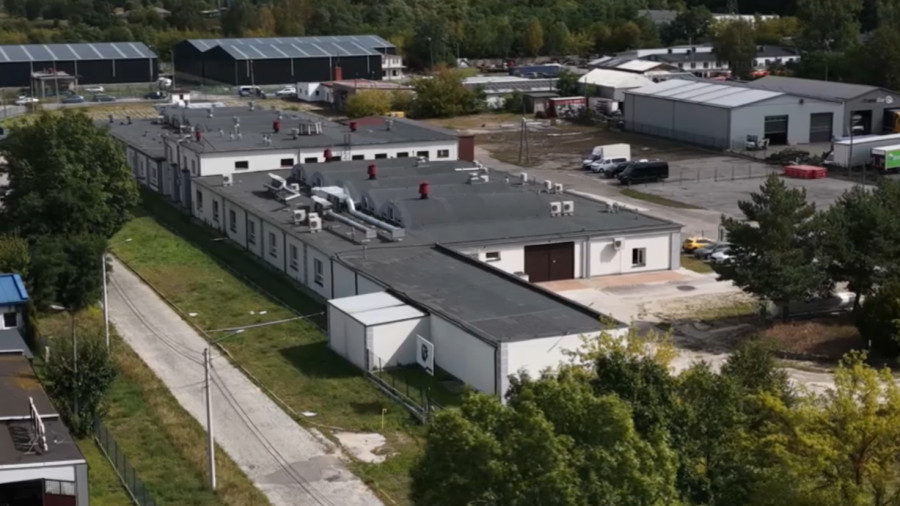
View of the WB Group factory building in Skarżysko-Kamienna, Poland. August 2026.

A fire at a Polish plant that makes drone parts for Ukraine's and Poland's militaries is being investigated as possible sabotage by a foreign intelligence service, Militarnyi reported. Poland's National Prosecutor's Office opened the case on two counts: foreign-intelligence activity against the country and a terrorist offense.

Fires and break-ins like this fit a widening pattern — the factories and supply lines that keep Ukraine armed are increasingly targets far from the front line. Across the continent, prosecutors keep opening the same kind of arson case against plants tied to Ukraine's defense.

A masked intruder and a two-hour fire

The fire started shortly after midnight on 31 August in the assembly hall of the WB Electronics plant in Skarżysko-Kamienna and spread to the storage rooms. Five crews put it out in under two hours. No one was hurt, but the storage rooms were destroyed, leaving at least 15 million zloty ($4 million) in damage. The plant had no permanent guards on site; a security company monitoring it remotely reported the fire.

Prosecutors say the blaze was set deliberately with a planted charge of flammable material, and no one has been charged. Security cameras recorded a masked person who climbed a fence and got onto the site.

Why Poland is looking at Moscow

Czesław Mroczek, deputy head of Poland's Interior Ministry, told RMF FM radio that many signs point to arson, and that a Russian trail is the obvious inference. An attack on the defense industry can suggest Russian involvement, he said, since European states have faced sabotage for years while backing Ukraine. Mroczek said protection plans for key defense plants must be richer than what this site had. No one has been detained, and investigators are still tracing how the intruder got in and who may have ordered it.

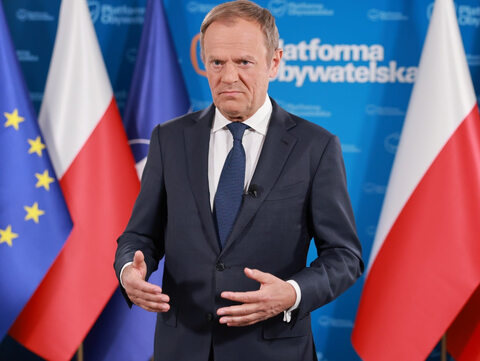
tusk polish prime minister
Explore further

After CIA head’s visit to Moscow, Poland’s PM warns Russia is preparing to escalate war. He puts critical window at seven or eight months

What the plant actually makes

WB Electronics is the core of WB Group, Poland's biggest private arms holding, whose firms build reconnaissance and strike drones such as the FlyEye and the Warmate. The Skarżysko-Kamienna site itself makes drone components for unmanned systems, used by both Polish and Ukrainian forces. Ukraine received FlyEye drones back in 2022 under its Army of Drones program, and in 2025 WB Group launched drone production inside Ukraine.

  • ✇Euromaidan Press
  • Zaporizhzhia’s largest mall closes as Russia’s attacks seek to make Ukrainian cities unlivable
    Zaporizhzhia’s largest shopping and entertainment complex, City Mall, will remain closed throughout September following a Russian drone strike on a neighboring hypermarket last week. Russia’s attacks are increasingly disrupting the basic civilian life of Ukrainian cities, as strikes on shops and other commercial facilities make it harder for businesses to operate and residents to go about their daily lives. The pattern is especially pronounced in cities close to the fro
     

Zaporizhzhia’s largest mall closes as Russia’s attacks seek to make Ukrainian cities unlivable

2 septembre 2026 à 08:46

Zaporizhzhia’s City Mall, the city’s largest shopping and entertainment complex. Photo: City Mall

Zaporizhzhia’s largest shopping and entertainment complex, City Mall, will remain closed throughout September following a Russian drone strike on a neighboring hypermarket last week.

Russia’s attacks are increasingly disrupting the basic civilian life of Ukrainian cities, as strikes on shops and other commercial facilities make it harder for businesses to operate and residents to go about their daily lives. The pattern is especially pronounced in cities close to the front, where Russia is unable to seize territory but can continue attacking from the air.

City Mall announced the closure on 1 September, apologizing to visitors and saying it would provide updates on when operations could resume. The complex did not give an official reason for the decision.

The announcement came four days after a Russian strike hit an Epicentr hypermarket located near the mall on 28 August. The attack sparked a fire covering about 2,000 square meters.

Russia targets Ukraine’s civilian economy

Shopping centers and other commercial facilities have increasingly been caught up in Russia’s attacks on Ukrainian cities.

In recent weeks, Russia has stepped up attacks on commercial sites and retail storage facilities, particularly in and around Kyiv, as well as other major cities closer to Russia and the frontlines.

On 21 August, a Russian drone strike on a shopping center in Kryvyi Rih killed at least 15 people and injured 130, including 23 children, according to local authorities. A second strike hit emergency responders about 30 minutes later as they worked at the scene.

The attacks have also hit Ukraine’s retail sector financially. As of August, three shopping centers had been destroyed and nine more damaged by Russian attacks since the beginning of 2026, with direct losses to the sector reaching 3.226 billion hryvnias ($72.5 million), according to industry data cited by Censor.NET.

Fear of attacks is also keeping shoppers away. Air raid alerts accounted for 21.8% of shopping centers’ operating hours in August, up from 20.1% in July and 9.4% a year earlier.

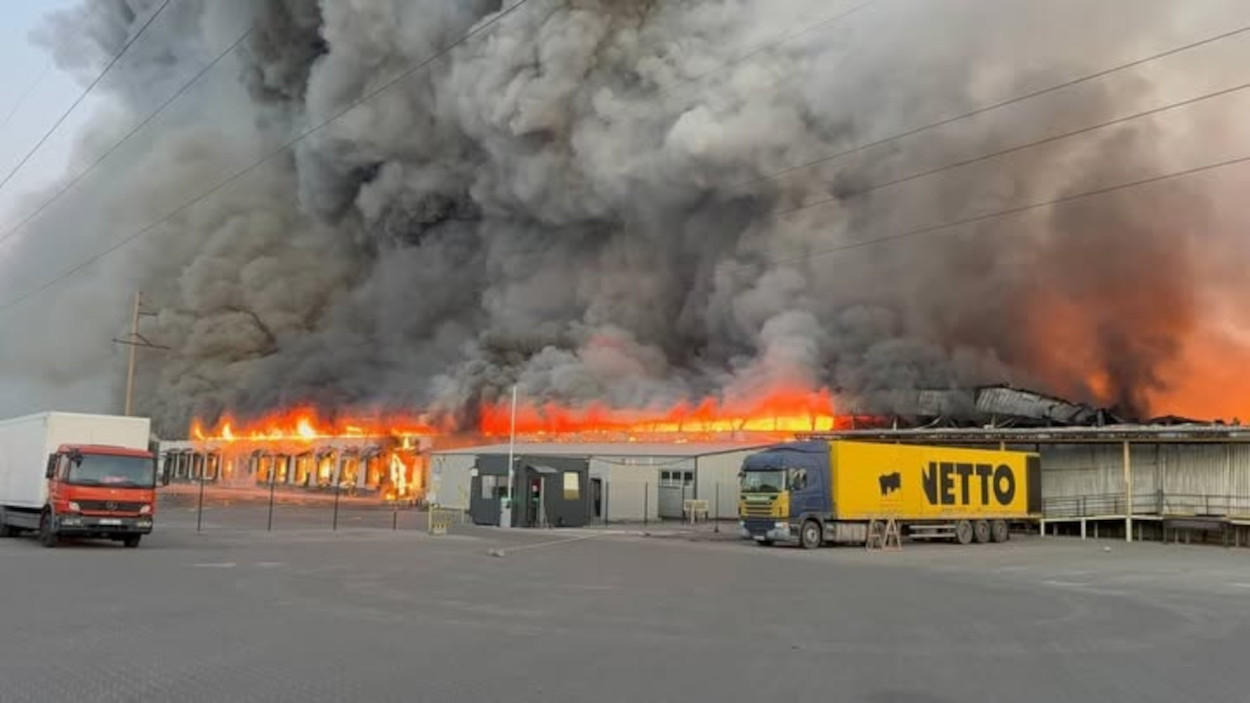
A fire burns at a Nova Poshta fulfillment and sorting center in Sviatopetrivske, Kyiv Oblast, after a Russian drone strike on 28 August 2026. More than 60,000 books were destroyed in the attack. Photo: Readeat
Explore further

Russia has burned millions of Ukrainian books, striking at the infrastructure of Ukrainian culture

Zaporizhzhia under Russian attack

For Zaporizhzhia, the pressure is particularly severe. The major city lies close to the front line and has faced sustained Russian attacks throughout the full-scale war. 

Unable to seize the city through ground advances, Russia has repeatedly used missiles and drones to strike its infrastructure and civilian areas.

The result is a city where even businesses that survive direct strikes can be forced to close because of the continuing threat.

❌