Vue normale

  • ✇US news | The Guardian
  • Federal judge tosses Trump lawsuit over young trans athletes in California school sports
    In a major LGBTQ+ rights victory, the justice department cannot force the state to ban trans girls from women’s sportsA federal judge has dismissed the Trump administration’s lawsuit challenging California’s policy of allowing transgender youth to play on sports teams that match their gender, a major loss for Donald Trump and the Department of Justice (DoJ).The justice department had been fighting for a year to force California to ban trans girls from women’s sports, with the president directly
     

Federal judge tosses Trump lawsuit over young trans athletes in California school sports

1 septembre 2026 à 20:33

In a major LGBTQ+ rights victory, the justice department cannot force the state to ban trans girls from women’s sports

A federal judge has dismissed the Trump administration’s lawsuit challenging California’s policy of allowing transgender youth to play on sports teams that match their gender, a major loss for Donald Trump and the Department of Justice (DoJ).

The justice department had been fighting for a year to force California to ban trans girls from women’s sports, with the president directly singling out one trans track and field athlete in online attacks and regularly mocking trans athletes in his speeches.

Continue reading...

© Photograph: Jessica Christian/San Francisco Chronicle via Getty Images

© Photograph: Jessica Christian/San Francisco Chronicle via Getty Images

© Photograph: Jessica Christian/San Francisco Chronicle via Getty Images

For These Children, Getting a Safe Education Means Going Underground

2 septembre 2026 à 10:50
In a frontline Ukrainian city, parents don’t see schools built below ground as apocalyptic. Instead, they offer relief from worry about the threat of Russian strikes.

© Jędrzej Nowicki for The New York Times

The first day of school at Sichovy Collegium in Zaporizhzhia, Ukraine, on Tuesday. The school operates from an underground space, built to allow children to continue learning safely amid the war.
  • ✇Euromaidan Press
  • Russian air attack interrupts lessons on first day of school in Ukraine
    Ukrainian president Volodymyr Zelenskyy marked the start of the academic year with children at a Kyiv Oblast school rebuilt after Russian forces destroyed it in 2022, before an air attack forced their first lessons into the shelter on 1 September 2026, the Kyiv Oblast Military Administration said. Knowledge Day, Ukraine’s traditional start of the academic year, fell during the full-scale invasion for the fifth time. Russia’s war now determines whether children can learn
     

Russian air attack interrupts lessons on first day of school in Ukraine

1 septembre 2026 à 12:04

President Volodymyr Zelenskyy watches as a pupil in an embroidered shirt speaks at a school event decorated with Ukrainian-colored balloons.

Ukrainian president Volodymyr Zelenskyy marked the start of the academic year with children at a Kyiv Oblast school rebuilt after Russian forces destroyed it in 2022, before an air attack forced their first lessons into the shelter on 1 September 2026, the Kyiv Oblast Military Administration said.

Knowledge Day, Ukraine’s traditional start of the academic year, fell during the full-scale invasion for the fifth time. Russia’s war now determines whether children can learn alongside their classmates: local security and shelter access govern classroom returns, while about 200,000 pupils near the front will remain fully remote.

Around three million pupils began the 2026–2027 academic year, including roughly 240,000 first-graders, 10% fewer than a year earlier, Member of Parliament Iryna Borzova of the Verkhovna Rada’s Committee on Youth and Sports told Ukrinform. Most will learn in person or through a blended format, but some 200,000 children near the front will study entirely online, she said.

More than 82% of school pupils and preschoolers can access shelters, Education Minister Andrii Butenko said. The government has allocated UAH 6 billion this year to expand access to shelters and other educational safety infrastructure.

Russian forces destroyed the school Zelenskyy visited in March 2022. It reopened only last autumn with a shelter and backup power, according to the Kyiv Oblast Military Administration.

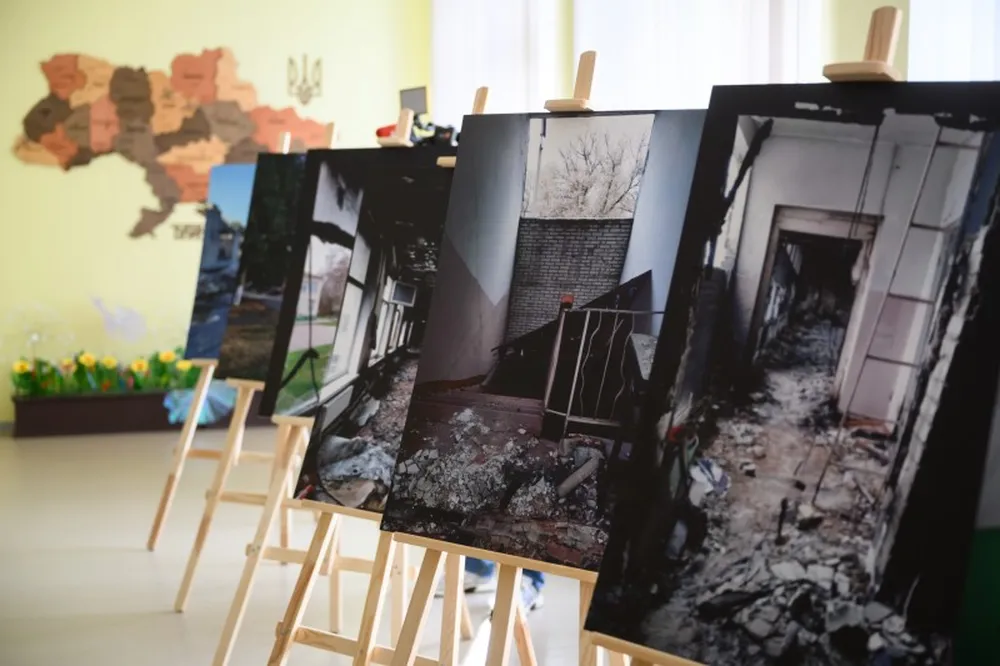
Photographs of burned and rubble-filled school interiors displayed on easels inside the rebuilt school.
An exhibition shows damage inflicted when Russian forces destroyed the Kyiv Oblast school in March 2022. The school reopened in autumn 2025. Photo: Office of the President of Ukraine

Zelenskyy said Russia had spent the preceding two weeks attacking infrastructure partly to disrupt the start of the academic year.

Ahead of Knowledge Day, Kyiv Oblast Military Administration head Tymur Tkachenko advised schools in high-risk communities not to hold mass opening ceremonies. Each school was to decide whether to proceed based on the security situation in its community.

“First and foremost, there must be safety,” Tkachenko said. If a ceremony went ahead, he recommended holding it directly in a shelter where possible. For events outside shelters, attendance was not to exceed the capacity of the nearest protective facility, and schools were told to avoid large gatherings of pupils, parents, and staff.

How Russia’s invasion has devastated Ukrainian education

Ukraine’s 2026 Knowledge Day began after six consecutive days of Russian attacks on Kyiv and its surrounding region, culminating overnight in a massed missile and drone strike. Eight people were killed, and seven were injured, including three children, while civilian infrastructure was damaged across five Kyiv districts.

Russia’s invasion has turned school safety and reconstruction into central parts of Ukraine's education policy. By September 2024, more than 3,500 educational institutions had been damaged and nearly 400 destroyed, with the World Bank estimating that almost $14 billion would be needed to rebuild them.

Attacks on Ukraine’s energy system have also left classrooms without heat or electricity, forcing prolonged holidays and renewed distance learning.

  • ✇Euromaidan Press
  • How flexible education can support professionals through career disruption
    Career disruption can change priorities faster than a long-term plan can adapt. Redundancy, relocation, caring responsibilities or a move into another sector may interrupt a familiar routine, yet professional development can continue. When circumstances shift, structured learning can provide direction. Professionals comparing options may review https://ihcl.org.uk/courses while deciding which type of study could help them keep building relevant knowledge through the transition. Why
     

How flexible education can support professionals through career disruption

1 septembre 2026 à 11:11

How Flexible Education Can Support Professionals Through Career Disruption


Career disruption can change priorities faster than a long-term plan can adapt. Redundancy, relocation, caring responsibilities or a move into another sector may interrupt a familiar routine, yet professional development can continue.

When circumstances shift, structured learning can provide direction. Professionals comparing options may review https://ihcl.org.uk/courses while deciding which type of study could help them keep building relevant knowledge through the transition.

Why does career continuity matter during prolonged uncertainty?

A break in employment does not remove previous experience, but it can make ongoing development more important. Employers may want recent evidence that a candidate has kept their knowledge current.

Career continuity does not mean following the same path at any cost. It means maintaining enough professional activity to keep future options open through study, project work, volunteering or other relevant practice.

During a longer transition, this helps people identify changes in their field. They can return to the market with a clearer view of current requirements instead of relying only on older experience.

Which skills travel well between vountries and industries?

Some abilities remain useful even when a person changes country, sector or employer. For international mobility, the most practical ones are:

  • negotiation — finding workable agreements when priorities differ;
  • research — locating reliable sources and turning unfamiliar information into useful context;
  • professional writing — preparing clear briefs, reports or handover documents;
  • remote collaboration — working effectively across time zones, platforms or distributed teams;
  • cultural awareness — recognising different workplace norms and responding appropriately.

These skills are useful in roles where people regularly work across borders or organisational cultures. They also help professionals transfer their experience into a new environment more convincingly.

Which learning format fits a busy schedule?

A career transition rarely produces a predictable timetable. Interviews, temporary work, family duties or relocation tasks may appear with little notice, so rigid study arrangements can become difficult to sustain.

A better fit is a format built around manageable units, visible milestones and materials available outside fixed class times. This gives learners a clear weekly direction while leaving room for changes in availability.

It is also worth checking how assessments are organised. Practical tasks completed in stages are easier to fit around an uneven schedule than several large assignments due at the same time.

What should learners prioritise when choosing a programme?

Start with the outcome rather than the course title. Check if the curriculum supports the roles you are considering, whether assessments produce work you can discuss in interviews and how much guidance is available when plans change.

Recognition, workload and access also deserve attention if you expect to move between countries. The programme should be understandable to future employers and realistic to complete from wherever you may be based.

During a career transition, progress is easier to maintain when the next task is clear and support is close at hand. IHCL brings this together through its ACEL approach, personal mentorship and custom-made LMS, helping learners keep moving even when work, location or long-term plans are changing.

❌