Vue normale

  • ✇Euromaidan Press
  • Glide bomb then infiltrate. This is Russia’s new way of war.
    In 2022, Russians fired artillery then advanced in vehicles Four years later, they launch glide bombs then advance as small teams of infantry Ukrainian drones stand in their way, and that's why drone operators are the main targets of Russian firepower before and during the advance On Monday, a small team of Russian infiltrators reportedly slipped 10 km behind the line of contact between Russian and Ukrainian troops just north of Kostiantynivka in eastern Ukrai
     

Glide bomb then infiltrate. This is Russia’s new way of war.

Par : David Axe
26 août 2026 à 17:16

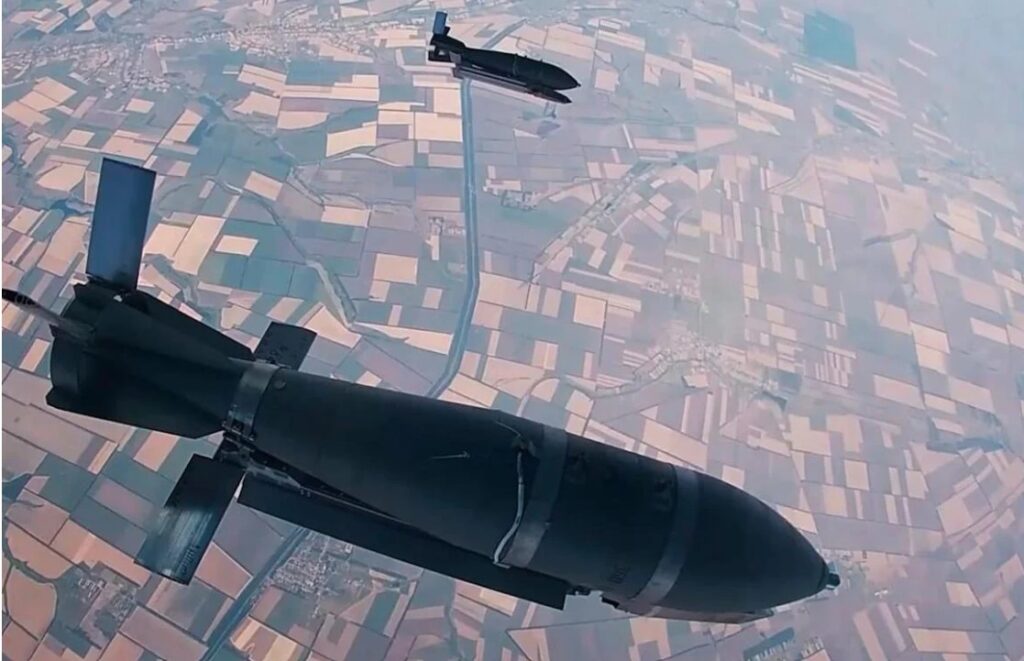
Glide bombs drop away from a Russian jet.

  • In 2022, Russians fired artillery then advanced in vehicles
  • Four years later, they launch glide bombs then advance as small teams of infantry
  • Ukrainian drones stand in their way, and that's why drone operators are the main targets of Russian firepower before and during the advance

On Monday, a small team of Russian infiltrators reportedly slipped 10 km behind the line of contact between Russian and Ukrainian troops just north of Kostiantynivka in eastern Ukraine's Donetsk Oblast.

Sneaking into the town of Druzhkivka, 10 km north of Kostiantynivka along the H20 highway, the Russians reportedly ambushed, captured and executed a group of three or four unarmed Ukrainian drone operators.

It's possible the drone operators had just arrived in Druzhkivka when the Russians appeared. According to analyst and mapper AMK Mapping, Ukrainian drone operators pulled out of the village of Oleksijevo-Druzhkivka—which lies between Kostiantynivka and Druzhkivka—owing to the increasing threat from Russian KAB glide bombs. "It's likely that Russian forces monitored the withdrawals of Ukrainian drone operators and sent in [an infiltration group] after the new position was identified," AMK Mapping concluded.

The atrocity underscores the Russian military's new approach to ground warfare as Russia's wider war on Ukraine grinds through its 54th month. An army that once counted on its own artillery to suppress enemy artillery in order to allow mechanized forces to advance now uses precision bombs, small cruise missiles, tiny drones, and, yes, some artillery to suppress the Ukrainian drone teams that represent the main obstacle to a swift Russian advance.

Yesterday, a group of Russian DRGs was able to infiltrate from Kostyantynivka for at least 10 km behind Ukrainian lines, and kill 3-4 Ukrainian drone operators in the city of Druzhkivka. The drone operators were unarmed in their positions at the time of the ambush, not expecting… pic.twitter.com/KNxN0JelwL

— AMK Mapping 🇳🇿 (@AMK_Mapping_) August 25, 2026

And when the Russian firepower manages to suppress Ukrainian drone operators, allowing small teams of infantry to advance, the infantry's objective is often to take out the same drone operators whose suppression was a necessary pre-condition of any successful assault.

In short, the Ukrainians largely defend with drones. That means the Russians are fixated on first striking the drone teams in order to prevent them from launching their tiny lethal robots—and then, when they can, assaulting the drone teams' positions in order to capture or kill them. Or capture then kill them, as reportedly happened in Druzhkivka.

The Russians have learned the hard way that they can't advance without first finding and attacking Ukrainian drone operators. That hard experience has driven a profound transformation of the Russian way of war in just the last few years.
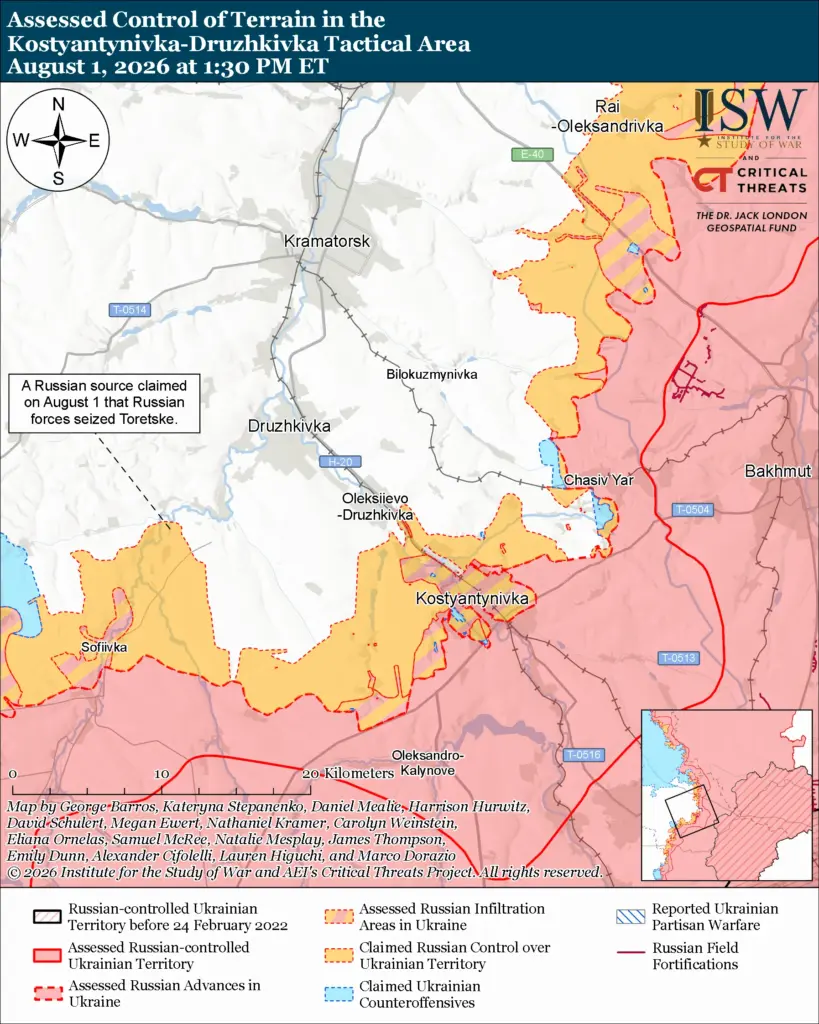
isw russia's long push toward sloviansk gains ground ukraine counterattacks · post kostyantynivka-druzhkivka-tactical-area-august-1-2026 news ukrainian reports
Map: ISW.

Precision suppression

As 2025 wore into 2026, Ukrainian forces finally deployed enough $500 drones to effectively halt any sustained Russian advance along the 1,200-km gray zone stretching across eastern and southern Ukraine. Between February and July, the Russians captured around 260 sq km of Ukrainian soil, according to a tally by the Black Bird Group. That's barely a fifth as much ground as they seized in the same six months in 2025.

Realizing they couldn't just fire an artillery barrage and then roll out the tanks the way they used to, the Russians have mostly parked their thousands of armored vehicles. Now they advance in small teams of lightly equipped infantry that, Russian commanders reason, stand a better chance of avoiding detecting and destruction by drones.

"Broadly speaking, current Russian military theory appears to emphasize restoring the ability to maneuver," Sidharth Kaushal and Sam Cranny-Evans wrote in a new study for the Royal United Services Institute in London. But the infantry infiltrators who do most of the maneuvering these days don't march out without support. A lot of it.

In the early months of the wider war in 2022 and 2023, the Russians counted on artillery—lots of artillery—to support the maneuver forces. But massed artillery is just as exposed to drone attack as massed tanks are, so Russian fire support has had to evolve, too.

Today, the Russians still fire artillery from fewer but more spread-out guns. But they also launch their own drones, small cruise missiles, and—perhaps most important—KAB glide bombs to force Ukrainian defenders, including drone teams, into their dugouts before the infantry dash across the gray zone. "Russian theorists appear to see the solution in highly mobile units designed to exploit lower-risk tunnels created by
precision strike," Kaushal and Cranny-Evans explained.

https://twitter.com/kriegsforscherD/status/2091923015604850800/

It's explosive choreography requiring careful communication between the infantry, the artillery, drone teams and the air force. "Sustaining momentum in the face of adversary precision strike is a considerable challenge," Kaushal and Cranny-Evans wrote. But a necessary one as the Russian military "contemplates how it can break the current positional deadlock" in Ukraine "and avoid future ones."

But when it works, it works to catastrophic effect for Ukrainian defenders. As those unfortunate, murdered drone operators found out.

The suppress-then-advance method, but with precision munitions and small teams of infiltrators, works for both sides, of course. The Ukrainians can do it, too—and they recently did in some unspecified sector of the gray zone.
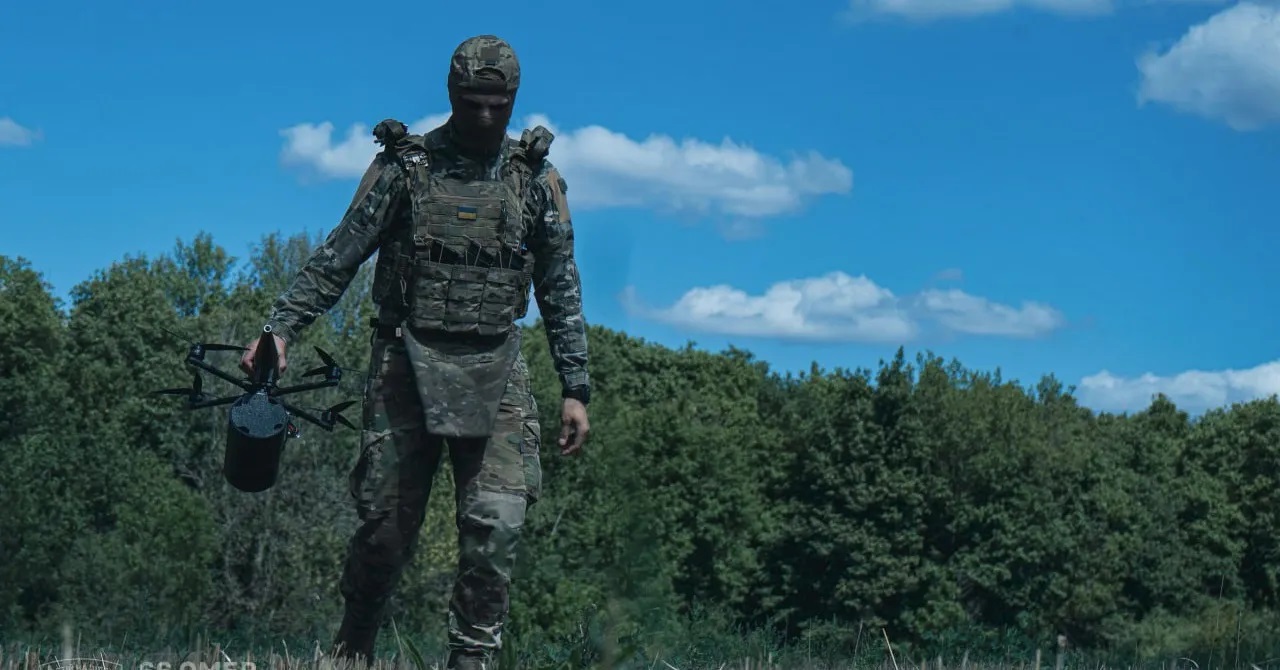
A Ukrainian soldier carries an FPV drone.
Explore further

Ukraine’s secret counteroffensive takes the pressure off Sloviansk

On the same day the Russians executed those drone operators, fellow Ukrainian drone pilot Dmytro Putiata reported a small Ukrainian mechanized advance. "At one of the direction at the front line, one of the Ukrainian brigades used four [infantry fighting vehicles] during the attack," Putiata wrote. "They have managed to break through up to three km; dismounted infantry and all of the vehicles managed to retreat."

They break through with the help of friendly drones units that suppressed Russian troops along the assault route, Putiata explained. "How did they manage not to be targeted by drones? The battlefield was prepared for that."

  • ✇Euromaidan Press
  • Ukraine’s secret counteroffensive is more successful than we thought
    Ukraine's quiet counteroffensive north of Lyman has produced dramatic results since April Now two Russian regiments are in danger of encirclement Escape is still likely for the Russians, but their retreat buys time for the Ukrainian defenders of Lyman and nearby Sloviansk Ukraine secret eastern counteroffensive seems to have been even more successful than some observers reported. It's possible that, in the sector just north of the town of Lyman in eastern Ukra
     

Ukraine’s secret counteroffensive is more successful than we thought

Par : David Axe
26 août 2026 à 17:15

  • Ukraine's quiet counteroffensive north of Lyman has produced dramatic results since April
  • Now two Russian regiments are in danger of encirclement
  • Escape is still likely for the Russians, but their retreat buys time for the Ukrainian defenders of Lyman and nearby Sloviansk

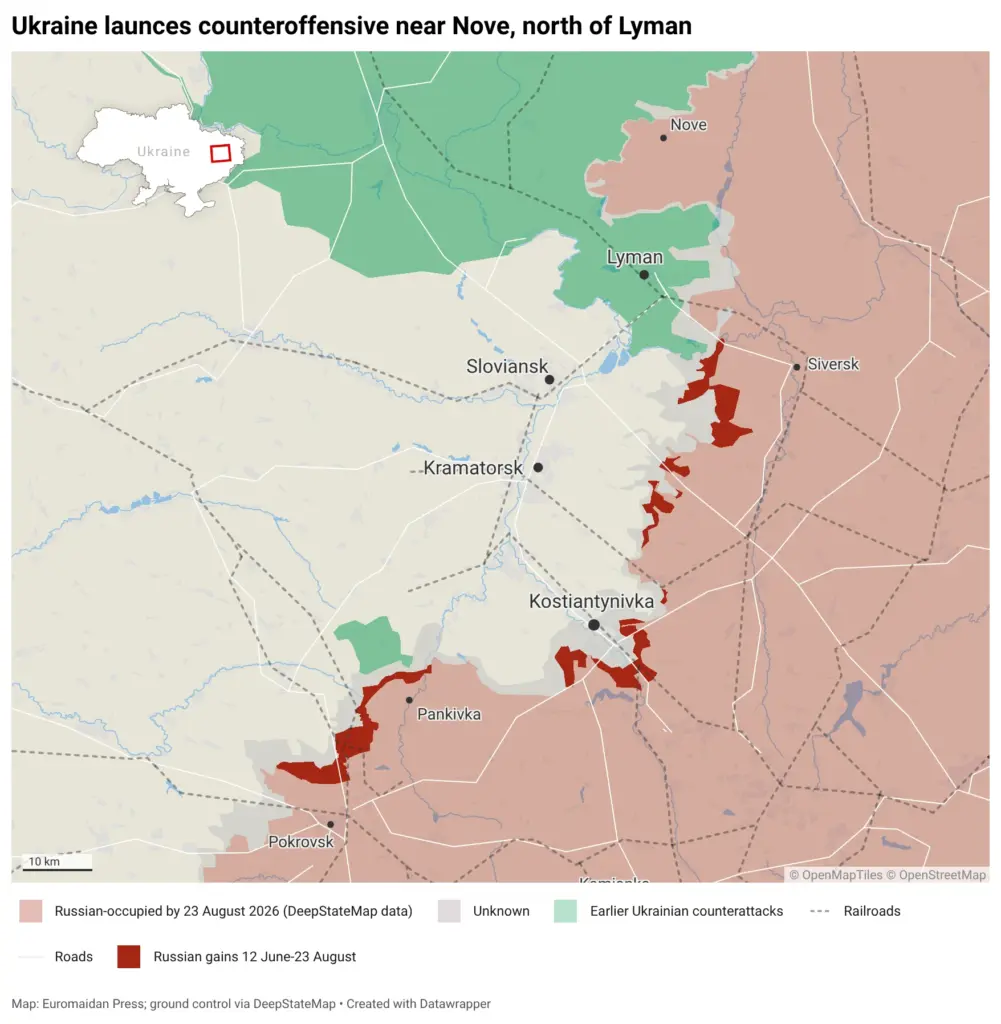
Ukraine secret eastern counteroffensive seems to have been even more successful than some observers reported. It's possible that, in the sector just north of the town of Lyman in eastern Ukraine's Donetsk Oblast, the Ukrainian 3rd Army Corps is just a few kilometers short of encircling two Russian regiments.

That doesn't mean the Russian units can't escape. After all, there isn't a contiguous line of Ukrainian forces—nor a contiguous line of Russian forces for that matter—anywhere along the 1,200-km disputed gray zone that threads across eastern and southern Ukraine.

Situation near Nove as of 23 August
Situation near Nove as of 23 August. Map: Euromaidan Press

But the closing pincer around elements of the Russian 2nd and 144th Motor Rifle Divisions could strain the Russians' logistics and compel the Russians to reconsolidate in order to preserve their combat power—by retreating east. That would take a lot of pressure off Lyman and, by extension, also take a lot of pressure off Sloviansk and Kramatorsk, the last two big free cities in Donetsk.

Lyman, which lies 15 km northeast of Sloviansk—the northernmost of the free cities—is the main obstacle between at least six Russian regiments and Sloviansk. The Russians have been inching toward Sloviansk and Kramatorsk from several directions for months now, racing against the coming winter to position forces for a possible siege of the twin cities next year. Winter in Ukraine punishes any attacker by depriving them of the leafy tree canopy that can conceal infiltrating troops during warmer months.

According to the most recent map from analyst and mapper Thorkill, one of the more reliable observers of unit-level action in Ukraine, the Ukrainian 3rd Assault Brigade is just a few kilometers away from linking up with the 60th Mechanized Brigade in or around the village of Kolodyazi.

Sytuacja w rejonie Nowego (Łyman), część II.

Jednym z odcinków frontu w Donbasie, na którym wojska ukraińskie prowadzą obecnie działania zaczepne, jest rejon Kateryniwka - Nowe – Zełena Dolyna, na północ od Łymanu. Od połowy maja 2026 r. pozycje rosyjskiej 144 Dywizji Strzelców… pic.twitter.com/AIvInwHGX3

— Thorkill (@Thorkill65) August 25, 2026

Galloping advance

If true, that means the 3rd Assault Brigade and adjacent units from the 3rd Army Corps have carried out one of the more successful Ukrainian counteroffensives in memory. In April they first exploited gaps in Russian defenses north of the village of Nove. In May and June they advanced toward the village. In July they captured it.

After that, the attacking Ukrainians kept pushing south into the right flank of a 10-km-by-10-km salient that advancing Russian regiments created as they maneuvered around Lyman from the north, aiming to surround the town instead of directly assaulting it on their way toward Sloviansk.

Leaving their flank exposed, the Russians trying to encircle Lyman found themselves at risk of encirclement, instead. If the 3rd Assault Brigade or 60th Mechanized Brigade—together possessing thousands of troops, on paper—can march through Kolodyazi, they will have closed a ring of loose Ukrainian control around at least two Russian regiments, also with potentially thousands of troops.

Emphasis on loose control. Again, there aren't enough Ukrainian forces on the ground north of Lyman to prevent any "encircled" Russians from retreating back to the east. But that retreat would represent a major victory for the Ukrainian defenders north and east of Sloviansk. "The fall of this salient [north of Lyman] would significantly delay the fall of Lyman," analyst and mapper AMK Mapping predicted.

Situational update on the Lyman direction:

The Ukrainian counterattacks north of Lyman are now entering their fourth month, as they come closer and closer to cutting off the Russian salient. Two pincers have been formed, which are both dangerously close to cutting the Russians… pic.twitter.com/mu2kZ4S3Jv

— AMK Mapping 🇳🇿 (@AMK_Mapping_) August 26, 2026

No one expects the Russians to halt their offensive toward Sloviansk and Kramatorsk. But in potentially taking two steps forward and one step back in their northerly march on the free cities, the Russians sacrifice time. Time the Ukrainians can use to stiffen their defenses in Sloviansk and Kramatorsk and evacuate more of the tens of thousands of civilians who remain in the cities despite the constant danger from Russian drones and bombs.

The possible extent of the Ukrainian gains north of Lyman—a 10-km march since April—is impressive given Russia's overall advantage in manpower and firepower in the east. Equally impressive is the operational security, or OPSEC, that cloaked the offensive until now. Sure, there were a few videos of action around Nove that hinted at a major Ukrainian action.

But the units involved exercised surprising discipline, and prevented too much information from leaking. "Someone in the 3rd Corps responsible for [OPSEC] is actually trying to do their job diligently and has quite effectively cut off information," Thorkill noted. The secrecy may have facilitated the Ukrainian advance by delaying any sense of panic among the Russian commanders who are responsible for reinforcing the Lyman salient, but who also tend to ignore bad news as long as possible because they know it could reflect poorly on them.

News of the counteroffensive is now available for all to see, even if official Ukrainian sources have yet to confirm it. That may mean time is running out for the 3rd Army Corps to close its pincer before the Russians retreat or reinforce. AMK Mapping has already seen some evidence of a "partial withdrawal from the most vulnerable positions in the salient.

A 53rd Mechanized Brigade trooper.
Explore further

Can Ukrainian forces save Sloviansk and Kramatorsk?

❌