Connexion
Tree lines out, swamps in—Lithuania rethinks how to stop Russian armor at the border

Lithuania's government approved an expanded plan on 12 August to fortify its borders with Russia and Belarus against a possible attack, LRT reports. Lithuania, a Baltic state and NATO member, sits wedged between Russia's Kaliningrad exclave and Belarus. The decision opens a new counter-mobility belt reaching inland from the border, a 20-meter strip that widens to 150 meters where the army marks out areas for operations.
The buildout answers a fear that has gripped the Baltics since Russia's full-scale invasion of Ukraine in 2022: that a Russia left unchecked in Ukraine could turn on them next. Western intelligence agencies have warned for years that Moscow could eventually threaten NATO itself, and former CIA director David Petraeus has singled out Lithuania as the likeliest first target, pinned between Kaliningrad and Belarus and sitting beside the Suwałki Gap, the thin land corridor that is NATO's only overland route to the Baltic states.
The decision raises the number of engineering parks, storage depots for obstacles like concrete blocks and roadblocks, from 27 to 50, and gives that work until the end of 2028, more than three years past the original April 2025 target. The state rail company LTG Infra is to store the equipment. The changes could cost an extra €50 million ($58 million) from the State Defense Fund between 2026 and 2030.
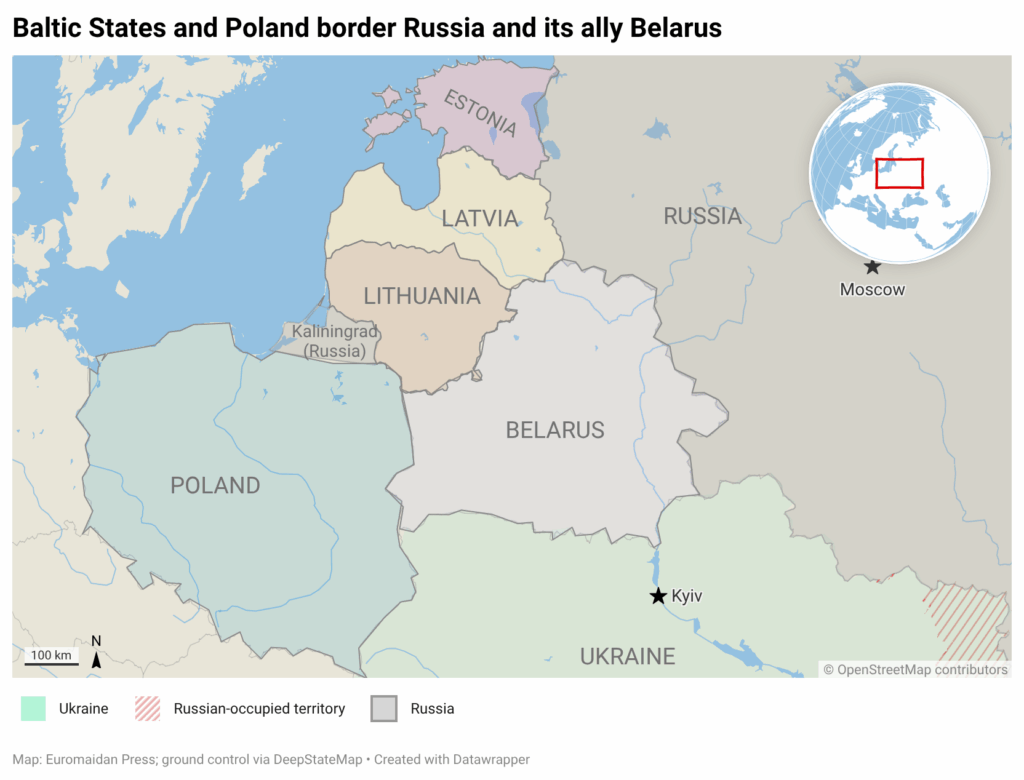
Of the Baltic states and Poland fortifying their eastern borders, Lithuania is the most at risk yet the least fortified, according to a satellite review by open-source analyst Clément Molin, even as Belarus keeps testing that border with engineered migrant crossings. The plan is Lithuania's share of the Baltic Defense Line, the joint barrier it launched in 2024 with Latvia and Estonia, alongside Poland's parallel East Shield.
The design comes straight from Ukraine. Lithuania began building counter-mobility parks in 2023, drawing on Russia's war against Ukraine, and much of what it is now putting into the ground, the swamps, ditches, and obstacle fields, was tested first on Ukrainian battlefields, where mud, water, and simple barriers have repeatedly stalled armored advances.
The restored swamps should make some ground impassable to heavy military vehicles within a few years, the Defense Ministry says, with that work due by the end of 2030. Plans for defensive ditches and streams in the Marijampolė municipality were dropped, and the ministry found better sites in the Vilkaviškis and Šakiai districts. Deadlines for obstacles on roads and bridge approaches, and for fitting bridges with holders for explosives, were also moved to the end of 2028.
"Military counter-mobility is an important part of Lithuania's defence preparedness," Deputy Defense Minister Tomas Mikelkevičius said. "We seek to make the best possible use of Lithuania's terrain and engineering measures to impede an adversary's movement if necessary and create more favorable conditions for our armed forces to operate."
Lithuania approved its first counter-mobility plan in July 2024. The plan's original 2024 estimate put the full system at around €600 million ($690 million) over the decade.
Russia's pressure on the Baltic borders
The buildout lands amid steady friction along NATO's eastern edge. Latvia has absorbed the bulk of the migrant crossings funneled from Belarus, and this week found its first used smuggling tunnel under the border. Estonia has switched on the first sensors of a planned drone wall along its Russian frontier and is reallocating €500 million ($575 million) toward air defense and long-range strike. Russia, for its part, has shut seven rail crossings with Latvia, Estonia, and Finland without explanation.
The fortification drive is a bet on time. Estonia's military chief has set a two-year clock, warning Russia could be combat-ready again by 2027, and ISW analysts assessed in May that Moscow was manufacturing pretexts for aggression against the Baltics. Poland's parallel East Shield, meanwhile, has gone up far slower than promised, leaving the region's defenses still thin where the threat is judged greatest.